

|
시장보고서
상품코드
2121349
그린 시멘트 : 시장 점유율 분석, 업계 동향과 통계, 성장 예측(2026-2031년)Green Cement - Market Share Analysis, Industry Trends & Statistics, Growth Forecasts (2026 - 2031) |
||||||
 Mordor Intelligence
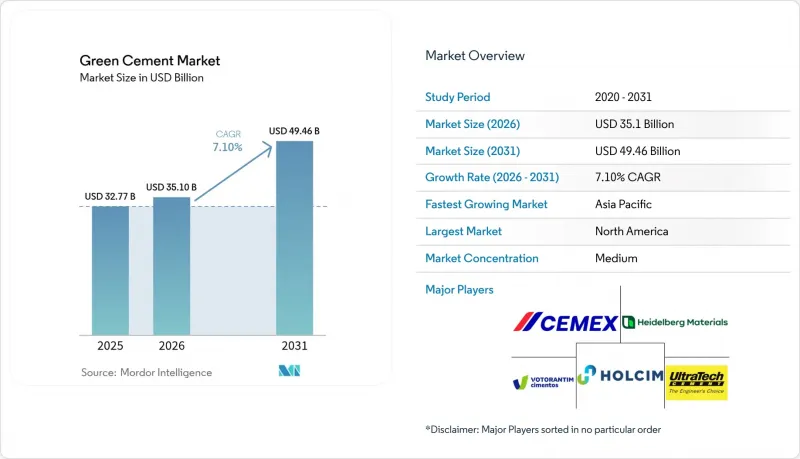
Mordor Intelligence에 의하면, 그린 시멘트 시장 규모는 2025년 327억 7,000만 달러에서 2026년에는 351억 달러에 이르고, 2026-2031년 CAGR 7.1%로 성장을 지속하여 2031년에는 494억 6,000만 달러에 달할 것으로 예측됩니다.
본 보고서는 제품 유형(플라이애시 계열, 슬래그 계열, 석회석 계열, 실리카퓸 계열, 기타 제품 유형), 건설 부문(주택, 비주택) 및 지역(아시아태평양, 북미, 유럽, 남미, 중동 및 아프리카)별로 분류되어 있습니다. 시장 전망은 금액(달러) 기준으로 제시되어 있습니다.
세계 그린 시멘트 시장 동향 및 인사이트
전 세계적인 탈탄소화 의무화 및 ESG를 중시하는 건축 기준
의무화된 저탄소 조달 정책에 따라, 일반 포틀랜드 시멘트에서 검증된 그린 시멘트로 수요 전환이 급속히 진행되고 있습니다. 캘리포니아주는 2035년까지 시멘트 부문의 배출량을 40% 감축하고, 2045년까지 순배출 제로를 달성하는 것을 목표로 하고 있으며, 미국의 다른 주에서도 유사한 노력이 진행되고 있습니다. EU의 개정 건설제품규정에 따르면, 2024년부터 콘크리트에 대해 디지털 여권 및 CO2 배출량 공개가 의무화되며, 이미 수명 주기 관련 문서를 갖춘 생산자가 입찰 목록 상위에 오르게 됩니다. 프랑스, 덴마크, 아일랜드 및 뉴욕주는 각각 선진적인 배출량 상한선이나 ‘바이 클린(Buy Clean)’ 규정을 도입하고 있으며, 이로 인해 규제를 준수하는 자재가 프리미엄 선택지가 아닌 기본 선택지가 되고 있습니다. 각 관할 구역이 선구적인 법규를 잇달아 도입함에 따라, 그린 시멘트 시장에는 정책 주도형 성장의 최저 기준이 확립되었으며, 기존 생산자가 이에 대응하기 위해서는 가마 개조나 전문 공급업체와의 제휴가 필수적입니다.
탄소 가격 상승과 배출권 거래 제도
탄소 비용은 CO2를 직접적인 경비로 전환함으로써 클링커의 경제성을 변화시키고 있습니다. EU 배출권 거래 제도에서는 무상 할당량이 단계적으로 감축되고 있어, 시멘트 제조업체는 저탄소 대체재 도입을 가속화하거나 이익률 압박 위험에 직면하게 됩니다. 중국의 전국 거래 플랫폼은 현재 시멘트도 대상으로 하고 있어, 세계 최대 생산국인 중국에도 비용 압박이 확대되고 있습니다. 더 많은 지역에서 탄소 가격 책정이 이루어짐에 따라 시멘트 대체 재료의 상대적 경쟁력이 높아지고 있으며, 친환경 시멘트 시장은 기존 제품에 비해 구조적인 비용 우위의 혜택을 누리고 있습니다.
건설업체 및 도급업체의 성능에 대한 회의론
일부 도급업체는 양생 기간의 장기화, 한파 시 경화 지연, 그리고 보충 자재의 지역별 공급 상황의 편차를 이유로 사양 변경에 저항을 보이고 있습니다. 표준화 기관은 규정된 배합 제한을 성능 기반 지침으로 대체하기 위해 노력하고 있으나, 특히 중소기업에서는 여전히 지식 격차가 존재합니다. 실증 프로젝트와 대상별 맞춤형 교육은 이 기술의 주류화를 위해 여전히 필수적입니다.
부문 분석
2025년, 플라이애시를 주성분으로 하는 배합은 그린 시멘트 시장에서 43.55%의 점유율을 유지하며, 석탄 연소 잔재물이 여전히 풍부하게 존재하는 지역에서 기본 저탄소 대체재로서의 입지를 확고히 했습니다. 각 제조업체는 확립된 물류 체계와 충분히 검증된 성능을 활용하여 대규모 인프라 계약 및 정부 입찰에 대응하고 있습니다. 그러나 석탄 화력 발전의 감소에 따라 향후 원료 공급원이 줄어들 것으로 예상에 따라, 기업들은 기존 재 저수지에서의 회수나 석회석·소성 점토 블렌드로의 전환을 추진하고 있습니다. 배출량을 최대 40%까지 줄일 수 있는 LC3 기술은 실험실 테스트를 통해 일반 포틀랜드 시멘트와 동등한 기계적 성능이 입증되어 주목을 받고 있습니다. 실리카 흄을 기반으로 한 제품은 고사양 틈새 시장을 점유하고 있으며, 해양 구조물이나 화학 물질 격리 구조물에 적합한 불투수성 콘크리트를 제공합니다. 슬래그를 기반으로 한 대체재는 임박한 공급 구조의 변화로 인해 어려움을 겪고 있지만, 통합 제철소 인근에서는 여전히 중요성을 유지하고 있습니다. 지오폴리머 콘크리트를 포함한 새로운 결합재의 화학 기술은 시범 프로젝트를 통해 발전하고 있으며, 규모의 경제가 향상되면 친환경 시멘트 시장의 다양화로 이어질 가능성이 있습니다.
다각화가 진행됨에 따라 단일 제품군에 대한 과도한 의존도가 완화되어, 생산자들은 원자재 가격의 급격한 변동으로부터 보호받고 있습니다. 회수된 재가 미국 재활용 플라이애시의 10%를 차지하게 됨에 따라 공급 안정성은 향상되었으나, 처리 비용은 상승하고 있습니다. 그 결과, 시멘트 제조업체와 발전소의 석탄재 재활용 사업자 간의 전략적 제휴가 최근 거래 동향에서 두드러진 위치를 차지하고 있습니다. 기업들이 기술적 실현 가능성, 배출 감축 목표, 그리고 원자재의 경제성을 모두 충족시켜 나가는 과정에서 슬래그 분쇄에 관한 제휴나 점토 소성 합작 사업도 마찬가지로 중요해지고 있습니다.
지역별 분석
북미는 연방 및 주 차원의 ‘Buy Clean’ 규제, 초기 단계의 탄소 포집 시범 사업, 그리고 혼합 시멘트에 대한 계약업체의 높은 이해도를 배경으로 2025년 매출의 37.55%를 차지했습니다. 하이델베르크 머티리얼즈의 미첼 CCS 프로젝트만 해도 30년 동안 5,000만 톤 이상의 CO2를 지하에 저장하는 것을 목표로 하고 있으며, 이는 장기적인 공급량 보장을 뒷받침하는 인프라가 잘 갖춰져 있음을 보여줍니다. 공급 상황은 지역에 따라 다릅니다. 중서부 주들은 석탄재 퇴적지와 가까운 입지 조건을 활용하는 반면, 연안 지역에서는 규격을 충족하기 위해 슬래그나 소성 점토를 수입하고 있습니다.
아시아태평양은 인도의 다년간에 걸친 인프라 계획과 동남아시아 전역에서 단계적으로 강화되는 규제의 뒷받침을 받아, 2031년까지 연평균 성장률(CAGR) 7.94%로 가장 높은 성장률을 기록하고 있습니다. 중국에서는 부동산 부문의 역풍 속에서도 허가를 유지하기 위해 대형 그룹들이 저탄소 생산 라인을 갖춘 공장으로의 업그레이드를 추진하고 있습니다. 전 세계 고속철도망의 3분의 2가 이 지역에 집중되어 있어, 배출 규제 강화 기준을 충족하는 콘크리트에 대한 수요가 높아지고 있습니다. 또한, 선로 및 역 시설 현대화 프로젝트가 진행됨에 따라 친환경 시멘트 시장은 활기를 띠고 있습니다.
유럽에서는 견고한 기후 정책과 성숙한 산업 역량이 융합되고 있습니다. 아일랜드가 2024년부터 모든 국가 프로젝트에서 저탄소 시멘트 사용을 의무화한 점과, 덴마크가 2025년에 7.1 kg CO2e/m2/년의 배출 상한선을 설정한 점은 영향력 있는 벤치마크가 되고 있습니다. 탄소 가격 제도 덕분에 건설량 변동과 관계없이 그린 시멘트 시장 규모는 확대될 것이 확실합니다. 이는 CO2 비용이 입찰 평가에서 저클링커 배합을 유리하게 만들기 때문입니다. 중동 및 아프리카에서는 특히 수소 허브나 대규모 유틸리티을 계획 중인 걸프 국가들에서 새로운 수요가 발생하고 있습니다. 그러나 규격의 불일치와 현장 전문 지식의 부족으로 인해, 통일된 지침이 확립되기 전까지는 시장 침투가 지연될 것입니다.
기타 혜택:
- 엑셀 형식 시장 예측(ME) 시트
- 3개월간 애널리스트 지원
자주 묻는 질문
목차
제1장 서론
제2장 조사 방법
제3장 주요 요약
제4장 시장 구도
제5장 시장 규모와 성장 예측
제6장 경쟁 구도
제7장 시장 기회와 향후 전망
LSH 26.09.08According to Mordor Intelligence, the green cement market size is expected to grow from USD 32.77 billion in 2025 to USD 35.1 billion in 2026 and is forecast to reach USD 49.46 billion by 2031 at 7.1% CAGR over 2026-2031.
This report is Segmented by Product Type (Fly-Ash-Based, Slag-Based, Limestone-Based, Silica-Fume-Based, Other Product Types), Construction Sector (Residential, Non-Residential), and Geography (Asia-Pacific, North America, Europe, South America, Middle East and Africa). The Market Forecasts are Provided in Terms of Value (USD).
Global Green Cement Market Trends and Insights
Global Decarbonization Mandates & ESG-Centric Building Codes
Mandatory low-carbon procurement policies drive immediate demand shifts from ordinary Portland cement to verified green formulations. California targets a 40% emissions cut for its cement sector by 2035 and net-zero by 2045, anchoring similar actions in other U.S. states. The EU's revised Construction Products Regulation obliges digital passports and CO2 disclosure for concrete from 2024, pushing producers already equipped with life-cycle documentation to the front of tender lists. France, Denmark, Ireland, and New York State have each introduced progressive emissions ceilings or Buy Clean rules that make compliant materials the default choice rather than a premium option. As jurisdictions replicate pioneering statutes, the green cement market gains a policy-driven growth floor that traditional producers can meet only by retrofitting kilns or partnering with specialized suppliers.
Rising Carbon Pricing & Emissions-Trading Schemes
Carbon costs alter clinker economics by turning CO2 into a direct expense. The EU Emission Trading System gradually withholds free allowances, prompting cement manufacturers to accelerate low-carbon substitutions or risk margin compression. China's national trading platform now covers cement, expanding cost pressure to the world's largest producer. As more regions price carbon, supplementary cementitious materials gain relative competitiveness, and the green cement market benefits from a structural cost advantage over legacy products.
Performance Scepticism Among Builders & Contractors
Some contractors resist specification changes, citing extended curing, cold-weather set delays, and inconsistent regional availability of supplementary materials. Standards bodies work to replace prescriptive mix limits with performance-based guidelines, yet knowledge gaps persist, especially in small and mid-size firms. Demonstration projects and targeted training remain essential for mainstream adoption.
Other drivers and restraints analyzed in the detailed report include:
- APAC Urbanization Surge Requiring Low-Carbon Materials
- Abundant SCM Feedstocks Lowering Costs
- Fragmented Standards in Emerging Markets
For complete list of drivers and restraints, kindly check the Table Of Contents.
Segment Analysis
Fly-ash-based formulations kept a 43.55% green cement market share in 2025, underscoring their status as the default low-carbon substitute where coal-combustion residues remain abundant. Producers leverage mature logistics and well-documented performance to serve large infrastructure contracts and government tenders. However, declining coal generation narrows future feedstock pools, prompting companies to harvest legacy ash ponds or shift toward limestone-calcined clay blends. LC3 technology, able to trim emissions by up to 40%, gains visibility as laboratories validate mechanical parity with ordinary Portland cement. Silica-fume-based variants occupy high-specification niches, delivering impermeable concrete suited to marine and chemical containment structures. Slag-based alternatives struggle with impending supply shifts but retain relevance near integrated steelworks. Novel binder chemistries, including geopolymer concretes, progress through pilot projects that could diversify the green cement market if scale economics improve.
Growing diversification reduces over-reliance on any single supplementary stream and insulates producers from raw-material shocks. With harvested ash constituting 10% of recycled U.S. fly ash, supply security improves, yet processing costs rise. Strategic agreements between cement makers and utility coal-ash reclamation entities therefore feature prominently in recent deal flow. Slag-grinding partnerships and clay-calcination joint ventures become equally critical as companies balance technical feasibility, emissions objectives, and raw-material economics.
Complete Report Scope:
- By Product Type
- Fly-Ash-Based
- Slag-Based
- Limestone-Based
- Silica-Fume-Based
- Other Product Types
- By Construction Sector
- Residential
- Non-Residential
- By Geography
- Asia-Pacific
- China
- India
- Japan
- South Korea
- Rest of Asia-Pacific
- North America
- United States
- Canada
- Mexico
- Europe
- Germany
- United Kingdom
- France
- Italy
- Rest of Europe
- South America
- Brazil
- Argentina
- Rest of South America
- Middle East and Africa
- Saudi Arabia
- South Africa
- Rest of Middle East and Africa
- Asia-Pacific
Geography Analysis
North America retained 37.55% of 2025 revenues, anchored by federal and state Buy Clean rules, early carbon-capture pilots, and high contractor familiarity with blended cements. Heidelberg Materials' Mitchell CCS project alone targets geological storage for more than 50 million t of CO2 over 30 years, signaling infrastructure that can underpin long-run volume commitments. Supply availability differs by region: Midwest states leverage proximity to coal-ash basins, while coastal areas import slag or calcined clay to meet specifications.
Asia-Pacific registers the fastest 7.94% CAGR to 2031, fueled by India's multi-year infrastructure pipeline and progressively stricter codes across Southeast Asia. China's consolidation efforts prompt large groups to upgrade plants with low-carbon lines to retain permits amid property-sector headwinds. Two-thirds of global high-speed rail networks reside in the region, requiring concrete that satisfies tightening emissions caps and boon the green cement market as projects replenish track and station stock.
Europe blends robust climate policy with mature industrial capabilities. Ireland's 2024 mandate for low-carbon cement in all state projects and Denmark's 2025 emissions ceiling of 7.1 kg CO2e/m2/year set influential benchmarks. Carbon pricing ensures that the green cement market size expands despite construction-volume volatility, as CO2 costs tilt bid evaluations toward low-clinker mixes. The Middle East and Africa witness emerging demand, especially in Gulf economies planning hydrogen hubs and large-scale public works, yet fragmented standards and limited on-site expertise slow penetration until harmonized guidelines mature.
- Adani Group
- Buzzi S.p.A.
- CarbonCure Technologies Inc.
- Cemex S.A.B DE C.V.
- Cenin
- China National Building Material Group Corporation
- Ecocem
- Heidelberg Materials
- Hoffmann Green Cement Technologies
- Holcim
- JSW Cement
- Kiran Global Chem Limited.
- TAIHEIYO CEMENT CORPORATION
- UltraTech Cement Ltd.
- Votorantim Cimentos
Additional Benefits:
- The market estimate (ME) sheet in Excel format
- 3 months of analyst support
TABLE OF CONTENTS
1 Introduction
- 1.1 Study Assumptions and Market Definition
- 1.2 Scope of the Study
2 Research Methodology
3 Executive Summary
4 Market Landscape
- 4.1 Market Overview
- 4.2 Market Drivers
- 4.2.1 Global decarbonisation mandates and ESG-centric building codes
- 4.2.2 Rising carbon pricing and emissions-trading schemes
- 4.2.3 APAC urbanisation surge requiring low-carbon materials
- 4.2.4 Abundant SCM feedstocks (fly-ash, slag) lowering costs
- 4.2.5 Commercialisation of hydrogen-fuelled kilns
- 4.3 Market Restraints
- 4.3.1 Performance scepticism among builders and contractors
- 4.3.2 Fragmented standards in emerging markets
- 4.3.3 Shrinking slag supply as steel shifts to EAF/DRI
- 4.4 Value Chain Analysis
- 4.5 Porter's Five Forces
- 4.5.1 Bargaining Power of Suppliers
- 4.5.2 Bargaining Power of Buyers
- 4.5.3 Threat of New Entrants
- 4.5.4 Threat of Substitutes
- 4.5.5 Competitive Rivalry
5 Market Size and Growth Forecasts (Value)
- 5.1 By Product Type
- 5.1.1 Fly-Ash-Based
- 5.1.2 Slag-Based
- 5.1.3 Limestone-Based
- 5.1.4 Silica-Fume-Based
- 5.1.5 Other Product Types
- 5.2 By Construction Sector
- 5.2.1 Residential
- 5.2.2 Non-Residential
- 5.3 By Geography
- 5.3.1 Asia-Pacific
- 5.3.1.1 China
- 5.3.1.2 India
- 5.3.1.3 Japan
- 5.3.1.4 South Korea
- 5.3.1.5 Rest of Asia-Pacific
- 5.3.2 North America
- 5.3.2.1 United States
- 5.3.2.2 Canada
- 5.3.2.3 Mexico
- 5.3.3 Europe
- 5.3.3.1 Germany
- 5.3.3.2 United Kingdom
- 5.3.3.3 France
- 5.3.3.4 Italy
- 5.3.3.5 Rest of Europe
- 5.3.4 South America
- 5.3.4.1 Brazil
- 5.3.4.2 Argentina
- 5.3.4.3 Rest of South America
- 5.3.5 Middle East and Africa
- 5.3.5.1 Saudi Arabia
- 5.3.5.2 South Africa
- 5.3.5.3 Rest of Middle East and Africa
- 5.3.1 Asia-Pacific
6 Competitive Landscape
- 6.1 Market Concentration
- 6.2 Strategic Moves
- 6.3 Market Share Analysis
- 6.4 Company Profiles (includes Global level Overview, Market level overview, Core Segments, Financials as available, Strategic Information, Market Rank/Share for key companies, Products and Services, and Recent Developments)
- 6.4.1 Adani Group
- 6.4.2 Buzzi S.p.A.
- 6.4.3 CarbonCure Technologies Inc.
- 6.4.4 Cemex S.A.B DE C.V.
- 6.4.5 Cenin
- 6.4.6 China National Building Material Group Corporation
- 6.4.7 Ecocem
- 6.4.8 Heidelberg Materials
- 6.4.9 Hoffmann Green Cement Technologies
- 6.4.10 Holcim
- 6.4.11 JSW Cement
- 6.4.12 Kiran Global Chem Limited.
- 6.4.13 TAIHEIYO CEMENT CORPORATION
- 6.4.14 UltraTech Cement Ltd.
- 6.4.15 Votorantim Cimentos
7 Market Opportunities and Future Outlook
- 7.1 White-space and Unmet-Need Assessment


