

|
시장보고서
상품코드
2121398
X-By-Wire 시스템 : 시장 점유율 분석, 업계 동향·통계, 성장 예측(2026-2031년)X-by-wire System - Market Share Analysis, Industry Trends & Statistics, Growth Forecasts (2026 - 2031) |
||||||
 Mordor Intelligence
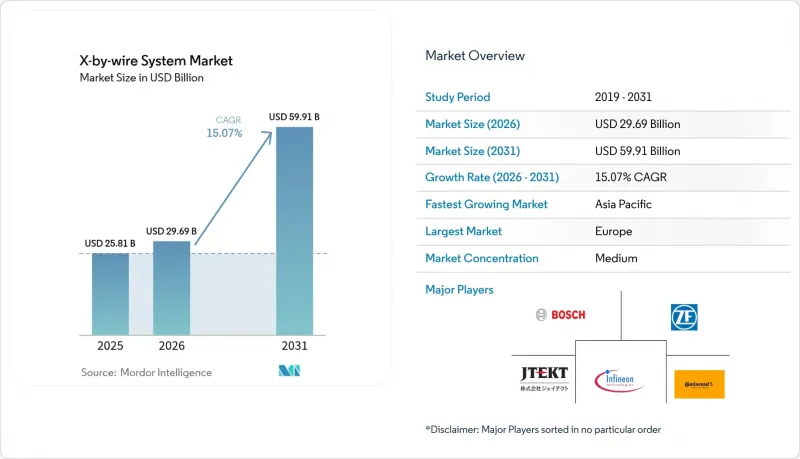
Mordor Intelligence에 따르면 X-By-Wire 시스템 시장 규모는 2025년에 258억 1,000만 달러, 2026년에 296억 9,000만 달러에 달하며, 2031년까지 599억 1,000만 달러에 달할 것으로 예측되고 있으며, 2026-2031년에 CAGR 15.07%로 성장할 것으로 전망되고 있습니다.
이 보고서는 유형별(Throttle-By-Wire, Brake-By-Wire 등), 차종별(승용차 등), 구성품별(센서, 페달 모듈 등), 추진 방식별(ICE, 하이브리드, BEV), 지역별로 분류되어 있습니다. 시장 예측은 금액(달러) 단위로 표시되어 있습니다.
글로벌 X-By-Wire 시스템 시장의 동향 및 인사이트
첨단 운전자 보조 시스템(ADAS) 및 자율주행의 확산
Steer-By-Wire 및 Brake-By-Wire는 제어 루프의 지연 시간을 50밀리초 미만으로 단축합니다. 이는 레벨 2 이상의 자율주행에서 안전한 차선 유지 및 긴급 회피 조작을 수행하는 데 필요한 임계값입니다. 메르세데스-벤츠는 2026년에 EQS 세단에 최초의 양산형 스티어-바이-와이어(Steer-By-Wire) 시스템을 탑재하여 출고할 예정입니다. 이 시스템은 ZF사의 듀얼 피니언 액추에이터를 채택하여, 좁은 공간에서 주차할 때 운전자의 조작력을 40% 경감시킵니다. 브레이크-바이-와이어(Brake-By-Wire)는 마찰 패드와 회생 토크를 매우 부드럽게 통합하여 원페달 주행을 지원하며, 보쉬의 ‘iBooster 3’는 도심 주행시 1마일당 최대 0.3kWh의 에너지를 회수합니다. 자율주행차 개발자들이 바이-와이어 방식을 선호하는 이유는 직접적인 CAN 명령을 통해 기계식 오버라이드 모터로 인한 에너지 소비를 피할 수 있으며, 불필요한 전력 예산을 25% 절감할 수 있기 때문입니다. 또한 토크, 각도, 온도의 텔레메트리 기능을 단일 하우징에 통합하는 공급업체에 대한 수요도 증가하고 있으며, 이를 통해 부품 리스트이 간소화되고 ISO 26262 평가가 가속화됩니다.
세계적인 안전 기준과 CO₂ 규제가 전자화를 지원
2024년부터 시행되는 EU 일반 안전 규정에서는 지능형 속도 지원, 긴급 차선 유지, 자동 제동이 의무화되어 있으며, 이 모든 기능은 정밀한 전자제어를 통한 제동력 및 조향 작동으로 쉽게 구현할 수 있습니다. 중국의 GB 7258 규정에서는 긴급 제동 적용 대상이 3.5톤을 초과하는 트럭으로 확대되었으며, 에어 브레이크의 200밀리초 지연을 해소하는 Brake-By-Wire 시스템의 탑재가 촉진되고 있습니다. 2030년까지 차량군의 CO₂ 배출량 목표가 49.5 g/km로 낮아짐에 따라 각 OEM 업체들은 유압 시스템과 스티어링 컬럼이 사라짐으로써 8-12 kg의 경량화가 가능한 BEV(배터리 전기자동차)로의 전환을 가속화하고 있습니다. ISO 26262 및 ISO/SAE 21434는 인증 기준을 엄격하게 설정하고 있으며, 이미 ASIL D 인증 플랫폼을 보유한 선도 기업이 유리한 입장에 있습니다. 그 결과, 규제에 따른 래칫 효과가 작용하여 모든 신차에 전자화의 최소 기준이 적용되게 되었으며, X-By-Wire 시스템 시장은 더욱 주류로 부상하고 있습니다.
기능 안전 인증의 장벽
ASIL D를 달성하려면 위험한 고장 확률을 10억 가동 시간당 10 미만으로 억제해야 하며, 이를 위해서는 듀얼 액추에이터, 절연 전원, 그리고 수백만 킬로미터에 달하는 시험 주행이 필요합니다. ZF사는 메르세데스-벤츠 EQS의 스티어-바이-와이어(Steer-By-Wire) 시스템 개발에 18개월간의 하드웨어-인-더-루프(Hardware-in-the-Loop) 작업을 거쳤으며, 계획을 초과한 4,500만 달러를 지출한 결과 출시가 연기되었습니다. 중소 공급업체들은 가속 시험에 실험실 1시간당 500-800달러를 지불하고 있지만, 많은 기업에게 이 예산을 감당하기는 어렵습니다. 브레이크-바이-와이어(Brake-By-Wire)는 압력 저하로 인한 부상 위험이 높기 때문에 더욱 엄격한 심사의 대상이 됩니다. 보쉬는 iBooster 3의 승인을 얻기 위해 240만 회의 듀티 사이클 시험을 시행했습니다. 미국내 형식 인증이 지연되고 있으며, NHTSA는 여전히 2,500대를 상한으로 하는 임시 면제를 허용하고 있으며, 초기 단계의 양산이 제한되고 있습니다.
부문 분석
2025년 매출 중 브레이크-바이-와이어(Brake-By-Wire)가 38.17%를 차지하며, X-By-Wire 시스템 시장 점유율에서 가장 큰 비중을 차지하고 있습니다. 한편, 스티어-바이-와이어(Steer-By-Wire) 시스템은 2031년까지 연평균 성장률(CAGR) 15.09%로 성장할 것으로 예측됩니다. 이러한 수요는 회생 제동과 마찰 제동의 원활한 전환에 기인하며, 이를 통해 도시 지역 1마일당 주행 거리가 0.3kWh 연장되어 OEM 각사는 배터리 팩의 소형화가 가능해집니다. 보쉬의 ‘iBooster 3’는 2025년 하반기 진공 펌프를 제거한 상태로 양산을 시작하며, 공급업체가 부품 수와 무게를 줄이고 있음을 보여주는 실제 사례입니다. ZF는 Brake-By-Wire 유닛 500만 대 분량의 다년 계약을 수주했으며, 이는 프리미엄 부문에서 양산 부문로의 전환을 시사합니다.
Steer-By-Wire 시스템은 현재 보급이 더딘 편이지만, 메르세데스-벤츠의 EQS, 렉서스의 RZ, 테슬라의 사이버트럭이 컬럼리스 설계를 보급해 나감에 따라 그 기세는 가속화될 것입니다. 통합 섀시 컨트롤러는 스로틀,변속, 주차 기능을 통합하며, 이러한 서브시스템은 이미 차량의 90%에 탑재되어 있으나, 바이-와이어 관련 매출을 더욱 끌어올릴 것입니다. 코너 모듈 공급업체는 스티어링, 브레이크, 구동 모터를 68kg짜리 하나의 어셈블리로 통합하여, 기존에 존재하던 시스템 유형 간의 구분을 해소하고 있습니다. 통합형 코너 유닛의 X-By-Wire 시스템 시장 규모는 인증 관련 병목 현상이 해소되는 대로 연평균 16% 이상의 성장률을 기록할 것으로 전망됩니다.
2025년에는 승용차가 판매 대수의 77.16%를 차지하며, 이는 첨단 회생 제동 및 요크식 스티어링이 필요한 프리미엄 BEV의 출시를 반영한 것입니다. 그러나 2031년까지 연평균 성장률(CAGR) 15.21%로 가장 빠르게 성장할 부문은 중형 및 대형 상용차가 될 전망입니다. 이는 플릿가 예측 유지보수 및 보다 긴밀한 플래토닝을 통한 연료 절감을 추구하고 있기 때문입니다. Geotab사가 500대의 밴을 대상으로 실시한 파일럿 프로젝트에서는 희토류 원소(REE)로 제작된 코너 모듈의 비정상적인 전류 소비를 추적함으로써 가동 중지 시간을 20% 줄일 수 있을 것으로 예측됩니다.
소형 상용차는 브레이크 바이 와이어(Brake-By-Wire)의 혜택을 받고 있지만, 이익률이 낮아 스티어 바이 와이어(Steer-By-Wire) 시스템에 드는 800-1,200달러의 추가 비용을 흡수하기 어려운 상황입니다. 대형 트럭의 경우, 중국의 GB 7258 제동 규제가 도입을 지원하고 있는 한편, 40밀리초의 전동 제동 응답 속도로 가능해진 플래토닝(platooning)을 통해 차간 거리가 10미터 미만으로 단축되어 공기 저항이 10% 감소합니다. X-By-Wire 시스템 업계에서는 자율적인 야드내 주차 및 원격 진단을 인건비 절감의 핵심으로 여기는 물류 기업의 수주가 견고한 추세를 보이고 있습니다.
지역별 분석
2025년, 유럽은 매출의 36.83%를 차지하며 X-By-Wire 시스템 시장을 주도했습니다. 이는 EU의 안전 규정이 전자식 차선 유지 및 제동을 의무화하고 있으며, CO₂ 배출 감축 목표에 따라 1kg 감축할 때마다 인센티브가 제공되기 때문입니다. 독일, 영국, 프랑스, 이탈리아에서는 현재 메르세데스-벤츠, 재규어 랜드로버, 아우디가 여러 가지 스티어-바이-와이어(Steer-By-Wire) 시스템을 출시하고 있습니다. 각 공급업체는 ASIL D 검증을 신속화하는 현지 테스트 코스 및 TUV 인증 기관을 활용하고 있으며, 이는 유럽의 얼리 어답터로서의 입지를 강화하고 있습니다.
아시아태평양은 중국의 레벨 3 보조금 로드맵과 일본의 고급차용 스티어-바이-와이어 시스템 도입에 힘입어, 2031년까지 연평균 성장률(CAGR) 15.17%를 기록하며 이 지역에서 가장 빠른 성장세를 보일 전망입니다. 중국의 GB 7258 긴급 제동 규제로 인해 중대형 트럭에 대한 채택이 가속화되고 있습니다. 이는 전기 기계식 캘리퍼가 에어 브레이크 특유의 200밀리초 지연을 해소할 수 있기 때문입니다. 한국의 현대와 기아는 2027년에 스티어-바이-와이어 시스템이 탑재된 크로스오버 차량을 출시하겠다는 공식 계획을 발표했으나, 인도의 경우 가격에 대한 민감성으로 인해 프리미엄 SUV에 탑재하는 데 그치고 있습니다.
북미는 다소 뒤처져 있습니다. 테슬라의 ‘사이버트럭’에 채택된 스티어-바이-와이어 시스템이나 REE의 FMVSS 인증을 획득한 코너 모듈이 성장세를 지원하고 있지만, NHTSA는 여전히 영구적인 스티어-바이-와이어 시스템 규정을 마련하지 않았으며,초기 생산 대수는 모델당 2,500대로 제한되어 있습니다. 남미, 중동 및 아프리카는 BEV 보급률이 낮아 유압식 플랫폼이 여전히 주류를 이루고 있으며, 틈새 시장에 머물고 있습니다. 터키와 사우디아라비아는 KD(Knock Down) 키트 조립 거점으로 부상하고 있으며, 지역내 배터리 기가팩토리의 규모가 확대되면 바이와이어 방식으로 전환될 가능성이 있습니다.
기타 혜택:
- 엑셀 형식의 시장 예측(ME) 시트
- 3개월간의 애널리스트 지원
자주 묻는 질문
목차
제1장 서론
제2장 조사 방법
제3장 개요
제4장 시장 구도
제5장 시장 규모와 성장 예측
제6장 경쟁 구도
제7장 시장 기회와 향후 전망
KSA 26.09.04According to Mordor Intelligence, the x-by-wire system market size is projected to be USD 25.81 billion in 2025, USD 29.69 billion in 2026, and reach USD 59.91 billion by 2031, growing at a CAGR of 15.07% from 2026 to 2031.
This report is Segmented by Type (Throttle-By-Wire, Brake-By-Wire, and More), Vehicle Type (Passenger Cars and More), Component (Sensors and Pedal Modules and More), Propulsion Type (ICE, Hybrid, and BEV), and Geography. The Market Forecasts are Provided in Value (USD).
Global X-by-wire System Market Trends and Insights
Advanced-driver-assistance and Autonomy Push
Steer-by-wire and brake-by-wire cut control-loop latency below 50 milliseconds, a threshold that Level 2+ autonomy requires for safe lane-keep and emergency maneuvers . Mercedes-Benz will ship the first mass-market steer-by-wire system in its EQS sedan during 2026, using ZF dual-pinion actuators that reduce driver effort by 40% in tight parking. Brake-by-wire supports one-pedal driving by merging friction pads with regenerative torque so smoothly that Bosch iBooster 3 recovers up to 0.3 kWh per mile in city cycles . Autonomous-vehicle developers favor by-wire because direct CAN commands avoid the energy drain of mechanical override motors, trimming redundant power budgets by 25%. Demand also extends to suppliers that embed torque, angle, and temperature telemetry in a single housing, streamlining the bill of materials and accelerating ISO 26262 assessments.
Global Safety and CO2 Rules Favor Electronics
The EU General Safety Regulation from 2024 mandates intelligent speed assistance, emergency lane keeping, and automatic braking, all of which are easier with precise electronic brake-force and steering actuation . China's GB 7258 rule extends emergency braking to trucks weighing more than 3.5 tonnes, spurring the fitment of brake-by-wire systems that eliminate 200-millisecond air-brake lag. CO2 fleet targets dropping to 49.5 g/km by 2030 drive OEMs toward BEVs that benefit from the 8-12 kg mass cut when hydraulics and columns disappear. ISO 26262 and ISO/SAE 21434 set a high bar for certification that favors early movers who already own ASIL D-approved platforms. Net effect is a regulatory ratchet that locks a rising electronics floor into every new vehicle, pushing the X-by-wire systems market deeper into the mainstream.
Functional-safety Certification Hurdles
Achieving ASIL D requires the hazardous failure probability to remain below 10 per billion operating hours, which necessitates dual actuators, isolated power, and millions of test kilometers. ZF needed 18 months of hardware-in-the-loop work for the Mercedes EQS steer-by-wire and spent USD 45 million beyond plan, delaying launch. Smaller suppliers pay USD 500-800 per laboratory hour for accelerated tests, a budget many cannot sustain. Brake-by-wire faces even closer scrutiny because loss of pressure poses a higher injury risk, and Bosch cycled its iBooster 3 through 2.4 million duty cycles to gain approval. U.S. homologation lags; NHTSA still grants temporary exemptions capped at 2,500 units, restricting early volume.
Other drivers and restraints analyzed in the detailed report include:
- EV Packaging and Weight-saving Benefits
- Digital Chassis Cost-saving Platforms
- High Integration Cost for Legacy Platforms
For complete list of drivers and restraints, kindly check the Table Of Contents.
Segment Analysis
Brake-by-wire generated 38.17% of 2025 revenue, the most significant slice of the X-by-wire systems market share, while steer-by-wire is projected to grow at a 15.09% CAGR to 2031. Demand stems from seamless regen-to-friction blending, which adds 0.3 kWh per urban mile in range and lets OEMs downsize packs. Bosch iBooster 3 began series production in late 2025 without a vacuum pump, illustrating how suppliers strip components and weight. ZF clinched a multi-year order for 5 million brake-by-wire units, signaling a migration from premium to volume segments.
Steer-by-wire is currently lagging but will accelerate as the Mercedes EQS, Lexus RZ, and Tesla Cybertruck popularize column-less designs. Unified chassis controllers mesh throttle, shift, and park functions, further lifting by-wire revenue even though those subsystems already appear in 90% of vehicles. Corner-module suppliers combine steering, braking, and drive motors into a single 68 kg assembly, collapsing historical distinctions among system types. The X-by-wire systems market size for integrated corner units is projected to expand at more than 16% annually once certification bottlenecks ease.
Passenger cars commanded 77.16% volume in 2025, reflecting premium BEV launches that require advanced regen and yoke steering. Yet medium- and heavy-duty commercial vehicles will grow fastest at a 15.21% CAGR to 2031, as fleets pursue predictive maintenance and fuel savings through tighter platooning. Geotab's 500-van pilot predicts 20% less downtime by tracking current draw anomalies in REE corner modules.
Light commercial vans benefit from brake-by-wire but wrestle with thin margins that make the USD 800-1,200 premium for steer-by-wire hard to absorb. For heavy trucks, China's GB 7258 braking mandate pushes adoption, while platooning enabled by 40 millisecond electric brake response shrinks inter-vehicle gaps to under 10 m, trimming drag 10%. The X-by-wire systems industry sees strong order pipelines from logistics firms that view autonomous yard parking and remote diagnostics as key to lowering labor costs.
Complete Report Scope:
- By Type
- Throttle-by-wire System
- Brake-by-wire System
- Steer-by-wire System
- Park-by-wire System
- Shift-by-wire System
- By Vehicle Type
- Passenger Cars
- Light Commercial Vehicles
- Medium and Heavy Commercial Vehicles
- By Component
- Sensors and Pedal Modules
- Actuators
- Electronic Control Units (ECUs)
- By Propulsion Type
- Internal-Combustion Engine Vehicles
- Hybrid Vehicles
- Battery-Electric Vehicles
- By Geography
- North America
- United States
- Canada
- Rest of North America
- South America
- Brazil
- Argentina
- Rest of South America
- Europe
- Germany
- United Kingdom
- France
- Italy
- Spain
- Russia
- Rest of Europe
- Asia Pacific
- China
- Japan
- India
- South Korea
- Rest of Asia Pacific
- Middle East and Africa
- Saudi Arabia
- United Arab Emirates
- Turkey
- South Africa
- Rest of Middle East and Africa
- North America
Geography Analysis
Europe led the X-by-wire systems market with 36.83% revenue in 2025 because EU safety rules require electronic lane-keeping and braking, and CO2 goals reward every kilogram saved. Germany, the United Kingdom, France, and Italy now host multiple steer-by-wire launches from Mercedes, Jaguar Land Rover, and Audi. Suppliers rely on local test tracks and TUV certification labs that expedite ASIL D validation, reinforcing Europe's early-adopter status.
Asia Pacific will register the fastest regional expansion at 15.17% CAGR to 2031, buoyed by China's Level 3 subsidy roadmap and Japan's luxury steer-by-wire rollouts. China's GB 7258 emergency-brake rule accelerates medium and heavy truck adoption because electro-mechanical calipers beat a 200-millisecond air-brake delay. South Korea's Hyundai and Kia have public programs to release steer-by-wire crossovers in 2027, while India restricts fitment to premium SUVs due to price sensitivity.
North America trails slightly; Tesla's Cybertruck steer-by-wire and REE's FMVSS-cleared corner modules spur momentum, but NHTSA has yet to issue permanent steer-by-wire rules, capping early volumes at 2,500 units per model. South America, the Middle East, and Africa remain niche markets because BEV penetration is low and hydromechanical platforms persist. Turkey and Saudi Arabia emerge as knock-down kit assembly hubs that may transition to by-wire once regional battery gigafactories scale.
- Continental AG
- ZF Friedrichshafen AG
- Robert Bosch GmbH
- JTEKT Corporation
- Nexteer Automotive
- Infineon Technologies AG
- Nissan Motor Corporation
- Tesla Inc.
- Audi AG
- Toyota Motor Corporation
- Hitachi Astemo Ltd.
- Denso Corporation
- Curtiss-Wright Corporation
- CTS Corporation
- Valeo SA
- Orscheln Products LLC
- Torc Robotics
- Jaguar Land Rover
- REE Automotive
Additional Benefits:
- The market estimate (ME) sheet in Excel format
- 3 months of analyst support
TABLE OF CONTENTS
1 Introduction
- 1.1 Study Assumptions & Market Definition
- 1.2 Scope of the Study
2 Research Methodology
3 Executive Summary
4 Market Landscape
- 4.1 Market Overview
- 4.2 Market Drivers
- 4.2.1 Advanced-driver-assistance and Autonomy Push
- 4.2.2 Global Safety and CO2 Rules Favour Electronics
- 4.2.3 EV Packaging and Weight-saving Benefits
- 4.2.4 Digital Chassis Cost-saving Platforms
- 4.2.5 OTA-tunable Software-defined Chassis
- 4.2.6 Corner-module EV Skateboards for Fleets
- 4.3 Market Restraints
- 4.3.1 Functional-safety Certification Hurdles
- 4.3.2 High Integration Cost for Legacy Platforms
- 4.3.3 In-vehicle-network Cyber-security Gaps
- 4.3.4 Supply Crunch of Redundancy-grade Sensors
- 4.4 Value / Supply-Chain Analysis
- 4.5 Regulatory Landscape
- 4.6 Technological Outlook
- 4.7 Porter's Five Forces
- 4.7.1 Threat of New Entrants
- 4.7.2 Bargaining Power of Suppliers
- 4.7.3 Bargaining Power of Buyers
- 4.7.4 Threat of Substitutes
- 4.7.5 Competitive Rivalry
5 Market Size & Growth Forecasts (Value (USD))
- 5.1 By Type
- 5.1.1 Throttle-by-wire System
- 5.1.2 Brake-by-wire System
- 5.1.3 Steer-by-wire System
- 5.1.4 Park-by-wire System
- 5.1.5 Shift-by-wire System
- 5.2 By Vehicle Type
- 5.2.1 Passenger Cars
- 5.2.2 Light Commercial Vehicles
- 5.2.3 Medium and Heavy Commercial Vehicles
- 5.3 By Component
- 5.3.1 Sensors and Pedal Modules
- 5.3.2 Actuators
- 5.3.3 Electronic Control Units (ECUs)
- 5.4 By Propulsion Type
- 5.4.1 Internal-Combustion Engine Vehicles
- 5.4.2 Hybrid Vehicles
- 5.4.3 Battery-Electric Vehicles
- 5.5 By Geography
- 5.5.1 North America
- 5.5.1.1 United States
- 5.5.1.2 Canada
- 5.5.1.3 Rest of North America
- 5.5.2 South America
- 5.5.2.1 Brazil
- 5.5.2.2 Argentina
- 5.5.2.3 Rest of South America
- 5.5.3 Europe
- 5.5.3.1 Germany
- 5.5.3.2 United Kingdom
- 5.5.3.3 France
- 5.5.3.4 Italy
- 5.5.3.5 Spain
- 5.5.3.6 Russia
- 5.5.3.7 Rest of Europe
- 5.5.4 Asia Pacific
- 5.5.4.1 China
- 5.5.4.2 Japan
- 5.5.4.3 India
- 5.5.4.4 South Korea
- 5.5.4.5 Rest of Asia Pacific
- 5.5.5 Middle East and Africa
- 5.5.5.1 Saudi Arabia
- 5.5.5.2 United Arab Emirates
- 5.5.5.3 Turkey
- 5.5.5.4 South Africa
- 5.5.5.5 Rest of Middle East and Africa
- 5.5.1 North America
6 Competitive Landscape
- 6.1 Market Concentration
- 6.2 Strategic Moves
- 6.3 Market Share Analysis
- 6.4 Company Profiles (includes Global Level Overview, Market Level Overview, Core Segments, Financials as Available, Strategic Information, Market Rank/Share for Key Companies, Products and Services, SWOT Analysis, and Recent Developments)
- 6.4.1 Continental AG
- 6.4.2 ZF Friedrichshafen AG
- 6.4.3 Robert Bosch GmbH
- 6.4.4 JTEKT Corporation
- 6.4.5 Nexteer Automotive
- 6.4.6 Infineon Technologies AG
- 6.4.7 Nissan Motor Corporation
- 6.4.8 Tesla Inc.
- 6.4.9 Audi AG
- 6.4.10 Toyota Motor Corporation
- 6.4.11 Hitachi Astemo Ltd.
- 6.4.12 Denso Corporation
- 6.4.13 Curtiss-Wright Corporation
- 6.4.14 CTS Corporation
- 6.4.15 Valeo SA
- 6.4.16 Orscheln Products LLC
- 6.4.17 Torc Robotics
- 6.4.18 Jaguar Land Rover
- 6.4.19 REE Automotive
7 Market Opportunities & Future Outlook
- 7.1 White-space & unmet-need assessment


