

|
시장보고서
상품코드
2121420
복합재 수리 시장 : 시장 점유율 분석, 업계 동향 및 통계, 성장 예측(2026-2031년)Composite Repair - Market Share Analysis, Industry Trends & Statistics, Growth Forecasts (2026 - 2031) |
||||||
 Mordor Intelligence
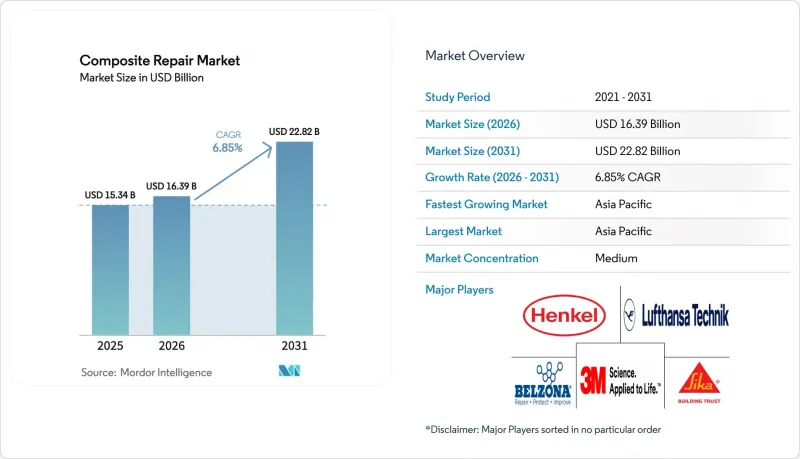
Mordor Intelligence에 의하면, 복합재 수리 시장 규모는 2025년에 153억 4,000만 달러로 평가되었고, 2026년에 163억 9,000만 달러로 추정되고, 2031년까지 228억 2,000만 달러에 이를 것으로 예측되며, 2026-2031년 CAGR 6.85%로 성장할 전망입니다.
본 보고서는 재료 유형별(탄소섬유 강화 폴리머, 유리섬유 강화 폴리머 등), 제품 유형별(구조용, 반구조용, 외관용), 보수 공정별(핸드 레이업, 진공 주입 등), 최종 사용자 산업별(항공우주 및 방위, 풍력 발전, 자동차 등), 지역별(아시아태평양, 북미, 유럽, 남미, 중동 및 아프리카)로 분류되어 있습니다.
세계의 복합재 수리 시장 동향 및 인사이트
노후화된 자산의 수명 연장 프로그램에 대한 투자가 급증
교체까지의 리드타임이 2년을 초과하고 규제상의 장벽이 높아지는 가운데, 사업자들은 신규 건설에서 수명 연장 프로젝트로 자본을 전환하고 있습니다. 미국 에너지부는 2025년, 원자력 발전소의 냉각수 배관에 대한 복합재 래핑에 12억 달러를 배정하여 원자로를 가동 중단 없이 업그레이드할 수 있도록 했습니다. 1980년대에 가동을 시작한 멕시코만 석유 플랫폼에서는 현재 유리섬유 오버랩이 채택되어, 강재로 교체하는 비용의 3분의 1로 라이저의 수명을 최대 20년까지 연장하고 있습니다. TD 윌리엄슨(TD Williamson)은 2024년 복합재 부문을 확장한 후, 셰브론(Chevron)과 쉘(Shell)로부터 해저 파이프라인에 관한 다년 계약을 수주했습니다. 유럽에서도 유사한 추세가 관찰됩니다. 북해의 사업자들은 2025년에 복합재를 활용한 구조 건전성 유지에 대한 지출을 2배인 8억 유로로 늘렸습니다. 이는 복합재 수리가 현금 흐름을 유지하면서 신규 건설 승인과 관련된 환경 심사를 미룰 수 있음을 보여주는 증거입니다.
금속 부품 교체와 비교했을 때 현장에서의 복합재 수리 비용 측면의 이점
현장 수리의 경제성 측면에서 복합재료는 압도적인 우위를 보이고 있습니다. 루프트한자 테크닉(Lufthansa Technik)의 추산에 따르면, 보잉 777의 복합재료로 제작된 레이더 돔을 기체에 부착한 채로 수리할 경우, 48시간 동안 3만 5,000달러의 비용이 듭니다. 반면, 교체할 경우 12만 달러의 비용에 더해 항공기가 7일간 운항을 중단하게 되어 20만 달러의 수익 손실이 발생합니다. 풍력 발전소 운영 사업자들도 이와 유사한 비용 절감 효과를 지적하고 있습니다. 90미터 길이의 블레이드를 현장에서 수리할 경우 비용은 8만 달러이지만, 정비 공장에서 작업할 경우 25만 달러가 소요되며, 게다가 2주간의 발전 손실이 발생합니다. HAECO사의 이동식 수리 유닛은 2025년 아시아태평양 공항에서 협폭기(narrow-body) 항공기의 턴어라운드 시간을 5일에서 18시간으로 단축했습니다. 이는 시간적 가치에 따른 이점이 직접적인 비용 절감 효과를 얼마나 증폭시키는지 보여줍니다.
자가복구형 복합재 적층판의 등장
자가 복구형 수지 시스템은 연구실 단계에서 제한적인 상업 시험 단계로 넘어가고 있습니다. 오크리지 국립연구소는 2025년, 자동차 부품 제조업체에 열가소성 수지 자가 복구 시스템의 라이선스를 부여했으며, 이를 통해 전기차 배터리 케이스의 미세 균열을 자가 복구할 수 있게 되었습니다. 이로 인해 5년 이내에 외관 수리 작업량이 최대 20% 감소할 것으로 예측됩니다. CompPair HealTech사는 2024년에 1,200만 유로의 자금 조달을 완료하고, 풍력 발전용 블레이드의 후연부에 생체 모방 수지를 적용한 파일럿 시험을 시작했습니다. 2027년 상용화를 목표로 하고 있습니다. 항공우주 분야의 인증 획득은 지연될 전망이지만, 자동차 및 풍력 발전 분야에서의 광범위한 채택으로 인해 이익률이 낮은 외관 수리 수요가 감소할 가능성이 있습니다.
부문 분석
2025년에는 탄소섬유 강화 플라스틱(CFRP)이 전 세계 매출의 54.69%를 차지한 것으로 평가되었습니다. 같은 해, 보잉 787의 기체 박리 수리만으로도 4억 2,000만 달러 규모의 CFRP 수리 수주가 발생하여 이 부문의 규모가 얼마나 큰지 여실히 드러났습니다. 유리섬유는 비용 중시적인 중견 시장에서 입지를 유지하고 있으며, 미 해군의 알레이 버크급 구축함 GFRP 상부 구조물 수리 프로그램(2,800만 달러)은 방위 분야에서의 그 중요성을 여실히 보여주고 있습니다. 하이브리드 및 천연섬유 시스템은 여전히 틈새 시장으로 남아 있지만, 환경 규제가 강화됨에 따라 인프라 개보수 분야에서 주목을 받고 있습니다.
아라미드 복합재료는 빠르게 성장하는 틈새 시장을 차지하고 있습니다. 수소 파이프라인 운영 사업자들은 극저온 취성에 내성이 있는 아라미드 섬유 복합재료를 선호하고 있으며, 이것이 2031년까지 연평균 성장률(CAGR) 7.85%를 견인하고 있습니다. 군용 차량용 방탄 보호 개조도 추가 수요를 뒷받침하고 있습니다. 규제의 구체성도 시장 점유율을 좌우하고 있습니다. FAA AC 43-214A는 외관상의 CFRP 수리를 OEM 승인 소재로만 제한하고 있어, 이로 인해 저비용 대체재가 사실상 배제되고 CFRP의 입지가 확고해지고 있습니다. 이러한 요인들을 종합해 보면, CFRP는 수량 면에서 우위를 유지하고 있지만, 아라미드의 고부가가치 기회와 규제의 허점은 규모에 비해 훨씬 더 큰 상승 여력을 가져다주고 있습니다.
구조용 분야는 가동 중단 위험 및 인증 요건으로 인해 다소 높은 가격이 용인되기 때문에 2025년 시장 가치의 44.71%를 차지했습니다. 보잉 777의 복합재 주익과 동체 페어링 수리에는 18만 달러가 소요되는 반면, 동등한 외관 복원에는 1만 2,000달러면 충분하다는 대조가 나타납니다. 풍력 터빈 블레이드 후연 처리와 같은 준구조용 수리는 해상 풍력 터빈 사업자들이 교체를 선호하기보다 수리를 선호하게 되면서 성장했습니다.
외관 복원은 2031년까지 연평균 성장률(CAGR) 7.71%로 가장 빠르게 성장이 전망되는 부문이지만, 자가 복원 재료의 부상으로 인해 장기적으로는 역풍에 직면할 전망입니다. 오크리지 국립연구소가 라이선스를 부여한 열가소성 수지 시스템 덕분에 5년 이내에 외관 수리 작업량이 최대 20% 감소할 가능성이 있습니다. 그럼에도 불구하고, 단기적인 성장은 전기차의 보급에 힘입어 가속화되고 있습니다. 현재 충돌 수리 센터에서는 인증된 기술자와 급속 경화형 에폭시 수지가 필요한 CFRP 배터리 케이스 수리를 진행하고 있습니다. 크로포드 컴포지트(Crawford Composites)는 현장 팀이 오토클레이브를 사용하지 않고도 사용할 수 있는 진공 주입 키트를 개발하여, 미국의 풍력 발전소에서 반구조용 수리 수주를 확보하고 있습니다.
지역별 분석
아시아태평양은 2025년 복합재 수리 시장 매출의 38.54%를 차지한 것으로 평가되었으며, 2031년까지 연평균 8.29%의 성장률을 보일 것으로 전망됩니다. COMAC C919의 복합재 점검, 도레이의 탄소섬유 생산 능력 20% 확대, 2025년 인도의 5GW 풍력 발전 용량 증가는 다양한 분야 수요를 뒷받침하고 있습니다. HAECO가 8,500만 달러를 투자해 싱가포르에 개설한 수리 센터는 해당 지역의 생산 능력 확충 사례 중 하나이며, 한편 한국의 프리깃함 프로그램에서는 장기적인 서비스 인프라가 필요한 복합재 상부 구조가 채택되고 있습니다.
북미 수요는 미국의 항공우주 MRO 집적화와 그레이트 플레인스 및 대서양 연안 전역에 걸친 풍력 발전소의 확장에 의해 견인되고 있습니다. 미국 에너지부의 2024년 로드맵에서는 이동식 블레이드 수리 교육에 자금이 지원되고 있으며, TD 윌리엄슨사가 수주한 1억 2,000만 캐나다 달러 규모의 파이프라인 관련 계약은 항공우주 분야를 넘어 다른 산업으로의 확산을 보여주고 있습니다. 그러나 기술자 부족으로 인해 잉여 업무는 멕시코 거점으로 흘러가고 있습니다. 멕시코에서는 노동력 공급이 더 유연하지만, 규제상의 제한으로 인해 그 범위는 주요 구조물 이외의 부분으로 한정되어 있습니다.
유럽 시장 점유율은 루프트한자 테크닉(Lufthansa Technik)의 이동식 오토클레이브 트레일러와, 2025년에 4억 8,000만 파운드의 블레이드 수리 수익을 창출한 영국의 15기가와트 해상 풍력 발전 용량에 의해 뒷받침되고 있습니다. 독일에서 전기차 배터리 케이스의 채택은 충돌 수리에 대한 새로운 수요를 창출하고 있으며, 시카(Seeka)의 아마 섬유 시스템은 독일과 프랑스 전역의 교량 보강 계약을 뒷받침하고 있습니다. 남미, 중동 및 아프리카 시장 점유율은 비교적 낮은 편이지만, 브라질의 풍력 발전 설비 확충과 ‘비전 2030’의 인프라 목표 달성을 위해 복합재 랩을 채택한 사우디아라비아의 파이프라인 개보수 사업이 성장의 견인차 역할을 하고 있습니다.
기타 혜택 :
- 엑셀 형식 시장 예측(ME) 시트
- 3개월간의 애널리스트 지원
자주 묻는 질문
목차
제1장 서론
제2장 조사 방법
제3장 주요 요약
제4장 시장 구도
제5장 시장 규모 및 성장 예측
제6장 경쟁 구도
제7장 시장 기회 및 향후 전망
AJY 26.09.09According to Mordor Intelligence, the composite repair market size is projected to be USD 15.34 billion in 2025, USD 16.39 billion in 2026, and reach USD 22.82 billion by 2031, growing at a CAGR of 6.85% from 2026 to 2031.
This report is Segmented by Material Type (Carbon-Fibre Reinforced Polymer, Glass-Fibre Reinforced Polymer, and More), Product Type (Structural, Semi-Structural, and Cosmetic), Repair Process (Hand Lay-Up, Vacuum Infusion, and More), End-User Industry (Aerospace and Defense, Wind Energy, Automotive, and More), and Geography (Asia-Pacific, North America, Europe, South America, and Middle-East and Africa).
Global Composite Repair Market Trends and Insights
Surging Investment in Aging-Asset Life-Extension Programs
Operators are redirecting capital from new builds to life-extension projects as replacement lead times stretch beyond two years and regulatory hurdles tighten. The U.S. Department of Energy earmarked USD 1.2 billion in 2025 for composite wrapping of nuclear-plant cooling-water piping, enabling upgrades without reactor shutdowns. Gulf of Mexico oil platforms commissioned in the 1980s now employ glass-fiber overwraps that extend riser life by up to 20 years at one-third the steel-replacement cost. TD Williamson secured multi-year subsea pipeline contracts from Chevron and Shell after expanding its composite division in 2024. Europe mirrors the trend: North Sea operators doubled composite integrity spending to EUR 800 million in 2025, evidence that composite repair preserves cash flow while deferring the environmental scrutiny triggered by new construction approvals.
Cost Advantages of On-Site Composite Repair Versus Metallic Part Replacement
Field repair economics favor composites by a wide margin. Lufthansa Technik quantified that on-wing repair of a Boeing 777 composite radome costs USD 35,000 over 48 hours, whereas replacement is USD 120,000 and grounds the jet for seven days, causing USD 200,000 revenue loss. Wind-farm operators echo these savings: in-situ repair of a 90-meter blade costs USD 80,000, compared with USD 250,000 for depot work and two-week generation loss. HAECO's mobile repair units trimmed narrow-body turnaround from five days to 18 hours at Asia-Pacific airports in 2025, illustrating how time-value benefits amplify direct cost savings.
Emergence of Self-Healing Composite Laminates
Self-healing resin systems are moving from labs to limited commercial trials. Oak Ridge National Laboratory licensed a thermoplastic healing system to automotive suppliers in 2025, enabling EV battery enclosures to self-repair micro-cracks and is forecast to cut cosmetic repair volume by up to 20% within five years. CompPair HealTech closed EUR 12 million funding in 2024 to pilot bio-inspired resins for wind-blade trailing edges, targeting a 2027 rollout. Aerospace certification will lag, but widespread adoption in automotive and wind could erode low-margin cosmetic repair demand.
Other drivers and restraints analyzed in the detailed report include:
- Increasing Use of Composites in the Aerospace and Defense Industry
- Offshore Wind Blade Length Growth Demanding In-Situ Repair Capability
- Scarcity of Certified Composite Repair Technicians
For complete list of drivers and restraints, kindly check the Table Of Contents.
Segment Analysis
The Carbon-fibre Reinforced Polymer (CFRP) accounts for 54.69% of global revenue in 2025. Boeing 787 fuselage delamination alone generated USD 420 million in CFRP repair orders that year, underscoring the segment's scale. Glass-fiber retains the cost-sensitive mid-market, and the U.S. Navy's USD 28 million GFRP superstructure repair program on Arleigh Burke-class destroyers highlights its defense relevance. Hybrid and natural-fiber systems remain niche but gain traction in infrastructure rehabilitation as environmental rules tighten.
Aramid composites occupy a swiftly growing niche. Hydrogen pipeline operators favor aramid-fibre composites that resist cryogenic embrittlement, driving a 7.85% CAGR through 2031. Ballistic-protection retrofits for military vehicles add further pull. Regulatory specificity also shapes share: FAA AC 43-214A restricts cosmetic CFRP repairs to OEM-approved materials, effectively locking lower-cost substitutes out and anchoring CFRP's position. Taken together, CFRP keeps numerical leadership, yet aramid's high-value opportunities and regulatory loopholes present outsized upside relative to scale.
Structural generated 44.71% of 2025 value because downtime risk and certification requirements allow premiums. A composite wing-to-body fairing repair on a Boeing 777 can fetch USD 180,000, contrasting with USD 12,000 for an equivalent cosmetic fix. Semi-structural repairs, such as wind-blade trailing-edge treatments, grew as offshore turbine operators favored repair over replacement.
Cosmetic work is the fastest segment at 7.71% CAGR through 2031 but faces long-run headwinds from self-healing materials. Oak Ridge National Laboratory's licensed thermoplastic system could trim cosmetic volumes by up to 20% inside five years. Still, near-term growth is fueled by electric-vehicle adoption: collision centers now handle CFRP battery enclosures that require certified technicians and rapid-cure epoxies. Crawford Composites developed a vacuum-infusion kit that field teams use without autoclaves, capturing semi-structural contracts across U.S. wind farms.
Complete Report Scope:
- By Material Type
- Carbon-fibre Reinforced Polymer (CFRP)
- Glass-fibre Reinforced Polymer (GFRP)
- Aramid-fibre Composites
- Hybrid and Other Fibres
- By Product Type
- Structural
- Semi-structural
- Cosmetic
- By Repair Process
- Hand Lay-up
- Vacuum Infusion
- Autoclave
- Other Processes
- By End-user Industry
- Aerospace and Defense
- Wind Energy
- Automotive
- Marine
- Construction
- Other End-user Industries
- By Geography
- Asia-Pacific
- China
- Japan
- India
- South Korea
- ASEAN Countries
- Rest of Asia-Pacific
- North America
- United States
- Canada
- Mexico
- Europe
- Germany
- United Kingdom
- France
- Italy
- Spain
- NORDIC Countries
- Rest of Europe
- South America
- Brazil
- Argentina
- Rest of South America
- Middle-East and Africa
- Saudi Arabia
- South Africa
- Rest of Middle-East and Africa
- Asia-Pacific
Geography Analysis
Asia-Pacific generated 38.54% of 2025 revenue for the composite repair market and is forecast to grow at 8.29% through 2031. COMAC C919 composite checks, Toray's 20% carbon-fiber capacity expansion, and India's 5 GW of wind-power additions in 2025 underpin multi-segment demand. HAECO's USD 85 million Singapore repair center exemplifies regional capacity build-out, while South Korea's frigate program embeds composite superstructures requiring long-term service infrastructure.
North America's demand is driven by U.S. aerospace MRO concentration and wind-farm expansion across the Great Plains and Atlantic Coast. The Department of Energy's 2024 roadmap funded mobile blade-repair training, and TD Williamson's CAD 120 million Canadian pipeline contracts show industrial adoption beyond aerospace. Technician shortages, however, push overflow work to Mexican hubs where labor supply is more elastic though regulatory limits confine scope to non-primary structures.
Europe's share is anchored by Lufthansa Technik's mobile autoclave trailer and the United Kingdom's 15 GW offshore wind capacity that produced GBP 480 million in blade repairs during 2025. Germany's EV battery-enclosure adoption brings new collision-repair volume, and Sika's flax-fiber system supports bridge-strengthening contracts across Germany and France. South America, the Middle East, and Africa contribute the lower share, led by Brazil's wind build-out and Saudi pipeline retrofits that employ composite wraps for Vision 2030 infrastructure objectives.
- 3M
- Advanced FRP Systems
- Belzona International Ltd.
- Boeing
- Composite Technology Inc.
- Crawford Composites LLC
- DIAB Group
- Gurit Holding AG
- HAECO Group
- Henkel AG & Co. KGaA
- Hexcel Corporation
- Lufthansa Technik
- ResinTech Inc.
- Sika AG
- TD Williamson Inc.
- TEAM, Inc.
- Toray Advanced Composites
- WR Composites
Additional Benefits:
- The market estimate (ME) sheet in Excel format
- 3 months of analyst support
TABLE OF CONTENTS
1 Introduction
- 1.1 Study Assumptions and Market Definition
- 1.2 Scope of the Study
2 Research Methodology
3 Executive Summary
4 Market Landscape
- 4.1 Market Overview
- 4.2 Market Drivers
- 4.2.1 Surging Investment in Ageing-Asset Life-Extension Programs
- 4.2.2 Cost Advantages of On-Site Composite Repair Versus Metallic Part Replacement
- 4.2.3 Increasing Use of Composites in the Aerospace and Defense Industry
- 4.2.4 Offshore Wind-Blade Length Growth Demanding In-Situ Repair Capability
- 4.2.5 Hydrogen Pipeline Retrofits Needing Non-Metallic Reinforcement
- 4.3 Market Restraints
- 4.3.1 Emergence of Self-Healing Composite Laminates
- 4.3.2 Scarcity of Certified Composite Repair Technicians
- 4.3.3 Lack of Harmonised Repair Codes for Subsea Composite Pipelines
- 4.4 Value Chain Analysis
- 4.5 Porter's Five Forces
- 4.5.1 Threat of New Entrants
- 4.5.2 Bargaining Power of Buyers
- 4.5.3 Bargaining Power of Suppliers
- 4.5.4 Threat of Substitutes
- 4.5.5 Intensity of Competitive Rivalry
5 Market Size and Growth Forecasts (Value)
- 5.1 By Material Type
- 5.1.1 Carbon-fibre Reinforced Polymer (CFRP)
- 5.1.2 Glass-fibre Reinforced Polymer (GFRP)
- 5.1.3 Aramid-fibre Composites
- 5.1.4 Hybrid and Other Fibres
- 5.2 By Product Type
- 5.2.1 Structural
- 5.2.2 Semi-structural
- 5.2.3 Cosmetic
- 5.3 By Repair Process
- 5.3.1 Hand Lay-up
- 5.3.2 Vacuum Infusion
- 5.3.3 Autoclave
- 5.3.4 Other Processes
- 5.4 By End-user Industry
- 5.4.1 Aerospace and Defense
- 5.4.2 Wind Energy
- 5.4.3 Automotive
- 5.4.4 Marine
- 5.4.5 Construction
- 5.4.6 Other End-user Industries
- 5.5 By Geography
- 5.5.1 Asia-Pacific
- 5.5.1.1 China
- 5.5.1.2 Japan
- 5.5.1.3 India
- 5.5.1.4 South Korea
- 5.5.1.5 ASEAN Countries
- 5.5.1.6 Rest of Asia-Pacific
- 5.5.2 North America
- 5.5.2.1 United States
- 5.5.2.2 Canada
- 5.5.2.3 Mexico
- 5.5.3 Europe
- 5.5.3.1 Germany
- 5.5.3.2 United Kingdom
- 5.5.3.3 France
- 5.5.3.4 Italy
- 5.5.3.5 Spain
- 5.5.3.6 NORDIC Countries
- 5.5.3.7 Rest of Europe
- 5.5.4 South America
- 5.5.4.1 Brazil
- 5.5.4.2 Argentina
- 5.5.4.3 Rest of South America
- 5.5.5 Middle-East and Africa
- 5.5.5.1 Saudi Arabia
- 5.5.5.2 South Africa
- 5.5.5.3 Rest of Middle-East and Africa
- 5.5.1 Asia-Pacific
6 Competitive Landscape
- 6.1 Market Concentration
- 6.2 Strategic Moves
- 6.3 Market Share(%)/Ranking Analysis
- 6.4 Company Profiles (includes Global level Overview, Market level overview, Core Segments, Financials as available, Strategic Information, Products and Services, Recent Developments)
- 6.4.1 3M
- 6.4.2 Advanced FRP Systems
- 6.4.3 Belzona International Ltd.
- 6.4.4 Boeing
- 6.4.5 Composite Technology Inc.
- 6.4.6 Crawford Composites LLC
- 6.4.7 DIAB Group
- 6.4.8 Gurit Holding AG
- 6.4.9 HAECO Group
- 6.4.10 Henkel AG & Co. KGaA
- 6.4.11 Hexcel Corporation
- 6.4.12 Lufthansa Technik
- 6.4.13 ResinTech Inc.
- 6.4.14 Sika AG
- 6.4.15 TD Williamson Inc.
- 6.4.16 TEAM, Inc.
- 6.4.17 Toray Advanced Composites
- 6.4.18 WR Composites
7 Market Opportunities and Future Outlook
- 7.1 White-space and Unmet-need Assessment
- 7.2 Automation of Composite Repair


