|
시장보고서
상품코드
2121429
자동차 코팅 : 시장 점유율 분석, 업계 동향과 통계, 성장 예측(2026-2031년)Automotive Coatings - Market Share Analysis, Industry Trends & Statistics, Growth Forecasts (2026 - 2031) |
||||||
 Mordor Intelligence
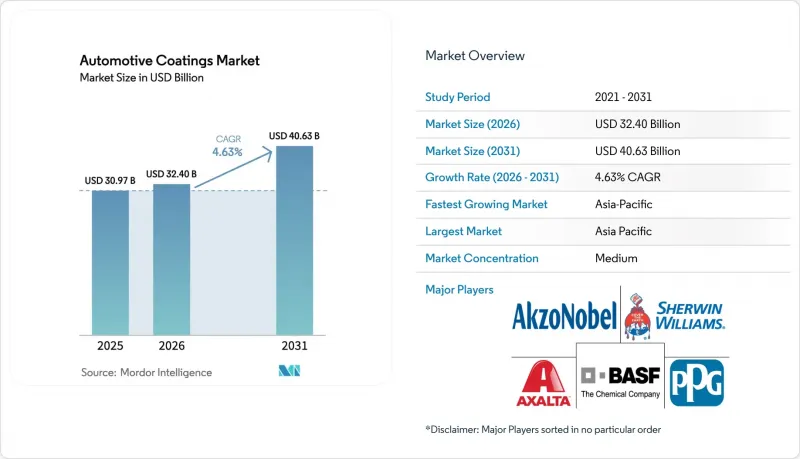
자동차 코팅 시장 규모는 2025년 309억 7,000만 달러에서 2026년에는 324억 달러로 확대되고, 2026년부터 2031년까지 CAGR 4.63%를 기록하며 2031년에는 406억 3,000만 달러에 달할 것으로 예측됩니다.
본 보고서는 수지 종류(아크릴, 폴리우레탄, 에폭시, 기타 수지), 기술(용제형, 수성, 분체), 도막층(클리어 코트, E-코트,프라이머, 베이스 코트), 용도(OEM 및 리피니시), 지역(아시아태평양, 북미, 유럽, 남미, 중동 및 아프리카)별로 분류되어 있습니다. 시장 예측은 금액(달러) 기준으로 제시되어 있습니다.
세계 자동차 코팅 시장의 동향 및 인사이트
세계 자동차 생산의 회복
세계 경차 생산 대수는 2024년에 9,250만 대까지 회복될 것이며, 반도체 부족 현상이 완화되고 새로운 생산능력이 가동됨에 따라 2026년까지 9,500만 대를 넘어설 것으로 예측됩니다. 중국은 3,128만 대를 생산했고, 인도와 일본은 합쳐서 1,400만 대 이상을 생산하여 아시아태평양의 우위를 뒷받침했습니다. 1대당 전착도장, 프라이머, 베이스 코트, 클리어 코트 각 층에서 3-5kg의 도료가 소비되므로, 생산의 급증은 도료 사용량 증가로 직결됩니다. 인도의 35억 달러 규모의 ‘생산 연계형 인센티브 제도’에 힘입어 마루티 스즈키, 현대, 타타 모터스의 투자가 가속화되고 있으며, 이에 따라 2027년까지 약 18만 메트르톤의 추가 수요가 예상됩니다. 기업들이 공급망 리스크를 헤지하는 가운데, 동남아시아에서의 조립 생산이 확대되고 있으며, 이에 따라 공급업체들은 관세와 리드타임을 줄이기 위해 현지에 배합 공장을 설립하고 있습니다.
휘발성 유기 화합물(VOC) 함유량 상한 규제에 대응하기 위한 수성 및 분체 도장 시스템으로의 전환
미국의 ‘유해 대기 오염 물질에 관한 국가 배출 기준(NHSHAP) 2단계’에서는 2025년 1월부터 프라이머 및 서페이서의 배출량을 리터당 420그램, 탑코트를 리터당 250그램으로 제한하고 있습니다. 한편, 유럽연합(EU) 지침 2004/42/EC에서는 2액형 시스템에 대해 더욱 엄격한 제한이 부과되고 있습니다. 수성 대체품은 1제곱미터당 휘발성 유기 화합물(VOC) 배출량을 60-80% 줄이고, 분체 도장은 용제를 완전히 배제하므로 도장 공장이 기업의 탄소 예산 상한선을 밑돌 수 있도록 돕습니다. PPG 인더스트리즈는 2024년에 자동차용 수성 도료 제품의 매출이 8% 증가하여 용제형 도료 수요 감소분을 완전히 상쇄했습니다. 중국의 GB 24409-2020 규격에 따라 국내 배합 제조업체들은 수지 시스템의 재설계를 강요받고 있으며, 이를 준수하지 않을 경우 OEM의 승인을 상실할 위험이 있습니다. 그 결과, 장쑤성과 광둥성에서는 대규모 수성 도료 생산 라인에 대한 투자로 전환되고 있습니다. 분체 클리어 코트 기술은 외장 패널의 클래스 A 마감 수준에는 아직 미치지 못하지만, 액설타(Axalta)사의 최근 박막 기술 발전으로 그 격차가 좁혀지면서 도어 프레임이나 트렁크 내부 마감 등 틈새 시장에서 채택이 가능해지고 있습니다.
용제 및 이소시아네이트 노출에 관한 엄격한 규제
미국 직업안전보건청(OSHA)은 톨루엔 디이소시아네이트의 노출 상한선을 0.02 ppm,메틸렌 디페닐 디이소시아네이트는 0.005 ppm으로 정하고 있으며, 도장 부스에서는 국소 배기 환기 설비의 업그레이드 및 호흡용 보호구 제공이 의무화되어 있습니다. EU의 ‘분류, 표시 및 포장 규정’은 이소시아네이트 함유 제품에 대한 위험성 표시를 추가로 의무화하고 있어, 공급업체들은 비용이 10-15% 더 비싸고 고형분 함량이 낮은 저유리 모노머형 폴리우레탄 수지로의 전환을 강요받고 있습니다. 2024년 미국 직업안전보건연구소(NIOSH)의 조사에 따르면, 자동차 도장 작업자의 5-10%는 개인보호구를 착용하고 있는 경우에도 5년 이내에 감작이 발생하는 것으로 밝혀졌으며, 이로 인해 수성 가교제 시스템으로의 전환이 가속화되고 있습니다.
부문 분석
2025년에는 아크릴 수지가 매출의 48.12%를 차지했으나, OEM 각사가 배터리식 전기자동차의 구조에서 중량 증가를 초래하지 않으면서도 내스크래치성이 뛰어난 클리어 코팅을 요구하고 있기 때문에 폴리우레탄계 시스템은 2031년까지 연평균 성장률(CAGR) 5.04%로 성장할 것으로 예측됩니다. 폴리우레탄계 클리어 코트는 2H-3H의 연필 경도를 가지고 있으며, 이는 아크릴계에 비해 약 30% 높은 수치입니다. 또한, 2,000시간의 가속 풍화 시험 후에도 광택도를 85% 이상 유지합니다. 에폭시 수지는 배터리 케이스를 포함한 복잡한 형상에도 균일하게 도포할 수 있기 때문에 전착 프라이머로는 여전히 주류 선택지로 남아 있습니다.
중국에서는 BYD와 NIO가 프리미엄 포지셔닝을 추구함에 따라 폴리우레탄의 채택이 가속화되고 있습니다. 한편, 이스트만 케미컬(Eastman Chemical)사의 140℃ 저온 경화 에폭시 수지는 알루미늄을 많이 사용하는 플랫폼에서 채택이 확대되고 있습니다. 이처럼 수지 라인업이 다양화됨에 따라 공급의 유연성이 유지되고, 자동차용 코팅 시장은 원자재 가격의 급격한 변동으로부터 보호받고 있습니다.
2025년 생산량에서 용제형 도료는 70.21%를 차지했으나, 규제 제한으로 인해 이미 전 세계 도장 라인은 수성 및 분체 도료로의 전환이 진행 중이며, 분체 도료는 2031년까지 연평균 성장률(CAGR) 4.97%로 성장할 것으로 전망됩니다. 현재 북미 및 유럽의 신규 도장 라인 거의 전부에 수성 베이스 코트가 채택되어, 휘발성 유기 화합물(VOC) 배출량을 60-80% 감축하는 동시에 용제형에 필적하는 메탈릭 플레이크의 발색성을 실현하고 있습니다.
인도, 동남아시아, 남미에서는 높은 습도와 공조 설비의 부족으로 인해 수성 도료의 경화가 불안정해지기 때문에 여전히 용제계 도료에 의존하고 있습니다. 유럽에서는 상용차 섀시의 경우, 내칩성이 클래스 A 마감보다 더 중요시되기 때문에 분체 도료의 채택이 확대되고 있습니다. 한편, 액설타(Axalta)사의 박막 분체 클리어 코트는 두께 40-50µm에서 광택도 90 이상을 실현하여, 적용 가능한 기재의 범위를 확대하고 있습니다. 화학 조성을 유연하게 변경할 수 있고, 습도가 관리되는 도장 부스에 투자할 수 있는 공급업체가 자동차용 코팅 시장의 미래 성장을 주도할 것으로 보입니다.
지역별 분석
아시아태평양은 2025년 매출의 58.89%를 차지했으며, 중국의 3,128만 대 생산량, 인도의 35억 달러 인센티브 기금, 그리고 OEM 조립을 유치하는 동남아시아의 다각화에 힘입어 연평균 성장률(CAGR) 6.12%를 기록할 것으로 전망됩니다. 중국의 휘발성 유기 화합물(VOC) 670g/L 상한 규제로 인해 도료의 재조성은 수성화로 향하고 있으며, BYD의 수직 통합은 가격 및 사양에 관한 협상력을 이 회사에 가져다주고 있습니다. 한국의 대형 배터리 제조사들은 질화 알루미늄 막을 요구하고 있으며, 이는 자동차 코팅 시장 내에서 고수익의 틈새 시장을 개척하고 있습니다.
북미에서는 Ultrium 플랫폼의 확대와 테슬라의 텍사스주 생산 확대가 OEM의 성장을 뒷받침하고 있지만, 전손 사고의 빈도가 높아짐에 따라 재도장 시장은 여전히 압박을 받고 있습니다. 멕시코에서의 생산이 현지 생산능력을 견인하고 있으며, PPG는 관세를 회피하고 포드, 제너럴 모터스, 스텔란티스의 생산 라인에 실시간으로 대응하기 위해 3개의 공장을 운영하고 있습니다. 캐나다에서는 주 정부의 휘발성 유기 화합물(VOC) 규제에 따라 수성 도료의 채택이 추진되고 있어, 중소 공급업체들이 설비 투자를 통한 업그레이드를 서두르고 있습니다.
유럽에서는 지침 2004/42/EC에 따라 엄격한 배출 상한선이 부과되고 있으며, 폭스바겐의 지속가능성 채권으로 인해 저 VOC(휘발성 유기 화합물) 지표가 공급업체 계약의 필수 요건이 되었습니다. 북유럽 국가들이 2030년까지 판매 대수의 100%를 제로 에미션 차량으로 전환할 계획인 만큼, 열 관리용 코팅에 대한 수요가 증가하고 있습니다. 남미, 중동 및 아프리카는 시장 점유율은 작지만, 브라질이 플렉스 연료 하이브리드 차량을 추진하고, 사우디아라비아가 사막의 부식 위험에 대응하는 고급 코팅이 필요한 국내 전기자동차 브랜드에 자금을 지원하고 있어 세계 평균을 상회하는 속도로 성장하고 있습니다.
기타 혜택:
- 엑셀 형식의 시장 예측(ME) 시트
- 3개월간의 애널리스트 지원
목차
제1장 소개
제2장 조사 방법
제3장 주요 요약
제4장 시장 구도
제5장 시장 규모와 성장 예측
제6장 경쟁 구도
제7장 시장 기회와 향후 전망
KSMAccording to Mordor Intelligence, the automotive coatings market size is expected to grow from USD 30.97 billion in 2025 to USD 32.40 billion in 2026 and is forecast to reach USD 40.63 billion by 2031 at 4.63% CAGR over 2026-2031.
This report is Segmented by Resin Type (Acrylic, Polyurethane, Epoxy, and Other Resin Types), Technology (Solvent-Borne, Water-Borne, and Powder), Coating Layer (Clear Coat, E-Coat, Primer, and Base Coat), Application (OEM and Refinish), and Geography (Asia-Pacific, North America, Europe, South America, and Middle-East and Africa). The Market Forecasts are Provided in Terms of Value (USD).
Global Automotive Coatings Market Trends and Insights
Growing Global Vehicle-Production Rebound
Global light-vehicle output recovered to 92.5 million units in 2024 and is projected to surpass 95 million by 2026 as semiconductor shortages ease and new capacity comes online. China delivered 31.28 million units, while India and Japan collectively added more than 14 million units, anchoring Asia-Pacific's dominance. Each vehicle consumes 3-5 kilograms of coatings across electro-coat, primer, basecoat, and clear-coat layers, translating the production surge directly into higher coating volumes. India's USD 3.5 billion Production-Linked Incentive scheme accelerates investment by Maruti Suzuki, Hyundai, and Tata Motors, which will add roughly 180,000 metric tons of incremental demand by 2027. Southeast Asian assembly is expanding as firms hedge supply-chain risk, prompting suppliers to establish localized blending plants to trim tariffs and lead times.
Shift Toward Water-Borne and Powder Systems to Meet Volatile Organic Content Caps
The United States National Emission Standards for Hazardous Air Pollutants Phase II caps emissions at 420 grams per liter for primer-surfacers and 250 grams per liter for topcoats from January 2025, while the European Union's Directive 2004/42/EC enforces even stricter limits for two-pack systems. Water-borne substitutes emit 60-80% fewer volatile organic compounds per square meter, and powder coatings remove solvents completely, which helps paint shops stay below corporate carbon-budget ceilings. PPG Industries recorded 8% revenue growth in its water-borne automotive lines during 2024, fully offsetting declines in solvent-borne demand. China's GB 24409-2020 standard compels domestic formulators to re-engineer resin systems or risk losing OEM approvals, and investment is shifting toward large-scale water-borne lines in Jiangsu and Guangdong. Powder clearcoat technology still lacks Class A finish on exterior panels, but recent thin-film breakthroughs from Axalta close the gap, making niche adoption viable for door jambs and trunk interiors.
Stringent Solvent and Isocyanate Exposure Limits
The United States Occupational Safety and Health Administration caps toluene diisocyanate exposure at 0.02 ppm and methylene diphenyl diisocyanate at 0.005 ppm, obliging paint booths to upgrade local exhaust ventilation and supply respiratory protection. The EU's Classification, Labelling and Packaging Regulation further mandates hazard statements on isocyanate-bearing products, pushing suppliers toward low-free-monomer polyurethane resins that cost 10-15% more and deliver lower solids. A 2024 National Institute for Occupational Safety and Health study found 5-10% of automotive painters develop sensitization within five years even when personal protective equipment is used, accelerating substitution to water-borne crosslinker systems.
Other drivers and restraints analyzed in the detailed report include:
- Rising EV-Specific Coating Demand for Battery Thermal Management
- Recovery of Collision-Repair Volumes in Mature Markets
- Volatile Petrochemical-Based Raw-Material Pricing
For complete list of drivers and restraints, kindly check the Table Of Contents.
Segment Analysis
Acrylic resins commanded 48.12% revenue in 2025, yet polyurethane systems are forecast for a 5.04% CAGR through 2031 because OEMs want scratch-resistant clear layers without mass penalties on battery-electric structures. Polyurethane clearcoats offer 2H-3H pencil hardness, about 30% higher than acrylic equivalents, and keep gloss above 85% after 2,000 hours of accelerated weathering. Epoxy resins remain the go-to for electro-coat primers thanks to uniform deposition on complex geometries including battery enclosures.
Polyurethane uptake accelerates in China as BYD and NIO chase premium positioning, while Eastman Chemical's 140 °C low-bake epoxy widens adoption in aluminum-heavy platforms. This diversified resin slate preserves supply flexibility and shields the automotive coatings market from raw-material shocks.
Solvent-borne held 70.21% of 2025 volume, but regulatory limits already steer global paint lines toward water-borne and powder alternatives, positioning powder for a 4.97% CAGR through 2031. Water-borne basecoats now cover nearly all new lines in North America and Europe, achieving 60-80% lower volatile organic compound output and offering color parity with metallic-flake orientation that rivals solvent systems.
India, Southeast Asia, and South America still rely on solvent-borne because high humidity and limited climate control make water-borne curing unpredictable. Powder uptake climbs in Europe for commercial-vehicle chassis where chip resistance outranks Class A finish, while Axalta's thin-film powder clearcoat achieving 40-50 µm thickness at more than 90 gloss expands addressable substrates. Suppliers able to flex between chemistries and invest in humidity-controlled booths will capture future gains in the automotive coatings market.
Complete Report Scope:
- By Resin Type
- Acrylic
- Polyurethane
- Epoxy
- Other Resin Types
- By Technology
- Solvent-borne
- Water-borne
- Powder
- By Coating Layer
- Clear Coat
- E-coat
- Primer
- Base Coat
- By Application
- OEM
- Refinish
- By Geography
- Asia-Pacific
- China
- India
- Japan
- South Korea
- ASEAN Countries
- Rest of Asia-Pacific
- North America
- United States
- Canada
- Mexico
- Europe
- Germany
- United Kingdom
- France
- Italy
- NORDIC Countries
- Rest of Europe
- South America
- Brazil
- Argentina
- Rest of South America
- Middle-East and Africa
- Saudi Arabia
- South Africa
- Egypt
- Rest of Middle-East and Africa
- Asia-Pacific
Geography Analysis
Asia-Pacific contributed 58.89% of 2025 revenue and is set for a 6.12% CAGR thanks to China's 31.28 million-unit output, India's USD 3.5 billion incentive fund, and Southeast Asian diversification that attracts OEM assembly. China's volatile organic compound cap of 670 g/L pushes reformulation toward water-borne, and BYD's vertical integration gives it bargaining muscle on pricing and specification. South Korea's battery majors request aluminum nitride films, carving high-margin niches within the automotive coatings market.
In North America, Ultrium platform expansion and Tesla's Texas ramp sustain OEM growth, yet refinish remains under pressure from elevated total-loss frequency. Mexico's production drives localized capacity, and PPG runs three plants to dodge tariffs and service Ford, General Motors, and Stellantis lines in real time. Canada pushes water-borne adoption under provincial volatile organic compound rules, nudging smaller suppliers toward capital upgrades.
In Europe, Directive 2004/42/EC enforces stringent emission ceilings, and Volkswagen's sustainability bond makes low-volatile organic compound metrics a must-have for supplier contracts. Nordic plans to shift to 100% zero-emission sales by 2030 lift thermal-management coating demand. South America and Middle-East and Africa contributed smaller share, yet grow faster than the global average as Brazil pursues flex-fuel hybrids and Saudi Arabia funds a domestic electric-vehicle brand that needs premium coatings for desert corrosion risk.
- Akzo Nobel N.V.
- Asian Paints PPG Pvt., Ltd.
- Axalta Coating Systems, LLC
- BASF
- Beckers Group
- Cabot Corporation
- Eastman Chemical Company
- Hempel A/S
- HMG Paints Limited
- Jotun
- Kansai Nerolac Paints Limited
- KCC Corporation
- Nippon Paint Holdings Co., Ltd.
- Parker Hannifin Corp
- PPG Industries Inc.
- RPM International Inc.
- Shanghai Kinlita Chemical Co., Ltd.
- The Sherwin-Williams Company
Additional Benefits:
- The market estimate (ME) sheet in Excel format
- 3 months of analyst support
TABLE OF CONTENTS
1 Introduction
- 1.1 Study Assumptions and Market Definition
- 1.2 Scope of the Study
2 Research Methodology
3 Executive Summary
4 Market Landscape
- 4.1 Market Overview
- 4.2 Market Drivers
- 4.2.1 Growing Global Vehicle-Production Rebound
- 4.2.2 Shift Toward Water-Borne And Powder Systems To Meet Volatile Organic Content Caps
- 4.2.3 Rising EV-Specific Coating Demand for Battery Thermal Management
- 4.2.4 Recovery Of Collision-Repair Volumes in Mature Markets
- 4.2.5 Sustainability-Linked Financing Tying Interest Rates to Paint-Shop Volatile Organic Content Intensity
- 4.3 Market Restraints
- 4.3.1 Stringent Solvent and Isocyanate Exposure Limits
- 4.3.2 Volatile Petrochemical-Based Raw-Material Pricing
- 4.3.3 EV Skateboard Platforms Reducing Painted Surface Area
- 4.4 Value Chain Analysis
- 4.5 Porter's Five Forces
- 4.5.1 Bargaining Power of Suppliers
- 4.5.2 Bargaining Power of Buyers
- 4.5.3 Threat of New Entrants
- 4.5.4 Threat of Substitute Products and Services
- 4.5.5 Degree of Competition
5 Market Size and Growth Forecasts (Value)
- 5.1 By Resin Type
- 5.1.1 Acrylic
- 5.1.2 Polyurethane
- 5.1.3 Epoxy
- 5.1.4 Other Resin Types
- 5.2 By Technology
- 5.2.1 Solvent-borne
- 5.2.2 Water-borne
- 5.2.3 Powder
- 5.3 By Coating Layer
- 5.3.1 Clear Coat
- 5.3.2 E-coat
- 5.3.3 Primer
- 5.3.4 Base Coat
- 5.4 By Application
- 5.4.1 OEM
- 5.4.2 Refinish
- 5.5 By Geography
- 5.5.1 Asia-Pacific
- 5.5.1.1 China
- 5.5.1.2 India
- 5.5.1.3 Japan
- 5.5.1.4 South Korea
- 5.5.1.5 ASEAN Countries
- 5.5.1.6 Rest of Asia-Pacific
- 5.5.2 North America
- 5.5.2.1 United States
- 5.5.2.2 Canada
- 5.5.2.3 Mexico
- 5.5.3 Europe
- 5.5.3.1 Germany
- 5.5.3.2 United Kingdom
- 5.5.3.3 France
- 5.5.3.4 Italy
- 5.5.3.5 NORDIC Countries
- 5.5.3.6 Rest of Europe
- 5.5.4 South America
- 5.5.4.1 Brazil
- 5.5.4.2 Argentina
- 5.5.4.3 Rest of South America
- 5.5.5 Middle-East and Africa
- 5.5.5.1 Saudi Arabia
- 5.5.5.2 South Africa
- 5.5.5.3 Egypt
- 5.5.5.4 Rest of Middle-East and Africa
- 5.5.1 Asia-Pacific
6 Competitive Landscape
- 6.1 Market Concentration
- 6.2 Strategic Moves
- 6.3 Market Share(%)/Ranking Analysis
- 6.4 Company Profiles (includes Global level Overview, Market level overview, Core Segments, Financials as available, Strategic Information, Products and Services, and Recent Developments)
- 6.4.1 Akzo Nobel N.V.
- 6.4.2 Asian Paints PPG Pvt., Ltd.
- 6.4.3 Axalta Coating Systems, LLC
- 6.4.4 BASF
- 6.4.5 Beckers Group
- 6.4.6 Cabot Corporation
- 6.4.7 Eastman Chemical Company
- 6.4.8 Hempel A/S
- 6.4.9 HMG Paints Limited
- 6.4.10 Jotun
- 6.4.11 Kansai Nerolac Paints Limited
- 6.4.12 KCC Corporation
- 6.4.13 Nippon Paint Holdings Co., Ltd.
- 6.4.14 Parker Hannifin Corp
- 6.4.15 PPG Industries Inc.
- 6.4.16 RPM International Inc.
- 6.4.17 Shanghai Kinlita Chemical Co., Ltd.
- 6.4.18 The Sherwin-Williams Company
7 Market Opportunities and Future Outlook
- 7.1 White-space and Unmet-need Assessment
- 7.2 Self-Cleaning Coating Technology