

|
시장보고서
상품코드
2121439
의료 영상 소프트웨어 : 시장 점유율 분석, 업계 동향과 통계, 성장 예측(2026-2031년)Medical Imaging Software - Market Share Analysis, Industry Trends & Statistics, Growth Forecasts (2026 - 2031) |
||||||
 Mordor Intelligence
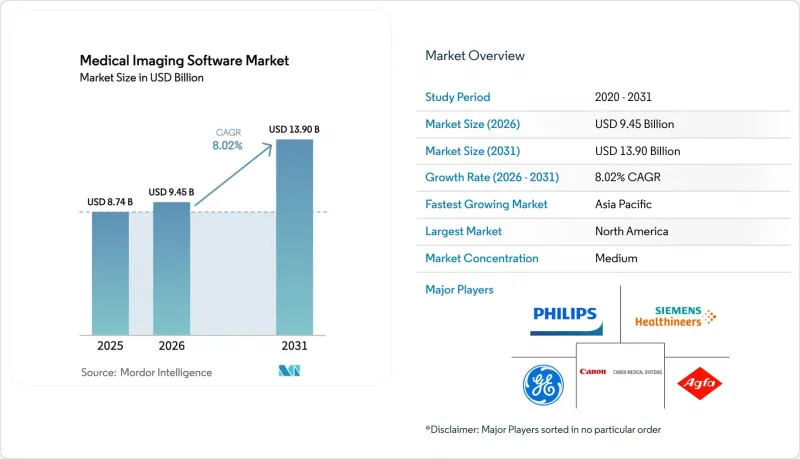
의료 영상 소프트웨어 시장 규모는 2025년 87억 4,000만 달러, 2026년 94억 5,000만 달러에서 2031년까지 139억 달러로 확대될 것으로 예측되며, 2026년부터 2031년까지 연평균 성장률(CAGR)은 8.02%가 될 전망입니다.
본 보고서는 영상 유형(2D, 3D, 4D), 모달리티(CT, MRI, X선, 초음파 등), 용도(정형외과, 종양학,순환기학, 신경학 등), 도입 모델(온프레미스, 클라우드 기반, 하이브리드), 최종사용자(병원, 영상 진단센터 등), 그리고 지역별로 분류되어 있습니다. 시장 예측은 금액(달러) 기준으로 제시되어 있습니다.
세계 의료 영상 소프트웨어 시장의 동향 및 인사이트
AI 기반 진단 도구의 도입 확대
규제 당국은 신중한 ‘게이트키퍼’에서 적극적인 ‘추진자’로 태도를 전환했습니다. FDA는 2024년에 171건의 AI 탑재 의료기기를 승인했는데, 이는 2023년 승인 건수를 거의 두 배로 늘린 것으로, 그 절반 이상이 방사선 의학 분야를 대상으로 합니다. 기존 제품을 기반으로 한 510(k) 신청으로 심사 기간이 18개월에서 6개월 미만으로 단축되어, 공급업체는 더 신속하게 수익화를 실현할 수 있게 되었습니다. Qure.ai사의 ‘qER’ 제품군은 그 상업적 영향력을 입증하고 있으며, 90초 이내에 두개내 출혈을 감지함으로써 지방 응급팀이 지역 방사선과 의사의 대기 시간을 피할 수 있게 해줍니다. 병원에서는 이러한 알고리즘을 PACS 워크리스트에 통합하여 중요한 검사를 최우선으로 표시함으로써, AI 이용 방식을 고정 라이선스 판매가 아닌 스캔당 과금 모델로 전환하고 있습니다. 업계 재편이 가속화되고 있는 가운데, Tempus사는 Arterys사를 흡수 합병하여 유전체학과 영상 바이오마커를 융합, 정밀 종양학 예산을 확보하려 하고 있습니다. 보험사가 AI 지원 판독에 대해 개별 CPT 코드를 발급함에 따라, 알고리즘의 성능과 적용 범위를 둘러싼 수익의 선순환은 더욱 강화되고 있습니다.
고도의 영상 진단을 필요로 하는 만성 질환의 부담 증가
세계적인 고령화로 인해 영상 검사 건수가 방사선과 의사의 처리 능력을 초과하는 수준에 도달했습니다. 2040년까지 65세 이상 성인은 미국 인구의 21.6%를 차지하게 되며, 젊은 층에 비해 3배 이상의 영상 검사를 받게 될 것입니다. 영국에서는 암 검진 의무화 확대를 배경으로, 2019년부터 2024년까지 CT 및 MRI 이용이 연평균 12% 증가했습니다. 현재 소프트웨어를 통해 반복적인 정량화 작업이 자동화되고 있습니다. 예를 들어, 지멘스 헬시니어스(Siemens Healthineers)의 ‘syngo.Via Frontier’는 심실 분할에 소요되는 시간을 20분에서 90초로 단축하여, 의사가 영상 진단에 전념할 수 있는 시간을 확보했습니다. 종양학 분야에서는 처리 능력 향상이 특히 중요시되고 있으며, 면역요법 치료 계획에는 연속적인 스캔이 필요하기 때문에 환자 1인당 영상 처리량이 두 배로 증가함에 따라, 이를 지원할 수 있는 소프트웨어에 대한 수요도 확대되고 있습니다. 측정 자동화를 통해 각 벤더들은 인구통계학적 압박을 지속적인 수요로 전환함으로써, 의료용 영상 소프트웨어 시장의 성장 궤도를 더욱 공고히 하고 있습니다.
고액의 소프트웨어 라이선스 및 유지보수 비용
엔터프라이즈 PACS의 라이선스 비용은 30만 달러에서 150만 달러 사이이며, 연간 지원 비용은 구매 가격의 20%에 육박하기 때문에 한 자릿수 이익률로 운영되는 중규모 의료 기관에는 큰 부담이 되고 있습니다. HFMA의 모델에 따르면, 클라우드 구독의 경우 7년에 걸친 꾸준한 검사 건수 증가가 있어야만 초기 비용과 유지비 간의 균형을 맞출 수 있습니다. 기존 PACS에서 마이그레이션하려면 인터페이스 재구축 및 직원 재교육에 추가로 20만-50만 달러의 비용이 들며, 구매자는 장기적인 감가상각 주기에 얽매이게 됩니다. 가격에 민감한 아시아 시장에서는 Orthanc과 같은 오픈 소스 스택을 채택하여 대응하고 있습니다. 이를 통해 라이선스 비용은 들지 않지만, 사내 전문 지식이 필요합니다. 이는 대규모 공립 병원에서는 선호되는 선택지이지만, 소규모 민간 클리닉에는 부담스러운 선택입니다. 그 결과 발생하는 높은 가격에 놀라 갱신 결정이 지연되면서, 단기적인 의료 영상 소프트웨어 시장의 확대가 억제되고 있습니다.
부문 분석
3D 시각화는 2025년 매출의 52.84%를 차지하며, 정형외과, 신경외과, 구강악안면외과 각 전문 분야의 수술 전 계획을 뒷받침하고 있습니다. 한편, 4D 워크플로는 심장이나 태아의 시간 경과에 따른 움직임을 포착함으로써 연평균 성장률(CAGR) 9.11%로 성장할 것으로 예상됩니다. 이러한 진화로 인해 데이터세트의 용량이 10배로 증가하여 온프레미스 스토리지의 한계를 시험하게 되겠지만, 90일이 지난 후 이용 빈도가 낮은 데이터를 저비용 오브젝트 스토리지로 계층화하는 클라우드 아카이브에는 완벽하게 적합합니다. 임상적 증거도 이러한 전환을 뒷받침하고 있습니다. 호흡 동기화 4D CT는 종양의 치료 여백을 좁히고 주변 조직에 대한 손상을 줄여줍니다. 고속 스크리닝에서는 2D가 여전히 필수적이지만, 현재 대부분의 벤더가 단일 인터페이스로 2D, 3D, 4D 파일을 불러올 수 있는 범용 뷰어를 제공하고 있어, 독립형 2D 라이선스에 대한 지불을 원하는 경향은 줄어들고 있습니다. 전반적으로, 강력한 업그레이드 인센티브 덕분에 의료 영상 소프트웨어 시장은 시각화 제품군 내에서 성장을 가속화하고 있습니다.
이러한 툴킷의 전환에 따라 대역폭 요구 사항이 증가하면서, 병원들은 엣지 캐시나 클라우드로의 직접 인제로 전환해야 하는 압박을 받고 있으며, 플랫폼 개편의 일환으로 네트워크 패브릭 현대화가 진행되고 있습니다. FDA 지침에 따르면, 4D 기능이 새로운 임상 효능을 제시하는 경우 별도의 승인이 필요하며, 이로 인해 신생 기업의 로드맵은 지연되고 있지만, 규제 대응 능력을 갖춘 기존 기업에게는 방어적인 경쟁 우위가 생겨나고 있습니다. 구독 기반 가격 체계가 보급됨에 따라, 공급업체들은 비용을 처리량에 맞춰 조정하고 있어 4D 모듈의 시험 사용 위험이 줄어들고 있습니다. 이러한 유연성은 장기적인 도입을 촉진하며, 의료 영상 소프트웨어 업계에서 실시간 영상 처리로의 전환을 뒷받침하고 있습니다.
CT(컴퓨터 단층촬영) 소프트웨어는 외상 및 응급 진료 현장에서 CT가 널리 보급되어 2025년 지출의 31.85%를 차지한 반면, PET 및 SPECT 플랫폼은 2031년까지 연평균 성장률(CAGR) 8.43%로 성장하고 있습니다. 종양학 분야에서는 면역요법의 경과를 관찰하고, 반복적인 생검 없이 투여량을 조정하기 위한 정량적 바이오마커가 요구되고 있습니다. 현재 Bracco Imaging의 한 부서로 편입된 SubtlePET는 진단적 유용성을 유지하면서 저선량 프로토콜을 가능하게함으로써 환자의 피폭량을 절반으로 줄이고, 의료기관이 동일한 방사성 추적자 배치로 더 많은 환자를 스캔할 수 있도록 하고 있습니다. MRI 개발은 검사 시간을 절반 이상 단축하는 합성 재구성에 초점을 맞추고 있으며, 검사 건수가 많은 외래 진료 센터의 업그레이드 물결을 뒷받침하고 있습니다.
초음파 및 X선 모듈은 몇 분 이내에 생명을 위협하는 소견을 감지하는 트라이아지 AI가 내장되어 있지 않은 한, 여전히 범용 제품에 그치고 있습니다. 섹트라(Sectora)의 모달리티 독립형 뷰어는 CT, MRI, 초음파를 하나의 라이선스로 통합하여 IT의 복잡성을 줄이는 동시에 분야 간 협업을 지원합니다. 과거에는 전용 워크스테이션으로 분리되었던 모달리티가 종합적인 플랫폼으로 통합되고 있으며, 이는 의료 영상 소프트웨어 시장 전체의 경쟁 구도를 재정의하고 있습니다.
지역별 분석
북미는 2025년에도 35.62%의 매출 점유율을 유지했습니다. 이는 AI 지원 영상 판독에 대한 보상을 지급하는 메디케어의 CPT 코드에 따라 소프트웨어가 청구 가능한 항목으로 인정받은 것이 원동력이 되었습니다. FDA의 승인 속도 향상은 규제 장벽을 보급의 원동력으로 전환시키고 있으며, 통합 의료 네트워크는 비용 절감을 확실시하기 위해 독자적인 플랫폼에 대한 투자를 추진하고 있습니다. 캐나다의 각 주에서는 HL7 FHIR 인터페이스 채택이 의무화되어 있어, 구매자들은 성숙한 상호운용성 툴킷을 갖춘 공급업체로 유도되고 있습니다. 한편, 멕시코의 공립 병원에서는 제한된 예산을 우선적으로 영상 장비 하드웨어에 할당하고 있습니다.
아시아태평양은 시장을 주도하고 있으며, 연평균 성장률(CAGR) 8.67%로 성장하고 있습니다. 중국의 ‘건강 중국 2030’ 프로젝트는 2024년에 AI 지원 영상 진단 네트워크를 위해 500억 위안(70억 달러)을 배정하여, 유나이티드 이미징과 같은 국내 공급업체에 안정적인 성장 기반을 제공하고 있습니다. 인도의 ‘아유슈만 바라트 디지털 미션(Ayushman Bharat Digital Mission)’은 15만 개의 의료 시설을 전국적인 정보 교환 네트워크에 연결하고 있으며, 새로운 원격의료 규정에 따라 주를 넘나드는 방사선 영상 판독이 허용됨에 따라 통합된 원격 방사선 진단 시장의 형성이 촉진되고 있습니다. 일본에서는 초고령화 사회가 진행되는 가운데, 뇌졸중 환자 증가로 인해 응급 부문이 과부하 상태에 놓여 있어 실시간 트리아지 AI가 필수적입니다. 한국은 AI를 활용한 폐 결절 검출에 대해 이 지역 최초로 보험 적용 코드를 발급하며, 보험사가 소프트웨어의 가치를 인정하는 태도를 보였습니다.
유럽에서는 GDPR 및 향후 시행될 AI법에 대한 대응에 고심하고 있습니다. 벤더는 인구통계학적 공정성을 입증하고 국경을 넘는 데이터 전송을 피해야 하기 때문에 페더레이티드 러닝은 혁신이라기보다는 이미 기본이 되는 아키텍처가 되었습니다. 영국 NHS에서는 2024년까지 CT 및 MRI 검사 건수가 연평균 12% 증가하여 전문의의 대응 능력이 한계에 다다르고 있습니다. 독일에서는 학습 데이터세트의 인구통계학적 정보 공개가 의무화되어 있어, 투명성이 확보되지 않은 모델의 시장 진입이 지연되고 있습니다. 프랑스에서는 200개 공립 병원에서 세크트라(Sectora)사의 엔터프라이즈 PACS가 표준화되었으며, 조달상의 장벽이 해소된다면 전국적인 도입이 가능하다는 것이 입증되었습니다.
남미에서는 통화 변동에 직면해 있으며, 브라질과 아르헨티나 등은 환율 변동을 피하기 위해 오픈 소스 PACS에 의존하고 있어 단기적인 상업적 기회는 제한적입니다. 중동의 프로그램, 특히 사우디아라비아의 ‘비전 2030’에서는 의료 IT에 25억 달러를 배정하고 있으며, 클라우드 PACS를 3차 의료 확대의 기반으로 자리매김하고 있습니다. 아프리카에서는 남아프리카공화국의 민간 네트워크와 나이지리아의 교육 병원이 도시와 농촌 간의 의료 격차를 해소하기 위한 원격 방사선 진단 협력을 선도적으로 도입하고 있지만, 의료 영상 소프트웨어 시장 전체 수익에서 차지하는 비중은 여전히 초기 단계에 머물러 있습니다.
기타 혜택:
- 엑셀 형식의 시장 예측(ME) 시트
- 3개월간의 애널리스트 지원
자주 묻는 질문
목차
제1장 소개
제2장 조사 방법
제3장 주요 요약
제4장 시장 구도
제5장 시장 규모와 성장 예측
제6장 경쟁 구도
제7장 시장 기회와 향후 전망
KSM 26.09.03According to Mordor Intelligence, the medical imaging software market size is projected to expand from USD 8.74 billion in 2025 and USD 9.45 billion in 2026 to USD 13.90 billion by 2031, registering a CAGR of 8.02% between 2026 to 2031.
This report is Segmented by Imaging Type (2D, 3D, and 4D), Modality (CT, MRI, X-Ray, Ultrasound, and More), Application (Orthopedic, Oncology, Cardiology, Neurology, and More), Deployment Model (On-Premise, Cloud-Based, and Hybrid), End User (Hospitals, Diagnostic Imaging Centers, and More), and Geography. The Market Forecasts are Provided in Terms of Value (USD).
Global Medical Imaging Software Market Trends and Insights
Growing Adoption of AI-Powered Diagnostic Tools
Regulators have moved from cautious gatekeepers to active enablers: the FDA cleared 171 AI-enabled devices in 2024, nearly doubling 2023 activity, and over half of them target radiology. Predicate-based 510(k) filings reduced review cycles from 18 months to under six, allowing vendors to achieve quicker revenue realization. Qure.ai's qER suite demonstrates its commercial impact, flagging intracranial bleeds within 90 seconds and enabling rural emergency teams to bypass local radiologist queues. Hospitals are incorporating such algorithms into PACS worklists, so that critical studies surface first, turning AI usage into a per-scan fee generator rather than a fixed license sale. Consolidation is intensifying, as Tempus has absorbed Arterys to fuse genomics with imaging biomarkers and capture precision-oncology budgets. As payers issue separate CPT codes for AI-assisted reads, the revenue flywheel tightens further around algorithm performance and breadth.
Increasing Chronic Disease Burden Requiring Advanced Imaging
An aging world pushes imaging volumes beyond radiologist capacity. Adults aged 65 and above will comprise 21.6% of the U.S. population by 2040 and will consume over three times the number of imaging studies as younger cohorts. The United Kingdom saw CT and MRI usage increase by 12% annually from 2019 to 2024, driven by expanded cancer screening mandates. Software now automates repetitive quantification tasks, such as those used by Siemens Healthineers' syngo.Via Frontier slashed cardiac chamber segmentation from 20 minutes to 90 seconds, freeing physicians for interpretive tasks. Oncology underscores the throughput imperative, immunotherapy regimens require serial scans, multiplying image load per patient and enlarging the addressable software pool. By automating measurements, vendors translate demographic pressure into sustained demand, thereby reinforcing the market's trajectory for medical imaging software.
High Software Licensing and Maintenance Costs
Enterprise PACS licenses range from USD 300,000 to USD 1.5 million, with annual support fees near 20% of the purchase price, straining mid-sized centers operating on single-digit margins. Cloud subscriptions only equalize outlays after seven years of steady volume growth, according to HFMA modeling. Migration away from an incumbent PACS can cost another USD 200,000-500,000 in interface rebuilds and staff retraining, locking buyers into long depreciation cycles. Price-sensitive Asian markets respond by adopting open-source stacks like Orthanc, which erase license fees but demand in-house expertise, a trade favored by large public hospitals but beyond reach for smaller private clinics. The resulting sticker shock slows refresh decisions and clips near-term medical imaging software market expansion.
Other drivers and restraints analyzed in the detailed report include:
- Rapid Shift Toward 3D and 4D Visualization Workflows
- Expansion of Cloud-Enabled Enterprise Imaging Platforms
- Shortage of Trained Imaging-Informatics Professionals
For complete list of drivers and restraints, kindly check the Table Of Contents.
Segment Analysis
3D visualization commanded 52.84% of 2025 revenue, underpinning pre-operative planning across orthopedic, neuro, and maxillofacial specialties, while 4D workflows are set to grow at a 9.11% CAGR by capturing temporal cardiac and fetal motion. This evolution scales dataset weights ten-fold, testing on-premise storage but slotting neatly into cloud archives that tier cold data to low-cost object storage after 90 days. Clinical evidence strengthens the shift: respiratory-gated 4D CT narrows tumor treatment margins and reduces collateral tissue damage. Although 2D remains vital for high-throughput screenings, most vendors now ship universal viewers that read 2D, 3D, and 4D files through a single interface, limiting willingness to pay for stand-alone 2D licenses. Overall, robust upgrade incentives keep the medical imaging software market accelerating inside visualization suites.
The toolkit transition increases bandwidth requirements and pushes hospitals toward edge caching or direct-to-cloud ingestion, modernizing network fabrics as part of platform overhauls. FDA guidance now requires separate clearances when 4D functions introduce fresh clinical claims, slowing startup roadmaps but creating defensible moats for incumbents with regulatory capital. As subscription pricing spreads, providers match costs with volumes, making 4D modules less risky to trial. That flexibility feeds long-run adoption and reinforces the medical imaging software industry's shift to real-time imaging.
Computed tomography software held 31.85% of 2025 spend thanks to CT's ubiquity in trauma and emergency pathways, yet PET and SPECT platforms are advancing at an 8.43% CAGR through 2031. Oncology departments want quantitative biomarkers to monitor immunotherapy and adjust dosing without repeat biopsies. SubtlePET, now part of Bracco Imaging, halves patient radiation by enabling low-dose protocols while preserving diagnostic utility, letting centers scan more patients from the same radiotracer batch. MRI developments focus on synthetic reconstruction that trims exam times by more than half, sustaining upgrade waves among high-volume outpatient centers.
Ultrasound and X-ray modules remain commodity offerings unless layered with triage AI that flags life-threatening findings within minutes. Sectra's modality-agnostic viewer bundles CT, MRI, and ultrasound into one license, curbing IT complexity and supporting cross-disciplinary collaboration. Modalities once walled off by proprietary workstations are collapsing into holistic platforms, redefining competitive battlegrounds across the medical imaging software market.
Complete Report Scope:
- By Imaging Type
- 2D Imaging
- 3D Imaging
- 4D Imaging
- By Modality
- Computed Tomography
- Magnetic Resonance Imaging
- X-Ray
- Ultrasound
- PET and SPECT
- Other Modalities
- By Application
- Orthopedic
- Oncology
- Cardiology
- Neurology
- Dental
- Obstetrics and Gynecology
- Mammography
- Urology and Nephrology
- By Deployment Model
- On-Premise
- Cloud-Based
- Hybrid
- By End User
- Hospitals
- Diagnostic Imaging Centers
- Ambulatory Surgical Centers
- Research and Academic Institutes
- Other End Users
- By Geography
- North America
- United States
- Canada
- Mexico
- South America
- Brazil
- Argentina
- Rest of South America
- Europe
- United Kingdom
- Germany
- France
- Italy
- Spain
- Rest of Europe
- Asia-Pacific
- China
- Japan
- India
- South Korea
- Australia and New Zealand
- Rest of Asia Pacific
- Middle East and Africa
- Middle East
- Saudi Arabia
- United Arab Emirates
- Turkey
- Rest of Middle East
- Africa
- South Africa
- Nigeria
- Rest of Africa
- Middle East
- North America
Geography Analysis
North America preserved 35.62% revenue share in 2025, powered by Medicare CPT codes that reimburse AI-assisted reads and elevate software to a billable line item. FDA clearance velocity converts regulatory friction into adoption fuel, and integrated delivery networks invest in proprietary platforms to lock in cost savings. Canada's provinces enforce HL7 FHIR interfaces, steering buyers toward vendors with mature interoperability toolkits, while Mexico's public hospitals direct limited budgets to modality hardware first.
Asia-Pacific is the pace car, growing at an 8.67% CAGR. China's Healthy China 2030 project earmarked CNY 50 billion (USD 7 billion) in 2024 for AI-ready imaging networks, giving domestic suppliers like United Imaging a protected runway. India's Ayushman Bharat Digital Mission connects 150,000 facilities to a national exchange, and new telemedicine rules permit cross-state radiology reads, catalyzing a unified teleradiology market. Japan's super-aged demographic makes real-time triage AI indispensable as emergency departments strain under stroke caseloads. South Korea issued the region's first reimbursement code for AI lung-nodule detection, signalling payer willingness to recognize software value.
Europe grapples with GDPR and the forthcoming AI Act. Vendors must evidence demographic fairness and avoid cross-border data transfers, so federated learning is baseline architecture rather than an innovation. The U.K.'s NHS saw CT and MRI volumes climb 12% annually through 2024, stretching consultant capacity. Germany demands disclosure of training-dataset demographics, delaying market entry for opaque models. France standardized 200 public hospitals on Sectra's enterprise PACS, proving that national-scale rollouts can proceed once procurement hurdles clear.
South America contends with currency volatility such as Brazil and Argentina lean on open-source PACS to dodge exchange swings, limiting near-term commercial opportunity. Middle Eastern programs, notably Saudi Arabia's Vision 2030, allocate USD 2.5 billion to health IT, positioning cloud PACS as the backbone of tertiary expansion. In Africa, South African private networks and Nigerian teaching hospitals pioneer teleradiology links that bridge urban-rural care gaps but remain early-stage contributors to overall medical imaging software market revenue.
- GE HealthCare Technologies, Inc.
- Siemens Healthineers AG
- Koninklijke Philips N.V.
- Canon Medical Systems Corporation
- Agfa-Gevaert N.V.
- Fujifilm Holdings Corporation
- Carestream Health, Inc.
- Sectra AB
- Novarad Corporation
- MIM Software Inc.
- Cerner Health Services, Inc.
- Change Healthcare LLC
- IBM Corporation (Watson Health was a division)
- Arterys, Inc.
- Circle Cardiovascular Imaging Inc.
- INFINITT Healthcare Co., Ltd.
- Visage Imaging GmbH
- Mach7 Technologies Ltd.
- TeraRecon, Inc.
Additional Benefits:
- The market estimate (ME) sheet in Excel format
- 3 months of analyst support
TABLE OF CONTENTS
1 INTRODUCTION
- 1.1 Study Assumptions and Market Definition
- 1.2 Scope of the Study
2 RESEARCH METHODOLOGY
3 EXECUTIVE SUMMARY
4 MARKET LANDSCAPE
- 4.1 Market Overview
- 4.2 Market Drivers
- 4.2.1 Growing Adoption of AI-Powered Diagnostic Tools
- 4.2.2 Increasing Chronic Disease Burden Requiring Advanced Imaging
- 4.2.3 Rapid Shift Toward 3D and 4D Visualization Workflows
- 4.2.4 Expansion of Cloud-Enabled Enterprise Imaging Platforms
- 4.2.5 Emergence of Federated Learning to Unlock Multi-Institutional Datasets
- 4.2.6 Increasing Use of Synthetic Data for Regulatory-Grade Validation
- 4.3 Market Restraints
- 4.3.1 High Software Licensing and Maintenance Costs
- 4.3.2 Shortage of Trained Imaging-Informatics Professionals
- 4.3.3 Cyber-Security Threats Targeting PACS and VNA Ecosystems
- 4.3.4 Algorithmic Bias Concerns Hindering AI Approvals
- 4.4 Industry Value Chain Analysis
- 4.5 Regulatory Landscape
- 4.6 Technological Outlook
- 4.7 Porter's Five Forces Analysis
- 4.7.1 Bargaining Power of Suppliers
- 4.7.2 Bargaining Power of Buyers
- 4.7.3 Threat of New Entrants
- 4.7.4 Threat of Substitutes
- 4.7.5 Degree of Competitive Rivalry
- 4.8 Impact of Macroeconomic Factors on the Market
5 MARKET SIZE AND GROWTH FORECASTS (VALUE)
- 5.1 By Imaging Type
- 5.1.1 2D Imaging
- 5.1.2 3D Imaging
- 5.1.3 4D Imaging
- 5.2 By Modality
- 5.2.1 Computed Tomography
- 5.2.2 Magnetic Resonance Imaging
- 5.2.3 X-Ray
- 5.2.4 Ultrasound
- 5.2.5 PET and SPECT
- 5.2.6 Other Modalities
- 5.3 By Application
- 5.3.1 Orthopedic
- 5.3.2 Oncology
- 5.3.3 Cardiology
- 5.3.4 Neurology
- 5.3.5 Dental
- 5.3.6 Obstetrics and Gynecology
- 5.3.7 Mammography
- 5.3.8 Urology and Nephrology
- 5.4 By Deployment Model
- 5.4.1 On-Premise
- 5.4.2 Cloud-Based
- 5.4.3 Hybrid
- 5.5 By End User
- 5.5.1 Hospitals
- 5.5.2 Diagnostic Imaging Centers
- 5.5.3 Ambulatory Surgical Centers
- 5.5.4 Research and Academic Institutes
- 5.5.5 Other End Users
- 5.6 By Geography
- 5.6.1 North America
- 5.6.1.1 United States
- 5.6.1.2 Canada
- 5.6.1.3 Mexico
- 5.6.2 South America
- 5.6.2.1 Brazil
- 5.6.2.2 Argentina
- 5.6.2.3 Rest of South America
- 5.6.3 Europe
- 5.6.3.1 United Kingdom
- 5.6.3.2 Germany
- 5.6.3.3 France
- 5.6.3.4 Italy
- 5.6.3.5 Spain
- 5.6.3.6 Rest of Europe
- 5.6.4 Asia-Pacific
- 5.6.4.1 China
- 5.6.4.2 Japan
- 5.6.4.3 India
- 5.6.4.4 South Korea
- 5.6.4.5 Australia and New Zealand
- 5.6.4.6 Rest of Asia Pacific
- 5.6.5 Middle East and Africa
- 5.6.5.1 Middle East
- 5.6.5.1.1 Saudi Arabia
- 5.6.5.1.2 United Arab Emirates
- 5.6.5.1.3 Turkey
- 5.6.5.1.4 Rest of Middle East
- 5.6.5.2 Africa
- 5.6.5.2.1 South Africa
- 5.6.5.2.2 Nigeria
- 5.6.5.2.3 Rest of Africa
- 5.6.5.1 Middle East
- 5.6.1 North America
6 COMPETITIVE LANDSCAPE
- 6.1 Market Concentration
- 6.2 Strategic Moves
- 6.3 Market Share Analysis
- 6.4 Company Profiles (includes Global-level Overview, Market-level Overview, Core Segments, Financials as available, Strategic Information, Market Rank/Share, Products and Services, Recent Developments)
- 6.4.1 GE HealthCare Technologies, Inc.
- 6.4.2 Siemens Healthineers AG
- 6.4.3 Koninklijke Philips N.V.
- 6.4.4 Canon Medical Systems Corporation
- 6.4.5 Agfa-Gevaert N.V.
- 6.4.6 Fujifilm Holdings Corporation
- 6.4.7 Carestream Health, Inc.
- 6.4.8 Sectra AB
- 6.4.9 Novarad Corporation
- 6.4.10 MIM Software Inc.
- 6.4.11 Cerner Health Services, Inc.
- 6.4.12 Change Healthcare LLC
- 6.4.13 IBM Corporation (Watson Health was a division)
- 6.4.14 Arterys, Inc.
- 6.4.15 Circle Cardiovascular Imaging Inc.
- 6.4.16 INFINITT Healthcare Co., Ltd.
- 6.4.17 Visage Imaging GmbH
- 6.4.18 Mach7 Technologies Ltd.
- 6.4.19 TeraRecon, Inc.
7 MARKET OPPORTUNITIES AND FUTURE OUTLOOK
- 7.1 White-Space and Unmet-Need Assessment


