|
시장보고서
상품코드
2121445
X선 튜브 : 시장 점유율 분석, 업계 동향과 통계, 성장 예측(2026-2031년)X-Ray Tube - Market Share Analysis, Industry Trends & Statistics, Growth Forecasts (2026 - 2031) |
||||||
 Mordor Intelligence
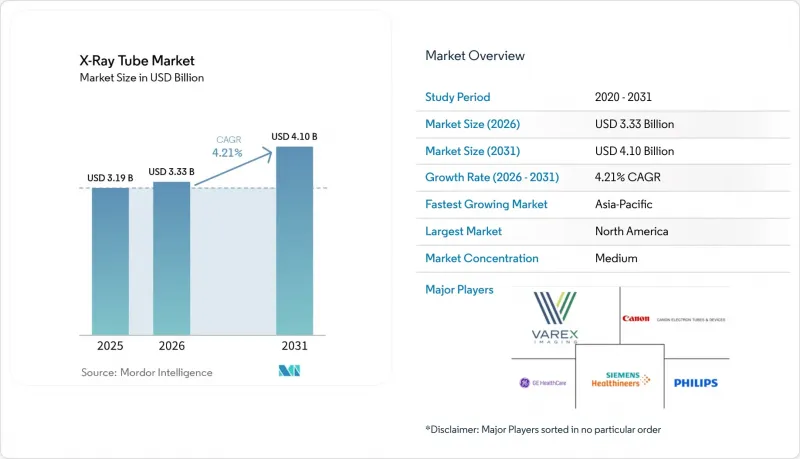
Mordor Intelligence에 의하면, X선 튜브 시장 규모는 2025년에 36억 4,000만 달러, 2026년에 37억 8,000만 달러에 이르고, 2031년까지 47억 7,000만 달러에 이를 것으로 예측되며, 이것은 예측 기간 CAGR 4.76%에 상당합니다.
본 보고서는 튜브 유형(회전 양극, 고정 양극 등), 구성 부품(음극 어셈블리, 양극/타겟, 튜브 하우징 및 엔벨로프 등), 용도(컴퓨터 단층촬영, 디지털 방사선 촬영, 이동식 C-암/투시 장치 등), 최종 사용자 산업(병원 및 의료 시스템, 영상 진단센터 등), 그리고 지역별로 분류되어 있습니다. 시장 예측은 금액(달러) 기준으로 제시되어 있습니다.
전 세계 X선 튜브 시장 동향 및 인사이트
진단 영상 검사가 필요한 만성 질환의 전 세계적 부담 증가
현재 심혈관 질환, 종양 질환, 호흡기 질환이 전 세계 사망 원인의 70% 이상을 차지하고 있으며, 이로 인해 CT 혈관조영술, 흉부 X선 촬영 및 유방촬영술 검진 건수가 증가하여 X선 튜브 시장 수요를 직접적으로 끌어올리고 있습니다. 국제암연구소(IARC)는 2040년까지 연간 2,840만 건의 신규 암 사례가 발생할 것으로 예측하고 있으며, 이는 전 세계적으로 1만 5,000대의 CT 스캐너와 이에 상응하는 X선 튜브 재고가 추가로 필요함을 의미합니다. 65세 이상 고령자는 젊은 층에 비해 3배 더 자주 영상 진단을 받고 있으며, 이러한 인구 통계학적 변화가 검사 건수 증가에 장기적인 호재로 작용하고 있습니다. 중국과 인도 정부는 영상 진단 역량을 국가 보건 전략의 핵심으로 삼고, 정책 로드맵에 X선 튜브 조달 목표를 포함시키고 있습니다. 성숙한 시장에서는 가치 기반 지불 모델이 조기 진단을 장려하고 있어, 스캔 1회당 환급액이 축소되더라도 역설적으로 검사 건수를 증가시키는 요인이 되고 있습니다.
디지털 X선 촬영 및 멀티슬라이스 CT 시스템으로의 교체 주기 가속화
북미와 유럽에서는 의료 서비스 제공업체들이 고주파 발생기 및 펄스 노출관이 필요한 검출기 기반 워크플로로 전환함에 따라, 아날로그 X선 촬영 장비가 연간 8-10%의 속도로 도태되고 있습니다. 선진국에서 멀티슬라이스 CT의 보급률은 80%에 육박하고 있지만, 64슬라이스에서 256슬라이스로의 전환에 따라 더 빠른 간트리 회전 및 듀얼 에너지 프로토콜에 대응하기 위해 X선 튜브의 업그레이드가 필수적입니다. 2024년 캐논이 출시한 초점 직경 0.25mm의 CT는 스캐너의 혁신이 성능 곡선에 따라 튜브 설계를 주도하는 모습을 여실히 보여주었습니다. 신흥 시장에서는 필름을 완전히 생략하고, 신규 검사실의 90%에 디지털 X선 촬영 장비를 도입하고 있어, 보급형 튜브의 교체 수요가 확대되고 있습니다. 또한, EU 규정에서는 선량 보고 기능이 의무화되어 있어, 이로 인해 기존의 아날로그 장비 및 관련 튜브 재고는 구식이 되어가고 있습니다.
엄격한 의료기기 승인 및 방사선 안전 규제
진단용 X선 장치에 관한 IEC 안전 규격의 개정에 따라, 표준 측정 거리에서의 허용 방사선 누출량이 대폭 감소하여 제조업체들은 차폐 재설계 및 적합성 시험 기간 연장을 피할 수 없게 되었습니다. 이러한 변경으로 인해 일반적으로 검증 기간이 장기화되어 제품 출시가 최대 1년 지연되는 사태가 발생하고 있습니다. 현재 FDA의 510(k) 심사에서는 연속 운전 시 열 시험이 의무화되어 있어, 공급업체는 가속 수명 시험 장비에 최대 100만 달러를 투자할 수밖에 없는 상황입니다. 유럽 의료기기 규정(MDR)은 모든 의료기기에 대해 시판 후 감시 및 개별 기기 식별(UDI) 요건을 부과하고 있어, 규정 준수에 드는 비용 측면에서 중소규모 신규 진출기업에 과도한 부담을 주고 있습니다. 중국의 국가약품감독관리국(NMPA)은 국내 조달 비율 기준을 도입하여 외국 공급업체들에게 현지 생산으로의 전환 또는 시장 점유율 양보를 강요하고 있습니다. 이러한 규제들이 복합적으로 작용하여 제품 업데이트 주기가 지연되고 고정비가 증가함에 따라, 단기적인 X선 튜브 시장의 성장은 둔화되고 있습니다.
부문 분석
이 부문에서는 회전 양극형이 가장 큰 매출을 기록하고 있으며, 2025년에는 X선 튜브 시장 점유율의 52.63%를 차지했습니다. 이는 5메가줄의 열용량을 갖추고 있어 멀티슬라이스 CT의 워크로드에 적합하기 때문입니다. 냉음극 전기장 방출형 모델은 연평균 성장률(CAGR) 5.13%로 확대될 것으로 예상되며, 순간적으로 기동하는 탄소나노튜브 이미터 덕분에 필라멘트 소손 문제가 해소되고 고정식 CT용 소형 멀티 소스 어레이가 가능해짐에 따라 가장 성장세가 두드러지는 카테고리가 되고 있습니다. 고정 양극 제품은 설치 면적이 작고 전력 소비도 적어 진료 현장에서 사용하기에 적합하기 때문에 치과 및 휴대용 영상 분야에서 여전히 널리 보급되어 있지만, 디지털 검출기에 의해 노출 시간이 단축됨에 따라 그 점유율은 서서히 감소하고 있습니다. 마이크로 포커스 튜브는 산업용 비파괴 검사 및 조사라는 틈새 시장을 뒷받침하고 있으며, 10µm 미만의 초점 스팟을 제공함으로써 복합재 기체나 생물 시료의 미세한 균열을 분해합니다.
Excillum사의 MetalJet 시스템은 획기적인 가능성을 보여주는 좋은 예입니다. 이 시스템은 자가 복구 기능을 갖춘 갈륨-인듐 양극을 채택하여 고체 타겟의 10배에 달하는 전력 밀도를 견뎌냄으로써, 과거에는 싱크로트론에서만 가능했던 밝기를 실현하고 있습니다. 휴대용 장치에 탑재된 탄소나노튜브 음극은 예열 지연을 해소하고 배터리 소모를 30% 절감합니다. 이는 재난 대응 시 전개에 있어 매우 중요한 기능입니다. 규제 당국은 냉음극의 안전상의 이점을 높이 평가했습니다. 필라멘트 회로를 제거함으로써 전기적 절연이 단순화되어 IEC 60601-1-2 준수가 용이해지기 때문입니다. 성능, 가동률 및 규정 준수상의 이점이 결합되어 냉음극의 채택이 가속화되고, 궁극적으로 X선 튜브 시장 경쟁 구도를 재정의할 것으로 기대됩니다.
튜브 하우징 및 엔벨로프는 주요 방열층 및 방사선 차폐층으로서 2025년 매출의 30.26%를 차지했으나, 음극 하위 어셈블리는 2031년까지 연평균 성장률(CAGR) 5.21%라는 더 빠른 속도로 성장하고 있습니다. 디스펜서형 음극은 다공성 텅스텐에 산화 바륨 이미터를 매립하여 최대 50,000시간 동안 안정적인 방출을 유지하며, 광자 계수 CT에서 요구되는 더 좁은 초점 스팟을 실현합니다. 텅스텐-레늄 타겟은 여전히 부품 원가의 약 3분의 2를 차지하고 있으며, 전 세계적으로 공급업체가 5개 미만인 만큼 제조업체들은 원자재 확보와 이익률 유지를 위해 수직 통합을 추진하고 있습니다.
4메가줄을 초과하는 정격의 튜브에서 액체 금속 베어링이 볼 베어링을 빠르게 대체하고 있으며, 기계적 마모와 진동을 제거함과 동시에 내구 횟수를 10만 회까지 연장하고 있습니다. 캐논의 몰리브덴 하층 양극 설계는 가동률이 높은 유방 촬영기에서 초점 궤도의 균열을 줄여주고 있으며, 미세한 재료 조정이 어떻게 경쟁적 차별화로 이어지는지를 보여주고 있습니다. 로터 및 고정자 시스템은 현재 자기 부상 기술을 채택하여 초당 4회전의 간트리 회전을 소음 없이 실현하고 있습니다. 이는 24시간 가동되는 심장 CT실의 큰 장점입니다. X선 튜브 전체가 아닌 음극 또는 양극만을 현장에서 교체할 수 있는 모듈식 아키텍처는 가동 중단 시간을 단축하며, X선 튜브 시장을 장악하고 있는 성과 기반 서비스 모델에도 부합합니다.
지역별 분석
북미는 2025년 매출의 40.26%를 차지했습니다. 이는 2010년부터 2015년 사이에 도입된 CT 스캐너의 교체 수요와, 영상 진단 장비를 우선시하는 연방 정부의 30억 달러 규모 지방 병원 현대화 기금에 힘입은 결과입니다. 연간 3,000만 건의 CT 검사를 포괄하는 선량 지수 레지스트리를 통해 의료 기관은 저선량 운영에 최적화된 X선 튜브를 채택해야만 하며, 이는 업그레이드 활동의 또 다른 원동력이 되고 있습니다. 캐나다의 공동 구매 통합은 공급업체의 이익률을 압박하는 한편, X선 튜브 모델의 표준화를 가져와 공급망을 간소화하고 서비스 수익을 끌어올리고 있습니다.
아시아태평양은 2031년까지 연평균 성장률(CAGR)이 4.22%로 가장 빠르게 성장하고 있는 지역입니다. 중국의 ‘건강 중국 2030’ 계획에서는 1,500억 달러를 투입해 1만 곳의 지역 의료 센터를 신설할 방침입니다. 각 센터에는 국산 튜브를 갖춘 디지털 X선 촬영실 및 CT실이 설치될 예정입니다. 인도의 ‘아유슈만 바라트’ 계획에서는 5,000개 지역 병원의 영상 진단에 보조금이 지급되고 있으나, 많은 경우 재생 스캐너가 채택되고 있어 이로 인해 중고 튜브 시장이 확대되고 있습니다. 일본에서는 고령화로 인해 교체 수요가 유지되고 있지만, 병원 합병으로 인해 시설 수가 감소하면서 구매력이 강화되고 있습니다. 태국과 싱가포르의 의료 관광은 자비로 진료를 받는 외국인 환자를 대상으로 한 고급 CT 및 투시 검사실에 대한 수요를 뒷받침하고 있습니다.
유럽은 세계 시장에서 중요한 역할을 하고 있으며, 독일, 프랑스, 영국이 해당 지역의 매출에 주요 기여를 하고 있습니다. 동유럽에서는 의료 인프라 현대화에 할당된 EU 구조기금의 견인 효과로 성장이 나타나고 있습니다. 중동에서는 ‘사우디 비전 2030’과 아랍에미리트의 의료 관광 프로젝트가 호재로 작용하고 있지만, 지정학적 리스크로 인해 장기적인 수주는 제한되고 있습니다. 아프리카에서는 대륙 전체의 CT 스캐너 대수가 2,000대 미만으로 보급률이 여전히 낮은 상황이지만, 다자간 융자를 통해 최초의 대규모 조달 사업이 시작되면서 장기적인 X선 튜브 시장 발전을 위한 초석이 다져지고 있습니다.
기타 혜택:
- 엑셀 형식 시장 예측(ME) 시트
- 3개월간 애널리스트 지원
자주 묻는 질문
목차
제1장 서론
제2장 조사 방법
제3장 주요 요약
제4장 시장 구도
제5장 시장 규모와 성장 예측
제6장 경쟁 구도
제7장 시장 기회와 향후 전망
LSH 26.09.09According to Mordor Intelligence, the x-Ray tube market size stood at USD 3.64 billion in 2025, USD 3.78 billion in 2026 and is projected to reach USD 4.77 billion by 2031, translating into a 4.76% CAGR over the forecast period.
This report is Segmented by Tube Type (Rotating Anode, Stationary Anode, and More), Component (Cathode Assembly, Anode/Target, Tube Housing and Envelope, and More), Application (Computed Tomography, Digital Radiography, Mobile C-arm/Fluoroscopy, and More), End-User Industry (Hospitals and Health Systems, Diagnostic Imaging Centers, and More), and Geography. The Market Forecasts are Provided in Terms of Value (USD).
Global X-Ray Tube Market Trends and Insights
Escalating Global Burden of Chronic Diseases Necessitating Diagnostic Imaging
Cardiovascular, oncologic, and respiratory disorders now account for over 70% of global deaths, pushing CT angiography, chest radiography, and screening mammography volumes higher and directly stimulating X-Ray Tube market demand. The International Agency for Research on Cancer projects 28.4 million new cancer cases annually by 2040, implying the need for 15,000 additional CT scanners and commensurate tube inventories worldwide. Populations aged 65 years and older undergo diagnostic imaging at triple the rate of younger cohorts, a demographic shift that maintains a long runway for volume growth. Governments in China and India place imaging capacity at the center of national health strategies, embedding tube procurement targets in policy roadmaps. In mature markets, value-based payment models reward early diagnosis, which paradoxically lifts exam counts even when reimbursement per scan tightens.
Accelerating Upgrade Cycle to Digital Radiography and Multi-slice CT Systems
Analog radiography units are retiring at an 8-10% annual clip in North America and Europe as providers pivot to detector-based workflows that mandate high-frequency generators and pulsed-exposure tubes. Multi-slice CT penetration nears 80% in developed economies, yet the leap from 64-slice to 256-slice platforms forces tube upgrades to handle faster gantry rotations and dual-energy protocols. Canon's 0.25-millimeter focal-spot CT launched in 2024 spotlighted how scanner innovation pulls tube design along the performance curve. Emerging markets bypass film entirely, installing digital radiography in 90% of new rooms, thereby enlarging the replacement pool for entry-level tubes. EU regulations additionally require dose-reporting functions that obsolete legacy analog gear and its associated tube stock.
Stringent Device-Approval and Radiation-Safety Regulations
Updates to the IEC safety standard for diagnostic X-ray equipment have significantly reduced the allowable radiation leakage at a standard measurement distance, forcing manufacturers to redesign shielding and extend their compliance testing. These changes have commonly stretched validation timelines, pushing product launches back by as much as a year. FDA 510(k) review now demands continuous-duty thermal testing, forcing vendors to invest as much as USD 1 million in accelerated life-test rigs. Europe's Medical Device Regulation imposes post-market surveillance and unique device identification requirements on every device, placing a disproportionate burden on smaller entrants in terms of compliance spending. China's National Medical Products Administration rolled out domestic-content thresholds, compelling foreign suppliers to localize or cede share. Collectively, these rules slow product refresh cycles and raise fixed costs, tempering near-term X-Ray Tube market expansion.
Other drivers and restraints analyzed in the detailed report include:
- Rapid Performance Gains in High-Heat Rotating-Anode Designs
- Healthcare-Infrastructure Build-outs in Emerging Economies
- High Upfront and Service Costs of Advanced Tubes
For complete list of drivers and restraints, kindly check the Table Of Contents.
Segment Analysis
The segment generated the largest revenue from rotating anode variants, which held a 52.63% X-Ray Tube market share in 2025, due to its 5 megajoule heat capacity, suited to multi-slice CT workloads. Cold-cathode field-emission models are forecast to expand at a 5.13% CAGR, making them the most dynamic category as instant-on carbon-nanotube emitters eliminate filament burnout and permit compact multi-source arrays for stationary CT. Stationary-anode products remain prevalent in dental and portable imaging because their smaller footprints and lower power draw fit point-of-care scenarios, though their share gradually slips as digital detectors shorten exposure times. Micro-focus tubes anchor industrial nondestructive testing and research niches, delivering sub-10 µm focal-spots that resolve micro-cracks in composite airframes and biological samples.
Excillum's MetalJet system exemplifies disruptive potential, utilizing a self-healing gallium-indium anode to tolerate ten times higher power density than solid targets, unlocking brightness once limited to synchrotrons. Carbon-nanotube cathodes in portable units eliminate warm-up delay and reduce battery draw by 30%, a critical feature for disaster-response deployment. Regulatory bodies recognize the merit of cold-cathode safety advantages, as eliminating filament circuits simplifies electrical isolation, thereby easing compliance with IEC 60601-1-2. The confluence of performance, uptime, and compliance benefits is expected to accelerate cold-cathode adoption, ultimately redefining competitive boundaries in the X-Ray Tube market.
Tube housing and envelopes delivered 30.26% of 2025 revenue as the primary heat-sink and radiation-shield layers, yet cathode subassemblies are on a faster 5.21% CAGR track through 2031. Dispenser cathodes embed barium-oxide emitters in porous tungsten, maintaining stable emission for up to 50,000 hours and enabling tighter focal spots demanded by photon-counting CT. Tungsten-rhenium targets still account for roughly two-thirds of bill-of-materials cost, and with fewer than five suppliers globally, manufacturers pursue vertical integration to lock in feedstock and margin.
Liquid-metal bearings are quickly supplanting ball bearings in tubes rated above 4 megajoules, eradicating mechanical wear and vibration while extending life to 100,000 exposures. Canon's molybdenum-underlayer anode design mitigates focal-track cracking in high-duty mammography, evidence of how micro-material tweaks translate into competitive differentiation. Rotor and stator systems now use magnetic levitation to support 4-revolution-per-second gantry spins without noise, a selling point for cardiac CT suites that operate around the clock. Modular architectures that allow in-field replacement of cathode or anode only, rather than the whole tube, reduce downtime and align with outcome-based service models that dominate the X-Ray Tube market.
Complete Report Scope:
- By Tube Type
- Rotating Anode Tube
- Stationary Anode Tube
- Micro-focus Tube
- Cold-cathode Field-Emission Tube
- By Component
- Cathode Assembly
- Anode/Target
- Tube Housing and Envelope
- Rotor and Stator
- Other Components
- By Application
- Computed Tomography (CT)
- Digital Radiography (DR)/General Radiography
- Mobile C-arm/Fluoroscopy
- Mammography
- Dental Imaging
- Security and Non-Security Testing
- Scientific and Research
- By End-User Industry
- Hospitals and Health Systems
- Diagnostic Imaging Centers
- Outpatient Clinics and Ambulatory Care
- Aerospace and Defense NDT Facilities
- Food and Beverage Inspection
- Research Institutes and Academia
- By Geography
- North America
- United States
- Canada
- Mexico
- South America
- Brazil
- Argentina
- Rest of South America
- Europe
- Germany
- United Kingdom
- France
- Italy
- Spain
- Rest of Europe
- Asia-Pacific
- China
- Japan
- India
- South Korea
- ASEAN
- Rest of Asia-Pacific
- Middle East
- Saudi Arabia
- United Arab Emirates
- Rest of Middle East
- Africa
- South Africa
- Nigeria
- Rest of Africa
- North America
Geography Analysis
North America held 40.26% of 2025 revenue, buoyed by a replacement wave of CT scanners installed between 2010 and 2015 and a federal USD 3 billion rural-hospital modernization fund that prioritizes imaging equipment. Dose-index registries covering 30 million annual CT exams push providers to adopt tubes optimized for low-dose operation, adding another lever for upgrade activity. Group-purchasing consolidation in Canada compresses vendor margins yet standardizes tube models, simplifying supply chains and lifting service revenues.
Asia-Pacific is the fastest-growing region at 4.22% CAGR through 2031. China's Healthy China 2030 earmarked USD 150 billion to add 10,000 community health centers, each with digital radiography and CT rooms stocked with locally manufactured tubes. India's Ayushman Bharat subsidizes imaging for 5,000 district hospitals but often opts for refurbished scanners, expanding the secondary tube market. Japan's aging population sustains replacement volumes, though hospital mergers reduce site counts and amplify purchasing power. Medical tourism in Thailand and Singapore spurs demand for premium CT and fluoroscopy suites aimed at cash-pay international patients.
Europe plays a significant role in the global market, with Germany, France, and the United Kingdom being key contributors to the regional turnover. Eastern Europe is experiencing growth driven by EU structural funds allocated for healthcare infrastructure upgrades. The Middle East benefits from Saudi Vision 2030 and United Arab Emirates medical-tourism projects, though geopolitical risk tempers long-horizon orders. Africa remains under-penetrated with fewer than 2,000 CT scanners continent-wide, yet multilateral financing initiates the first significant procurement tranches, planting seeds for long-term X-Ray Tube market development.
- Varex Imaging Corporation
- GE Healthcare Technologies Inc.
- Siemens Healthineers AG
- Canon Electron Tubes & Devices Co., Ltd.
- Koninklijke Philips N.V.
- Comet Holding AG
- Philips Medical Systems B.V. (Dunlee)
- Toshiba Electron Tubes & Devices Co., Ltd.
- Hangzhou Wandong Medical Equipment Co., Ltd.
- I.A.E Indsutrie Apparecchi Elettronici S.r.l
- Gulmay Limited
- Control-X Medical, Inc.
- Shimadzu Corporation
- Micro X-Ray Inc.
- Oxford Instruments plc
- Malvern Panalytical Ltd.
- Proto Manufacturing Inc.
- Lohmann X-Ray GmbH & Co. KG
- Kailong Medical Instruments Co., Ltd.
- Richardson Healthcare, Inc.
- Excillum AB
- Nanjing Keyway Electronics Co., Ltd.
- Zhuzhou Weilai New Materials Technology Co., Ltd.
Additional Benefits:
- The market estimate (ME) sheet in Excel format
- 3 months of analyst support
TABLE OF CONTENTS
1 INTRODUCTION
- 1.1 Study Assumptions and Market Definition
- 1.2 Scope of the Study
2 RESEARCH METHODOLOGY
3 EXECUTIVE SUMMARY
4 MARKET LANDSCAPE
- 4.1 Market Overview
- 4.2 Market Drivers
- 4.2.1 Escalating Global Burden of Chronic Diseases Necessitating Diagnostic Imaging
- 4.2.2 Rapid Performance Gains in High-Heat Rotating-Anode Designs
- 4.2.3 Accelerating Upgrade Cycle to Digital Radiography and Multi-slice CT Systems
- 4.2.4 Healthcare-infrastructure Build-outs in Emerging Economies
- 4.2.5 AI-enabled Predictive-maintenance Business Models Expanding Tube-replacement Demand (under-the-radar)
- 4.2.6 Emergence of Cold-athode Multi-source Arrays Creating New Demand Pockets (under-the-radar)
- 4.3 Market Restraints
- 4.3.1 Stringent Device-approval and Radiation-safety Regulations
- 4.3.2 High Upfront and Service Costs of Advanced Tubes
- 4.3.3 Supply-chain Risk for High-purity Tungsten/Rhenium and Liquid-bearing Alloys (under-the-radar)
- 4.3.4 Share-shift to Ultrasound and Low-field MRI for POC Imaging in Mature Markets (under-the-radar)
- 4.4 Industry Value Chain Analysis
- 4.5 Regulatory Landscape
- 4.6 Technological Outlook
- 4.7 Porter's Five Forces Analysis
- 4.7.1 Bargaining Power of Suppliers
- 4.7.2 Bargaining Power of Buyers
- 4.7.3 Threat of New Entrants
- 4.7.4 Threat of Substitutes
- 4.7.5 Intensity of Competitive Rivalry
5 MARKET SIZE AND GROWTH FORECASTS (VALUE)
- 5.1 By Tube Type
- 5.1.1 Rotating Anode Tube
- 5.1.2 Stationary Anode Tube
- 5.1.3 Micro-focus Tube
- 5.1.4 Cold-cathode Field-Emission Tube
- 5.2 By Component
- 5.2.1 Cathode Assembly
- 5.2.2 Anode/Target
- 5.2.3 Tube Housing and Envelope
- 5.2.4 Rotor and Stator
- 5.2.5 Other Components
- 5.3 By Application
- 5.3.1 Computed Tomography (CT)
- 5.3.2 Digital Radiography (DR)/General Radiography
- 5.3.3 Mobile C-arm/Fluoroscopy
- 5.3.4 Mammography
- 5.3.5 Dental Imaging
- 5.3.6 Security and Non-Security Testing
- 5.3.7 Scientific and Research
- 5.4 By End-User Industry
- 5.4.1 Hospitals and Health Systems
- 5.4.2 Diagnostic Imaging Centers
- 5.4.3 Outpatient Clinics and Ambulatory Care
- 5.4.4 Aerospace and Defense NDT Facilities
- 5.4.5 Food and Beverage Inspection
- 5.4.6 Research Institutes and Academia
- 5.5 By Geography
- 5.5.1 North America
- 5.5.1.1 United States
- 5.5.1.2 Canada
- 5.5.1.3 Mexico
- 5.5.2 South America
- 5.5.2.1 Brazil
- 5.5.2.2 Argentina
- 5.5.2.3 Rest of South America
- 5.5.3 Europe
- 5.5.3.1 Germany
- 5.5.3.2 United Kingdom
- 5.5.3.3 France
- 5.5.3.4 Italy
- 5.5.3.5 Spain
- 5.5.3.6 Rest of Europe
- 5.5.4 Asia-Pacific
- 5.5.4.1 China
- 5.5.4.2 Japan
- 5.5.4.3 India
- 5.5.4.4 South Korea
- 5.5.4.5 ASEAN
- 5.5.4.6 Rest of Asia-Pacific
- 5.5.5 Middle East
- 5.5.5.1 Saudi Arabia
- 5.5.5.2 United Arab Emirates
- 5.5.5.3 Rest of Middle East
- 5.5.6 Africa
- 5.5.6.1 South Africa
- 5.5.6.2 Nigeria
- 5.5.6.3 Rest of Africa
- 5.5.1 North America
6 COMPETITIVE LANDSCAPE
- 6.1 Market Concentration
- 6.2 Strategic Moves
- 6.3 Market Share Analysis
- 6.4 Company Profiles (includes Global level Overview, Market Level Overview, Core Segments, Financials as Available, Strategic Information, Market Rank/Share for Key Companies, Products and Services, and Recent Developments)
- 6.4.1 Varex Imaging Corporation
- 6.4.2 GE Healthcare Technologies Inc.
- 6.4.3 Siemens Healthineers AG
- 6.4.4 Canon Electron Tubes & Devices Co., Ltd.
- 6.4.5 Koninklijke Philips N.V.
- 6.4.6 Comet Holding AG
- 6.4.7 Philips Medical Systems B.V. (Dunlee)
- 6.4.8 Toshiba Electron Tubes & Devices Co., Ltd.
- 6.4.9 Hangzhou Wandong Medical Equipment Co., Ltd.
- 6.4.10 I.A.E Indsutrie Apparecchi Elettronici S.r.l
- 6.4.11 Gulmay Limited
- 6.4.12 Control-X Medical, Inc.
- 6.4.13 Shimadzu Corporation
- 6.4.14 Micro X-Ray Inc.
- 6.4.15 Oxford Instruments plc
- 6.4.16 Malvern Panalytical Ltd.
- 6.4.17 Proto Manufacturing Inc.
- 6.4.18 Lohmann X-Ray GmbH & Co. KG
- 6.4.19 Kailong Medical Instruments Co., Ltd.
- 6.4.20 Richardson Healthcare, Inc.
- 6.4.21 Excillum AB
- 6.4.22 Nanjing Keyway Electronics Co., Ltd.
- 6.4.23 Zhuzhou Weilai New Materials Technology Co., Ltd.
7 MARKET OPPORTUNITIES AND FUTURE OUTLOOK
- 7.1 White-space and Unmet-Need Assessment