

|
시장보고서
상품코드
2121477
헬스케어 자산관리 : 시장 점유율 분석, 업계 동향과 통계, 성장 예측(2026-2031년)Healthcare Asset Management - Market Share Analysis, Industry Trends & Statistics, Growth Forecasts (2026 - 2031) |
||||||
 Mordor Intelligence
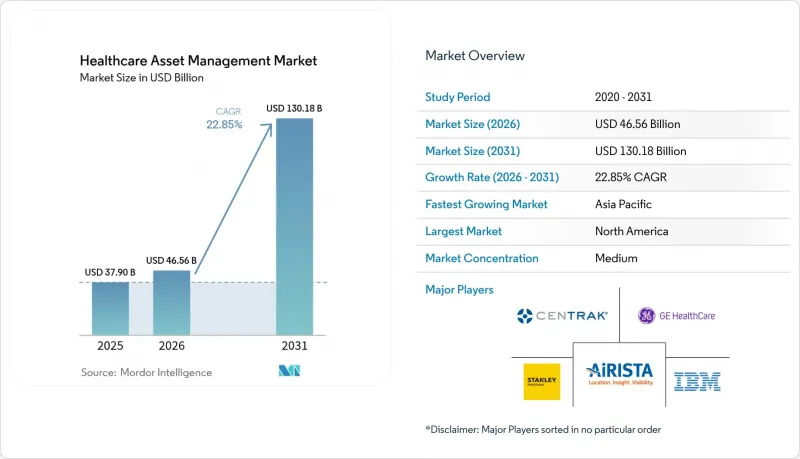
헬스케어 자산관리 시장 규모는 2025년 379억 달러에서 2026년에는 465억 6,000만 달러로 성장하고, 2026-2031년 CAGR 22.85%로 성장을 지속하여 2031년에는 1,301억 8,000만 달러에 달할 것으로 예측됩니다.
본 보고서는 기술별(RFID, 실시간 위치 정보 시스템 등), 구성 요소별(하드웨어, 소프트웨어, 서비스), 용도별(기기·디바이스 추적, 재고·공급망 관리 등), 최종 사용자별(병원 및 진료소, 검사실·진단센터 등), 지역별로 분류되어 있습니다. 시장 전망은 금액(달러) 기준으로 제시되어 있습니다.
세계 헬스케어 자산 관리 시장 동향 및 인사이트
의약품 위조를 억제하기 위한 RFID 수요 증가
의약품 위조는 세계 경제에 매년 약 2,000억 달러의 손실을 초래하고 있으며, 이에 따라 규제 당국은 종단간 가시화를 필수로 하는 일련번호 부여 및 출처 추적 요건을 부과하고 있습니다. 미국의 ‘의약품 공급망 보안법(Drug Supply Chain Security Act)’에 따라 제약 회사, 도매업체 및 조제업자는 제품이 인도될 때마다 제품의 출처를 증명해야 합니다. 현재, 암호화 인증 기능을 갖춘 RFID가 이러한 도입 사례의 대부분을 뒷받침하고 있습니다. 이는 품목 단위 식별과 온도에 민감한 생물학적 제제에 필수적인 실시간 환경 모니터링을 결합한 기술이기 때문입니다. 2024년 이후의 반도체 부족으로 태그 가격은 최대 20% 상승했지만, 규정 위반에 따른 벌금이나 리콜 비용이 하드웨어에 대한 지출을 훨씬 상회하기 때문에 각 조직은 여전히 투자를 계속하고 있습니다. SATO와 같은 공급업체들은 단일 공정에서 인증과 워크플로우 효율화를 모두 실현하는 멸균에 견디는 태그를 도입하고 있습니다. 이러한 요인들이 2025-2030년 제약 및 생명공학 제조 업계 고객을 대상으로 한 연평균 성장률(CAGR) 26.8%라는 예측의 근거가 되고 있습니다.
간호 인력 부족으로 인한 효율화 압박
주요 도시의 병원에서는 간호 인력 결원율이 15%를 초과하고 있어, 간호팀은 인력 부족 상황에 처할 수밖에 없으며, 관리자는 지원 기술을 통해 가능한 한 효율성을 극대화해야만 합니다. 조사에 따르면, 간호사들은 각 교대 근무 시간의 5분의 1 이상을 분실된 기기를 찾는 데 소비하고 있습니다. 따라서 수색 시간을 90% 이상 단축하는 RTLS 도입은 인력을 증원하지 않고도 병상별 직원 배치를 유지할 수 있게 해주는 직접적인 인력 측면의 이점을 제공합니다. 영국의 의료 기관에서는 기기 1대당 수색 시간이 60분에서 10분으로 단축된 실적이 있으며, 이는 환자 안전성 향상과 직원 이직률 개선으로 이어지고 있습니다. 현재 선진적인 도입 사례에서는 BLE 배지, 비상 호출 버튼, 예측 분석을 결합하여 임상 직원이 요청하기 전에 각 병동에 장비를 배치함으로써 업무 흐름의 부담을 줄이고 만족도를 높이고 있습니다.
데이터 개인정보 보호 및 사이버 보안에 대한 우려
2024년, 의료 분야의 정보 유출로 인한 평균 비용은 건당 977만 달러에 달하며, 보안 위험이 신속한 도입을 저해하는 주요 요인이 되고 있습니다. FDA의 2024년판 지침 초안에서는 시장 출시 전 보안 테스트 강화를 요구하고 있으며, 구매자는 본 가동 전에 암호화, 네트워크 세분화 및 지속적인 모니터링에 자금을 투자해야 할 의무가 있습니다. 그 결과, 많은 병원에서 클라우드로의 데이터 흐름을 제한하는 On-Premise 배포나 에어갭 네트워크부터 도입을 시작하며, 위험 감소를 위해 분석 기능의 일부를 희생하고 있습니다. 안전한 펌웨어가 탑재되지 않은 레거시 장비는 통합을 더욱 복잡하게 만들고, 프로젝트 기간을 연장하며, 예산을 부풀리고 있습니다.
부문 분석
RFID는 2025년 매출의 55.60%를 차지하고 있으며, 수십 년에 걸친 프로토콜의 성숙과 견고한 공급망을 통해 이 기술이 의약품 재고 및 수술 키트 추적의 표준이 되었음을 알 수 있습니다. 2025년 헬스케어 자산 관리 시장에서 RFID 시장 규모는 210억 7,000만 달러에 달하며, 이는 이 기술이 진료 현장의 캐비닛과 중앙 멸균 처리 부서에 얼마나 깊이 정착되어 있는지를 보여줍니다. 그러나 소프트웨어 정의 워크플로우에서는 단순한 식별 정보뿐만 아니라 위치 정보에 대한 필요성이 높아지고 있습니다. 따라서 BLE, Wi-Fi, 초광대역(UWB)을 활용한 실시간 위치 정보 시스템(RTLS)은 2031년까지 연평균 성장률(CAGR) 27.20%로 성장하여 정적 RFID의 성장세를 잠식할 것으로 예측됩니다.
두 번째 성장 단계로, 각 벤더들은 RFID와 RTLS를 통합하여 패시브 ID와 실시간 텔레메트리 간 전환이 가능한 멀티모드 태그를 개발하고 있습니다. 이러한 설계를 통해 기존의 설비 투자를 유지하면서 보다 정교한 분석이 가능해집니다. 소아 의료 센터의 도입 사례는 이러한 듀얼 모드의 가치를 입증하고 있습니다. 패시브 RFID는 고가의 의약품 분실을 방지하고, RTLS는 환자의 상태가 가장 위중한 곳에 주입 펌프가 확실하게 배치되도록 합니다. 태그, 게이트웨이, 익사이터가 캠퍼스 전체를 포괄하고 있기 때문에 지출의 대부분은 여전히 하드웨어가 차지하고 있지만, 수익의 원천은 기기의 식별 정보, 위치 정보, 이용 현황을 하나의 대시보드에 통합하는 플랫폼 라이선스로 점차 이동하고 있습니다. 이러한 융합이 진행됨에 따라, 헬스케어 자산 관리 시장에서 단일 모드 제품은 틈새 시장 제품으로 간주될 것입니다.
태그, 리더기, 천장 설치형 비콘이 수백만 개 단위로 지속적으로 구매되고 있는 만큼, 2025년 매출의 61.60%를 하드웨어가 차지했습니다. 그럼에도 불구하고, 병원이 설비 투자에서 성과 관리형 모델로 전환함에 따라 서비스 부문은 연평균 성장률(CAGR) 24.90%로 급속히 성장하고 있습니다. 구독 계약에 따라 공급업체는 가동률, 펌웨어 최신 상태, 규제 준수 감사 로그를 보장하며, 이를 통해 IT 팀은 환자 대응 업무에 집중할 수 있게 됩니다. 서비스와 관련된 헬스케어 자산 관리 시장 규모는 2031년까지 553억 2,000만 달러에 달할 것으로 예상되며, 인프라가 보급되고 차별화의 초점이 컨설팅을 통한 최적화로 이동하는 성숙기에 접어들고 있습니다.
전문 서비스 및 관리형 서비스는 기성 하드웨어만으로는 결코 해결할 수 없는 변경 관리, 시스템 통합, 사이버 보안 인증과 같은 가장 어려운 과제에도 대응하고 있습니다. 서비스 계약에는 일반적으로 원격 기기 상태 점검, 알고리즘 업데이트, 규정 준수 문서 작성 등이 패키지로 포함되어 있으며, 이러한 비용은 수년에 걸친 계약 기간에 고르게 분산되어 상환 주기와 일치합니다. 병원 측에서는 간호 인력의 초과 근무 감소, 병상 회전율 향상, 의료기기 임대료 절감을 통해 월간 구독 요금이 상쇄된다는 점을 제시함으로써 계약의 정당성을 점점 더 강조하고 있습니다.
지역별 분석
북미는 2025년 매출의 37.20%를 차지하고 있으며, 이는 미국의 종합적인 일련번호 부여법, 성숙한 전자건강기록(EHR) 기반, 그리고 통합된 보안 플랫폼을 뒷받침하는 의료기기에 대한 사이버 위협 증가에 힘입은 것입니다. 캐나다의 각 주도 유사한 정책을 채택하고 있는 반면, 멕시코의 민간 병원은 의료 관광객을 유지하고 미국 보험사의 감사 요건을 충족하기 위해 자산 추적 시스템에 투자하고 있습니다. 안전상의 결함에 대해 벌금을 부과하는 정부의 상환 모델로 인해 추적성은 이사회 수준의 지표가 되었으며, 이는 이 지역 전체의 의료 자산 관리 시장 확산을 더욱 촉진하고 있습니다.
아시아태평양은 가장 빠르게 성장하는 지역으로, 2031년까지 연평균 성장률(CAGR)이 21.90%를 나타낼 것으로 예측됩니다. 중국, 인도, 동남아시아의 공립 병원 건설 계획에 따라 기존의 바코드 단계를 생략하고, 개원 초기부터 RFID와 RTLS의 융합을 도입할 수 있는 그린필드 구축이 가능해졌습니다. 이러한 시설의 대부분은 자산 관리를 각국의 디지털 헬스 클라우드와 통합하여, 지역 전체 공급망에 걸친 의약품의 실시간 인증을 가능하게 하고 있습니다. 설비 투자가 국민건강보험 목표와 부합하는 가운데, 각 벤더사는 수백 개의 신규 병원을 대상으로 수년에 걸친 종합적인 계약을 체결하고 있다고 보고하고 있습니다.
유럽에서는 EU-MDR 의무화, EUDAMED 데이터베이스 구축, 그리고 라이프사이클 최적화를 중시하는 각국의 지속가능성 목표에 힘입어 꾸준한 보급이 진행되고 있습니다. 독일과 영국이 도입을 주도하고 있지만, 구조 기금이 디지털 전환을 중시함에 따라 동유럽의 자금 조달 메커니즘도 이를 따라잡고 있습니다. GDPR(EU 개인정보보호규정)에 기반한 사이버 보안에 대한 기대가 높아지는 가운데, 로컬 데이터 레지던시를 갖춘 On-Premise형 또는 하이브리드형 클라우드에 대한 수요가 증가하고 있으며, 플랫폼 제공업체들은 구성 옵션을 확충해야 하는 압박을 받고 있습니다. 브렉시트로 인해 국경을 넘는 의료 제품 거래의 통관 절차가 복잡해지는 가운데, 영국공급업체들은 항만에서의 지연이나 제품 폐기를 피하기 위해 추적 가능성에 의존하고 있습니다.
기타 혜택:
- 엑셀 형식 시장 예측(ME) 시트
- 3개월간의 애널리스트 지원
자주 묻는 질문
목차
제1장 서론
제2장 조사 방법
제3장 주요 요약
제4장 시장 인사이트
제5장 시장 규모와 성장 예측
제6장 경쟁 구도
제7장 시장 기회와 향후 동향
LSH 26.09.02According to Mordor Intelligence, the healthcare asset management market size is expected to grow from USD 37.90 billion in 2025 to USD 46.56 billion in 2026 and is forecast to reach USD 130.18 billion by 2031 at 22.85% CAGR over 2026-2031.
This report is Segmented by Technology (RFID, Real-Time Location Systems, and More), Component (Hardware, Software, and Services), Application (Equipment and Device Tracking, Inventory/Supply-Chain Management, and More), End-User (Hospitals and Clinics, Laboratories and Diagnostic Centers, and More), and Geography. The Market Forecasts are Provided in Terms of Value (USD).
Global Healthcare Asset Management Market Trends and Insights
Rising demand for RFID to curb drug counterfeiting
Pharmaceutical counterfeiting drains an estimated USD 200 billion from the global economy each year, prompting regulators to impose serialisation and pedigree requirements that make end-to-end visibility indispensable. Under the U.S. Drug Supply Chain Security Act, drug makers, wholesalers, and dispensers must prove product provenance at every hand-off. RFID with cryptographic authentication now underpins most of these deployments because it combines item-level identification with real-time environmental monitoring, a necessity for temperature-sensitive biologics. Semiconductor shortages since 2024 lifted tag prices by up to 20%, yet organisations still invest because non-compliance fines and recall costs far exceed hardware spending. Vendors such as SATO have introduced sterilisation-resistant tags that deliver both authentication and workflow efficiency in one process step. These factors underpin the 26.8% CAGR projected for pharmaceutical and biotech manufacturing customers between 2025 and 2030.
Efficiency pressures from nursing-staff shortages
Nursing vacancy rates above 15% in major urban hospitals leave care teams stretched and force administrators to squeeze every efficiency gain possible from support technology. Studies reveal that nurses spend over one-fifth of each shift searching for missing equipment; RTLS implementations that cut search time by more than 90% therefore provide a direct labour dividend that keeps beds staffed without adding headcount. British facilities have demonstrated time reductions from 60 minutes to 10 minutes per device, translating into heightened patient-safety scores and improved staff retention. Advanced deployments now combine BLE badges, panic buttons, and predictive analytics that stage equipment on units before clinicians request it, easing workflow strain and boosting satisfaction.
Data-privacy and cybersecurity concerns
Average breach costs in healthcare reached USD 9.77 million per incident in 2024, making security risk a material deterrent to rapid roll-outs. The FDA's 2024 draft guidance urges stronger pre-market security testing, compelling buyers to fund encryption, network segmentation, and continuous monitoring before go-live. Many hospitals, therefore, begin with on-premises deployments or air-gapped networks that limit data flow to the cloud, trading some analytics capability for risk reduction. Legacy devices without secure firmware further complicate integrations, extending project timelines and inflating budgets.
Other drivers and restraints analyzed in the detailed report include:
- Patient-safety regulations (UDI, EU-MDR)
- AI-based predictive maintenance embedded in tags
- High upfront RTLS/RFID infrastructure cost
For complete list of drivers and restraints, kindly check the Table Of Contents.
Segment Analysis
RFID accounted for 55.60% of 2025 revenue, underlining decades of protocol maturity and robust supply chains that made the technology the default for drug inventory and surgical kit tracking. The healthcare asset management market size for RFID was USD 21.07 billion in 2025, showing how deeply the modality is entrenched at point-of-care cabinets and central sterile processing. Yet software-defined workflows increasingly require location, not just identity. Real-Time Location Systems leveraging BLE, Wi-Fi, and ultra-wideband are therefore forecast to compound at 27.20% CAGR to 2031, eating into static RFID growth.
A second growth phase emerges as vendors collapse RFID and RTLS into multi-mode tags that pivot between passive ID and real-time telemetry, a design that preserves prior capital investment while enabling richer analytics. Deployments at paediatric-care centres demonstrate this twin-mode value: passive RFID limits shrinkage of high-value drugs, while RTLS ensures infusion pumps circulate where patient acuity is highest. Hardware still dominates spending because tags, gateways, and exciters blanket entire campuses; however, the profit pool is shifting toward platform licences that unite device identity, location, and utilisation into one dashboard. As this convergence proceeds, the healthcare asset management market will likely regard single-mode offerings as a niche.
Hardware captured 61.60% of 2025 sales thanks to ongoing purchases of millions of tags, readers, and ceiling-mounted beacons. Even so, services are pacing ahead with a 24.90% CAGR as hospitals pivot from capital expense toward managed outcomes. Under subscription agreements, vendors guarantee uptime, firmware currency, and regulatory-ready audit logs, freeing IT teams to focus on patient-facing initiatives. The healthcare asset management market size tied to services is forecast to reach USD 55.32 billion by 2031, pointing to a maturation cycle where infrastructure becomes ubiquitous and differentiation shifts to consultative optimisation.
Professional and managed services also address the hardest obstacles-change management, systems integration, and cybersecurity accreditation-that no amount of shelf hardware alone can solve. Service contracts typically bundle remote device health checks, algorithm updates, and compliance documentation generation, costs that spread evenly across multi-year terms and match reimbursement cycles. Hospitals increasingly justify deals by showing that avoided nursing overtime, faster bed turnover, and reduced device rentals offset monthly subscription fees.
Complete Report Scope:
- By Technology
- RFID
- Real-Time Location Systems (RTLS)
- Bluetooth Low Energy (BLE) and Wi-Fi
- Infrared and Ultrasound
- By Component
- Hardware (Tags, Readers, Gateways)
- Software (Analytics, Middleware)
- Services (Deployment, Managed, Training)
- By Application
- Equipment and Device Tracking
- Inventory/Supply-Chain Management
- Patient and Staff Tracking
- Bed and Capacity Management
- Environmental and Condition Monitoring
- By End-user
- Hospitals and Clinics
- Laboratories and Diagnostic Centers
- Pharmaceutical and Biotech Manufacturing
- Long-Term Care and Assisted-Living Facilities
- By Geography
- North America
- United States
- Canada
- Mexico
- South America
- Brazil
- Argentina
- Chile
- Rest of South America
- Europe
- Germany
- United Kingdom
- France
- Italy
- Spain
- Russia
- Rest of Europe
- Asia-Pacific
- China
- India
- Japan
- South Korea
- Australia
- Malaysia
- Singapore
- Rest of Asia-Pacific
- Middle East and Africa
- Middle East
- United Arab Emirates
- Saudi Arabia
- Turkey
- Rest of Middle East
- Africa
- South Africa
- Nigeria
- Egypt
- Rest of Africa
- Middle East
- North America
Geography Analysis
North America held 37.20% of 2025 revenue, sustained by the United States' comprehensive serialisation law, a mature EHR backbone, and rising incidents of medical device cyber threats that favour integrated, secure platforms. Canadian provinces are adopting similar policies, while Mexican private-sector hospitals invest in asset tracking to retain medical tourists and satisfy U.S. insurer audits. Government reimbursement models that penalise safety lapses make traceability a board-level metric, further supporting healthcare asset management market adoption across the region.
Asia-Pacific is the fastest-growing area with a 21.90% CAGR expected through 2031. Public-hospital construction programmes in China, India, and Southeast Asia enable greenfield deployments that skip legacy bar-code steps and implement RFID-RTLS convergence from day one. Many of these facilities integrate asset management with national digital-health clouds, allowing real-time drug authentication across regional supply chains. As capital investment aligns with universal health-coverage goals, vendors report multi-year master contracts covering hundreds of new hospitals.
Europe shows steady uptake led by the EU-MDR mandate, EUDAMED database roll-outs, and national sustainability targets that favour lifecycle optimisation. Germany and the United Kingdom drive early deployments, but funding mechanisms in Eastern Europe are catching up as structural funds emphasise digital transformation. Cybersecurity expectations anchored in GDPR elevate demand for on-premises or hybrid clouds with local data residency, nudging platform suppliers to broaden configuration options. With Brexit adding customs complexity for cross-channel medical trade, British providers rely on traceability to avoid port delays and product waste.
- Stanley Healthcare (Stanley Black & Decker)
- CenTrak Inc.
- AiRISTA Flow Inc.
- GE HealthCare Technologies Inc.
- IBM Corporation
- Infor Inc.
- Motorola Solutions Inc.
- Siemens Healthineers AG
- Accenture plc
- Sonitor Technologies AS
- Zebra Technologies Corporation
- Johnson Controls (Tyco International)
- Honeywell International Inc.
- Impinj Inc.
- Alien Technology LLC
- HID Global Corporation
- Ascom Holding AG
- Midmark Corporation (Versus RTLS)
- Trimble Inc. (Atrius)
- Cerner Corporation (Oracle Health)
- TagMaster AB
- Radianse LLC
- Kontakt.io Inc.
- Litum IoT Technologies
- Elpas Ltd. (Securitas)
Additional Benefits:
- The market estimate (ME) sheet in Excel format
- 3 months of analyst support
TABLE OF CONTENTS
1 INTRODUCTION
- 1.1 Study Assumptions and Market Definition
- 1.2 Scope of the Study
2 RESEARCH METHODOLOGY
3 EXECUTIVE SUMMARY
4 MARKET INSIGHTS
- 4.1 Market Overview
- 4.2 Market Drivers
- 4.2.1 Rising demand for RFID to curb drug counterfeiting
- 4.2.2 Efficiency pressures from nursing?staff shortages
- 4.2.3 Patient-safety regulations (e.g., UDI, EU-MDR)
- 4.2.4 AI-based predictive maintenance embedded in tags
- 4.2.5 Pay-for-performance reimbursement tied to asset traceability
- 4.3 Market Restraints
- 4.3.1 Data-privacy and cybersecurity concerns
- 4.3.2 High upfront RTLS/RFID infrastructure cost
- 4.3.3 Radio-interference with critical wireless medical devices
- 4.3.4 Fragmented legacy CMMS slowing integration
- 4.4 Industry Value Chain Analysis
- 4.5 Regulatory Landscape
- 4.6 Technological Outlook
- 4.7 Industry Attractiveness - Porter's Five Forces Analysis
- 4.7.1 Bargaining Power of Suppliers
- 4.7.2 Bargaining Power of Buyers
- 4.7.3 Threat of New Entrants
- 4.7.4 Threat of Substitute Products
- 4.7.5 Intensity of Competitive Rivalry
- 4.8 Impact of Macroeconomic Factors on the Market
5 MARKET SIZE AND GROWTH FORECASTS (VALUES)
- 5.1 By Technology
- 5.1.1 RFID
- 5.1.2 Real-Time Location Systems (RTLS)
- 5.1.3 Bluetooth Low Energy (BLE) and Wi-Fi
- 5.1.4 Infrared and Ultrasound
- 5.2 By Component
- 5.2.1 Hardware (Tags, Readers, Gateways)
- 5.2.2 Software (Analytics, Middleware)
- 5.2.3 Services (Deployment, Managed, Training)
- 5.3 By Application
- 5.3.1 Equipment and Device Tracking
- 5.3.2 Inventory/Supply-Chain Management
- 5.3.3 Patient and Staff Tracking
- 5.3.4 Bed and Capacity Management
- 5.3.5 Environmental and Condition Monitoring
- 5.4 By End-user
- 5.4.1 Hospitals and Clinics
- 5.4.2 Laboratories and Diagnostic Centers
- 5.4.3 Pharmaceutical and Biotech Manufacturing
- 5.4.4 Long-Term Care and Assisted-Living Facilities
- 5.5 By Geography
- 5.5.1 North America
- 5.5.1.1 United States
- 5.5.1.2 Canada
- 5.5.1.3 Mexico
- 5.5.2 South America
- 5.5.2.1 Brazil
- 5.5.2.2 Argentina
- 5.5.2.3 Chile
- 5.5.2.4 Rest of South America
- 5.5.3 Europe
- 5.5.3.1 Germany
- 5.5.3.2 United Kingdom
- 5.5.3.3 France
- 5.5.3.4 Italy
- 5.5.3.5 Spain
- 5.5.3.6 Russia
- 5.5.3.7 Rest of Europe
- 5.5.4 Asia-Pacific
- 5.5.4.1 China
- 5.5.4.2 India
- 5.5.4.3 Japan
- 5.5.4.4 South Korea
- 5.5.4.5 Australia
- 5.5.4.6 Malaysia
- 5.5.4.7 Singapore
- 5.5.4.8 Rest of Asia-Pacific
- 5.5.5 Middle East and Africa
- 5.5.5.1 Middle East
- 5.5.5.1.1 United Arab Emirates
- 5.5.5.1.2 Saudi Arabia
- 5.5.5.1.3 Turkey
- 5.5.5.1.4 Rest of Middle East
- 5.5.5.2 Africa
- 5.5.5.2.1 South Africa
- 5.5.5.2.2 Nigeria
- 5.5.5.2.3 Egypt
- 5.5.5.2.4 Rest of Africa
- 5.5.5.1 Middle East
- 5.5.1 North America
6 COMPETITIVE LANDSCAPE
- 6.1 Market Concentration
- 6.2 Strategic Moves
- 6.3 Market Share Analysis
- 6.4 Company Profiles (includes Global level Overview, Market level overview, Core Segments, Financials as available, Strategic Information, Market Rank/Share for key companies, Products and Services, and Recent Developments)
- 6.4.1 Stanley Healthcare (Stanley Black & Decker)
- 6.4.2 CenTrak Inc.
- 6.4.3 AiRISTA Flow Inc.
- 6.4.4 GE HealthCare Technologies Inc.
- 6.4.5 IBM Corporation
- 6.4.6 Infor Inc.
- 6.4.7 Motorola Solutions Inc.
- 6.4.8 Siemens Healthineers AG
- 6.4.9 Accenture plc
- 6.4.10 Sonitor Technologies AS
- 6.4.11 Zebra Technologies Corporation
- 6.4.12 Johnson Controls (Tyco International)
- 6.4.13 Honeywell International Inc.
- 6.4.14 Impinj Inc.
- 6.4.15 Alien Technology LLC
- 6.4.16 HID Global Corporation
- 6.4.17 Ascom Holding AG
- 6.4.18 Midmark Corporation (Versus RTLS)
- 6.4.19 Trimble Inc. (Atrius)
- 6.4.20 Cerner Corporation (Oracle Health)
- 6.4.21 TagMaster AB
- 6.4.22 Radianse LLC
- 6.4.23 Kontakt.io Inc.
- 6.4.24 Litum IoT Technologies
- 6.4.25 Elpas Ltd. (Securitas)
7 MARKET OPPORTUNITIES AND FUTURE TRENDS
- 7.1 White-Space and Unmet-Need Assessment


