

|
시장보고서
상품코드
2121478
테라헤르츠 기술 : 시장 점유율 분석, 업계 동향과 통계, 성장 예측(2026-2031년)Terahertz Technologies - Market Share Analysis, Industry Trends & Statistics, Growth Forecasts (2026 - 2031) |
||||||
 Mordor Intelligence
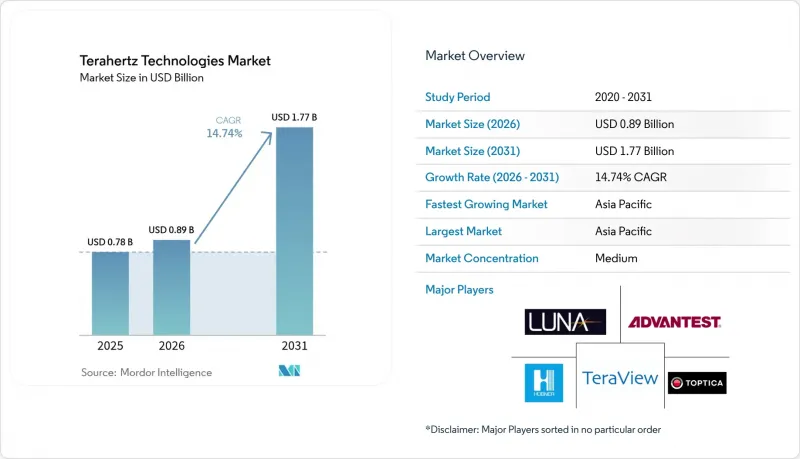
테라헤르츠 기술 시장 규모는 2025년에 7억 8,000만 달러로 평가되었고, 2026년8억 9,000만 달러에서 2031년까지 17억 7,000만 달러에 이를 것으로 예측되며, 예측 기간(2026년-2031년) CAGR은 14.74%를 기록할 전망입니다.
본 보고서는 용도별(테라헤르츠 이미징 시스템, 통신 시스템 등), 주파수 대역별(저주파 테라헤르츠, 중주파 테라헤르츠 등), 최종 사용자(의료, 산업, 기타),구성 요소 유형(테라헤르츠 광원, 테라헤르츠 검출기, 광학 소자 및 수동 부품, 기타), 그리고 지역별로 분류되어 있습니다. 시장 예측은 금액(달러) 기준으로 제시되어 있습니다.
세계 테라헤르츠 기술 시장 동향 및 인사이트
소형 포토닉 집적형 테라헤르츠 광원의 발전
포토닉 집적화를 통해 테라헤르츠 발진기는 벤치탑형 광학 어셈블리에서 휴대용 기기에 직접 내장할 수 있는 mm 규모의 칩으로 소형화가 진행되고 있습니다. 박막 리튬 니오브산 변조기는 현재 차주파수 혼합 효율이 1%에 육박하는 수준에 도달하여, 극저온 미러나 부피가 큰 정렬 장치가 필요 없이 1 THz를 초과하는 연속파 출력을 실현하고 있습니다. 2024년 이후, 상업 주조 회사는 40건 이상의 대학 특허 라이선싱을 실시하고 있으며, 이 기술을 200mm 실리콘 포토닉스 생산 라인에 도입함으로써 부품 수와 리드 타임을 절반 이상 줄이고 있습니다. 중출력 광원의 단가는 1만 달러 미만으로, 식품 검사나 문화유산 보존 등 가격에 민감한 분야로의 진출이 가능해졌습니다. 저렴한 가격과 현장 실용화에 적합한 폼 팩터의 조합이 2031년까지 이미징 시스템 시장의 15.32% 성장 전망을 뒷받침하고 있습니다.
6G 백홀 개념 증명(PoC) 도입의 급증
통신 사업자들은 2025년, 밀집된 도시 지역에서 25테라헤르츠 이상의 백홀 실증 실험을 완료했습니다. 이는 광섬유 설치 비용이 1킬로미터당 100만 달러를 초과하는 다기가비트급 링크를 대상으로 한 것입니다. 일본의 NICT는 도쿄 도심에서 500미터에 걸쳐 100 Gbps, 300GHz 연결을 실증하여, 실제 트래픽 조건 하에서 6G의 지연 및 패킷 오류 요건을 충족했습니다. 한국의 ETRI는 건물의 흔들림이나 보행자에 의한 차폐를 보정하는 적응형 빔 스티어링 기술을 활용하여 220GHz에서 50 Gbps를 달성하고, 스몰 셀 집약 환경에서의 견고성을 입증했습니다. 2026년도 자본 예산에는 마이크로파 및 광 백홀 장비에 더해 테라헤르츠 무선기가 포함되어 있어, 이 분야가 조사 단계에서 실용화 단계로 전환되었음을 뒷받침하고 있습니다. 이러한 시범 시험은 2025년에 통신 시스템이 42.36%의 시장 점유율을 유지한 이유를 설명해 줍니다.
실외 링크에서의 대기 투과 대역 제한
많은 테라헤르츠 주파수 대역에서 수증기로 인해 100 dB km-1을 초과하는 감쇠 피크가 발생하며, 신뢰성 높은 실외 서비스는 300GHz 및 350GHz 부근의 좁은 대역으로 제한됩니다. 습도가 높은 열대 기후에서는 손실이 2-3배 더 커지기 때문에 통신 사업자는 링크 예산을 넉넉하게 설정하거나 건기에만 서비스를 제공해야 합니다. 강수량이 10 mm h-1을 초과하면 링크 가용성이 통신 사업자의 기준을 밑돌 가능성이 있으므로, 내결함성을 확보하기 위해 네트워크에서는 마이크로파나 광섬유를 이용한 오버레이를 유지할 수밖에 없습니다. 이러한 환경적 제약으로 인해, 파일럿 테스트에서는 기술적인 성공을 거두었음에도 불구하고 백홀 아키텍처에서 테라헤르츠의 장기적인 점유율에는 상한선이 설정되어 있습니다. 그 결과, 투자는 대기의 영향을 최소화할 수 있는 실내, 단거리 또는 캠퍼스 내의 지점 간 링크로 이동하고 있습니다.
부문 분석
테라헤르츠 이미징 시스템은 2026년부터 2031년까지 연평균 성장률(CAGR) 15.32%를 나타낼 것으로 예측되며, 2025년에 테라헤르츠파 기술 시장 점유율의 42.36%를 차지한 통신 플랫폼을 바짝 추격하는 추세입니다. 이미징용 테라헤르츠파 기술 시장은 포토닉 집적 광원의 단가가 1만 달러 미만으로 떨어지면서, 제약 라인이나 복합재료 부품에 대한 일상적인 비파괴 검사가 가능해짐에 따라 하드웨어 가격 하락의 혜택을 볼 것으로 예측됩니다. 양자 캐스케이드 레이저와 고속 검출기를 결합한 능동형 이미저는 정제 코팅 검사나 항공우주 분야의 결함 매핑에서 주류를 이루고 있는 반면, 수동형 어레이는 고출력 이미터에 대한 수출 규제 제한을 회피할 수 있어 공항 보안 검사를 주도하고 있습니다.
피부과 클리닉, 치과, 문화유산 보존 분야에서의 이용 사례가 확대됨에 따라 연구 기관 이외의 분야에서도 수요가 증가하고 있습니다. 고대비 이미지에 스펙트럼 지문을 중첩시키는 하이브리드 장비를 통해, 하드웨어 교체 대신 소프트웨어 업데이트를 통해 단일 플랫폼에서 품질 관리, 보안, 의료 진단을 전환할 수 있게 됩니다. 이러한 다목적 시스템이 성숙해짐에 따라, 통합 업체들은 AI 분석 기능을 번들로 제공하여 운영자의 교육 시간을 단축하는 동시에 거점 간 결과를 표준화하고 있습니다. 이러한 요인들이 결합되어 2020년대 중반까지는 통신 분야가 최대 수익원으로 남아 있을 것이며, 이미징 분야에서는 지속적인 두 자릿수 성장을 뒷받침하고 있습니다.
약 0.5-1.5 THz 범위를 커버하는 중주파수 솔루션은 2025년 매출의 47.93%를 차지하며, 테라헤르츠파 기술 시장 점유율에서 가장 큰 비중을 차지하고 있으며, 2031년까지 연평균 성장률(CAGR) 15.37%로 확대될 것으로 예측됩니다. 테라헤르츠 기술 시장의 이 대역에서 1 THz 분광법은 5µm의 코팅층을 효과적으로 분해할 수 있어 재료 분석에 높은 정확도를 제공합니다. 동시에, 대기에 의한 감쇠나 부품 비용도 현장 시스템에 있어 허용 가능한 범위 내에 있으므로, 의료, 보안, 통신 등 다양한 산업 분야의 실용적인 응용에 가장 적합한 대역입니다.
0.5 THz 미만의 저주파 대역은 전파 거리가 길고 실온에서 작동하기 때문에 지점 간 연결이나 벽을 투과하는 감지에 적합하지만, mm 단위의 분해능을 가지기 때문에 정밀한 품질 관리(QA)에 적용하는 데에는 한계가 있습니다. 1.5 THz를 초과하는 대역에서는 서브mm급 이미징이 EUV 마스크 측정에 이용되고 있지만, 수증기에 의한 흡수가 강하고 검출기의 노이즈도 높기 때문에 이러한 장치는 주로 실험실에서의 이용으로 한정되어 있습니다. 따라서 극저온 환경의 운영 부담이나 가혹한 기상 조건의 제약을 받지 않으면서 균형 잡힌 성능이 필요한 제약, 통신, 보안 분야의 사용자에게는 중대역 설계가 여전히 표준적인 선택지로 남아 있습니다.
지역별 분석
아시아태평양은 2025년에 전 세계 매출의 38.23%를 차지하며, 지역별 최대 점유율을 기록했습니다. 또한 2031년까지 연평균 성장률(CAGR) 15.79%로 확대될 것으로 예측됩니다. 중국 과학기술부는 2025년, 국산 광원 및 검출기를 개발하는 6G 테라헤르츠 컨소시엄에 21억 위안(2억 9,000만 달러)을 배정했습니다. 일본 정보통신연구기구(NICT)는 2025년 하반기 도쿄 도심에서 500m 구간에 걸쳐 100Gbps, 300GHz 링크의 실증 실험을 실시하여, 고밀도 도시 환경 하에서 서브테라헤르츠 대역의 신뢰성을 입증했습니다. 한국의 ETRI는 2025년 중반 서울 거리에서 50Gbps를 구현하는 휴대형 220GHz 트랜시버의 현장 테스트를 실시하여, 시범 운영 분야에서 해당 지역의 리더십을 한층 더 공고히 했습니다. 이러한 노력들이 합쳐져, 이 지역은 미래의 부품 비용 곡선과 성능 벤치마크를 주도하는 입지에 서게 되었습니다.
북미는 수동형 원격 스캐너에 대한 DARPA의 보조금과 의약품 분야의 인라인 분광법 광범위한 도입에 힘입어 매출액 기준 2위를 차지했습니다. 북미의 테라헤르츠 기술 시장은 꾸준히 성장할 것으로 예상되지만, 통신 사업자들이 신중한 6G 백홀 확장을 추진함에 따라 이 지역의 연평균 성장률(CAGR)은 아시아태평양보다 낮습니다. 유럽의 기여도는 여전히 크며, 이는 프라운호퍼 IAF와 같은 연구 거점이 실온에서 작동하는 광원을 구현하는 박막 리튬 니오브산 포토믹서 개발을 추진하고 있기 때문입니다. 그러나 주파수 정책의 불일치와 보다 보수적인 설비 투자로 인해 국경을 초월한 전개는 지연되고 있습니다. 그 결과, 예측 기간 동안 유럽은 빠르게 변화하는 아시아 시장에 시장 점유율을 서서히 빼앗길 것으로 예측됩니다.
남미는 평가 단계에 있으며, 브라질의 농업 기관에서는 커피와 대두의 품질 관리를 위해 테라헤르츠 대역 수분 센서의 시험이 진행되고 있습니다. 멕시코 자동차 업계에서는 복합재 패널의 비파괴 검사가 시험적으로 도입되고 있지만, 수입 관세와 현지 생산의 제한된 규모가 대량 도입을 저해하고 있습니다. 중동 및 아프리카에서는 공항 보안 검사 및 국경 관리 수요로 인해 간헐적이긴 하지만 고부가가치 매출이 발생하고 있으나, 현지 부품 공급 체계가 갖춰지지 않아 시장 확대가 제한되고 있습니다. 전반적으로, 이러한 신흥 지역은 현재 테라헤르츠파 기술 시장 점유율의 10% 미만을 차지하고 있으며, 아시아태평양의 가격 하락으로 접근성이 확대되기 전까지는 시장 기여도가 한 자릿수에 그칠 것으로 예측됩니다.
기타 혜택:
- 엑셀 형식 시장 예측(ME) 시트
- 3개월간의 애널리스트 지원
자주 묻는 질문
목차
제1장 서론
제2장 조사 방법
제3장 주요 요약
제4장 시장 구도
제5장 시장 규모와 성장 예측
제6장 경쟁 구도
제7장 시장 기회와 향후 전망
LSH 26.09.02According to Mordor Intelligence, the terahertz technologies market size was valued at USD 0.78 billion in 2025 and estimated to grow from USD 0.89 billion in 2026 to reach USD 1.77 billion by 2031, at a CAGR of 14.74% during the forecast period (2026-2031).
This report is Segmented by Application Category (Terahertz Imaging Systems, Communication Systems, and More), Frequency Range (Low-Frequency Terahertz, Mid-Frequency Terahertz, and More), End User (Healthcare, Industrial, and More), Component Type (Terahertz Sources, Terahertz Detectors, Optics and Passive Components, and More), and Geography. The Market Forecasts are Provided in Terms of Value (USD).
Global Terahertz Technologies Market Trends and Insights
Advances in Compact Photonic-Integrated THz Sources
Photonic integration is shrinking terahertz emitters from bench-top optical assemblies to millimeter-scale chips that drop directly into handheld instruments. Thin-film lithium niobate modulators now achieve difference-frequency mixing efficiencies approaching 1%, providing continuous-wave output above 1 THz without cryogenic mirrors or bulky alignment hardware. Commercial foundries have licensed more than 40 university patents since 2024, bringing the technology to 200 mm silicon photonics lines that cut part counts and lead times by more than half. Unit cost is falling below USD 10,000 for mid-power sources, opening up price-sensitive segments such as food inspection and cultural heritage conservation. The combination of a lower price and a field-ready form factor underpins the projected 15.32% growth in imaging systems through 2031.
Surge in 6G-Backhaul Proof-of-Concept Installations
Telecom operators completed over 25 terahertz backhaul pilots in dense urban corridors during 2025, targeting multi-gigabit links where trenching fiber exceeds USD 1 million per kilometer. Japan's NICT validated a 100 Gbps, 300 GHz connection over 500 m in downtown Tokyo, meeting 6G latency and packet-error requirements under real traffic conditions. South Korea's ETRI achieved 50 Gbps at 220 GHz with adaptive beam steering that compensated for building sway and pedestrian blockage, demonstrating robustness for small-cell aggregation. Capital budgets for 2026 now include terahertz radios alongside microwave and optical backhaul gear, confirming the segment's transition from research to deployment. These pilots explain why communication systems retained 42.36% market share in 2025.
Limited Atmospheric Transmission Windows for Outdoor Links
Water vapor creates attenuation peaks above 100 dB km-1 at many terahertz frequencies, restricting reliable outdoor service to narrow windows near 300 GHz and 350 GHz. Humid tropical climates experience two-to-three times higher losses, forcing operators to oversize link budgets or confine deployments to dry seasons. Rainfall above 10 mm h-1 can drop link availability below carrier standards, pushing networks to retain microwave or fiber overlays for resiliency. These environmental limits cap the long-term share of terahertz in backhaul architectures despite technical successes in pilot trials. Investment, therefore, shifts toward indoor, short-range, or point-to-point campus links where atmospheric effects are minimal.
Other drivers and restraints analyzed in the detailed report include:
- Rising Adoption in Inline Pharmaceutical QA/QC
- Defense Demand for mm-Resolution Passive Standoff Scanners
- Cryogenic Cooling Cost for High-Power QCL Sources
For complete list of drivers and restraints, kindly check the Table Of Contents.
Segment Analysis
Terahertz imaging systems are projected to grow at a 15.32% CAGR between 2026-2031, closing in on communication platforms that commanded 42.36% of the terahertz technologies market share in 2025. The terahertz technologies market for imaging will benefit from falling hardware prices as photonic-integrated sources reach sub-USD 10,000 unit costs and enable routine non-destructive testing on pharmaceutical lines and composite-material parts. Active imagers that couple quantum-cascade lasers with fast detectors dominate tablet-coating inspection and aerospace defect mapping, while passive arrays lead airport screening by avoiding export-control limits on high-power emitters.
The expanding use cases in dermatology clinics, dental practices, and cultural-heritage conservation are driving demand beyond research labs. Hybrid instruments that overlay spectral fingerprints on high-contrast images allow a single platform to shift between quality control, security, and medical diagnostics through software updates rather than hardware swaps. As these multipurpose systems mature, integrators bundle AI analytics that reduce operator training time and standardize results across sites. Together, these factors underpin sustained double-digit growth for imaging despite communication remaining the largest revenue generator through mid-decade.
Mid-frequency solutions spanning roughly 0.5-1.5 THz held 47.93% of 2025 revenue, the largest slice of the terahertz technologies market share, and are expected to expand at a 15.37% CAGR to 2031. In this band of the terahertz technologies market, 1 THz spectroscopy can effectively resolve 5 µm coating layers, providing high precision in material analysis. At the same time, atmospheric attenuation and component costs remain manageable for field systems, making it an optimal range for practical applications in various industries, including healthcare, security, and telecommunications.
Low-frequency gear below 0.5 THz propagates farther and operates at room temperature, making it well-suited for point-to-point links and through-wall sensing, but millimeter-scale resolution limits its appeal for precision QA. Above 1.5 THz, sub-millimeter imaging is used for EUV mask metrology, although stronger water-vapor absorption and higher detector noise keep such units largely laboratory-bound. Mid-band designs, therefore, remain the default for pharmaceutical, telecom, and security users that need balanced performance without cryogenic overhead or severe weather constraints.
Complete Report Scope:
- By Application Category
- Terahertz Imaging Systems
- Active Systems
- Passive Systems
- Terahertz Spectroscopy Systems
- Time-Domain
- Frequency-Domain
- Communication Systems
- Terahertz Imaging Systems
- By Frequency Range
- Low-Frequency Terahertz
- Mid-Frequency Terahertz
- High-Frequency Terahertz
- By End User
- Healthcare
- Defense and Security
- Telecommunications
- Industrial
- Food and Agriculture
- Laboratories
- Other End Users
- By Component Type
- Terahertz Sources
- Terahertz Detectors
- Optics and Passive Components
- Systems and Softwares
- By Geography
- North America
- United States
- Canada
- Mexico
- South America
- Brazil
- Argentina
- Rest of South America
- Europe
- United Kingdom
- Germany
- France
- Italy
- Rest of Europe
- Asia Pacific
- China
- Japan
- India
- South Korea
- Rest of Asia Pacific
- Middle East and Africa
- Middle East
- United Arab Emirates
- Saudi Arabia
- Rest of Middle East
- Africa
- South Africa
- Egypt
- Rest of Africa
- Middle East
- North America
Geography Analysis
Asia-Pacific captured 38.23% of global revenue in 2025, the highest regional share, and is projected to expand at a 15.79% CAGR through 2031. China's Ministry of Science and Technology allocated CNY 2.1 billion (USD 290 million) in 2025 to 6G terahertz consortia that develop indigenous sources and detectors. Japan's National Institute of Information and Communications Technology demonstrated a 100 Gbps, 300 GHz link across 500 m of central Tokyo in late 2025, validating sub-terahertz reliability under dense urban conditions. South Korea's ETRI field-tested a portable 220 GHz transceiver that delivered 50 Gbps on Seoul streets in mid-2025, further cementing regional leadership in pilot deployments. Together, these initiatives position the region to dictate future component cost curves and performance benchmarks.
North America ranked second in revenue, buoyed by DARPA grants for passive standoff scanners and widespread pharmaceutical rollout of inline spectroscopy. The terahertz technologies market in North America is forecast to grow steadily, though the region's CAGR trails Asia-Pacific as telecom operators pursue measured 6G backhaul expansion. Europe's contribution remains significant thanks to research hubs such as Fraunhofer IAF, which advanced thin-film lithium-niobate photomixers that enable room-temperature sources. Fragmented spectrum policy and more conservative capital expenditure, however, slow cross-border deployments. As a result, Europe is expected to yield incremental share to faster-moving Asian markets through the forecast window.
South America stands at an evaluation stage, with Brazil's agricultural agencies testing terahertz moisture sensors for coffee and soybean quality control. Mexico's automotive sector pilots non-destructive testing of composite panels, yet import duties and limited local manufacturing constrain volume adoption. In the Middle East and Africa, airport security screening and border-control orders generate periodic but high-value sales, while the absence of an indigenous component supply curbs scale. Collectively, these emerging regions hold less than 10% of the terahertz technologies market share today and are expected to remain single-digit contributors until falling Asia-Pacific price points broaden accessibility.
- ADVANTEST Corporation
- Luna Innovations Incorporated
- TeraView Limited
- TOPTICA Photonics AG
- HUBNER GmbH and Co. KG
- BATOP GmbH
- Microtech Instruments Inc.
- Menlo Systems GmbH
- Gentec-EO Inc.
- Bakman Technologies LLC
- QMC Instruments Ltd
- Bruker Corporation
- Lytid SAS
- Attocube Systems AG
- Helmut Fischer GmbH
- Baugh and Weedon Ltd
- Das-nano S.L.
- Teravil Ltd
- Terasense Group Inc.
- Virginia Diodes Inc.
Additional Benefits:
- The market estimate (ME) sheet in Excel format
- 3 months of analyst support
TABLE OF CONTENTS
1 INTRODUCTION
- 1.1 Study Assumptions and Market Definition
- 1.2 Scope of the Study
2 RESEARCH METHODOLOGY
3 EXECUTIVE SUMMARY
4 MARKET LANDSCAPE
- 4.1 Market Overview
- 4.2 Market Drivers
- 4.2.1 Advances in Compact Photonic-Integrated THz Sources
- 4.2.2 Surge in 6G-Backhaul Proof-of-Concept Installations
- 4.2.3 Rising Adoption in Inline Pharmaceutical QA/QC
- 4.2.4 Defense Demand for mm-Resolution Passive Standoff Scanners
- 4.2.5 Standardization of THz EUV Lithography Mask Metrology
- 4.2.6 Funding for THz Cultural Heritage Preservation Analysis
- 4.3 Market Restraints
- 4.3.1 Limited Atmospheric Transmission Windows for Outdoor Links
- 4.3.2 Cryogenic Cooling Cost for High-Power QCL Sources
- 4.3.3 Scarcity of Volume-Manufacturable Low-Loss THz Packaging
- 4.3.4 Absence of Harmonised Global EMC and Health Exposure Limits Above 275 GHz
- 4.4 Industry Value Chain Analysis
- 4.5 Impact of Macroeconomic Factors
- 4.6 Regulatory Landscape
- 4.7 Technological Outlook
- 4.8 Porter's Five Forces Analysis
- 4.8.1 Bargaining Power of Suppliers
- 4.8.2 Bargaining Power of Buyers
- 4.8.3 Threat of New Entrants
- 4.8.4 Threat of Substitutes
- 4.8.5 Degree of Competition
- 4.9 Pricing Analysis
- 4.10 Analysis of Non-Destructive Testing Applications of Terahertz Technology
- 4.11 Legal and Regulatory Space for Terahertz Technologies
5 MARKET SIZE AND GROWTH FORECASTS (VALUE)
- 5.1 By Application Category
- 5.1.1 Terahertz Imaging Systems
- 5.1.1.1 Active Systems
- 5.1.1.2 Passive Systems
- 5.1.2 Terahertz Spectroscopy Systems
- 5.1.2.1 Time-Domain
- 5.1.2.2 Frequency-Domain
- 5.1.3 Communication Systems
- 5.1.1 Terahertz Imaging Systems
- 5.2 By Frequency Range
- 5.2.1 Low-Frequency Terahertz
- 5.2.2 Mid-Frequency Terahertz
- 5.2.3 High-Frequency Terahertz
- 5.3 By End User
- 5.3.1 Healthcare
- 5.3.2 Defense and Security
- 5.3.3 Telecommunications
- 5.3.4 Industrial
- 5.3.5 Food and Agriculture
- 5.3.6 Laboratories
- 5.3.7 Other End Users
- 5.4 By Component Type
- 5.4.1 Terahertz Sources
- 5.4.2 Terahertz Detectors
- 5.4.3 Optics and Passive Components
- 5.4.4 Systems and Softwares
- 5.5 By Geography
- 5.5.1 North America
- 5.5.1.1 United States
- 5.5.1.2 Canada
- 5.5.1.3 Mexico
- 5.5.2 South America
- 5.5.2.1 Brazil
- 5.5.2.2 Argentina
- 5.5.2.3 Rest of South America
- 5.5.3 Europe
- 5.5.3.1 United Kingdom
- 5.5.3.2 Germany
- 5.5.3.3 France
- 5.5.3.4 Italy
- 5.5.3.5 Rest of Europe
- 5.5.4 Asia Pacific
- 5.5.4.1 China
- 5.5.4.2 Japan
- 5.5.4.3 India
- 5.5.4.4 South Korea
- 5.5.4.5 Rest of Asia Pacific
- 5.5.5 Middle East and Africa
- 5.5.5.1 Middle East
- 5.5.5.1.1 United Arab Emirates
- 5.5.5.1.2 Saudi Arabia
- 5.5.5.1.3 Rest of Middle East
- 5.5.5.2 Africa
- 5.5.5.2.1 South Africa
- 5.5.5.2.2 Egypt
- 5.5.5.2.3 Rest of Africa
- 5.5.5.1 Middle East
- 5.5.1 North America
6 COMPETITIVE LANDSCAPE
- 6.1 Market Concentration
- 6.2 Strategic Moves
- 6.3 Market Share Analysis
- 6.4 Company Profiles (includes Global Level Overview, Market Level Overview, Core Segments, Financials as available, Strategic Information, Market Rank/Share, Products and Services, Recent Developments)
- 6.4.1 ADVANTEST Corporation
- 6.4.2 Luna Innovations Incorporated
- 6.4.3 TeraView Limited
- 6.4.4 TOPTICA Photonics AG
- 6.4.5 HUBNER GmbH and Co. KG
- 6.4.6 BATOP GmbH
- 6.4.7 Microtech Instruments Inc.
- 6.4.8 Menlo Systems GmbH
- 6.4.9 Gentec-EO Inc.
- 6.4.10 Bakman Technologies LLC
- 6.4.11 QMC Instruments Ltd
- 6.4.12 Bruker Corporation
- 6.4.13 Lytid SAS
- 6.4.14 Attocube Systems AG
- 6.4.15 Helmut Fischer GmbH
- 6.4.16 Baugh and Weedon Ltd
- 6.4.17 Das-nano S.L.
- 6.4.18 Teravil Ltd
- 6.4.19 Terasense Group Inc.
- 6.4.20 Virginia Diodes Inc.
7 MARKET OPPORTUNITIES AND FUTURE OUTLOOK
- 7.1 White-Space and Unmet-Need Assessment


