|
시장보고서
상품코드
2121487
리스크 분석 : 시장 점유율 분석, 업계 동향과 통계, 성장 예측(2026-2031년)Risk Analytics - Market Share Analysis, Industry Trends & Statistics, Growth Forecasts (2026 - 2031) |
||||||
 Mordor Intelligence
Mordor Intelligence에 의하면, 리스크 분석 시장 규모는 2025년 429억 2,000만 달러에서 2026년에는 472억 6,000만 달러에 이르고, 2026-2031년 CAGR 10.11%로 성장을 지속하여 2031년에는 764억 9,000만 달러에 달할 것으로 예측됩니다.
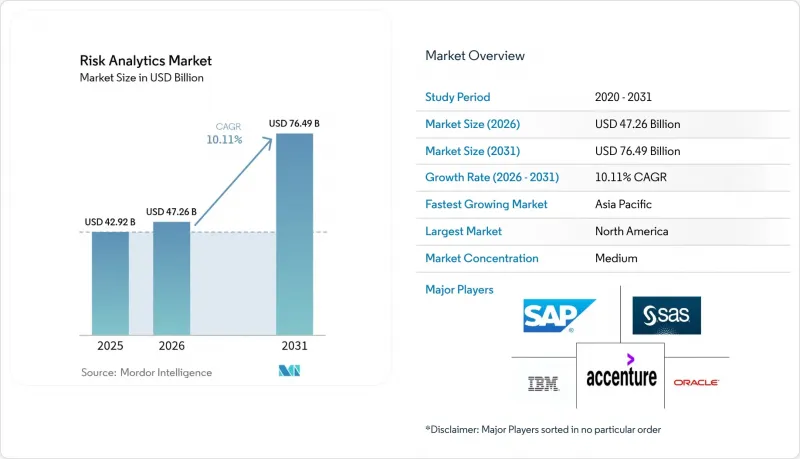
본 보고서는 구성 요소(솔루션 및 서비스), 도입 형태(On-Premise 및 클라우드), 리스크 유형(신용 리스크, 운영 리스크 등), 용도(사기 감지 및 AML, 스트레스 테스트 및 시나리오 분석 등), 최종 사용자 산업(은행, 금융서비스 및 보험(BFSI), 헬스케어 및 생명과학 등),조직 규모(대기업 및 중소기업(SME)), 지역별로 분류되어 있습니다.
세계 리스크 분석 시장 동향 및 인사이트
즉시 결제 시스템에서 급증하는 실시간 부정 행위
즉시 결제 환경에서 은행은 배치 처리형 부정 감지 도구의 처리 능력을 능가하는 거래 수준의 공격에 노출되어 있습니다. 전 세계 실시간 결제 거래량은 2028년까지 5,750억 건에 달할 것으로 예상되며, 금융 기관은 행동 생체 인식, 디바이스 인텔리전스, 네트워크 분석을 융합한 밀리초 단위의 분석을 도입하는 동시에 오감지율을 1% 미만으로 억제해야 합니다. 영국에서 승인된 송금 사기에 대한 강제 환불 규정은 거래 발생 시 즉시 스코어링을 수행하는 AI 네이티브 플랫폼의 경제적 타당성을 더욱 강화하고 있습니다. 스트리밍 데이터 수집, 그래프 분석, 모델 거버넌스를 단일 클라우드 네이티브 스택 내에서 통합할 수 있는 벤더는 결정적인 우위를 점하게 됩니다.
바젤 IV 이후 자기자본비율에 대한 감독 강화
2025년 1월 EU의 바젤 IV 도입 및 FINMA의 강화된 운영 리스크 관련 규정에 따라, 다국적 은행은 여러 리스크 가중 자산 계산을 병행하여 수행해야 할 의무가 있습니다. 클라우드 기반 몬테카를로 엔진을 활용하면 BCBS 239의 데이터 집계 테스트 요건을 충족하면서, 서로 다른 규칙 세트에 걸쳐 거의 실시간으로 자본 최적화를 수행할 수 있습니다. 규제 당국의 현장 데이터 감사가 강화됨에 따라, 통합된 데이터 계보, 감사 추적, 시나리오 라이브러리에 대한 수요가 높아지고 있으며, 규제 로직을 기본적으로 내장한 다양한 서비스를 제공하는 플랫폼으로의 전환이 가속화되고 있습니다.
모델 리스크 거버넌스 분야의 심각한 인력 부족
은행의 54%가 정량적 검증 기술의 부족을 보고하고 있으며, 이는 모델 출시 지연과 규정 준수 비용 증가를 초래하고 있습니다. 통계학, 규제 관련 지식, AI 전문 지식을 겸비한 전문가의 급여 상승률이 가장 높습니다. 금융 기관들은 실제 데이터를 재현하고 거버넌스 경고를 발령하는 자동 검증 툴킷을 도입하고 있지만, 감독 당국은 여전히 사람의 승인을 요구하고 있습니다. 워크플로우, 문서화, 자동 테스트 기능을 통합한 벤더는 이러한 제약을 완화해 주지만, 희소한 전문 지식을 완전히 대체할 수는 없습니다.
부문 분석
시장 점유율 데이터에 따르면, 2025년 ‘솔루션’ 부문의 점유율은 64.20%를 나타낼 것으로 예측되지만, ‘서비스’ 부문은 연평균 성장률(CAGR) 11.62%로 더 빠르게 확대되고 있습니다. 각 은행이 AI 거버넌스, 기후 변화 스트레스 테스트, 양자 리스크 모델링에 직면함에 따라 컨설팅, 도입, 운영 관리와 관련된 리스크 분석 시장 규모는 확대되고 있습니다. 서비스 기업들은 첨단 엔진을 레거시 코어 시스템과 통합하는 동시에, 출력 결과를 각 관할 구역의 템플릿에 맞추도록 지원하고 있습니다. 이와 병행하여 코어 소프트웨어는 로우코드 기반 설정 기능, 자연어 지원 프론트엔드, 양자 내성 라이브러리로 진화하고 있습니다.
지속적인 규제 변화로 인해 고객은 모델 인벤토리의 큐레이션, 문서화 및 검증에 있어 계속해서 외부 전문가에 의존하고 있습니다. 데이터 품질, 시나리오 라이브러리, 실시간 모니터링을 아우르는 매니지드 서비스는 중견 기업의 운영 비용을 경감시킵니다. 그 결과, 영구 라이선스가 계속 사용되고 있는 경우에도 지출은 정기적인 서비스 계약으로 전환되고 있습니다. 소프트웨어 업그레이드와 성과 기반 서비스 계약을 결합하는 벤더는 계약 갱신 및 업셀링 기회를 확보하고 있습니다.
기관들이 기밀 데이터를 역외 접근으로부터 보호함에 따라, 2025년에도 On-Premise 시스템의 점유율은 66.95%를 유지할 것으로 전망됩니다. 그러나 클라우드의 연평균 성장률(CAGR)이 11.92%에 달한다는 점은 결정적인 전환의 모멘텀을 보여주고 있으며, SaaS 및 PaaS 모델을 통해 제공되는 리스크 분석 시장의 가치를 높이고 있습니다. 클라우드 도입을 통해 주중 스트레스 테스트, 실시간 부정 감지 스코어링, 그리고 빈번한 시장 위험 재계산을 위한 탄력적인 컴퓨팅 능력의 급증에 대응할 수 있습니다. 소버린 클라우드 존을 제공하는 사업자는 유럽, 중동, 아시아의 데이터 거주 요건에 대한 우려를 완화하고 있습니다.
전환 로드맵에서는 하이브리드 아키텍처가 주류를 이루고 있습니다. 레거시 신용 평가 엔진은 On-Premise에 남기면서, AI 추론 레이어, 시각화 대시보드, 배치 보고서는 클라우드 마이크로서비스로 전환되고 있습니다. 고객은 락인을 피하고, 워크로드를 지연 시간, 비용,데이터 현지화 제약에 맞추어 조정하기 위해 멀티클라우드 오케스트레이터를 활용하고 있습니다. 금융 기관이 자원 배분 전략을 정교화함에 따라, 워크로드 배치 로직과 크로스 클라우드 비용 분석 기능을 통합한 솔루션이 시장 점유율을 확보하고 있습니다.
지역별 분석
북미는 엄격한 감독 체계와 하이퍼스케일 클라우드의 조기 도입에 힘입어 2025년 매출의 38.15%를 차지했습니다. 연방준비제도이사회(FRB)의 기후 변화 관련 지침과 바젤 III의 최종 단계 규정에 따라 자본 최적화, 스트레스 테스트, 데이터 계보 솔루션에 대한 지출이 유지되고 있습니다. 또한, 미국의 금융 기관들은 IBM의 수십억 달러 규모의 양자 컴퓨팅 로드맵에 힘입어 결제 인프라의 미래 경쟁력을 확보하기 위해 양자 내성 암호화 기술을 시범 도입하고 있습니다.
유럽은 큰 비중을 차지하며 전 세계 규제 프레임워크를 형성하고 있습니다. 2025년 ‘디지털 운영 복원력법(Digital Operational Resilience Act)’의 시행에 따라 은행들은 ICT 위험 분석을 기존의 금융 위험 지표와 통합해야 할 의무가 생겼습니다. ESG 규제 분야에서 유럽연합(EU)의 주도적인 입장이 기후 시나리오 관련 지출을 뒷받침하는 한편, BCBS 239 준수가 실시간 데이터 집계에 대한 투자를 촉진하고 있습니다. 회원국별 규제가 제각각이기 때문에 여러 보고 스키마를 일관된 데이터 모델로 매핑하는 플랫폼에 대한 수요가 증가하고 있습니다.
아시아태평양은 연평균 성장률(CAGR) 11.23%로 가장 빠르게 성장하는 지역입니다. 인도의 ‘통합 결제 인터페이스(UPI)’는 매달 수십억 건의 송금을 처리하고 있어, 실시간 사기 방지 수요가 높아지고 있습니다. 중국에서는 공급망 금융 분석이 심화되고 있으며, 디지털 화폐 위험 관리 프레임워크 구축이 진행되고 있습니다. 동남아시아 시장에서는 얼터너티브 데이터를 활용한 첫 대출자 대상 신용 평가가 가속화되고 있습니다. 규제 당국은 벤더 승인을 신속화하는 샌드박스 제도를 도입하여, 현지 데이터 현지화 규제에 부합하는 확장 가능한 클라우드 서비스의 신속한 도입을 뒷받침하고 있습니다.
기타 혜택:
- 엑셀 형식 시장 예측(ME) 시트
- 3개월간의 애널리스트 지원
자주 묻는 질문
목차
제1장 서론
제2장 조사 방법
제3장 주요 요약
제4장 시장 구도
제5장 시장 규모와 성장 예측
제6장 경쟁 구도
제7장 시장 기회와 향후 전망
LSH 26.09.09According to Mordor Intelligence, the risk analytics market size is expected to grow from USD 42.92 billion in 2025 to USD 47.26 billion in 2026 and is forecast to reach USD 76.49 billion by 2031 at 10.11% CAGR over 2026-2031.
This report is Segmented by Component (Solution and Services), Deployment (On-Premises and Cloud), Risk Type (Credit, Operational, and More), Application (Fraud Detection and AML, Stress Testing and Scenario-Analysis, and More), End-User Industry (BFSI, Healthcare and Life-Sciences, and More), Organization Size (Large Enterprises and Small and Medium Enterprises (SMEs)), and Geography.
Global Risk Analytics Market Trends and Insights
Real-time fraud surge in instant-payment rails
Instant settlement environments expose banks to transaction-level attacks that overwhelm batch fraud tools. Global real-time payment volumes are on track to hit 575 billion transactions by 2028, forcing institutions to deploy millisecond analytics that blend behavioral biometrics, device intelligence, and network analytics while maintaining false-positive rates below 1%. The United Kingdom's mandatory reimbursement rule for authorized push-payment fraud strengthens the economic case for AI-native platforms that score transactions as they occur. Vendors that can combine streaming data ingestion, graph analytics, and model governance within a single cloud-native stack hold a decisive edge.
Heightened post-Basel IV capital-adequacy scrutiny
The EU's January 2025 Basel IV rollout and FINMA's enhanced operational-risk ordinances oblige multinational banks to run several risk-weighted asset calculations in parallel. Cloud-based Monte-Carlo engines allow near real-time capital optimization across diverging rulesets while satisfying BCBS 239 data-aggregation tests. As regulators intensify on-site data audits, demand for unified data lineage, audit trails, and scenario libraries accelerates the migration toward service-rich platforms that embed regulatory logic natively.
Acute talent shortage in model-risk governance
Fifty-four percent of banks report gaps in quantitative validation skills, delaying model releases and inflating compliance costs. Salary inflation is steepest for specialists who combine statistics, regulatory insight, and AI competence. Institutions are adopting automated validation toolkits that replay production data and issue governance alerts, but supervisors still require human sign-off. Vendors that bundle workflow, documentation, and auto-testing capabilities mitigate the constraint yet cannot fully replace scarce expertise.
Other drivers and restraints analyzed in the detailed report include:
- Mandatory climate-risk disclosure
- AI-powered credit scoring for thin-file borrowers
- Rising SaaS subscription fatigue among mid-tiers
For complete list of drivers and restraints, kindly check the Table Of Contents.
Segment Analysis
Market share data show Solutions at 64.20% in 2025, yet the Services arm is expanding faster at 11.62% CAGR. The risk analytics market size tied to consulting, implementation, and managed operations grows as banks confront AI governance, climate stress testing, and quantum-risk modeling. Service firms help integrate advanced engines with legacy cores while aligning outputs to jurisdictional templates. In parallel, core software evolves toward low-code configurability, natural language front-ends, and quantum-resistant libraries.
Ongoing regulatory change keeps customers reliant on external specialists for model inventory curation, documentation, and validation. Managed services covering data quality, scenario libraries, and real-time monitoring reduce overhead for mid-tier players. As a result, spending tilts toward recurring service contracts even where perpetual licenses remain in place. Vendors that fuse software upgrades with outcome-based service commitments guard renewals and upsell opportunities.
On-premises systems retain 66.95% share in 2025 as institutions guard sensitive data against extraterritorial access. Yet a 11.92% CAGR for cloud indicates decisive migration momentum, raising the risk analytics market value delivered via SaaS and platform-as-a-service models. Cloud deployments support elastic compute bursts for intraday stress testing, real-time fraud scoring, and high-frequency market-risk recalculations. Providers of sovereign-cloud zones ease data-residency objections in Europe, the Middle East, and Asia.
Hybrid architectures dominate transition roadmaps. Legacy credit engines remain on-premises while AI inference layers, visualization dashboards, and batch reporting shift to cloud micro-services. Clients use multi-cloud orchestrators to avoid lock-in and align workloads with latency, cost, and data-localization constraints. Solutions that embed workload-placement logic and cross-cloud cost analytics capture wallet share as institutions refine resource allocation strategies.
Complete Report Scope:
- By Component
- Solution
- Risk-calculation engines
- Risk reporting and dashboards
- ETL / Data-management hubs
- Services
- Consulting
- Integration and Implementation
- Managed / BPO Services
- Solution
- By Deployment
- On-premises
- Cloud
- By Risk Type
- Credit
- Operational
- Liquidity
- Compliance / RegTech
- Climate and ESG
- By Application
- Fraud Detection and AML
- Stress Testing and Scenario-Analysis
- Model-Risk Management
- Cyber-Risk Analytics
- Supply-chain / Third-party Risk
- By End-user Industry
- BFSI
- Healthcare and Life-sciences
- Retail and E-commerce
- Energy and Utilities
- IT and Telecom
- Others
- By Organisation Size
- Large Enterprises
- Small and Medium Enterprises (SMEs)
- Geography
- North America
- United States
- Canada
- Mexico
- Europe
- Germany
- United Kingdom
- France
- Italy
- Spain
- Russia
- Rest of Europe
- Asia-Pacific
- China
- Japan
- India
- South Korea
- Australia and New Zealand
- Rest of Asia-Pacific
- South America
- Brazil
- Argentina
- Rest of South America
- Middle East and Africa
- Middle East
- Saudi Arabia
- United Arab Emirates
- Turkey
- Rest of Middle East
- Africa
- South Africa
- Nigeria
- Rest of Africa
- Middle East
- North America
Geography Analysis
North America held 38.15% of revenue in 2025, underpinned by strict supervisory regimes and early hyperscale-cloud adoption. The Federal Reserve's climate guidance and Basel III endgame rules sustain spending on capital optimization, stress testing, and data lineage solutions. U.S. institutions also pilot quantum-resistant encryption to future-proof payment rails, supported by IBM's multi-billion dollar quantum roadmap.
Europe commands significant share and shapes regulatory templates worldwide. Implementation of the Digital Operational Resilience Act in 2025 obliges banks to integrate ICT-risk analytics with traditional financial-risk metrics. The bloc's leadership on ESG rules propels climate-scenario spending, while BCBS 239 compliance pushes real-time data aggregation investments. Fragmented member-state rules raise demand for platforms that map multiple reporting schemas onto consistent data models.
Asia-Pacific is the fastest-growing region at 11.23% CAGR. India's Unified Payments Interface processes billions of monthly transfers, heightening real-time fraud needs. China deepens supply-chain finance analytics and readies digital currency risk frameworks. Southeast Asian markets accelerate credit-scoring for first-time borrowers using alternative data. Regulators adopt sandbox schemes that speed vendor approvals, fuelling rapid deployment of scalable cloud offerings adapted to local data-localization norms.
- SAS Institute Inc.
- IBM Corporation
- Oracle Corporation
- SAP SE
- Moody's Analytics Inc.
- FIS Global
- NICE Actimize
- Fair Isaac Corp (FICO)
- AxiomSL / Adenza Group
- Capgemini SE
- Accenture plc
- OneSpan Inc.
- Risk Edge Solutions
- Provenir Inc.
- Verisk Analytics
- LexisNexis Risk Solutions
- Riskonnect Inc.
- Dun and Bradstreet Holdings
- Nasdaq Risk Platform
- Palantir Technologies
Additional Benefits:
- The market estimate (ME) sheet in Excel format
- 3 months of analyst support
TABLE OF CONTENTS
1 INTRODUCTION
- 1.1 Study Assumptions and Market Definition
- 1.2 Scope of the Study
2 RESEARCH METHODOLOGY
3 EXECUTIVE SUMMARY
4 MARKET LANDSCAPE
- 4.1 Market Overview
- 4.2 Market Drivers
- 4.2.1 Real-time fraud surge in instant-payment rails
- 4.2.2 Heightened post-Basel IV capital-adequacy scrutiny
- 4.2.3 Mandatory climate-risk disclosure
- 4.2.4 AI-powered credit scoring for thin-file borrowers
- 4.2.5 Multi-cloud risk-data fabrics cut TCO by above 25%
- 4.2.6 Quantum-computing threat to legacy crypto-algos
- 4.3 Market Restraints
- 4.3.1 Acute talent shortage in model-risk governance
- 4.3.2 Rising SaaS subscription fatigue among mid-tiers
- 4.3.3 Vendor-lock-in concerns over proprietary ML stacks
- 4.3.4 Inconsistent ESG taxonomies across jurisdictions
- 4.4 Value Chain Analysis
- 4.5 Regulatory Landscape
- 4.6 Technological Outlook
- 4.7 Porter's Five Forces Analysis
- 4.7.1 Threat of New Entrants
- 4.7.2 Bargaining Power of Buyers/Consumers
- 4.7.3 Bargaining Power of Suppliers
- 4.7.4 Threat of Substitute Products
- 4.7.5 Intensity of Competitive Rivalry
- 4.8 Assessment of the Impact of Macroeconomic Trends on the Market
5 MARKET SIZE AND GROWTH FORECASTS (VALUE)
- 5.1 By Component
- 5.1.1 Solution
- 5.1.1.1 Risk-calculation engines
- 5.1.1.2 Risk reporting and dashboards
- 5.1.1.3 ETL / Data-management hubs
- 5.1.2 Services
- 5.1.2.1 Consulting
- 5.1.2.2 Integration and Implementation
- 5.1.2.3 Managed / BPO Services
- 5.1.1 Solution
- 5.2 By Deployment
- 5.2.1 On-premises
- 5.2.2 Cloud
- 5.3 By Risk Type
- 5.3.1 Credit
- 5.3.2 Operational
- 5.3.3 Liquidity
- 5.3.4 Compliance / RegTech
- 5.3.5 Climate and ESG
- 5.4 By Application
- 5.4.1 Fraud Detection and AML
- 5.4.2 Stress Testing and Scenario-Analysis
- 5.4.3 Model-Risk Management
- 5.4.4 Cyber-Risk Analytics
- 5.4.5 Supply-chain / Third-party Risk
- 5.5 By End-user Industry
- 5.5.1 BFSI
- 5.5.2 Healthcare and Life-sciences
- 5.5.3 Retail and E-commerce
- 5.5.4 Energy and Utilities
- 5.5.5 IT and Telecom
- 5.5.6 Others
- 5.6 By Organisation Size
- 5.6.1 Large Enterprises
- 5.6.2 Small and Medium Enterprises (SMEs)
- 5.7 Geography
- 5.7.1 North America
- 5.7.1.1 United States
- 5.7.1.2 Canada
- 5.7.1.3 Mexico
- 5.7.2 Europe
- 5.7.2.1 Germany
- 5.7.2.2 United Kingdom
- 5.7.2.3 France
- 5.7.2.4 Italy
- 5.7.2.5 Spain
- 5.7.2.6 Russia
- 5.7.2.7 Rest of Europe
- 5.7.3 Asia-Pacific
- 5.7.3.1 China
- 5.7.3.2 Japan
- 5.7.3.3 India
- 5.7.3.4 South Korea
- 5.7.3.5 Australia and New Zealand
- 5.7.3.6 Rest of Asia-Pacific
- 5.7.4 South America
- 5.7.4.1 Brazil
- 5.7.4.2 Argentina
- 5.7.4.3 Rest of South America
- 5.7.5 Middle East and Africa
- 5.7.5.1 Middle East
- 5.7.5.1.1 Saudi Arabia
- 5.7.5.1.2 United Arab Emirates
- 5.7.5.1.3 Turkey
- 5.7.5.1.4 Rest of Middle East
- 5.7.5.2 Africa
- 5.7.5.2.1 South Africa
- 5.7.5.2.2 Nigeria
- 5.7.5.2.3 Rest of Africa
- 5.7.5.1 Middle East
- 5.7.1 North America
6 COMPETITIVE LANDSCAPE
- 6.1 Market Concentration
- 6.2 Strategic Moves
- 6.3 Market Share Analysis
- 6.4 Company Profiles (includes Global level Overview, Market level overview, Core Segments, Financials as available, Strategic Information, Market Rank/Share for key companies, Products and Services, and Recent Developments)
- 6.4.1 SAS Institute Inc.
- 6.4.2 IBM Corporation
- 6.4.3 Oracle Corporation
- 6.4.4 SAP SE
- 6.4.5 Moody's Analytics Inc.
- 6.4.6 FIS Global
- 6.4.7 NICE Actimize
- 6.4.8 Fair Isaac Corp (FICO)
- 6.4.9 AxiomSL / Adenza Group
- 6.4.10 Capgemini SE
- 6.4.11 Accenture plc
- 6.4.12 OneSpan Inc.
- 6.4.13 Risk Edge Solutions
- 6.4.14 Provenir Inc.
- 6.4.15 Verisk Analytics
- 6.4.16 LexisNexis Risk Solutions
- 6.4.17 Riskonnect Inc.
- 6.4.18 Dun and Bradstreet Holdings
- 6.4.19 Nasdaq Risk Platform
- 6.4.20 Palantir Technologies
7 MARKET OPPORTUNITIES AND FUTURE OUTLOOK
- 7.1 White-space and Unmet-need Assessment