|
시장보고서
상품코드
2121493
유럽 창고용 로보틱스 : 시장 점유율 분석, 업계 동향과 통계, 성장 예측(2026-2031년)Europe Warehouse Robotics - Market Share Analysis, Industry Trends & Statistics, Growth Forecasts (2026 - 2031) |
||||||
 Mordor Intelligence
Mordor Intelligence에 의하면, 유럽 창고 로봇 시장 규모는 2026년에 34억 4,000만 달러로 평가되고 있어 CAGR15.69%를 배경으로, 2031년까지 71억 3,000만 달러까지 확대될 것으로 예측됩니다.
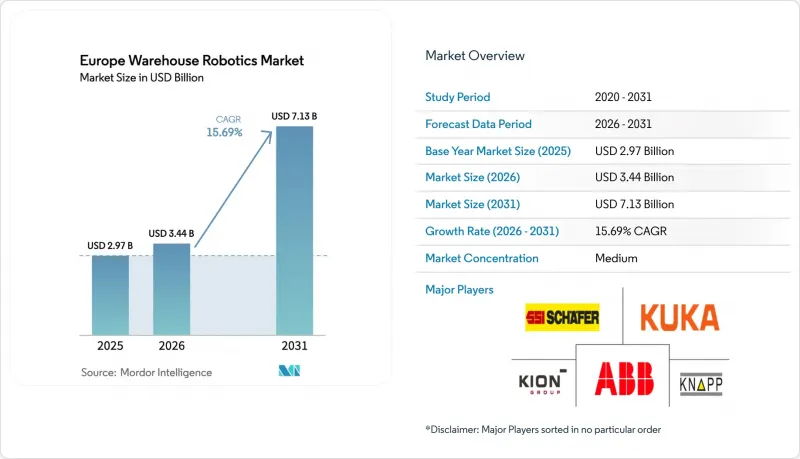
본 보고서는 유형별(산업용 로봇, 분류 시스템, 컨베이어,팔레타이저 등), 기능별(보관, 포장, 환적 등), 최종 사용자용도별(식품 및 음료, 자동차, 소매 및 전자상거래 등), 구성 요소별(하드웨어, 소프트웨어, 서비스), 지역별로 분류되어 있습니다. 시장 예측은 금액(달러) 기준으로 제시되어 있습니다.
유럽 창고 로봇 시장 동향 및 인사이트
전자상거래용 마이크로 풀필먼트 센터의 급증
도심에서 10킬로미터 이내의 거리에 설치된 마이크로 풀필먼트 센터는 배송 시간을 2시간 미만으로 단축하는 동시에, 지역 배송 센터에 비해 부동산 비용을 60% 절감하고 있습니다. 빌뇌브-다스크에 위치한 오카도(Ocado)의 그리드형 로봇은 매주 6만 건의 식료품 주문을 98.5%의 피킹 정확도로 처리하고 있으며, 이는 수직 통합형 자동화가 어떻게 수익성과 데이터를 모두 확보할 수 있는지를 보여줍니다. 2024년 노르웨이 우체국에서 실시된 AutoStore사의 10만 빈 규모 프로젝트에서는 공간 활용률이 400% 향상된 것이 입증되어, 임대료가 1제곱미터당 25유로를 초과하는 경우에도 마이크로 창고의 실현 가능성을 보여주었습니다. 이에 따라 소매업체들은 풀필먼트를 자체화하고, 재설계 없이 5,000-50,000개의 SKU를 처리할 수 있는 모듈형 로봇을 요구하고 있으며, 이는 유럽 창고 로봇 시장의 성장 궤도를 더욱 공고히 하고 있습니다.
옴니채널 소매에서 SKU의 급증
매장과 온라인 채널을 합쳐 10만 SKU 이상을 관리하는 소매업체의 경우, SKU가 1만 개 증가할 때마다 수작업 피킹 오류가 12% 증가하고 있습니다. Boozt.com에 도입된 KNAPP사의 ‘Open Shuttle Fork’는 인기 상품을 4시간마다 동적으로 재배치하여 작업자의 이동 거리를 40% 단축하고 있습니다. 묀헨글라트바흐에 위치한 Zalando의 15만 SKU를 취급하는 시설에서는 재프로그래밍 없이 포장 변경에 대응할 수 있는 비전 가이드 방식의 단품 피킹을 활용하고 있습니다. 이러한 유연성은 고정식 컨베이어 레이아웃으로는 실현할 수 없으며, 유럽의 창고 로봇 시장이 다양한 주문 프로파일에 대응할 수 있도록 지원하는 첨단 소프트웨어를 탑재한 이동형 로봇에 대한 수요를 촉진하고 있습니다.
높은 초기 설비 투자 비용과 긴 투자 회수 기간
일반적인 그린필드 프로젝트에는 200만-500만 유로의 투자가 필요하며, 투자 회수 기간은 24-36개월에 달하지만, 많은 스페인 및 이탈리아 사업자들은 이를 과도하다고 생각합니다. ‘Robots-as-a-Service(RaaS)’ 계약을 통해 로봇 1대당월1,500-3,000유로를 지불함으로써 현금 흐름의 위험을 줄일 수 있지만, 그럼에도 수년에 걸친 계약 기간이 필요합니다. 그 결과, 일일 주문 건수가 1만 건 미만인 중소기업들은 도입을 미루고 있어, 유럽 창고 로봇 시장의 단기적인 성장세를 둔화시키고 있습니다.
부문 분석
AMR 및 AGV를 포함한 이동형 로봇은 2025년 유럽 창고 로봇 시장 점유율의 34.63%를 차지할 것으로 예상되며, 2031년까지 연평균 성장률(CAGR) 16.33%로 성장할 것으로 전망됩니다. GXO가 500대의 Geek+를 도입한 결과, 프랑스의 한 스포츠 용품 시설에서는 설치 후 불과 8주 만에 처리 능력이 3배로 증가했습니다. 소포 허브에서 고정식 컨베이어가 일일 SKU 변동에 대응할 수 있는 자율 주행형 유닛으로 대체됨에 따라, 유럽 창고 로봇 시장에서 이동형 로봇 시장 규모는 더욱 확대될 전망입니다.
일일 소포 처리량이 5만 개를 초과하는 현장에서는 여전히 분류 시스템이 필수적이며, DHL 라이프치히 허브에서 BEUMER사의 ‘BG Sorter’가 시간당 1만 5,000개의 소포를 처리하고 있는 것이 그 증거입니다. 그러나 500만 유로가 넘는 가격과 1년에 달하는 리드타임으로 인해 도입은 초대형 시설로 한정되어 있습니다. 산업용 로봇은 인트라로지스틱스 분야로 진출하고 있으며, 그 예로 KUKA사의 협업 로봇 ‘KMR iisy’를 들 수 있습니다. 이 로봇은 시간당 800회의 피킹 작업을 처리하며, SKU가 혼재된 구역에도 대응합니다. 재구성 가능한 솔루션이 선호되는 추세에 따라 이동식 플랫폼은 유럽 창고 로봇 시장의 성장 핵심을 확고히 차지하고 있습니다.
2025년에도 보관은 여전히 가장 큰 기능으로, 유럽 창고 로봇 시장에서 46.73%의 점유율을 차지했습니다. 그러나 사업자들이 보관 비용을 절감하기 위해 24시간 이내 재고 소진을 목표로 하는 가운데, 이송 업무는 연평균 성장률(CAGR) 16.56%를 나타낼 것으로 예측됩니다. Exotec과 Decathlon의 제휴를 통해 주문의 80%가 직접 크로스독 흐름으로 전환되었고, 정적 보관 구역이 제거되어 시설의 점유 면적이 40% 감소했습니다.
포장 자동화도 확대되는 추세이며, 특히 독일의 경우 인건비가 시간당 18유로를 초과하기 때문에 로봇식 케이스 조립기를 도입하면 3년 이내에 투자 비용을 회수할 수 있을 것으로 전망됩니다. 반품 처리나 키트 조립은 SKU의 다양성으로 인해 여전히 인력에 크게 의존하고 있지만, 새로운 비전 유도형 피킹·플레이스 도구는 전환점이 다가오고 있음을 시사합니다. ‘당일 배송’ 경제가 성숙해짐에 따라, 레이아웃을 결정짓는 요소는 보관 밀도가 아닌 처리 속도가 되며, 투자가 고속 분류기나 이동형 로봇으로 향함에 따라 유럽의 창고 로봇 시장은 계속 확대되고 있습니다.
기타 혜택:
- 엑셀 형식 시장 예측(ME) 시트
- 3개월간의 애널리스트 지원
자주 묻는 질문
목차
제1장 서론
제2장 조사 방법
제3장 주요 요약
제4장 시장 구도
제5장 시장 규모와 성장 예측
제6장 경쟁 구도
제7장 시장 기회와 향후 전망
LSH 26.09.09According to Mordor Intelligence, the Europe warehouse robotics market size is valued at USD 3.44 billion in 2026 and is forecast to expand to USD 7.13 billion by 2031, underpinned by a 15.69% CAGR.
This report is Segmented by Type (Industrial Robots, Sortation Systems, Conveyors, Palletizers, and More), Function (Storage, Packaging, Trans-Shipments, and More), End-User Application (Food and Beverage, Automotive, Retail and E-Commerce, and More), Component (Hardware, Software, and Services), and Geography. The Market Forecasts are Provided in Terms of Value (USD).
Europe Warehouse Robotics Market Trends and Insights
Surge of E-Commerce Micro-Fulfillment Centers
Micro-fulfillment centers positioned within 10 kilometers of city cores compress delivery windows to under 2 hours while cutting real-estate costs by 60% relative to regional distribution centers. Ocado's grid-based robots in Villeneuve-d'Ascq process 60,000 grocery orders weekly with 98.5% picking accuracy, showing how vertically integrated automation captures both margin and data. AutoStore's 100,000-bin project at Norway Post in 2024 demonstrated 400% space-utilization gains that make micro-warehousing viable even when lease rates exceed EUR 25 per square meter. Retailers therefore internalize fulfillment and demand modular robots able to scale from 5,000 to 50,000 SKUs without redesign, reinforcing the growth path of the Europe warehouse robotics market.
Growing SKU Proliferation in Omni-Channel Retail
Retailers that manage more than 100,000 SKUs across stores and online channels see manual picking errors climb 12% for every additional 10,000 SKUs. KNAPP's Open Shuttle Fork at Boozt.com dynamically re-slots fast movers every 4 hours, shortening operator walk-distance by 40%. Zalando's 150,000-SKU facility in Monchengladbach leverages vision-guided piece-picking that adapts to packaging changes without reprogramming. Such flexibility is unattainable with static conveyor layouts, driving demand for software-rich mobile robots that help the Europe warehouse robotics market meet diverse order profiles.
High Upfront CAPEX and Long ROI Cycles
Typical greenfield projects demand EUR 2 million to EUR 5 million, amounting to 24-36 month payback that many Spanish and Italian operators deem excessive. Robots-as-a-Service contracts payable at EUR 1,500 to EUR 3,000 per robot per month mitigate cash-flow risk but still require multi-year commitments. Small and mid-sized firms handling fewer than 10,000 daily orders therefore delay adoption, tempering near-term momentum in the Europe warehouse robotics market.
Other drivers and restraints analyzed in the detailed report include:
- Rising Intra-Logistics Labor Shortages
- EU Green Deal Incentives for Energy-Efficient Automation
- Fragmented Legacy WMS and ERP Integration Challenges
For complete list of drivers and restraints, kindly check the Table Of Contents.
Segment Analysis
Mobile robots, including AMRs and AGVs, captured 34.63% of 2025 Europe warehouse robotics market share and are projected to grow at 16.33% CAGR through 2031. GXO's 500-unit Geek+ rollout achieved triple throughput in a French sporting-goods site after only eight weeks of installation. The Europe warehouse robotics market size for mobile robots is set to widen further as parcel hubs replace fixed conveyors with self-navigating units able to adapt to daily SKU churn.
Sortation systems remain indispensable where parcel volume exceeds 50,000 units per day, evidenced by BEUMER's BG Sorter running 15,000 parcels hourly at DHL's Leipzig hub. Yet their EUR 5 million-plus price tag and year-long lead times limit uptake to mega-sites. Industrial robots are expanding into intralogistics, as exemplified by KUKA's KMR iisy cobot, which delivers 800 picks per hour and addresses mixed-SKU zones. The preference for reconfigurable solutions keeps mobile platforms squarely at the heart of growth for the Europe warehouse robotics market.
Storage remained the largest function in 2025, holding 46.73% share within the Europe warehouse robotics market. However, trans-shipments are forecast to post a 16.56% CAGR as operators strive to clear inventory inside 24 hours to contain carrying costs. Exotec's partnership with Decathlon resulted in a 80% shift of orders to direct cross-dock flows, eliminating static holding areas and reducing the facility footprint by 40%.
Packaging automation is also on the rise, particularly in Germany, where labor costs exceed EUR 18 per hour, enabling robotic case erectors to pay back within three years. Returns processing and kitting still rely heavily on people due to SKU variability, but new vision-guided pick-and-place tools indicate an emerging inflection point. As the same-day economy matures, throughput velocity rather than storage density will dictate layout, steering investments toward high-speed sorters and mobile robots that keep the Europe warehouse robotics market expanding.
Complete Report Scope:
- By Type
- Industrial Robots
- Sortation Systems
- Conveyors
- Palletizers
- Automated Storage and Retrieval Systems (ASRS)
- Mobile Robots (AGVs and AMRs)
- By Function
- Storage
- Packaging
- Trans-shipments
- Other Functions
- By End-user Application
- Food and Beverage
- Automotive
- Retail and E-commerce
- Electrical and Electronics
- Pharmaceutical and Healthcare
- Other End-user Applications
- By Component
- Hardware
- Software
- Services
- By Country
- United Kingdom
- Germany
- France
- Italy
- Spain
- Netherlands
- Rest of Europe
List of Companies Covered in this Report:
- ABB Ltd.
- KUKA AG
- SSI Schaefer AG
- KION Group AG (Dematic)
- Mecalux S.A.
- KNAPP AG
- Kardex Holding AG
- viastore SYSTEMS GmbH
- BEUMER Group GmbH and Co. KG
- Vanderlande Industries B.V.
- Siemens AG
- Swisslog Holding AG
- AutoStore Holdings Ltd.
- Exotec SAS
- Geekplus Technology Co., Ltd.
- Locus Robotics Corp.
- GreyOrange Pte. Ltd.
- Amazon Robotics LLC
- Ocado Group plc
- Scallog SAS
- Quicktron Intelligent Tech Co., Ltd.
- Magazino GmbH
- Hikrobot Technology Co., Ltd.
- Seegrid Corporation
- Fetch Robotics Inc. (Zebra Technologies)
Additional Benefits:
- The market estimate (ME) sheet in Excel format
- 3 months of analyst support
TABLE OF CONTENTS
1 INTRODUCTION
- 1.1 Study Assumptions and Market Definition
- 1.2 Scope of the Study
2 RESEARCH METHODOLOGY
3 EXECUTIVE SUMMARY
4 MARKET LANDSCAPE
- 4.1 Market Overview
- 4.2 Market Drivers
- 4.2.1 Surge of e-commerce micro-fulfilment centers
- 4.2.2 Growing SKU proliferation in omni-channel retail
- 4.2.3 Rising intra-logistics labour shortages
- 4.2.4 EU Green Deal incentives for energy-efficient automation
- 4.2.5 Proliferation of open API-based robot orchestration software
- 4.2.6 Venture capital inflow into AMR start-ups
- 4.3 Market Restraints
- 4.3.1 High upfront CAPEX and long ROI cycles
- 4.3.2 Fragmented legacy WMS/ERP integration challenges
- 4.3.3 Limited availability of safety-certified cobot standards
- 4.3.4 Persistent shortage of robot-skilled maintenance talent
- 4.4 Value Chain Analysis
- 4.5 Regulatory Landscape
- 4.6 Technological Outlook
- 4.7 Porter's Five Forces Analysis
- 4.7.1 Bargaining Power of Suppliers
- 4.7.2 Bargaining Power of Buyers
- 4.7.3 Threat of New Entrants
- 4.7.4 Intensity of Competitive Rivalry
- 4.7.5 Threat of Substitute Products
- 4.8 Investment Analysis
5 MARKET SIZE AND GROWTH FORECASTS (VALUE)
- 5.1 By Type
- 5.1.1 Industrial Robots
- 5.1.2 Sortation Systems
- 5.1.3 Conveyors
- 5.1.4 Palletizers
- 5.1.5 Automated Storage and Retrieval Systems (ASRS)
- 5.1.6 Mobile Robots (AGVs and AMRs)
- 5.2 By Function
- 5.2.1 Storage
- 5.2.2 Packaging
- 5.2.3 Trans-shipments
- 5.2.4 Other Functions
- 5.3 By End-user Application
- 5.3.1 Food and Beverage
- 5.3.2 Automotive
- 5.3.3 Retail and E-commerce
- 5.3.4 Electrical and Electronics
- 5.3.5 Pharmaceutical and Healthcare
- 5.3.6 Other End-user Applications
- 5.4 By Component
- 5.4.1 Hardware
- 5.4.2 Software
- 5.4.3 Services
- 5.5 By Country
- 5.5.1 United Kingdom
- 5.5.2 Germany
- 5.5.3 France
- 5.5.4 Italy
- 5.5.5 Spain
- 5.5.6 Netherlands
- 5.5.7 Rest of Europe
6 COMPETITIVE LANDSCAPE
- 6.1 Market Concentration
- 6.2 Strategic Moves
- 6.3 Market Share Analysis
- 6.4 Company Profiles {(includes Global level Overview, Market level overview, Core Segments, Financials as available, Strategic Information, Market Rank/Share for key companies, Products and Services, and Recent Developments)}
- 6.4.1 ABB Ltd.
- 6.4.2 KUKA AG
- 6.4.3 SSI Schaefer AG
- 6.4.4 KION Group AG (Dematic)
- 6.4.5 Mecalux S.A.
- 6.4.6 KNAPP AG
- 6.4.7 Kardex Holding AG
- 6.4.8 viastore SYSTEMS GmbH
- 6.4.9 BEUMER Group GmbH and Co. KG
- 6.4.10 Vanderlande Industries B.V.
- 6.4.11 Siemens AG
- 6.4.12 Swisslog Holding AG
- 6.4.13 AutoStore Holdings Ltd.
- 6.4.14 Exotec SAS
- 6.4.15 Geekplus Technology Co., Ltd.
- 6.4.16 Locus Robotics Corp.
- 6.4.17 GreyOrange Pte. Ltd.
- 6.4.18 Amazon Robotics LLC
- 6.4.19 Ocado Group plc
- 6.4.20 Scallog SAS
- 6.4.21 Quicktron Intelligent Tech Co., Ltd.
- 6.4.22 Magazino GmbH
- 6.4.23 Hikrobot Technology Co., Ltd.
- 6.4.24 Seegrid Corporation
- 6.4.25 Fetch Robotics Inc. (Zebra Technologies)
7 MARKET OPPORTUNITIES AND FUTURE OUTLOOK
- 7.1 White-space and Unmet-Need Assessment