

|
시장보고서
상품코드
2121500
바이오테크놀러지 시약 : 시장 점유율 분석, 업계 동향과 통계, 성장 예측(2026-2031년)Biotechnology Reagents - Market Share Analysis, Industry Trends & Statistics, Growth Forecasts (2026 - 2031) |
||||||
 Mordor Intelligence
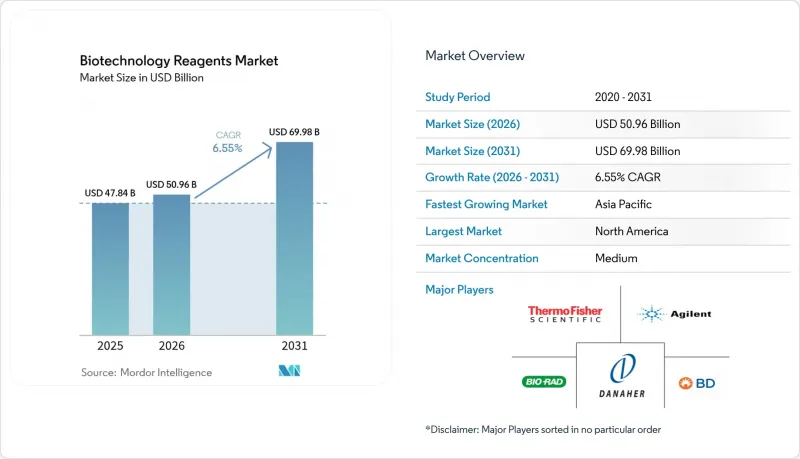
Mordor Intelligence에 의하면, 2026년 바이오테크놀러지 시약 시장 규모는 509억 6,000만 달러로 추정되며, 2025년 478억 4,000만 달러에서 성장하여 2031년에는 699억 8,000만 달러에 달할 것으로 예측됩니다.
또한 2026-2031년 연평균 성장률(CAGR) 6.55%를 기록할 전망입니다.
본 보고서에서는 시장을 시약의 유형(생명과학용 시약(PCR 등), 분석용 시약(크로마토그래피 등)), 용도(단백질 합성·정제 등), 최종 사용자(제약·바이오기술 기업 등), 지역(북미, 유럽, 아시아태평양 등)별로 분류하고 있습니다. 시장 전망은 금액(달러) 기준으로 제시되어 있습니다.
세계 생명공학 시약 시장 동향 및 인사이트
생명공학 기업의 막대한 연구개발비와 스타트업 기업의 파이프라인 확대
정밀 발효 및 합성 생물학 분야의 스타트업 기업에 대한 벤처 자금이 급증했으며, 세포 및 유전자 치료 워크플로우에 프리미엄 등급 시약이 필요한 새로운 플랫폼에 20억 달러가 투자되었습니다. 각 바이오의약품 후보에는 각각에 특화된 분석용 소모품이 필요하며, 이것이 전 세계 바이오프로세스 기술 시장의 지속적인 수요를 견인하고 있습니다. 수요가 세분화되어 있어 전문 공급업체는 높은 가격을 책정할 수 있지만, 한편으로는 플랫폼 기반의 신약 개발 모델로 인해 연구소는 여러 표적에 대응 가능한 시약 시스템의 표준화를 요구받고 있습니다. 그 결과, 조달 전략에서는 검증된 성능 데이터를 갖춘 모듈식 AI 지원 키트를 제공하는 공급업체가 점점 더 중요시되고 있습니다.
확대되는 줄기세포 및 재생의학 연구
성체 줄기세포를 활용한 프로토콜이 주류를 이루고 있으며, 표현형을 유지하는 분리·증식용 시약의 혁신이 촉진되고 있습니다. 아시아태평양의 각국 정부는 오로라 바이오신세틱스(Aurora BioSynthetics)사의 2억 호주 달러(1억 2,940만 달러) 규모의 공장 등 대규모 GMP 시설에 공동 투자하고 있으며, 이로 인해 규제를 준수하는 소모품에 대한 지역적 수요가 증가하고 있습니다. 맞춤형 재생의료 시술이 보급됨에 따라, 공급업체는 환자별로 맞춤화된 소량 처리가 가능한 유연한 제형을 제공해야 합니다.
엄격한 다자간 품질·안전 인증
FDA와 EMA 간에 참조 표준의 타당성 평가에 대한 견해 차이가 있어, 공급업체는 연구를 중복하여 수행할 수밖에 없으며, 이로 인해 제품 출시까지 6-12개월의 지연이 발생하고 개발 비용이 최대 30% 증가하고 있습니다. 각 생산 거점에서 ISO 13485 인증을 취득하는 것은 중소기업에게 큰 부담이 되고 있습니다. 또한, Quality-by-Design(QbD) 문서화가 제품 수명 주기 전반에 걸쳐 적용됨에 따라, 규정 준수 비용을 감당할 수 있는 대규모 수직 통합형 기업에 대한 수요가 증가하고 있습니다.
부문 분석
2025년, 생명과학 시약은 생명공학 시약 시장 점유율의 55.10%를 차지했습니다. PCR 기반 진단 및 차세대 염기서열 분석에서의 꾸준한 활용으로 인해 이 부문은 계속해서 선두를 유지하고 있으며, 한편 코로나19 시대에 분자진단 인프라에 대한 지속적인 투자가 기초적인 수요를 뒷받침하고 있습니다. 분석용 시약은 규모는 작지만, 상세한 특성 평가에 대한 규제 당국의 중시 및 질량 분석법에 기반한 단백질체학의 보급을 호재로 삼아 연평균 성장률(CAGR) 8.85%를 기록하며 전체 생명공학 시약 시장의 성장률을 상회할 전망입니다. 시료 전처리와 분석 시약을 통합한 신흥 하이브리드 키트는 고처리량 연구소가 중시하는 워크플로우의 단순화를 약속합니다.
2세대 크로마토그래피 완충액 및 일회용 여과 시약은 연속적인 바이오프로세싱을 가능하게 하는 반면, 전기영동용 소모품은 무세포 시스템에서 분해능을 최적화합니다. 공급업체들은 지속적인 분석 수익을 확보하기 위해 시약에 소프트웨어 라이선스를 묶어 제공하는 사례가 늘어나고 있으며, 이는 실험실 업무와 디지털 서비스의 융합이 진행되고 있음을 보여줍니다.
지역별 분석
북미는 확립된 바이오의약품 클러스터, 풍부한 벤처 캐피털 자금원, 그리고 지원적인 규제 환경을 배경으로 2025년 매출의 38.80%를 차지했습니다. 첨단 바이오 제조를 촉진하는 연방 정부의 프로그램으로 인해 GMP 검증된 시약에 대한 안정적인 수요가 창출되고 있습니다. 유럽에서는 지속가능성에 관한 규제를 지속적으로 준수함에 따라 친환경 화학 성분 및 재활용 가능한 포장에 대한 관심이 높아지고 있으며, 공급업체들은 제품의 수명 주기 평가를 재검토하고 있습니다.
아시아태평양은 전 세계 성장을 주도하고 있으며, 2031년까지 연평균 성장률(CAGR) 9.15%를 나타낼 것으로 예측됩니다. 중국의 ‘제53호 통지’에 따라 심사 기간이 단축되고 데이터 보호 기간이 연장됨에 따라, 현지 혁신과 해외 기업과의 제휴가 촉진되고 있습니다. 2030년까지 생명공학 경제를 3배로 확대하겠다는 일본의 목표는 임상용 시약에 대한 국내 수요를 뒷받침하고 있는 반면, 동남아시아에서 CDMO의 부상은 일회용 소모품에 대한 새로운 판로를 창출하고 있습니다. 현지 공급업체들은 정부 보조금을 활용하여 역량 격차를 해소하고 있지만, 국제적인 품질 관리(QC) 기준 준수는 여전히 과제로 남아 있습니다.
중동 및 아프리카, 남미의 각 시장에서는 한 자릿수 중반대의 성장률을 기록하고 있습니다. 다자간 보건 기구가 후원하는 기술 이전 협정에 따라 현지 시약 충전 및 마무리 작업이 촉진되어 수입 의존도가 낮아지고 있습니다. 그러나 콜드체인 인프라 부족과 환율 변동으로 인해 고가 제품의 도입은 억제되고 있으며, 공급업체들은 지역의 구매력에 맞추어 모듈식이며 가격대가 단계적으로 설정된 시약 라인의 제공을 촉진하고 있습니다.
기타 혜택:
- 엑셀 형식 시장 예측(ME) 시트
- 3개월간의 애널리스트 지원
자주 묻는 질문
목차
제1장 서론
제2장 조사 방법
제3장 주요 요약
제4장 시장 구도
제5장 시장 규모와 성장 예측
제6장 경쟁 구도
제7장 시장 기회와 향후 전망
LSH 26.09.09According to Mordor Intelligence, biotechnology reagents market size in 2026 is estimated at USD 50.96 billion, growing from 2025 value of USD 47.84 billion with 2031 projections showing USD 69.98 billion, growing at 6.55% CAGR over 2026-2031.
This report Segments the Industry Into by Reagent Type (Life-Science Reagents [PCR, and More], Analytical Reagents [Chromatography, and More]), Application (Protein Synthesis & Purification, and More), End User (Pharmaceutical & Biotechnology Companies, and More), and Geography (North America, Europe, Asia-Pacific, and More). The Market Forecasts are Provided in Terms of Value (USD).
Global Biotechnology Reagents Market Trends and Insights
High R&D Spending by Biotech Firms & Swelling Startup Pipeline
Venture funding in precision fermentation and synthetic biology startups surged, channeling USD 2 billion into new platforms that rely on premium-grade reagents for cell-and gene-therapy workflows. Each biologic candidate requires bespoke analytical consumables, driving recurring demand in the global bioprocess technology market. Fragmented demand lets specialist suppliers command premium pricing, while platform-based discovery models push labs to standardise reagent systems compatible with multiple targets. Consequently, procurement strategies increasingly favour vendors that offer modular, AI-ready kits with validated performance data.
Expanding Stem-Cell & Regenerative-Medicine Studies
Adult stem-cell protocols dominate, prompting innovation in isolation and expansion reagents that preserve phenotype. APAC governments co-fund large-scale GMP facilities, such as Aurora Biosynthetics' AUD200 million (USD 129.4 million) plant, boosting regional demand for compliant consumables. As personalised regenerative procedures proliferate, suppliers must deliver flexible formulations capable of small-batch, patient-specific processing.
Stringent Multi-Jurisdictional Quality & Safety Certifications
FDA and EMA divergence on reference-standard validation forces suppliers to duplicate studies, adding 6-12 months to product launches and raising development costs by up to 30%. Achieving ISO 13485 certification for each production site strains smaller firms, while Quality-by-Design documentation now covers entire life-cycles, pushing demand toward larger, vertically integrated players able to absorb compliance costs.
Other drivers and restraints analyzed in the detailed report include:
- Oncology-Centric Omics Projects Demanding High-Throughput Reagents
- AI-Assisted Reagent Optimisation Shortening Development Cycles
- Volatile Bioprocess Raw-Material Supply Chain Post-COVID
For complete list of drivers and restraints, kindly check the Table Of Contents.
Segment Analysis
Life-Science Reagents captured 55.10% of biotechnology reagents market share in 2025. Strong utilisation in PCR-based diagnostics and next-generation sequencing keeps the segment ahead, while continuing investment in COVID-era molecular infrastructure supports baseline demand. Analytical Reagents, though smaller, are set to surpass overall biotechnology reagents market growth with a 8.85% CAGR, benefitting from regulatory emphasis on deep characterisation and the proliferation of mass-spectrometry-driven proteomics. Emerging hybrid kits that integrate sample prep with assay reagents promise workflow simplification valued by high-throughput labs.
Second-generation chromatography buffers and single-use filtration reagents enable continuous bioprocessing, while electrophoresis consumables optimise resolution for cell-free systems. Suppliers increasingly bundle software licences with reagents to capture recurring analytics revenue, signalling convergence between wet-lab and digital offerings.
Complete Report Scope:
- By Reagent Type
- Life-Science Reagents
- PCR
- Cell Culture
- Hematology
- In-vitro Diagnostics
- Other Technologies
- Analytical Reagents
- Chromatography
- Mass Spectrometry
- Electrophoresis
- Flow Cytometry
- Other Analytical Reagents
- Life-Science Reagents
- By Application
- Protein Synthesis & Purification
- Gene Expression
- DNA & RNA Analysis
- Drug Testing
- Other Applications
- By End User
- Pharmaceutical & Biotechnology Companies
- Contract Research Organisations (CROs)
- Academic & Research Institutes
- Clinical & Diagnostic Laboratories
- By Geography
- North America
- United States
- Canada
- Mexico
- Europe
- Germany
- United Kingdom
- France
- Italy
- Spain
- Rest of Europe
- Asia-Pacific
- China
- Japan
- India
- Australia
- South Korea
- Rest of Asia-Pacific
- Middle East & Africa
- GCC
- South Africa
- Rest of Middle East & Africa
- South America
- Brazil
- Argentina
- Rest of South America
- North America
Geography Analysis
North America anchored 38.80% of 2025 revenues on the back of entrenched biopharmaceutical clusters, deep venture capital pools, and a supportive regulatory climate. Federal programmes promoting advanced biomanufacturing generate steady requisitions for GMP-validated reagents. In Europe, continued adherence to sustainability mandates propels interest in green-chemistry formulations and recyclable packaging, prompting suppliers to revamp product life-cycle assessments.
Asia-Pacific tops global expansion, expected to post 9.15% CAGR through 2031. China's Circular No. 53 has trimmed review timelines and expanded data-protection windows, catalysing local innovation and inbound partnerships. Japan's goal of tripling its biotech economy by 2030 underwrites domestic demand for clinical-grade reagents, while Southeast Asia's CDMO rise creates fresh outlets for single-use consumables. Local suppliers leverage government subsidies to close capability gaps, although adherence to international QC standards remains a hurdle.
Markets in the Middle East, Africa, and South America record mid-single-digit growth. Technology-transfer agreements sponsored by multilateral health agencies facilitate local reagent fill-finish operations, reducing import reliance. However, limited cold-chain infrastructure and fluctuating currency valuations temper the adoption of premium products, incentivising suppliers to offer modular, cost-tiered reagent lines tailored to regional purchasing power.
- Abbott Laboratories
- Agilent Technologies
- Danaher (Cytiva & Beckman Coulter)
- Beckton Dickinson
- Bio-Rad Laboratories
- bioMerieux
- Siemens Healthineers
- Merck KGaA (MilliporeSigma)
- Thermo Fisher Scientific
- Waters Corporation
- Eurofins
- Takara Bio
- QIAGEN
- Illumina
- PerkinElmer (Revvity)
- Promega
- Roche
- Lonza Group
- Bio-Techne (R&D Systems)
- New England Biolabs
Additional Benefits:
- The market estimate (ME) sheet in Excel format
- 3 months of analyst support
TABLE OF CONTENTS
1 Introduction
- 1.1 Study Assumptions & Market Definition
- 1.2 Scope of the Study
2 Research Methodology
3 Executive Summary
4 Market Landscape
- 4.1 Market Overview
- 4.2 Market Drivers
- 4.2.1 High R&D Spending by Biotech Firms & Swelling Startup Pipeline
- 4.2.2 Expanding Stem-Cell & Regenerative-Medicine Studies
- 4.2.3 Oncology-Centric Omics Projects Demanding High-Throughput Reagents
- 4.2.4 AI-Assisted Reagent Optimisation Shortening Development Cycles
- 4.2.5 Rising Point-Of-Care Molecular Diagnostics Adoption
- 4.2.6 Government Biomanufacturing Localisation Incentives in Asia
- 4.3 Market Restraints
- 4.3.1 Stringent Multi-Jurisdictional Quality & Safety Certifications
- 4.3.2 Volatile Bioprocess Raw-Material Supply Chain Post-COVID
- 4.3.3 Rising Average Selling Price of Premium-Grade Reagents
- 4.3.4 Sustainability Pressures on Hazardous Reagent Components
- 4.4 Porter's Five Forces Analysis
- 4.4.1 Threat of New Entrants
- 4.4.2 Bargaining Power of Buyers
- 4.4.3 Bargaining Power of Suppliers
- 4.4.4 Threat of Substitutes
- 4.4.5 Intensity of Competitive Rivalry
5 Market Size & Growth Forecasts (Value in USD)
- 5.1 By Reagent Type
- 5.1.1 Life-Science Reagents
- 5.1.1.1 PCR
- 5.1.1.2 Cell Culture
- 5.1.1.3 Hematology
- 5.1.1.4 In-vitro Diagnostics
- 5.1.1.5 Other Technologies
- 5.1.2 Analytical Reagents
- 5.1.2.1 Chromatography
- 5.1.2.2 Mass Spectrometry
- 5.1.2.3 Electrophoresis
- 5.1.2.4 Flow Cytometry
- 5.1.2.5 Other Analytical Reagents
- 5.1.1 Life-Science Reagents
- 5.2 By Application
- 5.2.1 Protein Synthesis & Purification
- 5.2.2 Gene Expression
- 5.2.3 DNA & RNA Analysis
- 5.2.4 Drug Testing
- 5.2.5 Other Applications
- 5.3 By End User
- 5.3.1 Pharmaceutical & Biotechnology Companies
- 5.3.2 Contract Research Organisations (CROs)
- 5.3.3 Academic & Research Institutes
- 5.3.4 Clinical & Diagnostic Laboratories
- 5.4 By Geography
- 5.4.1 North America
- 5.4.1.1 United States
- 5.4.1.2 Canada
- 5.4.1.3 Mexico
- 5.4.2 Europe
- 5.4.2.1 Germany
- 5.4.2.2 United Kingdom
- 5.4.2.3 France
- 5.4.2.4 Italy
- 5.4.2.5 Spain
- 5.4.2.6 Rest of Europe
- 5.4.3 Asia-Pacific
- 5.4.3.1 China
- 5.4.3.2 Japan
- 5.4.3.3 India
- 5.4.3.4 Australia
- 5.4.3.5 South Korea
- 5.4.3.6 Rest of Asia-Pacific
- 5.4.4 Middle East & Africa
- 5.4.4.1 GCC
- 5.4.4.2 South Africa
- 5.4.4.3 Rest of Middle East & Africa
- 5.4.5 South America
- 5.4.5.1 Brazil
- 5.4.5.2 Argentina
- 5.4.5.3 Rest of South America
- 5.4.1 North America
6 Competitive Landscape
- 6.1 Market Concentration
- 6.2 Market Share Analysis
- 6.3 Company Profiles (includes Global level Overview, Market level overview, Core Segments, Financials as available, Strategic Information, Market Rank/Share for key companies, Products & Services, and Recent Developments)
- 6.3.1 Abbott Laboratories
- 6.3.2 Agilent Technologies
- 6.3.3 Danaher (Cytiva & Beckman Coulter)
- 6.3.4 Becton Dickinson & Company
- 6.3.5 Bio-Rad Laboratories
- 6.3.6 bioMerieux SA
- 6.3.7 Siemens Healthineers
- 6.3.8 Merck KGaA (MilliporeSigma)
- 6.3.9 Thermo Fisher Scientific
- 6.3.10 Waters Corporation
- 6.3.11 Eurofins Scientific
- 6.3.12 Takara Bio Inc.
- 6.3.13 QIAGEN N.V.
- 6.3.14 Illumina Inc.
- 6.3.15 PerkinElmer (Revvity)
- 6.3.16 Promega Corporation
- 6.3.17 Roche Diagnostics
- 6.3.18 Lonza Group
- 6.3.19 Bio-Techne (R&D Systems)
- 6.3.20 New England Biolabs
7 Market Opportunities & Future Outlook
- 7.1 White-space & Unmet-need Assessment


