
|
시장보고서
상품코드
2121506
디지털 서명 : 시장 점유율 분석, 업계 동향과 통계, 성장 예측(2026-2031년)Digital Signatures - Market Share Analysis, Industry Trends & Statistics, Growth Forecasts (2026 - 2031) |
||||||
 Mordor Intelligence
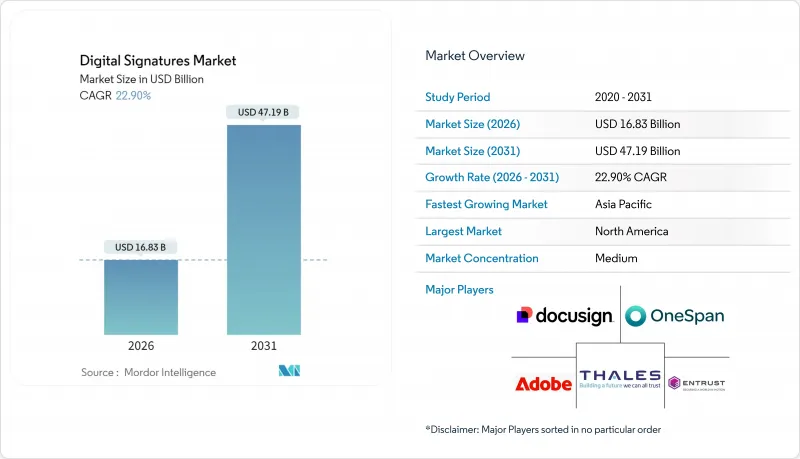
디지털 서명 시장 규모는 2026년에 168억 3,000만 달러에 달하고, 2031년까지 471억 9,000만 달러에 달할 것으로 예측되며, 2026년부터 2031년까지 CAGR 22.90%로 확대될 것으로 전망됩니다.
본 보고서는 도입 형태(온프레미스 및 클라우드), 제공 형태(소프트웨어, 하드웨어, 서비스), 최종사용자 산업(BFSI, 정부, 의료, 석유·가스, 군·방위, 물류·운송 등), 서명 유형(기본 전자서명, 고도 전자서명 등) 및 지역별로 분류되어 있습니다. 시장 전망은 금액(달러) 기준으로 제시되어 있습니다.
세계 디지털 서명 시장의 동향 및 인사이트
EU 내 적격 전자서명(eIDAS 2.0) 규정 준수 요건의 가속화
eIDAS 2.0의 단계적 도입에 따라, 기업들은 EU 전역의 관할권에서 자필 서명과 동등한 법적 효력을 지닌 적격 전자서명을 채택해야만 합니다. 이행 규칙 2025/1569에는 암호화 알고리즘 및 감사 요건이 명시되어 있으며, 이로 인해 적격 인증서 발급 건수가 급증하여 2025년 상반기에는 전년 동기 대비 340% 증가했습니다. 공증인, 토지등기소, 정부 조달 포털은 새로운 사양을 준수하고 있으며, 기존 인증 기관들은 현대화를 추진하거나 시장에서 철수해야 하는 선택의 기로에 서 있습니다. 이 규제의 역외 적용에 따른 영향은 두바이 국제금융센터(DIFC)에서도 뚜렷하게 나타납니다. 이 센터는 eIDAS 요건을 준수하기 위해 ‘전자거래법’을 개정하고 있으며, 이는 디지털 서명 시장을 활성화하는 더 광범위한 조화 추세를 보여줍니다.
아시아태평양 공공 부문 워크플로우의 대규모 디지털화 프로그램
인도에서는 2024년에 ‘eSign’ 프레임워크 하에서 Aadhaar 인증 서명 12억 건을 처리했습니다. 이는 68%의 급증이며, 그 파급 효과는 은행 업무 및 자동차 등록 사례까지 미치고 있습니다. 싱가포르의 ‘Sign with Singpass’는 2025년 중반까지 각 기관 전반에 걸쳐 95%의 도입률을 달성하여, 공공 주택 승인 주기를 5일에서 2시간 미만으로 단축했습니다. 2024년 11월부터 운영이 시작된 호주의 ‘디지털 ID’ 시스템은 향후 10년간 114억 호주 달러(76억 달러)의 비용 절감이 예상됩니다. 이러한 프로그램들은 민간 기업이 활용할 수 있는 국가 차원의 신뢰 인프라를 구축하여 네트워크 효과를 가속화하는 동시에, 디지털 서명 시장의 최저 기준을 높이고 있습니다.
국가별 데이터 현지화 규제가 국경을 초월한 효력을 저해
2024년에 개정된 중국의 ‘사이버 보안법’은 모든 서명 키 및 로그를 국내에 보관할 것을 의무화하고 있어, 다국적 클라우드 사업자가 아시아태평양 전체에 걸쳐 통일된 서비스를 제공하는 것을 방해하고 있습니다. 인도에서는 정부 기관에 제출되는 모든 문서에 대해 국내에서 발급된 인증서의 사용이 의무화되어 있어, 공공 계약과 민간 계약 모두에 서명해야 하는 기업의 업무 흐름이 단절되고 있습니다. 브라질의 LGPD(개인정보보호법)는 키가 기밀 데이터에 해당하는지 여부에 대한 불확실성을 야기하여, 기업들은 자회사마다 별도의 서명 스택을 호스팅할 수밖에 없는 상황입니다. 이러한 중복된 규제는 규정 준수 비용을 증가시키고, 중견 기업의 도입을 지연시키며, 전 세계 디지털 서명 시장의 연평균 성장률(CAGR)을 둔화시키고 있습니다.
부문 분석
2025년에는 디지털 서명 시장 점유율의 66.22%를 클라우드 도입이 차지했으며, 기업들이 서명 1건당 비용을 0.10달러 미만으로 억제할 수 있는 멀티테넌트형 플랫폼을 선호함에 따라 이 부문은 2031년까지 연평균 성장률(CAGR) 25.66%로 성장할 것으로 예측됩니다. 마이크로소프트가 Microsoft 365 E5 가입자에게 추가 비용 없이 서명 기능을 제공하기로 결정함에 따라 전환이 가속화되었고, 벤더의 난립이 억제되었습니다. 클라우드 워크플로우로 인한 디지털 서명 시장 규모는 현재 ISO/IEC 27001 인증을 획득한 아웃소싱을 수용하고 있는 규제 산업에서 가장 빠르게 확대되고 있습니다.
에어 갭 방식의 방어 네트워크에서는 온프레미스가 여전히 중요하지만, 하이브리드 모델도 부상하고 있습니다. 병원에서는 환자의 키를 시설 내에 보관하면서, 벤더와의 계약은 클라우드 기반 오케스트레이터를 통해 처리함으로써 처리 시간을 며칠에서 몇 시간으로 단축하고 있습니다. IoT 게이트웨이가 오프라인 상태에서 펌웨어 서명을 검증하는 엣지 배포는 해외 에너지 사업자들 사이에서 보급이 확대되고 있습니다. 이러한 미묘한 추세는 클라우드가 전반적인 성장을 주도하고 있음에도 불구하고, 디지털 서명 시장이 다양성을 유지하고 있는 이유를 여실히 보여줍니다.
2025년 디지털 서명 시장 규모에서 소프트웨어는 여전히 78.44%를 차지하고 있지만, 기업들이 레거시 시스템 통합에 직면함에 따라 서비스 부문은 연평균 성장률(CAGR) 24.76%로 확대되고 있습니다. 관리형 PKI, 규정 준수 컨설팅, 사용자 교육이 결합된 번들 서비스는 소프트웨어만으로는 메울 수 없는 격차를 해소합니다. OneSpan의 전문 서비스 매출이 전년 대비 32% 증가한 것은 이러한 방향 전환을 반영하고 있습니다.
하드웨어 지출은 유효한 서명에 변조 방지 모듈이 필요하기 때문에 정체되어 있지만, 범용화된 USB 토큰은 20달러 미만의 가격대로 고급 서명 워크플로우를 지원합니다. 교육 및 변경 관리 프로그램은 적격 서명 도입에 따른 헬프데스크의 부담을 줄여주며, 성과 기반의 참여 모델을 뒷받침합니다. 기업들이 라이선스 대신 턴키 솔루션을 요구함에 따라, 디지털 서명 시장 전체의 성장에 대한 기여도 측면에서 서비스 부문은 소프트웨어 부문을 앞지를 것으로 전망됩니다.
지역별 분석
북미는 성숙한 ‘ESIGN법’과 주요 공급업체의 집중에 힘입어 2025년 디지털 서명 시장의 40.12%를 차지했습니다. 캐나다 금융 기관에 따르면, 2025년에는 주택 담보 대출 신청의 84%에서 전자서명이 사용되었으며, 한편 멕시코에서는 2024년 법 개정을 통해 공증 절차가 온라인화되었습니다. 법정 집행의 확실성과 풍부한 벤더 선택지 덕분에 핀테크, 의료, 부동산 각 분야에서 견조한 거래량이 유지되고 있습니다.
아시아태평양은 2031년까지 연평균 성장률(CAGR)이 23.22%로 가장 빠르게 성장하는 지역입니다. 인도의 ‘eSign’은 2025년에 자동차 소유권 이전의 76%를 전자서명으로 처리하며, 그 이용 범위를 은행 업무 이외의 분야로 확대했습니다. 싱가포르 정부 기관의 거의 전면적인 도입과 호주의 전국적인 디지털 ID 제도는 공공 부문의 주도적 역할이 민간 수요를 급속히 유발할 수 있음을 입증하고 있습니다. 중국의 엄격한 데이터 현지화 규제는 해외 클라우드 공급업체의 진출을 둔화시키고 있지만, 현지 데이터 거주 요건을 충족하는 국내 유력 기업을 육성하고 있습니다. 일본에서는 2024년 법 개정을 통해 수출 서류의 디지털화가 가능해지면서 제조업에서의 이용이 확대되었습니다.
유럽에서는 복잡한 동향이 관찰됩니다. eIDAS 2.0은 적격 서명의 EU 전역 상호 인정을 의무화하고 있으며, 2025년에는 독일에서만 230만 건의 인증서가 발급되었습니다. EU를 탈퇴한 영국은 2024년 규정에 따라 전자 선하증권을 승인하고 있으며, 무역 금융의 디지털화를 촉진하고 있습니다. 프랑스는 2025년의 엄격한 감사 규정에 따라 인증된 신뢰 서비스 제공업체를 12개사로 축소하여, 대형 사업자 간의 시장 점유율 집중이 진행되었습니다. 중동 및 아프리카와 같은 소규모 지역에서는 EU 규정을 준수한 체계의 혜택을 누리고 있으며, 브라질의 ICP-Brasil은 남미 전역에서 적격한 세금 신고를 지원하고 있습니다. 이러한 지역적 동향들이 맞물려 디지털 서명 시장의 전 세계적 확산을 부각시키고 있습니다.
기타 혜택:
- 엑셀 형식의 시장 예측(ME) 시트
- 3개월간의 애널리스트 지원
자주 묻는 질문
목차
제1장 소개
제2장 조사 방법
제3장 주요 요약
제4장 시장 구도
제5장 시장 규모와 성장 예측
제6장 경쟁 구도
제7장 시장 기회와 향후 전망
KSM 26.09.07According to Mordor Intelligence, the digital signatures market size is USD 16.83 billion in 2026 and is forecast to reach USD 47.19 billion by 2031, expanding at a 22.90% CAGR during 2026-2031.
This report is Segmented by Deployment (On-Premise, and Cloud), Offering (Software, Hardware, and Services), End-User Industry (BFSI, Government, Healthcare, Oil and Gas, Military and Defense, Logistics and Transportation, and More), Signature Type (Basic Electronic Signatures, Advanced Electronic Signatures, and More), and Geography. The Market Forecasts are Provided in Terms of Value (USD).
Global Digital Signatures Market Trends and Insights
Accelerated Compliance Mandates For Qualified E-Signatures In EU (eIDAS 2.0)
The phased rollout of eIDAS 2.0 is forcing enterprises to adopt qualified electronic signatures that carry the same legal weight as handwritten ink across all EU jurisdictions. Implementing Regulation 2025/1569 spells out cryptographic algorithms and audit requirements, prompting a surge in qualified certificate issuance that climbed 340% year-over-year in H1 2025. Notaries, land registries, and government procurement portals are aligning on the new specifications, compressing timelines for legacy certificate authorities to modernize or exit. The regulation's extraterritorial pull is visible in Dubai International Financial Centre, which amended its Electronic Transactions Law to mirror eIDAS requirements, signaling a broader harmonization trend that stimulates the digital signatures market.
Mega-Scale Digitization Programs In Asia Pacific Public-Sector Workflows
India processed 1.2 billion Aadhaar-authenticated signatures in 2024 under its eSign framework, a 68% jump that spilled into banking and vehicle registration use cases. Singapore's Sign with Singpass had reached 95% adoption across agencies by mid-2025, cutting approval cycles for public housing from five days to less than two hours. Australia's Digital Identity system, live since November 2024, is projected to save AUD 11.4 billion (USD 7.6 billion) over 10 years. These programs establish national trust infrastructures that private firms can tap, accelerating network effects and raising the floor for the digital signatures market.
Country-Specific Data-Localization Rules Hindering Cross-Border Validity
China's 2024 Cybersecurity Law revision forces all signature keys and logs to stay onshore, blocking multinational clouds from offering unified services across Asia Pacific. India mandates domestic certificates for any document addressed to government entities, fragmenting workflows for firms signing both public and private contracts. Brazil's LGPD raises uncertainty around whether keys constitute sensitive data, pushing firms to host separate signature stacks for subsidiaries. These overlapping rules inflate compliance costs and slow adoption among mid-market firms, moderating the global CAGR of the digital signatures market.
Other drivers and restraints analyzed in the detailed report include:
- Embedded E-Signature APIs In Enterprise SaaS Suites
- Renewal Cycle Toward Post-Quantum Cryptography Certificate Stacks
- Fragmented Global Trust-Service Accreditation Regimes
For complete list of drivers and restraints, kindly check the Table Of Contents.
Segment Analysis
Cloud deployments accounted for 66.22% of the digital signatures market share in 2025, and the segment is projected to grow at a 25.66% CAGR to 2031 as firms favor multi-tenant platforms that keep per-signature costs below USD 0.10. Microsoft's decision to include signatures at no extra charge for Microsoft 365 E5 subscribers accelerated migration and reduced vendor sprawl. The digital signatures market size attributable to cloud workflows is expanding fastest in regulated industries that now accept ISO/IEC 27001-certified outsourcing.
While on-premise remains important for air-gapped defense networks, hybrid models are emerging. Hospitals hold patient keys on-site yet route vendor contracts through cloud-based orchestrators, compressing turnaround from days to hours. Edge deployments, where IoT gateways validate firmware signatures offline, are gaining traction among offshore energy operators. These nuanced patterns underscore why the digital signatures market retains diversity even as cloud dominates overall growth.
Software still captured 78.44% of the 2025 digital signatures market size, but services are expanding at a 24.76% CAGR as firms confront legacy integrations. Managed PKI, compliance consulting, and user-training bundles address gaps that pure software cannot. OneSpan's professional-services revenue jumped 32% year-over-year, reflecting this pivot.
Hardware spends remain steady because qualified signatures require tamper-resistant modules, yet commoditized USB tokens serve advanced-signature workflows at sub-USD 20 price points. Training and change-management programs reduce help-desk load for qualified signature rollouts, supporting outcome-based engagement models. As enterprises demand turnkey solutions rather than licenses, the services segment will outpace software in contribution to overall digital signatures market growth.
Complete Report Scope:
- By Deployment
- On-Premise
- Cloud
- By Offering
- Software
- Hardware
- Services
- By Signature Type
- Basic Electronic Signatures
- Advanced Electronic Signatures
- Qualified Electronic Signatures
- By End-User Industry
- BFSI
- Government
- Healthcare
- Oil and Gas
- Military and Defense
- Logistics and Transportation
- Other End-User Industries (Research and Education, Real Estate, Manufacturing, Legal, IT and Telecom)
- By Geography
- North America
- United States
- Canada
- Mexico
- South America
- Brazil
- Argentina
- Chile
- Peru
- Rest of South America
- Europe
- Germany
- United Kingdom
- France
- Italy
- Spain
- Rest of Europe
- Asia Pacific
- China
- Japan
- South Korea
- India
- Australia
- New Zealand
- Rest of Asia Pacific
- Middle East
- United Arab Emirates
- Saudi Arabia
- Turkey
- Africa
- South Africa
- Kenya
- Nigeria
- Rest of Africa
- North America
Geography Analysis
North America accounted for 40.12% of the digital signatures market in 2025, buoyed by the mature ESIGN Act and concentration of major vendors. Canadian lenders report that 84% of mortgage applications used electronic signatures in 2025, while Mexico's 2024 code amendment has pushed notarial acts online. Court enforcement certainty and abundant vendor choice sustain robust transaction volumes across fintech, healthcare, and real estate.
Asia Pacific is the fastest-growing region with a 23.22% CAGR to 2031. India's eSign handled 76% of vehicle transfers through digital signatures in 2025, extending reach beyond banking. Singapore's near-universal government adoption and Australia's national digital identity scheme prove public-sector leadership can jump-start private demand. China's tight data-localization rules slow foreign cloud vendors but foster domestic champions that satisfy local residency mandates. Japan's 2024 legal update unlocked export-documentation digitization, lifting usage among manufacturers.
Europe shows complex dynamics. eIDAS 2.0 mandates pan-EU recognition of qualified signatures, and Germany alone issued 2.3 million certificates in 2025. The United Kingdom, outside the EU, recognizes electronic bills of lading under its 2024 regulations, spurring trade-finance digitization. France reduced accredited trust providers to 12 under stricter 2025 audit rules, consolidating share among larger players. Smaller regions such as the Middle East and Africa benefit from EU-aligned frameworks, and Brazil's ICP-Brasil underpins qualified tax filings across South America. Together these regional trends underscore the global breadth of the digital signatures market.
- DocuSign Inc.
- Adobe Inc. (Adobe Sign)
- OneSpan Inc.
- Thales Group (SafeNet)
- Entrust Corporation
- Nitro Software Ltd.
- airSlate Inc. (SignNow)
- Dropbox Inc. (HelloSign)
- Box Inc. (SignRequest)
- SIGNiX Inc.
- Ascertia Limited
- GlobalSign GMO
- Signeasy
- PandaDoc Inc.
- RPost Communications Ltd.
- CertiSign Certificadora Digital S.A.
- Kofax Ltd.
- DigiCert Inc.
- Signicat AS
- Zoho Corporation Pvt. Ltd. (Zoho Sign)
- eMudhra Ltd.
- Namirial S.p.A.
Additional Benefits:
- The market estimate (ME) sheet in Excel format
- 3 months of analyst support
TABLE OF CONTENTS
1 INTRODUCTION
- 1.1 Study Assumptions and Market Definition
- 1.2 Scope of the Study
2 RESEARCH METHODOLOGY
- 2.1 Research Framework
- 2.2 Secondary Research
- 2.3 Primary Research
- 2.4 Data Triangulation and Insight Generation
3 EXECUTIVE SUMMARY
4 MARKET LANDSCAPE
- 4.1 Market Overview
- 4.2 Market Drivers
- 4.2.1 Accelerated Compliance Mandates for Qualified E-Signatures in EU (eIDAS 2.0)
- 4.2.2 Mega-Scale Digitisation Programmes in Asia Pacific Public Sector Workflows
- 4.2.3 Embedded E-Signature APIs in Enterprise SaaS Suites (Microsoft 365, Salesforce)
- 4.2.4 Renewal Cycle Toward Post-Quantum Cryptography Certificate Stacks
- 4.2.5 ESG-Linked Push for Paperless Transactions and Scope-3 Carbon Reduction
- 4.2.6 Digital Signatures Embedded in IoT Device Firmware Updates
- 4.3 Market Restraints
- 4.3.1 Country-Specific Data-Localisation Rules Hindering Cross-Border Validity
- 4.3.2 Fragmented Global Trust-Service Accreditation Regimes
- 4.3.3 UX Gaps for Biometric Signatures on Low-Bandwidth Mobile Networks
- 4.3.4 High Cost of HSM-Backed Qualified Signatures for SMBs
- 4.4 Industry Value Chain Analysis
- 4.5 Regulatory Outlook
- 4.6 Technological Outlook
- 4.7 Impact of Macroeconomic Factors on the Market
- 4.8 Porter's Five Forces Analysis
- 4.8.1 Bargaining Power of Suppliers
- 4.8.2 Bargaining Power of Buyers
- 4.8.3 Threat of New Entrants
- 4.8.4 Threat of Substitute Products
- 4.8.5 Intensity of Competitive Rivalry
5 MARKET SIZE AND GROWTH FORECASTS (VALUE)
- 5.1 By Deployment
- 5.1.1 On-Premise
- 5.1.2 Cloud
- 5.2 By Offering
- 5.2.1 Software
- 5.2.2 Hardware
- 5.2.3 Services
- 5.3 By Signature Type
- 5.3.1 Basic Electronic Signatures
- 5.3.2 Advanced Electronic Signatures
- 5.3.3 Qualified Electronic Signatures
- 5.4 By End-User Industry
- 5.4.1 BFSI
- 5.4.2 Government
- 5.4.3 Healthcare
- 5.4.4 Oil and Gas
- 5.4.5 Military and Defense
- 5.4.6 Logistics and Transportation
- 5.4.7 Other End-User Industries (Research and Education, Real Estate, Manufacturing, Legal, IT and Telecom)
- 5.5 By Geography
- 5.5.1 North America
- 5.5.1.1 United States
- 5.5.1.2 Canada
- 5.5.1.3 Mexico
- 5.5.2 South America
- 5.5.2.1 Brazil
- 5.5.2.2 Argentina
- 5.5.2.3 Chile
- 5.5.2.4 Peru
- 5.5.2.5 Rest of South America
- 5.5.3 Europe
- 5.5.3.1 Germany
- 5.5.3.2 United Kingdom
- 5.5.3.3 France
- 5.5.3.4 Italy
- 5.5.3.5 Spain
- 5.5.3.6 Rest of Europe
- 5.5.4 Asia Pacific
- 5.5.4.1 China
- 5.5.4.2 Japan
- 5.5.4.3 South Korea
- 5.5.4.4 India
- 5.5.4.5 Australia
- 5.5.4.6 New Zealand
- 5.5.4.7 Rest of Asia Pacific
- 5.5.5 Middle East
- 5.5.5.1 United Arab Emirates
- 5.5.5.2 Saudi Arabia
- 5.5.5.3 Turkey
- 5.5.6 Africa
- 5.5.6.1 South Africa
- 5.5.6.2 Kenya
- 5.5.6.3 Nigeria
- 5.5.6.4 Rest of Africa
- 5.5.1 North America
6 COMPETITIVE LANDSCAPE
- 6.1 Market Concentration
- 6.2 Strategic Developments
- 6.3 Market Share Analysis
- 6.4 Vendor Positioning Analysis
- 6.5 Company Profiles (Includes Global Level Overview, Market Level Overview, Core Segments, Financials as Available, Strategic Information, Market Rank/Share for Key Companies, Products and Services, and Recent Developments)
- 6.5.1 DocuSign Inc.
- 6.5.2 Adobe Inc. (Adobe Sign)
- 6.5.3 OneSpan Inc.
- 6.5.4 Thales Group (SafeNet)
- 6.5.5 Entrust Corporation
- 6.5.6 Nitro Software Ltd.
- 6.5.7 airSlate Inc. (SignNow)
- 6.5.8 Dropbox Inc. (HelloSign)
- 6.5.9 Box Inc. (SignRequest)
- 6.5.10 SIGNiX Inc.
- 6.5.11 Ascertia Limited
- 6.5.12 GlobalSign GMO
- 6.5.13 Signeasy
- 6.5.14 PandaDoc Inc.
- 6.5.15 RPost Communications Ltd.
- 6.5.16 CertiSign Certificadora Digital S.A.
- 6.5.17 Kofax Ltd.
- 6.5.18 DigiCert Inc.
- 6.5.19 Signicat AS
- 6.5.20 Zoho Corporation Pvt. Ltd. (Zoho Sign)
- 6.5.21 eMudhra Ltd.
- 6.5.22 Namirial S.p.A.
7 MARKET OPPORTUNITIES AND FUTURE OUTLOOK
- 7.1 White-Space and Unmet-Need Assessment