|
시장보고서
상품코드
2121507
자동차용 온도 센서 : 시장 점유율 분석, 업계 동향과 통계, 성장 예측(2026-2031년)Automotive Temperature Sensor - Market Share Analysis, Industry Trends & Statistics, Growth Forecasts (2026 - 2031) |
||||||
 Mordor Intelligence
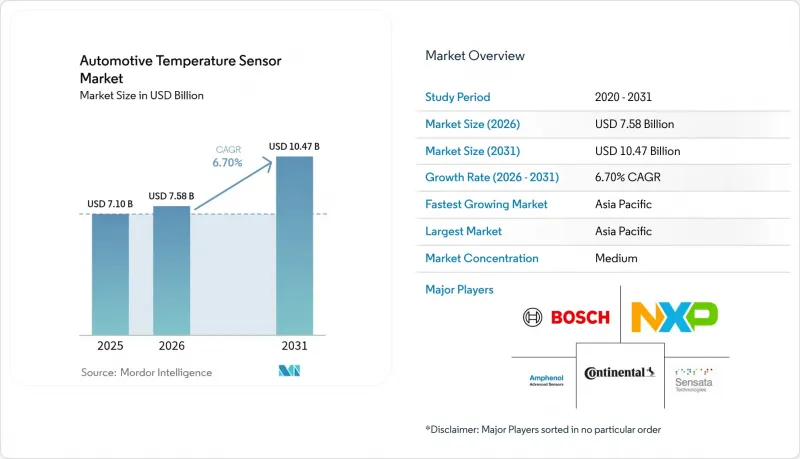
Mordor Intelligence에 의하면, 자동차용 온도 센서 시장 규모는 2025년에 71억 달러로 평가되었고, 2026년 75억 8,000만 달러에서 2031년까지 104억 7,000만 달러에 이를 것으로 예측되며, 예측 기간(2026-2031년) CAGR은 6.70%를 기록할 전망입니다.
본 보고서는 차종별(승용차, 소형 상용차 등), 용도별(파워트레인, 차체 전자기기, 대체 연료 차량 등), 센서 유형별(서미스터, 열전대 등), 판매 채널별(OEM 순정 장비 등) 및 지역별로 분류되어 있습니다. 시장 규모 및 전망은 금액(달러)으로 표시되어 있습니다.
세계 자동차용 온도 센서 시장 동향 및 인사이트
SiC 기반 파워 일렉트로닉스의 채택 가속화로 인해 EV 인버터의 열 정밀도 요건이 강화됨
SiC 스위치를 통해 드라이브 모듈은 600°C에 가까운 접합부 온도를 견디면서 실리콘에 비해 변환 효율을 30% 향상시킬 수 있습니다. 따라서 각 SiC 하프 브리지에는 열 폭주를 방지하고 800V 급속 충전 시 디레이팅 곡선을 최적화하기 위해 2-3개의 추가 온도 감지 지점이 통합되어 있습니다. 온세미(Onsemi) 및 기타 공급업체들의 파운드리 확장은 게이트 구동 보정 및 인버터 보증 기간 연장에 있어 열 데이터가 얼마나 중요하고 필수적인지 여실히 보여주고 있습니다.
존 아키텍처형 ECU의 급속한 보급이 다점 온도 모니터링을 촉진
존 컨트롤러 기반의 차량용 네트워크는 수십 개의 독립적인 ECU를 대체하여 배선량을 30% 줄이는 한편, 밀폐형 알루미늄 하우징 내의 열 밀도를 높이고 있습니다. 설계자들은 현재 로컬 I3C 링크에 소형 디지털 센서를 분산 배치하고 있으며, 이를 통해 펌웨어가 부하, 팬 속도, 중복성을 실시간으로 균형 있게 조정할 수 있게 되었습니다. 유럽의 프리미엄 차량 모델에 대한 초기 도입 사례에서 실제 운용상의 신뢰성이 입증되었으며, 이러한 실적을 바탕으로 양산 부문의 OEM 업체들도 2026년 이후부터 이 기술로의 전환을 추진하고 있습니다.
Tier 1 공급업체 간 NTC 서미스터 표준화에 따른 가격 하락
Tier 1 하네스 제조업체들은 1 kΩ-100 kΩ의 특성 곡선에 관한 사양을 통일했습니다. 이를 통해 대량 구매가 가능해져 연간 3%-5%의 가격 인하가 실현되고 있습니다. 이에 반해, 서미스터 전문 벤더들은 250°C 구역용 고부가가치 에폭시 피복 비드로 생산을 전환하거나, 이익률을 확보하기 위해 보정 테이블을 내장한 디지털 IC와 같은 고부가가치 제품으로 시장을 전환함으로써 대응하고 있습니다.
부문 분석
서미스터는 저렴한 비용과 냉각수, HVAC 및 엔트리 레벨 배터리 모듈에서 입증된 신뢰성 덕분에 2025년 자동차용 온도 센서 시장에서 42.62%의 점유율을 유지했습니다. 각 BEV에는 이미 100개 이상의 NTC 소자가 탑재되어 있으며, 단가가 하락 추세를 보이고 있음에도 불구하고 서미스터에 기인한 자동차용 온도 센서 시장 규모는 꾸준히 확대될 전망입니다. 이러한 기존 기술의 확고한 입지로 인해, 하이엔드 차종에서는 정확도 격차를 해소하기 위해 NTC와 구역별 연산 허브 내의 선형화 알고리즘을 결합할 수밖에 없습니다.
반도체 기반 IC 센서는 2031년까지 연평균 성장률(CAGR) 8.66%로 성장하고 있습니다. ±0.4°C의 정밀도와 I3C/I2C로의 직접 출력을 통해, 1mm 단위의 정밀도가 요구되는 인휠 파워 일렉트로닉스 등 제한된 공간에서의 배선이 간소화됩니다. 시스템 설계자들이 부피가 큰 보정 테이블을 단계적으로 폐지함에 따라, 자동차용 온도 센서 시장은 성능과 BOM(부품표) 효율의 동시 향상이라는 이점을 누리고 있습니다. RTD는 금속 가격 변동에도 불구하고 고정밀 배기 피드백 루프에 계속 활용되고 있는 반면, 열전대는 900°C를 초과하는 터보 하우징에 여전히 통합되어 있습니다.
승용차는 2025년 매출의 67.94%를 차지하며, 자동차용 온도 센서 시장의 중추적인 역할을 계속하고 있습니다. 프리미엄 등급의 정교한 실내 쾌적성 알고리즘에서는 여러 센싱 노드를 활용하여 마이크로 제트, 시트 히터, 구역별 HVAC 루버를 제어하고 있습니다. 콘티넨탈(Continental)의 공장 테스트에 따르면, 생산 라인에 추가적인 열 진단 시스템을 도입한 결과 종합 설비 효율(OEE)이 15% 향상되었다고 보고되어, 업스트림 제조 공정도 센서의 소비처 중 하나임을 보여주고 있습니다.
BEV(배터리 전기자동차)는 연평균 성장률(CAGR) 10.12%로 가장 빠르게 성장하고 있는 부문입니다. 모든 배터리 모듈에는 버스바에 서미스터가 장착되어 있고, 셀 탭 아래에 박막 RTD가 내장되어 있으며, 비접촉 모니터링용 적외선 다이(die)가 배치되어 있습니다. 이로 인해 하이브리드 차량에 비해 차량 1대당 자동차용 온도 센서 시장 규모는 전체적으로 2배에 달할 전망입니다. 소형 상용 전기 밴에는 현재 가스 발생 감지 센서가 탑재되어 있으며, 조기 경보 데이터를 차량 관리 대시보드로 전송함으로써 열 안전성과 자산 가동률 지표를 연계하고 있습니다. 아시아의 밀집된 도시 지역에서 이륜차 시장도 규모가 확대되고 있으며, 진동에 강한 소형 에폭시 수지 밀봉형 NTC 비드가 활용되고 있습니다.
지역별 분석
아시아태평양은 2025년에 자동차용 온도 센서 시장 점유율의 41.12%를 차지할 것으로 예상되며, 이는 세계 최대의 자동차 생산 거점으로서의 위상을 반영합니다. 중국의 자동차 제조업체들은 2030년까지 첨단 전자 부품의 현지 조달률을 15%에서 60%로 높일 예정이며, 이를 통해 국내 서미스터 및 IC 제조 공장에 더 많은 설계 채택 기회가 제공될 것입니다. 일본과 한국은 고밀도 센싱 어레이를 탑재한 고체 배터리 시범 사업에 지속적으로 막대한 투자를 하고 있으며, 향후 10년 동안 자동차용 온도 센서 시장 규모에 대한 해당 지역의 기여도를 높여갈 전망입니다.
유럽은 2위를 차지하고 있으며, 실시간 배기가스 분석을 의무화하는 엄격한 EU7 규제와 차량 내 공조 성능 향상을 중시하는 프리미엄 차량의 강력한 개발 파이프라인에 힘입고 있습니다. 독일의 각 OEM 업체들은 구역별 아키텍처 도입을 주도하고 있으며, 새로운 컨트롤러 클러스터마다 독자적인 주변 온도용, 기판 가장자리용, MOSFET 뒷면용 다이가 탑재되기 때문에 수요가 여러 제품군으로 분산되고 있습니다. 라인강 유역에 거점을 둔 공급업체들은 백금 공급 부족에 대응하기 위해 니켈 박막 RTD 생산 라인을 가동하고 있어, 지역의 자급자족 능력을 강화하고 있습니다.
북미는 트레일러 견인용으로 800V 구동을 선호하는 픽업 트럭 및 SUV에서 SiC 기반 구동 모듈의 채택이 확대되고 있는 덕분에 견고한 입지를 유지하고 있습니다. 현지 배터리 제조에 대한 법적 우대 조치로 인해 센서 조달처는 수직 통합형 미국 시설로 이동하고 있습니다. 중동은 현재 시장 규모는 작지만, 리야드와 두바이에 조성된 자율주행 전용 구역에서 사막의 더위로부터 컴퓨팅 클러스터를 보호하기 위한 이중화된 열 관리 노드를 탑재한 L4 레벨 셔틀이 표준화됨에 따라 연평균 성장률(CAGR) 9.03%를 나타낼 것으로 예측됩니다. 남미의 점진적인 성장은 브라질의 대도시권에서 운행되는 신흥 전기 버스는 물론, 여전히 배기가스 센서가 필요한 플렉스 연료 파워트레인과도 관련이 있습니다.
기타 혜택:
- 엑셀 형식 시장 예측(ME) 시트
- 3개월간의 애널리스트 지원
자주 묻는 질문
목차
제1장 서론
제2장 조사 방법
제3장 주요 요약
제4장 시장 구도
제5장 시장 규모와 성장 예측
제6장 경쟁 구도
제7장 시장 기회와 향후 전망
LSH 26.09.09According to Mordor Intelligence, the automotive temperature sensor market size was valued at USD 7.1 billion in 2025 and estimated to grow from USD 7.58 billion in 2026 to reach USD 10.47 billion by 2031, at a CAGR of 6.70% during the forecast period (2026-2031).
This report is Segmented by Vehicle Type (Passenger Cars, Light Commercial Vehicles, and More), Application (Powertrain, Body Electronics, Alternative Fuel Vehicles, and More), Sensor Type (Thermistor, Thermocouple, and More), Sales Channel(OEM-Fitted and More) and Geography. The Market Sizes and Forecasts are Provided in Terms of Value in (USD).
Global Automotive Temperature Sensor Market Trends and Insights
Accelerating Adoption of SiC-Based Power Electronics Intensifying Thermal Accuracy Requirements in EV Inverters
SiC switches enable drive modules to sustain junction temperatures near 600 °C while boosting conversion efficiency by 30% compared with silicon. Each SiC half-bridge therefore integrates two to three extra temperature sensing points to guard against thermal runaway and to optimise derating curves during 800 V fast charging. Foundry expansions at Onsemi and other suppliers underline how thermal data has become mission-critical for gate-drive calibration and extended inverter warranties.
Rapid Growth of Zonal-Architecture ECUs Driving Multi-Point Temperature Monitoring
Vehicle networks built on zone controllers replace dozens of standalone ECUs, trimming wiring mass by 30% yet raising heat density inside sealed aluminium housings. Designers now distribute small digital sensors on local I3C links so that firmware can balance load, fan speed and redundancy in real time. Early deployments across premium European platforms are demonstrating field reliability that is convincing volume-segment OEMs to transition from 2026 onward.
Price-Erosion from Standardisation of NTC Thermistors among Tier-1s
Tier-1 harness builders have harmonised specifications around 1 kΩ to 100 kΩ curves, allowing large volume buys that drive annual price concessions of 3%-5%. Pure-play thermistor vendors are responding by shifting output to higher-value epoxy--coated beads for 250 °C zones or by moving up-market into digital ICs that embed calibration tables to secure margins.
Other drivers and restraints analyzed in the detailed report include:
- EU7 and China VI-b Emission Norms Mandating Exhaust Gas Sensors with Wider Range
- Thermal Management Imperatives in Solid-State Battery Packs
- Supply-Chain Volatility of High-Purity Nickel & Platinum Used in RTDs
For complete list of drivers and restraints, kindly check the Table Of Contents.
Segment Analysis
Thermistors retained a 42.62% share of the automotive temperature sensor market in 2025 owing to their low cost and proven reliability in coolant, HVAC and entry-level battery modules. Each BEV already deploys more than 100 NTC elements, and the automotive temperature sensor market size attributable to thermistors is on course to rise steadily even as unit prices drift lower. The firm grip of this legacy technology has forced higher-end vehicles to pair NTCs with linearisation algorithms inside zonal compute hubs to reconcile accuracy gaps.
Semiconductor-based IC sensors are advancing at an 8.66% CAGR through 2031. Their +-0.4 °C accuracy and direct I3C/I^2C output simplify harnessing in confined zones such as in-wheel power electronics, where every millimetre counts. As system designers phase out bulky compensation tables, the automotive temperature sensor market benefits from simultaneous gains in performance and bill-of-materials efficiency. RTDs continue serving precision exhaust feedback loops despite metal volatility, while thermocouples stay embedded in turbo housings that exceed 900 °C.
Passenger cars commanded 67.94% of 2025 revenue and remain the anchor for the automotive temperature sensor market. Sophisticated cabin comfort algorithms in premium trims exploit multiple sensing nodes to modulate micro-jets, seat heaters and zoned HVAC louvers. Continental's factory trials reported a 15% uplift in overall equipment effectiveness after equipping production lines with additional thermal diagnostics - evidence that upstream manufacturing is also a consumption vector for sensors.
BEVs represent the fasting-growing cohort at a 10.12% CAGR. Every battery module clips thermistors to bus bars, embeds thin-film RTDs under cell tabs, and situates infrared die for non-contact monitoring-collectively doubling the automotive temperature sensor market size per vehicle relative to hybrids. Light commercial e-vans now integrate gas-generation detection sensors that relay early warning data to fleet dashboards, aligning thermal safety with asset-availability metrics. Two-wheelers in dense Asian cities add scale, leveraging compact, epoxy-sealed NTC beads resistant to vibration.
Complete Report Scope:
- By Sensor Type
- Thermistor (NTC/PTC)
- Resistance Temperature Detector (RTD)
- Thermocouple
- Semiconductor-Based IC Sensor
- MEMS and Infra-Red Sensor
- By Vehicle Type
- Passenger Cars
- Light Commercial Vehicles
- Heavy Commercial Vehicles
- Two-Wheelers and Micro-Mobility
- By Application
- Powertrain (ICE, Hybrid)
- Battery and Electric Drive-Train
- Chassis and Safety Systems
- Body and Comfort Electronics
- Telematics and Connectivity Modules
- By Sales Channel
- OEM-Fitted
- Aftermarket
- By Geography
- North America
- United States
- Canada
- South America
- Brazil
- Argentina
- Europe
- Germany
- France
- Italy
- Spain
- United Kingdom
- Nordics
- Rest of Europe
- Middle East
- Gulf Cooperation Council
- Turkey
- Rest of Middle East
- Africa
- South Africa
- Nigeria
- Rest of Africa
- Asia-Pacific
- China
- Japan
- India
- South Korea
- ASEAN-5
- Rest of Asia-Pacific
- North America
Geography Analysis
Asia-Pacific held 41.12% of automotive temperature sensor market share in 2025, reflecting its status as the world's largest vehicle production hub. Chinese assemblers are localising advanced electronic content from 15% to 60% by 2030, funnelling additional design-win opportunities to domestic thermistor and IC fabs. Japan and South Korea continue to invest heavily in solid-state battery pilots, which embed denser sensing arrays and lift the region's contribution to automotive temperature sensor market size through the decade.
Europe ranks second, propelled by stringent EU7 rules that require real-time exhaust gas analytics and by a strong premium vehicle pipeline that emphasises in-cabin climate refinement. German OEMs spearhead zonal architecture rollouts; each new controller cluster carries its own ambient, board-edge, and MOSFET backside die, spreading demand across multiple product families. Suppliers located near the Rhine valley are setting up nickel-film RTD lines to navigate platinum scarcity, reinforcing regional self-sufficiency.
North America maintains a robust position thanks to high uptake of SiC-based drive modules in pickup trucks and SUVs that favour 800 V propulsion for trailer towing. Legislative incentives for local battery manufacturing are steering sensor sourcing toward vertically integrated US facilities. The Middle East, although small today, is forecast to clock a 9.03% CAGR as purpose-built autonomous mobility zones in Riyadh and Dubai standardise L4 shuttles loaded with redundant thermal nodes to safeguard compute clusters against desert heat. South America's incremental growth is linked to flex-fuel powertrains that still need exhaust gas sensors alongside emergent electric buses operating in Brazilian megacities.
- NXP Semiconductors N.V.
- Sensata Technologies, Inc.
- Amphenol Advanced Sensors
- Robert Bosch GmbH
- Continental AG
- Texas Instruments Inc.
- TE Connectivity Ltd.
- Panasonic Holdings Corp.
- Murata Manufacturing Co., Ltd.
- TDK Corporation
- Honeywell International Inc.
- Infineon Technologies AG
- STMicroelectronics N.V.
- Denso Corporation
- BorgWarner Inc. (Delphi Technologies)
- Vishay Intertechnology, Inc.
- Microchip Technology Inc.
- Analog Devices, Inc.
- Renesas Electronics Corporation
- Littelfuse, Inc.
Additional Benefits:
- The market estimate (ME) sheet in Excel format
- 3 months of analyst support
TABLE OF CONTENTS
1 INTRODUCTION
- 1.1 Study Assumptions and Market Definition Scope of the Study
2 RESEARCH METHODOLOGY
3 EXECUTIVE SUMMARY
4 MARKET LANDSCAPE
- 4.1 Market Overview
- 4.2 Market Drivers
- 4.2.1 Accelerating Adoption of SiC-based Power Electronics Intensifying Thermal Accuracy Requirements in EV Inverters
- 4.2.2 Rapid Growth of Zonal-Architecture ECUs Driving Multi-Point Temperature Monitoring
- 4.2.3 EU7 and China VI-b Emission Norms Mandating Exhaust Gas Temperature Sensors with Wider Operating Range
- 4.2.4 Thermal Management Imperatives in Solid-State Battery Packs
- 4.2.5 Rising Demand for Cabin Health Sensors (HVAC Air Quality and Seat Comfort) in Premium Vehicles
- 4.2.6 Semiconductor Packaging Shift to Automotive-Grade Wafer-Level Sensors
- 4.3 Market Restraints
- 4.3.1 Price-Erosion from Standardization of NTC Thermistors among Tier-1s
- 4.3.2 Supply-Chain Volatility of High-Purity Nickel and Platinum Used in RTDs
- 4.3.3 Slow Retrofit Rates in Commercial Vehicle Fleets
- 4.3.4 Cross-Sensitivity and Drift Issues in Low-Cost MEMS Sensors Limiting Aftermarket Adoption
- 4.4 Value / Supply-Chain Analysis
- 4.5 Regulatory Outlook
- 4.6 Technological Outlook
- 4.7 Porter's Five Forces Analysis
- 4.7.1 Threat of New Entrants
- 4.7.2 Bargaining Power of Buyers
- 4.7.3 Bargaining Power of Suppliers
- 4.7.4 Threat of Substitutes
- 4.7.5 Competitive Rivalry
- 4.8 Investment Analysis
5 MARKET SIZE AND GROWTH FORECASTS (VALUE)
- 5.1 By Sensor Type
- 5.1.1 Thermistor (NTC/PTC)
- 5.1.2 Resistance Temperature Detector (RTD)
- 5.1.3 Thermocouple
- 5.1.4 Semiconductor-Based IC Sensor
- 5.1.5 MEMS and Infra-Red Sensor
- 5.2 By Vehicle Type
- 5.2.1 Passenger Cars
- 5.2.2 Light Commercial Vehicles
- 5.2.3 Heavy Commercial Vehicles
- 5.2.4 Two-Wheelers and Micro-Mobility
- 5.3 By Application
- 5.3.1 Powertrain (ICE, Hybrid)
- 5.3.2 Battery and Electric Drive-Train
- 5.3.3 Chassis and Safety Systems
- 5.3.4 Body and Comfort Electronics
- 5.3.5 Telematics and Connectivity Modules
- 5.4 By Sales Channel
- 5.4.1 OEM-Fitted
- 5.4.2 Aftermarket
- 5.5 By Geography
- 5.5.1 North America
- 5.5.1.1 United States
- 5.5.1.2 Canada
- 5.5.2 South America
- 5.5.2.1 Brazil
- 5.5.2.2 Argentina
- 5.5.3 Europe
- 5.5.3.1 Germany
- 5.5.3.2 France
- 5.5.3.3 Italy
- 5.5.3.4 Spain
- 5.5.3.5 United Kingdom
- 5.5.3.6 Nordics
- 5.5.3.7 Rest of Europe
- 5.5.4 Middle East
- 5.5.4.1 Gulf Cooperation Council
- 5.5.4.2 Turkey
- 5.5.4.3 Rest of Middle East
- 5.5.5 Africa
- 5.5.5.1 South Africa
- 5.5.5.2 Nigeria
- 5.5.5.3 Rest of Africa
- 5.5.6 Asia-Pacific
- 5.5.6.1 China
- 5.5.6.2 Japan
- 5.5.6.3 India
- 5.5.6.4 South Korea
- 5.5.6.5 ASEAN-5
- 5.5.6.6 Rest of Asia-Pacific
- 5.5.1 North America
6 COMPETITIVE LANDSCAPE
- 6.1 Market Concentration
- 6.2 Strategic Moves
- 6.3 Market Share Analysis
- 6.4 Company Profiles {(includes Global level Overview, Market level overview, Core Segments, Financials as available, Strategic Information, Market Rank/Share for key companies, Products and Services, and Recent Developments)}
- 6.4.1 NXP Semiconductors N.V.
- 6.4.2 Sensata Technologies, Inc.
- 6.4.3 Amphenol Advanced Sensors
- 6.4.4 Robert Bosch GmbH
- 6.4.5 Continental AG
- 6.4.6 Texas Instruments Inc.
- 6.4.7 TE Connectivity Ltd.
- 6.4.8 Panasonic Holdings Corp.
- 6.4.9 Murata Manufacturing Co., Ltd.
- 6.4.10 TDK Corporation
- 6.4.11 Honeywell International Inc.
- 6.4.12 Infineon Technologies AG
- 6.4.13 STMicroelectronics N.V.
- 6.4.14 Denso Corporation
- 6.4.15 BorgWarner Inc. (Delphi Technologies)
- 6.4.16 Vishay Intertechnology, Inc.
- 6.4.17 Microchip Technology Inc.
- 6.4.18 Analog Devices, Inc.
- 6.4.19 Renesas Electronics Corporation
- 6.4.20 Littelfuse, Inc.
7 MARKET OPPORTUNITIES AND FUTURE OUTLOOK
- 7.1 White-Space and Unmet-Need Assessment