|
시장보고서
상품코드
2121513
티타늄 합금 : 시장 점유율 분석, 업계 동향과 통계, 성장 예측(2026-2031년)Titanium Alloy - Market Share Analysis, Industry Trends & Statistics, Growth Forecasts (2026 - 2031) |
||||||
 Mordor Intelligence
티타늄 합금 시장 규모는 2025년 158.23 킬로톤에서 2026년에는 166.44 킬로톤으로 확대되고, 2026년부터 2031년까지 CAGR 5.19%를 기록하며 2031년에는 214.35 킬로톤에 달할 것으로 예측됩니다.
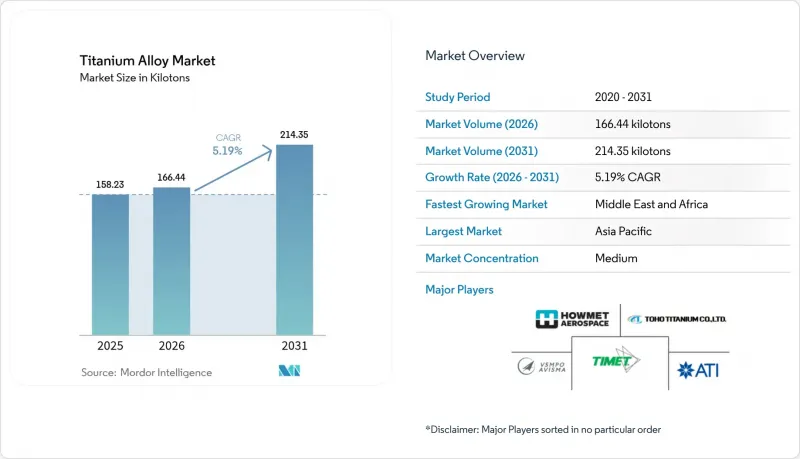
본 보고서는 미세구조(알파 및 니어 알파, 알파·베타, 베타), 최종사용자 산업(항공우주, 자동차·조선, 화학 처리, 전력·해수 담수화, 의료·치과용 임플란트, 기타 최종사용자 산업), 및 지역(아시아태평양, 북미, 유럽, 남미, 중동 및 아프리카)별로 분류되어 있습니다. 시장 예측은 킬로톤 기준으로 제시됩니다.
세계 티타늄 합금 시장의 동향 및 인사이트
항공우주·방위 분야의 기체 수요 확대
15,000대를 넘는 민간 항공기 수주로 인해 티타늄은 구조 부품, 착륙 장치 및 엔진 부품에 확실히 채택되고 있으며, 경량화는 연료비 절감으로 이어지고 있습니다. ATI는 2025년 1분기 매출의 66%를 항공우주 및 방위 분야에서 올렸으며, 에어버스와 5년간 10억 달러 규모의 공급 계약을 체결했습니다. 하우메트 에어로스페이스는 엔진 수요의 급증으로 인해 2024년 3분기 민간 항공우주 부문 매출이 17% 증가했습니다. 현재 제트 엔진 무게에서 티타늄이 차지하는 비율은 15-25%에 달하며, 방위 프로그램에서는 스텔스성과 내구성을 확보하기 위해 티타늄 합금의 사용이 지정되어 있습니다. 러시아산 원자재 의존에서 벗어나기 위한 다각화가 진행되고 있으며, 일본 및 중동의 공급업체와의 새로운 제휴가 촉진되면서 티타늄 합금 시장의 생산 재편이 더욱 가속화되고 있습니다.
군용 지상 차량 경량화 프로그램
방위 계획 담당자들은 방어 성능을 저해하지 않으면서 항속 거리와 적재량을 향상시키기 위해 장갑, 구동계, 서스펜션 분야에서 강재 대신 티타늄을 사용하는 것을 점점 더 확대하고 있습니다. 미국 국방부가 IperionX사에 4,710만 달러 규모의 계약을 체결한 것은 안전하고 저비용의 티타늄 생산능력 확보를 위한 국가적 노력을 뒷받침하고 있습니다. 재료 사양을 통일하는 NATO 규격은 국경을 초월한 수요를 확대하고 있으며, 현장 데이터에 따르면 티타늄 부품이 강철을 대체할 경우 15-20%의 연료 절감 효과가 확인되었습니다. 첨단 제조 기술로 인해 부품 수가 감소하여 배치 중인 차량군의 유지보수 부담이 경감될 뿐만 아니라, 티타늄 합금 시장의 장기적인 성장세를 뒷받침하고 있습니다.
높은 생산 비용과 복잡한 야금 공정
기존의 크롤 공법에서는 1톤당 11-13MWh의 에너지를 소비하기 때문에 티타늄의 가격은 알루미늄의 3-4배, 강철의 10-15배에 달합니다. 반응성이 높은 야금 공정에는 불활성 분위기나 특수한 절삭유가 필요하며, 이는 다운스트림 공정의 기계 가공 생산성을 저해하고 있습니다. 수소를 보조로 사용하는 환원법은 저온화가 기대되지만, 아직 실용화 전 단계에 있습니다. 도쿄대학이 개발한 이트륨 반응을 이용한 산소 제거 기술은 비용 절감 가능성을 내포하고 있지만, 산업 규모로 확대하기까지는 아직 수년이 소요될 것입니다. 새로운 공정이 성숙하기 전까지는 높은 전환 비용이 티타늄 합금 시장의 잠재력을 제한하게 될 것입니다.
부문 분석
베타 합금은 2031년까지 연평균 성장률(CAGR) 6.02%를 기록할 것으로 예측되지만, 2025년 시점에서는 알파·베타계 합금이 티타늄 합금 시장 점유율의 51.12%를 차지했습니다. Ti-5553은 뛰어난 주조성을 보이며, 주익의 캐리 스루 부분이나 랜딩 기구의 구조에 필수적인 높은 강도 대 중량 비율을 실현하고 있습니다. 지르코늄 및 하프늄을 배합한 고엔트로피 금속간 화합물에 대한 연구 결과, 8%의 소성 변형률에서 1.5 GPa의 항복 강도가 달성되어 초음속 용도의 선택지가 넓어지고 있습니다.
진행 중인 적층 제조 기술의 도입으로 니어넷쉐이프(near-net-shape) 생산이 가능해져, 구매에서 비행까지의 비율을 최대 60%까지 단축하는 동시에 터빈 블레이드의 복잡한 냉각 채널 구조를 구현하고 있습니다. 베타계 티타늄 합금의 시장 규모는 분말 분무 능력의 향상과 중요한 비행용 하드웨어 인증 시험에서의 시너지 효과에 힘입어, 향후 10년 말에는 전체의 약 25%에 달할 것으로 전망됩니다. 500°C를 초과하는 온도 환경에 적합한 알파 합금 및 니어 알파 합금에 대한 병행된 관심으로 인해, 가스 터빈 및 우주 추진 분야에서의 수요가 유지되고 있습니다. 생산자들이 진공 아크 재용해 매개변수를 표준화함에 따라 합금의 화학 성분이 안정화되어, 항공우주 및 방위 분야의 주요 기업들 간의 신뢰가 높아지고 있습니다.
지역별 분석
2025년, 아시아태평양은 티타늄 합금 시장의 41.02%를 차지했으며, 그 기반이 되는 것은 전 세계 금속 생산량의 60%를 차지하는 중국의 점유율입니다. 그러나 이 지역의 항공우주 인증 지연으로 인해 고부가가치 제트기 프로그램에 즉시 진입하는 데 차질이 생기고 있습니다. 인도는 HAL 및 DRDO와 제휴하여 국산 스펀지 티타늄의 생산능력 확충에 주력하고 있는 반면, 호주의 광산 기업들은 밸류체인의 업스트림에서 더 많은 이익을 확보하기 위해 다운스트림 공정에서의 합금화 사업을 모색하고 있습니다. 품질 측면의 과제는 여전히 남아 있지만, 이러한 노력들이 어우러져 견조한 생산량 증가를 뒷받침하고 있습니다.
연평균 성장률(CAGR) 5.85%로 확대되고 있는 중동 및 아프리카는 사우디아라비아의 460억 달러 규모의 광업 전략의 혜택을 받고 있습니다. 이 전략은 2030년까지 광업이 GDP에서 차지하는 비중을 750억으로 끌어올리고, 사우디아라비아를 중립적인 티타늄 공급국으로 자리매김하는 것을 목표로 하고 있습니다. 북미에서는 스펀지 생산량이 극히 적음에도 불구하고 소비량은 높은 수준을 유지하고 있습니다. 노스캐롤라이나주 컴벌랜드 카운티에서는 수소 보조 환원법을 활용한 국내 생산능력 재구축을 위해 8억 6,700만 달러 규모의 플랜트 건설이 결정되었습니다. 이 플랜트는 본격 가동 시 연간 1만 톤을 공급할 수 있을 것으로 전망됩니다. 캐나다에서는 퀘벡주의 수력발전을 활용한 일메나이트 광산이 저탄소 스펀지로의 수직 통합을 모색하고 있습니다.
대서양 건너편에서는 유럽의 OEM 각사가 제재 준수와 생산 지속의 균형을 맞추는 데 고심하고 있으며, 카자흐스탄 및 일본의 공급업체와의 합작 사업에 관한 협의가 진행되고 있습니다. 또한, EU의 ‘중요 원자재법’에 따라 노르웨이와 스페인 내 스펀지 티타늄 프로젝트의 인허가 절차가 신속히 진행되고 있습니다. 남미는 여전히 주로 원광 수출 지역이지만, 브라질 국가개발은행은 기존 일메나이트 광산 인근의 다운스트림 합금 공장 공동 금융에 관심을 보이고 있습니다. 전반적으로 공급 기반의 변화가 티타늄 합금 시장의 재편을 지속적으로 촉진하고 있습니다.
기타 혜택:
- 엑셀 형식의 시장 예측(ME) 시트
- 3개월간의 애널리스트 지원
자주 묻는 질문
목차
제1장 소개
제2장 조사 방법
제3장 주요 요약
제4장 시장 구도
제5장 시장 규모와 성장 예측
제6장 경쟁 구도
제7장 시장 기회와 향후 전망
KSM 26.09.07According to Mordor Intelligence, the titanium alloy market size is expected to grow from 158.23 kilotons in 2025 to 166.44 kilotons in 2026 and is forecast to reach 214.35 kilotons by 2031 at 5.19% CAGR over 2026-2031.
This report is Segmented by Microstructure (Alpha and Near-Alpha, Alpha-Beta, and Beta), End-User Industry (Aerospace, Automotive and Shipbuilding, Chemical Processing, Power and Desalination, Medical and Dental Implants, and Other End-User Industries), and Geography (Asia-Pacific, North America, Europe, South America, and Middle-East and Africa). The Market Forecasts are Provided in Terms of Volume (Kilotons).
Global Titanium Alloy Market Trends and Insights
Growing Aerospace and Defense Airframe Demand
Orders exceeding 15,000 commercial aircraft place titanium squarely in structural, landing-gear, and engine components, where weight reduction translates into fuel savings. ATI drew 66% of Q1 2025 revenue from aerospace and defense and locked in a five-year USD 1 billion supply pact with Airbus. Howmet Aerospace recorded 17% commercial-aerospace sales growth in Q3 2024 on surging engine demand. Titanium intensity now reaches 15-25% of a jet engine's weight, while defense programs specify the alloy for stealth and durability. Diversification away from Russian feedstock is driving new partnerships with Japanese and Middle Eastern suppliers, reinforcing the titanium alloy market's production realignment.
Military Ground-Vehicle Light-Weighting Programs
Defense planners increasingly swap steel for titanium in armor, drivetrains, and suspensions to boost range and payload without sacrificing protection. The U.S. Department of Defense's USD 47.1 million award to IperionX underscores a national push for secure, low-cost titanium capacity. NATO standards that harmonize material specifications amplify cross-border demand, and field data show 15-20% fuel savings when titanium components replace steel. Advanced manufacturing shortens part lists, easing maintenance burden for deployed vehicle fleets and fueling long-run momentum in the titanium alloy market.
High Production Cost and Complex Metallurgy
The legacy Kroll route burns 11-13 MWh per ton, making titanium 3-4 times pricier than aluminum and 10-15 times pricier than steel. Reactive metallurgy demands inert atmospheres and specialized cutting fluids, hampering productivity in downstream machining. Hydrogen-assisted reduction pathways promise lower temperatures but remain pre-commercial. University of Tokyo techniques for oxygen removal via yttrium reactions offer potential cost savings, yet industrial scaling is several years. Until new processes mature, elevated conversion costs cap the full potential of the titanium alloy market.
Other drivers and restraints analyzed in the detailed report include:
- Expansion of Medical and Dental Implant Procedures
- Additive Manufacturing Unlocking Novel Grades
- Geopolitical Dependence on Russian Feedstock
For complete list of drivers and restraints, kindly check the Table Of Contents.
Segment Analysis
Beta alloys are projected to register a 6.02% CAGR through 2031, while Alpha-Beta grades retained 51.12% of the titanium alloy market share in 2025. Ti-5553 demonstrates superior castability, delivering high strength-to-weight ratios vital for wing-carry-throughs and landing-gear structures. Research into high-entropy intermetallics incorporating zirconium and hafnium achieves yield strengths of 1.5 GPa with 8% plastic strain, expanding options for hypersonic applications.
Ongoing additive-manufacturing deployments enable near-net-shape production, slashing buy-to-fly ratios by up to 60% and supporting intricate cooling-channel architectures in turbine blades. Beta alloys' titanium alloy market size is on track to close the decade at roughly 25% of overall volume, supported by synergistic gains in powder-atomization capacity and qualification tests for critical flight hardware. Parallel interest in Alpha and Near-Alpha alloys for temperatures above 500 °C preserves demand in gas turbines and space-propulsion contexts. As producers standardize vacuum-arc-remelting parameters, alloy chemistries stabilize, improving confidence among aerospace and defense primes.
Complete Report Scope:
- By Microstructure
- Alpha and Near-Alpha
- Alpha-Beta
- Beta
- By End-User Industry
- Aerospace
- Automotive and Shipbuilding
- Chemical Processing
- Power and Desalination
- Medical and Dental Implants
- Other End-user Industries (Oil and Gas, etc.)
- Geography
- Asia-Pacific
- China
- Japan
- India
- South Korea
- Rest of Asia-Pacific
- North America
- United States
- Canada
- Mexico
- Europe
- Germany
- United Kingdom
- France
- Italy
- Russia
- Rest of Europe
- South America
- Brazil
- Argentina
- Rest of South America
- Middle-East and Africa
- Saudi Arabia
- South Africa
- Rest of Middle-East and Africa
- Asia-Pacific
Geography Analysis
Asia-Pacific commanded 41.02% of the titanium alloy market in 2025, anchored by China's 60% share of global metal output. However, the region's aerospace certification gap curtails immediate penetration into high-value jet programs. India collaborates with HAL and DRDO on indigenous sponge capacity, while Australian miners explore downstream alloying to capture margin farther along the value chain. These initiatives collectively support robust volume gains, although quality hurdles remain.
The Middle East and Africa region, expanding at a 5.85% CAGR, benefits from Saudi Arabia's USD 46 billion mining strategy, which aims to lift mining GDP share to 75 billion by 2030 and position the kingdom as a neutral titanium supplier. North American consumption stays high despite minimal sponge output. Cumberland County, North Carolina, secured a USD 867 million plant to rebuild domestic capacity with hydrogen-assisted reduction that could supply 10,000 tons annually once fully operational. In Canada, Quebec's hydro-powered ilmenite operations explore vertically integrating into low-carbon sponge.
Across the Atlantic, European OEMs juggle sanction compliance and production continuity, prompting joint-venture discussions with Kazakh and Japanese suppliers; the EU's Critical Raw Materials Act expedites permitting for sponge projects in Norway and Spain. South America remains largely a raw-ore exporter, but Brazil's state development bank signals interest in co-financing downstream alloy plants near existing ilmenite mines. Overall, shifting supply footprints continue to reshape the titanium alloy market.
- ATI
- Alleima
- AMG
- BAOTI Group Co.,Ltd.
- Corporation VSMPO-AVISMA
- CRS Holdings, LLC
- Daido Steel Co., Ltd.
- Hermith GmbH
- Howmet Aerospace
- KOBE STEEL, LTD.
- OSAKA Titanium Technologies Co.,Ltd.
- Perryman Company
- PJSC VSMPO-AVISMA Corporation
- TIMET (Precision Castparts Corp.)
- Toho Titanium Co., Ltd.
- Weber Metals (OTTO FUCHS Kommanditgesellschaft)
- Western Superconducting Technologies Co., Ltd
Additional Benefits:
- The market estimate (ME) sheet in Excel format
- 3 months of analyst support
TABLE OF CONTENTS
1 Introduction
- 1.1 Study Assumptions and Market Definition
- 1.2 Scope of the Study
2 Research Methodology
3 Executive Summary
4 Market Landscape
- 4.1 Market Overview
- 4.2 Market Drivers
- 4.2.1 Growing Aerospace and Defense Airframe Demand
- 4.2.2 Military Ground-Vehicle Light-Weighting Programs
- 4.2.3 Expansion of Medical and Dental Implant Procedures
- 4.2.4 Additive Manufacturing Unlocking Novel Grades
- 4.2.5 Heat-Exchanger Demand in Emerging Hydrogen Economy
- 4.3 Market Restraints
- 4.3.1 High Production Cost and Complex Metallurgy
- 4.3.2 Limited Global Sponge Capacity
- 4.3.3 Geopolitical Dependence on Russian Feedstock
- 4.4 Value Chain Analysis
- 4.5 Porter's Five Forces Analysis
- 4.5.1 Bargaining Power of Suppliers
- 4.5.2 Bargaining Power of Buyers
- 4.5.3 Threat of New Entrants
- 4.5.4 Threat of Substitutes
- 4.5.5 Competitive Rivalry
5 Market Size and Growth Forecasts (Volume)
- 5.1 By Microstructure
- 5.1.1 Alpha and Near-Alpha
- 5.1.2 Alpha-Beta
- 5.1.3 Beta
- 5.2 By End-User Industry
- 5.2.1 Aerospace
- 5.2.2 Automotive and Shipbuilding
- 5.2.3 Chemical Processing
- 5.2.4 Power and Desalination
- 5.2.5 Medical and Dental Implants
- 5.2.6 Other End-user Industries (Oil and Gas, etc.)
- 5.3 Geography
- 5.3.1 Asia-Pacific
- 5.3.1.1 China
- 5.3.1.2 Japan
- 5.3.1.3 India
- 5.3.1.4 South Korea
- 5.3.1.5 Rest of Asia-Pacific
- 5.3.2 North America
- 5.3.2.1 United States
- 5.3.2.2 Canada
- 5.3.2.3 Mexico
- 5.3.3 Europe
- 5.3.3.1 Germany
- 5.3.3.2 United Kingdom
- 5.3.3.3 France
- 5.3.3.4 Italy
- 5.3.3.5 Russia
- 5.3.3.6 Rest of Europe
- 5.3.4 South America
- 5.3.4.1 Brazil
- 5.3.4.2 Argentina
- 5.3.4.3 Rest of South America
- 5.3.5 Middle-East and Africa
- 5.3.5.1 Saudi Arabia
- 5.3.5.2 South Africa
- 5.3.5.3 Rest of Middle-East and Africa
- 5.3.1 Asia-Pacific
6 Competitive Landscape
- 6.1 Market Concentration
- 6.2 Strategic Moves
- 6.3 Market Share (%)**/Ranking Analysis
- 6.4 Company Profiles (includes Global level Overview, Market level overview, Core Segments, Financials as available, Strategic Information, Market Rank/Share for key companies, Products and Services, and Recent Developments)
- 6.4.1 ATI
- 6.4.2 Alleima
- 6.4.3 AMG
- 6.4.4 BAOTI Group Co.,Ltd.
- 6.4.5 Corporation VSMPO-AVISMA
- 6.4.6 CRS Holdings, LLC
- 6.4.7 Daido Steel Co., Ltd.
- 6.4.8 Hermith GmbH
- 6.4.9 Howmet Aerospace
- 6.4.10 KOBE STEEL, LTD.
- 6.4.11 OSAKA Titanium Technologies Co.,Ltd.
- 6.4.12 Perryman Company
- 6.4.13 PJSC VSMPO-AVISMA Corporation
- 6.4.14 TIMET (Precision Castparts Corp.)
- 6.4.15 Toho Titanium Co., Ltd.
- 6.4.16 Weber Metals (OTTO FUCHS Kommanditgesellschaft)
- 6.4.17 Western Superconducting Technologies Co., Ltd
7 Market Opportunities and Future Outlook
- 7.1 White-space and Unmet-Need Assessment