|
시장보고서
상품코드
2121516
열교환기 : 시장 점유율 분석, 업계 동향과 통계, 성장 예측(2026-2031년)Heat Exchanger - Market Share Analysis, Industry Trends & Statistics, Growth Forecasts (2026 - 2031) |
||||||
 Mordor Intelligence
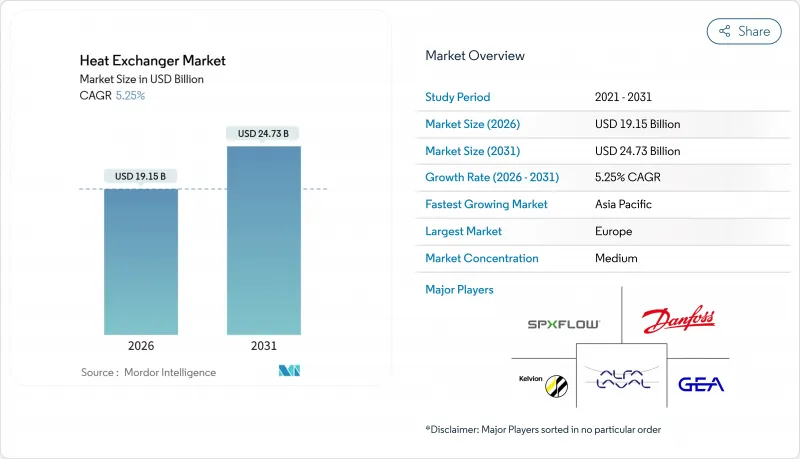
Mordor Intelligence에 의하면, 열교환기 시장 규모는 2026년에 191억 5,000만 달러로 추정되며, 예측 기간(2026-2031년)에 CAGR 5.25%로 성장을 지속하여 2031년에는 247억 3,000만 달러에 이를 전망입니다.
본 보고서는 유형별(쉘 앤 튜브, 플레이트 앤 프레임, 공랭식 등), 재질별(스테인리스 스틸, 탄소강 등), 유로 배치별(역류, 병류, 횡류, 하이브리드/멀티패스), 최종 사용자 산업(석유 및 가스,발전, 상하수도 처리, 기타), 지역(북미, 유럽, 아시아태평양, 남미, 기타)별로 분류되어 있습니다.
전 세계 열교환기 시장 동향 및 인사이트
LNG 액화 프로젝트의 급증으로 극저온 열교환기 수요가 증가
세계 LNG 투자, 카타르의 노스 필드 확장, 미국의 골든 패스 및 프락민스, 텍사스주의 리오 그란데와 같은 프로젝트로 인해, 나선형 및 플레이트 핀형 극저온 유닛의 수주 잔고는 15억 달러 이상에 달할 전망입니다. 장비는 API 660 및 ASME Division 2 규격을 준수하고, 영하 160°C의 환경에 대응하며, 16개월 이내의 건설 기간 내에 납품되어야 합니다.
GCC 및 동남아시아 지역의 냉방 시장 확대가 플레이트 프레임식 열교환기 매출을 견인
엠파워(Empower)사의 두바이 네트워크는 2025년에 24만 1,000 냉동톤을 넘어섰으며, 싱가포르의 마리나 베이도 20만 3,000 냉동톤에 도달했습니다. 두 곳 모두 개스킷식 플레이트 열교환기를 채택하여 냉동톤당 전력 소비량을 0.6kW 미만으로 억제하고 있습니다. 현재 용해 고형분이 많은 지열 루프에는 티타늄 플레이트가 지정되어 있으며, 플레이트의 내구 연한은 25년으로 연장되었습니다.
니켈과 티타늄의 가격 변동이 내식성 유닛 수요를 끌어올렸으며
2024년, 니켈 가격은 연간 30%의 변동폭을 보였으며, 티타늄 스폰지도 15-20%의 변동을 겪었습니다. 이로 인해 스테인리스 스틸 304 판재의 원가는 12-18% 상승했고, 특수 합금의 납기 기간은 36주로 연장되었습니다. EPC 계약에서는 비용 상승분의 전가 기준이 5%에서 3%로 낮아져, 공급업체의 이익률이 압박받고 있습니다.
부문별 분석
사막 지대의 정유시설 및 LNG 플랜트가 물 사용에 따른 벌금을 피하려는 움직임에 따라, 공랭식 유닛 시장 규모는 연평균 성장률(CAGR) 6.6%로 확대될 것으로 예측되며, 이는 열교환기 시장 전체의 성장률을 1% 포인트 상회하는 수치입니다. 쉘 앤 튜브(Shell & Tube)형은 고압 석유화학 용도에서 ASME 인증이 여전히 필수적이기 때문에 2025년에도 35.4%의 점유율을 유지했습니다. 플레이트 앤 프레임(Plate & Frame)형은 지역 냉방 분야에서 점유율을 확대하고 있으며, 인쇄 회로식 장치는 점유율이 2% 미만이지만 200바 이상에서 가동되는 수소 충전소에서는 주류를 이루고 있습니다.
데이터센터용 리어 도어형 및 마이크로채널 코일, 그리고 중동의 크래커용 조립식 핀이 부착된 튜브 모듈은 견조한 수주 사이클을 유지하고 있습니다. 공랭식 열교환기 시장 규모는 현장 작업을 30% 단축하는 ‘플러그 앤 플레이’형 스키드를 EPC가 선호함에 따라 2031년까지 97억 달러에 달할 것으로 예측됩니다.
수소 압축기, 해양 사워 가스 시설 및 해수 담수화 플랜트에서 피칭 저항성이 뛰어난 티타늄 그레이드 2 및 니켈 합금이 요구됨에 따라, 특수 합금 시장은 연평균 성장률(CAGR) 7.0%로 성장할 전망입니다. 스테인리스 스틸은 식품 및 음료의 위생 기준 및 중등도의 염화물에 대응하는 듀얼 페이즈 강 등급에 힘입어, 2025년에도 여전히 30.5%의 점유율을 유지하고 있습니다. 탄소강 어셈블리는 부식이 적은 용도에서는 여전히 사용되고 있지만, 탈탄소화로 인해 운전 온도가 400°C를 초과하게 되면 그 점유율은 감소하고 있습니다.
중동의 해수 담수화 프로젝트에서는 수명 30년의 티타늄 번들이 선호되고 있기 때문에 2031년까지 열교환기 시장에서 특수 합금의 점유율은 18%까지 상승할 가능성이 있습니다. 유럽의 바이오 정제소에서는 원료의 산도가 pH 2를 초과하는 경우 니켈 계 하스테로이 또는 인코넬이 지정되어 있으며, 스테인리스 스틸 유닛에 비해 3-4배의 프리미엄 가격이 책정되고 있습니다.
지역별 분석
아시아태평양은 중국의 연간 4,000만 톤 규모 정유시설 프로젝트, 인도의 HPCL 발마르 정유시설 개보수, 그리고 아세안(ASEAN) 국가들의 석유화학 분야 투자에 힘입어 2026년부터 2031년까지 연평균 성장률(CAGR) 6.5%를 기록할 전망입니다. 아시아태평양의 열교환기 시장 규모는 현지 EPC 기업들이 냉각탑으로 인한 물 사용량에 대한 벌금을 피할 수 있는 공랭식 모듈의 채택을 의무화하고 있기 때문에 2031년까지 102억 달러에 달할 가능성이 있습니다.
유럽에서는 엄격한 에너지 효율 지침과 스칸디나비아 지역의 지역 냉방 성장에 힘입어 2025년 시점에서 33.0%의 점유율을 유지했습니다. BASF 루트비히스하펜 등의 개보수 프로그램에서는 연료 소비를 15% 절감하는 응축식 열회수 번들이 도입되고 있습니다. EU 그린딜의 목표는 스테인리스 스틸 및 특수 합금 유닛에 대한 수요를 더욱 부추기고 있습니다.
북미는 매출의 약 22%를 차지하고 있으며, LNG 터미널, SMR(소형 모듈형 원자로) 시범 프로젝트, 그리고 버지니아주와 애리조나주의 데이터센터 집적지가 수주를 주도하고 있습니다. 중동 및 아프리카에서는 가스 처리 및 해수 담수화를 위한 공랭식 열교환기가 널리 채택되고 있는 반면, 남미에서는 저탄소 연료 규제에 대응하기 위해 브라질과 아르헨티나의 정유시설 현대화에 주력하고 있습니다.
기타 혜택:
- 엑셀 형식 시장 예측(ME) 시트
- 3개월간의 애널리스트 지원
자주 묻는 질문
목차
제1장 서론
제2장 조사 방법
제3장 주요 요약
제4장 시장 구도
제5장 시장 규모와 성장 예측
제6장 경쟁 구도
제7장 시장 기회와 향후 전망
LSH 26.09.09According to Mordor Intelligence, the heat exchanger market size is estimated at USD 19.15 billion in 2026, and is expected to reach USD 24.73 billion by 2031, at a CAGR of 5.25% during the forecast period (2026-2031).
This report is Segmented by Type (Shell and Tube, Plate and Frame, Air-Cooled, and More), Material of Construction (Stainless Steel, Carbon Steel, and More), Flow Arrangement (Counter-Current, Parallel, Cross-Flow, and Hybrid/Multi-Pass), End-User Industry (Oil and Gas, Power Generation, Water and Waste-Water Treatment, and More), and Geography (North America, Europe, Asia-Pacific, South America, and More).
Global Heat Exchanger Market Trends and Insights
Surge in LNG Liquefaction Projects Boosting Demand for Cryogenic Exchangers
Global LNG investments, North Field expansion in Qatar, Golden Pass and Plaquemines in the U.S., and Rio Grande in Texas, are driving a backlog worth more than USD 1.5 billion for spiral-wound and plate-fin cryogenic units. Equipment must meet API 660 and ASME Division 2 standards, handle minus-160 °C service, and ship within 16-month construction windows.
District-Cooling Expansion in GCC & Southeast Asia Driving Plate-Frame Sales
Empower's Dubai network exceeded 241,000 refrigeration tons in 2025, while Marina Bay Singapore reached 203,000 refrigeration tons, both relying on gasketed-plate exchangers to trim electrical consumption below 0.6 kW per refrigeration ton. Titanium plates are now specified in geothermal loops with high dissolved solids, extending plate life to 25 years.
Nickel and Titanium Price Volatility Inflating Corrosion-Resistant Units
Nickel traded with 30% intra-year swings in 2024, while titanium sponge experienced 15-20% shifts, lifting stainless-steel 304 plate costs 12-18% and extending exotic-alloy delivery to 36 weeks. EPC contracts lowered escalation pass-through thresholds from 5% to 3%, squeezing vendor margins.
Other drivers and restraints analyzed in the detailed report include:
- Hydrogen Pilot Plants Adopting Printed-Circuit Exchangers for 200-Bar Service
- Mandatory EU Industrial Boiler Upgrades Spurring Retrofit Tube Bundles
- Bio-Process Fouling Issues Limiting Adoption in Biorefineries
For complete list of drivers and restraints, kindly check the Table Of Contents.
Segment Analysis
Air-cooled units are projected to rise at a 6.6% CAGR, a full percentage point above the overall heat exchanger market growth, as desert refineries and LNG trains avoid water usage penalties. Shell-and-tube designs retained a 35.4% share in 2025 because ASME certifications remain indispensable for high-pressure petrochemical service. Plate-and-frame variants are climbing in district cooling, while printed-circuit equipment, though under 2% share, dominates hydrogen stations that operate above 200 bar.
Rear-door and micro-channel coils for data centers, together with prefabricated finned-tube modules for Middle East crackers, sustain robust ordering cycles. The heat exchanger market size for air-cooled units is anticipated to reach USD 9.7 billion by 2031, thanks to EPC preference for plug-and-play skids that shorten site work by 30%.
Exotic alloys will expand at a 7.0% CAGR as hydrogen compressors, offshore sour-gas facilities, and desalination plants require titanium Grade 2 or nickel alloys with high pitting resistance. Stainless steel still held a 30.5% share in 2025, sustained by food and beverage hygiene standards and duplex grades that handle moderate chlorides. Carbon-steel assemblies persist in low-corrosion duties but lose ground as decarbonization raises operating temperatures beyond 400 °C.
The heat exchanger market share of exotic alloys could climb to 18% by 2031 because Middle East desalination projects prefer titanium bundles with 30-year lifetimes. Nickel-based Hastelloy and Inconel are specified in European bio-refineries where feedstock acidities exceed pH 2, driving a premium of 3-4X over stainless units.
Complete Report Scope:
- By Type
- Shell and Tube
- Plate and Frame (Gasketed Plate, Brazed Plate, Welded Plate)
- Air-Cooled (Fin and Tube, Plate-Fin, Micro-Channel)
- Regenerative (Rotary and Plate)
- Printed Circuit
- Others (Double-Pipe, Spiral, Coaxial)
- By Material of Construction
- Stainless Steel
- Carbon Steel
- Non-Ferrous (Copper, Aluminium)
- Exotic Alloys (Titanium, Nickel, Hastelloy)
- Polymers and Composites (PTFE, Graphite, Ceramic)
- By Flow Arrangement
- Counter-Current
- Parallel
- Cross-Flow
- Hybrid/Multi-Pass
- By End-Use Industry
- Oil and Gas
- Chemical and Petrochemical
- Power Generation (incl. Nuclear)
- Food and Beverage
- Pulp and Paper
- Water and Waste-water Treatment
- Other Industries (Automotive and Transportation, Metallurgy, Mining, HVACR, Pharmaceutical and Biotechnology)
- By Geography
- North America
- United States
- Canada
- Mexico
- Europe
- United Kingdom
- Germany
- France
- Italy
- Spain
- Nordic Countries
- Russia
- Rest of Europe
- Asia-Pacific
- China
- India
- Japan
- South Korea
- ASEAN Countries
- Australia
- Rest of Asia-Pacific
- South America
- Brazil
- Argentina
- Chile
- Colombia
- Rest of South America
- Middle East and Africa
- Saudi Arabia
- United Arab Emirates
- South Africa
- Egypt
- Rest of Middle East and Africa
- North America
Geography Analysis
Asia-Pacific is set to post a 6.5% CAGR from 2026 to 2031, driven by Chinese 40 million tpa refinery projects, Indian HPCL Barmer upgrades, and ASEAN petrochemical investments. The heat exchanger market size for Asia-Pacific could reach USD 10.2 billion by 2031 as local EPC firms mandate air-cooled modules that avoid cooling-tower water penalties.
Europe maintained a 33.0% share in 2025 because of stringent energy-efficiency directives and district-cooling growth in Scandinavia. Retrofit programs, such as BASF Ludwigshafen, deploy condensing heat-recovery bundles that cut fuel 15%. EU Green Deal targets further bolster demand for stainless and exotic-alloy units.
North America contributes about 22% of revenue, with LNG terminals, SMR pilots, and data-center corridors in Virginia and Arizona pushing order books. The Middle East and Africa rely on air-cooled exchangers for gas processing and desalination, while South America focuses on refinery modernization in Brazil and Argentina to meet low-carbon fuel rules.
- Alfa Laval AB
- Kelvion Holding GmbH
- Danfoss A/S
- SPX Flow Inc.
- GEA Group AG
- Hisaka Works Ltd.
- Xylem Inc.
- Thermax Ltd.
- Mersen SA
- API Heat Transfer Inc.
- GE Vernova Inc.
- Barriquand Technologies Thermiques SAS
- Koch Heat Transfer Company LP
- SWEP International AB
- Heatric
- Kobelco Steel Ltd.
- Accessen Group
- Funke WarmeaustauscherGmbH
- Tranter Inc.
- HRS Heat Exchangers Ltd.
- Hamon Thermal Europe SA
- Graham Corporation
- United Heat Transfer Ltd.
- KRN Heat Exchanger & Refrigeration Ltd.
Additional Benefits:
- The market estimate (ME) sheet in Excel format
- 3 months of analyst support
TABLE OF CONTENTS
1 Introduction
- 1.1 Study Assumptions & Market Definition
- 1.2 Scope of the Study
2 Research Methodology
3 Executive Summary
4 Market Landscape
- 4.1 Market Overview
- 4.2 Market Drivers
- 4.2.1 Surge in LNG liquefaction projects boosting demand for cryogenic exchangers
- 4.2.2 District-cooling expansion in GCC & SE-Asia driving plate-frame sales
- 4.2.3 Hydrogen pilot plants adopting printed-circuit exchangers for 200-bar service
- 4.2.4 Mandatory EU industrial boiler upgrades spurring retrofit tube bundles
- 4.2.5 SMR (small modular reactor) roll-out needing compact safety-class exchangers
- 4.2.6 Data-centre liquid cooling uptake accelerating micro-channel adoption
- 4.3 Market Restraints
- 4.3.1 Nickel & titanium price volatility inflating corrosion-resistant units
- 4.3.2 Bio-process fouling issues limiting adoption in biorefineries
- 4.3.3 EPC demand for 12-week lead-times curbing engineered-to-order designs
- 4.3.4 Direct air-cooling in power plants cannibalising air-cooled exchangers
- 4.4 Supply-Chain Analysis
- 4.5 Regulatory Outlook
- 4.6 Technological Outlook
- 4.7 Porter's Five Forces
- 4.7.1 Bargaining Power of Suppliers
- 4.7.2 Bargaining Power of Buyers
- 4.7.3 Threat of New Entrants
- 4.7.4 Threat of Substitutes
- 4.7.5 Intensity of Competitive Rivalry
5 Market Size & Growth Forecasts
- 5.1 By Type
- 5.1.1 Shell and Tube
- 5.1.2 Plate and Frame (Gasketed Plate, Brazed Plate, Welded Plate)
- 5.1.3 Air-Cooled (Fin and Tube, Plate-Fin, Micro-Channel)
- 5.1.4 Regenerative (Rotary and Plate)
- 5.1.5 Printed Circuit
- 5.1.6 Others (Double-Pipe, Spiral, Coaxial)
- 5.2 By Material of Construction
- 5.2.1 Stainless Steel
- 5.2.2 Carbon Steel
- 5.2.3 Non-Ferrous (Copper, Aluminium)
- 5.2.4 Exotic Alloys (Titanium, Nickel, Hastelloy)
- 5.2.5 Polymers and Composites (PTFE, Graphite, Ceramic)
- 5.3 By Flow Arrangement
- 5.3.1 Counter-Current
- 5.3.2 Parallel
- 5.3.3 Cross-Flow
- 5.3.4 Hybrid/Multi-Pass
- 5.4 By End-Use Industry
- 5.4.1 Oil and Gas
- 5.4.2 Chemical and Petrochemical
- 5.4.3 Power Generation (incl. Nuclear)
- 5.4.4 Food and Beverage
- 5.4.5 Pulp and Paper
- 5.4.6 Water and Waste-water Treatment
- 5.4.7 Other Industries (Automotive and Transportation, Metallurgy, Mining, HVACR, Pharmaceutical and Biotechnology)
- 5.5 By Geography
- 5.5.1 North America
- 5.5.1.1 United States
- 5.5.1.2 Canada
- 5.5.1.3 Mexico
- 5.5.2 Europe
- 5.5.2.1 United Kingdom
- 5.5.2.2 Germany
- 5.5.2.3 France
- 5.5.2.4 Italy
- 5.5.2.5 Spain
- 5.5.2.6 Nordic Countries
- 5.5.2.7 Russia
- 5.5.2.8 Rest of Europe
- 5.5.3 Asia-Pacific
- 5.5.3.1 China
- 5.5.3.2 India
- 5.5.3.3 Japan
- 5.5.3.4 South Korea
- 5.5.3.5 ASEAN Countries
- 5.5.3.6 Australia
- 5.5.3.7 Rest of Asia-Pacific
- 5.5.4 South America
- 5.5.4.1 Brazil
- 5.5.4.2 Argentina
- 5.5.4.3 Chile
- 5.5.4.4 Colombia
- 5.5.4.5 Rest of South America
- 5.5.5 Middle East and Africa
- 5.5.5.1 Saudi Arabia
- 5.5.5.2 United Arab Emirates
- 5.5.5.3 South Africa
- 5.5.5.4 Egypt
- 5.5.5.5 Rest of Middle East and Africa
- 5.5.1 North America
6 Competitive Landscape
- 6.1 Market Concentration
- 6.2 Strategic Moves (M&A, Partnerships, PPAs)
- 6.3 Market Share Analysis (Market Rank/Share for key companies)
- 6.4 Company Profiles (includes Global level Overview, Market level overview, Core Segments, Financials as available, Strategic Information, Products & Services, Recent Developments)
- 6.4.1 Alfa Laval AB
- 6.4.2 Kelvion Holding GmbH
- 6.4.3 Danfoss A/S
- 6.4.4 SPX Flow Inc.
- 6.4.5 GEA Group AG
- 6.4.6 Hisaka Works Ltd.
- 6.4.7 Xylem Inc.
- 6.4.8 Thermax Ltd.
- 6.4.9 Mersen SA
- 6.4.10 API Heat Transfer Inc.
- 6.4.11 GE Vernova Inc.
- 6.4.12 Barriquand Technologies Thermiques SAS
- 6.4.13 Koch Heat Transfer Company LP
- 6.4.14 SWEP International AB
- 6.4.15 Heatric
- 6.4.16 Kobelco Steel Ltd.
- 6.4.17 Accessen Group
- 6.4.18 Funke WarmeaustauscherGmbH
- 6.4.19 Tranter Inc.
- 6.4.20 HRS Heat Exchangers Ltd.
- 6.4.21 Hamon Thermal Europe SA
- 6.4.22 Graham Corporation
- 6.4.23 United Heat Transfer Ltd.
- 6.4.24 KRN Heat Exchanger & Refrigeration Ltd.
7 Market Opportunities & Future Outlook
- 7.1 White-space & Unmet-Need Assessment