|
시장보고서
상품코드
2121527
세포 기반 분석법 : 시장 점유율 분석, 산업 동향 및 통계 데이터, 성장 예측(2026-2031년)Cell Based Assay - Market Share Analysis, Industry Trends & Statistics, Growth Forecasts (2026 - 2031) |
||||||
 Mordor Intelligence
Mordor Intelligence에 의하면, 세포 기반 분석법 시장 규모는 2025년에 194억 5,000만 달러로 평가되었고, 2026년211억 3,000만 달러에서 2031년까지 320억 2,000만 달러에 이를 것으로 예측되며, 예측 기간(2026년-2031년) CAGR은 8.67%를 기록할 전망입니다.
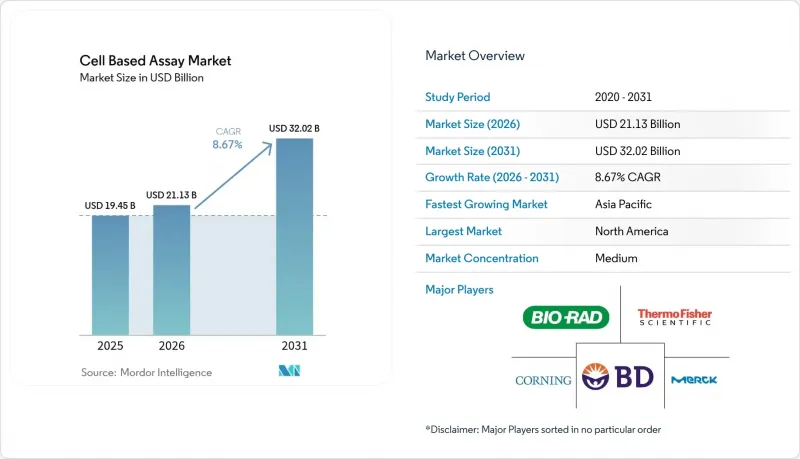
본 보고서는 제품별(세포주, 시약 및 키트 등), 기술별(고속 스크리닝 등), 용도별(신약 개발 등), 최종 사용자별(제약·바이오기술 기업 등), 지역별(북미, 유럽, 아시아태평양, 중동 및 아프리카, 남미)로 분류되어 있습니다. 시장 전망은 금액(달러) 기준으로 제시되어 있습니다.
전 세계 세포 기반 분석 시장 동향 및 인사이트
만성 질환 및 생활습관병 유병률 증가
암 및 대사성 질환의 발생률이 증가함에 따라, 신약 개발 주기를 단축하는 첨단 표현형 스크리닝에 대한 수요가 높아지고 있습니다. 미국 국립암연구소(NCI)의 2024년도 예산은 4억 760만 달러 증액되었으며, 암 치료 파이프라인을 대상으로 한 하이컨텐츠 플랫폼에 자금이 배정되었습니다. Vertex Pharmaceuticals는 1형 당뇨병을 위한 줄기세포 치료법을 확대하기 위해 2억 4,000만 달러를 투자했습니다. 이는 질환 주도형 투자가 세포 기반 분석 시장을 어떻게 가속화하고 있는지를 보여줍니다. 고령화에 따라 임상적 수요가 확대되는 가운데, 제약 기업들은 오가노이드 패널과 다중 유세포 분석법을 통합하여 번역의학적 관련성을 높이고, 장기적인 성장을 뒷받침하고 있습니다.
신약 개발 분야에서 제약 및 바이오기술 기업의 연구개발비 확대
서모피셔 사이언티픽(Thermo Fisher Scientific)은 세포 분석 기능을 갖춘 미국의 제조 및 연구개발 거점에 20억 달러(2025년-2028년)의 예산을 편성했습니다. 아스트라제네카가 메릴랜드주에 건설하는 3억 달러 규모의 세포 치료 시설과 노보노르디스크의 41억 달러 규모 주사제 제조 공장은 체외(in vitro) 시험 워크플로우를 위한 광범위한 자본 재분배를 보여줍니다. 후지필름 디오신(Fujifilm Diosynth) 등의 수탁 제조 기업들도 포유류 세포 공정에 초점을 맞춘 16억 달러 규모의 확장 계획을 추진하고 있으며, 이는 세포 기반 분석 업계에 대한 다방면의 이해관계자들의 신뢰를 보여줍니다.
첨단 플랫폼의 높은 도입 및 유지 비용
스펙트럴 플로우 시스템의 가격은 50만 달러를 초과할 수 있으며, 연간 유지보수 계약 비용이 그 금액의 20%를 추가로 부담하기 때문에 가격에 민감한 학술 기관이나 신흥 시장에서의 도입이 제한되고 있습니다. 벡만 콜터(Beckman Coulter)사의 모듈식 업그레이드를 포함한 자금 조달 방안은 진입 장벽을 낮추기 위해 마련되었으나, 자본 지출은 여전히 세포 기반 분석 시장의 추가적인 확산에 있어 병목 현상이 되고 있습니다.
부문 분석
반복 구매를 통한 경제적 이점을 누리는 시약 및 키트는 2025년에 세포 기반 분석 시장의 51.02%를 차지하며, 소모품의 수익 기반을 뒷받침하고 있습니다. 한편, 세포주는 중요한 혁신의 원동력이 되고 있으며, iPS 세포의 발전과 CRISPR 기술을 활용한 질병 모델을 배경으로 연평균 성장률(CAGR) 10.02%로 확대되고 있습니다. TreeFrog Therapeutics가 Vertex와 체결한 2억 4,000만 달러 규모의 ‘C-Stem’ 라이선싱 계약은 확장 가능하고 고품질의 세포 소재에 대한 평가가 높아지고 있음을 여실히 보여줍니다.
마이크로플레이트 하위 부문은 실험실 자동화와의 호환성으로 인해 꾸준한 성장을 보이고 있는 반면, 특수 배지 및 완충액은 시장 전체의 확대를 반영하고 있습니다. 하이컨텐츠 스크리닝에 필수적인 일관성 향상으로 인해, 줄기세포 유래 세포주가 1세대 배양을 대체하는 경향이 강해지고 있습니다.
오랫동안 신약 개발의 기반이 되어 온 하이 스루풋 스크리닝(HTS) 플랫폼은 2025년 매출의 41.66%를 차지했습니다. 그러나 수요는 생체 내의 생물학적 거동을 보다 정확하게 재현하는 생리학적으로 타당한 3차원 모델로 이동하고 있습니다. 3D 배양 부문의 연평균 성장률(CAGR) 8.14%는 오가노이드의 표준화와 규제 당국의 승인이 주도하고 있습니다. BD사가 로봇 팔과 스펙트럼 유동 측정을 통합한 사례는 주요 벤더들이 자동화와 다중 모드 검출을 통해 HTS의 미래 경쟁력을 확보하고 있음을 보여줍니다.
라벨 프리 검출 및 스펙트럼 사이토메트리를 통해 분석의 측정 항목이 확대되는 한편, 자동 액체 핸들러가 시료 준비 시간을 단축하고 처리량을 향상시키고 있습니다. 이러한 발전들이 맞물리면서 통합 플랫폼을 위한 세포 기반 분석법 시장 규모는 확대되고 있으며, 종양학 워크플로우 분야에서 두 자릿수 성장이 예상됩니다.
지역별 분석
북미는 2025년 매출의 40.85%를 차지하고 있으며, 그 배경에는 탄탄한 바이오의약품 파이프라인, NIH(미국 국립보건원)의 자금 지원, 그리고 인간 관련 모델을 권장하는 FDA(미국 식품의약국)의 지침이 있습니다. 정부의 인센티브와 서모피셔 사이언티픽(Thermo Fisher Scientific)의 20억 달러 규모 계획으로 대표되는 국내 제조에 대한 투자가 지역 공급망을 강화하고 세포 기반 분석 시장을 확대되고 있습니다.
아시아태평양은 연평균 성장률(CAGR) 9.02%로 가장 빠른 성장세를 기록하고 있습니다. 중국의 인력 풀과 인프라는 급속히 확대되고 있으며, 고차원 유세포 분석 시스템을 목표로 하는 우시에 위치한 Cytek Biosciences의 50,000제곱피트 규모의 제조 거점이 그 대표적인 예입니다. 일본의 세포 및 유전자 치료 신속 승인 절차는 분석법에 의존하는 제품의 상용화를 가속화하며, 3차원 배양 및 AI를 활용한 분석에 대한 수요를 뒷받침하고 있습니다.
유럽은 독일, 스위스, 영국에 뿌리내린 제약 클러스터를 통해 여전히 큰 시장 점유율을 유지하고 있습니다. 대체 시험에 관한 규제가 미국 기준과 조화를 이루고 있는 것이 라벨 프리 검출 및 ‘장기 온 칩(organ-on-a-chip)’ 플랫폼으로의 업그레이드를 촉진하고 있습니다. 한편, 라틴아메리카, 중동 및 아프리카에서는 기술 이전과 공동 프로그램을 통해 높은 진입 장벽이 완화되면서 새로운 기회가 창출되고 있습니다. 이 지역들은 규제 조화가 진행됨에 따라 전 세계 세포 기반 분석법 시장에 추가적인 성장을 가져오고 있습니다.
기타 혜택:
- Excel 형식 시장 예측(ME) 시트
- 3개월간의 애널리스트 지원
자주 묻는 질문
목차
제1장 서론
제2장 분석 방법
제3장 주요 요약
제4장 시장 구도
제5장 시장 규모·성장률 예측
제6장 경쟁 구도
제7장 시장 기회와 향후 전망
LSH 26.09.02According to Mordor Intelligence, the cell based assay market size was valued at USD 19.45 billion in 2025 and estimated to grow from USD 21.13 billion in 2026 to reach USD 32.02 billion by 2031, at a CAGR of 8.67% during the forecast period (2026-2031).
This report is Segmented by Product (Cell Lines, Reagents and Kits, and More), Technology (High-Throughput Screening, and More), Application (Drug Discovery and Development, and More), End User (Pharmaceutical and Biotechnology Companies, and More), and Geography (North America, Europe, Asia-Pacific, Middle East and Africa, South America). The Market Forecasts are Provided in Terms of Value (USD).
Global Cell Based Assay Market Trends and Insights
Rising Prevalence of Chronic & Lifestyle Diseases
Escalating cancer and metabolic-disease incidence is intensifying demand for sophisticated phenotypic screens that shorten discovery cycles. The National Cancer Institute budget rose by USD 407.6 million in 2024, earmarking funds for high-content platforms aimed at oncology pipelines. Vertex Pharmaceuticals committed USD 240 million to scale stem-cell therapeutics for type 1 diabetes, illustrating how disease-driven investment accelerates the cell-based assay market. As aging demographics widen clinical need, pharmaceutical groups integrate organoid panels and multiplex flow cytometry to improve translational relevance, reinforcing long-term growth.
Escalating Pharma-Biotech R&D Spending on Drug Discovery
Thermo Fisher Scientific has budgeted USD 2 billion (2025-2028) for U.S. manufacturing and R&D sites that include cell-analysis capabilities. AstraZeneca's USD 300 million cell-therapy facility in Maryland and Novo Nordisk's USD 4.1 billion injectable-therapeutic plant reveal broad capital reallocation toward in vitro testing workflows. Contract manufacturers such as Fujifilm Diosynth follow with USD 1.6 billion expansions focused on mammalian-cell processes, indicating multistakeholder confidence in the cell based assay industry
High Capital & Maintenance Costs of Advanced Platforms
Spectral flow systems can exceed USD 500,000, while annual service contracts add 20% of that figure, limiting uptake in price-sensitive academic and emerging-market settings. Financing schemes, including Beckman Coulter's modular upgrades, seek to lower entry barriers, but capital outlays remain a gating factor for broader cell-based assay market penetration.
Other drivers and restraints analyzed in the detailed report include:
- Continuous Advances in High-Throughput & Label-Free Assays
- Growing Adoption of 3-D Organoid Models for Precision Oncology
- Shortage of Multi-Disciplinary, Assay-Development Talent
For complete list of drivers and restraints, kindly check the Table Of Contents.
Segment Analysis
Reagents and kits, benefiting from repeat-purchase economics, contributed 51.02% of the cell-based assay market in 2025, anchoring the consumables revenue base. Cell lines, however, represent the pivotal innovation engine, expanding at 10.02% CAGR on the back of induced pluripotent stem cell advances and CRISPR-engineered disease models. TreeFrog Therapeutics' USD 240 million C-Stem licensing deal with Vertex underscores rising valuations for scalable, high-quality cellular material.
The microplates subsegment enjoys steady gains from laboratory-automation compatibility, while specialty media and buffers mirror overall market expansion. Stem-cell-derived lines increasingly replace primary cultures due to improved consistency, a critical requirement for high-content screens.
High-throughput screening (HTS) platforms, long the backbone of pharmaceutical discovery, delivered 41.66% revenue in 2025. Yet, demand is shifting toward physiologically relevant 3-D models that more accurately recapitulate in-vivo biology. The 3-D culture segment's 8.14% CAGR is propelled by organoid standardization and regulatory endorsement. BD's spectral flow integration with robotic arms illustrates how established vendors are future-proofing HTS through automation and multi-modal detection.
Label-free detection and spectral cytometry broaden assay readouts, while automated liquid handlers compress sample-prep times, enhancing throughput. Together, these advances are expanding the cell based assay market size for integrated platforms expected to post double-digit growth within oncology workflows.
Complete Report Scope:
- By Product
- Cell Lines
- Primary Cell Lines
- Stem Cell Lines
- Induced Pluripotent Cell Lines
- Engineered / Recombinant Lines
- Others
- Reagents & Kits
- Assay Reagents
- Reporter Gene & Substrate Kits
- Buffers & Media
- Other Reagents
- Microplates
- Other Consumables
- Cell Lines
- By Technology
- High-Throughput Screening
- Flow Cytometry
- Automated Liquid Handling
- Label-free Detection
- 3-D Cell-Culture Assays
- Others
- By Application
- Drug Discovery & Development
- ADME & Toxicology Studies
- Basic Research
- Precision & Regenerative Medicine
- Other Applications
- By End User
- Pharmaceutical & Biotechnology Companies
- Contract Research Organizations
- Academic & Government Institutes
- Others
- By Geography
- North America
- United States
- Canada
- Mexico
- Europe
- Germany
- United Kingdom
- France
- Italy
- Spain
- Rest of Europe
- Asia-Pacific
- China
- Japan
- India
- Australia
- South Korea
- Rest of Asia-Pacific
- Middle East & Africa
- GCC
- South Africa
- Rest of Middle East & Africa
- South America
- Brazil
- Argentina
- Rest of South America
- North America
Geography Analysis
North America generated 40.85% of 2025 revenue, underpinned by deep biopharma pipelines, NIH funding, and FDA guidance favoring human-relevant models. Government incentives and domestic manufacturing investments, for example, Thermo Fisher Scientific's USD 2 billion plan, fortify regional supply chains and enlarge the cell based assay market.
Asia-Pacific posts the fastest expansion at 9.02% CAGR. China's talent pool and infrastructure are scaling rapidly, highlighted by Cytek Biosciences' 50,000 sq ft manufacturing hub in Wuxi targeting high-dimensional cytometry systems. Japan's fast-track approval path for cell and gene therapies accelerates commercialization of assay-dependent products, reinforcing demand for 3-D cultures and AI-enhanced analytics.
Europe retains a substantial share through entrenched pharma clusters in Germany, Switzerland, and the UK. Harmonization of alternative-testing regulations with U.S. standards is catalyzing upgrades to label-free detection and organ-on-chip platforms. Meanwhile, Latin America, the Middle East, and Africa offer emerging opportunities where technology transfer and collaborative programs mitigate high-capital entry barriers. Collectively these regions add incremental volume to the global cell based assay market while progressing toward regulatory convergence.
- Beckton Dickinson
- Thermo Fisher Scientific
- Danaher
- Merck
- PerkinElmer
- Bio-Rad Laboratories
- Corning
- Lonza Group
- Promega
- Cell Signaling Technology
- Agilent Technologies
- Charles River
- Eurofins
- DiscoverX Corporation
- Revvity Life Sciences
- Abcam
- GE HealthCare Technologies Inc.
- Miltenyi Biotec
- Sartorius
- ATCC
Additional Benefits:
- The market estimate (ME) sheet in Excel format
- 3 months of analyst support
TABLE OF CONTENTS
1 Introduction
- 1.1 Study Assumptions & Market Definition
- 1.2 Scope of the Study
2 Research Methodology
3 Executive Summary
4 Market Landscape
- 4.1 Market Overview
- 4.2 Market Drivers
- 4.2.1 Rising Prevalence of Chronic & Lifestyle Diseases
- 4.2.2 Escalating Pharma-Biotech R&D Spending on Drug Discovery
- 4.2.3 Continuous Advances in High-Throughput & Label-Free Assays
- 4.2.4 Growing Adoption of 3-D Organoid Models for Precision Oncology
- 4.2.5 AI-Powered High-Content Analytics Accelerating Screening Cycles
- 4.2.6 Global Regulatory Shift Toward In Vitro Alternatives to Animal Tests
- 4.3 Market Restraints
- 4.3.1 High Capital & Maintenance Costs of Advanced Platforms
- 4.3.2 Shortage of Multi-Disciplinary, Assay-Development Talent
- 4.3.3 Steep Learning Curve for Data Integration & Assay Interoperability
- 4.3.4 Fragile, Specialty-Reagent Supply Chains Post-Pandemic
- 4.4 Porter's Five Forces Analysis
- 4.4.1 Threat of New Entrants
- 4.4.2 Bargaining Power of Buyers
- 4.4.3 Bargaining Power of Suppliers
- 4.4.4 Threat of Substitutes
- 4.4.5 Intensity of Competitive Rivalry
5 Market Size & Growth Forecasts (Value in USD)
- 5.1 By Product
- 5.1.1 Cell Lines
- 5.1.1.1 Primary Cell Lines
- 5.1.1.2 Stem Cell Lines
- 5.1.1.3 Induced Pluripotent Cell Lines
- 5.1.1.4 Engineered / Recombinant Lines
- 5.1.1.5 Others
- 5.1.2 Reagents & Kits
- 5.1.2.1 Assay Reagents
- 5.1.2.2 Reporter Gene & Substrate Kits
- 5.1.2.3 Buffers & Media
- 5.1.2.4 Other Reagents
- 5.1.3 Microplates
- 5.1.4 Other Consumables
- 5.1.1 Cell Lines
- 5.2 By Technology
- 5.2.1 High-Throughput Screening
- 5.2.2 Flow Cytometry
- 5.2.3 Automated Liquid Handling
- 5.2.4 Label-free Detection
- 5.2.5 3-D Cell-Culture Assays
- 5.2.6 Others
- 5.3 By Application
- 5.3.1 Drug Discovery & Development
- 5.3.2 ADME & Toxicology Studies
- 5.3.3 Basic Research
- 5.3.4 Precision & Regenerative Medicine
- 5.3.5 Other Applications
- 5.4 By End User
- 5.4.1 Pharmaceutical & Biotechnology Companies
- 5.4.2 Contract Research Organizations
- 5.4.3 Academic & Government Institutes
- 5.4.4 Others
- 5.5 By Geography
- 5.5.1 North America
- 5.5.1.1 United States
- 5.5.1.2 Canada
- 5.5.1.3 Mexico
- 5.5.2 Europe
- 5.5.2.1 Germany
- 5.5.2.2 United Kingdom
- 5.5.2.3 France
- 5.5.2.4 Italy
- 5.5.2.5 Spain
- 5.5.2.6 Rest of Europe
- 5.5.3 Asia-Pacific
- 5.5.3.1 China
- 5.5.3.2 Japan
- 5.5.3.3 India
- 5.5.3.4 Australia
- 5.5.3.5 South Korea
- 5.5.3.6 Rest of Asia-Pacific
- 5.5.4 Middle East & Africa
- 5.5.4.1 GCC
- 5.5.4.2 South Africa
- 5.5.4.3 Rest of Middle East & Africa
- 5.5.5 South America
- 5.5.5.1 Brazil
- 5.5.5.2 Argentina
- 5.5.5.3 Rest of South America
- 5.5.1 North America
6 Competitive Landscape
- 6.1 Market Concentration
- 6.2 Market Share Analysis
- 6.3 Company Profiles (includes Global level Overview, Market level overview, Core Segments, Financials as available, Strategic Information, Market Rank/Share for key companies, Products & Services, and Recent Developments)
- 6.3.1 Becton, Dickinson and Company
- 6.3.2 Thermo Fisher Scientific Inc.
- 6.3.3 Danaher Corporation
- 6.3.4 Merck KGaA
- 6.3.5 PerkinElmer Inc.
- 6.3.6 Bio-Rad Laboratories Inc.
- 6.3.7 Corning Incorporated
- 6.3.8 Lonza Group AG
- 6.3.9 Promega Corporation
- 6.3.10 Cell Signaling Technology Inc.
- 6.3.11 Agilent Technologies Inc.
- 6.3.12 Charles River Laboratories
- 6.3.13 Eurofins Scientific SE
- 6.3.14 DiscoverX Corporation
- 6.3.15 Revvity Life Sciences
- 6.3.16 Abcam plc
- 6.3.17 GE HealthCare Technologies Inc.
- 6.3.18 Miltenyi Biotec
- 6.3.19 Sartorius AG
- 6.3.20 ATCC
7 Market Opportunities & Future Outlook
- 7.1 White-space & Unmet-Need Assessment