

|
시장보고서
상품코드
2121536
포장용 코팅 : 시장 점유율 분석, 업계 동향과 통계, 성장 예측(2026-2031년)Packaging Coatings - Market Share Analysis, Industry Trends & Statistics, Growth Forecasts (2026 - 2031) |
||||||
 Mordor Intelligence
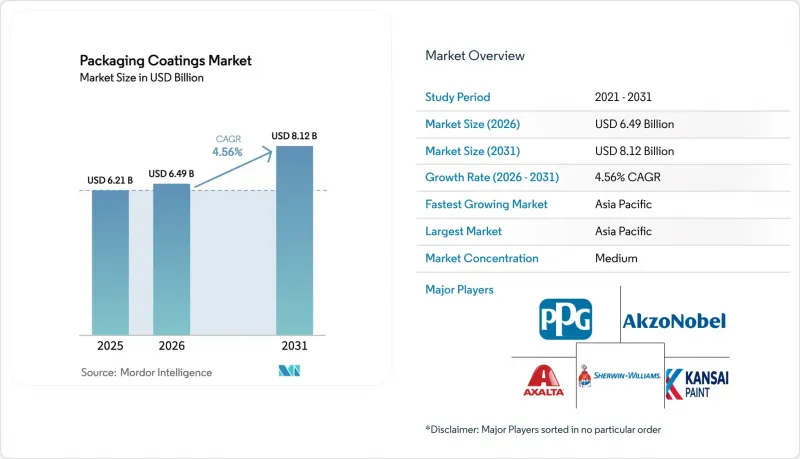
Mordor Intelligence에 의하면, 포장용 코팅 시장 규모는 2025년 62억 1,000만 달러에서 2026년에는 64억 9,000만 달러에 이르고, 2026-2031년 CAGR 4.56%로 성장을 지속하여 2031년에는 81억 2,000만 달러에 달할 것으로 예측됩니다.
본 보고서는 수지(에폭시, 아크릴 등), 코팅 기술(수성 등), 포장 유형(경질, 연질), 용도(식품 캔, 음료 캔 등), 최종 사용자 산업(식품 및 음료 등), 지역(아시아태평양, 북미, 유럽, 남미, 중동 및 아프리카)별로 분류되어 있습니다. 시장 전망은 금액(달러) 기준으로 제시되어 있습니다.
전 세계 포장용 코팅 시장 동향 및 인사이트
BPA 무함유 캔 내면 코팅에 관한 규제
유럽연합(EU) 규정 2024/3190에 따르면, 2025년 1월 20일부터 식품 접촉용 코팅에 BPA 사용이 금지되며, 음료 캔의 경우 2026년 7월, 기타 금속 용기의 경우 2028년 1월을 이행 기한으로 설정하고 있습니다. 각 캔 제조업체들은 기존의 에폭시·페놀계 라이너를, 비스페놀계 성분을 포함하지 않으면서도 동등한 차단 성능을 발휘하는 아크릴, 폴리에스터, 폴리올레핀계 소재로 대체하고 있습니다. 악소노벨(AkzoNobel)은 2024년 1월, 비스페놀 프리 제품의 생산 능력 확대에 3,200만 유로를 투자했는데, 이는 기존 기업들이 규정 준수를 단순한 비용 부담이 아닌 경쟁상의 강점으로 인식하고 있음을 보여줍니다. 미국에서는 주 차원의 규제와 코카콜라, 펩시코의 자발적인 단계적 폐지 움직임에 힘입어 북미의 관행이 EU 기준과 조화를 이루고 있습니다. 12-18개월로 단축된 재처방 기간 덕분에 신속한 제품 인증과 온라인 기술 서비스를 제공할 수 있는 공급업체가 유리한 입지를 점하고 있습니다.
크래프트 음료 붐이 UV 경화형 바니시 수요를 견인
독립 양조장 및 프리미엄 즉석 칵테일 제조업체들은 재활용이 가능하고 전면 그래픽 표시가 가능하다는 점 때문에 알루미늄 캔을 선호하고 있으며, 이로 인해 1초 미만에 경화되고 열 건조로가 필요 없는 UV 경화형 외부 코팅 바니스 수요가 발생하고 있습니다. 쿠어즈 브루잉(Coors Brewing)의 조사에 따르면, 열경화 방식에서 UV 경화 방식으로 전환함으로써 10억 캔당 14,000 MMBtu의 에너지 절감 효과가 확인되었습니다. 2024년 7월에 출시된 PPG의 ‘DuraNEXT’ 포트폴리오는 목재 및 코일 코팅용으로 사용되던 전자빔 및 UV 화학 기술을 금속 포장 분야로 확대하여, 상온에서 경화되는 무용제 베이스 코트를 제공합니다. 전환 시간 단축은 소량 생산이나 다수의 SKU를 다루는 크래프트 제조업체에 적합하며, 한편 볼 코퍼레이션(Ball Corporation)의 ‘그래픽스 센터 오브 엑설런스(Graphics Center of Excellence)’에서는 브랜드 차별화를 위한 UV 바니시 설계를 검증하고 있습니다.
에폭시 수지 가격 변동
2025년 1월, 미국의 에폭시 수지 현물 가격은 2.18% 상승했습니다. 한편, EU에서는 중국산 수입품에 최대 40.8%의 반덤핑 관세가 부과됨에 따라 시세가 상승했습니다. 연간 공급 계약을 체결한 캔 제조업체는 회계 연도 중반에 수지 가격이 급등할 경우 위험에 노출되어 이익률이 압박받게 됩니다. BPA 프리 아크릴 수지나 폴리에스터 수지는 에폭시 수지에 대한 의존도를 줄여주지만, 이러한 화학 물질들도 자체적인 원료 가격 변동에 직면해 있습니다. 대형 공급업체들은 수직 통합이나 다년간의 원료 조달 계약 체결을 통해 리스크를 헤지하고 있지만, 중소규모 기업들은 이러한 전략에 필요한 자금 조달에 어려움을 겪고 있습니다.
부문별 분석
에폭시 수지는 2025년 포장용 도료 시장 규모의 51.67%를 차지하고 있으며, 2031년까지 연평균 성장률(CAGR) 4.81%를 나타낼 것으로 예측됩니다. 이러한 확고한 입지는 알루미늄 및 철강에 대한 타의 추종을 불허하는 접착력뿐만 아니라, 리콜 위험을 줄여주는 수십 년에 걸친 전환 데이터에 기인합니다. 각 공급업체들은 성능을 저하시키지 않으면서 EU 규정을 준수하기 위해 비스페놀 S 및 비스페놀을 포함하지 않는 골격을 기반으로 한 배합 재검토를 진행하고 있습니다. PPG사의 ‘INNOVEL PRO’를 필두로 한 아크릴계 수지는 낮은 이주량과 플래티넘 수준의 재료 안전 인증을 바탕으로 음료 캔 시장에서 점유율을 확대되고 있습니다. 폴리에스테르계 수지는 열 안정성과 추출물이 적다는 점으로 인해 레토르트 식품 및 헬스케어용 포장 분야에서 지지를 얻고 있는 반면, 폴리우레탄계 수지는 높은 유연성이 요구되는 접이식 튜브 분야에서 틈새 시장을 차지하고 있습니다.
금지 조치가 확대됨에 따라 아크릴 수지와 폴리에스터 수지는 에폭시 수지 시장 점유율을 서서히 빼앗아 갈 것이지만, 비용 대비 성능의 균형을 고려할 때 에폭시 수지는 산업용 및 도료 캔 용도에서 여전히 중요한 위치를 차지할 것으로 보입니다. 시장 진출기업들은 수지 포트폴리오가 용도별로 세분화될 것으로 예상하고 있습니다. 구체적으로는 고부식성 환경용으로는 에폭시 수지, 청량음료 및 맥주 캔용으로는 아크릴 수지, 의료용 캔용으로는 폴리에스테르 수지, 퍼스널케어용 에어로졸용으로는 폴리우레탄 수지라는 구성이 될 것입니다.
수성 도료는 20년에 걸친 VOC 규제의 결과, 2025년에는 포장용 도료 시장 규모의 43.44% 점유율을 차지했습니다. 이러한 분산형 도료는 150-200°C에서 경화되며, 물이 증발함에 따라 응집하는 계면활성제로 안정화된 폴리머 입자를 활용하고 있습니다. 용제형 시스템은 급속한 휘발이 필수적인 틈새 에어로졸 용도로 점차 축소되고 있습니다. PPG사의 모노블록 에어로졸용 ‘Hoba’ 시리즈로 대표되는 분체 도료는 VOC를 제로로 억제할 수 있지만, 높은 경화 온도가 필요하기 때문에 캡이나 두꺼운 캔에 사용이 제한됩니다.
UV 경화형 및 전자빔 경화형 플랫폼은 가장 빠르게 성장하는 분야로, 캔 제조업체들이 에너지 절약과 신속한 전환을 추구하는 가운데 연평균 성장률(CAGR) 5.11%로 확대되고 있습니다. 1초 미만의 경화 시간으로 오븐이 불필요해져 설치 면적과 이산화탄소 배출량을 줄일 수 있습니다. 열 노출을 최소화해야 하는 크래프트 음료, 퍼스널케어용 에어로졸, 디지털 인쇄 캔 분야에서 그 채택이 가장 활발합니다.
지역별 분석
아시아태평양은 2025년에 시장의 43.75%를 차지할 것으로 예상되며, 2031년까지 연평균 성장률(CAGR) 4.79%로 확대될 것으로 전망됩니다. 중국에서는 VOC 규제 강화로 인해 분체 도장 및 수성 도장 라인으로의 전환이 가속화되고 있는 반면, 베트남과 인도에는 지역 공급을 뒷받침하는 초대형 캔 제조 공장이 입지해 있습니다. 일본의 재활용률은 73.9%에 달하며, 100% 재생 소재를 사용한 캔에 대한 협력이 진행되고 있어, 일본은 순환형 경제의 실증 무대로서의 위상을 확립하고 있습니다. 인도네시아, 태국, 말레이시아를 포함한 동남아시아 시장은 가처분 소득 증가와 다국적 음료 기업의 사업 확장의 혜택을 받고 있습니다.
북미 수요는 호황을 누리고 있는 크래프트 음료 생태계와 연방 기준보다 엄격한 주 차원의 VOC 규제에 의해 견인되고 있습니다. UV 경화형 생산 라인 및 기술 서비스 거점에 대한 투자가 SKU의 급속한 교체를 뒷받침하고 있습니다. USMCA(미국·멕시코·캐나다 협정) 하에서 멕시코의 비용 우위는 국내 시장 및 미국 수출 채널 양쪽을 위한 코팅 생산을 촉진하고 있습니다.
유럽 시장 점유율은 BPA를 금지하고 폴리에스터 및 아크릴의 채택을 가속화하는 규정 2024/3190에 의해 견인되고 있습니다. 악소노벨(AkzoNobel)사가 3,200만 유로를 투자하여 진행 중인 비스페놀 프리 생산 능력 확대는 공급업체의 준비 태세를 보여주는 좋은 사례입니다. 영국의 재활용 가능성 평가 제도는 각 브랜드 기업들에게 폐쇄형 순환 방식의 금속 회수에 대응하는 코팅제 선정을 요구하고 있으며, 이로 인해 지역 내 제품 구성이 더욱 재편되고 있습니다.
기타 혜택:
- 엑셀 형식 시장 예측(ME) 시트
- 3개월간의 애널리스트 지원
자주 묻는 질문
목차
제1장 서론
제2장 조사 방법
제3장 주요 요약
제4장 시장 구도
제5장 시장 규모와 성장 예측
제6장 경쟁 구도
제7장 시장 기회와 향후 전망
LSH 26.09.09According to Mordor Intelligence, the packaging coatings market size is expected to grow from USD 6.21 billion in 2025 to USD 6.49 billion in 2026 and is forecast to reach USD 8.12 billion by 2031 at a 4.56% CAGR over 2026-2031.
This report is Segmented by Resin (Epoxies, Acrylics, and More), Coating Technology (Water-Based, and More), Packaging Type (Rigid and Flexible), Application (Food Cans, Beverage Cans, and More), End-User Industry (Food and Beverage, and More), and Geography (Asia-Pacific, North America, Europe, South America, and Middle East and Africa). The Market Forecasts are Provided in Terms of Value (USD).
Global Packaging Coatings Market Trends and Insights
BPA-Free Can-Lining Mandates
The European Union's Regulation 2024/3190 prohibits BPA in food-contact coatings from January 20, 2025, setting transitional deadlines that end in July 2026 for beverage cans and January 2028 for other metal formats . Canmakers are replacing legacy epoxy-phenolic liners with acrylic, polyester, and polyolefin chemistries that match barrier performance without bisphenol building blocks. AkzoNobel invested EUR 32 million in January 2024 to scale bisphenol-free capacity, illustrating how incumbents treat compliance as a competitive lever rather than a cost burden. In the United States, state-level restrictions and voluntary brand-owner phase-outs by Coca-Cola and PepsiCo are harmonizing North American practices with EU norms. Compressed reformulation windows of 12-18 months reward suppliers that provide rapid product qualification and online technical service.
Craft Beverage Boom Spurring UV-Curable Varnish Demand
Independent breweries and premium ready-to-drink cocktails favor aluminum cans for recyclability and full-surface graphics, creating demand for UV-curable exterior varnishes that harden in under one second and do not require thermal ovens. A Coors Brewing study logged energy savings of 14,000 MMBtu per billion cans when switching from thermal to UV curing. PPG's DuraNEXT portfolio, launched in July 2024, extends electron-beam and UV chemistries from wood and coil coatings into metal packaging, offering solvent-free basecoats that cure at ambient temperature. Faster changeovers suit craft producers that run short batches and multiple SKUs, while Ball Corporation's Graphics Centers of Excellence validate UV varnish designs for brand differentiation.
Epoxy Resin Price Volatility
US spot epoxy prices climbed 2.18% in January 2025, while EU quotes rose after anti-dumping duties of up to 40.8% on Chinese imports. Annual supply contracts leave canmakers exposed when resin costs spike mid-year, compressing margins. Although BPA-free acrylics and polyesters lessen epoxy exposure, those chemistries face their own feedstock swings. Large suppliers hedge by vertically integrating or signing multi-year feedstock deals, but smaller firms struggle to finance such strategies.
Other drivers and restraints analyzed in the detailed report include:
- E-Grocery Logistics Fueling Scuff-Resistant Cap/Closure Coats
- Rise of Refill-Ready Metal Packaging
- Weak Recycling Streams Limiting Bio-Barrier Uptake
For complete list of drivers and restraints, kindly check the Table Of Contents.
Segment Analysis
Epoxies held 51.67% of the packaging coatings market size in 2025 and are forecast to post a 4.81% CAGR through 2031. Their entrenched status stems from unmatched adhesion to aluminum and steel, plus decades of migration data that lower recall risk. Suppliers are reformulating around bisphenol-S or non-bisphenol backbones to comply with EU rules without sacrificing performance. Acrylics, led by PPG's INNOVEL PRO, are gaining beverage-can share through lower migration and platinum-level material-health certifications. Polyesters are gaining traction in retort food and healthcare packaging thanks to thermal stability and low extractables, while polyurethanes fill niche roles in collapsible tubes that demand high flexibility.
Acrylics and polyesters will chip away at epoxies as bans widen, yet cost-performance trade-offs keep epoxies relevant in industrial and paint-can applications. Market participants expect resin portfolios to fragment along application lines: epoxies for high-corrosion environments, acrylics for soft-drink and beer cans, polyesters for medical cans, and polyurethanes for personal-care aerosols.
Water-based chemistries captured 43.44% share of the packaging coatings market size in 2025, owing to two decades of VOC curbs. These dispersions cure at 150-200°C, leveraging surfactant-stabilized polymer particles that coalesce as water evaporates. Solvent-based systems retreat to niche aerosol uses where rapid flash-off is essential. Powder coatings, exemplified by PPG's Hoba line for monobloc aerosols, deliver zero VOCs but require high cure temperatures, limiting use to caps and thicker-gauge cans.
UV-curable and electron-beam platforms represent the fastest-growing slice, advancing at 5.11% CAGR as canmakers chase energy savings and faster changeovers. Their sub-second cure eliminates ovens, trimming floor space, and carbon output. Adoption is strongest in craft beverages, personal-care aerosols, and digitally printed cans, where thermal exposure must be minimized.
Complete Report Scope:
- By Resin
- Epoxies
- Acrylics
- Polyurethane
- Polyolefins
- Polyester
- Other Resins
- By Coating Technology
- Water-based
- Solvent-based
- Powder
- UV curable
- By Packaging Type
- Rigid (Cans, Caps and Closures)
- Flexible (Pouches, Films, Sachets)
- By Application
- Food Cans
- Beverage Cans
- Aerosol and Tubes
- Caps and Closures
- Industrial and Specialty Packaging
- By End-User Industry
- Food and Beverage
- Personal Care and Cosmetics
- Healthcare and Pharmaceutical
- Industrial Goods
- By Geography
- Asia-Pacific
- China
- India
- Japan
- South Korea
- Indonesia
- Malaysia
- Thailand
- Vietnam
- Rest of Asia-Pacific
- North America
- United States
- Canada
- Mexico
- Europe
- Germany
- United Kingdom
- France
- Italy
- Spain
- Nordics
- Turkey
- Russia
- Rest of Europe
- South America
- Brazil
- Argentina
- Colombia
- Rest of South America
- Middle East and Africa
- Qatar
- United Arab Emirates
- Nigeria
- Egypt
- South Africa
- Rest of Middle East and Africa
- Asia-Pacific
Geography Analysis
Asia-Pacific accounted for 43.75% of the market in 2025 and is projected to advance at a 4.79% CAGR to 2031. China's tightening VOC rules are escalating the shift to powder and water-based lines, while Vietnam and India host mega-scale can plants that anchor regional supply. Japan's recycle rate of 73.9% and collaborations on 100% recycled-content cans position the nation as a circular-economy test bed. Southeast Asian markets including Indonesia, Thailand, and Malaysia benefit from rising disposable incomes and multinational beverage expansions.
North America's demand is propelled by a flourishing craft beverage ecosystem and statewide VOC norms stricter than federal thresholds. Investments in UV-curable lines and technical service hubs support rapid SKU turnover. Mexico's cost advantages under USMCA are spurring coatings production for both domestic and US export channels.
Europe's share is driven by Regulation 2024/3190, which bans BPA and accelerates polyester and acrylic adoption. AkzoNobel's EUR 32 million bisphenol-free capacity expansion exemplifies supplier readiness. The U.K.'s recyclability scoring system pressures brands to select coatings compatible with closed-loop metal recovery, further reshaping the regional product mix.
- Akzo Nobel N.V.
- ALTANA
- artience Co., Ltd.
- Axalta Coating Systems LLC
- BASF
- DIC Corporation
- Dow
- H.B. Fuller Company
- Hempel A/S
- Henkel AG & Co. KGaA
- Jamestown Coating Technologies
- Jotun
- KANGNAM JEVISCO CO., LTD.
- Kansai Paint Co., Ltd.
- Michelman, Inc.
- PPG Industries Inc.
- RPM International Inc.
- Siegwerk Druckfarben AG & Co. KGaA
- Silgan Holdings Inc.
- The Sherwin-Williams Company
Additional Benefits:
- The market estimate (ME) sheet in Excel format
- 3 months of analyst support
TABLE OF CONTENTS
1 Introduction
- 1.1 Study Assumptions & Market Definition
- 1.2 Scope of the Study
2 Research Methodology
3 Executive Summary
4 Market Landscape
- 4.1 Market Overview
- 4.2 Market Drivers
- 4.2.1 BPA-free can-lining mandates in North America and Europe
- 4.2.2 Craft beverage boom spurring UV-curable varnish demand
- 4.2.3 E-grocery logistics fuelling scuff-resistant cap/closure coats
- 4.2.4 Rise of refill-ready metal packaging
- 4.2.5 Direct-to-shape inkjet print adoption raising low-temp cure needs
- 4.3 Market Restraints
- 4.3.1 Epoxy resin price volatility
- 4.3.2 Weak recycling streams limiting bio-barrier uptake
- 4.3.3 VOC-emission compliance costs
- 4.4 Value Chain Analysis
- 4.5 Porter's Five Forces
- 4.5.1 Bargaining Power of Suppliers
- 4.5.2 Bargaining Power of Buyers
- 4.5.3 Threat of New Entrants
- 4.5.4 Threat of Substitutes
- 4.5.5 Competitive Rivalry
5 Market Size and Growth Forecasts (Value)
- 5.1 By Resin
- 5.1.1 Epoxies
- 5.1.2 Acrylics
- 5.1.3 Polyurethane
- 5.1.4 Polyolefins
- 5.1.5 Polyester
- 5.1.6 Other Resins
- 5.2 By Coating Technology
- 5.2.1 Water-based
- 5.2.2 Solvent-based
- 5.2.3 Powder
- 5.2.4 UV curable
- 5.3 By Packaging Type
- 5.3.1 Rigid (Cans, Caps and Closures)
- 5.3.2 Flexible (Pouches, Films, Sachets)
- 5.4 By Application
- 5.4.1 Food Cans
- 5.4.2 Beverage Cans
- 5.4.3 Aerosol and Tubes
- 5.4.4 Caps and Closures
- 5.4.5 Industrial and Specialty Packaging
- 5.5 By End-User Industry
- 5.5.1 Food and Beverage
- 5.5.2 Personal Care and Cosmetics
- 5.5.3 Healthcare and Pharmaceutical
- 5.5.4 Industrial Goods
- 5.6 By Geography
- 5.6.1 Asia-Pacific
- 5.6.1.1 China
- 5.6.1.2 India
- 5.6.1.3 Japan
- 5.6.1.4 South Korea
- 5.6.1.5 Indonesia
- 5.6.1.6 Malaysia
- 5.6.1.7 Thailand
- 5.6.1.8 Vietnam
- 5.6.1.9 Rest of Asia-Pacific
- 5.6.2 North America
- 5.6.2.1 United States
- 5.6.2.2 Canada
- 5.6.2.3 Mexico
- 5.6.3 Europe
- 5.6.3.1 Germany
- 5.6.3.2 United Kingdom
- 5.6.3.3 France
- 5.6.3.4 Italy
- 5.6.3.5 Spain
- 5.6.3.6 Nordics
- 5.6.3.7 Turkey
- 5.6.3.8 Russia
- 5.6.3.9 Rest of Europe
- 5.6.4 South America
- 5.6.4.1 Brazil
- 5.6.4.2 Argentina
- 5.6.4.3 Colombia
- 5.6.4.4 Rest of South America
- 5.6.5 Middle East and Africa
- 5.6.5.1 Qatar
- 5.6.5.2 United Arab Emirates
- 5.6.5.3 Nigeria
- 5.6.5.4 Egypt
- 5.6.5.5 South Africa
- 5.6.5.6 Rest of Middle East and Africa
- 5.6.1 Asia-Pacific
6 Competitive Landscape
- 6.1 Market Concentration
- 6.2 Strategic Moves
- 6.3 Market Share(%)/Ranking Analysis
- 6.4 Company Profiles {(includes Global level Overview, Market level overview, Core Segments, Financials as available, Strategic Information, Market Rank/Share for key companies, Products and Services, and Recent Developments)}
- 6.4.1 Akzo Nobel N.V.
- 6.4.2 ALTANA
- 6.4.3 artience Co., Ltd.
- 6.4.4 Axalta Coating Systems LLC
- 6.4.5 BASF
- 6.4.6 DIC Corporation
- 6.4.7 Dow
- 6.4.8 H.B. Fuller Company
- 6.4.9 Hempel A/S
- 6.4.10 Henkel AG & Co. KGaA
- 6.4.11 Jamestown Coating Technologies
- 6.4.12 Jotun
- 6.4.13 KANGNAM JEVISCO CO., LTD.
- 6.4.14 Kansai Paint Co., Ltd.
- 6.4.15 Michelman, Inc.
- 6.4.16 PPG Industries Inc.
- 6.4.17 RPM International Inc.
- 6.4.18 Siegwerk Druckfarben AG & Co. KGaA
- 6.4.19 Silgan Holdings Inc.
- 6.4.20 The Sherwin-Williams Company
7 Market Opportunities and Future Outlook
- 7.1 White-space and Unmet-Need Assessment
- 7.2 Growing Inclination for Eco-Friendly Packaging Coatings


