|
시장보고서
상품코드
2121599
폴리머 콘크리트 : 시장 점유율 분석, 업계 동향과 통계, 성장 예측(2026-2031년)Polymer Concrete - Market Share Analysis, Industry Trends & Statistics, Growth Forecasts (2026 - 2031) |
||||||
 Mordor Intelligence
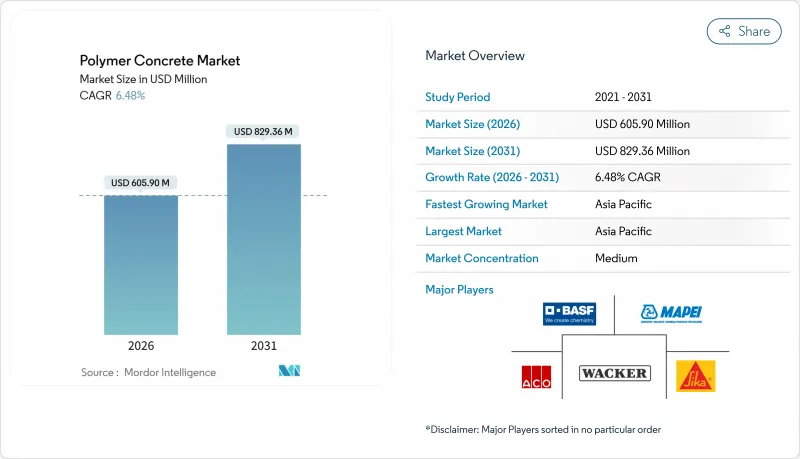
Mordor Intelligence에 의하면, 폴리머 콘크리트 시장 규모는 2026년에 6억 590만 달러로 추정되며, 예측 기간(2026-2031년)에 CAGR 6.48%로 성장을 지속하여 2031년까지 8억 2,936만 달러에 이를 전망입니다.
본 보고서는 폴리머 유형별(에폭시, 메틸메타크릴레이트 등),결합제(천연 수지 및 합성 수지), 용도(아스팔트 포장 및 오버레이, 건축 및 유지보수 등), 최종 사용자(주택, 상업시설 등), 지역(아시아태평양, 북미, 유럽, 남미, 중동 및 아프리카)별로 분류되어 있습니다. 시장 예측은 금액(달러) 기준으로 제시되어 있습니다.
세계 폴리머 콘크리트 시장 동향 및 인사이트
하수도 및 해수 담수화 시설의 개보수 가속화
황화수소에 의한 부식으로 인해 1960년부터 1985년 사이에 설치된 콘크리트 하수관의 두께가 30-50%나 손실되었으며,이에 따라 전 세계 상수도 유틸리티자들은 2030년까지 12,000km에 달하는 본관의 내벽 시공 또는 교체를 서둘러야 하는 상황입니다. 폴리머 콘크리트를 이용한 내벽 시공은 교체 비용의 60%만으로도 자산 수명을 최대 40년까지 연장할 수 있어, 예산에 제약이 있는 지자체에게 매력적인 가치 제안을 제공합니다. 해수 담수화 분야에서는 사우디아라비아가 2025년에 3개의 역삼투막 플랜트를 가동하며, 염화물 농도가 35,000 ppm을 초과하는 염수 수로에는 폴리머 콘크리트의 사용을 지정했습니다. 아랍에미리트(UAE)의 ‘2026-2030년 물 안보 전략’에서는 모든 신규 해수 담수화 시설에 내식성 자재의 사용을 의무화하고 있어, 공급업체에게 1억 8,000만 달러 규모 시장 기회가 창출되고 있습니다.
EU 내 내화학성 라이닝 의무화
지침 2024/3019에 따라, 회원국은 2028년 12월까지 pH 2-12의 배수를 허용할 수 있도록 12,000 km의 하수도 본관을 개량해야 할 의무가 있습니다. 독일은 이 지침을 준수하기 위해 21억 유로를 예산으로 편성했으며, 폴리머 콘크리트는 해당 지침이 정한 50년의 설계 수명 시험을 충족하기 때문에 자금 지원을 받은 프로젝트의 34%에서 채택되고 있습니다. EN 14627의 2019년 개정판에서는 접착 강도 및 투수성의 기준치가 상향 조정되었으며, 이로 인해 라텍스 개질 코팅보다 우수한 성능을 가진 에폭시 및 폴리에스테르 계열 제품에 대한 수요가 간접적으로 촉진되고 있습니다.
중층 건축물에 대한 화재 방지 기준의 미비
ISO 834 및 ASTM E119는 기존 콘크리트를 대상으로 하고 있지만, 폴리머계 결합재는 대상에서 제외되어 있어 건축가는 4-8층 건물에 관한 통일된 시험 데이터를 이용할 수 없습니다. 독일의 모델 건축 기준법에서는 90분간의 내화성을 요구하고 있지만, 시멘트계 혼합물이 47유형 있는 반면, 폴리머 콘크리트 시스템 중 국가 승인을 받은 것은 고작 3유형에 불과합니다. 명확한 기준의 부재로 인해 2025년에는 약 120,000 m³ 수요가 감소할 것으로 예측됩니다.
부문 분석
에폭시 계열 등급은 열화된 기층에 대한 탁월한 접착력과 pH 1-14의 전체 범위에 걸친 내성을 바탕으로 2025년 매출의 52.18%를 차지했습니다. 이 등급은 연평균 성장률(CAGR) 7.38%로 경쟁사를 앞설 것으로 예측되어, 폴리머 콘크리트 시장의 성장 동력으로서의 입지를 공고히 하고 있습니다. 폴리에스테르 계열은 출하량 기준 2위를 차지하고 있으며, 교량 오버레이에서 2시간 내 경화되는 점이 높이 평가되고 있지만, 인장 강도가 15% 낮기 때문에 화학 약품 탱크에의 사용은 제한되고 있습니다. -10°C에서 경화되는 MMA계 수지는 2025년 캐나다의 도로 보수 가능 기간을 6주 연장했습니다. 프란 수지 및 페놀 수지는 강산성 환경이라는 틈새 시장에서 활용되고 있으나, 취성 및 공급업체의 제한으로 인해 시장 점유율은 3% 미만에 그치고 있습니다. BASF가 2025년에 출시할 하이브리드 에폭시·폴리우레탄계 바인더는 25%의 성장률을 실현하여 지진 다발 지역에서의 균열 전파를 억제합니다.
유틸리티 및 석유화학 플랜트에서 고내성 라이닝의 표준화가 진행됨에 따라, 폴리머 콘크리트 시장 내 에폭시 수지의 점유율은 상승할 것으로 예측됩니다. 폴리에스테르 수지와 MMA 수지는 온도에 민감한 오버레이 용도에서 안정적인 점유율을 유지하는 한편, 하이브리드 화학 조성에 대한 새로운 연구 개발을 통해 유연성과 내화학성을 하나의 SKU에 융합하는 것을 목표로 하고 있습니다.
합성 수지는 신뢰성 높은 성능과 프리캐스트 공장을 위한 효율적인 배치 처리 덕분에 2025년 총 생산량의 82.29%를 차지했습니다. 에폭시, 폴리에스테르, 비닐 에스테르의 각 유형은 모두 40 MPa를 초과하는 인장 강도를 가지며, ASTM C267에 따른 침지 시험 후의 수분 흡수율은 0.5% 미만입니다. 천연 수지는 7.64%라는 가장 높은 성장률을 보이고 있으며, 탄소 가격 인상에 따라 합성 수지의 우위를 서서히 잠식해 나갈 전망입니다. 인프라 온타리오(Infrastructure Ontario)는 작년에 8건의 교량 입찰에서 20%의 재생 가능 성분 함유를 의무화했으나, 이 획기적인 요건을 충족한 것은 시카(Seeka)사와 마페이(Mapei)사의 바이오 수지 블렌드였습니다.
천연 바인더는 여전히 원료가 되는 작물의 품질에 기인한 점도 변동에 직면해 있으며, 압축 강도 면에서 합성 수지 제품보다 10-15% 낮은 경우가 있습니다. 바커 케미(Wacker Chemie)사의 아마씨유 유래 바이오 비닐 에스테르는 ISO 527 규격을 완벽하게 준수하며, 2025년에 독일의 폐수 처리 승인을 획득했습니다. 2025년 4분기에 톤당 95유로에 달한 EU의 CO2 가격 급등으로 인해 석유계 배합재의 비용은 1입방미터당 18유로 증가하여 바이오 수지와의 가격 차이가 좁혀지고 있습니다.
지역별 분석
아시아태평양은 2025년 매출의 42.29%를 차지하며, 2031년까지 연평균 7.61%의 성장이 예상됩니다. 중국은 제14차 5개년 계획에서 농촌 지역의 상하수도 프로젝트에 7,800억 위안 예산을 편성했으며, 산성 광산 배수가 발생하는 성에서는 폴리머 라이닝 사용을 명시하고 있습니다. 인도의 ‘스마트 시티 미션’에서는 몬순으로 인한 홍수 대책의 일환으로 34개 지자체에서 폴리머 배수관 사용을 의무화하고 있으며, 한편 일본의 쓰나미 대피로 복구 공사에서는 6개월이라는 공사 기간을 준수하기 위해 급속 경화형 오버레이가 채택되고 있습니다. 한국은 하수도 개보수에 1조 2,000억 원을 배정하고 50년의 자산 수명을 요건으로 하고 있으며, 자금 지원을 받은 프로젝트의 42%에서 폴리머 콘크리트가 채택되고 있습니다.
북미는 2위를 차지했습니다. ‘초당파 인프라 법’에 따라 상수도 시스템에 550억 달러, 송전망 현대화에 650억 달러가 투입되었으며, 환경보호청(EPA)이 자금을 지원하는 하수 처리 시설 개보수 프로젝트의 18%에서 폴리머 콘크리트가 지정되었습니다. 캐나다의 ‘Investing in Canada’ 계획에서는 지방자치단체의 상수도 유틸리티에 42억 캐나다 달러가 배정되어, 동결과 해동이 빈번하게 발생하는 앨버타주와 서스캐처원주에서 수요가 발생하고 있습니다. 멕시코는 2025년에 8개의 해수 담수화 플랜트 건설을 결정하고, 40,000 ppm의 염화물을 처리하기 위해 염수 파이프라인에 폴리머 콘크리트를 채택했습니다.
유럽의 동향은 지침 2024/3019 및 그린 딜의 탄소 배출 감축 목표에 의해 형성되고 있습니다. 독일에서는 21억 유로 규모의 규정 준수 계획에 따라 자금을 지원받은 하수 처리 프로젝트의 34%에 폴리머 콘크리트가 채택되었습니다. 영국의 WINEP 프로그램은 2030년까지 자산 건전성 유지를 위해 31억 파운드를 지원하겠다고 약속했으며, 합류식 하수도의 오버플로우 구간에 내식성 라이닝을 우선적으로 적용하고 있습니다. 프랑스는 재활용 체계 구축이 지연되고 있어 폴리머 콘크리트에 대한 순환 경제 보조금을 보류하고 있습니다. 브라질, 사우디아라비아 및 기타 급성장 지역에서는 ‘비전 2030’의 자금 지원 범위 하에, 연안 도시의 위생 시설과 염수 수로에 이 자재가 선호되어 채택되고 있습니다.
기타 혜택:
- 엑셀 형식 시장 예측(ME) 시트
- 3개월간의 애널리스트 지원
자주 묻는 질문
목차
제1장 서론
제2장 조사 방법
제3장 주요 요약
제4장 시장 구도
제5장 시장 규모와 성장 예측(금액 기준)
제6장 경쟁 구도
제7장 시장 기회와 향후 전망
LSHAccording to Mordor Intelligence, the polymer concrete market size is estimated at USD 605.90 million in 2026, and is expected to reach USD 829.36 million by 2031, at a CAGR of 6.48% during the forecast period (2026-2031).
This report is Segmented by Polymer Type (Epoxy, Methyl Methacrylate, and More), Binding Agent (Natural Resin and Synthetic Resin), Application (Asphalt Pavement and Overlays, Building and Maintenance, and More), End-User (Residential, Commercial, and More), and Geography (Asia-Pacific, North America, Europe, South America, and Middle East and Africa). Market Forecasts are Provided in Terms of Value (USD).
Global Polymer Concrete Market Trends and Insights
Accelerated Sewer and Desalination Upgrades
Hydrogen-sulfide corrosion is stripping 30-50% of wall thickness from concrete sewer pipes installed between 1960 and 1985, prompting utilities to line or replace 12,000 km of mains worldwide by 2030. Polymer concrete linings extend asset life by up to 40 years at 60% of replacement cost, an attractive value proposition for budget-constrained municipalities. On the desalination front, Saudi Arabia brought three reverse-osmosis plants online in 2025 and specified polymer concrete for brine channels where chloride levels exceed 35,000 ppm. The United Arab Emirates' 2026-2030 Water Security Strategy mandates corrosion-resistant materials in all new desalination assets, anchoring a USD 180 million addressable opportunity for suppliers.
Mandated Chemical-Resistant Linings in the EU
Directive 2024/3019 obliges member states to upgrade 12,000 km of sewer mains to tolerate pH 2-12 effluent by December 2028. Germany has earmarked EUR 2.1 billion to comply, and polymer concrete appears in 34% of funded projects because it meets the directive's 50-year design-life test. EN 14627's 2019 revision tightened adhesion and permeability thresholds, indirectly steering demand toward epoxy and polyester grades that outperform latex-modified coatings.
Insufficient Fire-Rating Codes for Mid-Rise Structures
ISO 834 and ASTM E119 cover traditional concrete but omit polymer binders, leaving architects without harmonized test data for 4-to-8-story buildings. Germany's Model Building Code calls for 90-minute fire resistance, yet only three polymer concrete systems have national approvals, compared with 47 cement-based mixes. The absence of clear standards erased an estimated 120,000 m3 of demand in 2025.
Other drivers and restraints analyzed in the detailed report include:
- US Grid-Hardening Specifying Non-Conductive Pads
- Data-Center Boom Favoring Prefabricated Trench Drains
- BPA-Epoxy Price Volatility
For complete list of drivers and restraints, kindly check the Table Of Contents.
Segment Analysis
Epoxy grades delivered 52.18% of 2025 revenue, supported by unmatched adhesion to deteriorated substrates and resistance across the full pH 1-14 range. They are forecast to outpace rivals at a 7.38% CAGR, confirming their position as the growth engine of the polymer concrete market. Polyester ranks second by volume, favored for two-hour cure-downs on bridge overlays, yet 15% lower tensile strength restricts use in chemical tanks. MMA systems, curing at -10°C, extended Canada's road-repair window by six weeks in 2025. Furan and phenolic resins serve extreme-acid niches but remain below 3% share due to brittleness and limited suppliers. BASF's 2025 hybrid epoxy-polyurethane binder brings 25% elongation, curbing crack propagation in seismic zones.
The polymer concrete market share for epoxy is expected to rise as utilities and petrochemical plants standardize on high-resistance linings. Polyester and MMA will hold steady in temperature-sensitive overlays, while renewed R&D in hybrid chemistries seeks to combine flexibility and chemical durability in one SKU.
Synthetic resins supplied 82.29% of the 2025 volume thanks to reliable performance and streamlined batching for precast shops. Epoxy, polyester, and vinyl ester varieties all exceed 40 MPa tensile strength and absorb less than 0.5% water after immersion tests per ASTM C267. Natural resins are the fastest-growing segment at 7.64% and are set to chip away at synthetic dominance as carbon pricing tightens. Infrastructure Ontario required 20% renewable content in eight bridge tenders last year, a milestone won by Sika and Mapei bio-resin blends.
Natural binders still face viscosity swings tied to crop feedstock quality and can trail synthetic peers by 10-15% in compressive strength. Wacker Chemie's bio-vinyl ester, derived from linseed oil, achieved full ISO 527 parity and gained German wastewater approval in 2025. Rising EU CO2 prices, which hit EUR 95 per ton in Q4 2025, add up to EUR 18 per cubic meter to petroleum-based formulations, narrowing the price gap with bio-resins.
Complete Report Scope:
- By Polymer Type
- Epoxy
- Polyester
- Methyl Methacrylate
- Latex
- Acrylate
- Others (Furan, Phenolic-Formaldehyde, Acetone-Formaldehyde, Carbamide)
- By Binding Agent
- Natural Resin
- Synthetic Resin
- By Application
- Asphalt Pavement and Overlays
- Building and Maintenance
- Industrial Tanks
- Prefabricated Drainage Systems
- Others (Outdoor Furniture and Architectural Components, Solid-Surface Counters and Overlays)
- By End-User
- Residential
- Commercial
- Infrastruture
- Industrial
- By Geography
- Asia-Pacific
- China
- India
- Japan
- South Korea
- Rest of Asia-Pacific
- North America
- United States
- Canada
- Mexico
- Europe
- Germany
- United Kingdom
- France
- Italy
- Rest of Europe
- South America
- Brazil
- Argentina
- Rest of South America
- Middle East and Africa
- Saudi Arabia
- South Africa
- Rest of Middle East and Africa
- Asia-Pacific
Geography Analysis
Asia-Pacific contributed 42.29% of 2025 sales and is projected to grow at 7.61% through 2031. China budgeted CNY 780 billion for rural water and wastewater projects in its 14th Five-Year Plan, specifying polymer linings in acid-mine-drainage provinces. India's Smart Cities Mission mandates polymer drains in 34 municipalities to fight monsoon flooding, while Japan's tsunami-evacuation route repairs rely on rapid-cure overlays to meet six-month deadlines. South Korea earmarked KRW 1.2 trillion for sewer renewals and requires a 50-year asset life, steering 42% of funded projects to polymer concrete.
North America ranks second. The Bipartisan Infrastructure Law mobilized USD 55 billion for water systems and USD 65 billion for grid modernization, with polymer concrete specified in 18% of EPA-funded wastewater upgrades. Canada's Investing in Canada plan allocated CAD 4.2 billion for municipal water, with demand emerging in freeze-thaw-prone Alberta and Saskatchewan. Mexico awarded eight desalination plants in 2025, placing polymer concrete in brine pipelines to handle 40,000 ppm chlorides.
Europe's trajectory is shaped by Directive 2024/3019 and Green Deal carbon goals. Germany placed polymer concrete in 34% of wastewater projects funded under a EUR 2.1 billion compliance scheme. The United Kingdom's WINEP program committed GBP 3.1 billion to asset health through 2030, prioritizing corrosion-resistant linings in combined-sewer overflows. France withheld circular-economy subsidies from polymer concrete because recycling pathways lag. Brazil, Saudi Arabia, and other fast-growing regions favor the material for coastal-city sanitation and brine channels under Vision 2030 funding.
- ACO Ahlmann SE & Co. KG
- ACO FUNKI A/S
- Arizona Polymer Flooring Inc. (ICP Building Solutions Group)
- BASF
- Dudick Inc.
- Forte Composites Inc.
- Fosroc International Ltd.
- Hycrete Inc.
- Interplastic Corporation
- Mapei S.p.A.
- Metro Cast Corporation
- Owens Corning
- QGPC
- Sika AG
- TPP Manufacturing Sdn. Bhd.
- Ulma Architectural Solutions
- Wacker Chemie AG
Additional Benefits:
- The market estimate (ME) sheet in Excel format
- 3 months of analyst support
TABLE OF CONTENTS
1 Introduction
- 1.1 Study Assumptions & Market Definition
- 1.2 Scope of the Study
2 Research Methodology
3 Executive Summary
4 Market Landscape
- 4.1 Market Overview
- 4.2 Market Drivers
- 4.2.1 Accelerated sewer and desalination upgrades
- 4.2.2 Mandated chemical-resistant linings for EU water infrastructure
- 4.2.3 US grid-hardening programs specifying non-conductive pads
- 4.2.4 Data-center boom driving prefabricated trench drains
- 4.2.5 Net-zero concrete policies spurring bio-based polymer binders
- 4.3 Market Restraints
- 4.3.1 Insufficient fire-rating codes for mid-rise structures
- 4.3.2 BPA-epoxy price volatility squeezing contractors
- 4.3.3 End-of-life recycling gaps limiting public-sector uptake
- 4.4 Value Chain Analysis
- 4.5 Porter's Five Forces
- 4.5.1 Bargaining Power of Suppliers
- 4.5.2 Bargaining Power of Buyers
- 4.5.3 Threat of New Entrants
- 4.5.4 Threat of Substitutes
- 4.5.5 Degree of Competition
5 Market Size and Growth Forecasts ( Value)
- 5.1 By Polymer Type
- 5.1.1 Epoxy
- 5.1.2 Polyester
- 5.1.3 Methyl Methacrylate
- 5.1.4 Latex
- 5.1.5 Acrylate
- 5.1.6 Others (Furan, Phenolic-Formaldehyde, Acetone-Formaldehyde, Carbamide)
- 5.2 By Binding Agent
- 5.2.1 Natural Resin
- 5.2.2 Synthetic Resin
- 5.3 By Application
- 5.3.1 Asphalt Pavement and Overlays
- 5.3.2 Building and Maintenance
- 5.3.3 Industrial Tanks
- 5.3.4 Prefabricated Drainage Systems
- 5.3.5 Others (Outdoor Furniture and Architectural Components, Solid-Surface Counters and Overlays)
- 5.4 By End-User
- 5.4.1 Residential
- 5.4.2 Commercial
- 5.4.3 Infrastruture
- 5.4.4 Industrial
- 5.5 By Geography
- 5.5.1 Asia-Pacific
- 5.5.1.1 China
- 5.5.1.2 India
- 5.5.1.3 Japan
- 5.5.1.4 South Korea
- 5.5.1.5 Rest of Asia-Pacific
- 5.5.2 North America
- 5.5.2.1 United States
- 5.5.2.2 Canada
- 5.5.2.3 Mexico
- 5.5.3 Europe
- 5.5.3.1 Germany
- 5.5.3.2 United Kingdom
- 5.5.3.3 France
- 5.5.3.4 Italy
- 5.5.3.5 Rest of Europe
- 5.5.4 South America
- 5.5.4.1 Brazil
- 5.5.4.2 Argentina
- 5.5.4.3 Rest of South America
- 5.5.5 Middle East and Africa
- 5.5.5.1 Saudi Arabia
- 5.5.5.2 South Africa
- 5.5.5.3 Rest of Middle East and Africa
- 5.5.1 Asia-Pacific
6 Competitive Landscape
- 6.1 Market Concentration
- 6.2 Strategic Moves (Mergers and Acquisitions, Joint Ventures, Agreements)
- 6.3 Market Share(%)/Ranking Analysis
- 6.4 Company Profiles (includes Global Level Overview, Market Level Overview, Core Segments, Financials, Strategic Info, Products and Services, Recent Developments)
- 6.4.1 ACO Ahlmann SE & Co. KG
- 6.4.2 ACO FUNKI A/S
- 6.4.3 Arizona Polymer Flooring Inc. (ICP Building Solutions Group)
- 6.4.4 BASF
- 6.4.5 Dudick Inc.
- 6.4.6 Forte Composites Inc.
- 6.4.7 Fosroc International Ltd.
- 6.4.8 Hycrete Inc.
- 6.4.9 Interplastic Corporation
- 6.4.10 Mapei S.p.A.
- 6.4.11 Metro Cast Corporation
- 6.4.12 Owens Corning
- 6.4.13 QGPC
- 6.4.14 Sika AG
- 6.4.15 TPP Manufacturing Sdn. Bhd.
- 6.4.16 Ulma Architectural Solutions
- 6.4.17 Wacker Chemie AG
7 Market Opportunities and Future Outlook
- 7.1 White-Space and Unmet-Need Assessment