|
시장보고서
상품코드
2121601
스마트 웨어러블 : 시장 점유율 분석, 업계 동향과 통계, 성장 예측(2026-2031년)Smart Wearable - Market Share Analysis, Industry Trends & Statistics, Growth Forecasts (2026 - 2031) |
||||||
 Mordor Intelligence
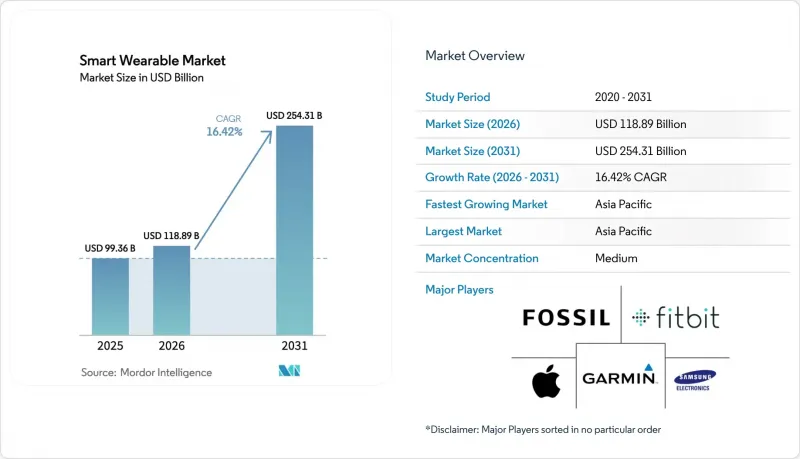
Mordor Intelligence에 의하면, 스마트 웨어러블 시장 규모는 2025년 993억 6,000만 달러에서 2026년에는 1,188억 9,000만 달러로 성장하고, 2026-2031년 CAGR 16.42%로 성장을 지속하여 2031년에는 2,543억 1,000만 달러에 달할 것으로 예측됩니다.
본 보고서는 제품별(스마트 워치, 히어러블, 피트니스 트래커, 헤드마운트 디스플레이, 스마트웨어, 바디 카메라, 스마트 링 등), 구성 요소별(하드웨어, 소프트웨어, 서비스), 연결 방식별(블루투스, 셀룰러 등),최종 용도별(소비자, 헬스케어 등), 유통 채널별(온라인, 오프라인), 지역별로 분류되어 있습니다. 시장 예측은 금액(달러) 기준으로 제시되어 있습니다.
세계 스마트 웨어러블 시장 동향 및 인사이트
소비자의 건강 및 피트니스에 대한 인식 제고
하루 걸음 수, 심박 변이도, 수면 단계 점수는 일상적인 지표가 되었으며, 웨어러블 기기는 자기 관리의 동반자로 변모하고 있습니다. 애플에 따르면, 2025년 ‘Apple Watch Series 9’ 구매자의 70%가 건강 관리 도구를 구매의 주된 이유로 꼽았으며, 이는 2022년 대비 12퍼센트 포인트 증가한 수치입니다. 가민의 러닝 및 사이클링용 제품 라인업은 2025년에 전년 대비 18% 확대되었습니다. 이는 캐주얼한 조깅 애호가를 데이터 기반 운동선수로 변화시키는 Strava 및 Training Peaks와의 연동이 뒷받침한 결과입니다. 삼성은 갤럭시 워치 6에 체성분 분석 기능을 추가하여, 기존에는 의료 기관의 체중계에서만 얻을 수 있었던 근육량 및 체지방률에 대한 정보를 제공합니다. 게이미피케이션을 접목한 소프트웨어에 통합된 이러한 의료 등급 센서들은 스마트폰 교체 주기가 길어지고 있는 상황에서도 두 자릿수의 판매량 성장을 유지하고 있습니다.
심장 원격 모니터링용 보험 적용 웨어러블
메디케어·메디케이드 서비스 센터(CMS)는 2024년부터 웨어러블 기기에서 얻은 심전도 데이터에 대한 임상의의 심사에 대해 환자 1인당월50-65달러를 보상하기 시작했습니다. 오므론의 ‘HeartGuide’ 시계는 FDA 승인을 받은 최초의 오실로메트릭 방식 혈압 측정 웨어러블 기기로, 2025년에 유나이티드 헬스케어 및 앤섬으로부터 보험 적용을 받아 가입자의 본인 부담금을 499달러에서 100달러 미만으로 낮췄습니다. 위징스(Withings)의 ‘ScanWatch 2’는 심방세동 감지에 대해 FDA 승인을 획득했으며, 2025년 중반까지 40개 이상의 책임의료기구(ACO)가 해당 데이터를 에픽(Epic) 및 서너(Cerner)의 의료 기록에 통합했습니다. 이처럼 보험 환급 제도의 정비에 힘입어 웨어러블 기기는 단순한 건강 증진을 위한 부가적인 도구에서 청구 가능한 진단 수단으로 그 위상이 변화하고 있습니다.
유럽의 데이터 거주 요건이 클라우드 컴패니언 앱을 제한
‘슈렘스 II’ 판결에 따라, EU 규제 당국은 2025년에 단속을 강화하고, 공급업체에게 건강 데이터를 유럽 내에 호스팅할 것을 의무화했습니다. 애플은 iCloud Health의 워크로드를 독일 및 아일랜드 시설로 이전하기 위해 약 2억 달러를 지출했습니다. 핏빗은 사용자의 동의 없이 사용자 데이터를 미국 서버를 통해 전송했다는 이유로 800만 유로의 벌금을 부과받았으며, 규정 준수 위반으로 인한 재정적 위험이 부각되었습니다. 지역에 뿌리내린 인프라를 구축할 자금력이 부족한 소규모 브랜드들은 시장에서 철수할 수밖에 없거나, 지역 클라우드 사업자와의 제휴로 인해 이익률이 압박받고 고객 확보 비용이 증가하는 상황에 직면하고 있습니다.
부문 분석
스마트 워치는 2025년 매출의 60.39%를 차지하며, 이 카테고리는 스마트 웨어러블 시장 규모의 중심에 자리 잡았습니다. 이는 애플, 삼성, 가민이 생태계의 락인 효과와 다종목 스포츠 지원 GPS 정확도를 활용하여 시장 점유율을 지켰기 때문입니다. 히어러블은 출하 대수의 18%를 차지했으며, 애플 에어팟 프로 2가 일반용 보청기로 승인을 받은 것을 계기로 경미한 청력 손실을 겪는 3,000만 명의 미국인에게 서비스를 제공했습니다. 반면, 피트니스 밴드 시장 점유율은 12%로 축소되었습니다. 이는 소비자들이 결제 기능, 휴대폰 통화, 건강 대시보드를 통합한 풀스택형 스마트 워치로 눈을 돌렸기 때문입니다.
시장 흐름은 눈에 띄지 않는 폼 팩터로 이동하고 있습니다. Oura의 연간 5억 달러 규모의 구독 매출과 삼성의 ‘Galaxy Ring’이 주도하는 스마트 링 시장은 연평균 성장률(CAGR) 17.05%를 기록하며, 스마트 웨어러블 시장 내 모든 제품군 중 가장 빠른 성장세를 보이고 있습니다. 헤드마운트 디스플레이 시장 점유율은 5%에 그쳤지만, 메타(Meta)의 ‘퀘스트 3S(Quest 3S)’ 가격 인하 조치는 향후 판매량 확대를 시사하고 있습니다. 스마트 웨어, 의료용 패치, 동력식 외골격과 같은 틈새 분야는 합쳐서 5%의 점유율에 그치고 있지만, 미개척 시장으로서의 가능성을 내포하고 있습니다. 그 증거로, Ekso Bionics사가 2025 회계연도에 미 육군에 ‘EVO’ 외골격 120대를 납품한 사례가 있습니다.
2025년 매출의 71.22%는 하드웨어가 차지했으나, 서비스 분야는 2031년까지 연평균 성장률(CAGR) 16.94%로 확대되고 있어 스마트 웨어러블 시장 내 수익원의 구성비가 재편되고 있습니다. 애플의 서비스 부문은 2025 회계연도에 960억 달러를 돌파했으며, 그 중 약 8%는 Fitness Plus 및 iCloud Health 스토리지와 관련되어 있습니다. WHOOP의 초기 하드웨어 비용 불필요 모델은월30달러로 120만 명의 가입자를 확보하며, 정기적인 현금 흐름을 통한 기업 가치 상승 여력을 보여주고 있습니다.
시장 점유율의 8%를 차지하는 소프트웨어 및 동반 앱은 하드웨어의 편의성과 개방형 개발자 생태계를 뒷받침하고 있습니다. Garmin은 2025년에 5,000만 건 이상의 Connect IQ 다운로드를 기록한 반면, 샤오미가 2025년 3월에 웨어러블용 HyperOS SDK를 오픈소스로 공개함에 따라 6개월 이내에 타사 제출 건수가 150% 증가했습니다. 그 결과, 스마트 웨어러블 업계에서 구독 중심 벤더의 주가수익비율(PER)은 현재 8-12배 수준에서 거래되고 있는 반면, 하드웨어만 취급하는 동종 업계 경쟁사들은 2-4배 수준에 머물고 있습니다.
지역별 분석
2025년에는 아시아태평양이 매출의 34.91%를 차지하며 1위를 차지할 것으로 예상되며, 2031년까지 연평균 성장률(CAGR) 17.31%를 나타낼 것으로 전망되어 지역별 가장 빠른 성장 속도를 보일 것으로 보입니다. 중국 규제 당국은 2025년에 47종의 이중 용도 스마트 워치를 승인했으며, 이는 2024년 대비 56% 증가한 수치입니다. 또한, 기기당 최대 500위안(71.4달러)의 보조금이 화웨이, 샤오미, 오포의 판매량 급증을 뒷받침했습니다. 인도에서는 출하량이 68% 증가했으며, 국내 브랜드인 Noise, Fire-Boltt, boAt가 50달러 미만의 가격 책정과 현지 언어 지원 앱을 통해 60%가 넘는 시장 점유율을 차지했습니다. 일본에서는 2025년 4월, 웨어러블 기기에서 수집한 혈압 데이터에 대한 보험 적용 범위가 확대되면서 오므론의 ‘HeartGuide’ 출하량이 한 분기 만에 34% 증가했습니다.
북미에서는 메디케어 코드와 기업의 웰니스 예산을 기반으로 2025년 매출의 32%를 창출했습니다. 2024년 9월에 출시되어 FDA 승인을 받은 수면 무호흡증 감지 기능을 탑재한 ‘Apple Watch Series 10’은 50세 이상 사용자로부터 매출 구성비의 18%를 차지했습니다. 캐나다 각 주에서는 만성 질환 대책 시범 사업을 위해 2만 5,000대의 보조금 지원 스마트 워치를 배포한 반면, 멕시코 시장에서는 중국산 기기에 대한 관세 인상에도 불구하고 수입품 덕분에 41%의 성장을 기록했습니다.
유럽은 매출의 22%를 차지했으나, 규정 준수 측면에서의 부담이 가장 큽니다. 독일 연방정보보안국은 현재 생체 정보의 국경 간 전송에 대해 명시적인 동의를 의무화하고 있으며, 이로 인해 제품 출시 일정이 최대 3개월까지 지연되는 상황이 발생하고 있습니다. 영국에서는 2025년에 웨어러블 데이터를 NHS 앱에 통합하여 1,200만 명의 시민이 의사와 측정값을 공유할 수 있게 되었습니다. 남미, 중동 및 아프리카는 각각 매출의 6%를 차지하고 있으며, 브라질은 판매 대수를 견인하고 있지만 ARPU가 낮아 성장에 한계가 있고, 아랍에미리트(UAE)는 고급 스마트 워치 수요를 주도하고 있습니다.
기타 혜택:
- 엑셀 형식 시장 예측(ME) 시트
- 3개월간의 애널리스트 지원
자주 묻는 질문
목차
제1장 서론
제2장 조사 방법
제3장 주요 요약
제4장 시장 구도
제5장 시장 규모와 성장 예측
제6장 경쟁 구도
제7장 시장 기회와 향후 전망
LSH 26.09.02According to Mordor Intelligence, the smart wearable market size is expected to grow from USD 99.36 billion in 2025 to USD 118.89 billion in 2026 and is forecast to reach USD 254.31 billion by 2031 at 16.42% CAGR over 2026-2031.
This report is Segmented by Product (Smartwatches, Hearables, Fitness Trackers, Head-Mounted Displays, Smart Clothing, Body-Worn Cameras, Smart Rings, and More), Component (Hardware, Software, and Services), Connectivity (Bluetooth, Cellular, and More), Application (Consumer, Healthcare, and More), Distribution (Online, and Offline), and Geography. Market Forecasts are Provided in Terms of Value (USD).
Global Smart Wearable Market Trends and Insights
Rising Health and Fitness Consciousness Among Consumers
Daily step counts, heart-rate variability, and sleep-stage scores have become routine metrics, transforming wearables into accountability companions. Apple disclosed that 70% of 2025 Watch Series 9 buyers ranked health tools as the main reason for purchase, up 12 percentage points from 2022. Garmin's running and cycling portfolio expanded 18% year over year in 2025, boosted by links to Strava and Training Peaks that turn casual joggers into data-driven athletes. Samsung added body-composition analysis to Galaxy Watch 6, offering muscle and body-fat insights previously confined to clinic scales. These medical-grade sensors wrapped in gamified software are sustaining double-digit unit growth even as smartphone replacement cycles lengthen.
Insurance-Approved Wearables for Cardiac Remote Monitoring
Centers for Medicare and Medicaid Services began reimbursing clinician review of wearable-derived electrocardiogram data in 2024, paying USD 50-USD 65 per patient each month. Omron's HeartGuide watch, the first FDA-cleared oscillometric blood-pressure wearable, gained coverage from UnitedHealthcare and Anthem in 2025, lowering member costs from USD 499 to under USD 100. Withings' ScanWatch 2 earned FDA clearance for atrial-fibrillation detection, and more than 40 accountable-care organizations embedded its data into Epic and Cerner records by mid-2025. Reimbursement is therefore repositioning wearables from wellness extras to billable diagnostic endpoints.
Data-Residency Mandates Limiting Cloud Companion Apps in Europe
Following the Schrems II judgment, EU regulators intensified enforcement in 2025, forcing vendors to host health data within European borders. Apple spent an estimated USD 200 million migrating iCloud Health workloads to German and Irish facilities. Fitbit was fined EUR 8 million for routing user data through U.S. servers without consent, highlighting the financial risk of non-compliance. Smaller brands lacking capital for localized infrastructure face exit decisions or margin-eroding partnerships with regional clouds, raising customer acquisition costs.
Other drivers and restraints analyzed in the detailed report include:
- China's Dual-Use Smartwatch Subsidies Under Healthy China 2030
- AI-On-Chip Wearables Enable Needle-Free Glucose Monitoring
- High-Density Battery Thermal Runaway Concerns
For complete list of drivers and restraints, kindly check the Table Of Contents.
Segment Analysis
Smartwatches delivered 60.39% of 2025 revenue, placing the category at the center of the smart wearable market size, as Apple, Samsung, and Garmin leveraged ecosystem lock-ins and multisport GPS accuracy to defend share. Hearables supplied 18% of shipments, riding Apple AirPods Pro 2's over-the-counter hearing-aid approval to serve 30 million Americans with mild hearing loss. Fitness bands tapered to 12% as consumers gravitated toward full-stack watches that fuse payments, cellular calls, and health dashboards.
Momentum is shifting toward discreet form factors. Smart rings, led by Oura's USD 500 million annual subscription run rate and Samsung's Galaxy Ring, are rising at a 17.05% CAGR, the fastest of any product line in the smart wearable market. Head-mounted displays held 5% share, but Meta's Quest 3S price drop hints at future volume plays. Niche frontiers in smart clothing, medical patches, and powered exoskeletons contributed a combined 5% yet hold white-space potential, evidenced by Ekso Bionics shipping 120 EVO exoskeletons to the U.S. Army in fiscal 2025.
Hardware retained 71.22% of 2025 revenue, but the services layer is expanding at a 16.94% CAGR to 2031, repositioning revenue streams inside the smart wearable market. Apple's services unit topped USD 96 billion in fiscal 2025, with roughly 8% linked to Fitness Plus and iCloud Health storage. WHOOP's no-upfront-hardware model achieved 1.2 million subscribers at USD 30 monthly, illustrating the valuation upside in annuity cash flows.
Software and companion apps, representing 8% share, underpin hardware utility and open developer ecosystems. Garmin processed more than 50 million Connect IQ downloads in 2025, while Xiaomi's decision to open-source its HyperOS wearable SDK in March 2025 boosted third-party submissions 150% within six months. Consequently, subscription-centric vendors in the smart wearable industry now trade at 8-12X revenue multiples, compared with 2-4X for hardware-only peers.
Complete Report Scope:
- By Product
- Smartwatches
- Hearables (Ear-Worn, Smart Earbuds)
- Fitness and Activity Trackers
- Head-Mounted Displays (AR, VR, MR)
- Smart Clothing and Textiles
- Body-Worn Cameras
- Smart Rings and Jewelry
- Medical Wearable Patches and Biosensors
- Powered Exoskeletons
- By Component
- Hardware
- Software and Apps
- Services and Subscriptions
- By Connectivity Technology
- Bluetooth, BLE
- Cellular (3G, 4G, LTE-M)
- 5G Stand-Alone
- NFC, RFID
- Wi-Fi, WLAN
- Others Connectivity Technology (UWB, ANT+)
- By End-Use
- Consumer Electronics and Lifestyle
- Healthcare and Medical
- Fitness and Sports
- Industrial and Enterprise Safety
- Military and Defense
- By Distribution Channel
- Online (Brand E-Store, Marketplaces)
- Offline (Consumer Electronics Stores, Specialty, Clinics)
- By Geography
- North America
- United States
- Canada
- Mexico
- Europe
- Germany
- United Kingdom
- France
- Italy
- Spain
- Rest of Europe
- Asia Pacific
- China
- Japan
- South Korea
- India
- South-East Asia
- Rest of Asia Pacific
- South America
- Brazil
- Rest of South America
- Middle East
- United Arab Emirates
- Saudi Arabia
- Rest of Middle East
- Africa
- South Africa
- Rest of Africa
- North America
Geography Analysis
Asia Pacific led with 34.91% revenue in 2025 and is projected to register a 17.31% CAGR to 2031, the quickest regional pace. China's regulator cleared 47 dual-use smartwatch models in 2025, a 56% jump from 2024, and subsidies of up to CNY 500 (USD 71.4) per unit fostered a volume surge for Huawei, Xiaomi, and Oppo. India's unit shipments climbed 68%, allowing domestic brands Noise, Fire-Boltt, and boAt to command over 60% share via sub-USD 50 pricing and vernacular apps. Japan expanded reimbursement for wearable-sourced blood-pressure data in April 2025, lifting Omron's HeartGuide volumes 34% in a single quarter.
North America generated 32% revenue in 2025, anchored by Medicare codes and enterprise wellness budgets. Apple Watch Series 10, released in September 2024 with FDA-cleared sleep-apnea detection, drew an 18% sales mix from users over 50. Provinces in Canada distributed 25,000 subsidized smartwatches for chronic-disease pilots, while Mexico's market grew 41% on imported stock despite higher tariffs on Chinese devices.
Europe supplied 22% revenue but faces the heaviest compliance drag. Germany's Federal Office for Information Security now demands explicit consent for any cross-border transfer of biometric information, adding as much as three months to launch timelines. The United Kingdom integrated wearable data into the NHS App in 2025, enabling 12 million citizens to share metrics with doctors. South America and Middle East and Africa each represented 6% revenue, with Brazil driving volume yet limited by low ARPU and the United Arab Emirates propelling luxury smartwatch demand.
- Apple Inc.
- Samsung Electronics Co. Ltd.
- Alphabet Inc. (Fitbit, Google Pixel)
- Garmin Ltd.
- Huawei Technologies Co. Ltd.
- Xiaomi Corporation
- Meta Platforms Inc. (Oculus)
- Sony Group Corporation
- Microsoft Corp.
- Withings SA
- Huami Corp. (Zepp Health)
- GoPro Inc.
- Fossil Group Inc.
- Omron Healthcare Inc.
- Ekso Bionics Holdings Inc.
- Cyberdyne Inc.
- Nuheara Ltd.
- Bragi GmbH
- Sensoria Inc.
- AIQ Smart Clothing Inc.
- Polar Electro Oy
- Coros Wearables Inc.
- Oura Health Ltd.
- WHOOP Inc.
Additional Benefits:
- The market estimate (ME) sheet in Excel format
- 3 months of analyst support
TABLE OF CONTENTS
1 INTRODUCTION
- 1.1 Study Assumptions and Market Definition
- 1.2 Scope of the Study
2 RESEARCH METHODOLOGY
3 EXECUTIVE SUMMARY
4 MARKET LANDSCAPE
- 4.1 Market Overview
- 4.2 Market Drivers
- 4.2.1 Rising Health-and-Fitness Consciousness Among Consumers
- 4.2.2 Enterprise Digital-Wellness Programs Boosting Device Subsidies
- 4.2.3 Insurance-Approved Wearables for Cardiac Remote Monitoring in North America
- 4.2.4 China's Dual-Use (Consumer + Medical) Smartwatch Subsidies Through Healthy China 2030
- 4.2.5 Rise of AI-on-Chip Wearables Enabling Continuous Glucose Monitoring Without Needles
- 4.2.6 Defense Exoskeleton Procurements Under United States Soldier Lethality Program
- 4.3 Market Restraints
- 4.3.1 Data-Residency Mandates Limiting Cloud Companion Apps in Europe
- 4.3.2 High-Density Battery Thermal Runaway Concerns in Ultra-Slim Smartwatches
- 4.3.3 Patent-Licensing Litigation Costs for Gesture-Based Smart Rings
- 4.3.4 Low ARPU in South America Limiting 5G Stand-Alone Wearable Roll-outs
- 4.4 Industry Value-Chain Analysis
- 4.5 Regulatory Landscape
- 4.6 Technological Outlook
- 4.7 Impact of Macroeconomic Factors on the Market
- 4.8 Porter's Five Forces Analysis
- 4.8.1 Bargaining Power of Suppliers
- 4.8.2 Bargaining Power of Buyers
- 4.8.3 Threat of New Entrants
- 4.8.4 Threat of Substitute Products
- 4.8.5 Intensity of Competitive Rivalry
- 4.9 Investment and Funding Analysis
5 MARKET SIZE AND GROWTH FORECASTS (VALUES)
- 5.1 By Product
- 5.1.1 Smartwatches
- 5.1.2 Hearables (Ear-Worn, Smart Earbuds)
- 5.1.3 Fitness and Activity Trackers
- 5.1.4 Head-Mounted Displays (AR, VR, MR)
- 5.1.5 Smart Clothing and Textiles
- 5.1.6 Body-Worn Cameras
- 5.1.7 Smart Rings and Jewelry
- 5.1.8 Medical Wearable Patches and Biosensors
- 5.1.9 Powered Exoskeletons
- 5.2 By Component
- 5.2.1 Hardware
- 5.2.2 Software and Apps
- 5.2.3 Services and Subscriptions
- 5.3 By Connectivity Technology
- 5.3.1 Bluetooth, BLE
- 5.3.2 Cellular (3G, 4G, LTE-M)
- 5.3.3 5G Stand-Alone
- 5.3.4 NFC, RFID
- 5.3.5 Wi-Fi, WLAN
- 5.3.6 Others Connectivity Technology (UWB, ANT+)
- 5.4 By End-Use
- 5.4.1 Consumer Electronics and Lifestyle
- 5.4.2 Healthcare and Medical
- 5.4.3 Fitness and Sports
- 5.4.4 Industrial and Enterprise Safety
- 5.4.5 Military and Defense
- 5.5 By Distribution Channel
- 5.5.1 Online (Brand E-Store, Marketplaces)
- 5.5.2 Offline (Consumer Electronics Stores, Specialty, Clinics)
- 5.6 By Geography
- 5.6.1 North America
- 5.6.1.1 United States
- 5.6.1.2 Canada
- 5.6.1.3 Mexico
- 5.6.2 Europe
- 5.6.2.1 Germany
- 5.6.2.2 United Kingdom
- 5.6.2.3 France
- 5.6.2.4 Italy
- 5.6.2.5 Spain
- 5.6.2.6 Rest of Europe
- 5.6.3 Asia Pacific
- 5.6.3.1 China
- 5.6.3.2 Japan
- 5.6.3.3 South Korea
- 5.6.3.4 India
- 5.6.3.5 South-East Asia
- 5.6.3.6 Rest of Asia Pacific
- 5.6.4 South America
- 5.6.4.1 Brazil
- 5.6.4.2 Rest of South America
- 5.6.5 Middle East
- 5.6.5.1 United Arab Emirates
- 5.6.5.2 Saudi Arabia
- 5.6.5.3 Rest of Middle East
- 5.6.6 Africa
- 5.6.6.1 South Africa
- 5.6.6.2 Rest of Africa
- 5.6.1 North America
6 COMPETITIVE LANDSCAPE
- 6.1 Market Concentration
- 6.2 Strategic Moves
- 6.3 Market Share Analysis
- 6.4 Company Profiles (includes Global Level Overview, Market Level Overview, Core Segments, Financials as Available, Strategic Information, Market Rank/Share for Key Companies, Products and Services, and Recent Developments)
- 6.4.1 Apple Inc.
- 6.4.2 Samsung Electronics Co. Ltd.
- 6.4.3 Alphabet Inc. (Fitbit, Google Pixel)
- 6.4.4 Garmin Ltd.
- 6.4.5 Huawei Technologies Co. Ltd.
- 6.4.6 Xiaomi Corporation
- 6.4.7 Meta Platforms Inc. (Oculus)
- 6.4.8 Sony Group Corporation
- 6.4.9 Microsoft Corp.
- 6.4.10 Withings SA
- 6.4.11 Huami Corp. (Zepp Health)
- 6.4.12 GoPro Inc.
- 6.4.13 Fossil Group Inc.
- 6.4.14 Omron Healthcare Inc.
- 6.4.15 Ekso Bionics Holdings Inc.
- 6.4.16 Cyberdyne Inc.
- 6.4.17 Nuheara Ltd.
- 6.4.18 Bragi GmbH
- 6.4.19 Sensoria Inc.
- 6.4.20 AIQ Smart Clothing Inc.
- 6.4.21 Polar Electro Oy
- 6.4.22 Coros Wearables Inc.
- 6.4.23 Oura Health Ltd.
- 6.4.24 WHOOP Inc.
7 MARKET OPPORTUNITIES AND FUTURE OUTLOOK
- 7.1 White-Space and Unmet-Need Assessment