

|
시장보고서
상품코드
2121619
사이토카인 : 시장 점유율 분석, 업계 동향과 통계, 성장 예측(2026-2031년)Cytokine - Market Share Analysis, Industry Trends & Statistics, Growth Forecasts (2026 - 2031) |
||||||
 Mordor Intelligence
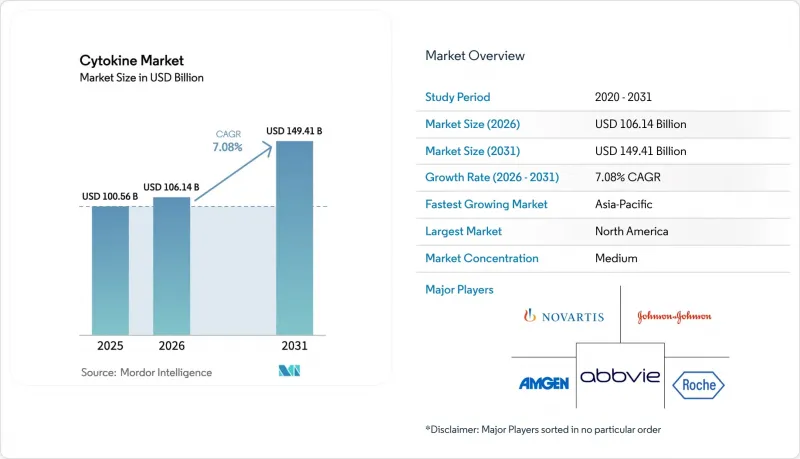
Mordor Intelligence에 의하면, 사이토카인 시장 규모는 2025년에 1,005억 6,000만 달러, 2026년에 1,061억 4,000만 달러에 이르고, 2031년까지 1,494억 1,000만 달러에 이를 것으로 예측되며, 2026-2031년 CAGR 7.08%를 기록할 전망입니다.
본 보고서는 제품 유형(인터루킨, 종양괴사인자 등), 치료 용도(암 및 악성 종양 등), 최종 사용자(제약·바이오기술 기업 등), 기능(염증 유발성 사이토카인 등), 유통 채널(병원 약국 등), 지역(북미 등)별로 분류되어 있습니다. 시장 전망은 금액(달러) 기준으로 제시되어 있습니다.
세계 사이토카인 시장 동향 및 인사이트
만성 질환 및 자가면역 질환 유병률 증가
자가면역 질환 유병률 증가로 인해 사이토카인, 특히 인터루킨-17, 인터루킨-23 및 TNF 경로를 억제하는 약물의 처방이 꾸준히 증가하고 있습니다. 듀필루맙은 2024년 미국에서 3개의 새로운 적응증을 획득하여 매출 전망이 130억 달러를 넘어섰으며, 확립된 항체를 인접한 질환으로 확대하는 전략이 부각되었습니다. 류마티스 관절염, 건선, 염증성 장 질환은 미국에서 3,000만 명 이상의 진단 환자에게 영향을 미치고 있지만, 주사 부위 반응 및 면역원성으로 인해 여전히 약물 복용 순응도가 저조한 실정입니다. 장시간 작용형 제제 및 피하 투여용 기기는 이러한 과제를 해결하기 위한 목적으로 개발되었으며, 보험사의 재택 사용 승인을 뒷받침하고 있습니다. 따라서 사이토카인 시장은 환자층 확대와 편의성을 향상시키는 치료법 개선이라는 두 가지 측면에서 혜택을 받고 있으며, 이는 채택 확대의 선순환을 만들어내고 있습니다.
사이토카인을 기반으로 한 면역요법을 활용한 종양학 파이프라인의 확대
사이토카인은 지지 요법에서 암 치료의 최전선으로 전환되고 있으며, 많은 경우 체크포인트 억제제나 CAR-T 요법과 병용되고 있습니다. BNT152는 지질 나노입자 내에 인터루킨-2의 mRNA를 봉입하여 종양 내 투여를 통해 전신 노출을 억제하면서 국소 면역 세포를 활성화합니다. Moderna사의 mRNA-2752는 인터루킨-2와 OX40 리간드를 결합하여 T세포의 활성화 범위를 넓혔으며, 2024년에 1상 임상시험을 시작했습니다. 이러한 접근 방식은 재조합 단백질의 제조 공정을 생략함으로써 생산 주기를 수개월에서 수주일로 단축합니다. 초기 데이터에 따르면 발현은 48-72시간 동안 일시적으로만 나타나므로, 최적의 투여량은 여전히 불분명합니다. 하지만 우수한 안전성 프로파일이 확인된다면, 이러한 약물은 2030년까지 고형암 분야에서 단백질 기반 사이토카인 시장 점유율을 빼앗을 가능성도 있습니다.
높은 제조 비용과 복잡한 정제 요건
재조합 사이토카인은 1리터당 500-1,200달러의 무혈청 배지가 필요한 고비용 포유류 발현 시스템에 의존하며, 다단계 크로마토그래피를 통해,인터루킨-2의 원가는 1그램당 8,000-12,000달러에 달할 전망입니다. 수탁 제조업체는 50kg의 최소 주문량을 요구하며, 임상적 개념 증명(PoC) 전에 60만 달러를 초과하는 선급금 약정이 필요합니다. 소규모 후원 기업들은 이러한 기준을 충족할 자금이 부족한 경우가 많아, 그 결과 혁신은 자금력이 있는 기업에 집중되고 있습니다. 신흥 시장에서는 여과용 수지에 대한 수입 관세나 공급 지연과 같은 추가적인 과제에 직면하고 있어, 비용 격차가 확대되고 현지 사이토카인 시장의 성장이 둔화되고 있습니다. 연속 공정은 비용을 절감하지만, 그 도입은 견고한 품질 관리 체계를 갖춘 대규모 시설로 제한되어 있습니다.
부문 분석
인터루킨은 스폰서들이 성숙한 TNF 제품군에서 희귀 염증성 질환 대응으로 무게 중심을 옮기면서 9.84%의 연평균 성장률(CAGR)로 확대되어 모든 카테고리를 능가하는 성장이 예상됩니다. 종양괴사인자(TNF) 제제는 2025년 매출의 44.36%를 차지했으나, 바이오시밀러로 인한 가격 압박이 심화되면서,애브비의 ‘휴미라’ 매출은 2022년 212억 달러에서 2023년 144억 달러로 감소했습니다. 따라서 인터루킨 사이토카인 시장 규모는 인터페론과의 격차를 더욱 벌릴 것으로 예측됩니다. 인터페론의 매출액은 C형 간염 치료에서 경구용 항바이러스제가 주류를 이루고 있는 탓에 5억 달러 미만의 수준으로 축소되었습니다.
콜로니 자극 인자는 안정적인 지지 요법 및 종양학 분야의 틈새 시장을 담당하고 있으며, 2025년까지 ‘자르키오’와 ‘니베스팀’이 미국 판매량의 40%를 차지할 것으로 전망됩니다. CSF, 에리스로포이에틴, PDGF, VEGF 이외의 성장 인자는 2024년에 승인된 기존 제품보다 35% 저렴한 달베포이에틴 바이오시밀러의 호조에 힘입어, 2026년부터 2031년에 걸쳐 연평균 성장률(CAGR) 10.13%로 성장할 전망입니다. 케모카인은 여전히 대부분이 상용화 전 단계이지만, CXCR4 길항제는 줄기세포 동원 분야에서 유망한 것으로 평가받고 있습니다. 전반적으로, 혁신적인 기업들은 자가면역 질환과 종양학 양쪽 모두에서 잠재력을 지닌 인터루킨-23 및 인터루킨-6 신호 전달 경로를 표적으로 삼고 있으며, 이는 사이토카인 시장에 새로운 활력을 불어넣고 있습니다.
2025년에도 암 분야는 여전히 사이토카인 전체 처방의 49.78%를 차지하고 있으며, 이는 콜로니 자극 인자나 CAR-T 치료제 제조에 사용되는 사이토카인의 확고한 사용 현황을 반영합니다. 그러나 구셀쿠맙, 듀필루맙 및 기타 인터루킨을 표적으로 하는 약물의 적응증 확대로 인해 자가면역 질환 분야가 연평균 성장률(CAGR) 9.54%로 가장 빠른 성장을 기록할 것으로 전망됩니다. 현재의 추세가 지속된다면, 자가면역 질환 치료 분야의 사이토카인 시장 규모는 2031년까지 종양학 분야를 추월할 가능성이 있습니다.
감염증 분야에서의 사이토카인 사용은 치료 효과가 있는 항바이러스제가 인터페론 요법을 대체함에 따라 축소되는 추세이지만, 한편으로 염증성 호흡기 질환은 병태 기전의 측면에서 자가면역 경로와 공통점을 가지고 있어, IL-4, IL-5,및 IL-13 억제제의 적응증 외 사용이 가능해졌습니다. 경구용 야누스키나제 억제제는 경쟁 압력을 높이고 있지만, 생물학적 제제의 투여 시작이 지연될 경우 가교 요법으로 자주 사용되어, 간접적으로 생물학적 제제의 지속적인 매출을 뒷받침하고 있습니다.
지역별 분석
북미는 2025년 사이토카인 매출의 41.53%를 차지할 것으로 예상되며, 이는 FDA의 ‘패스트 트랙’ 및 ‘우선 심사’ 제도에 따라 승인까지의 기간 중앙값이 9개월로 단축된 데 기인합니다. 2024년 메디케어가 외래 환자를 대상으로 한 CAR-T 치료의 보험 적용을 결정함에 따라, 환자 1인당 5만 달러의 비용 부담이 경감되었으며, 대학 병원 이외의 시설에서도 치료를 받을 수 있게 되었습니다. 캐나다의 ‘전캐나다 의약품 연합(PCA)’은 바이오시밀러 TNF 억제제의 가격을 25-40% 인하할 것을 촉구하여, 온타리오주 및 브리티시컬럼비아주에서의 전환율을 가속화했습니다. 멕시코는 2025년에 최초의 국내 생산 필그라스팀 바이오시밀러를 승인하여 수입 의존도를 30% 줄였습니다.
아시아태평양은 2031년까지 연평균 성장률(CAGR) 10.79%를 나타낼 것으로 예측됩니다. 이를 견인하는 요인은 외국 데이터의 활용을 허용하고 현지 3상 임상시험을 면제하는 완화된 규제 하에, 2024년 중국에서 18종의 사이토카인 바이오시밀러가 승인된 점입니다. 인도는 공급 병목 현상에 직면한 유럽 및 미국 고객을 유치하기 위해 수출용 사이토카인 생산 확대에 2억 달러를 배정했습니다. 일본은 바이오시밀러 심사를 ICH 지침에 부합하도록 하고 심사 기간을 16개월로 단축함으로써, 삼성바이오로직스와 셀트리온으로부터 총 12억 달러 상당의 투자를 유치했습니다. 한국의 국민건강보험에서는 현재 승인된 모든 바이오시밀러가 보험 적용 대상이며, 병원에서 오리지널 의약품에서 바이오시밀러로의 전환율은 60%를 초과하고 있습니다. 호주의 2025년 상호 대체성 규정에 따라 약사는 바이오시밀러를 자동으로 대체할 수 있게 되었으며, 이를 통해 연간 3억 호주 달러(1억 9,500만 달러)의 비용 절감이 예상됩니다.
2025년 매출의 28%를 유럽이 차지하고 있으며, 그 대부분은 독일, 프랑스, 영국에 집중되어 있습니다. EMA(유럽의약품청)의 지침에 따라 1건의 바이오시밀러성 시험으로 모든 적응증에 대한 승인을 받을 수 있게 되어, 아달리무맙 및 인플릭시맙 바이오시밀러의 다중 적응증 시장 진입이 용이해졌습니다. 독일에서는 TNF 바이오시밀러의 처방 할당률을 80%로 설정하여, 2025년까지 오리지널 의약품 시장 점유율을 18%까지 낮추고 있습니다. 프랑스에서는 현재 가격 프리미엄을 적용하기 위해 임상적 우월성이 요구되고 있어, 기존 생물학적 제제의 입지가 위태로워지고 있습니다. NICE(영국 국립의료기술평가기구)는 QALY(질 조정 생존년)당 1만 파운드 미만의 바이오시밀러를 우선시하는 비용 대비 효과 기준에 환급을 연계하고 있어, 처방 의사가 오리지널 의약품에서 바이오시밀러로 전환하도록 장려하고 있습니다. 브라질, 남아프리카, 그리고 걸프 국가들이 신흥 수요국으로서 시장을 형성하고 있으며, 브라질의 수량 기준 계약으로 인해 사이토카인 제제의 가격이 절반으로 낮아지고, 공적 의료 제도를 통한 적용 범위가 확대되었습니다.
기타 혜택:
- 엑셀 형식 시장 예측(ME) 시트
- 3개월간의 애널리스트 지원
자주 묻는 질문
목차
제1장 서론
제2장 조사 방법
제3장 주요 요약
제4장 시장 구도
제5장 시장 규모와 성장 예측
제6장 경쟁 구도
제7장 시장 기회와 향후 전망
LSH 26.09.09According to Mordor Intelligence, the cytokine market size is projected to be USD 100.56 billion in 2025, USD 106.14 billion in 2026, and reach USD 149.41 billion by 2031, growing at a CAGR of 7.08% from 2026 to 2031.
This report is Segmented by Product Type (Interleukins, Tumor Necrosis Factor, and More), Therapeutic Application (Cancer & Malignancies, and More), End User (Pharmaceutical & Biotechnology Companies, and More), Function (Pro-Inflammatory Cytokines, and More), Distribution Channel (Hospital Pharmacies, and More), and Geography (North America, and More). The Market Forecasts are Provided in Terms of Value (USD).
Global Cytokine Market Trends and Insights
Rising Prevalence of Chronic and Autoimmune Diseases
Escalating autoimmune prevalence is fueling steady cytokine prescribing, especially agents that block interleukin-17, interleukin-23, and TNF pathways. Dupilumab added three new U.S. indications in 2024, lifting revenue expectations above USD 13 billion and highlighting the strategy of extending established antibodies into adjacent diseases. Rheumatoid arthritis, psoriasis, and inflammatory bowel disease affect over 30 million diagnosed U.S. patients, yet injection-site reactions and immunogenicity still curb adherence. Long-acting formulations and subcutaneous devices aim to ease this gap, encouraging payers to authorize at-home use. The cytokine market therefore benefits from both a widening patient pool and therapeutic refinements that improve convenience, creating a virtuous cycle of uptake.
Expanding Oncology Pipeline Using Cytokine-Based Immunotherapies
Cytokines are moving from supportive care to frontline oncology, often paired with checkpoint inhibitors or CAR-T therapies. BNT152 encodes interleukin-2 mRNA inside lipid nanoparticles for intratumoral delivery, limiting systemic exposure while activating local immune cells. Moderna's mRNA-2752 combines interleukin-2 with an OX40 ligand to broaden T-cell activation and entered Phase I trials in 2024. These approaches bypass recombinant protein manufacturing, shortening production cycles from months to weeks. Early data show transient expression of 48-72 hours, so optimal dosing remains uncertain. Nonetheless, positive safety profiles could position these assets to take share from protein-based cytokines in solid tumors by 2030.
High Manufacturing Cost and Complex Purification Requirements
Recombinant cytokines rely on costly mammalian expression systems that demand serum-free media priced at USD 500-1,200 per liter, while multi-step chromatography pushes cost-of-goods for interleukin-2 to USD 8,000-12,000 per gram. Contract manufacturers impose 50 kg minimum orders, requiring upfront commitments exceeding USD 600,000 before clinical proof-of-concept. Smaller sponsors often lack the capital to meet these thresholds, concentrating innovation among cash-rich firms. Emerging markets face added challenges from import tariffs on filtration resins and resupply delays, widening the cost gap and slowing local cytokine market growth. While continuous processing lowers expenses, adoption remains limited to large facilities with robust quality-systems infrastructure.
Other drivers and restraints analyzed in the detailed report include:
- Advances in Recombinant Engineering & Bioprocessing Technologies
- mRNA-Encoded, Locally Delivered Cytokine Adjuvants Gaining Traction
- Dose-Limiting Toxicities Driving Stringent Regulatory Scrutiny
For complete list of drivers and restraints, kindly check the Table Of Contents.
Segment Analysis
Interleukins are set to outpace all categories, expanding at a 9.84% CAGR as sponsors pivot from mature TNF franchises to address rare inflammatory disorders. Tumor necrosis factor agents retained 44.36% of 2025 revenue, but biosimilars now pressure prices, pulling AbbVie's Humira down from USD 21.2 billion in 2022 to USD 14.4 billion in 2023. The cytokine market size for interleukins is therefore expected to widen its gap over interferons, whose sales have contracted below USD 500 million as oral antivirals dominate hepatitis care.
Colony-stimulating factors serve a stable supportive-oncology niche, with Zarxio and Nivestym securing 40% of U.S. volume by 2025. Growth factors beyond CSFs, erythropoietin, PDGF, and VEGF, will rise at a 10.13% CAGR (2026-2031), aided by a 35%-cheaper darbepoetin biosimilar approved in 2024. Chemokines remain largely pre-commercial, though CXCR4 antagonists show promise in stem-cell mobilization. Overall, innovators target interleukin-23 and interleukin-6 pathways for their dual autoimmune and oncology potential, injecting fresh momentum into the cytokine market.
Cancer still generated 49.78% of cytokine prescriptions in 2025, reflecting entrenched use of colony-stimulating factors and CAR-T manufacturing cytokines. Yet autoimmune disorders will log the fastest expansion at a 9.54% CAGR, thanks to label extensions for guselkumab, dupilumab, and other interleukin-targeted drugs. The cytokine market size for autoimmune care could surpass oncology by 2031 if current trajectories persist.
Infectious-disease cytokine use is contracting as curative antivirals displace interferon regimens, while inflammatory respiratory disorders converge mechanistically with autoimmune pathways, opening cross-indication leveraging of IL-4, IL-5, and IL-13 blockers. Oral Janus-kinase inhibitors add competitive pressure but often serve as bridge therapy when biologic access is delayed, indirectly supporting ongoing biologic sales.
Complete Report Scope:
- By Product Type
- Interleukins
- Tumor Necrosis Factor (TNF)
- Interferons
- Colony-Stimulating Factors (CSFs)
- Chemokines
- Growth Factors
- By Therapeutic Application
- Cancer & Malignancies
- Autoimmune Disorders
- Infectious Diseases
- Inflammatory Disorders
- Others
- By End User
- Pharmaceutical & Biotechnology Companies
- Academic & Research Institutes
- Hospitals & Diagnostic Laboratories
- Contract Research Organizations (CROs)
- By Function
- Pro-inflammatory Cytokines
- Anti-inflammatory Cytokines
- Growth & Differentiation Factors
- By Distribution Channel
- Hospital Pharmacies
- Specialty Clinics
- Retail Pharmacies
- Online Pharmacies
- By Geography
- North America
- United States
- Canada
- Mexico
- Europe
- Germany
- France
- United Kingdom
- Italy
- Spain
- Rest of Europe
- Asia-Pacific
- China
- Japan
- India
- South Korea
- Australia
- Rest of Asia-Pacific
- Middle East & Africa
- GCC
- South Africa
- Rest of Middle East & Africa
- South America
- Brazil
- Argentina
- Rest of South America
- North America
Geography Analysis
North America generated 41.53% of 2025 cytokine revenue, sustained by FDA Fast-Track and Priority Review pathways that cut median approval times to nine months. Medicare's 2024 decision to reimburse outpatient CAR-T saved each patient USD 50,000 and widened access beyond academic hospitals. Canada's pan-Canadian Pharmaceutical Alliance forced 25-40% price reductions for biosimilar TNF blockers, accelerating switch rates in Ontario and British Columbia. Mexico approved its first locally made filgrastim biosimilar in 2025, trimming import reliance by 30%.
Asia-Pacific is forecast to post a 10.79% CAGR through 2031, led by China's 18 cytokine biosimilar approvals in 2024 under relaxed rules that allow foreign data and waive local Phase III trials. India earmarked USD 200 million to expand cytokine manufacturing for export, courting Western clients facing supply bottlenecks. Japan aligned its biosimilar review to ICH guidelines, cutting timelines to 16 months and attracting Samsung Biologics and Celltrion investments worth USD 1.2 billion. South Korea's national insurance now covers all approved biosimilars, driving originator-to-biosimilar switching above 60% in hospitals. Australia's 2025 interchangeability rule permits pharmacists to auto-substitute biosimilars, expected to save AUD 300 million (USD 195 million) per year.
Europe accounted for 28% of 2025 sales, concentrated in Germany, France, and the United Kingdom. EMA guidance lets one biosimilarity study unlock approvals across all indications, easing multi-label entry for adalimumab and infliximab copies. Germany enforces 80% prescribing quotas for TNF biosimilars, slashing originator share to 18% by 2025. France now demands clinical superiority for price premiums, squeezing legacy biologics. NICE ties reimbursement to cost-effectiveness thresholds that favor biosimilars below GBP 10,000 per QALY, nudging prescribers away from originators. Brazil, South Africa, and Gulf states round out the landscape as emerging buyers; Brazil's volume-based contracts halved cytokine prices, widening public-system coverage.
- Abbvie
- Acro Biosystems
- Amgen
- Biogen
- Bio-Rad Laboratories
- Bio-Techne / R&D Systems
- Bristol-Myers Squibb
- Eli Lilly and Company
- Roche
- Gilead Sciences
- Johnson & Johnson
- Merck
- Miltenyi Biotec
- Novartis
- Pfizer
- Regeneron
- Sanofi
- Takeda Pharmaceuticals
- Thermo Fisher Scientific
- Vertex Pharmaceuticals
Additional Benefits:
- The market estimate (ME) sheet in Excel format
- 3 months of analyst support
TABLE OF CONTENTS
1 Introduction
- 1.1 Study Assumptions & Market Definition
- 1.2 Scope of the Study
2 Research Methodology
3 Executive Summary
4 Market Landscape
- 4.1 Market Overview
- 4.2 Market Drivers
- 4.2.1 Rising Prevalence of Chronic & Autoimmune Diseases
- 4.2.2 Expanding Oncology Pipeline Using Cytokine-Based Immunotherapies
- 4.2.3 Advances In Recombinant Engineering & Bioprocessing Technologies
- 4.2.4 mRNA-Encoded, Locally-Delivered Cytokine Adjuvants Gaining Traction
- 4.2.5 GMP-Grade Cytokine Demand for Cell & Gene Therapy Manufacturing
- 4.2.6 Recent FDA / EMA Approvals of First-In-Class Cytokine Therapeutics for Rare Indications
- 4.3 Market Restraints
- 4.3.1 High Manufacturing Cost & Complex Purification Requirements
- 4.3.2 Dose-Limiting Toxicities Driving Stringent Regulatory Scrutiny
- 4.3.3 Patent Cliffs & Biosimilar Competition Compressing Margins
- 4.3.4 Supply-Chain Bottlenecks for Single-Use Bioprocess Consumables
- 4.4 Value / Supply-Chain Analysis
- 4.5 Technological Outlook
- 4.6 Regulatory Landscape
- 4.7 Porter's Five Forces Analysis
- 4.7.1 Threat of New Entrants
- 4.7.2 Bargaining Power of Suppliers
- 4.7.3 Bargaining Power of Buyers
- 4.7.4 Threat of Substitutes
- 4.7.5 Competitive Rivalry
5 Market Size & Growth Forecasts (Value in USD)
- 5.1 By Product Type
- 5.1.1 Interleukins
- 5.1.2 Tumor Necrosis Factor (TNF)
- 5.1.3 Interferons
- 5.1.4 Colony-Stimulating Factors (CSFs)
- 5.1.5 Chemokines
- 5.1.6 Growth Factors
- 5.2 By Therapeutic Application
- 5.2.1 Cancer & Malignancies
- 5.2.2 Autoimmune Disorders
- 5.2.3 Infectious Diseases
- 5.2.4 Inflammatory Disorders
- 5.2.5 Others
- 5.3 By End User
- 5.3.1 Pharmaceutical & Biotechnology Companies
- 5.3.2 Academic & Research Institutes
- 5.3.3 Hospitals & Diagnostic Laboratories
- 5.3.4 Contract Research Organizations (CROs)
- 5.4 By Function
- 5.4.1 Pro-inflammatory Cytokines
- 5.4.2 Anti-inflammatory Cytokines
- 5.4.3 Growth & Differentiation Factors
- 5.5 By Distribution Channel
- 5.5.1 Hospital Pharmacies
- 5.5.2 Specialty Clinics
- 5.5.3 Retail Pharmacies
- 5.5.4 Online Pharmacies
- 5.6 By Geography
- 5.6.1 North America
- 5.6.1.1 United States
- 5.6.1.2 Canada
- 5.6.1.3 Mexico
- 5.6.2 Europe
- 5.6.2.1 Germany
- 5.6.2.2 France
- 5.6.2.3 United Kingdom
- 5.6.2.4 Italy
- 5.6.2.5 Spain
- 5.6.2.6 Rest of Europe
- 5.6.3 Asia-Pacific
- 5.6.3.1 China
- 5.6.3.2 Japan
- 5.6.3.3 India
- 5.6.3.4 South Korea
- 5.6.3.5 Australia
- 5.6.3.6 Rest of Asia-Pacific
- 5.6.4 Middle East & Africa
- 5.6.4.1 GCC
- 5.6.4.2 South Africa
- 5.6.4.3 Rest of Middle East & Africa
- 5.6.5 South America
- 5.6.5.1 Brazil
- 5.6.5.2 Argentina
- 5.6.5.3 Rest of South America
- 5.6.1 North America
6 Competitive Landscape
- 6.1 Market Concentration
- 6.2 Market Share Analysis
- 6.3 Company Profiles (includes Global level Overview, Market level overview, Core Segments, Financials as available, Strategic Information, Market Rank/Share for key companies, Products and Services, and Recent Developments)
- 6.3.1 AbbVie
- 6.3.2 ACROBiosystems
- 6.3.3 Amgen
- 6.3.4 Biogen
- 6.3.5 Bio-Rad Laboratories
- 6.3.6 Bio-Techne / R&D Systems
- 6.3.7 Bristol-Myers Squibb
- 6.3.8 Eli Lilly
- 6.3.9 F. Hoffmann La Roche Ltd
- 6.3.10 Gilead Sciences
- 6.3.11 Johnson & Johnson (Janssen)
- 6.3.12 Merck & Co.
- 6.3.13 Miltenyi Biotec
- 6.3.14 Novartis
- 6.3.15 Pfizer
- 6.3.16 Regeneron
- 6.3.17 Sanofi
- 6.3.18 Takeda
- 6.3.19 Thermo Fisher Scientific
- 6.3.20 Vertex Pharmaceuticals
7 Market Opportunities & Future Outlook
- 7.1 White-space & Unmet-need Assessment


