

|
시장보고서
상품코드
2121623
자동차용 연료 공급 시스템 : 시장 점유율 분석, 업계 동향과 통계, 성장 예측(2026-2031년)Automotive Fuel Delivery System - Market Share Analysis, Industry Trends & Statistics, Growth Forecasts (2026 - 2031) |
||||||
 Mordor Intelligence
Mordor Intelligence에 의하면, 자동차용 연료 공급 시스템 시장 규모는 2025년에 51억 3,000만 달러로 평가되었고, 2026년 54억 1,000만 달러에서 2031년까지 70억 9,000만 달러에 이를 것으로 추정되고 있어 예측 기간(2026년-2031년) CAGR은 5.55%를 기록할 전망입니다.
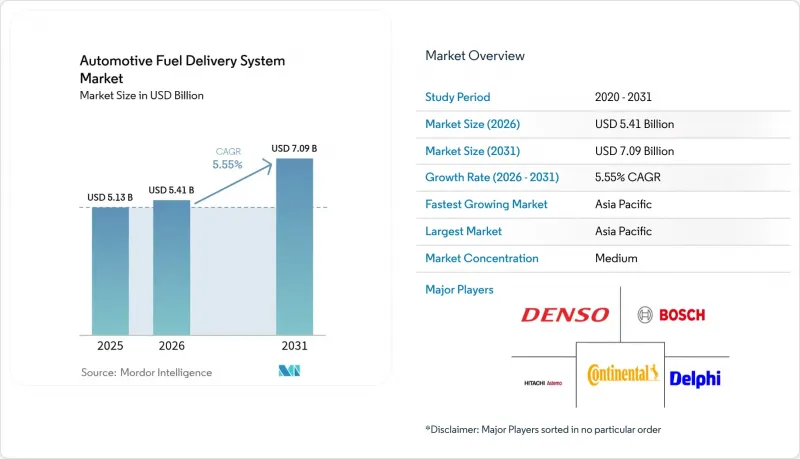
본 보고서는 구성품(연료 펌프, 연료 인젝터 등), 차량 유형(승용차, 상용차),연료 유형별(가솔린, 디젤 등), 공급 방식별(포트 연료 분사, 가솔린 직접 분사 등), 유통 채널별(OEM(순정 장비) 및 애프터마켓(교체용)), 그리고 지역별로 분류되어 있습니다. 시장 예측은 금액(달러) 기준으로 제시되어 있습니다.
세계 자동차 연료 공급 시스템 시장 동향 및 인사이트
엄격한 배기가스 규제가 첨단 연료 공급 모듈의 보급을 촉진
유로 7 규제에 따르면, 2026년 11월부터 모든 경차용 엔진에 대해 미세먼지 및 NOx의 허용 기준치가 상향 조정되며, 한편 EPA 3단계에서는 2027년에 대형 트럭의 NOx 배출량을 35 mg/hp-hr까지 대폭 감축하도록 규정되어 있습니다. 이에 따라 각 자동차 제조업체들은 전 세계 플랫폼 전반에 걸쳐 고압 펌프 및 가솔린 미립자 필터의 표준화를 추진하고 있습니다. 내구성 요건이 160,000km로 상향됨에 따라, 공급업체들은 수명이 긴 인젝터와 내식성 레일의 개발을 서두르고 있으며, 이러한 요인들이 2030년까지 자동차 연료 공급 시스템 시장을 지탱하는 기반이 되고 있습니다.
전 세계 자동차 생산 대수 증가 및 차량 교체
2025년에 경차 생산 대수가 회복되었고, 유럽에서는 차량의 평균 보유 연수가 12년을 넘어서면서 교체 주기가 단축되어 자동차 연료 공급 시스템 시장의 부품 수요가 더욱 강해졌습니다. 자동차 제조업체들은 인도, 인도네시아, 멕시코에 공장을 현지화하고 있으며, 이로 인해 1차 공급업체에 대한 지역적 조달 수요가 발생하고 있습니다. 차량 운영 사업자들은 연비 기준을 충족하기 위해 하드웨어를 업데이트하고 있으며, 전기차(EV)의 보급이 확대되는 상황에서도 내연기관(ICE)의 중요성은 여전히 지속되고 있습니다.
전기차의 급속한 성장에 따른 내연기관(ICE) 점유율 하락
중국과 캘리포니아주는 2035년까지 완전한 제로 배출 의무화를 향해 속도를 높이고 있습니다. 전기차의 성장세에 힘입어, 향후 10년 동안 내연기관(ICE) 관련 수익원은 50% 감소할 것으로 예측됩니다. 배터리 구동 차량에는 연료 펌프나 인젝터가 필요하지 않기 때문에 장기적으로는 역풍이 될 수 있으나, 지역별 차이로 인해 자동차용 연료 공급 시스템 시장은 대형차, 지방 및 개발도상국 부문에서 여전히 중요한 위치를 차지하고 있습니다.
부문 분석
2025년, 연료 펌프는 자동차 연료 공급 시스템 시장 매출의 37.22%를 차지할 것으로 예상되며, 모든 엔진 크기에서 필수적인 요소로 남아 자동차 연료 공급 시스템 시장의 기반을 형성할 것입니다. 이러한 보편성 덕분에 전동화가 진행되더라도 안정적인 판매량이 예상됩니다. 가장 빠르게 성장하고 있는 인젝터는 2,200 psi의 GDI(직분사) 요구 사항을 배경으로 2031년까지 연평균 성장률(CAGR) 7.06%로 확대될 것이며, 에탄올 혼합 연료용 ‘스마트’ 노즐 설계 및 스테인리스 스틸 레일을 주도할 것입니다. 현재 부품 업그레이드에서는 차량 진단 시스템, 원격 압력 감지, 그리고 예기치 않은 가동 중지 시간을 줄여주는 무선 펌웨어 업데이트가 중시되고 있습니다. 바이오연료의 성장으로 인해 내식성 배관 및 필터에 대한 수요가 높아지는 한편, 증기 회수 밸브와 탱크 탑재형 센서는 전자 분야에서 부가가치를 더욱 높이고 있습니다. 이러한 변화들이 맞물리면서, 향후 전기차(EV)에 의한 시장 점유율 잠식이라는 위협이 있음에도 불구하고, 자동차 연료 공급 시스템 시장의 부품 규모는 상승 추세를 유지하고 있습니다.
2025년에는 승용차가 자동차 연료 공급 시스템 시장 매출의 63.62%를 차지했습니다. 해치백이나 세단에는 비용 효율이 뛰어난 리턴리스 펌프가 요구되는 반면, SUV에서는 토크 부하 증가에 따라 더 높은 압력의 레일이 채택되고 있습니다. 연평균 성장률(CAGR) 6.15%로 예측되는 소형 상용차의 경우, 효율성보다 내구성이 중시되어 스틸 편조 호스와 교체 가능한 필터가 계속해서 채택되고 있습니다. 이러한 추세로 인해 상용차 플랫폼이 차지하는 자동차 연료 공급 시스템 시장 점유율은 확대되고 있습니다. 일일 주행 거리가 길고, 차량 텔레매틱스 도입이 진행되고 있어 사후 장착 개조 사업이 확대되고 있습니다. 한편, 중형 및 대형 트럭은 생산 대수는 적지만 고유량 디젤 분사 레일을 유지하고 있어, 배터리의 에너지 밀도가 장거리 운송을 대체할 수 있을 때까지 시장 규모가 안정적으로 유지되고 있습니다. 이처럼 자동차 연료 공급 시스템 시장은 사용 주기에 따라 다양성을 유지하고 있습니다.
지역별 분석
아시아태평양은 2025년 자동차 연료 공급 시스템 시장 매출의 38.12%를 차지할 것으로 예상되며, 중국의 막대한 생산량,인도의 고속도로망 확장, 그리고 아세안(ASEAN)의 현지 조립 클러스터 덕분에 2031년까지 연평균 성장률(CAGR) 6.82%로 다른 모든 지역을 앞지르는 성장이 예상됩니다. 중국의 각 OEM 기업들은 관세를 회피하고 물류 체인을 단축하기 위해 태국과 인도네시아에서 연료 시스템의 하위 시스템을 생산하고 있으며, 이는 동남아시아 전역의 자동차 연료 공급 시스템 시장을 강화하고 있습니다. 또한, 일본의 반도체 합작 사업도 고압 펌프용 마이크로컨트롤러공급을 확보함으로써 지역적 공급 리스크를 완화하고 있습니다.
북미는 2027년까지 NOx 배출량을 0.035 g/b-hp-hr 이하로 제한하는 EPA 규제의 뒷받침을 받아, 계속해서 기술적으로 충실한 상태를 유지하고 있습니다. 미국 농무부(USDA)의 2,600만 달러 규모의 E15 인프라 프로그램 등의 투자를 통해 바이오연료의 보급이 확대되면서, 에탄올 대응 레일 및 씰에 대한 틈새 수요가 발생하고, 자동차용 연료 공급 시스템 시장을 확대되고 있습니다. 멕시코에서는 매력적인 인건비와 USMCA(미국·멕시코·캐나다 협정)에 따른 무역상의 이점으로 인해, Tier 1 공급업체들이 라모스 아리스페와 아과스칼리엔테스에서 생산 능력을 확충하는 움직임이 나타나고 있습니다.
유럽은 유로 7 규제와 가속화되는 탄소 중립 노력이라는 이중의 압박에 직면해 있습니다. 각 OEM 업체들은 2026년을 앞두고 입자상 물질 필터 및 증기 포집 장치의 개조를 진행하고 있으며, 이로 인해 차량당 부품 원가는 상승하고 있지만, 공급업체의 수주 잔고는 유지되고 있습니다. 동유럽 공장은 라인 조립 비용이 낮아, 서유럽 공장이 전기 모듈로 전환하는 상황에서도 경쟁력을 확보하고 있습니다. 또한, 스페인에서 독일까지 이어지는 수소 회랑 시범 사업을 통해 자동차용 연료 공급 시스템 시장은 연료전지 분야에서 조기에 입지를 다져가고 있습니다.
기타 특전:
- 엑셀 형식 시장 예측(ME) 시트
- 3개월간의 애널리스트 지원
자주 묻는 질문
목차
제1장 서론
제2장 조사 방법
제3장 주요 요약
제4장 시장 구도
제5장 시장 규모와 성장 예측
제6장 경쟁 구도
제7장 시장 기회와 향후 전망
LSH 26.09.02According to Mordor Intelligence, the automotive fuel delivery system market size was valued at USD 5.13 billion in 2025 and estimated to grow from USD 5.41 billion in 2026 to reach USD 7.09 billion by 2031, at a CAGR of 5.55% during the forecast period (2026-2031).
This report is Segmented by Component (Fuel Pump, Fuel Injector, and More), Vehicle Type (Passenger Cars, and Commercial Vehicles), Fuel Type (Gasoline, Diesel, and More), Delivery Method (Port Fuel Injection, Gasoline Direct Injection, and More), Distribution Channel (OEM (Factory-Fitted) and Aftermarket (Replacement)), and Geography. The Market Forecasts are Provided in Terms of Value (USD).
Global Automotive Fuel Delivery System Market Trends and Insights
Stringent Emission Norms Driving Advanced Fuel-Delivery Modules
Euro 7 tightens particulate and NOx thresholds for all light-duty engines from November 2026, while EPA Phase 3 slashes NOx to 35 mg/hp-hr for heavy trucks in 2027 . Automakers are therefore standardizing high-pressure pumps and gasoline particulate filters across global platforms. Durability requirements rise to 160,000 km, pushing suppliers to develop long-life injectors and corrosion-proof rails, factors that underpin the automotive fuel delivery system market through 2030.
Rising Global Vehicle Production and Parc Rejuvenation
Light-vehicle output rebounded in 2025, and replacement cycles shortened as average fleet age passed 12 years in Europe, reinforcing component demand for the automotive fuel delivery system market. Vehicle-makers localize plants in India, Indonesia, and Mexico, creating regional sourcing pull for tier-1 suppliers. Fleet operators refresh hardware to meet fuel-economy benchmarks, prolonging ICE relevance despite EV penetration.
Rapid Growth of Electric Vehicles Reducing ICE Share
China and California are accelerating toward full zero-emission mandates by 2035. EV momentum is cutting ICE-linked profit pools by an anticipated 50% this decade. Fuel pumps and injectors are absent from battery platforms, creating long-run headwinds, yet regional differences keep the automotive fuel delivery system market relevant in heavy-duty, rural, and developing-country segments.
Other drivers and restraints analyzed in the detailed report include:
- Growing Demand for Gasoline Direct-Injection Engines in Passenger Cars
- Increasing Sales of Light Commercial Vehicles
- Volatility in Raw-Material Prices for Fuel-System Components
For complete list of drivers and restraints, kindly check the Table Of Contents.
Segment Analysis
Fuel pumps generated 37.22% revenue of the automotive fuel delivery system market in 2025 and remain indispensable across all engine sizes, anchoring the automotive fuel delivery system market. Their ubiquity provides steady volumes even as electrification advances. Accelerating fastest, injectors will rise at 7.06% CAGR to 2031 on the back of 2,200 psi GDI requirements, pushing "smart" tip designs and stainless-steel rails for ethanol blends.Component upgrades now emphasize on-board diagnostics, remote pressure sensing, and over-the-air firmware that cuts unplanned downtime. Biofuel growth lifts demand for corrosion-resistant lines and filters, while vapor-recovery valves and tank-mounted sensors add incremental electronics value. Together, these shifts keep the automotive fuel delivery system market size for components on an upward curve despite future EV displacement threats.
Passenger cars delivered 63.62% of the automotive fuel delivery system market revenue in 2025. Hatchbacks and sedans require cost-efficient returnless pumps, whereas SUVs integrate higher-pressure rails because of increased torque loads. Light commercial vehicles, forecast at 6.15% CAGR, prefer robustness over efficiency, sustaining steel-braid hoses and replaceable filters, a pattern that enlarges the automotive fuel delivery system market share commanded by commercial platforms.Longer daily mileage and fleet telematics open retrofitting business, while medium and heavy trucks, though smaller in volume, retain high-flow diesel injection rails that stabilize volumes until battery densities permit long-haul substitution. As such, the automotive fuel delivery system market remains diversified across duty cycles.
Complete Report Scope:
- By Component
- Fuel Pump
- Fuel Injector
- Fuel Rail
- Fuel Pressure Regulator
- Fuel Filter
- Fuel Line and Hoses
- Others
- By Vehicle Type
- Passenger Cars
- Hatchback
- Sedan
- Sports Car and Coupe
- SUV and Crossover
- Commercial Vehicles
- Light Commercial Vehicles (LCV)
- Medium and Heavy Commercial Vehicles (MCV and HCV)
- Passenger Cars
- By Fuel Type
- Gasoline
- Diesel
- Flex Fuel (E10-E85)
- CNG and LPG
- Biofuel and Synthetic Fuel
- Hydrogen
- By Delivery Method
- Port Fuel Injection
- Gasoline Direct Injection
- Returnless Fuel Systems
- Common-Rail Diesel Injection
- By Distribution Channel
- OEM (Factory-fitted)
- Aftermarket (Replacement)
- By Geography
- North America
- United States
- Canada
- Rest of North America
- South America
- Brazil
- Argentina
- Chile
- Rest of South America
- Europe
- Germany
- United Kingdom
- France
- Italy
- Spain
- Russia
- Rest of Europe
- Asia Pacific
- China
- Japan
- India
- South Korea
- Australia and New Zealand
- Rest of APAC
- Middle East and Africa
- Saudi Arabia
- UAE
- Turkey
- South Africa
- Nigeria
- Egypt
- Rest of Middle East and Africa
- North America
Geography Analysis
Asia Pacific captured 38.12% of the automotive fuel delivery system market's 2025 turnover and will outpace all other regions with a 6.82% CAGR to 2031, owing to China's outsized production, India's highway expansion, and ASEAN's localized assembly clusters. Chinese OEMs are building fuel-system subsystems in Thailand and Indonesia to bypass tariffs and shorten logistics chains, strengthening the automotive fuel delivery system market across Southeast Asia. Semiconductor joint ventures in Japan also secure microcontroller flow for high-pressure pumps, buffering regional supply risk.
North America remains technology-rich, driven by EPA regulations that mandate 0.035 g/b-hp-hr NOx by 2027. Investments such as the USDA's USD 26 million E15 infrastructure program expand biofuel uptake, creating niche demand for ethanol-ready rails and seals that enlarge the automotive fuel delivery system market. Mexico's attractively priced labor and USMCA trade benefits encourage tier-1s to add capacity in Ramos Arizpe and Aguascalientes.
Europe faces the twin pressures of Euro 7 and accelerated carbon-neutrality pledges. OEMs are retrofitting particulate filters and vapor-containment hardware ahead of 2026, raising per-vehicle bill-of-materials but sustaining supplier order books. Eastern European plants offer lower costs for line assemblies, ensuring competitiveness even as Western European factories pivot to electric modules. Hydrogen corridor pilots from Spain to Germany are also giving the automotive fuel delivery system market an early foothold in fuel-cell applications.
- Robert Bosch GmbH
- Continental AG
- DENSO Corporation
- Delphi Technologies (BorgWarner)
- Magna International Inc.
- TI Fluid Systems plc (TI Automotive)
- Toyoda Gosei Co., Ltd.
- Ucal Fuel Systems Ltd.
- Marelli Holdings Co., Ltd.
- Hitachi Astemo Ltd.
- Stanadyne LLC
- Carter Fuel Systems LLC
- Aisin Corporation
- Valeo SA
- MS Motorservice International GmbH (Pierburg)
- Walbro LLC
- Johnson Electric Holdings Ltd.
- Woodward, Inc.
Additional Benefits:
- The market estimate (ME) sheet in Excel format
- 3 months of analyst support
TABLE OF CONTENTS
1 Introduction
- 1.1 Study Assumptions & Market Definition
- 1.2 Scope of the Study
2 Research Methodology
3 Executive Summary
4 Market Landscape
- 4.1 Market Overview
- 4.2 Market Drivers
- 4.2.1 Stringent emission norms driving adoption of advanced fuel-delivery modules
- 4.2.2 Rising global vehicle production and parc rejuvenation
- 4.2.3 Growing demand for gasoline direct-injection engines in passenger cars
- 4.2.4 Increasing sales of light commercial vehicles in emerging markets
- 4.2.5 Integration of smart diagnostics within electric fuel pumps
- 4.2.6 Surge in synthetic/bio-fuel blends requiring corrosion-resistant lines
- 4.3 Market Restraints
- 4.3.1 Rapid growth of electric vehicles reducing ICE share
- 4.3.2 Volatility in raw-material prices for fuel-system components
- 4.3.3 Tightening evaporative-emission norms raising system cost
- 4.3.4 Semiconductor shortages disrupting electronic pump controllers
- 4.4 Value/Supply-Chain Analysis
- 4.5 Regulatory Landscape
- 4.6 Technological Outlook
- 4.7 Porter's Five Forces Analysis
- 4.7.1 Threat of New Entrants
- 4.7.2 Bargaining Power of Buyers/Consumers
- 4.7.3 Bargaining Power of Suppliers
- 4.7.4 Threat of Substitute Products
- 4.7.5 Intensity of Competitive Rivalry
5 Market Size & Growth Forecasts (Value, USD)
- 5.1 By Component
- 5.1.1 Fuel Pump
- 5.1.2 Fuel Injector
- 5.1.3 Fuel Rail
- 5.1.4 Fuel Pressure Regulator
- 5.1.5 Fuel Filter
- 5.1.6 Fuel Line and Hoses
- 5.1.7 Others
- 5.2 By Vehicle Type
- 5.2.1 Passenger Cars
- 5.2.1.1 Hatchback
- 5.2.1.2 Sedan
- 5.2.1.3 Sports Car and Coupe
- 5.2.1.4 SUV and Crossover
- 5.2.2 Commercial Vehicles
- 5.2.2.1 Light Commercial Vehicles (LCV)
- 5.2.2.2 Medium and Heavy Commercial Vehicles (MCV and HCV)
- 5.2.1 Passenger Cars
- 5.3 By Fuel Type
- 5.3.1 Gasoline
- 5.3.2 Diesel
- 5.3.3 Flex Fuel (E10-E85)
- 5.3.4 CNG and LPG
- 5.3.5 Biofuel and Synthetic Fuel
- 5.3.6 Hydrogen
- 5.4 By Delivery Method
- 5.4.1 Port Fuel Injection
- 5.4.2 Gasoline Direct Injection
- 5.4.3 Returnless Fuel Systems
- 5.4.4 Common-Rail Diesel Injection
- 5.5 By Distribution Channel
- 5.5.1 OEM (Factory-fitted)
- 5.5.2 Aftermarket (Replacement)
- 5.6 By Geography
- 5.6.1 North America
- 5.6.1.1 United States
- 5.6.1.2 Canada
- 5.6.1.3 Rest of North America
- 5.6.2 South America
- 5.6.2.1 Brazil
- 5.6.2.2 Argentina
- 5.6.2.3 Chile
- 5.6.2.4 Rest of South America
- 5.6.3 Europe
- 5.6.3.1 Germany
- 5.6.3.2 United Kingdom
- 5.6.3.3 France
- 5.6.3.4 Italy
- 5.6.3.5 Spain
- 5.6.3.6 Russia
- 5.6.3.7 Rest of Europe
- 5.6.4 Asia Pacific
- 5.6.4.1 China
- 5.6.4.2 Japan
- 5.6.4.3 India
- 5.6.4.4 South Korea
- 5.6.4.5 Australia and New Zealand
- 5.6.4.6 Rest of APAC
- 5.6.5 Middle East and Africa
- 5.6.5.1 Saudi Arabia
- 5.6.5.2 UAE
- 5.6.5.3 Turkey
- 5.6.5.4 South Africa
- 5.6.5.5 Nigeria
- 5.6.5.6 Egypt
- 5.6.5.7 Rest of Middle East and Africa
- 5.6.1 North America
6 Competitive Landscape
- 6.1 Market Concentration
- 6.2 Strategic Moves
- 6.3 Market Share Analysis
- 6.4 Company Profiles (includes Global Level Overview, Market Level Overview, Core Segments, Financials as Available, Strategic Information, Market Rank/Share for Key Companies, Products and Services, SWOT Analysis, and Recent Developments)
- 6.4.1 Robert Bosch GmbH
- 6.4.2 Continental AG
- 6.4.3 DENSO Corporation
- 6.4.4 Delphi Technologies (BorgWarner)
- 6.4.5 Magna International Inc.
- 6.4.6 TI Fluid Systems plc (TI Automotive)
- 6.4.7 Toyoda Gosei Co., Ltd.
- 6.4.8 Ucal Fuel Systems Ltd.
- 6.4.9 Marelli Holdings Co., Ltd.
- 6.4.10 Hitachi Astemo Ltd.
- 6.4.11 Stanadyne LLC
- 6.4.12 Carter Fuel Systems LLC
- 6.4.13 Aisin Corporation
- 6.4.14 Valeo SA
- 6.4.15 MS Motorservice International GmbH (Pierburg)
- 6.4.16 Walbro LLC
- 6.4.17 Johnson Electric Holdings Ltd.
- 6.4.18 Woodward, Inc.
7 Market Opportunities & Future Outlook
- 7.1 White-space & Unmet-Need Assessment


