

|
시장보고서
상품코드
2121663
데이터센터용 UPS : 시장 점유율 분석, 업계 동향과 통계, 성장 예측(2026-2031년)Data Center UPS - Market Share Analysis, Industry Trends & Statistics, Growth Forecasts (2026 - 2031) |
||||||
 Mordor Intelligence
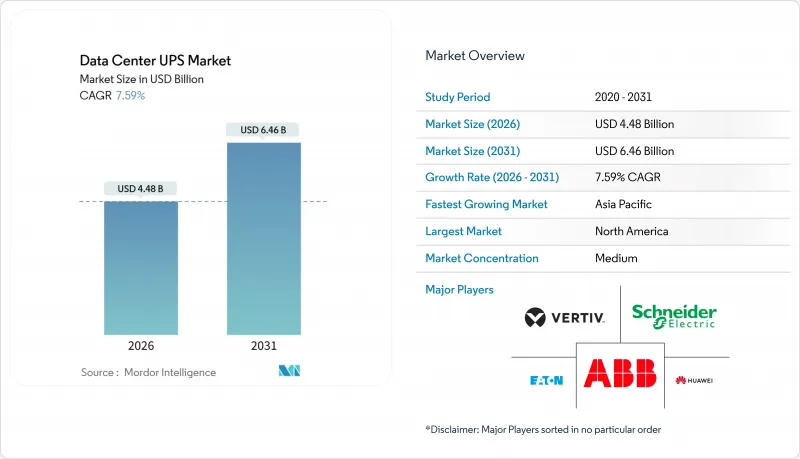
Mordor Intelligence에 따르면 데이터센터용 UPS 시장 규모는 2026년에 44억 8,000만 달러에 달하고, 2031년까지 64억 6,000만 달러에 달할 것으로 예측되며, CAGR은 7.59%가 될 전망입니다.
본 보고서는 UPS 유형(스탠바이형, 라인 인터랙티브형 등), 전력 용량(20 kVA 이하 등), 아키텍처(집중형 등), 배터리 유형(납축배터리 VRLA, 리튬이온, 기타), 티어 유형(Tier 1 및 2, Tier 3, Tier 4), 데이터센터 규모(소규모, 중규모, 기타), 데이터센터 유형(코로케이션, 기타), 및 지역별로 분류되어 있습니다. 시장 예측은 금액(달러)으로 표시되어 있습니다.
세계 데이터센터용 UPS 시장의 동향 및 인사이트
하이퍼스케일 데이터센터 건설 가속화, 10 MW 이상 시설 증가
하이퍼스케일 사업자들은 2025년에 10 MW를 초과하는 47개의 캠퍼스를 가동할 예정이며, 이는 전년 대비 38% 증가한 수치로, 이에 따라 향후 수년에 걸친 UPS 조달 파이프라인이 확정되었습니다. 일반적인 사이트 설계에서는 2-3 MVA 스트링을 4-6개 배치하고 있으며, 이로 인해 단일 계약 금액이 1,500만 달러 이상에 달해, 공급업체에 의한 냉각 인터페이스 및 배터리 인클로저 형태의 맞춤화가 촉진되고 있습니다. 북부 버지니아 및 싱가포르의 전력 회사는 현재 계통연계 대기 기간이 36-48개월이라고 밝히고 있어, 개발자들은 몇 시간에 이르는 정전을 극복하기 위해 디젤 로터리 백업이 장착된 UPS 장치를 지정하고 있습니다. 500 kVA 단위로 확장 가능한 모듈식 프레임을 통해 건설사는 서버 랙 도입에 맞춰 자본 지출을 단계적으로 진행할 수 있으며, 유휴 용량으로 인한 손실을 줄일 수 있습니다. 유럽연합(EU) 및 인도의 Sovereign-AI 관련 규제로 인해 5-8 MW 규모의 설비 도입이 더욱 확산되면서, 하이퍼스케일 시설의 전개 범위가 기존의 북미 거점을 넘어 확대되고 있습니다.
AI 및 ML 워크로드의 전력 밀도 급증 : 랙당 20 kW 이상
2026년에는 훈련 클러스터의 전력 밀도가 랙당 100kW를 넘어, 불과 2년 전만 해도 표준으로 여겨지던 15-20kW를 훨씬 상회했습니다. 이러한 급격한 변화로 인해 UPS 제조업체들은 전압 강하 없이 400 A의 연속 전류를 공급할 수 있는 배전 장치를 재설계해야만 하는 상황에 처해 있습니다. 중앙 집중식 룸에서는 긴 구리선 배선으로 인한 저항 손실이 발생하기 때문에 이러한 고밀도 환경에 대응하기 어려우며, 부하로부터 10m 이내의 위치에 설치되는 열 단위 모듈로의 전환이 가속화되고 있습니다. 칩 직결형 액체 냉각을 통해 팬에 의한 기생 전력 소비가 제거되어, 운영자는 정격 UPS 용량을 최대 20%까지 축소할 수 있게 되었습니다. VRLA의 80 Wh/l에 비해 250 Wh/l의 에너지 밀도를 가진 리튬이온 배터리를 통해 설치 면적을 줄임으로써 불필요한 랙 공간을 확보하고, 랙당 UPS 비용을 절감할 수 있습니다. 복잡성이 증가함에 따라 기술 격차가 확대되면서, 구매자들은 설치, 시운전, 원격 모니터링이 포함된 턴키 계약을 선택하고 있습니다.
초기 설비 투자(CAPEX)는 더블 컨버전 방식의 경우 약 35% 더 높습니다.
더블 컨버전 방식의 시스템은 듀얼 인버터 단과 대형 방열판을 채택하고 있기 때문에 라인 인터랙티브형 모델보다 약 35% 비싸며, Tier III 준수를 목표로 하는 기업의 자본 예산을 압박하고 있습니다. 현재 리스 프로그램은 UPS 용량을 서비스로 패키지화하여 설비 투자(CAPEX)를 운영비(OPEX)로 전환함으로써 도입을 용이하게 하고 있지만, 신흥 시장의 금융 금리는 여전히 10%를 초과하여 보급을 저해하고 있습니다. 100-500 kVA 단위로 확장 가능한 모듈식 프레임을 통해 구매자는 자금 지출을 미룰 수 있지만, 펌웨어 불일치나 부하 분산 로직 등의 상호 운용성 문제로 인해 숨겨진 신뢰성 위험이 드러날 가능성이 있습니다. 저가형 중국산 수입품이 대안으로 작용할 수 있지만, 지적 재산권 및 사후 서비스에 대한 우려로 인해 아시아태평양 이외의 지역에서는 보급이 제한되고 있습니다. 그 결과, 가격 차이로 인해 예산에 민감한 소유자층을 대상으로 하는 데이터센터용 UPS 시장의 잠재적 대상 부문이 제한되고 있습니다.
부문 분석
모듈형 및 병렬 중복형 프레임은 연평균 성장률(CAGR) 8.13%로 확대될 전망이며, 이는 데이터센터용 UPS 시장 전체의 성장률을 상회하는 수치입니다. 더블 컨버전 온라인형 유닛은 원활한 페일오버가 필요한 Tier III 및 Tier IV 시설에 힘입어 2025년에도 44.65%의 점유율을 차지하며 여전히 시장을 독점하고 있습니다. 라인 인터랙티브형 제품은 40%의 비용 우위가 고조파 왜곡 및 짧은 가동 시간을 상쇄하기 때문에 소규모 기업의 서버실에서 틈새 시장 지위를 유지하고 있습니다. 한편, 스탠바이형 유닛은 초저 자본 지출(Capex)을 추구하는 엣지 캐비닛에 널리 도입되고 있습니다. 로터리식 및 플라이휠식 설계는 디젤 발전기 화재 발생 시 20초 미만의 라이드스루가 필요한 시설을 위해 제공되며, 배터리 유지보수를 희생하여 기계적 복잡성을 실현하고 있습니다.
랙 밀도가 높아짐에 따라 조달 결정은 모듈화 쪽으로 기울고 있습니다. 이는 데이터 홀의 부하가 단일 임대 주기 내에 500 kVA에서 2 MVA로 급증할 가능성이 있기 때문입니다. 100-500 kVA 단위로 클릭 방식으로 확장 가능한 프레임은 30% 부하에서 가동 시 발생하는 효율 저하를 방지하고 연간 전력 사용 효율(PUE)을 향상시킵니다. 소프트웨어 정의 제어 계층이 부하 분산을 조정하지만, 이로 인해 펌웨어 관리 위험이 발생하므로 운영자는 감사를 수행해야 합니다. 그 결과, 온디맨드 방식으로 전력을 계량하는 코로케이션 임대 모델과 병행하여 모듈식 방식의 보급률은 계속 상승하고 있습니다.
200 kVA를 초과하는 시스템은 2025년 매출의 52.23%를 차지했으며, 2031년까지 연평균 성장률(CAGR) 8.56%를 기록할 것으로 전망되어 시장 전체의 성장률을 상회하고 있습니다. 랙당 100 kW를 초과하는 AI 훈련 클러스터의 경우, 병렬로 연결된 UPS 스트링이 상시 필요하기 때문에 대형 프레임 시스템의 경제성이 입증되고 있습니다.
21-200 kVA 구간은 랙당 전력 밀도가 15 kW 미만에 그치는 엔터프라이즈 및 지역 코로케이션 홀을 뒷받침하고 있습니다. 20 kVA 미만의 유닛은 소매 및 통신 분야의 엣지 노드에 설치되어 있지만, 외부 캐비닛이 필요 없는 서버 랙 일체형 카트리지로 인한 가격 압박에 직면해 있습니다. 엔터프라이즈 사이트의 메가와트급 캠퍼스로의 집약에 따라 대형 프레임에 대한 수요는 더욱 높아지고 있습니다.
2025년에도 중앙 집중형 홀은 여전히 46.21%의 점유율을 차지하고 있었지만, 사업자들이 에너지 절약과 신속한 수리를 추구하는 가운데 분산형 아키텍처는 연평균 성장률(CAGR) 8.72%로 확대되고 있습니다. UPS 모듈을 부하로부터 10m 이내에 배치함으로써 구리선 손실을 최대 5%까지 줄일 수 있습니다.
한편, Tier IV 시설에서는 인증 감사를 간소화하는 2N+1형 집중형 레이아웃이 계속해서 선호되고 있습니다. 단계적 확장의 경우, 초기 설비 도입을 1열부터 시작하여 임차인의 수요가 구체화될 때까지 UPS 설비 투자의 40-60%를 미룰 수 있으므로 분산형 설계가 유리합니다. 기존 시설의 개보수에서는 개폐장치나 버스웨이에 대한 매몰 비용을 고려하여, 집중형 룸이 유지되는 경우가 많습니다.
지역별 분석
북미는 버지니아주 북부, 실리콘 밸리, 댈러스-포트워스의 하이퍼스케일 집적도가 높아 2025년 수익의 39.43%를 차지했습니다. 토지 부족과 48개월에 달하는 공공 서비스 대기 시간으로 인해 투자자들의 관심이 피닉스, 애틀랜타, 콜럼버스로 이동함에 따라 성장세는 완만해지고 있습니다. 캐나다는 수력발전의 잉여 전력과 서늘한 기후를 활용하여 하이퍼스케일러를 유치하고 있지만, 국경을 넘는 데이터 규제로 인해 미국으로의 워크로드 배치가 복잡해지고 있습니다. 멕시코는 니어쇼어링 수요를 흡수하기 위해 몬테레이와 케레타로 지역의 송전망 업그레이드에 주목하고 있습니다. 2025년 도입 기준 리튬이온 배터리 보급률은 40%를 넘어섰으며, TCO(총 소유 비용)를 중시하는 경향이 두드러졌습니다. 이 지역은 120곳 이상의 인증된 데이터센터를 보유하고 있으며, Tier IV 규격 채택에서 세계를 선도하고 있습니다.
아시아태평양은 연평균 성장률(CAGR) 9.02%가 예상되며, 중국의 Tier 2 도시에서는 저렴한 재생에너지를 무기로 건설을 유치하고 있는 반면, Tier 1 대도시권에서는 에너지 공급 한계에 직면해 있습니다. 인도의 코로케이션 수요 급증은 디지털 결제 성장과 데이터 현지화 의무화에 힘입고 있지만,월 4-6시간에 달하는 정전으로 인해 UPS 스트링의 과잉 설계를 피할 수 없는 실정입니다. 싱가포르는 2024년에 2019년에 설정된 건설 상한선을 일부 해제했으나, 이는 전력 사용 효율(PUE)이 1.3 미만을 달성한 시설로 제한됩니다. 일본과 호주는 성숙한 티어 III 인프라를 유지하고 있지만, 토지 부족에 시달리고 있어 모듈식 UPS 프레임의 도입이 촉진되고 있습니다. 동남아시아, 특히 말레이시아와 인도네시아에서는 모바일 커머스로 인한 엣지 수요가 나타나고 있으며, 도입은 20-100 kVA 대역에 집중되어 있습니다.
2025년, 유럽은 전 세계 지출의 약 25%를 차지했지만, 도시의 모라토리엄으로 인해 물과 전력 할당이 제한된 지역에서는 성장이 둔화되고 있습니다. 2026년에 발효될 탄소국경조정메커니즘(CBAM)은 탄소 배출량이 많은 부품의 공급망에 벌금을 부과하여, 조달을 스칸디나비아나 독일의 재생에너지로 가동되는 팹으로 유도하고 있습니다. 정부 주도의 AI 도입 의무화로 인해 Tier IV 건설이 가속화되며, 스톡홀름이나 밀라노와 같은 2차 도시의 성장을 뒷받침하고 있습니다. 영국은 브렉시트 이후 데이터 규제의 혜택을 누리는 한편, 남유럽은 태양광발전과 저렴한 토지를 활용하여 기존 허브 도시들과 어깨를 나란히 하려 하고 있습니다. 남미는 여전히 소규모에 그치고 있지만, 브라질의 데이터 주권법과 칠레의 그린 에너지가 조기 진출 기업들을 끌어모으고 있습니다. 중동은 지역 AI 허브에 100억 달러가 배정되어 성장을 가속화하고 있으며, 아프리카의 성장 거점은 남아프리카공화국과 나이지리아에 집중되어 있고, 이곳에서는 통신 사업자 주도의 엣지 인프라 구축이 정착되고 있습니다.
기타 혜택:
- 엑셀 형식의 시장 예측(ME) 시트
- 3개월간 애널리스트 지원
자주 묻는 질문
목차
제1장 소개
제2장 조사 방법
제3장 주요 요약
제4장 시장 구도
제5장 시장 규모와 성장 예측
제6장 경쟁 구도
제7장 시장 기회와 향후 전망
KSM 26.09.07According to Mordor Intelligence, the data center UPS market size stood at USD 4.48 billion in 2026 and is projected to reach USD 6.46 billion by 2031, reflecting a 7.59% CAGR.
This report is Segmented by UPS Type (Standby, Line-Interactive, and More), Power Capacity (<=20 KVA, and More), Architecture (Centralized, and More), Battery Type (Lead-Acid VRLA, Lithium-Ion, and More), Tier Type (Tier 1 and 2, Tier 3, and Tier 4), Data Center Size (Small, Medium, and More), Data Center Type (Colocation, and More), and Geography. The Market Forecasts are Provided in Terms of Value (USD).
Global Data Center UPS Market Trends and Insights
Hyperscale Data-Center Build-Outs Accelerating >=10 MW Facilities
Hyperscale operators commissioned 47 campuses above 10 MW in 2025, a 38% annual jump that locks in multi-year UPS procurement pipelines. Typical site designs deploy four to six 2-3 MVA strings, creating single-contract values of USD 15 million or more and spurring vendor customization of cooling interfaces and battery enclosure formats. Utilities in Northern Virginia and Singapore now quote interconnection queues of 36-48 months, so developers specify UPS units with diesel rotary backup to bridge multi-hour grid outages. Modular frames that scale in 500 kVA steps let builders phase capital alongside server rack deployments, trimming idle capacity losses. Sovereign-AI rules in the European Union and India add another wave of 5-8 MW installations, broadening the hyperscale footprint beyond legacy North American hubs.
AI and ML Workload Power-Density Surge >=20 kW per Rack
Training clusters exceeded 100 kW per rack in 2026, eclipsing the 15-20 kW norm seen just two years earlier. This step-change forces UPS makers to redesign power distribution units capable of carrying 400 A continuous currents without voltage sag. Centralized rooms struggle at these densities because long copper runs incur resistive losses, catalyzing a shift to row-level modules situated within 10 m of the load. Direct-to-chip liquid cooling eliminates parasitic fan power, enabling operators to downsize rated UPS capacity by up to 20%. Floor-space savings from lithium-ion batteries, which pack 250 Wh/l compared with 80 Wh/l for VRLA, free up extra rack positions and reduce per-rack UPS cost. The complexity uptick widens a skills gap, steering buyers toward turnkey contracts that bundle installation, commissioning, and remote monitoring.
Upfront CAPEX Premium ~35% of Double-Conversion Topology
Double-conversion systems cost roughly 35% more than line-interactive models because they employ dual inverter stages and larger heat sinks, stretching capital budgets for enterprises targeting Tier III compliance. Leasing programs now package UPS capacity as a service, converting capex into opex and easing adoption, but finance rates in emerging markets still exceed 10%, dampening uptake. Modular frames that scale in 100-500 kVA blocks let buyers defer cash, yet interoperability issues such as mismatched firmware or load-sharing logic can expose hidden reliability risks. Lower-priced Chinese imports offer an alternative, but concerns around intellectual property and after-sales support curb penetration outside Asia-Pacific. The price gap therefore limits the addressable segment of the data center UPS market among budget-sensitive owners.
Other drivers and restraints analyzed in the detailed report include:
- Edge Micro-Data-Center Proliferation in Retail and Telecom
- Lithium-Ion TCO Advantage Over VRLA in >=500 kVA UPS
- Supply-Chain Volatility for Power Electronic Components
For complete list of drivers and restraints, kindly check the Table Of Contents.
Segment Analysis
Modular and parallel-redundant frames are set to expand at an 8.13% CAGR, outrunning the broader data center UPS market. Double-conversion online units still dominate with a 44.65% share in 2025, anchored in Tier III and Tier IV halls that need seamless failover. Line-interactive products retain a niche in small-enterprise rooms because their 40% cost advantage compensates for harmonic distortion and shorter runtime, while standby units populate edge cabinets, chasing ultra-low capex. Rotary and flywheel designs serve facilities that demand sub-20s ride-through for diesel generator fire, trading battery maintenance for mechanical complexity.
Rising rack densities tilt the procurement calculus toward modularity because data hall load can jump from 500 kVA to 2 MVA inside a single lease cycle. Frames that click in 100-500 kVA increments avoid the efficiency penalty of operating at 30% load, lifting annualized power-usage effectiveness. Software-defined control layers orchestrate load-sharing, but they introduce firmware-management risk that operators must audit. As a result, modular penetration continues to climb in tandem with colocation leasing models that meter power on demand.
Systems above 200 kVA represented 52.23% of 2025 revenue and are forecast to post an 8.56% CAGR to 2031, ahead of overall market velocity. AI training clusters exceeding 100 kW per rack routinely require parallel UPS strings, validating the economics of large-frame systems.
The 21-200 kVA tier underpins enterprise and regional colocation halls, where power density remains below 15 kW per rack. Sub-20 kVA units inhabit edge nodes in retail and telecom and face price compression from server-rack-integrated cartridges that eliminate the need for external cabinets. Consolidation of enterprise sites into megawatt campuses further swells demand for large frames.
Centralized halls still held a 46.21% share in 2025, but distributed architectures are advancing at an 8.72% CAGR as operators hunt for energy savings and faster repairs. Positioning UPS modules within 10 m of the load cuts copper losses by up to 5%.
Tier IV facilities, however, continue to prefer 2N+1 centralized layouts that simplify certification audits. Phased buildouts reward distributed designs because initial fit-out can start with a single row, deferring 40-60% of UPS capital until tenant demand materializes. Retrofit sites often stick with centralized rooms, given sunk costs in switchgear and busway.
Complete Report Scope:
- By UPS Type
- Standby
- Line-Interactive
- Double-Conversion On-Line
- Modular / Parallel-Redundant
- Rotary and Flywheel
- By Power Capacity
- <=20 kVA
- 21-200 kVA
- >200 kVA
- By Architecture
- Centralized
- Distributed (Row-Level)
- Modular Scalable
- By Battery Type
- Lead-Acid (VRLA)
- Lithium-Ion
- Nickel-Cadmium and Others
- By Tier Type
- Tier 1 and 2
- Tier 3
- Tier 4
- By Data Center Size
- Small Data Center
- Medium Data Center
- Large Data Center
- Hyperscale Data Center
- By Data Center Type
- Colocation Data Center
- Hyperscalers Data Center/CSPs
- Enterprise and Edge Data Center
- By Geography
- North America
- United States
- Canada
- Mexico
- South America
- Brazil
- Chile
- Argentina
- Rest of South America
- Europe
- United Kingdom
- Germany
- France
- Italy
- Spain
- Rest of Europe
- Asia-Pacific
- China
- Japan
- India
- Singapore
- Australia
- Malaysia
- Rest of Asia-Pacific
- Middle East and Africa
- Middle East
- United Arab Emirates
- Saudi Arabia
- Turkey
- Rest of Middle East
- Africa
- South Africa
- Nigeria
- Rest of Africa
- Middle East
- North America
Geography Analysis
North America controlled 39.43% of 2025 revenue thanks to hyperscale density in Northern Virginia, Silicon Valley, and Dallas-Fort Worth. Growth moderates as land scarcity and 48-month utility queues push investors toward Phoenix, Atlanta, and Columbus. Canada uses hydroelectric surplus and cool weather to attract hyperscalers, yet cross-border data rules complicate U.S. workload placement. Mexico eyes grid upgrades in Monterrey and Queretaro to capture nearshoring demand. Lithium-ion penetration exceeded 40% of 2025 installs, underscoring TCO priorities. The region leads Tier IV adoption with more than 120 certified halls.
Asia-Pacific is set for a 9.02% CAGR as China's tier-2 cities entice builds with cheap renewable power while tier-1 metros face energy caps. India's colocation surge rides on digital payment growth and data-localization mandates, though 4-6-hour monthly grid outages force oversizing of UPS strings. Singapore partially lifted its 2019 build cap in 2024, but only for facilities that achieve power-usage effectiveness below 1.3. Japan and Australia maintain mature Tier III footprints but wrestle with land scarcity that favors modular UPS frames. Southeast Asia, particularly Malaysia and Indonesia, sees edge demand tied to mobile commerce, with deployments clustering in the 20-100 kVA band.
Europe accounted for roughly 25% of global spend in 2025, yet growth slows where city moratoriums cap water or power allocations. The Carbon Border Adjustment Mechanism effective 2026 penalizes carbon-heavy component supply chains, nudging procurement toward renewable-powered fabs in Scandinavia and Germany. Sovereign-AI mandates accelerate Tier IV builds, boosting secondary metros like Stockholm and Milan. The United Kingdom benefits from post-Brexit data rules, while Southern Europe leverages solar power and cheaper land to rival historic hubs. South America stays sub-scale, though Brazil's data-sovereignty law and Chile's green energy draw early movers. The Middle East accelerates with USD 10 billion earmarked for regional AI hubs, and Africa's pockets of growth center on South Africa and Nigeria where telecom-led edge builds take root.
- ABB Ltd
- Schneider Electric SE
- Eaton Corporation plc
- Vertiv Holdings Co.
- Huawei Technologies Co. Ltd.
- Power Innovations International LLC
- Mitsubishi Electric Corp.
- Riello Elettronica S.p.A
- SOCOMEC Group S.A.
- Piller Power Systems GmbH
- Toshiba Corp.
- Gamatronic (SolarEdge Technologies Inc.)
- Delta Electronics Inc.
- Kohler Co.
- Legrand SA
- Socomec UPS India Pvt Ltd.
- Caterpillar Inc.
- AEG Power Solutions BV
- Tripp Lite (Eaton)
- Kehua Tech Co. Ltd.
Additional Benefits:
- The market estimate (ME) sheet in Excel format
- 3 months of analyst support
TABLE OF CONTENTS
1 INTRODUCTION
- 1.1 Study Assumptions and Market Definition
- 1.2 Scope of the Study
2 RESEARCH METHODOLOGY
3 EXECUTIVE SUMMARY
4 MARKET LANDSCAPE
- 4.1 Market Overview
- 4.2 Market Drivers
- 4.2.1 Hyperscale Data-Center Build-Outs Accelerating >=10 MW Facilities
- 4.2.2 Edge Micro-Data-Center Proliferation in Retail and Telecom
- 4.2.3 Carbon-Neutral Procurement Mandates by Hyperscalers
- 4.2.4 Lithium-Ion TCO Advantage Over VRLA in >=500 kVA UPS
- 4.2.5 AI / ML Workload Power-Density (>=20 kW / Rack) Surge
- 4.2.6 Mandatory Tier III+ Uptime Compliance in Emerging Markets
- 4.3 Market Restraints
- 4.3.1 Upfront CAPEX Premium (≈35 %) of Double-Conversion Topology
- 4.3.2 Grid-Interactive Energy-Storage Regulations Still Nascent
- 4.3.3 Supply-Chain Volatility for Power Electronic Components
- 4.3.4 Data-Center Moratoriums on Water / Energy Use in EU Metros
- 4.4 Industry Value Chain Analysis
- 4.5 Regulatory Landscape
- 4.6 Technological Outlook
- 4.7 Porter's Five Forces Analysis
- 4.7.1 Bargaining Power of Suppliers
- 4.7.2 Bargaining Power of Buyers
- 4.7.3 Threat of New Entrants
- 4.7.4 Threat of Substitutes
- 4.7.5 Intensity of Competitive Rivalry
- 4.8 Impact of Macroeconomic Factors on the Market
5 MARKET SIZE AND GROWTH FORECASTS (VALUE)
- 5.1 By UPS Type
- 5.1.1 Standby
- 5.1.2 Line-Interactive
- 5.1.3 Double-Conversion On-Line
- 5.1.4 Modular / Parallel-Redundant
- 5.1.5 Rotary and Flywheel
- 5.2 By Power Capacity
- 5.2.1 <=20 kVA
- 5.2.2 21-200 kVA
- 5.2.3 >200 kVA
- 5.3 By Architecture
- 5.3.1 Centralized
- 5.3.2 Distributed (Row-Level)
- 5.3.3 Modular Scalable
- 5.4 By Battery Type
- 5.4.1 Lead-Acid (VRLA)
- 5.4.2 Lithium-Ion
- 5.4.3 Nickel-Cadmium and Others
- 5.5 By Tier Type
- 5.5.1 Tier 1 and 2
- 5.5.2 Tier 3
- 5.5.3 Tier 4
- 5.6 By Data Center Size
- 5.6.1 Small Data Center
- 5.6.2 Medium Data Center
- 5.6.3 Large Data Center
- 5.6.4 Hyperscale Data Center
- 5.7 By Data Center Type
- 5.7.1 Colocation Data Center
- 5.7.2 Hyperscalers Data Center/CSPs
- 5.7.3 Enterprise and Edge Data Center
- 5.8 By Geography
- 5.8.1 North America
- 5.8.1.1 United States
- 5.8.1.2 Canada
- 5.8.1.3 Mexico
- 5.8.2 South America
- 5.8.2.1 Brazil
- 5.8.2.2 Chile
- 5.8.2.3 Argentina
- 5.8.2.4 Rest of South America
- 5.8.3 Europe
- 5.8.3.1 United Kingdom
- 5.8.3.2 Germany
- 5.8.3.3 France
- 5.8.3.4 Italy
- 5.8.3.5 Spain
- 5.8.3.6 Rest of Europe
- 5.8.4 Asia-Pacific
- 5.8.4.1 China
- 5.8.4.2 Japan
- 5.8.4.3 India
- 5.8.4.4 Singapore
- 5.8.4.5 Australia
- 5.8.4.6 Malaysia
- 5.8.4.7 Rest of Asia-Pacific
- 5.8.5 Middle East and Africa
- 5.8.5.1 Middle East
- 5.8.5.1.1 United Arab Emirates
- 5.8.5.1.2 Saudi Arabia
- 5.8.5.1.3 Turkey
- 5.8.5.1.4 Rest of Middle East
- 5.8.5.2 Africa
- 5.8.5.2.1 South Africa
- 5.8.5.2.2 Nigeria
- 5.8.5.2.3 Rest of Africa
- 5.8.5.1 Middle East
- 5.8.1 North America
6 COMPETITIVE LANDSCAPE
- 6.1 Market Concentration
- 6.2 Strategic Moves
- 6.3 Market Share Analysis
- 6.4 Company Profiles (includes Global Level Overview, Market Level Overview, Core Segments, Financials as available, Strategic Information, Market Rank/Share, Products and Services, Recent Developments)
- 6.4.1 ABB Ltd
- 6.4.2 Schneider Electric SE
- 6.4.3 Eaton Corporation plc
- 6.4.4 Vertiv Holdings Co.
- 6.4.5 Huawei Technologies Co. Ltd.
- 6.4.6 Power Innovations International LLC
- 6.4.7 Mitsubishi Electric Corp.
- 6.4.8 Riello Elettronica S.p.A
- 6.4.9 SOCOMEC Group S.A.
- 6.4.10 Piller Power Systems GmbH
- 6.4.11 Toshiba Corp.
- 6.4.12 Gamatronic (SolarEdge Technologies Inc.)
- 6.4.13 Delta Electronics Inc.
- 6.4.14 Kohler Co.
- 6.4.15 Legrand SA
- 6.4.16 Socomec UPS India Pvt Ltd.
- 6.4.17 Caterpillar Inc.
- 6.4.18 AEG Power Solutions BV
- 6.4.19 Tripp Lite (Eaton)
- 6.4.20 Kehua Tech Co. Ltd.
7 MARKET OPPORTUNITIES AND FUTURE OUTLOOK
- 7.1 White-Space and Unmet-Need Assessment


