

|
시장보고서
상품코드
2121665
민간 항공기용 창문 및 윈드실드 : 시장 점유율 분석, 업계 동향과 통계, 성장 예측(2026-2031년)Commercial Aircraft Windows And Windshields - Market Share Analysis, Industry Trends & Statistics, Growth Forecasts (2026 - 2031) |
||||||
 Mordor Intelligence
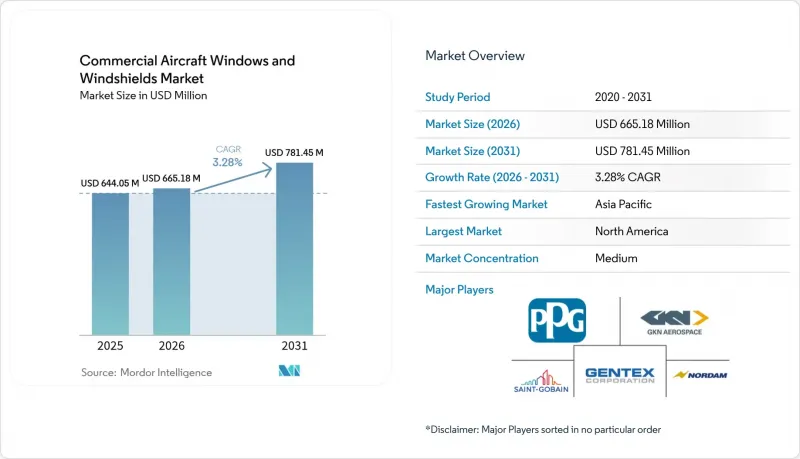
Mordor Intelligence에 따르면 민간 항공기용 창문 및 윈드실드 시장 규모는 2025년에 6억 4,405만 달러로 평가되며, 2026년 6억 6,518만 달러에서 2031년까지 7억 8,145만 달러에 달할 것으로 예측되며, 예측 기간의 CAGR은 3.28%입니다(2026-2031년).
본 보고서는 항공기 유형(나로우드기, 와이드바디기 등), 용도(객실 창문 등), 소재(유리 적층재, 아크릴, 폴리카보네이트 등), 기술(가열식/방빙 창문 등), 최종사용자(OEM 및 애프터마켓), 지역(북미, 유럽 등)별로 분류되어 있습니다. 시장 예측은 금액(달러) 기준으로 제시되어 있습니다.
세계 민간 항공기용 창문 및 윈드실드 시장의 동향과 인사이트
대형 파노라마식 객실 창문에 대한 수요 증가
각 항공사는 대형 창문을 수익성이 높은 항공권 판매를 촉진할 수 있는 브랜드 차별화 요인으로 보고 있습니다. 에어버스는 A350에 초대형 개구부를 적용하고, A320의 측벽을 재설계하여 더 많은 자연광이 객실로 들어오도록 했습니다. 이를 통해 공간의 개방감이 향상되고, 시차로 인한 피로가 완화됩니다. 각 공급업체는 이에 대응하여, 대형화되어도 구조적 무결성을 유지하면서 경량화를 실현하는, 강도가 더 높은 얇은 유리 적층재를 개발했습니다. 착색 코팅과 발수층 덕분에 반복적인 세척 후에도 높은 투명도가 유지됩니다. 프리미엄 항공사들은 구형 와이드바디 항공기에 더 큰 창문 유리와 LED 무드 조명에 대응하는 개량형 창틀을 사후 장착하고 있습니다. 이러한 업그레이드는 객실 개조 비용을 증가시키지만, 기체의 수명을 연장하는 결과로 이어집니다. 그 결과, 파노라마 디자인은 단순한 신기함에서 벗어나 새로운 단일 통로 항공기 프로그램의 주류 표준 사양 옵션으로 자리 잡아가고 있습니다.
일렉트로크로믹 스마트 윈드실드 채택 가속화
한때 비즈니스 제트기에만 국한되었던 전자식 조광 솔루션이 대형 상용기에도 도입되고 있습니다. 젠텍스(Gentex)사의 최신 장치는 빛을 99.9% 차단하며, 90초 만에 완전히 투명해집니다. 이 기능은 현재 B787 및 일부 A321XLR 인도 기체에 표준 사양으로 장착되어 있습니다. 실험실 테스트 결과, 적외선 차단율은 77.3%, 가시광선 투과율은 39.2%에서 56.4%인 것으로 나타났으며, 이를 통해 조종실의 열 부하가 감소하고 공조 시스템의 전력 소비가 절감됩니다. 전면 유리 주변에 박막 태양전지 집열기를 통합함으로써, 항공기의 버스 시스템에 부하를 주지 않고도 착색 사이클에 전원을 공급할 수 있습니다. 프리미엄 클래스에 이 기술을 도입한 항공사들은 블라인드가 더 이상 필요 없어짐에 따라 순추천지수(NPS)가 향상되고 항공기 회전 시간이 단축되었다고 보고하고 있습니다. 인증 사례가 축적됨에 따라 공급업체들은 창문당 비용이 낮아져, 협폭기(narrow-body) 항공기에서의 채택이 더욱 확대될 것으로 전망하고 있습니다.
특수 소재의 공급망 제약
화학 강화 유리 기판과 중간막 수지는 북미 및 유럽의 소수 공장에 의존하고 있습니다. 팬데믹 기간에 발생한 혼란은 여전히 조달 일정에 영향을 미치고 있으며, 로트 규모 제한과 현물 가격 급등을 초래하고 있습니다. 협폭기 생산 확대에 따라 2차 라미네이트 제조업체는 여러 OEM 라인 간 할당량을 조정할 수밖에 없어 리드타임이 길어지고 있습니다. 또한, 온도 조절 컨테이너를 이용할 수 없는 경우 화물 운송의 병목 현상이 위험 요인이 됩니다. 그 결과, 일부 항공사는 교체용 창유리를 미리 구매하여 재고를 확보하고 있으며, 이로 인해 운전자금이 묶여 있습니다. 연구자들은 원자재 다각화를 위해 재활용 유리 조각이나 바이오 기반 수지의 활용을 모색하고 있지만, 상업적 생산량은 여전히 적은 상황입니다.
부문 분석
2025년, 협폭기(Narrow-body) 부문은 민간 항공기용 창문 및 윈드실드 시장 점유율의 61.78%를 차지했으며, 2031년까지 연평균 성장률(CAGR) 6.12%로 확대될 전망입니다. A320neo 및 B737 MAX 계열은 단거리 직항 노선을 우선시하는 저비용 항공사(LCC)로부터 계속해서 주문을 확보하고 있습니다. 각 단일 통로 항공기는 이중 통로 항공기에 비해 창문 수가 적지만, 막대한 도입 대수 덕분에 수익의 대부분을 차지하고 있습니다. 개조 공사에서는 수익성이 높은 좌석 열에 조광 기능이 있는 솔루션이 추가되고, 개구부를 확대하기 위해 프레임이 보강되고 있습니다. 와이드바디 항공기는 시장 점유율은 작지만, A350이나 B787에는 초대형 파노라마 창이 채택되어 있으며, 프리미엄 가격으로 판매되기 때문에 기체당 가치는 높습니다. 리저널 제트기나 터보프롭기는 경량 폴리카보네이트를 활용하여 항속 거리를 연장하고 블록 타임의 경제성을 향상시키고 있지만, 화물기는 하역 시 손상을 견딜 수 있는 튼튼한 유리를 채택하고 있습니다. 장기적으로는 창문이 없는 객실이라는 구상을 통해 추가적인 경량화가 가능해질 수도 있겠지만, 인증 절차의 복잡성을 고려할 때 급격한 전환보다는 단계적인 진화가 예상됩니다.
나로우바디 항공기의 성장세는 민간 항공기용 창문 및 윈드실드 시장의 규모 확대에 기여하고 있습니다. 이는 단일 통로 항공기 프로그램이 수주 잔고의 대부분을 차지하고 있기 때문입니다. 유닛 세트의 공급량이 증가함에 따라 공급업체들은 라미네이트 및 코팅 라인의 자동화를 추진하게 되고, 이로 인해 단가가 하락하여 엔트리 레벨 객실에도 스마트 기능이 도입될 것입니다. 고객은 연료 소비의 미미한 절감 효과와 구매 비용의 프리미엄을 저울질하기 때문에 일렉트로크로믹 패널의 채택은 플래그십 항공사를 시작으로 하향식 패턴으로 진행될 것입니다. 하지만 OEM의 생산 목표가 상승하고 있어, 보수적인 항공사조차도 기체 갱신이 진행되고 있습니다. 와이드바디 항공기 인도는 브랜드 이미지가 더욱 중요시되는 국제 허브 공항에 집중되어 있으며, 초장거리 항공기에서 최대 크기의 조광 가능 창문에 대한 수요를 뒷받침하고 있습니다.
2025년에는 모든 좌석에서 열당 4-6장의 배치가 채택됨에 따라, 객실 창문이 민간 항공기용 창문 및 윈드실드 시장 규모의 64.86%를 차지했습니다. 승무원이 조작하는 ‘aerBlade’ 쉐이드 설치나 OLED 조명 내장 등의 개조 공사는 브랜드 차별화 측면에서 객실의 중요성을 부각시키고 있습니다. 지문 방지 코팅 기술의 발전으로 인해 승객의 빈번한 접촉이나 청소 주기에도 불구하고 높은 투명도가 유지되고 있습니다. 조종실 전면 유리는 조류 충돌에 대한 내성 기준이 강화되고, 새롭게 등장한 증강 현실(AR) 오버레이가 도입됨에 따라 해당 부문에서 가장 높은 연평균 성장률(CAGR) 6.05%를 기록하고 있습니다. 하네웰과 NXP의 대형 조종석 디스플레이 공동 개발로 인해 광학적 부하가 증가함에 따라, 창 제조업체들은 전자기 간섭(EMI) 차폐 성능 향상을 위해 전도성 코팅을 개선해야 할 필요성에 직면해 있습니다. 또한 자외선 차단 기술은 고위도 노선에서 조종사를 더욱 보호하고, 산업 안전 보건 관련 규제 요건도 충족시키고 있습니다.
규정 준수 기준이 엄격해지면 조종실 유리 교체 주기가 단축되어 애프터마켓 수익이 확대됩니다. 인증 규정에서는 결빙을 방지하기 위해 중복 가열 요소가 요구되며, 이로 인해 부품 원가는 상승하지만 운항 안전성은 향상됩니다. 항공사들은 앞유리 교체를 정기적인 엔진 정비와 동기화함으로써 가동 중단 시간을 최적화하고, 이러한 비용의 균형을 맞추고 있습니다. 객실 창문 교체 주기는 비교적 완만하지만, 기체 전체를 대상으로 한 개조 프로그램으로 인해 수주가 갑작스럽게 급증할 가능성이 있습니다. 지속가능성 관련 지표 규제가 강화됨에 따라, 기체 경량화는 편당 배출량을 줄이기 위한 매력적인 수단으로 주목받고 있습니다.
지역별 분석
북미는 치밀한 항공기 제조 생태계와 광범위한 MRO(정비·수리·점검) 역량을 바탕으로 2025년 민간 항공기용 창문 및 윈드실드 시장의 34.25%를 차지했습니다. FAA(연방항공청)의 규정에 따라 앞유리 교체가 조기에 이루어져야 하므로, 이 지역의 수요가 확대되고 있습니다. PPG의 항공우주 분야 수주 잔고와 Gentex의 조광 유리 관련 개발 파이프라인은 이 지역의 기술적 견인력을 뒷받침하고 있습니다. 캐나다는 폴리카보네이트 접착 기술을 정교화하는 복합재료 연구 거점을 통해 미국을 보완하고 있습니다.
아시아태평양은 가장 빠르게 성장하고 있으며, 2031년까지 연평균 성장률(CAGR) 7.75%로 확대될 전망입니다. 보잉사는 인도 및 남아시아의 항공기 보유 대수가 2043년까지 4배로 증가하여 2,835대의 신규 항공기가 필요할 것으로 예측하고 있습니다. 현지 항공사들은 중산층 여행객을 유치하기 위해 최신 객실 기준을 채택하고 있으며, 그 결과 조광 기능이 있는 창문이나 파노라마식 창문이 더욱 빠르게 표준 사양으로 장착되고 있습니다. 여러 OEM 제조사들은 턴어라운드 시간을 단축하기 위해 광저우, 하이데라바드, 나고야 인근에 현지 정비 센터를 설치하고 있습니다. 그러나 자재 수입 시 물류 리드타임이 길어짐에 따라 수지 부족의 영향이 더욱 커지고 있습니다.
유럽은 툴루즈와 함부르크의 에어버스 생산을 중심으로 여전히 높은 시장 점유율을 유지하고 있습니다. 이 지역의 기후 정책에 따라, 편당 배출량을 줄이는 경량 소재의 도입이 가속화되고 있습니다. 현지 공급업체들은 자원 효율이 높은 유리 용융 공정을 선도적으로 도입하여, 세계 표준이 될 수 있는 재활용 기준을 주도하고 있습니다. 에미레이트 항공 등 중동의 항공사들은 유럽산 키트를 활용한 대규모 개조에 투자하며, 지역 간 물류 흐름을 유지하고 있습니다. 아프리카는 기체 규모 면에서는 뒤처져 있지만, 대륙 내 연결성이 높아짐에 따라 현지 정비 거점에 새로운 비즈니스 기회가 생겨나고 있습니다. 라틴아메리카에서는 브라질의 리저널 제트기 및 상 조제 두스 캄포스 주변의 MRO 클러스터에 힘입어 꾸준한 확장이 이루어지고 있습니다.
기타 혜택:
- 엑셀 형식의 시장 예측(ME) 시트
- 3개월간의 애널리스트 지원
자주 묻는 질문
목차
제1장 소개
제2장 조사 방법
제3장 주요 요약
제4장 시장 구도
제5장 시장 규모와 성장 예측
제6장 경쟁 구도
제7장 시장 기회와 향후 전망
KSM 26.09.07According to Mordor Intelligence, the commercial aircraft windows and windshields market size was valued at USD 644.05 million in 2025 and estimated to grow from USD 665.18 million in 2026 to reach USD 781.45 million by 2031, at a CAGR of 3.28% during the forecast period (2026-2031).
This report is Segmented by Aircraft Type (Narrowbody Aircraft, Widebody Aircraft, and More), Application (Cabin Windows, and More), Material (Glass Laminates, Acrylic, Polycarbonate, and More), Technology (Heated/Anti-Ice Windows, and More), End-User (OEM and Aftermarket) and Geography (North America, Europe, and More). The Market Forecasts are Provided in Terms of Value (USD).
Global Commercial Aircraft Windows And Windshields Market Trends and Insights
Growing Demand for Larger Panoramic Cabin Windows
Airlines view larger windows as a brand differentiator that can lift high-yield ticket sales. Airbus integrated oversized apertures on the A350 and redesigned A320 sidewalls to let more daylight flood the cabin, which improves the perception of space and reduces jet-lag-related fatigue. Suppliers have responded with stronger thin-glass laminates that preserve structural integrity at greater dimensions while trimming weight. Tinted coatings and hydrophobic layers keep clarity high even after repeated cleaning cycles. Premium carriers retrofit older widebodies with upgraded window surrounds that support bigger panes and LED mood lighting. These upgrades raise cabin refurbishment costs but extend airframe service life. Consequently, panoramic designs move from novelty to mainstream line-fit options on new single-aisle programs.
Acceleration of Electrochromic Smart Windshield Adoption
Electronically dimmable solutions, once confined to business jets, are entering large commercial platforms. Gentex's latest devices block 99.9% of light and reach full-clear in 90 seconds, a feature now line-fit on the B787 and selected A321XLR deliveries.Laboratory tests show infrared rejection of 77.3% and visible transmittance from 39.2% to 56.4%, which lowers cockpit heat load and cuts air-conditioning draw. Embedding thin-film solar collectors along the windshield perimeter powers tint cycles without tapping aircraft buses. Airlines that install the technology in premium cabins report higher Net Promoter Scores and faster turnarounds because blinds are no longer needed. As certification precedents accumulate, suppliers expect the cost per window to fall, driving wider adoption on narrowbody fleets.
Supply-Chain Constraints in Specialty Materials
Chemically toughened glass substrates and interlayer resins rely on a few plants in North America and Europe. Pandemic-era disruptions still ripple through procurement schedules, limiting batch sizes and driving spot price spikes. Narrowbody ramp-ups have forced tier-2 laminators to juggle allocation across multiple OEM lines, which elongates lead times. Freight bottlenecks add risk when climate-controlled containers are unavailable. Some airlines, therefore, pre-buy replacement panes and hold inventory, tying up working capital. Researchers explore recycled glass cullet and bio-based resins to diversify feedstocks, yet commercial volumes remain small.
Other drivers and restraints analyzed in the detailed report include:
- Increasing Production Backlog at Boeing and Airbus Stimulating Tier-1 Suppliers
- Lightweight Acrylic and Polycarbonate Adoption for Fuel-Burn Reduction
- High Certification and Qualification Costs Hindering New Technologies
For complete list of drivers and restraints, kindly check the Table Of Contents.
Segment Analysis
The narrowbody segment contributed 61.78% of the market share of commercial aircraft windows and windshields in 2025 and will expand at a 6.12% CAGR through 2031. A320neo and B737 MAX families continue to capture orders from low-cost carriers prioritizing short-haul, point-to-point service. Each single-aisle airframe houses fewer panes than a twin-aisle, yet the fleet's huge installed base secures the bulk of revenue. Retrofits add dimmable solutions on high-yield rows and reinforce frames for larger apertures. Widebody aircraft keep a smaller slice but deliver high value per shipset because the A350 and B787 specify oversized panoramic windows that fetch premium pricing. Regional jets and turboprops leverage lightweight polycarbonate to widen range and improve block-time economics, while freighters opt for rugged glass that resists handling damage. Long-term, conceptual windowless cabins could trim weight further, yet certification complexity suggests a gradual evolution rather than a sudden switch.
Narrowbody momentum benefits the commercial aircraft windows and windshields market size because single-aisle programs dominate order backlogs. Greater shipset volumes incentivize suppliers to automate lamination and coating lines, which lowers unit cost and unlocks smart features for entry-level cabins. Customers weigh marginal fuel savings against acquisition premiums, so adopting electrochromic panes follows a top-down pattern starting with flagship carriers. Still, rising OEM production targets ensure even conservative airlines refresh their inventory. Widebody deliveries concentrate in international hubs where brand positioning matters more, sustaining demand for the largest dimmable windows on ultra-long-range variants.
Cabin windows accounted for 64.86% of the commercial aircraft and windshields market size in 2025 due to a four-to-six-per-row geometry across all seats. Retrofits that install crew-controlled aerBlade shades or embed OLED lighting underline the cabin's importance in brand differentiation. Advancements in anti-smudge coatings keep clarity high despite frequent passenger contact and cleaning cycles. Cockpit windshields post the fastest segment CAGR of 6.05%, given stricter bird-strike tolerance and emerging augmented-reality overlays. Honeywell and NXP's collaboration on large-area cockpit displays increases optical load, pushing window makers to refine conductive coatings for better EMI shielding.UV-blocking technology further protects pilots on high-latitude routes, addressing occupational health mandates.
The replacement interval for cockpit glass narrows when compliance standards tighten, magnifying aftermarket revenue. Certification rules demand redundant heating elements to prevent ice build-up, which raises the bill of materials but enhances operational safety. Airlines balance these costs by synchronizing windshield swaps with scheduled engine overhauls, optimizing downtime. Cabin pane turnover is slower, yet fleet-wide retrofit programs can spur lumpy order spikes. As sustainability metrics gain regulatory teeth, lighter planes emerge as an attractive lever to cut per-trip emissions.
Complete Report Scope:
- By Aircraft Type
- Narrowbody Aircraft
- Widebody Aircraft
- Regional Jets
- Freighter/Converted Freighter Aircraft
- By Application
- Cabin Windows
- Cockpit Windshields
- By Material
- Glass Laminates
- Acrylic
- Polycarbonate
- Hybrid/Composite Sandwich Structures
- By Technology
- Conventional Multi-Layer Laminates
- Electrochromic/Dimmable Smart Windows
- Heated/Anti-Ice Windows
- UV and IR-Coated Windows
- By End Market
- OEM
- Aftermarket (MRO and Retrofit)
- By Geography
- North America
- United States
- Canada
- Mexico
- South America
- Brazil
- Rest of South America
- Europe
- United Kingdom
- Germany
- France
- Russia
- Rest of Europe
- Asia-Pacific
- China
- Japan
- India
- South Korea
- Rest of Asia-Pacific
- Middle East and Africa
- Middle East
- United Arab Emirates
- Saudi Arabia
- Qatar
- Rest of Middle East
- Africa
- South Africa
- Rest of Africa
- Middle East
- North America
Geography Analysis
North America controlled 34.25% of the commercial aircraft windows and windshields market in 2025, buoyed by its dense airframe manufacturing ecosystem and extensive MRO capacity. FAA regulations compel quicker windshield replacement, expanding local demand. PPG's aerospace backlog and Gentex's dimmable glass pipeline underscore the region's technology pull. Canada complements the US with composite research hubs that refine polycarbonate bonding techniques.
Asia-Pacific is the fastest mover, advancing at an 7.75% CAGR through 2031. Boeing foresees India and South Asia quadrupling their fleet by 2043, requiring 2,835 new airplanes. Local carriers adopt the latest cabin standards to woo middle-class travelers, so dimmable and panoramic panes see quicker line-fit. Multiple OEMs have site repair centers near Guangzhou, Hyderabad, and Nagoya to shorten turnaround times. Yet, material imports face longer logistics lead times, magnifying the impact of resin shortages.
Europe retains a strong share anchored by Airbus production in Toulouse and Hamburg. The bloc's climate policies accelerate the adoption of lighter materials that shrink per-trip emissions. Suppliers there pioneer resource-efficient glass melting processes and lead recycling standards that could become global benchmarks. Middle Eastern carriers such as Emirates invest in large-scale retrofits that rely on European-built kits, sustaining cross-regional flows. Africa lags in fleet size but offers a greenfield opportunity for local repair stations as intra-continental connectivity rises. Latin America shows steady expansion driven by Brazilian regional jets and MRO clusters around Sao Jose dos Campos.
- PPG Industries Inc.
- GKN Aerospace Services Ltd.
- Gentex Corporation
- Saint-Gobain Aerospace
- NORDAM Group LLC
- Control Logistics Inc.
- Plexiweiss GmbH
- Llamas Plastics Inc.
- Aerospace Plastic Components (APC) Pty. Ltd.
- Lee Aerospace, Inc.
- LP Aero Plastics Inc.
- Tech-Tool Plastics, Inc.
- Triumph Group, Inc.
- Cee Bailey's Aircraft Plastics, Inc.
- Great Lakes Aero Products, Inc.
Additional Benefits:
- The market estimate (ME) sheet in Excel format
- 3 months of analyst support
TABLE OF CONTENTS
1 INTRODUCTION
- 1.1 Study Assumptions and Market Definition
- 1.2 Scope of the Study
2 RESEARCH METHODOLOGY
3 EXECUTIVE SUMMARY
4 MARKET LANDSCAPE
- 4.1 Market Overview
- 4.2 Market Drivers
- 4.2.1 Growing demand for larger panoramic cabin windows
- 4.2.2 Acceleration of electrochromic smart windshield adoption
- 4.2.3 Increasing production backlog at Boeing and Airbus
- 4.2.4 Stringent FAA and EASA bird-strike and thermal-shock standards
- 4.2.5 Lightweight acrylic and polycarbonate adoption
- 4.2.6 Airline fleet modernization programs in Asia and Middle East
- 4.3 Market Restraints
- 4.3.1 Supply-chain constraints in specialty materials
- 4.3.2 High certification and qualification costs
- 4.3.3 Volatile OEM production rates
- 4.3.4 Limited repair capabilities outside North America and Europe
- 4.4 Value Chain Analysis
- 4.5 Regulatory and Technological Outlook
- 4.6 Porter's Five Forces Analysis
- 4.6.1 Bargaining Power of Buyers
- 4.6.2 Bargaining Power of Suppliers
- 4.6.3 Threat of New Entrants
- 4.6.4 Threat of Substitute Products
- 4.6.5 Intensity of Competitive Rivalry
5 MARKET SIZE AND GROWTH FORECASTS (VALUE)
- 5.1 By Aircraft Type
- 5.1.1 Narrowbody Aircraft
- 5.1.2 Widebody Aircraft
- 5.1.3 Regional Jets
- 5.1.4 Freighter/Converted Freighter Aircraft
- 5.2 By Application
- 5.2.1 Cabin Windows
- 5.2.2 Cockpit Windshields
- 5.3 By Material
- 5.3.1 Glass Laminates
- 5.3.2 Acrylic
- 5.3.3 Polycarbonate
- 5.3.4 Hybrid/Composite Sandwich Structures
- 5.4 By Technology
- 5.4.1 Conventional Multi-Layer Laminates
- 5.4.2 Electrochromic/Dimmable Smart Windows
- 5.4.3 Heated/Anti-Ice Windows
- 5.4.4 UV and IR-Coated Windows
- 5.5 By End Market
- 5.5.1 OEM
- 5.5.2 Aftermarket (MRO and Retrofit)
- 5.6 By Geography
- 5.6.1 North America
- 5.6.1.1 United States
- 5.6.1.2 Canada
- 5.6.1.3 Mexico
- 5.6.2 South America
- 5.6.2.1 Brazil
- 5.6.2.2 Rest of South America
- 5.6.3 Europe
- 5.6.3.1 United Kingdom
- 5.6.3.2 Germany
- 5.6.3.3 France
- 5.6.3.4 Russia
- 5.6.3.5 Rest of Europe
- 5.6.4 Asia-Pacific
- 5.6.4.1 China
- 5.6.4.2 Japan
- 5.6.4.3 India
- 5.6.4.4 South Korea
- 5.6.4.5 Rest of Asia-Pacific
- 5.6.5 Middle East and Africa
- 5.6.5.1 Middle East
- 5.6.5.1.1 United Arab Emirates
- 5.6.5.1.2 Saudi Arabia
- 5.6.5.1.3 Qatar
- 5.6.5.1.4 Rest of Middle East
- 5.6.5.2 Africa
- 5.6.5.2.1 South Africa
- 5.6.5.2.2 Rest of Africa
- 5.6.5.1 Middle East
- 5.6.1 North America
6 COMPETITIVE LANDSCAPE
- 6.1 Market Concentration
- 6.2 Strategic Moves
- 6.3 Market Share Analysis
- 6.4 Company Profiles (includes Global level Overview, Market level overview, Core Segments, Financials as available, Strategic Information, Market Rank/Share for key companies, Products and Services, and Recent Developments)
- 6.4.1 PPG Industries Inc.
- 6.4.2 GKN Aerospace Services Ltd.
- 6.4.3 Gentex Corporation
- 6.4.4 Saint-Gobain Aerospace
- 6.4.5 NORDAM Group LLC
- 6.4.6 Control Logistics Inc.
- 6.4.7 Plexiweiss GmbH
- 6.4.8 Llamas Plastics Inc.
- 6.4.9 Aerospace Plastic Components (APC) Pty. Ltd.
- 6.4.10 Lee Aerospace, Inc.
- 6.4.11 LP Aero Plastics Inc.
- 6.4.12 Tech-Tool Plastics, Inc.
- 6.4.13 Triumph Group, Inc.
- 6.4.14 Cee Bailey's Aircraft Plastics, Inc.
- 6.4.15 Great Lakes Aero Products, Inc.
7 MARKET OPPORTUNITIES AND FUTURE OUTLOOK
- 7.1 White-space and Unmet-Need Assessment


