|
시장보고서
상품코드
2121676
단열 콘크리트 거푸집(ICF) : 시장 점유율 분석, 업계 동향과 통계, 성장 예측(2026-2031년)Insulated Concrete Form (ICF) - Market Share Analysis, Industry Trends & Statistics, Growth Forecasts (2026 - 2031) |
||||||
 Mordor Intelligence
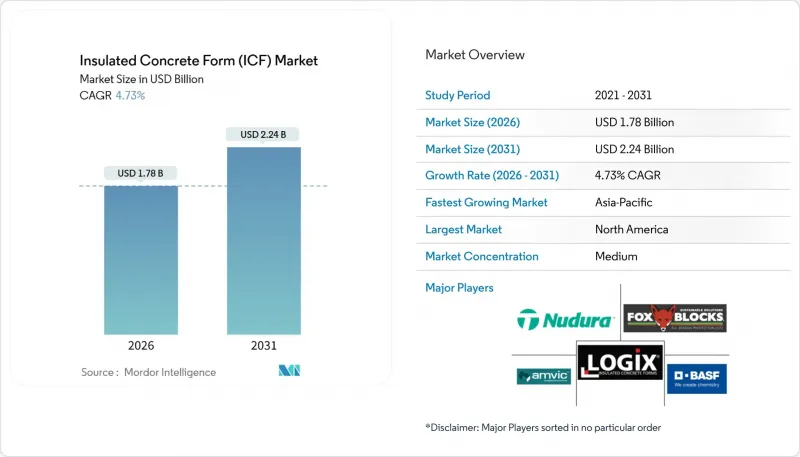
Mordor Intelligence에 의하면, 단열 콘크리트 거푸집(ICF) 시장 규모는 2026년에 17억 8,000만 달러로 추정되며, 예측 기간(2026-2031년)에 CAGR 4.73%로 확대되어 2031년에는 22억 4,000만 달러에 이를 전망입니다.
본 보고서는 재료 유형(폴리스티렌 폼, 폴리우레탄 폼 등), 시스템 유형(플랫월시스템, 와플 그리드 시스템 등), 건설 유형(신축, 개보수·리모델링), 용도(주택, 상업시설, 공공시설), 지역(아시아태평양, 북미, 유럽 등)별로 분류되어 있습니다. 시장 전망은 금액(달러) 기준으로 제시되어 있습니다.
전 세계 단열 콘크리트 거푸집(ICF) 시장 동향 및 인사이트
더욱 엄격해진 친환경 건축 기준 및 인센티브
2024년판 ‘국제 에너지 절약 기준(IECC)’에서는 기후 구역 3-8에 대한 벽의 규정 R값 목표가 상향 조정되어, 실질적으로 연속적인 단열이 요구되고 있습니다. 목조 프레임 구조의 경우, 추가적인 층이나 인력을 투입하지 않으면 이 요건을 충족하기 어렵습니다. 2025년에 시행될 영국의 ‘퓨처 홈스 스탠다드(Future Homes Standard)’에서는 신축 주택에 대해 2013년 기준치에 비해 운영 시 이산화탄소 배출량을 최대 80% 감축할 것을 의무화하고 있어, 건축가들은 높은 열용량을 가진 외피를 채택하는 방향으로 이끌리고 있습니다. 중국의 ‘제14차 5개년 계획’에서는 20,000 m²를 초과하는 공공 건축물에 대해 초저에너지 목표가 의무화되어 있으며, 수명 주기 비용 분석을 통해 초기 투자 증가가 정당화되는 경우 ICF는 우위를 점합니다. 인도에서는 2024년 ‘에너지 절약 건축 기준’에 따라 열교를 페널티 대상으로 하는 외피 성능 지표가 도입되었으나, 일체형 ICF 벽체에는 이러한 약점이 없습니다. 마지막으로, 사우디아라비아는 2024년에 16건의 단열 규정을 공표하고 공공 조달에 대한 성능 기준을 설정함으로써, 인증을 받은 ICF 공급업체를 둘러싼 규정 준수상의 장벽을 구축했습니다.
에너지 효율이 높은 중·고층 빌딩에 대한 수요 증가
호텔 체인, 기숙사 개발업자 및 기관 투자자들은 목조 프레임의 STC 값 38에 비해 ICF의 평균 STC 값 55를 높이 평가했습니다. 이러한 차이로 인해 입주자 이직률이 감소하고 순영업수익이 향상됩니다. 공사 기간 단축에 따른 비용 절감 효과도 뚜렷합니다. 세인트 마틴 섬의 2,000만 달러 규모 ‘디비 리틀 베이 리조트’는 구조와 단열 기능을 겸비한 ICF 거푸집을 채택함으로써 60일 빨리 준공되었습니다. 텍사스주의 팬서 크릭 고등학교에서는 ICF의 연속적인 R값을 활용하여 HVAC의 냉난방 용량을 30% 절감하고, 그 자금을 교실의 IT 설비 갱신에 충당할 수 있었습니다. ASTM C1363 시험에 따르면, 코어 두께 6인치의 ICF 벽은 -31°C에서 정상 상태의 열전달에 도달하는 데 320시간 이상이 소요되는 반면, R값 20의 목조 프레임은 60시간이면 충분합니다. 이러한 열전달 지연으로 인해 극한 기후 조건에서 발생하는 피크 부하 요금이 절감됩니다. 현재 미국 18개 주에서 도입된 에너지 환급 제도는 센터파크 홀리데이 인이 ASHRAE 기준을 30% 상회했을 때 획득한 성능 인센티브와 유사한 구조로 되어 있습니다.
목조 골조에 비해 초기 비용이 높음
ICF 구조의 건설비는 1제곱피트당 목조 골조보다 10%-15% 더 비쌉니다. 또한, 많은 투기성 주택 개발업자들은 미래의 에너지 절약 효과를 8% 이상 할인하여 계산하기 때문에 투자 회수 기간이 10년에 달하기도 합니다. 조지아주 컴포트 인에서 볼 수 있듯이, 부지 고유의 지반 조건이 비용을 상쇄할 수 있는 경우도 있지만, 그러한 지반 조건은 드뭅니다. 시공업체들은 학습 곡선에 따른 지연이나 콘크리트 타설 중 예산 초과를 우려하기 때문에 여전히 5%-8%의 예비비를 추가로 책정하고 있습니다. 계단 코어나 샤프트에만 ICF를 사용하는 하이브리드형 가치 공학(Value Engineering)을 통해 뉴햄프셔주 워싱턴 스트리트 오피스에서는 30% 이상의 비용 절감을 실현했으나, 이를 위해서는 많은 팀이 갖추지 못한 고도의 설계 능력이 요구됩니다. 연방 세법 제45L조 및 제179D조에 따른 세제 혜택으로 비용 가산분을 1제곱피트당 최대 5달러까지 줄일 수 있지만, 인증 절차가 여전히 충분히 이해되지 않고 있어 그 활용은 제한적입니다.
부문 분석
2025년 현재, 폴리스티렌 폼은 단열 콘크리트 거푸집(ICF) 시장의 88.66% 점유율을 차지하고 있으며, 이 부문은 2031년까지 연평균 성장률(CAGR) 4.82%로 성장할 전망입니다. 폴리스티렌 제품의 ICF 시장 규모는 EPS(발포 폴리스티렌)의 낮은 열전도율, 높은 압축 강도, 그리고 전 세계적으로 풍부한 공급량에 힘입어 성장하고 있습니다. BASF사의 ‘Neopor’ 등급은 동일한 두께에서 R값을 약 20% 향상시켜, 벽을 두껍게 하지 않고도 건축 기준을 준수할 수 있게 해줍니다. 폴리우레탄 폼은 여전히 좁은 공간을 위한 틈새 시장에서 사용되고 있지만, 콘크리트 다짐 및 높은 비용과 같은 과제에 직면해 있습니다. 시멘트 결합 목질 섬유판은 탄소 크레딧 확보를 목표로 하는 프로젝트에서 채택되고 있지만, 유통망이 제한적이고 가격이 25% 더 비싸기 때문에 시장 점유율은 8%에 그치고 있습니다.
2024년에 북미 및 유럽 공급업체들이 HBCD계 난연제 사용을 단계적으로 폐지하고 규제상의 우려가 해소됨에 따라, 폴리스티렌 분야의 경쟁 우위는 더욱 확대되었습니다. 수직 통합형 EPS 제조업체는 현재 스티렌 가격 변동에 대해 보다 효과적으로 헤지하고 있으며, 이는 소규모 가공업체가 따라할 수 없는 강점입니다. 고밀도 유형 II EPS를 사용한 쿼드록(Quadlock)사의 ‘울트라 패널(Ultra Panel)’은 과거 압축 강도의 제약으로 인해 제한되었던 중층 건축 시장을 개척하고 있습니다. 폴리우레탄의 경우, 스프레이 설비가 필요하다는 점과 관련된 시공업체의 소극적인 태도가 보다 광범위한 활용을 저해하고 있습니다. 시멘트 결합형 혼합물은 시멘트 함량으로 인해 더 높은 매립 CO₂를 수반하지만, 이러한 상충 관계는 탄소세가 급격히 상승할 경우에만 수용될 수 있게 될 것입니다.
2025년에는 플랫월 구조가 54.23%의 점유율을 차지했으나, 스크리닝 그리드 방식의 대체재는 연평균 성장률(CAGR) 5.33%로 확대되고 있으며, 이는 시스템 유형 중 가장 빠른 성장률입니다. 스크린 그리드의 개방형 구조 덕분에 철근 공사는 나사산 가공 없이 수평 및 수직 철근을 삽입할 수 있어, 철근 사용량이 막대한 상업용 건축물에서 발생하는 인력 병목 현상이 해소됩니다. 개발업자들이 철근 밀도가 높은 중층 건축을 추구함에 따라, 스크리닝 그리드 제품용 단열 콘크리트 거푸집(ICF) 시장 규모는 확대되고 있습니다. 와플 그리드 시스템은 동등한 강도에서 콘크리트 사용량을 10%-15% 절감할 수 있지만, 비용이 높고 웹 배치에 세심한 주의가 필요합니다.
스크린 그리드의 8%-12%에 해당하는 추가 자재 비용은 내진 설계 및 내폭 설계에서 인건비 절감 효과가 나타나면 비용 면에서 상쇄됩니다. 조지아주의 베스트 웨스턴에서 사용된 폴리크레이트 패널화 키트는 스크린 그리드 거푸집이 타이바에 걸리지 않고 크레인으로 쉽게 들어 올릴 수 있음을 보여줍니다. 플랫월은 편의성이 인건비 계산을 우선시하는 단독 주택 건설 분야에서 여전히 인기를 유지하고 있지만, 이 부문의 성장은 상업용 수요에 비해 완만합니다. 와플 그리드의 채택은 여전히 북미가 중심을 이루고 있습니다. 이는 레디믹스 콘크리트 가격이 150달러/yd3를 초과할 때 콘크리트 비용 절감 효과가 두드러지기 때문입니다. 포스트 앤 빔 방식의 ICF는 기존 골조를 활용하는 기존 건축물의 재활용 프로젝트에 적합하지만, 출하량의 불과 6%만을 차지할 뿐이며, 주요 경쟁은 플랫월과 스크린 그리드 시스템 간에 벌어지고 있습니다.
지역별 분석
북미는 2025년 매출의 39.67%를 차지하며, FEMA(연방재난관리청)가 지원하는 회복력 기금 및 엄격한 에너지 기준의 중심지로서의 위치를 계속 유지하고 있습니다. 미국 35개 주가 2024년판 IECC(미국 에너지 효율 기준)를 채택하고 있으며, ICF 공법에 유리한 연속 단열 요건이 추진되고 있습니다. 캐나다의 2020년판 ‘국가 건축 기준법’에서는 열교가 고려되게 되어 스틸 스터드의 불리한 입지를 강화하는 한편, 온타리오주의 웰링턴 이스트 비즈니스 센터와 같은 공동 주택 건설에서 ICF의 채택을 뒷받침하고 있습니다. 멕시코에서는 허리케인 피해를 입기 쉬운 연안 지역에서 호텔 및 관광 업계 수요가 조기에 나타나고 있지만, 시공 업체 부족으로 인해 보급이 지연되고 있습니다. 전략적 전환 요인은 대규모 주택 건설업체들이 ICF를 대규모로 채택할지 여부입니다. D.R. 호튼(D.R. Horton)과 레너(Lennar)사의 시범 도입은 진행 중이지만, 현재로서는 확약 단계에는 이르지 않았습니다.
아시아태평양은 중국의 초저에너지 규제와 인도의 2024년 건축 외피 기준에 힘입어, 세계 최고 수준인 연평균 성장률(CAGR) 5.12%를 기록할 전망입니다. 중국에서는 현재 20,000 m²를 초과하는 공공 건축물에 대해 엄격한 에너지 기준 달성이 의무화되어 있어, 이에 따라 기관계 개발사들은 고품질 벽체로의 전환을 강요받고 있습니다. 인도의 개정된 건축 기준에서는 열교가 규제 대상이 되어, U값을 30% 이상 개선하는 ICF 벽체의 도입 여지가 생겼습니다. 싱가포르의 ‘2024 그린 빌딩 마스터 플랜’에서는 2030년까지 건축물의 80%를 플래티넘 등급으로 만드는 것을 목표로 하고 있지만, 고층 건축물에 편중되어 있어 ICF의 적용은 포디움 층으로 제한되고 있습니다. 베트남 등 아세안(ASEAN) 국가들에서는 온도 관리가 극히 중요한 냉장 창고에서 ICF의 시범 도입이 진행되고 있습니다.
유럽 시장에서는 EU 택소노미 및 각국 차원의 에너지 관련 법에 따라 성장이 나타나고 있습니다. 영국의 ‘2025년 퓨처 홈즈 스탠다드’는 허용 탄소 배출량을 대폭 감축하고, 열용량이 높은 벽체를 우대하고 있습니다. 독일의 ‘2024년 건축물 에너지법’은 단열 기준을 상향 조정했으며, 프랑스의 ‘RE 2020’은 건물 전체의 수명 주기에 걸친 탄소 배출 지표를 도입하고 있어, 콘크리트를 많이 사용하는 솔루션에서 미묘한 상충 관계가 발생하고 있습니다. 남유럽에서는 벽돌 공급망이 확고히 자리 잡혀 있고 에너지 가격이 낮은 탓에 여전히 성장 속도가 완만합니다.
남미의 ICF 시장 성장은 브라질 법률 제15.042호에 기반한 탄소 크레딧 제도와 새롭게 등장한 ‘그린 씰’ 인증이 주도하고 있습니다. 칠레의 2024년 벽체 단열 의무화로 산티아고 시장이 개방되고 있지만, 여전히 철근 콘크리트 구조가 주류를 이루고 있습니다.
중동 및 아프리카 시장에서는 가까운 시일 내에 현저한 성장이 예상됩니다. 사우디아라비아의 ‘비전 2030’은 모래폭풍에 강한 프로젝트에 자금을 지원하며, 엄격한 단열 규격을 정하고 있습니다. UAE의 ‘에스티다마’ 및 ‘LEED’ 인증 기준은 상업 건축물에서 고성능 외피를 권장하고 있습니다. 사하라 이남 아프리카에서의 보급은 이제 막 시작되었지만, 케냐의 시범 주택에서 그 조짐을 엿볼 수 있습니다.
기타 혜택:
- 엑셀 형식 시장 예측(ME) 시트
- 3개월간의 애널리스트 지원
자주 묻는 질문
목차
제1장 서론
제2장 조사 방법
제3장 주요 요약
제4장 시장 구도
제5장 시장 규모와 성장 예측
제6장 경쟁 구도
제7장 시장 기회와 향후 전망
LSH 26.09.09According to Mordor Intelligence, the insulated concrete form (ICF) market size is estimated at USD 1.78 billion in 2026, and is expected to reach USD 2.24 billion by 2031, at a CAGR of 4.73% during the forecast period (2026-2031).
This report is Segmented by Material Type (Polystyrene Foam, Polyurethane Foam, and More), System Type (Flat-Wall Systems, Waffle-Grid Systems, and More), Construction Type (New-Build, and Retrofit/Remodeling), Application (Residential, Commercial, and Institutional), and Geography (Asia-Pacific, North America, Europe, and More). Market Forecasts are Provided in Terms of Value (USD).
Global Insulated Concrete Form (ICF) Market Trends and Insights
Stricter Green-Building Codes And Incentives
The 2024 International Energy Conservation Code lifted prescribed R-value targets for walls across climate zones 3-8, effectively demanding continuous insulation that wood frames struggle to achieve without added layers and labor. The United Kingdom's Future Homes Standard, effective in 2025, obliges new dwellings to cut operational carbon by up to 80% compared with 2013 baselines, steering architects toward high-thermal-mass envelopes. China's 14th Five-Year Plan enforces ultra-low-energy targets for public buildings above 20,000 m2, giving ICF an advantage where lifecycle cost analyses justify higher upfront spend. In India, the 2024 Energy Conservation Building Code introduced envelope-performance indices that penalize thermal bridging, a weakness absent from monolithic ICF walls. Finally, Saudi Arabia published 16 thermal-insulation regulations in 2024 that set performance gates for public procurement, establishing a compliance moat around certified ICF suppliers.
Rising Demand For Energy-Efficient Mid/High-Rise Buildings
Hotel chains, student housing developers, and institutional owners value ICF's average STC rating of 55 over wood-frame's 38, a difference that lowers tenant turnover and boosts net operating income. Schedule savings are material: the USD 20 million Divi Little Bay Resort in St. Maarten finished 60 days early by staying with ICF forms that combine structure and insulation. Panther Creek High School in Texas cut HVAC tonnage by 30% by leveraging ICF's continuous R-values, releasing capital for classroom tech upgrades. ASTM C1363 testing shows a 6-inch-core ICF wall needs more than 320 hours to reach steady-state heat transfer at -31 °C, compared with 60 hours for an R-20 wood frame, a lag that trims peak-load charges in extreme climates. Energy rebate models now in 18 U.S. states replicate the performance incentives the Centre Park Holiday Inn secured when it beat ASHRAE standards by 30%.
Higher Upfront Cost Versus Wood Framing
ICF assemblies run 10%-15% above wood frames on a per-square-foot basis, and many speculative residential developers discount future energy savings at more than 8%, stretching payback to a decade. Site-specific soil advantages can offset costs, as seen at the Comfort Inn in Georgia, yet such geotechnical conditions are rare. Contingency mark-ups of 5%-8% persist because contractors fear learning-curve delays and blowouts during concrete pours. Hybrid value-engineering, using ICF only for stair-cores and shafts, saved over 30% at New Hampshire's Washington Street Office but demands design sophistication many teams lack. Federal tax incentives under Sections 45L and 179D reduce the premium by up to USD 5 per ft2, yet uptake is limited because certification steps remain poorly understood.
Other drivers and restraints analyzed in the detailed report include:
- Increased Adoption Of Off-Site And Modular ICF Systems
- Expansion Of Performance-Linked Green-Finance Programs
- Limited Contractor Familiarity And Skilled-Labor Gap
For complete list of drivers and restraints, kindly check the Table Of Contents.
Segment Analysis
Polystyrene foam controlled 88.66% of the insulated concrete form market share in 2025, and the segment is on track for a 4.82% CAGR to 2031. The insulated concrete form market size for polystyrene products benefits from EPS's low thermal conductivity, high compressive strength, and abundant global supply. BASF's Neopor grade raises R-value roughly 20% at equal thickness, permitting code compliance without thicker walls. Polyurethane foam still serves tight-space niches but struggles with concrete consolidation and higher cost. Cement-bonded wood-fiber boards win projects chasing embodied-carbon credits yet hold just 8% share due to limited distribution and a 25% premium.
The polystyrene segment's competitive edge widened after North American and European suppliers phased out HBCD flame retardants in 2024, removing a regulatory overhang. Backward-integrated EPS producers now hedge styrene swings more effectively, an advantage smaller converters cannot match. Quad-Lock's Ultra panel, using higher-density Type II EPS, is opening mid-rise markets once limited by compressive-strength constraints. For polyurethane, installer reluctance tied to spray-equipment needs hampers wider use. Cement-bonded mixes carry higher embodied CO2 because of their cement content, a trade-off that only becomes acceptable when carbon taxation rises sharply.
Flat-wall configurations held a 54.23% share in 2025, yet screen-grid alternatives are expanding at a 5.33% CAGR, the fastest among system types. Screen-grid's open geometry lets ironworkers drop horizontal and vertical bars without threading, eliminating a labor choke point on heavily reinforced commercial builds. The insulated concrete form market size for screen-grid products is rising as developers pursue mid-rise structures where rebar density grows. Waffle-grid systems save 10%-15% concrete volume at equal strength but cost more and require meticulous web placement.
Screen-grid's 8%-12% material premium becomes cost-neutral once labor savings accrue on seismic or blast-resistant designs. Polycrete's panelized kits, used at the Best Western in Georgia, show how screen-grid forms facilitate crane picks without snagging ties. Flat-wall keeps momentum in single-family builds where simplicity tops labor arithmetic, yet that segment is growing more slowly than commercial demand. Waffle-grid adoption remains North America-centric because ready-mix pricing above USD 150 yd3 makes concrete savings compelling. Post-and-beam ICF serves adaptive-reuse jobs with existing frames but represents only 6% of shipments, leaving the main contest between flat-wall and screen-grid systems.
Complete Report Scope:
- Material Type
- Polystyrene Foam
- Polyurethane Foam
- Cement-Bonded Wood Fiber
- Cement-Bonded Polystyrene Beads
- System Type
- Flat-Wall Systems
- Waffle-Grid Systems
- Screen-Grid Systems
- Post-and-Beam Systems
- Construction Type
- New-build
- Retrofit / Remodeling
- Application
- Residential
- Commercial
- Institutional
- Geography
- Asia-Pacific
- China
- Japan
- India
- South Korea
- ASEAN Countries
- Rest of Asia-Pacific
- North America
- United States
- Canada
- Mexico
- Europe
- Germany
- France
- United Kingdom
- Italy
- Rest of Europe
- South America
- Brazil
- Argentina
- Rest of South America
- Middle East and Africa
- Saudi Arabia
- South Africa
- Rest of Middle East and Africa
- Asia-Pacific
Geography Analysis
North America accounted for 39.67% of 2025 revenue and remains the epicenter of FEMA-backed resilience funding and energy-code stringency. Thirty-five U.S. states adopted the 2024 IECC, driving continuous-insulation requirements that favor ICF construction. Canada's 2020 National Building Code now factors thermal bridging, disadvantaging steel studs and lifting ICF uptake in multi-family builds like Ontario's Wellington East Business Centre. Mexico shows early hospitality demand along hurricane-exposed coasts, but installer shortages slow penetration. A strategic swing factor is whether volume homebuilders adopt ICF at scale; pilots by D.R. Horton and Lennar are ongoing yet non-committal.
Asia-Pacific is poised for a 5.12% CAGR, the fastest globally, fueled by China's ultra-low-energy mandates and India's 2024 envelope standards. China now requires public buildings above 20,000 m2 to meet stringent energy baselines, nudging institutional developers toward high-mass walls. India's updated code penalizes thermal bridging, opening room for ICF walls that improve U-values by 30% or more. Singapore's 2024 Green Building Masterplan targets 80% of structures at the Platinum level by 2030, yet high-rise bias limits ICF to podium levels. ASEAN nations such as Vietnam are trialing ICF in refrigerated warehouses where temperature control is mission-critical.
The European market is witnessing growth under the EU Taxonomy and national-level energy laws. The UK's 2025 Future Homes Standard slashes allowable carbon and privileges high-thermal-mass walls. Germany's 2024 Gebaudeenergiegesetz raises minimum insulation, and France's RE 2020 introduces whole-building lifecycle carbon metrics, creating nuanced trade-offs for concrete-intensive solutions. Southern Europe remains slower due to entrenched brick supply chains and lower energy prices.
South America ICF market growth is led by Brazil's carbon-credit scheme under Law 15.042 and the emerging Green Seal certification. Chile's 2024 wall-insulation mandates open Santiago's market, though reinforced-concrete frames still dominate.
The Middle East and Africa market growth is anticipated to witness considerable gains in the near future. Saudi Arabia's Vision 2030 funds sand-storm-resistant projects and sets rigid insulation specs. The UAE's Estidama and LEED pathways favor high-performance envelopes in commercial builds. Sub-Saharan uptake is nascent but visible in Kenyan pilot homes.
- Airlite Plastics Company and Fox Blocks (Fox Blocks)
- Alleguard
- Amvic Ireland LTD
- BASF
- Beco Products Ltd
- BuildBlock Building Systems LLC
- Carlisle Construction Materials (Carlisle Companies Inc.)
- Durisol
- Future Foam Inc.
- INTEGRASPEC
- LiteForm
- Logix Brands Ltd.
- Polycrete International
- Quad-Lock Building Systems
- RASTRA
- Nudura Inc. (RPM International Inc.)
- Sismo Building Technology
- SuperForm
- TF System
- Tremco CPG Inc.
Additional Benefits:
- The market estimate (ME) sheet in Excel format
- 3 months of analyst support
TABLE OF CONTENTS
1 Introduction
- 1.1 Study Assumptions and Market Definition
- 1.2 Scope of the Study
2 Research Methodology
3 Executive Summary
4 Market Landscape
- 4.1 Market Overview
- 4.2 Market Drivers
- 4.2.1 Stricter green-building codes and incentives
- 4.2.2 Rising demand for energy-efficient mid/high-rise buildings
- 4.2.3 Increased adoption of off-site and modular ICF systems
- 4.2.4 Expansion of performance-linked green-finance programs
- 4.2.5 FEMA resilience grants favouring ICF construction
- 4.3 Market Restraints
- 4.3.1 Higher upfront cost versus wood framing
- 4.3.2 Limited contractor familiarity and skilled-labour gap
- 4.3.3 Volatile styrene supply and pricing risk for EPS cores
- 4.4 Value Chain Analysis
- 4.5 Porter's Five Forces
- 4.5.1 Bargaining Power of Suppliers
- 4.5.2 Bargaining Power of Buyers
- 4.5.3 Threat of New Entrants
- 4.5.4 Threat of Substitutes
- 4.5.5 Degree of Competition
5 Market Size and Growth Forecasts (Value)
- 5.1 Material Type
- 5.1.1 Polystyrene Foam
- 5.1.2 Polyurethane Foam
- 5.1.3 Cement-Bonded Wood Fiber
- 5.1.4 Cement-Bonded Polystyrene Beads
- 5.2 System Type
- 5.2.1 Flat-Wall Systems
- 5.2.2 Waffle-Grid Systems
- 5.2.3 Screen-Grid Systems
- 5.2.4 Post-and-Beam Systems
- 5.3 Construction Type
- 5.3.1 New-build
- 5.3.2 Retrofit / Remodeling
- 5.4 Application
- 5.4.1 Residential
- 5.4.2 Commercial
- 5.4.3 Institutional
- 5.5 Geography
- 5.5.1 Asia-Pacific
- 5.5.1.1 China
- 5.5.1.2 Japan
- 5.5.1.3 India
- 5.5.1.4 South Korea
- 5.5.1.5 ASEAN Countries
- 5.5.1.6 Rest of Asia-Pacific
- 5.5.2 North America
- 5.5.2.1 United States
- 5.5.2.2 Canada
- 5.5.2.3 Mexico
- 5.5.3 Europe
- 5.5.3.1 Germany
- 5.5.3.2 France
- 5.5.3.3 United Kingdom
- 5.5.3.4 Italy
- 5.5.3.5 Rest of Europe
- 5.5.4 South America
- 5.5.4.1 Brazil
- 5.5.4.2 Argentina
- 5.5.4.3 Rest of South America
- 5.5.5 Middle East and Africa
- 5.5.5.1 Saudi Arabia
- 5.5.5.2 South Africa
- 5.5.5.3 Rest of Middle East and Africa
- 5.5.1 Asia-Pacific
6 Competitive Landscape
- 6.1 Market Concentration
- 6.2 Strategic Moves
- 6.3 Market Share (%)/Ranking Analysis
- 6.4 Company Profiles (includes Global level Overview, Market level overview, Core Segments, Financials as available, Strategic Information, Products and Services, and Recent Developments)
- 6.4.1 Airlite Plastics Company and Fox Blocks (Fox Blocks)
- 6.4.2 Alleguard
- 6.4.3 Amvic Ireland LTD
- 6.4.4 BASF
- 6.4.5 Beco Products Ltd
- 6.4.6 BuildBlock Building Systems LLC
- 6.4.7 Carlisle Construction Materials (Carlisle Companies Inc.)
- 6.4.8 Durisol
- 6.4.9 Future Foam Inc.
- 6.4.10 INTEGRASPEC
- 6.4.11 LiteForm
- 6.4.12 Logix Brands Ltd.
- 6.4.13 Polycrete International
- 6.4.14 Quad-Lock Building Systems
- 6.4.15 RASTRA
- 6.4.16 Nudura Inc. (RPM International Inc.)
- 6.4.17 Sismo Building Technology
- 6.4.18 SuperForm
- 6.4.19 TF System
- 6.4.20 Tremco CPG Inc.
7 Market Opportunities and Future Outlook
- 7.1 White-space and Unmet-need Assessment