|
시장보고서
상품코드
2121683
모노에틸렌글리콜 : 시장 점유율 분석, 업계 동향과 통계, 성장 예측(2026-2031년)Monoethylene Glycol - Market Share Analysis, Industry Trends & Statistics, Growth Forecasts (2026 - 2031) |
||||||
 Mordor Intelligence
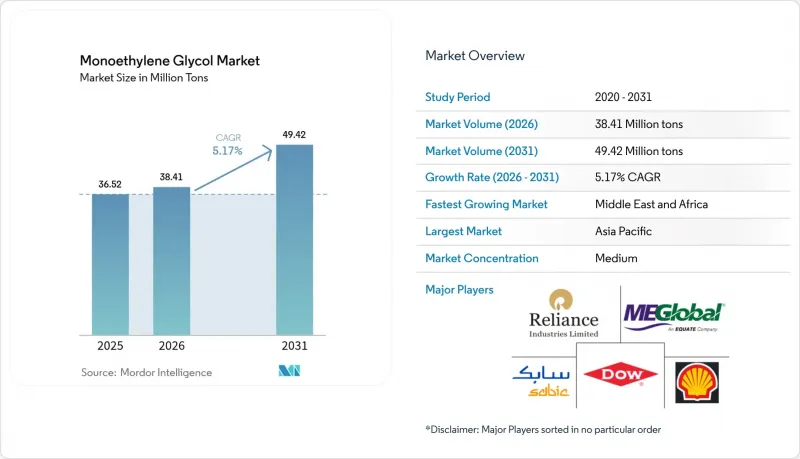
Mordor Intelligence에 따르면 모노에틸렌글리콜 시장 규모는 2025년에 3,652만 톤으로 평가되며, 2026년 3,841만 톤에서 2031년까지 4,942만 톤에 달할 것으로 예측되며, 예측 기간(2026-2031년) 동안 CAGR은 5.17%가 될 전망입니다.
본 보고서는 용도별(폴리에스터 섬유, PET 병, PET 필름·시트, 부동액, 산업용), 최종사용자 산업별(섬유·의류,포장, 자동차·운송, 플라스틱, 기타 최종사용자 산업), 및 지역별(아시아태평양, 북미, 유럽, 남미, 중동 및 아프리카)로 분류되어 있습니다. 시장 예측은 톤 기준으로 제시되어 있습니다.
세계 모노에틸렌글리콜 시장의 동향 및 인사이트
PET 포장 수요 급증
소비재 기업들은 가볍고 재활용 가능한 포장재로 전환을 추진하고 있으며, 이에 따라 PET 병 및 용기를 통한 MEG 소비량이 증가하고 있습니다. 코카콜라가 제시한 2030년까지의 재생 소재 사용 목표는 아이러니하게도 버진 PET의 수요를 끌어올리고 있습니다. 이는 병용 rPET의 공급량이 높아지는 회수 목표를 여전히 따라잡지 못하고 있기 때문입니다. 또한, E-Commerce의 확대도 수요량을 늘리고 있습니다. 아마존의 ‘프러스트레이션 프리 패키징(Frustration-Free Packaging)’ 프로그램에서는 부피 효율과 낙하 내구성을 극대화하는 고배리어성 PET 필름이 지정되어 있기 때문입니다. 신흥 시장에서는 유리에서 PET로의 전환이 가속화되고 있으며, 선진국의 프리미엄 음료 브랜드는 광학적 특성을 향상시키는 투명화 등급의 MEG를 선호하여 채택하고 있습니다. 유제품 및 주스용 특수 다층 병은 용도의 폭을 더욱 넓히고 있습니다. 전반적으로 브랜드 소유주의 지속가능성 목표는 수요를 억제하는 요인이라기보다는, 더 높은 품질의 MEG를 많이 사용하는 등급에 대한 수요를 촉진하는 촉매 역할을 하고 있습니다.
아시아태평양의 폴리에스터 섬유 생산능력 확대
중국 섬유 업계의 재편은 MEG 조달을 최적화하고, 전력, 증기, 물 등의 유틸리티를 통합하여 단위당 비용 절감을 실현하는 100만 톤 규모의 폴리에스터 복합 시설 개발을 추진하고 있습니다. 인도의 ‘생산 연계형 인센티브(PLI)’ 제도는 합성섬유에 중점을 두고 있어, 이를 통해 현지 정제소에 새로운 구매처가 확보되고, 걸프 국가들로부터의 MEG 수입량이 증가하고 있습니다. 무역 구조 재편을 계기로 베트남이 의류 허브로 급속히 부상하면서, 싱가포르와 태국의 인근 공급업체들에게 유리한 수요 거점이 만들어지고 있습니다. 이와 병행하여 진행되는 화학 재활용에 대한 투자는 버진 MEG와 재활용 MEG를 모두 필요로 하는 폐쇄형 공정을 도입하여, 두 축의 성장을 확고히 하고 있습니다. 그 결과, 모노에틸렌글리콜 시장은 공급량 확대와 제품 구성 고도화라는 두 가지 혜택을 모두 누리고 있습니다.
에틸렌/원유 원자재 가격 변동
에틸렌 원가 변동은 특히 구형 나프타 기반 플랜트에서 마진을 압박하고 있습니다. 2024년에는 브렌트 원유 가격이 변동하여 MEG의 현금 원가 곡선에 직접적인 영향을 미쳤습니다. 중동의 통합형 복합 시설은 원료의 안정성을 누리고 있는 반면, 수입에 의존하는 아시아의 시설은 변동성을 증폭시키는 운임 및 환율 충격에 취약합니다. 재고 관리의 타이밍이 매우 중요합니다. 자사 내에 크래커를 통합한 생산자는 헤지가 가능하지만, 단독 구매자는 마이너스 스프레드 위험에 노출됩니다. 경기 침체기에는 병목 현상 해소를 위한 자본 예산이 동결되어 효율성 향상을 위한 설비 업그레이드가 지연될 가능성이 있습니다. 그 결과, 모노에틸렌글리콜 시장은 단기적인 가격 급등락에 직면해 있으며, 이는 투자 의욕을 위축시키고 있습니다.
부문 분석
2025년에는 폴리에스테르 섬유가 판매량의 44.02%를 차지하며, 모노에틸렌글리콜 시장의 주요 판매처로서의 입지를 공고히 했습니다. 처리 능력이 뛰어난 중국의 방적 공장과 계속 확대되고 있는 남아시아 사업 덕분에, 의류 시장의 경기 변동기에도 베이스로드 수요가 확보되고 있습니다. PET 필름 및 시트는 규모는 작지만, 엄격한 두께 공차와 우수한 차단성이 요구되는 전자기기용 포장재 덕분에 연평균 성장률(CAGR) 5.86%를 기록하고 있습니다. 연속 주조 기술의 향상으로 기계적 강도를 유지하면서도 더 얇은 두께의 제품 생산이 가능해졌으며, 그로 인해 필름 단위당 MEG 소비량이 증가하고 있습니다. 부동액 및 산업용은 안정적인 이익률 향상을 가져오는 수요를 창출하고 있으며, PET 병은 음료 분야에서 유리나 알루미늄을 꾸준히 대체하고 있습니다.
특수 용도는 가치 창출의 폭을 넓히고 있습니다. 스낵, 유제품, 영양 보조 식품 포장용 메탈라이즈드 PET 필름은 유통 기한 연장 효과로 인해 높은 이익률을 실현하고 있습니다. 자동차 내장재 분야에서는 비동물성 가죽 대체 소재 마감을 라미네이팅한 PET 기판이 각 OEM사의 지속가능성 기준 달성을 지원하고 있습니다. 이러한 동향으로 인해 다운스트림 제품의 평균 판매 가격이 상승하여 원자재 가격 변동을 상쇄하는 동시에, 모노에틸렌글리콜 시장의 장기적인 수익성을 뒷받침하고 있습니다. 또한, 동남아시아의 저결함률 PET 시트 생산 라인은 한국 및 일본의 전자기기 조립 제조업체에 제품을 공급하고 있으며, 최대 3년에 걸친 MEG 공급 계약을 공고히 하는 통합된 지역 밸류체인을 형성하고 있습니다.
지역별 분석
2025년, 아시아태평양은 세계 생산량의 53.10%를 차지했습니다. 이는 중국의 닝보 및 하이난에 위치한 초대형 폴리에스터 산업 클러스터와 인도의 PLI(생산 연계 인센티브)에 힘입은 제조 거점 확충이 원동력이 되었습니다. 정유소에서 폴리에스터 공장에 이르기까지 통합된 산업 단지는 물류와 유틸리티를 효율화하여, 그 결과 톤당 비용이 세계 평균을 크게 밑돌고 있습니다. 베트남, 인도네시아, 태국은 ‘중국 플러스 원(China Plus One)’ 조달 전략을 추구하는 브랜드로부터 추가 투자를 유치하여, 수요 거점의 견고한 지역 네트워크를 형성하고 있습니다. 배출권 거래제 준수로 인해 운영 기준이 강화되면서 중국의 소규모 사업자들은 통합으로 내몰리고 있으며, 에너지 효율이 높은 대규모 복합 시설이 우위를 점하고 있습니다. 따라서 아시아태평양의 모노에틸렌글리콜 시장은 다른 지역에서는 재현하기 어려운 규모의 경제를 누리고 있습니다.
중동 및 아프리카는 다운스트림 석유화학제품을 우선시하는 사우디아라비아의 ‘비전 2030’에 따른 다각화에 힘입어 연평균 성장률(CAGR) 5.98%라는 가장 높은 성장률을 기록할 것으로 예측됩니다. 저렴한 에탄 원료, 심수항 접근성, 그리고 정부 지원에 의한 인프라 덕분에 걸프협력회의(GCC) 회원국의 생산자들은 유럽 및 아프리카로의 운송 비용 면에서 우위를 점하고 있습니다. 에티오피아와 이집트 등 아프리카 국가들에서는 사우디아라비아와 오만으로부터 MEG를 수입하는 섬유 산업 클러스터 구축이 시작되었으며, EU 수출 완제품 의류에 대한 관세 면제 협정과 맞물려 공급망의 순환이 실현되고 있습니다. 정치적 안정과 안정적인 전력 공급은 여전히 과제로 남아 있지만, 초기 성공 사례들은 이 지역이 가진 확장 가능성을 보여주고 있습니다.
북미와 유럽에서는 더욱 엄격한 탄소 가격 제도와 일회용 플라스틱 규제에 직면해 있지만, 고부가가치 틈새 용도 및 첨단 재활용 인프라를 통해 여전히 중요한 역할을 수행하고 있습니다. 미국의 셰일 가스는 비용 경쟁력 있는 에틸렌 크래커의 실현을 가능하게 하고 있지만, 텍사스주 등의 물 사용 제한이 향후 병목 현상 해소를 위한 노력을 제약할 가능성이 있습니다. 2026년에 발효될 EU의 ‘탄소 국경 조정 메커니즘’은 제조 과정에서 발생하는 배출량에 대해 과세하는 것으로, 재생에너지 인증서를 구매하는 현지 글리콜 생산자에게 유리하게 작용할 가능성이 있습니다. 이러한 조치들은 바이오 기반이나 CO₂ 유래 등급 등 저탄소형 MEG(모노에틸렌글리콜)에 대한 국내 투자를 촉진하여, 모노에틸렌글리콜 시장 내에 프리미엄 부문을 창출하게 될 것입니다.
기타 혜택:
- 엑셀 형식의 시장 예측(ME) 시트
- 3개월간의 애널리스트 지원
자주 묻는 질문
목차
제1장 소개
제2장 조사 방법
제3장 주요 요약
제4장 시장 구도
제5장 시장 규모와 성장 예측
제6장 경쟁 구도
제7장 시장 기회와 향후 전망
KSM 26.09.07According to Mordor Intelligence, the monoethylene glycol market size was valued at 36.52 million tons in 2025 and estimated to grow from 38.41 million tons in 2026 to reach 49.42 million tons by 2031, at a CAGR of 5.17% during the forecast period (2026-2031).
This report is Segmented by Application (Polyester Fibre, PET Bottles, PET Film and Sheets, Antifreeze, and Industrial), End-User Industry (Textile and Apparel, Packaging, Automotive and Transportation, Plastics, and Other End-User Industries), and Geography (Asia-Pacific, North America, Europe, South America, and Middle-East and Africa). The Market Forecasts are Provided in Terms of Volume (Tons).
Global Monoethylene Glycol Market Trends and Insights
PET Packaging Demand Surge
Consumer goods companies are pivoting toward lightweight, recyclable packaging, which increases MEG consumption through PET bottles and containers. Coca-Cola's goal of using recycled content by 2030 paradoxically lifts virgin PET demand because bottle-grade rPET availability still lags rising collection targets. E-commerce expansion adds volume as Amazon's Frustration-Free Packaging program specifies high-barrier PET films that maximize cube efficiency and drop resilience. Emerging markets are accelerating the shift from glass to PET, and premium beverage brands in developed countries are favoring clarifying-grade MEG that improves optical properties. Specialty multilayer bottles for dairy and juice further widen the application mix. Overall, brand-owner sustainability targets act less as demand dampeners and more as catalysts for higher-quality, MEG-intensive grades.
Polyester-Fiber Capacity Additions in Asia-Pacific
Consolidation in China's textile sector is driving the development of million-ton polyester complexes that optimize MEG procurement and integrate power, steam, and water utilities to achieve lower per-unit costs. India's Production Linked Incentive scheme commits to synthetic fiber, unlocking fresh offtake for local refineries and increasing inbound MEG cargoes from the Gulf. Vietnam's rapid ascendancy as a garment hub, spurred by trade realignment, adds demand nodes that favor nearby suppliers in Singapore and Thailand. Parallel investment in chemical recycling introduces a closed-loop pathway that requires both virgin and recycled MEG, ensuring dual-stream growth. As a result, the monoethylene glycol market benefits from both volume expansion and product-mix upgrades.
Volatile Ethylene/Crude Oil Feedstock Pricing
Ethylene cost swings compress margins, especially for older naphtha-based plants. Brent crude fluctuated in 2024, directly feeding MEG cash-cost curves. Integrated Middle Eastern complexes enjoy feedstock stability, whereas import-dependent Asian facilities are vulnerable to freight and currency shocks that amplify volatility. Inventory timing becomes critical; producers with internal cracker integration can hedge, while standalone buyers risk negative spreads. Capital budgets for debottlenecking pause during downcycles, potentially delaying efficiency upgrades. Consequently, the monoethylene glycol market faces near-term pricing turbulence that weighs on investment sentiment.
Other drivers and restraints analyzed in the detailed report include:
- Automotive Shift Toward E-Coolants and EV Thermal Fluids
- Middle-East On-Purpose MEG Projects Leveraging Cheap Ethane
- Anti-Plastic Regulations Curbing Virgin PET
For complete list of drivers and restraints, kindly check the Table Of Contents.
Segment Analysis
Polyester Fibre accounted for 44.02% of volume in 2025, cementing its role as the primary offtake channel for the monoethylene glycol market. High-throughput Chinese spinning mills and expanding South Asian operations secure base-load demand, even during apparel cycles. PET Film and Sheets, although smaller, posts a 5.86% CAGR thanks to electronics packaging that requires tight-tolerance thickness and superior barrier films. Continuous casting technology upgrades permit thinner gauges that still meet mechanical strength, thereby lifting MEG consumption per unit of film. Antifreeze and industrial uses add stable, margin-accretive volume, while PET Bottles show steady replacement of glass and aluminum in beverages.
Specialty applications broaden value capture. Metalized PET films for snack, dairy, and nutraceutical packaging fetch higher margins due to extended shelf-life performance. In automotive interiors, PET substrates laminated with vegan leather finishes help OEMs meet sustainability benchmarks. These developments raise the average selling price of downstream products, offsetting feedstock price swings and supporting the long-term profitability of the monoethylene glycol market. Furthermore, low-defect PET sheet lines in Southeast Asia supply South Korean and Japanese electronics assemblers, creating integrated regional value chains that lock in MEG supply contracts for up to three years.
Complete Report Scope:
- By Application
- Polyester Fibre
- PET Bottles
- PET Film and Sheets
- Antifreeze
- Industrial
- By End-User Industry
- Textile and Apparel
- Packaging
- Automotive and Transportation
- Plastics
- Other End-user Industries (Electronics, Paints)
- By Geography
- Asia-Pacific
- China
- India
- Japan
- South Korea
- Rest of Asia-pacific
- North America
- United States
- Canada
- Mexico
- Europe
- Germany
- United Kingdom
- Italy
- France
- Spain
- Rest of Europe
- South America
- Brazil
- Argentina
- Rest of South America
- Middle-East and Africa
- Saudi Arabia
- South Africa
- Rest of Middle-East and Africa
- Asia-Pacific
Geography Analysis
Asia-Pacific controlled 53.10% of global volume in 2025, powered by China's mega-scale polyester clusters in Ningbo and Hainan and India's PLI-driven manufacturing build-out. Integrated refinery-to-polyester parks streamline logistics and utilities, resulting in per-ton costs that are well below global averages. Vietnam, Indonesia, and Thailand capture incremental investments from brands seeking China-plus-one sourcing strategies, creating a robust regional mesh of demand centers. Emission-trading compliance raises operating thresholds, pushing smaller Chinese players toward consolidation and favoring large, energy-efficient complexes. Thus, the monoethylene glycol market in Asia-Pacific enjoys scale economies that are difficult for other regions to replicate.
The Middle East and Africa are projected to post the highest forecast growth at 5.98% CAGR, underpinned by Saudi Arabia's Vision 2030 diversification, which prioritizes downstream petrochemicals. Cheap ethane feedstock, access to deepwater ports, and state-backed infrastructure give Gulf Cooperation Council producers a shipping cost advantage in Europe and Africa. African nations, such as Ethiopia and Egypt, are beginning to build textile clusters that import MEG from Saudi Arabia and Oman, thereby closing the loop with duty-free agreements for finished garments destined for the EU. Political stability and reliable power remain challenges, yet early success stories demonstrate the region's scalability potential.
North America and Europe are facing stricter carbon-pricing regimes and single-use plastic rules, yet they remain relevant through high-value niche applications and sophisticated recycling infrastructure. U.S. shale gas unlocks cost-competitive ethylene crackers, although water-usage restrictions in states like Texas may constrain future debottlenecking efforts. The EU's Carbon Border Adjustment Mechanism, effective 2026, imposes levies on embedded emissions, potentially favoring local glycol producers who purchase renewable electricity certificates. These measures encourage domestic investment in low-carbon MEG variants, such as bio-based and CO2-derived grades, creating a premium tier within the monoethylene glycol market.
- BASF
- China Petrochemical Corporation
- Dow
- Eastman Chemical Company
- Exxon Mobil Corporation
- Formosa Plastics Corporation
- Hengil Group Co., Ltd
- Huntsman International LLC
- India Glycols Limited
- Indorama Ventures Public Company Limited.
- LG Chem
- MEGlobal
- Mitsubishi Chemical Corporation
- NAN YA PLASTICS CORPORATION
- PTT Global Chemical Public Company Limited
- Reliance Industries Limited
- SABIC
- Shell plc
- Sustainea
Additional Benefits:
- The market estimate (ME) sheet in Excel format
- 3 months of analyst support
TABLE OF CONTENTS
1 Introduction
- 1.1 Study Assumptions and Market Definition
- 1.2 Scope of the Study
2 Research Methodology
3 Executive Summary
4 Market Landscape
- 4.1 Market Overview
- 4.2 Market Drivers
- 4.2.1 PET packaging demand surge
- 4.2.2 Polyester-fiber capacity additions in Asia-Pacific
- 4.2.3 Automotive shift toward e-coolants and EV thermal fluids
- 4.2.4 Middle-East on-purpose MEG (Monoethylene Glycol) projects leveraging cheap ethane
- 4.2.5 Commercialisation of indirect CO2-to-MEG technologies
- 4.3 Market Restraints
- 4.3.1 Volatile ethylene/crude oil feedstock pricing
- 4.3.2 Anti-plastic regulations curbing virgin PET
- 4.3.3 Process-water and carbon intensity penalties in China and European Union
- 4.4 Value Chain Analysis
- 4.5 Porter's Five Forces
- 4.5.1 Bargaining Power of Suppliers
- 4.5.2 Bargaining Power of Buyers
- 4.5.3 Threat of New Entrants
- 4.5.4 Threat of Substitutes
- 4.5.5 Degree of Competition
5 Market Size and Growth Forecasts (Volume)
- 5.1 By Application
- 5.1.1 Polyester Fibre
- 5.1.2 PET Bottles
- 5.1.3 PET Film and Sheets
- 5.1.4 Antifreeze
- 5.1.5 Industrial
- 5.2 By End-User Industry
- 5.2.1 Textile and Apparel
- 5.2.2 Packaging
- 5.2.3 Automotive and Transportation
- 5.2.4 Plastics
- 5.2.5 Other End-user Industries (Electronics, Paints)
- 5.3 By Geography
- 5.3.1 Asia-Pacific
- 5.3.1.1 China
- 5.3.1.2 India
- 5.3.1.3 Japan
- 5.3.1.4 South Korea
- 5.3.1.5 Rest of Asia-pacific
- 5.3.2 North America
- 5.3.2.1 United States
- 5.3.2.2 Canada
- 5.3.2.3 Mexico
- 5.3.3 Europe
- 5.3.3.1 Germany
- 5.3.3.2 United Kingdom
- 5.3.3.3 Italy
- 5.3.3.4 France
- 5.3.3.5 Spain
- 5.3.3.6 Rest of Europe
- 5.3.4 South America
- 5.3.4.1 Brazil
- 5.3.4.2 Argentina
- 5.3.4.3 Rest of South America
- 5.3.5 Middle-East and Africa
- 5.3.5.1 Saudi Arabia
- 5.3.5.2 South Africa
- 5.3.5.3 Rest of Middle-East and Africa
- 5.3.1 Asia-Pacific
6 Competitive Landscape
- 6.1 Market Concentration
- 6.2 Strategic Moves
- 6.3 Market Share(%)/Ranking Analysis
- 6.4 Company Profiles (includes Global level Overview, Market level overview, Core Segments, Financials as available, Strategic Information, Market Rank/Share for key companies, Products and Services, and Recent Developments)
- 6.4.1 BASF
- 6.4.2 China Petrochemical Corporation
- 6.4.3 Dow
- 6.4.4 Eastman Chemical Company
- 6.4.5 Exxon Mobil Corporation
- 6.4.6 Formosa Plastics Corporation
- 6.4.7 Hengil Group Co., Ltd
- 6.4.8 Huntsman International LLC
- 6.4.9 India Glycols Limited
- 6.4.10 Indorama Ventures Public Company Limited.
- 6.4.11 LG Chem
- 6.4.12 MEGlobal
- 6.4.13 Mitsubishi Chemical Corporation
- 6.4.14 NAN YA PLASTICS CORPORATION
- 6.4.15 PTT Global Chemical Public Company Limited
- 6.4.16 Reliance Industries Limited
- 6.4.17 SABIC
- 6.4.18 Shell plc
- 6.4.19 Sustainea
7 Market Opportunities and Future Outlook
- 7.1 White-space and Unmet-need Assessment