
|
시장보고서
상품코드
2121697
뇌모니터링 : 시장 점유율 분석, 업계 동향과 통계, 성장 예측(2026-2031년)Brain Monitoring - Market Share Analysis, Industry Trends & Statistics, Growth Forecasts (2026 - 2031) |
||||||
 Mordor Intelligence
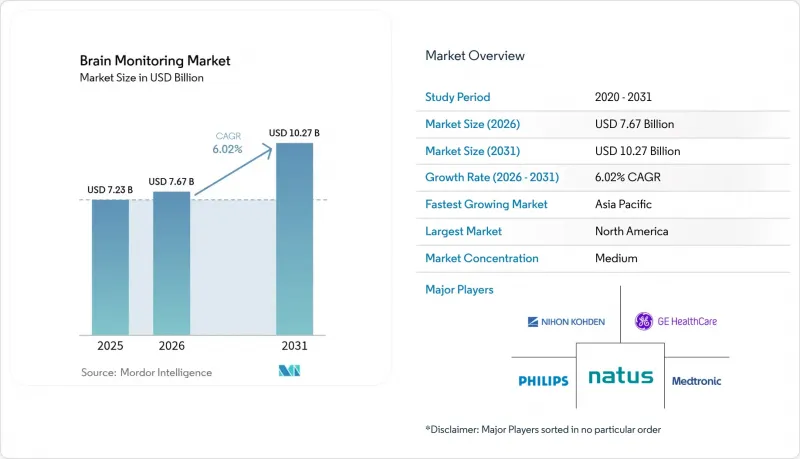
Mordor Intelligence에 의하면, 뇌모니터링 시장 규모는 2025년 72억 3,000만 달러에서 2026년에는 76억 7,000만 달러에 이르고, 2026-2031년 CAGR 6.02%로 성장을 지속하여 2031년에는 102억 7,000만 달러에 달할 것으로 예측됩니다.
본 보고서는 제품 유형(자기뇌파측정기(MEG) 시스템, 액세서리(전극 등), 기타), 시술(침습적 모니터링, 기타),모달리티(고정식/독립형 시스템, 기타), 적응증(외상성 뇌손상 등), 최종 사용자(병원 등), 지역(북미, 유럽, 아시아태평양 등)별로 분류되어 있습니다. 시장 예측은 금액(달러) 기준으로 제시되어 있습니다.
세계 뇌 모니터링 시장 동향 및 인사이트
신경 질환 유병률의 급증
뇌졸중, 치매, 간질, 신경 장애 사례는 현재 30억 명 이상(세계 인구의 43%)에게 영향을 미치고 있으며, 1990년 이후 18% 이상 증가했습니다. 이러한 질환으로 인해 매년 4억 4,300만 년의 건강 수명이 상실되고 있으며, 의료 시스템에 대한 부담이 더욱 가중되고 있습니다. 평균 수명의 연장으로 알츠하이머병 등 노화 관련 질환의 발병 위험이 높아지는 한편, 당뇨병 등의 대사성 질환은 신경 장애 발생률을 3배나 증가시키고 있습니다. 환자 수요와 신경과 전문의공급 간 격차가 확대됨에 따라, 병원에서는 고위험 사례를 선별하여 데이터를 통합된 진단센터로 전송하는 자동 모니터링 시스템 도입이 진행되고 있습니다. 향후 10년 동안 보편적인 선별 검사 프로그램이나 지역 진료소에서는 조기 기능 저하를 감지하기 위해 저비용 신경 센서가 활용될 것으로 예상되며, 뇌 모니터링 시장의 장기적인 성장이 지속될 것으로 전망됩니다.
진단 정확도 향상을 위한 AI 기반 다중 모드 분석
현재 머신러닝 알고리즘은 뇌파(EEG), 영상, 혈역학, 임상 점수를 통합하여 외상성 뇌손상의 사망률 및 예후 불량을 최대 95.6%의 정확도로 예측했습니다. Ceribell Clarity와 같은 FDA 승인 플랫폼은 병상에서 수 분 이내에 간질 중첩 상태의 뇌파를 감지하여, 중환자 치료팀이 수작업으로 확인해야 하는 부담을 덜어주고 있습니다. 북미 및 유럽의 병원에서는 이러한 SaMD 모듈을 기존 모니터에 통합하고, 클라우드 분석과 소모품을 세트로 포함한 서비스 계약을 체결하고 있습니다. 알고리즘을 통한 진단 지원이 보험 환급 코드로 인정받게 됨에 따라, 아시아태평양의 도시권 의료시설에서의 도입이 가속화되고 있습니다. 중기적으로는 더욱 충실한 데이터 파이프라인을 통해 뇌졸중 병동이나 중환자실에서 의사 결정 시간이 단축되고, 뇌 모니터링 시장 전체의 이용률이 향상될 것입니다.
첨단 검사법의 높은 구입 및 유지 비용
자기뇌파계(MEG)나 기능적 MRI(fMRI) 시스템의 가격은 300만 달러를 초과하기도 하며, 연간 서비스 계약에는 정가의 10-15%가 추가됩니다. 주류인 뇌파(EEG) 장치조차 소모품이나 교정이 필요하여 병원 운영 예산을 압박하고 있습니다. 벤더들이 AI 지원 모델을 출시함에 따라 업데이트 주기가 가속화되고 있으며, 가격에 민감한 시장에서는 재무위원회가 구매를 미루는 움직임이 나타나고 있습니다. 학술 연구 기관이 개발한 오픈소스 웨어러블 fNIRS 프로토타입은 비용 절감에 대한 기대를 모으고 있지만, 인증 획득까지 아직 수년이 소요될 것으로 예상되므로 비용 문제는 계속해서 뇌 모니터링 시장의 중기적인 걸림돌이 될 것입니다.
부문 분석
2025년, 뇌 모니터링 시장에서 EEG 시스템은 매출의 30.18%를 차지하며 가장 큰 점유율을 기록했습니다. 병원에서는 발작 진단, 진정 깊이 확인, 뇌허혈 모니터링에 EEG 시스템이 활용되고 있습니다. 현재 휴대용 신속 EEG 카트는 병상에서 10분 이내에 발작을 감지함으로써 응급 의료 워크플로우를 혁신하고, 장비 회전율을 향상시키고 있습니다. 액세서리(캡, 건식 전극, 케이블)는 신규 도입 기기 1대당 소모품에 대한 지속적인 수요가 발생하기 때문에 연평균 성장률(CAGR) 7.78%로 가장 빠르게 성장하고 있습니다. 유연한 폴리머 전극은 착용감을 향상시키고 설정 시간을 단축함으로써 소아과 및 원격 모니터링 분야에서 뇌파(EEG)의 활용을 확대되고 있습니다. 감염 위험을 줄이기 위해 일회용 캡을 표준화하는 병원이 늘어남에 따라, 액세서리 하위 부문은 전체 뇌 모니터링 시장보다 높은 성장률을 보일 것으로 전망됩니다.
두피 뇌파(EEG), 기능적 근적외선 분광법(fNIRS), 경두개 도플러(TCD)와 같은 비침습적 기법은 위험이 낮고 의료진의 수고가 적기 때문에 2025년 매출의 73.12%를 차지했습니다. 알고리즘으로 강화된 시스템이 침습적 기법의 정확도에 근접하고 있어 그 매력은 더욱 확대되고 있습니다. 그러나 중환자실에서는 난치성 사례에 대해 여전히 두개내압(ICP) 프로브나 심부 전극에 의존하고 있습니다. 새로운 나노막 센서가 임상시험 단계에 접어들어 혈관을 통해 전달됨으로써 두개골 천자가 불필요해짐에 따라, 이러한 침습적 도구 시장은 연평균 성장률(CAGR) 6.72%로 확대되고 있습니다. 향후 하이브리드 솔루션을 통해 카테고리 간의 경계가 더욱 모호해지면서, 뇌 모니터링 시장의 양쪽 부문 모두에서 성장이 지속될 가능성이 있습니다.
지역별 분석
북미는 탄탄한 보험 적용 범위, NIH(미국 국립보건원)의 보조금, 그리고 1급 외상 센터의 밀집된 네트워크에 힘입어 2025년에 전 세계 매출의 37.28%를 차지했습니다. 이 지역의 뇌 모니터링 시장 규모는 병원이 장비를 AI 지원 모델로 업데이트하고 외래 진료 기관이 원격 뇌파(EEG) 키트를 도입함에 따라 연평균 성장률(CAGR) 5.95%라는 꾸준한 속도로 확대되고 있습니다. 유럽은 성숙 단계에 접어들었으나 계획적인 조달이 이루어지고 있으며, 예산 관리가 엄격해지고 있음에도 도입이 완전히 중단되지는 않아 성장률은 5.72%로 성장을 지속하고, 있습니다. 특히 주목할 만한 것은 부상 후 ‘골든 아워’에 외상성 뇌손상(TBI) 바이오마커를 검출하는 휴대용 안구 레이저로, 구급차 내 표준 치료법이 될 가능성이 있습니다.
아시아태평양은 연평균 성장률(CAGR) 8.26%로 가장 빠른 성장세를 보이고 있습니다. 중국에서는 2급 도시에 뇌졸중 센터에 대한 자금 지원이 이루어지고 있으며, 일본에서는 가정용 뇌파 검사(EEG)에 대한 보험 적용 코드 시범 도입이 진행되고 있고, 인도의 민간 병원에서는 응급실용으로 신속 뇌파 검사 카트를 수입하고 있습니다. 신경 질환으로 인한 사망의 80%가 저·중소득 국가에서 발생하고 있다는 점을 고려할 때, 합리적인 가격에 유지보수 부담이 적은 의료기기에 대한 지역적 수요는 여전히 높은 수준을 유지하고 있습니다. 현지 제조업체들이 비용 효율성이 뛰어난 대체품 공급을 시작함에 따라 뇌 모니터링 시장공급망 탄력성이 강화되고 있습니다.
중동 및 아프리카 및 남미에서는 걸프 국가들이 신경 중환자 치료 센터를 건설하고, 브라질의 병원들이 원격 뇌졸중 네트워크에 참여함에 따라 소규모 기반에서 시장이 확대되고 있습니다. 그러나 환율 변동과 조달상의 장벽이 이러한 확대 속도를 둔화시키고 있습니다. 다자간 금융기관과 민관 파트너십이 임상적 및 경제적 가치를 입증하는 시범 프로그램을 지원함으로써, 향후 시장 성장을 위한 기반을 마련할 것으로 예측됩니다.
기타 혜택:
- 엑셀 형식 시장 예측(ME) 시트
- 3개월간의 애널리스트 지원
자주 묻는 질문
목차
제1장 서론
제2장 조사 방법
제3장 주요 요약
제4장 시장 구도
제5장 시장 규모와 성장 예측
제6장 경쟁 구도
제7장 시장 기회와 향후 전망
LSH 26.09.09According to Mordor Intelligence, the brain monitoring market size is expected to grow from USD 7.23 billion in 2025 to USD 7.67 billion in 2026 and is forecast to reach USD 10.27 billion by 2031 at 6.02% CAGR over 2026-2031.
This report is Segmented by Product Type (Magnetoencephalograph (MEG) Systems, Accessories [Electrodes and More], and More), Procedure (Invasive Monitoring and More), Modality (Fixed/Standalone Systems and More), Application (Traumatic Brain Injury and More), End-User (Hospitals and More), and Geography (North America, Europe, Asia-Pacific, and More). The Market Forecasts are Provided in Terms of Value (USD).
Global Brain Monitoring Market Trends and Insights
Escalating Prevalence of Neurological Disorders
Cases of stroke, dementia, epilepsy, and neuropathies now affect more than 3 billion individuals-43% of the global population-over 18% jump since 1990. These conditions generate 443 million years of healthy life lost each year, intensifying pressure on health systems. Growing longevity worsens exposure to age-linked illnesses such as Alzheimer's, while metabolic diseases like diabetes triple the incidence of neuropathy. The widening gap between patient demand and neurologist supply pushes hospitals to adopt automated monitoring that triages high-risk cases and feeds data into centralized interpretation hubs. Over the next decade, universal screening programs and community clinics are expected to rely on lower-cost neural sensors to catch early deterioration, sustaining long-run expansion of the brain monitoring market.
AI-Enabled Multimodal Analytics for Enhanced Diagnostic Accuracy
Machine-learning algorithms now integrate EEG, imaging, hemodynamics, and clinical scores to predict mortality or poor outcomes in traumatic brain injury with up to 95.6% accuracy. FDA-cleared platforms such as Ceribell Clarity deliver bedside electrographic status-epilepticus detection within minutes, freeing critical-care teams from manual review. Hospitals in North America and Europe are embedding these SaMD modules into existing monitors, creating service contracts that bundle cloud analytics with consumables. As reimbursement codes recognize algorithm-assisted interpretation, adoption in urban Asia-Pacific centers is accelerating. Over the medium term, richer data pipelines will shorten decision times in stroke and intensive-care units, lifting utilization across the brain monitoring market.
High Purchase and Upkeep Costs for Advanced Modalities
Magnetoencephalography and fMRI systems can exceed USD 3 million, with annual service contracts adding 10-15% of list price. Even mainstream EEG rigs require consumables and calibration that strain hospital operating budgets. Replacement cycles accelerate as vendors launch AI-ready models, prompting finance committees to defer purchases in price-sensitive markets. Open-source wearable fNIRS prototypes from academic labs promise relief, yet certification remains years away, so cost remains a mid-term drag on the brain monitoring market.
Other drivers and restraints analyzed in the detailed report include:
- Proliferation of Wearable and Minimally Invasive Brain Sensors
- Investment Surge in Neuro-Critical-Care Infrastructure
- Global Shortage of Trained Neuro-Technologists
For complete list of drivers and restraints, kindly check the Table Of Contents.
Segment Analysis
EEG systems generated the most significant slice of the brain monitoring market in 2025 by capturing 30.18% revenue. Hospitals rely on them for seizure diagnostics, sedation depth checks, and cerebral ischemia surveillance. Portable rapid-EEG carts now transform emergency workflows by delivering seizure detection within 10 minutes at the bedside, boosting device turnover. Accessories-caps, dry electrodes, cables-grow fastest at an 7.78% CAGR because every new unit drives recurring consumable demand. Flexible polymer electrodes improve comfort and cut setup time, widening EEG use in pediatrics and tele-monitoring. As more hospitals standardize on disposable caps to limit infection risk, the accessories sub-segment will outpace the overall brain monitoring market.
Non-invasive modalities such as scalp EEG, fNIRS, and transcranial Doppler controlled 73.12% of 2025 revenue thanks to lower risk and simpler staffing. Their appeal broadens as algorithm-enhanced systems approximate invasive accuracy. Yet critical-care units still depend on intracranial pressure (ICP) probes and depth electrodes for refractory cases. These invasive tools expand at a 6.72% CAGR as new nanomembrane sensors enter trials, delivered through blood vessels and eliminating skull penetration. Over time, hybrid solutions may blur categories further, sustaining growth in both cohorts of the brain monitoring market.
Complete Report Scope:
- By Product Type
- Magnetoencephalograph (MEG) Systems
- Electroencephalograph (EEG) Systems
- Transcranial Doppler (TCD) Ultrasound
- Cerebral Oximeters
- Magnetic Resonance Imaging (MRI) Devices
- Intracranial Pressure (ICP) Monitors
- Computerized Tomography (CT) Devices
- Positron Emission Tomography (PET) Devices
- Accessories
- Electrodes
- Sensors
- Cables
- Gels & Pastes
- Other Accessories
- Other Brain Monitoring Devices
- By Procedure
- Invasive Monitoring
- Non-invasive Monitoring
- By Modality
- Fixed / Standalone Systems
- Portable & Wearable Systems
- By Application
- Traumatic Brain Injury
- Stroke
- Epilepsy
- Parkinson's Disease
- Alzheimer's & Other Dementias
- Sleep Disorders
- Other Neurological Conditions
- By End-User
- Hospitals
- Diagnostic & Imaging Centers
- Ambulatory Surgical & Specialty Clinics
- Home-care Settings & Tele-neurology Platforms
- Academic & Research Institutes
- By Geography
- North America
- United States
- Canada
- Mexico
- Europe
- Germany
- United Kingdom
- France
- Italy
- Spain
- Rest of Europe
- Asia-Pacific
- China
- India
- Japan
- Australia
- South Korea
- Rest of Asia-Pacific
- Middle East & Africa
- GCC
- South Africa
- Rest of Middle East & Africa
- South America
- Brazil
- Argentina
- Rest of South America
- North America
Geography Analysis
North America held 37.28% of global sales in 2025, supported by robust insurance coverage, NIH grants, and a dense network of level-one trauma centers. The brain monitoring market size in the region is expanding at a steady 5.95% CAGR as hospitals refresh fleets to AI-enabled models and outpatient providers embrace remote EEG kits. Europe follows with mature yet methodical procurement; growth runs at 5.72% as budget oversight slows but does not halt adoption. Noteworthy is a handheld ocular laser that detects TBI biomarkers during the golden hour after injury, a potential standard of care in ambulances.
Asia-Pacific posts the quickest gains at an 8.26% CAGR. China funds stroke centers in tier-2 cities; Japan pilots insurance codes for home EEG; India's private hospitals import rapid-EEG carts for emergency departments. Given that 80% of neurological deaths occur in low- and middle-income countries, regional demand for affordable, low-maintenance devices remains high. Local manufacturers have begun supplying cost-effective alternatives, reinforcing supply-chain resilience in the brain monitoring market.
The Middle East & Africa and South America expand from smaller bases as Gulf states build neuro-critical centers and Brazilian hospitals join telestroke networks. However, currency volatility and procurement hurdles temper acceleration. Multilateral lenders and public-private partnerships are expected to underwrite pilot programs that demonstrate clinical and economic value, creating footholds for future market growth.
- Abbott Laboratories
- Advanced Brain Monitoring
- Boston Scientific
- BrainScope Company Inc.
- Cadwell
- Cerenion
- Compumedics
- Elekta
- EMOTIV Inc.
- GE Healthcare
- Koninklijke Philips
- Masimo
- Medtronic
- Mespere LifeSciences
- Natus Medical
- Neurable Inc.
- NeuraSignal, Inc.
- NeuroSky Inc.
- Nihon Kohden
- Siemens Healthineers
- Zeto, Inc.
Additional Benefits:
- The market estimate (ME) sheet in Excel format
- 3 months of analyst support
TABLE OF CONTENTS
1 Introduction
- 1.1 Study Assumptions & Market Definition
- 1.2 Scope of the Study
2 Research Methodology
3 Executive Summary
4 Market Landscape
- 4.1 Market Overview
- 4.2 Market Drivers
- 4.2.1 Escalating prevalence of neurological disorders
- 4.2.2 AI-enabled multimodal analytics that enhance diagnostic accuracy
- 4.2.3 Proliferation of wearable and minimally invasive brain sensors
- 4.2.4 Investment surge in neuro-critical-care infrastructure
- 4.2.5 Brain-focused drug trials requiring objective monitoring biomarkers
- 4.2.6 Accelerated approvals for software-as-a-medical-device modules
- 4.3 Market Restraints
- 4.3.1 High purchase and upkeep costs for advanced modalities
- 4.3.2 Global shortage of trained neuro-technologists
- 4.3.3 Interoperability and cybersecurity risks in connected devices
- 4.3.4 Uncertain reimbursement for ambulatory monitoring solutions
- 4.4 Supply-Chain Analysis
- 4.5 Technological Outlook
- 4.6 Porter's Five Forces Analysis
- 4.6.1 Threat of New Entrants
- 4.6.2 Bargaining Power of Buyers / Consumers
- 4.6.3 Bargaining Power of Suppliers
- 4.6.4 Threat of Substitute Products & Services
- 4.6.5 Intensity of Competitive Rivalry
5 Market Size & Growth Forecasts (Value)
- 5.1 By Product Type
- 5.1.1 Magnetoencephalograph (MEG) Systems
- 5.1.2 Electroencephalograph (EEG) Systems
- 5.1.3 Transcranial Doppler (TCD) Ultrasound
- 5.1.4 Cerebral Oximeters
- 5.1.5 Magnetic Resonance Imaging (MRI) Devices
- 5.1.6 Intracranial Pressure (ICP) Monitors
- 5.1.7 Computerized Tomography (CT) Devices
- 5.1.8 Positron Emission Tomography (PET) Devices
- 5.1.9 Accessories
- 5.1.9.1 Electrodes
- 5.1.9.2 Sensors
- 5.1.9.3 Cables
- 5.1.9.4 Gels & Pastes
- 5.1.9.5 Other Accessories
- 5.1.10 Other Brain Monitoring Devices
- 5.2 By Procedure
- 5.2.1 Invasive Monitoring
- 5.2.2 Non-invasive Monitoring
- 5.3 By Modality
- 5.3.1 Fixed / Standalone Systems
- 5.3.2 Portable & Wearable Systems
- 5.4 By Application
- 5.4.1 Traumatic Brain Injury
- 5.4.2 Stroke
- 5.4.3 Epilepsy
- 5.4.4 Parkinson's Disease
- 5.4.5 Alzheimer's & Other Dementias
- 5.4.6 Sleep Disorders
- 5.4.7 Other Neurological Conditions
- 5.5 By End-User
- 5.5.1 Hospitals
- 5.5.2 Diagnostic & Imaging Centers
- 5.5.3 Ambulatory Surgical & Specialty Clinics
- 5.5.4 Home-care Settings & Tele-neurology Platforms
- 5.5.5 Academic & Research Institutes
- 5.6 By Geography
- 5.6.1 North America
- 5.6.1.1 United States
- 5.6.1.2 Canada
- 5.6.1.3 Mexico
- 5.6.2 Europe
- 5.6.2.1 Germany
- 5.6.2.2 United Kingdom
- 5.6.2.3 France
- 5.6.2.4 Italy
- 5.6.2.5 Spain
- 5.6.2.6 Rest of Europe
- 5.6.3 Asia-Pacific
- 5.6.3.1 China
- 5.6.3.2 India
- 5.6.3.3 Japan
- 5.6.3.4 Australia
- 5.6.3.5 South Korea
- 5.6.3.6 Rest of Asia-Pacific
- 5.6.4 Middle East & Africa
- 5.6.4.1 GCC
- 5.6.4.2 South Africa
- 5.6.4.3 Rest of Middle East & Africa
- 5.6.5 South America
- 5.6.5.1 Brazil
- 5.6.5.2 Argentina
- 5.6.5.3 Rest of South America
- 5.6.1 North America
6 Competitive Landscape
- 6.1 Market Concentration
- 6.2 Product Portfolio Analysis
- 6.3 Market Share Analysis
- 6.4 Company Profiles (includes Global level Overview, Market level overview, Core Segments, Financials as available, Strategic Information, Market Rank/Share for key companies, Products & Services, and Recent Developments)
- 6.4.1 Abbott Laboratories
- 6.4.2 Advanced Brain Monitoring Inc.
- 6.4.3 Boston Scientific Corporation
- 6.4.4 BrainScope Company Inc.
- 6.4.5 Cadwell Industries Inc.
- 6.4.6 Cerenion Oy
- 6.4.7 Compumedics Limited
- 6.4.8 Elekta AB
- 6.4.9 EMOTIV Inc.
- 6.4.10 GE Healthcare
- 6.4.11 Koninklijke Philips N.V.
- 6.4.12 Masimo Corporation
- 6.4.13 Medtronic PLC
- 6.4.14 Mespere LifeSciences
- 6.4.15 Natus Medical Incorporated
- 6.4.16 Neurable Inc.
- 6.4.17 NeuraSignal, Inc.
- 6.4.18 NeuroSky Inc.
- 6.4.19 Nihon Kohden Corporation
- 6.4.20 Siemens Healthineers AG
- 6.4.21 Zeto, Inc.
7 Market Opportunities & Future Outlook
- 7.1 White-space & Unmet-need Assessment