
|
시장보고서
상품코드
2121700
산업용 모터 : 시장 점유율 분석, 업계 동향과 통계, 성장 예측(2026-2031년)Industrial Motors - Market Share Analysis, Industry Trends & Statistics, Growth Forecasts (2026 - 2031) |
||||||
 Mordor Intelligence
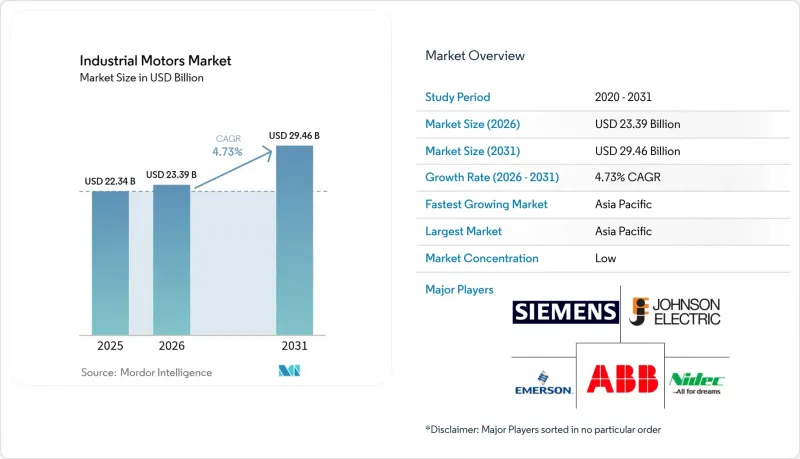
Mordor Intelligence에 의하면, 산업용 모터 시장 규모는 2025년 223억 4,000만 달러에서 2026년에는 233억 9,000만 달러에 이르고, 2026-2031년 CAGR 4.73%로 성장을 지속하여 2031년에는 294억 6,000만 달러에 달할 것으로 예측됩니다.
본 보고서는 모터 유형별(AC 모터, DC 모터, 서보 모터, PMSM, EC/BLDC 모터), 전압별(저전압, 중전압, 고전압), 최종 사용자별(석유 및 가스,발전, 광업 및 금속, 상하수도 처리, 화학제품 및 석유화학제품, 디스크리트 제조, 식음료, 기타), 지역별(북미, 유럽, 아시아태평양, 남미, 기타)로 분류되어 있습니다. 시장 전망은 금액(달러) 기준으로 제시되어 있습니다.
전 세계 산업용 모터 시장 동향 및 인사이트
에너지 효율 관련 규제
EU의 IE5 및 새로 도입되고 있는 IE6 규격의 의무화와 미국의 NEMA Premium 규정 개정에 따라, 산업용 모터 사용자들은 초고효율 제품으로의 교체를 서둘러야 하는 상황에 처해 있습니다. ABB의 초고효율 동기 릴랙턴스 플랫폼은 IE5보다 에너지 손실을 20% 줄여, 규제가 어떻게 기술의 도약을 촉진하는지를 보여줍니다. 산업용 전력 소비의 70% 가까이가 모터와 관련되어 있기 때문에 구형 장치를 교체함으로써 Scope 2 배출량을 줄일 수 있으며, 기업은 ISO 50001 인증 인센티브의 대상이 됩니다. 화학 및 석유화학 산업 사업자들은 검증 가능한 효율성을 조달의 필수 조건으로 간주하고 있으며, 규정 준수가 경쟁상의 차별화 요소가 되고 있습니다. 수명 주기의 투명성 및 재활용 가능성에 관한 지침 또한 지속 가능한 소재를 사용한 재설계를 요구하며, 희토류를 포함하지 않는 토폴로지에 대한 수요를 창출하고 있습니다. 그 결과 발생하는 수년에 걸친 갱신 주기가 고가 제품의 안정적인 판매량 증가를 뒷받침하고 있습니다.
스마트 팩토리의 자동화 수요
인더스트리 4.0 전략에서는 통합 센싱, 엣지 컴퓨팅, 신속한 재구성을 지원하는 모터가 요구됩니다. 반도체의 발전으로 인해 드라이브에서 직접 AI 기반 예측 유지보수 모듈을 구현할 수 있게 되었으며, 최근 자동화 전시회에서 주목받은 STMicroelectronics의 임베디드 솔루션이 그 대표적인 예입니다. 자동차 및 전자 기기의 디스크리트 제조 라인에서는 현재 동기화된 다축 모션이 요구되고 있으며, 서보 모터, 영구 자석 모터, 전자 정류 모터의 설계를 통한 수익의 점진적 증대가 촉진되고 있습니다. 모터 드라이브 컨트롤러를 통합한 패키지는 시운전을 간소화하고 가동 중지 시간을 단축할 뿐만 아니라, 기존 속도 제어 아키텍처에 비해 공장의 에너지 소비를 최대 15%까지 절감할 수 있습니다. 또한, 사이버 보안을 고려한 디지털 인터페이스도 네트워크에 연결된 생산 자산에 있어 필수적인 보호 수단으로 부상하고 있습니다.
막대한 초기 투자
IE5 규격의 고효율 모터는 표준 효율 제품에 비해 최대 40% 더 비싸기 때문에 중소기업에 예산 부담이 되고 있습니다. 업그레이드를 위해서는 대부분의 경우 가변 주파수 드라이브나 디지털 모니터링 시스템에 대한 추가 투자가 필요하며, 가동률이 낮은 자산의 경우 투자 회수 기간이 3년을 초과하기도 합니다. 신흥 시장에서는 전문적인 자금 조달 수단이 제한적이기 때문에 교체 결정이 더욱 지연되고 있습니다. 또한, 개조 설치 프로젝트에서는 설치 및 배선 변경에 추가 비용이 발생하기 때문에 수명 주기 비용 측면에서는 유리함에도 불구하고 설비 투자가 도입의 장벽으로 남아 있습니다.
부문 분석
2025년, AC 유도 모터는 산업용 모터 시장에서 44.78%의 점유율을 유지하며, 그 신뢰성과 매력적인 가성비를 입증하고 있습니다. 그러나 폐쇄 루프 피드백과 예측 유지보수를 중시하는 정밀 자동화를 원동력으로, 스마트 AC 서보 기술은 연평균 성장률(CAGR) 5.03%로 확대되고 있습니다. 에너지 효율을 중시하는 사업자들이 소형 고토크 솔루션을 요구하는 가운데, 영구자석 동기 기기와 관련된 산업용 모터 시장 규모는 확대되고 있으나, 희토류 가격 변동이 위험 요인으로 작용하고 있습니다. SEW-EURODRIVE가 2025년에 출시한 IE5 규격의 영구자석 모터 ‘DR2C’는 IE3 규격의 비동기 모델에 비해 손실을 50% 저감하여 효율 향상 효과를 입증했습니다. DC 모터와 전자 정류 모터는 정밀한 속도 제어, 저소음, 또는 유지보수가 필요 없는 브러쉬리스 설계가 중시되는 부문에서 계속해서 틈새 시장 역할을 담당하고 있습니다. 각 제조업체는 비용과 성능이라는 두 가지 요건을 모두 충족하기 위해, 자석을 사용하지 않는 동기 릴랙턴스형 모터와 첨단 서보 아키텍처 사이에서 기술 로드맵의 균형을 맞추고 있습니다.
시장 수요는 센서와 엣지 컴퓨팅을 통합하여 도입 직후부터 상태 모니터링이 가능한 모터로 기울고 있습니다. 이 기능 세트는 가격이 다소 비싸지만, 예기치 못한 가동 중지 시간을 줄여주기 때문에 개별 산업의 제조업체들로부터 지지를 받고 있습니다. 서보 시장의 성장은 소형화된 인코더와 반도체 게이트 드라이버의 입수 가능성이 확대된 점도 호재로 작용하고 있습니다. 디지털 트윈과 적응 제어 기술이 보급됨에 따라, 기존 유도 모터 제품과 지능형 기능을 갖춘 제품 간의 경쟁 격차는 확대되고 있습니다. 각 벤더들은 초기 비용보다 수명 주기 비용 절감을 강조하며, 가동 시간 보장 및 에너지 소비 현황의 가시화를 중심으로 가치 제안을 재검토하고 있습니다.
지역별 분석
아시아태평양은 51.32%의 점유율을 유지하고 있으며, 2031년까지 5.66%라는 가장 높은 연평균 성장률(CAGR)을 보일 것으로 전망됩니다. 이는 중국의 막대한 도입 실적과, 인도가 7년 이내에 제조업이 GDP에서 차지하는 비중을 17%에서 21%로 끌어올리겠다는 목표에 힘입은 것입니다. 태국 투자위원회는 철도 및 디지털 프로젝트를 위해 2,000억 바트(54억 달러) 규모의 투자를 승인하여 동남아시아 수요를 뒷받침하고 있습니다. 2025년 2월 일본의 공작기계 수주액이 1,200억 엔(10억 6,000만 달러)을 넘어선 것은 정밀 기기에 대한 설비 투자가 다시 활성화되고 있음을 보여줍니다. 아시아의 긴밀한 공급망 생태계가 기술 보급을 가속화하고 있지만, 지속가능성을 위한 정책 전환으로 인해 제조업체들은 효율성 향상을 쫓고 있습니다.
북미에서는 ‘인프라 투자 및 고용법’의 혜택을 받고 있습니다. 이 법은 상수도 시스템 현대화에 자금을 지원하며, 모터 제어 센터의 업그레이드를 추진하고 있습니다. ‘Build America Buy America(미국에서 제조하고, 미국에서 구매하라)’ 규정은 슐루저(Sulzer)사의 미국 시설 투자에서 볼 수 있듯이, 국내 생산 능력 확대를 촉진하고 있습니다. 유럽 수요에서는 에코디자인 지침에 따라 초고효율 및 희토류 미사용 설계가 중시되고 있습니다. 각 공급업체들은 검증된 수명 주기 내 지속가능성과 고도화된 디지털 서비스를 경쟁적으로 제공하며, 이는 평균 판매 가격의 상승으로 이어지고 있습니다.
중동 및 아프리카 및 남미에서는 광업, 석유, 수자원 인프라 부문에서 생산 능력 확대가 진행되고 있습니다. 사업자들은 높은 방진·방수 성능(IP 등급)과 내식성 코팅을 갖춘 위험 지역 인증 모터를 우선적으로 채택하고 있습니다. 2034년까지 12조 6,000억 달러에 달할 것으로 예상되는 전 세계 물 안보 수요 전망은 펌프 관련 모터에 대한 장기적인 수요를 뒷받침하고 있습니다. 따라서 지역별 전략은 성숙한 경제권에서의 고효율화 개조와 개발도상국 시장에서의 생산 능력 증강으로 양분되어 있습니다.
기타 혜택
- 엑셀 형식 시장 예측(ME) 시트
- 3개월간의 애널리스트 지원
자주 묻는 질문
목차
제1장 서론
제2장 조사 방법
제3장 주요 요약
제4장 시장 구도
제5장 시장 규모와 성장 예측
제6장 경쟁 구도
제7장 시장 기회와 향후 전망
LSH 26.09.02According to Mordor Intelligence, the industrial motors market size is expected to grow from USD 22.34 billion in 2025 to USD 23.39 billion in 2026 and is forecast to reach USD 29.46 billion by 2031 at 4.73% CAGR over 2026-2031.
This report is Segmented by Type of Motor (AC Motors, DC Motors, Servo Motors, PMSM, and EC/BLDC Motors), Voltage (Low, Medium, and High), End User (Oil and Gas, Power Generation, Mining, Water and Wastewater, Chemicals, Discrete Manufacturing, Food and Beverage, and More), and Geography (North America, Europe, Asia Pacific, South America, and More). The Market Forecasts are Provided in Terms of Value (USD).
Global Industrial Motors Market Trends and Insights
Energy-Efficiency Regulations
Mandated IE5 and emerging IE6 standards in the EU and updated NEMA Premium rules in the United States push industrial customers toward ultra-efficient replacements. ABB's hyper-efficiency synchronous-reluctance platform shows energy losses 20% lower than IE5, illustrating how regulation propels technology leaps. Since nearly 70% of industrial electricity use is motor-related, swapping legacy units cuts Scope 2 emissions and qualifies companies for ISO 50001 certification incentives. Chemicals and petrochemicals operators consider verifiable efficiency a procurement prerequisite, turning compliance into a competitive differentiator. Lifecycle transparency and recyclability guidelines also force redesign around sustainable materials, creating demand for rare-earth-free topologies. The resulting multi-year replacement cycle underpins stable volume growth for premium-priced offerings.
Smart Factory Automation Demand
Industry 4.0 strategies require motors that support integrated sensing, edge computing, and rapid reconfiguration. Semiconductor advances enable AI-driven predictive maintenance modules directly on the drive, as evidenced by STMicroelectronics' embedded solutions highlighted in recent automation showcases.Discrete manufacturing lines in automotive and electronics now demand synchronized multi-axis motion, fostering incremental revenue from servo, permanent-magnet, and electronically commutated designs. Integrated motor-drive-controller packages simplify commissioning, shorten downtime, and can lower plant energy use by up to 15% compared with legacy speed-control architectures. Cyber-secure digital interfaces also emerge as essential safeguards for connected production assets.
High Initial Capital Outlay
Premium IE5-rated motors cost up to 40% more than standard-efficiency units, stretching the budgets of small and medium enterprises. Upgrades often require complementary investments in variable-frequency drives and digital monitoring, pushing payback horizons beyond three years for low-utilization assets. Limited access to specialized financing in emerging markets further delays replacement decisions. Retrofit projects present added costs for mounting and wiring modifications, making capital expenditure a persistent enrollment hurdle despite favorable lifecycle economics.
Other drivers and restraints analyzed in the detailed report include:
- Rise of HVAC and Water Infrastructure
- Trade-Tariff-Driven Reshoring of Motor Supply Chains
- Supply-Chain Raw-Material Volatility
For complete list of drivers and restraints, kindly check the Table Of Contents.
Segment Analysis
AC induction units retained a 44.78% industrial motors market share in 2025, underscoring their reliability and attractive cost profile. However, smart AC servo technology is expanding at a 5.03% CAGR, fueled by precision automation that values closed-loop feedback and predictive maintenance. The industrial motors market size tied to permanent-magnet synchronous equipment grows as energy-sensitive operations seek compact, high-torque solutions, though rare-earth price volatility injects risk. SEW-EURODRIVE's DR2C IE5 permanent-magnet launch in 2025 achieved 50% lower losses versus IE3 asynchronous models, confirming the efficiency upside. DC and electronically commutated motors keep niche roles where precise speed control, low acoustic emissions, or maintenance-free brushless designs matter. Manufacturers balance technology roadmaps between magnet-free synchronous-reluctance options and advanced servo architectures to satisfy both cost and performance criteria.
Market demand tilts toward motors with integrated sensors and edge computing that deliver condition monitoring out of the box. This feature set commands premiums yet reduces unplanned downtime, appealing to discrete manufacturers. Servo growth also benefits from broader availability of miniaturized encoders and semiconductor gate drivers. As digital twins and adaptive control proliferate, the competitive gap widens between legacy induction products and intelligence-enabled offerings. Vendors promote lifecycle savings rather than upfront price, repositioning value propositions around uptime assurance and energy visibility.
Complete Report Scope:
- By Type of Motor
- Alternating Current (AC) Motors
- Direct Current (DC) Motors
- Servo Motors
- Permanent-Magnet Synchronous Motors (PMSM)
- Electronically Commutated (EC) / BLDC Motors
- By Voltage
- Low Voltage (<1 kV)
- Medium Voltage (1-35 kV)
- High Voltage (> 35 kV)
- By End User
- Oil and Gas
- Power Generation
- Mining and Metals
- Water and Wastewater
- Chemicals and Petrochemicals
- Discrete Manufacturing (Automotive, Electronics)
- Food and Beverage
- Other End User Industries
- By Geography
- North America
- United States
- Canada
- Mexico
- South America
- Brazil
- Argentina
- Rest of South America
- Europe
- United Kingdom
- Germany
- France
- Italy
- Spain
- Russia
- Rest of Europe
- Asia Pacific
- China
- Japan
- India
- South Korea
- Australia and New Zealand
- Southeast Asia
- Rest of Asia Pacific
- Middle East
- United Arab Emirates
- Saudi Arabia
- Turkey
- Rest of Middle East
- Africa
- South Africa
- Nigeria
- Egypt
- Rest of Africa
- North America
Geography Analysis
Asia Pacific maintained 51.32% share and posts the fastest 5.66% CAGR to 2031, supported by China's large installed base and India's goal to lift manufacturing's GDP weight from 17% to 21% within seven years. Thailand's Board of Investment approved investments worth THB 200 billion (USD 5.4 billion) for rail and digital projects, reinforcing Southeast Asian demand. Japan's machine-tool order recovery above JPY 120 billion (USD 1.06 billion) in February 2025 signals renewed capital expenditure in precision equipment. Asia's dense supplier ecosystem accelerates technology diffusion, though policy shifts toward sustainability push manufacturers to upgrade efficiency classes.
North America benefits from the Infrastructure Investment and Jobs Act, which funds water-system modernization and propels motor control center upgrades. Build America Buy America rules stimulate domestic capacity expansions, as seen in Sulzer's U.S. facility investments. European demand emphasizes ultra-premium efficiency and rare-earth-free designs under the Ecodesign Directive. Suppliers compete on verified lifecycle sustainability and advanced digital services, creating higher average selling prices.
Middle East and Africa and South America pursue capacity growth in mining, oil, and water infrastructure. Operators prioritize hazardous-area certified motors with high ingress protection and corrosion-resistant coatings. Global water-security projections of USD 12.6 trillion through 2034 reinforce long haul demand for pump-related motors. Regional strategies thus divide between high-efficiency retrofits in mature economies and capacity additions in developing markets.
- ABB Ltd.
- Siemens AG
- Emerson Electric Co.
- Nidec Corporation
- Johnson Electric Holdings Limited
- Regal Rexnord Corporation
- Schneider Electric SE
- Yaskawa Electric Corporation
- WEG S.A.
- Toshiba Electronic Devices and Storage Corporation
- Rockwell Automation Inc.
- Ametek Inc.
- Franklin Electric Co. Inc.
- Fuji Electric Co. Ltd.
- Arc Systems Inc.
- Wolong Electric Group Co. Ltd.
- ATB Austria Antriebstechnik AG
- Menzel Elektromotoren GmbH
- Maxon Motor AG
- TECO Electric and Machinery Co. Ltd.
- Hitachi Ltd.
Additional Benefits:
- The market estimate (ME) sheet in Excel format
- 3 months of analyst support
TABLE OF CONTENTS
1 INTRODUCTION
- 1.1 Study Assumptions and Market Definition
- 1.2 Scope of the Study
2 RESEARCH METHODOLOGY
3 EXECUTIVE SUMMARY
4 MARKET LANDSCAPE
- 4.1 Market Overview
- 4.2 Market Drivers
- 4.2.1 Energy-Efficiency Regulations
- 4.2.2 Smart Factory Automation Demand
- 4.2.3 Rise of HVAC and Water Infrastructure
- 4.2.4 Trade Tariff-Driven Reshoring of Motor Supply Chains
- 4.2.5 Edge-AI Embedded Predictive Maintenance Modules
- 4.2.6 Surging Demand for IE5 Rare-Earth-Free Motors in Europe
- 4.3 Market Restraints
- 4.3.1 High Initial Capital Outlay
- 4.3.2 Supply-Chain Raw-Material Volatility
- 4.3.3 Shortage of Motor-Specific Power Electronics Chips
- 4.3.4 Skilled Labor Gap for Digital Motor Commissioning
- 4.4 Industry Value Chain Analysis
- 4.5 Porter's Five Forces Analysis
- 4.5.1 Bargaining Power of Suppliers
- 4.5.2 Bargaining Power of Buyers
- 4.5.3 Threat of New Entrants
- 4.5.4 Threat of Substitute Products
- 4.5.5 Intensity of Competitive Rivalry
- 4.6 Impact of Macroeconomic Factors
- 4.7 Technological Outlook
5 MARKET SIZE AND GROWTH FORECASTS (VALUE)
- 5.1 By Type of Motor
- 5.1.1 Alternating Current (AC) Motors
- 5.1.2 Direct Current (DC) Motors
- 5.1.3 Servo Motors
- 5.1.4 Permanent-Magnet Synchronous Motors (PMSM)
- 5.1.5 Electronically Commutated (EC) / BLDC Motors
- 5.2 By Voltage
- 5.2.1 Low Voltage (< 1 kV)
- 5.2.2 Medium Voltage (1-35 kV)
- 5.2.3 High Voltage (> 35 kV)
- 5.3 By End User
- 5.3.1 Oil and Gas
- 5.3.2 Power Generation
- 5.3.3 Mining and Metals
- 5.3.4 Water and Wastewater
- 5.3.5 Chemicals and Petrochemicals
- 5.3.6 Discrete Manufacturing (Automotive, Electronics)
- 5.3.7 Food and Beverage
- 5.3.8 Other End User Industries
- 5.4 By Geography
- 5.4.1 North America
- 5.4.1.1 United States
- 5.4.1.2 Canada
- 5.4.1.3 Mexico
- 5.4.2 South America
- 5.4.2.1 Brazil
- 5.4.2.2 Argentina
- 5.4.2.3 Rest of South America
- 5.4.3 Europe
- 5.4.3.1 United Kingdom
- 5.4.3.2 Germany
- 5.4.3.3 France
- 5.4.3.4 Italy
- 5.4.3.5 Spain
- 5.4.3.6 Russia
- 5.4.3.7 Rest of Europe
- 5.4.4 Asia Pacific
- 5.4.4.1 China
- 5.4.4.2 Japan
- 5.4.4.3 India
- 5.4.4.4 South Korea
- 5.4.4.5 Australia and New Zealand
- 5.4.4.6 Southeast Asia
- 5.4.4.7 Rest of Asia Pacific
- 5.4.5 Middle East
- 5.4.5.1 United Arab Emirates
- 5.4.5.2 Saudi Arabia
- 5.4.5.3 Turkey
- 5.4.5.4 Rest of Middle East
- 5.4.6 Africa
- 5.4.6.1 South Africa
- 5.4.6.2 Nigeria
- 5.4.6.3 Egypt
- 5.4.6.4 Rest of Africa
- 5.4.1 North America
6 COMPETITIVE LANDSCAPE
- 6.1 Market Concentration
- 6.2 Strategic Moves
- 6.3 Market Share Analysis
- 6.4 Company Profiles (Includes Global Level Overview, Market Level Overview, Core Segments, Financials as Available, Strategic Information, Market Rank/Share for Key Companies, Products and Services, and Recent Developments)
- 6.4.1 ABB Ltd.
- 6.4.2 Siemens AG
- 6.4.3 Emerson Electric Co.
- 6.4.4 Nidec Corporation
- 6.4.5 Johnson Electric Holdings Limited
- 6.4.6 Regal Rexnord Corporation
- 6.4.7 Schneider Electric SE
- 6.4.8 Yaskawa Electric Corporation
- 6.4.9 WEG S.A.
- 6.4.10 Toshiba Electronic Devices and Storage Corporation
- 6.4.11 Rockwell Automation Inc.
- 6.4.12 Ametek Inc.
- 6.4.13 Franklin Electric Co. Inc.
- 6.4.14 Fuji Electric Co. Ltd.
- 6.4.15 Arc Systems Inc.
- 6.4.16 Wolong Electric Group Co. Ltd.
- 6.4.17 ATB Austria Antriebstechnik AG
- 6.4.18 Menzel Elektromotoren GmbH
- 6.4.19 Maxon Motor AG
- 6.4.20 TECO Electric and Machinery Co. Ltd.
- 6.4.21 Hitachi Ltd.
7 MARKET OPPORTUNITIES AND FUTURE OUTLOOK
- 7.1 White-space and Unmet-need Assessment