

|
시장보고서
상품코드
2121711
바이오뱅크 장비 : 시장 점유율 분석, 업계 동향과 통계, 성장 예측(2026-2031년)Biobank Equipment - Market Share Analysis, Industry Trends & Statistics, Growth Forecasts (2026 - 2031) |
||||||
 Mordor Intelligence
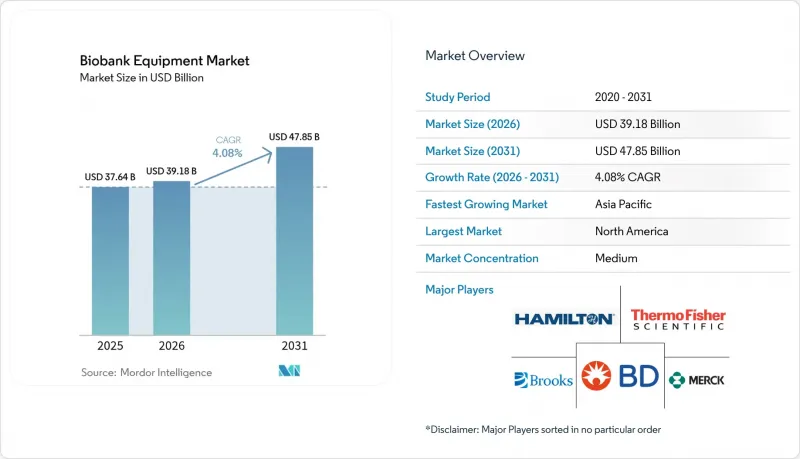
Mordor Intelligence에 의하면, 바이오뱅크 장비 시장 규모는 2025년에 376억 4,000만 달러로 평가되었고, 2026년391억 8,000만 달러에서 2031년까지 478억 5,000만 달러에 이를 것으로 예측되며, 예측 기간(2026-2031년) CAGR은 4.08%를 기록할 전망입니다.
본 보고서는 제품별(극저온 저장 시스템(냉장고 등), 경보·모니터링 시스템), 용도별(재생의학, 기타), 최종 사용자별(바이오뱅크·바이오리포지토리, 기타), 지역별(북미, 유럽, 아시아태평양, 중동 및 아프리카, 남미)로 분류되어 있습니다. 시장 예측은 금액(달러)으로 표시되어 있습니다.
세계 바이오뱅크 장비 시장 동향 및 인사이트
줄기세포·재생의학의 발전
CAR-T 요법 및 기타 세포 요법에 대한 규제 당국의 승인으로 인해 보존 정확도에 대한 기준이 높아지고 있으며, 바이오뱅크 운영자는 장기간에 걸쳐 세포 생존율을 유지할 수 있는 초저온 냉동고 도입을 요구받고 있습니다. 60만 건의 샘플에서 5,400유형의 단백질을 분석하는 영국 바이오뱅크의 단백질체학 연구와 같은 프로젝트는 현재 저장소에 소장된 시료의 양과 다양성을 입증하고 있습니다. 이에 대응하여 각 제조업체는 온도 제어, 자동 피킹 앤 플레이스 로봇, 감사 대응 데이터 관리 기능을 통합한 시스템으로 대응하고 있습니다. 연구용 등급에서 GMP 준수 보존으로의 전환에 따라, 하드웨어와 소프트웨어를 단일 검증된 패키지로 통합하는 공급업체의 이익 마진은 확대되고 있습니다. 상업용 세포 치료 플랜트의 규모가 확대됨에 따라, 이중화된 전원 공급 장치 및 모니터링에 대한 수요도 증가하고 있으며, 이로 인해 수년에 걸친 서비스 계약이 정착되고 있습니다.
만성 질환 유병률 증가
당뇨병, 종양학, 심혈관 질환에 대한 종단적 코호트 연구에서는 멀티오믹스 추적을 위해 수백만 개의 분주된 샘플 아카이브가 필요하며, 이는 첸나이에 개설된 인도 최초의 당뇨병 바이오뱅크에서도 확인할 수 있습니다. 이 모델에서는 기존 시료를 손상시키지 않으면서 용량을 확장할 수 있는 모듈식 장비가 선호됩니다. 현재 IoT 센서가 미세한 온도 변동을 감지하여 대사체학의 무결성을 보호하는 한편, 예측 유지보수를 통해 예기치 못한 가동 중지 시간을 줄이고 있습니다. 유연한 랙 배치, 신속한 액체 질소(LN2) 보충, 클라우드 대시보드를 제공하는 공급업체는 수십 년에 걸친 추적 조사를 담당하는 공중보건 프로그램에서 우선적으로 선정되고 있습니다. 이러한 추세는 검체 운송 시간을 단축하고 콜드체인의 위험을 줄이는 지역 위성 은행에도 힘을 실어주고 있습니다.
복잡하고 제각각인 규제
국경을 넘는 보관 시설을 관리하는 운영자는 일관성 없는 동의 규정, 생물 시료 수출 제한, 냉동 보관 안전 기준에 직면해 있습니다. 중국의 유전자원 규제 완화는 장기적으로는 긍정적인 움직임이지만, 다국적 연구의 경우 단기적으로는 규정 준수 체계를 근본적으로 재검토해야만 하는 상황에 놓이게 되었습니다. 한편, 의료기기 제조업체에 대한 FDA의 집행 조치는 품질 관리 미비에 대한 처벌이 얼마나 엄격한지를 여실히 보여주고 있습니다. 소규모 공급업체는 문서 작성 및 감사 업무에 드는 비용을 마련하는 데 어려움을 겪고 있으며, 전담 규제 대응 인력을 보유한 기존 기업이 유리한 입장에 있습니다. 또한 규제가 세분화되어 있어 지역별로 인증 절차가 달라, 혁신적인 저GWP 냉매의 도입이 지연되고 있습니다.
부문 분석
2025년, 극저온 저장 시스템은 바이오뱅크 장비 시장의 52.10%를 차지하며, 첨단 치료용 시료 보존에서 그 중요성이 부각되었습니다. 수요의 중심이 되고 있는 것은 -80°C에서의 안정성과 20% 낮은 전력 소비의 균형을 실현하여 대규모 운영 시 운영 비용을 절감하는 초저온 냉동고입니다. PHC의 ‘VIP ECO SMART’ 시리즈는 가변 속도 압축기와 문 개폐를 모두 기록하는 클라우드 텔레메트리 기능을 통해 이러한 변화를 구현하고 있습니다. 또한, 위탁 개발·제조 기관(CDMO)이 제조 시설 인근에 위성 저장소를 증설함에 따라, 냉동고 시장도 2031년까지 연평균 성장률(CAGR) 5.45%로 성장을 주도하고 있습니다. 냉장고는 단주기 검체 전처리 분야에서 수요를 유지하고 있으며, 제빙기는 운송용 포드용 틈새 도구로서의 입지를 지키고 있습니다. 이와 병행하여 경보 및 모니터링 모듈에 대한 수요도 증가하고 있어, 기존 설비에 규정 준수 기능을 사후 장착하려는 사업자로부터 수주를 확보하고 있습니다.
에너지 관련 법규가 설계에 영향을 미치고 있어, 각 벤더사는 정전 시 보냉 시간을 연장하는 자연 냉매나 현장 발포 단열재의 도입을 추진하고 있습니다. 하이얼 바이오메디컬의 ‘CryoBio’ 시리즈는 이중 컨트롤러와 RFID 태그가 부착된 랙을 조합하여 이중화 기능을 강화하고 있습니다. 또한 각 벤더사는 하드웨어를 모듈화하고 있어, 사용자는 보관 작업을 중단하지 않고도 압축기 교체나 카메라 추가를 할 수 있습니다. 실험실 정보 관리 시스템과의 통합을 통해 데이터의 연속성이 확보되어, 연구자는 재고 상황을 실시간으로 확인할 수 있게 됩니다. 서비스 계약에는 연간 교정, 펌웨어 업데이트, 에너지 감사가 세트로 포함되게 되어 정기적인 수익원이 확대되고 있습니다. 오픈 API와 사이버 보안 인증을 제공하는 공급업체는 통합 모니터링 체계를 원하는 병원 IT 팀으로부터 우선적으로 선택받고 있습니다.
지역별 분석
2025년, 북미는 바이오뱅크 장비 시장의 37.20%를 차지했습니다. 이는 확립된 NIH 및 FDA의 체계가 엄격한 검증 규정을 충족하는 공급업체를 우대하기 때문입니다. ‘All of Us’와 같은 프로그램 덕분에 냉동고 조달은 안정적인 반면, 캐나다 해밀턴 인근의 세포 치료 클러스터는 액체 질소 저장 시설에 대한 투자를 유치하고 있습니다. 또한, 미국의 기후 정책 전환으로 인해 저 GWP 플랫폼으로의 업그레이드가 가속화되고 있으며, 천연 냉매를 활용한 제품 라인업을 보유한 공급업체들이 유리한 입지를 점하고 있습니다. 멕시코의 의약품 수출 기반 확대는 배치 릴리스 검사에 대응하는 중규모 바이오뱅크에 대한 수요를 촉진하고 있지만, 인프라 부족으로 인해 자동화 도입은 여전히 제한적입니다.
유럽에서는 표준화를 추진하는 국경 간 데이터 공유 이니셔티브를 배경으로 꾸준한 확장이 관찰됩니다. 영국 바이오뱅크는 계속해서 주요 고객으로 자리 잡고 있으며, 로봇 피킹 암과 AI를 활용한 재고 분석 시스템 도입을 추진하고 있습니다. 노르트라인-베스트팔렌주 등 독일의 생명과학 클러스터는 쇼룸 수요를 창출하고 있으며, 그 예로 2026년 뒤셀도르프에 개관할 Bio-Techne의 새로운 체험 센터를 들 수 있습니다. EU의 그린딜 목표에 따라 에너지 효율이 높은 냉동고 구매가 촉진되고 있으며, 지역 보조금 공모에서는 현재 ACT 라벨이 부착된 제품에 추가 점수가 부여되고 있습니다.
아시아태평양은 정밀의료 시범 사업이 확대됨에 따라 2031년 연평균 성장률(CAGR)이 7.05%로 가장 빠르게 성장하고 있는 지역입니다. 중국에서 유전자 자원에 대한 승인 규제가 완화되면서 하드웨어의 해외 조달이 가능해진 반면, 현지 공장에서는 소모품 생산이 확대되고 있습니다. 호주의 ‘Genomics Health Futures Mission’은 국가 바이오뱅크 역량에 장기 자본을 투자하고 있어, 자동 아카이브 시스템 수주를 뒷받침하고 있습니다. 인도에서는 당뇨병을 시작으로 질환 특화형 리포지토리가 구축되고 있으며, 공급업체들은 2선 도시를 위해 견고하고 전력 공급이 안정적인 시스템 개발을 요구받고 있습니다. 일본이나 한국 등 성숙한 시장에서는 교체 주기가 지속되고 있어, 첨단 병원 IT 시스템과 통합 가능한 기기가 선호되고 있습니다.
기타 혜택
- 엑셀 형식 시장 예측(ME) 시트
- 3개월간의 애널리스트 지원
자주 묻는 질문
목차
제1장 서론
제2장 조사 방법
제3장 주요 요약
제4장 시장 구도
제5장 시장 규모와 성장 예측
제6장 경쟁 구도
제7장 시장 기회와 향후 전망
LSH 26.09.02According to Mordor Intelligence, the biobank equipment market size was valued at USD 37.64 billion in 2025 and estimated to grow from USD 39.18 billion in 2026 to reach USD 47.85 billion by 2031, at a CAGR of 4.08% during the forecast period (2026-2031).
This report is Segmented by Product (Cryogenic Storage Systems [Refrigerators, and More], Alarm & Monitoring Systems), Application (Regenerative Medicine, and More), End User (Biobanks & Biorepositories, and More), and Geography (North America, Europe, Asia-Pacific, Middle East and Africa, and South America). The Market Forecasts are Provided in Terms of Value (USD).
Global Biobank Equipment Market Trends and Insights
Progress in Stem-Cell and Regenerative Medicine
Regulatory approvals for CAR-T and other cell therapies are lifting the bar for storage precision, prompting biobank operators to adopt ultra-low freezers able to hold viability over extended timelines. Projects such as the UK Biobank's proteomics study, which profiles 5,400 proteins from 600,000 samples, confirm the volume and diversity of material now entering repositories. Manufacturers respond with integrated systems that bundle temperature control, automated pick-and-place robotics, and audit-ready data footprints. The shift from research-grade to GMP-compliant storage widens margins for suppliers that combine hardware and software into a single validated package. As commercial cell-therapy plants scale, demand for redundant power and monitoring also rises, locking in multi-year service contracts.
Rising Prevalence of Chronic Diseases
Longitudinal diabetes, oncology, and cardiovascular cohorts require archiving of millions of aliquots for multi-omics tracking, visible in India's first diabetes biobank launched in Chennai. The model favours modular equipment that expands capacity without disturbing legacy samples. IoT sensors now flag micro-temperature drifts to protect metabolomic integrity, while predictive maintenance reduces unplanned downtime. Suppliers that offer flexible racking, rapid LN2 refill, and cloud dashboards gain preference among public-health programs tasked with decades-long follow-up. The trend also supports regional-satellite banks that shorten sample transport times and lower cold-chain risk.
Complex & Divergent Regulations
Operators managing cross-border repositories face inconsistent consent rules, biosample export limits, and refrigeration safety codes. China's relaxation of genetic-resource controls, while positive long-term, forces a near-term compliance overhaul for multinational studies. Meanwhile, FDA enforcement actions against device makers illustrate the penalties for quality lapses. Smaller suppliers struggle to finance the documentation and auditing workload, favouring incumbents with dedicated regulatory affairs staff. Fragmented rules also delay roll-outs of innovative low-GWP refrigerants because certification pathways differ by region.
Other drivers and restraints analyzed in the detailed report include:
- Increased Funding from Governments and NGOs
- Growing Demand for Precision-Medicine Samples
- Environmental Regulations and F-Gas Phase-Down Mandates
For complete list of drivers and restraints, kindly check the Table Of Contents.
Segment Analysis
Cryogenic storage systems captured 52.10% of the biobank equipment market in 2025, underscoring their centrality to advanced-therapy preservation. Demand centres on ultra-low freezers that balance -80 °C stability with 20% lower power draw, reducing operating expense at scale. The PHC VIP ECO SMART line illustrates this shift through variable-speed compressors and cloud telemetry that log every door opening. Freezers also lead growth at a 5.45% CAGR to 2031 as contract development and manufacturing organizations multiply satellite repositories near manufacturing suites. Refrigerators maintain traction for short-cycle sample prep, while ice machines remain niche tools for transport pods. Alarm and monitoring modules rise in parallel, winning orders from operators that retrofit compliance capability onto installed fleets.
Energy legislation is shaping design, prompting vendors to adopt natural refrigerants and foam-in-place insulation that boosts hold-time during power outages. Haier Biomedical's CryoBio series layers dual controllers and RFID-tagged racks to enhance redundancy. Vendors also modularize hardware so that users can swap compressors or add cameras without disrupting storage. Integration with laboratory information-management systems creates data continuity, letting researchers query inventory in real time. Service contracts now bundle annual calibration, firmware updates, and energy audits, expanding annuity revenue streams. Suppliers that deliver open APIs and cybersecurity certification win preference from hospital IT teams seeking single-pane-of-glass oversight.
Complete Report Scope:
- By Product
- Cryogenic Storage Systems
- Refrigerators
- Freezers
- Ice Machines
- Alarm & Monitoring Systems
- Cryogenic Storage Systems
- By Application
- Regenerative Medicine
- Drug Discovery
- Disease & Epidemiology Research
- Life-Science & Genomic Research
- By End User
- Biobanks & Biorepositories
- Pharma & Biotech Companies
- Academic & Research Institutes
- Hospitals & Diagnostic Centres
- By Geography
- North America
- United States
- Canada
- Mexico
- Europe
- Germany
- United Kingdom
- France
- Italy
- Spain
- Rest of Europe
- Asia-Pacific
- China
- Japan
- India
- Australia
- South Korea
- Rest of Asia-Pacific
- Middle East & Africa
- GCC
- South Africa
- Rest of Middle East & Africa
- South America
- Brazil
- Argentina
- Rest of South America
- North America
Geography Analysis
North America commanded 37.20% of the biobank equipment market in 2025 as established NIH and FDA frameworks reward suppliers that meet rigorous validation rules. Programs such as All of Us keep freezer procurement steady, while Canada's cell-therapy corridor around Hamilton attracts investment in liquid-nitrogen repositories. US climate-policy shifts also accelerate upgrades toward low-GWP platforms, favouring vendors with natural-refrigerant portfolios. Mexico's growing pharmaceutical export base sparks demand for mid-scale biobanks that support batch release testing, though infrastructure gaps still limit automation uptake.
Europe records consistent expansion on the back of cross-border data-sharing initiatives that push standardization. The UK Biobank remains a flagship customer, trialling robotic picker arms and AI-powered inventory analytics. Germany's life-sciences clusters, such as North Rhine-Westphalia, create showroom demand, evidenced by Bio-Techne's new Dusseldorf experience centre opening in 2026. EU Green Deal targets reinforce purchases of energy-efficient freezers, and regional grant calls now award extra points to ACT-labelled units.
Asia-Pacific is the fastest-growing region at 7.05% CAGR through 2031 as precision-medicine pilots scale. China's relaxation of genetic-resource approvals unlocks foreign sourcing of hardware while local factories ramp up production of consumables. Australia's Genomics Health Futures Mission injects long-term capital into national biobanking capacity, boosting orders for automated archives. India's disease-specific repositories, starting with diabetes, push suppliers to develop rugged, power-stable systems for tier-2 cities. Mature markets in Japan and South Korea sustain replacement cycles and favour equipment that integrates with advanced hospital IT stacks.
- Azenta Life Sciences (Brooks)
- Thermo Fisher Scientific
- Hamilton Company
- PHC
- Beckton Dickinson
- Merck
- Lonza Group
- Bio-Techne
- QIAGEN
- Stem Cell Technologies
- Tecan Group
- Eppendorf
- Haier Biomedical
- Cryoport Inc.
- Chart Industries
- BioLife Solutions
- BioCision
- Micronic BV
- So-Low Environmental
- Taylor-Wharton
Additional Benefits:
- The market estimate (ME) sheet in Excel format
- 3 months of analyst support
TABLE OF CONTENTS
1 Introduction
- 1.1 Study Assumptions & Market Definition
- 1.2 Scope of the Study
2 Research Methodology
3 Executive Summary
4 Market Landscape
- 4.1 Market Overview
- 4.2 Market Drivers
- 4.2.1 Progress in Stem-Cell and Regenerative Medicine
- 4.2.2 Rising Prevalence of Chronic Diseases
- 4.2.3 Increased Funding from Governments and NGOs
- 4.2.4 Growing Demand for Precision-Medicine Samples
- 4.2.5 Expansion of Decentralized and Near-Patient Biobanks
- 4.2.6 AI-Enhanced Inventory and Access Management
- 4.3 Market Restraints
- 4.3.1 Complex & Divergent Regulations
- 4.3.2 High Capex for Ultra-Low Temperature Assets
- 4.3.3 Environmental Regulations and F-Gas Phase-Down Mandates
- 4.3.4 Lack of Data Standardization and LIMS Interoperability
- 4.4 Technological Outlook
- 4.5 Porter's Five Forces Analysis
- 4.5.1 Bargaining Power of Buyers
- 4.5.2 Bargaining Power of Suppliers
- 4.5.3 Threat of New Entrants
- 4.5.4 Threat of Substitutes
- 4.5.5 Intensity of Competitive Rivalry
5 Market Size & Growth Forecasts (Value in USD)
- 5.1 By Product
- 5.1.1 Cryogenic Storage Systems
- 5.1.1.1 Refrigerators
- 5.1.1.2 Freezers
- 5.1.1.3 Ice Machines
- 5.1.2 Alarm & Monitoring Systems
- 5.1.1 Cryogenic Storage Systems
- 5.2 By Application
- 5.2.1 Regenerative Medicine
- 5.2.2 Drug Discovery
- 5.2.3 Disease & Epidemiology Research
- 5.2.4 Life-Science & Genomic Research
- 5.3 By End User
- 5.3.1 Biobanks & Biorepositories
- 5.3.2 Pharma & Biotech Companies
- 5.3.3 Academic & Research Institutes
- 5.3.4 Hospitals & Diagnostic Centres
- 5.4 By Geography
- 5.4.1 North America
- 5.4.1.1 United States
- 5.4.1.2 Canada
- 5.4.1.3 Mexico
- 5.4.2 Europe
- 5.4.2.1 Germany
- 5.4.2.2 United Kingdom
- 5.4.2.3 France
- 5.4.2.4 Italy
- 5.4.2.5 Spain
- 5.4.2.6 Rest of Europe
- 5.4.3 Asia-Pacific
- 5.4.3.1 China
- 5.4.3.2 Japan
- 5.4.3.3 India
- 5.4.3.4 Australia
- 5.4.3.5 South Korea
- 5.4.3.6 Rest of Asia-Pacific
- 5.4.4 Middle East & Africa
- 5.4.4.1 GCC
- 5.4.4.2 South Africa
- 5.4.4.3 Rest of Middle East & Africa
- 5.4.5 South America
- 5.4.5.1 Brazil
- 5.4.5.2 Argentina
- 5.4.5.3 Rest of South America
- 5.4.1 North America
6 Competitive Landscape
- 6.1 Market Concentration
- 6.2 Market Share Analysis
- 6.3 Company Profiles (includes Global level Overview, Market level overview, Core Segments, Financials as available, Strategic Information, Market Rank/Share for key companies, Products & Services, and Recent Developments)
- 6.3.1 Azenta Life Sciences (Brooks)
- 6.3.2 Thermo Fisher Scientific
- 6.3.3 Hamilton Company
- 6.3.4 PHC Corporation
- 6.3.5 Becton, Dickinson and Company
- 6.3.6 Merck KGaA
- 6.3.7 Lonza Group
- 6.3.8 Bio-Techne
- 6.3.9 QIAGEN
- 6.3.10 Stemcell Technologies
- 6.3.11 Tecan Group
- 6.3.12 Eppendorf AG
- 6.3.13 Haier Biomedical
- 6.3.14 Cryoport Inc.
- 6.3.15 Chart Industries
- 6.3.16 BioLife Solutions
- 6.3.17 BioCision LLC
- 6.3.18 Micronic BV
- 6.3.19 So-Low Environmental
- 6.3.20 Taylor-Wharton
7 Market Opportunities & Future Outlook
- 7.1 White-space & Unmet-need Assessment


