|
시장보고서
상품코드
2121723
상변화물질 : 시장 점유율 분석, 업계 동향과 통계, 성장 예측(2026-2031년)Phase Change Materials - Market Share Analysis, Industry Trends & Statistics, Growth Forecasts (2026 - 2031) |
||||||
 Mordor Intelligence
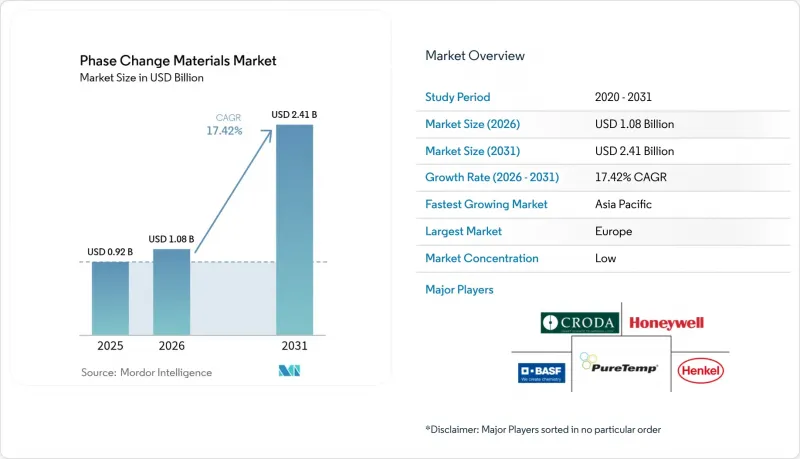
Mordor Intelligence에 의하면, 2026년 상변화물질 시장 규모는 10억 8,000만 달러로 추정되고 있으며, 2025년 9억 2,000만 달러에서 2031년에는 24억 1,000만 달러에 달할 것으로 예측됩니다.
2026-2031년 연평균 성장률(CAGR)은 17.42%를 기록할 것으로 전망됩니다.
본 보고서에서는 산업을 제품 유형(유기, 무기, 바이오), 화학 조성(파라핀, 비파라핀계 탄화수소, 기타), 캡슐화 기술(매크로 캡슐화, 기타), 최종 사용자 산업(건축 및 건설, 포장, 섬유, 전자기기, 기타),지역(아시아태평양, 북미, 유럽, 남미, 중동 및 아프리카)별로 분류하고 있습니다.
전 세계 상변화물질(PCM) 시장 동향 및 인사이트
유럽 및 북미의 건축물 에너지 기준 의무화로 인한 PCM 도입 가속화
성능 기준에 따른 적합 요건으로 인해, 건축가는 현재 경질 단열재를 잠열 저장층으로 대체할 수 있게 되어, 경량 벽체에서 피크 냉방 부하를 35-45% 절감할 수 있게 되었습니다. 미네소타주에서 실시한 현장 측정 결과에 따르면, 실내 최고 온도가 5.49°C 하락했으며, 부하의 77.8%가 비피크 시간대로 이동한 것으로 보고되었는데, 이는 규제 당국에 공조(HVAC) 비용 절감에 대한 실증 데이터를 제공합니다. 2027년 EU 개보수 목표를 위한 적합 기준 상향 조정으로 인해, PCM이 혼합된 석고보드 및 콘크리트 블록에 대한 관심이 더욱 높아질 것으로 예상되며, 이에 따라 상변화물질 시장 전체의 조달량이 확대될 것으로 전망됩니다.
콜드체인 물류 인프라의 급속한 확충
백신, 첨단 생물 제제, 배양육은 대부분의 경우 3일 이하 동안 ±0.5°C 이내의 온도 편차만 허용되는 온도대를 필요로 합니다. 상변화 소재는 외부 전원이 없어도 해당 온도 유지 시간을 72시간으로 연장하여, 공항이나 세관에서의 지연 시 디젤 발전기에 대한 의존도를 낮춥니다. 글리세롤·물·NaCl의 혼합물은 능동 냉각에 비해 탄소 발자국을 30-40% 줄이고, 의약품의 보존 기간을 15-25% 연장하기 때문에 상변화물질 시장 전체에 두 자릿수 수요 증가를 가져오고 있습니다.
상변화물질의 위험성
파라핀 왁스는 약 170°C에서 발화하기 때문에 브롬계 난연제 사용이 필요하지만, 이로 인해 비용이 증가하고 건강 관련 표시 규제의 대상이 될 가능성이 있습니다. LiNO3 등의 무기계 후보 물질에는 독성 위험이 있습니다. 최근 개발된 현장 중합형 고체-고체 PCM은 누출을 방지하며, 할로겐을 사용하지 않고도 UL94 V-0 난연성 기준을 충족합니다. 보다 광범위한 채택을 위해서는 이러한 봉입 기술의 발전을 확대하고, 전 세계 화학물질 안전 기준의 조화를 도모하는 것이 핵심입니다.
부문 분석
유기 파라핀 왁스는 상변화물질 시장의 주요 수익원으로 자리매김하고 있으며, 2025년에는 전 세계 매출의 43.62%를 차지할 것으로 예측됩니다. 이러한 우위는 성숙한 공급망, 광범위한 온도 대응 범위, 건축용 패널에 사용되는 매크로 캡슐화 슬래브와의 호환성을 반영합니다. 그러나 이해관계자들이 수명 주기 전반에 걸친 배출량 감축을 추구하는 가운데, 상변화물질 시장에서는 바이오 유지, 동물성 지방, 지방산 혼합물로 급격한 전환이 나타나고 있습니다. 이 신흥 하위 부문은 생물 유래 소재를 명시적으로 권장하는 LEED 크레딧과 지자체의 친환경 조달 의무에 힘입어, 2031년까지 연평균 성장률(CAGR) 18.90%를 기록하며 다른 모든 부문을 능가하는 성장을 보일 것으로 전망됩니다.
파라핀계 배합물은 안정적인 결정화 특성과 0-90°C 범위에서 융점을 쉽게 조절할 수 있다는 점 덕분에 2025년에는 상변화물질 시장 매출의 41.02%를 차지했습니다. 그럼에도 불구하고, 염수화물은 2031년까지 연평균 성장률(CAGR) 17.76%로 확대되어 그 순위를 뒤집을 기세입니다. 높은 체적 비열(최대 350kJ/L)과 탄소계 첨가제에 의한 열전도율 향상으로 인해, 염수화물을 사용하면 부품의 크기와 무게를 줄일 수 있습니다. 그 결과 얻어지는 밀도 측면의 우위는 설치 공간이 제한된 전기차 배터리 슬리브나 소형 데이터센터 랙에서 특히 매력적입니다.
지역별 분석
2025년, 유럽은 전 세계 매출의 32.40%를 차지했습니다. 이는 신축 및 대규모 개보수 프로젝트 모두에 준넷제로 목표 달성을 의무화하는 EU의 ‘건축물 에너지 성능에 관한 지침’에 힘입은 결과입니다. 독일과 북유럽 국가들의 초기 도입 사례에 따르면, 외벽 단열 시스템에 PCM을 통합한 결과, HVAC(냉난방·환기)의 에너지 소비량이 20-35% 감소한 것으로 나타났습니다. 탄소 거래 및 그린본드 적격성에 관한 규제가 명확해짐에 따라 PCM을 풍부하게 함유한 건축자재로 자본 유입이 지속되고 있으며, 상변화물질 시장에서 유럽의 주도적 지위가 더욱 공고해지고 있습니다.
아시아태평양은 가장 빠르게 성장하고 있는 지역으로, 2031년까지 연평균 18.55%의 성장률이 예상됩니다. 중국에서 열펌프를 적극적으로 도입함으로써 피크 시간대의 전력 수요를 줄여 PCM을 통한 축열을 보완하고 있으며, 이러한 시너지 효과는 ‘열펌프의 미래(Future of Heat Pumps)’ 로드맵에 따라 추진되고 있습니다.
북미에서는 엄격한 에너지 기준의 개정과 급성장하는 전기차(EV) 부문이 맞물려 시장을 견인하고 있습니다. 미국의 데이터센터 운영 사업자들은 현장 에너지 저장에 대한 세액 공제에 매력을 느껴 PCM 기반 열 버퍼를 시범 도입하여 서버의 급격한 발열을 흡수하는 동시에 냉각기의 가동 시점을 늦추는 노력을 기울이고 있습니다.
기타 혜택
- 엑셀 형식 시장 예측(ME) 시트
- 3개월간의 애널리스트 지원
자주 묻는 질문
목차
제1장 서론
제2장 조사 방법
제3장 주요 요약
제4장 시장 구도
제5장 시장 규모와 성장 예측
제6장 경쟁 구도
제7장 시장 기회와 향후 전망
LSH 26.09.02According to Mordor Intelligence, phase change materials market size in 2026 is estimated at USD 1.08 billion, growing from 2025 value of USD 0.92 billion with 2031 projections showing USD 2.41 billion, growing at 17.42% CAGR over 2026-2031.
This report Segments the Industry by Product Type (Organic, Inorganic, and Bio-Based), Chemical Composition (Paraffin, Non-Paraffin Hydrocarbons, and More), Encapsulation Technology (Macro-Encapsulation, and More), End-User Industry (Building and Construction, Packaging, Textiles, Electronics, and More), and Geography (Asia-Pacific, North America, Europe, South America, and Middle-East and Africa).
Global Phase Change Materials Market Trends and Insights
Mandatory Building-Energy Codes Accelerating PCM Integration
Performance-based compliance criteria now allow architects to substitute rigid insulation with latent-heat storage layers, unlocking a 35-45% reduction in peak cooling loads within lightweight walls. Measured field results in Minnesota reported a 5.49 °C drop in peak indoor temperature plus a 77.8% load shift toward off-peak hours, providing regulators with real-world evidence of HVAC savings. Rising compliance thresholds for 2027 EU renovation targets are expected to place additional emphasis on PCM-infused gypsum boards and concrete blocks, thereby lifting procurement volumes across the Phase Change Material market.
Rapid Deployment of Cold-Chain Logistics Infrastructure
Vaccines, advanced biologics, and precision meats require temperature bands that often tolerate a +-0.5 °C deviation for less than three days. PCMs extend that holdover to 72 hours without external power, cutting diesel-generator reliance during airport or customs delays. Glycerol-water-NaCl blends slash carbon footprints 30-40% versus active cooling and lift pharmaceutical shelf life by 15-25%, feeding double-digit demand across the Phase Change Material market.
Hazardous Nature of Phase Change Materials
Paraffin waxes ignite at roughly 170 °C and require brominated flame retardants that add cost and can trigger health-labeling restrictions. Inorganic candidates such as LiNO3 present toxicity risks. Recent in-situ polymerized solid-solid PCMs eliminate leakage, passing UL94 V-0 flammability without halogens. Broader adoption hinges on scaling these encapsulation advances and harmonizing global chemical safety standards.
Other drivers and restraints analyzed in the detailed report include:
- Electrification of Vehicles Necessitating Advanced Thermal Battery Packs
- Government Incentives for Net-Zero Buildings Propelling Bio-Based PCM Adoption
- Supply-Chain Volatility of High-Purity Salt Hydrates
For complete list of drivers and restraints, kindly check the Table Of Contents.
Segment Analysis
Organic paraffin waxes remain the revenue anchor for the Phase Change Material market, accounting for 43.62% of global sales in 2025. Their dominance reflects mature supply chains, broad temperature coverage, and compatibility with macro-encapsulation slabs used in building panels. Yet the Phase Change Material market is witnessing a sharp pivot toward bio-derived oils, tallow, and fatty-acid blends as stakeholders chase lower life-cycle emissions. The emergent sub-segment is forecast to outpace all others at 18.90% CAGR to 2031, buoyed by LEED credits and municipal green-procurement mandates that explicitly endorse biogenic materials.
Paraffin-based formulations captured 41.02% of the Phase Change Material market revenue in 2025 due to their stable crystallization and ease of tailoring melting points across the 0-90 °C spectrum. Even so, salt hydrates are on course to disrupt that hierarchy, expanding at an 17.76% CAGR through 2031. High volumetric heat capacity (up to 350 kJ/L) and thermal conductivity improvements via carbon additives are allowing salt hydrates to shrink component size and weight. The resulting density advantage is especially attractive for electric-vehicle battery sleeves and compact data-center racks, where available footprint is constrained.
Complete Report Scope:
- By Product Type
- Organic
- Inorganic
- Bio-based
- By Chemical Composition
- Paraffin
- Non-Paraffin Hydrocarbons
- Salt Hydrates
- Eutectics
- By Encapsulation Technology
- Macro-encapsulation
- Micro-encapsulation
- Molecular Encapsulation
- By End-user Industry
- Building and Construction
- Packaging
- Textiles
- Electronics
- Transportation
- Other Industries (Healthcare, Defense)
- By Geography
- Asia-Pacific
- China
- India
- Japan
- South Korea
- Rest of Asia-Pacific
- North America
- United States
- Canada
- Mexico
- Europe
- Germany
- United Kingdom
- France
- Italy
- Rest of Europe
- South America
- Brazil
- Argentina
- Rest of South America
- Middle-East and Africa
- Saudi Arabia
- South Africa
- Rest of Middle-East and Africa
- Asia-Pacific
Geography Analysis
Europe held 32.40% of global sales in 2025, underpinned by the EU's Energy Performance of Buildings Directive, which compels both new construction and deep-renovation projects to hit quasi-net-zero targets. Early adopters in Germany and the Nordics have shown 20-35% HVAC energy savings after embedding PCMs into external wall insulation systems. Regulatory clarity around carbon trading and green-bond eligibility continues to draw capital toward PCM-rich building materials, consolidating Europe's leadership position in the Phase Change Material market.
Asia-Pacific is the fastest-growing region, anticipated to expand 18.55% annually through 2031. China's aggressive heat-pump rollout complements PCM thermal storage by shaving peak electricity demand, a synergy encouraged under the "Future of Heat Pumps" roadmap.
North America combines stringent energy-code updates with an exploding electric-vehicle sector. Data-center operators in the United States, drawn by tax credits for on-site energy storage, pilot PCM-based thermal buffers to absorb server heat spikes and postpone chiller start-up.
- BASF
- Appvion, LLC.
- Climator
- Croda International Plc
- Cryopak
- DuPont
- Henkel AG & Co. KGaA
- Honeywell International Inc.
- Laird Technologies, Inc.
- Microtek
- National Gypsum Services Company
- Outlast Technologies GmbH
- Parker Hannifin Corp
- Phase Change Solutions
- Pluss Advanced Technologies
- PureTemp LLC
- Rubitherm Technologies GmbH
- Shenzhen Aochuan Technology Co.,Ltd.
- Shin-Etsu Chemical Co., Ltd.
- Sonoco Products Company
Additional Benefits:
- The market estimate (ME) sheet in Excel format
- 3 months of analyst support
TABLE OF CONTENTS
1 Introduction
- 1.1 Study Assumptions and Market Definition
- 1.2 Scope of the Study
2 Research Methodology
3 Executive Summary
4 Market Landscape
- 4.1 Market Overview
- 4.2 Market Drivers
- 4.2.1 Mandatory Building-Energy Codes in Europe and North America Accelerating PCM Integration
- 4.2.2 Rapid Deployment of Cold-Chain Logistics Infrastructure
- 4.2.3 Electrification of Vehicles Necessitating Advanced Thermal Battery Packs Using Salt-Hydrate PCMs
- 4.2.4 Government Incentives for Net-Zero Buildings Propelling Bio-based PCM Adoption
- 4.2.5 Expanding Global Trend Towards Energy Conservation and Sustainable Development
- 4.3 Market Restraints
- 4.3.1 Hazardous Nature of Phase Change Materials
- 4.3.2 Supply-Chain Volatility of High-Purity Salt Hydrates
- 4.3.3 Limited Awareness and Understanding
- 4.4 Value Chain Analysis
- 4.5 Porter's Five Forces
- 4.5.1 Bargaining Power of Suppliers
- 4.5.2 Bargaining Power of Buyers
- 4.5.3 Threat of New Entrants
- 4.5.4 Threat of Substitutes
- 4.5.5 Degree of Competition
- 4.6 Raw-Material Analysis
- 4.7 Patent Analysis
5 Market Size and Growth Forecasts (Value)
- 5.1 By Product Type
- 5.1.1 Organic
- 5.1.2 Inorganic
- 5.1.3 Bio-based
- 5.2 By Chemical Composition
- 5.2.1 Paraffin
- 5.2.2 Non-Paraffin Hydrocarbons
- 5.2.3 Salt Hydrates
- 5.2.4 Eutectics
- 5.3 By Encapsulation Technology
- 5.3.1 Macro-encapsulation
- 5.3.2 Micro-encapsulation
- 5.3.3 Molecular Encapsulation
- 5.4 By End-user Industry
- 5.4.1 Building and Construction
- 5.4.2 Packaging
- 5.4.3 Textiles
- 5.4.4 Electronics
- 5.4.5 Transportation
- 5.4.6 Other Industries (Healthcare, Defense)
- 5.5 By Geography
- 5.5.1 Asia-Pacific
- 5.5.1.1 China
- 5.5.1.2 India
- 5.5.1.3 Japan
- 5.5.1.4 South Korea
- 5.5.1.5 Rest of Asia-Pacific
- 5.5.2 North America
- 5.5.2.1 United States
- 5.5.2.2 Canada
- 5.5.2.3 Mexico
- 5.5.3 Europe
- 5.5.3.1 Germany
- 5.5.3.2 United Kingdom
- 5.5.3.3 France
- 5.5.3.4 Italy
- 5.5.3.5 Rest of Europe
- 5.5.4 South America
- 5.5.4.1 Brazil
- 5.5.4.2 Argentina
- 5.5.4.3 Rest of South America
- 5.5.5 Middle-East and Africa
- 5.5.5.1 Saudi Arabia
- 5.5.5.2 South Africa
- 5.5.5.3 Rest of Middle-East and Africa
- 5.5.1 Asia-Pacific
6 Competitive Landscape
- 6.1 Market Concentration
- 6.2 Strategic Moves (Mergers and Acquistions, JV, Collaboration, Funding)
- 6.3 Market Share(%)/Ranking Analysis
- 6.4 Company Profiles {(includes Global level Overview, Market level overview, Core Segments, Financials as available, Strategic Information, Market Rank/Share, Products and Services, and Recent Developments)}
- 6.4.1 BASF
- 6.4.2 Appvion, LLC.
- 6.4.3 Climator
- 6.4.4 Croda International Plc
- 6.4.5 Cryopak
- 6.4.6 DuPont
- 6.4.7 Henkel AG & Co. KGaA
- 6.4.8 Honeywell International Inc.
- 6.4.9 Laird Technologies, Inc.
- 6.4.10 Microtek
- 6.4.11 National Gypsum Services Company
- 6.4.12 Outlast Technologies GmbH
- 6.4.13 Parker Hannifin Corp
- 6.4.14 Phase Change Solutions
- 6.4.15 Pluss Advanced Technologies
- 6.4.16 PureTemp LLC
- 6.4.17 Rubitherm Technologies GmbH
- 6.4.18 Shenzhen Aochuan Technology Co.,Ltd.
- 6.4.19 Shin-Etsu Chemical Co., Ltd.
- 6.4.20 Sonoco Products Company
7 Market Opportunities and Future Outlook
- 7.1 White-space and Unmet-Need Assessment
- 7.2 Development of Phase Change Thermal Interface Material