
|
시장보고서
상품코드
2121727
유바이오틱스 : 시장 점유율 분석, 업계 동향과 통계, 성장 예측(2026-2031년)Eubiotics - Market Share Analysis, Industry Trends & Statistics, Growth Forecasts (2026 - 2031) |
||||||
 Mordor Intelligence
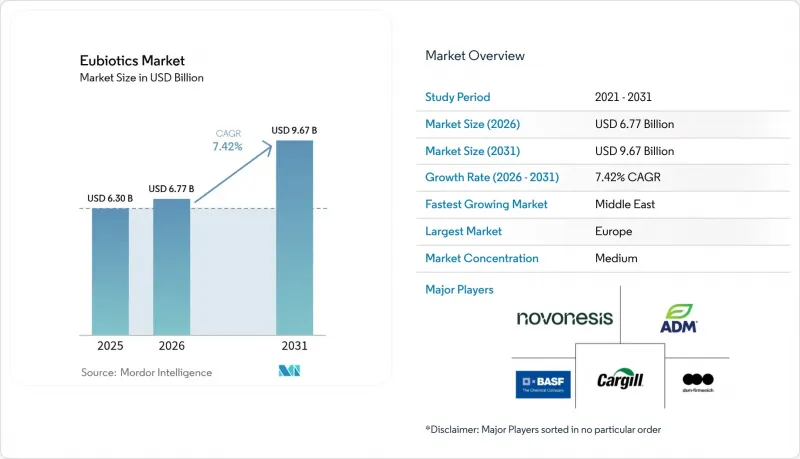
Mordor Intelligence에 의하면, 유바이오틱스 시장 규모는 2025년에 63억 달러로 평가되었고, 2026년67억 7,000만 달러에서 2031년까지 96억 7,000만 달러에 이를 것으로 예측되며, 예측 기간(2026-2031년) CAGR은 7.42%를 기록할 전망입니다.
본 보고서는 유형(프리바이오틱스, 프로바이오틱스, 유기산, 에센셜 오일), 동물 유형(반추동물, 가금류, 돼지, 수산 양식, 기타), 제형(건조·액체), 기능(면역 기능 강화, 기타),지역(북미, 유럽, 아시아태평양, 남미, 중동 및 아프리카)별로 분류되어 있습니다. 시장 예측은 금액(달러) 기준으로 제시되어 있습니다.
전 세계 유바이오틱스 시장 동향 및 인사이트
항생제계 성장 촉진제에 대한 규제적 제한
주요 축산 지역에서 항생제계 성장 촉진제의 공식적인 단계적 폐지에 따라, 유바이오틱스로의 돌이킬 수 없는 전환이 진행되고 있습니다. 규정(EC) 제1831/2003호에 따라 엄격한 안전성 자료 제출 절차가 확립되었으며, 현재는 다른 많은 관할권에서도 유사한 절차가 채택되고 있습니다. 그 결과, 확고한 임상 데이터 패키지를 제시할 수 있는 공급업체에게 유리한, 보다 명확하고 표준화된 승인 절차가 확립되었습니다. 미국 FDA의 ‘Innovative FEED Act’에서도 유사한 합리화 조치가 도입됨에 따라, 다국적 제조업체들은 자료 제출을 조정하여 시장 출시까지의 기간을 단축함과 동시에, 공통된 안전 기준을 충족하는 조화로운 제제를 출시할 수 있게 되었습니다.
항생제를 사용하지 않은 축산물에 대한 소비자 수요 증가
항생제를 사용하지 않은 육류 및 유제품에 대한 수요는 틈새 시장에서 주류 시장으로 전환되었습니다. 대형 슈퍼마켓 체인들은 항생제 사용을 배제하는 공급업체 정책을 시행하고 있으며, 첨가물 비용이 높아짐에도 불구하고 생산자들이 유바이오틱스를 채택하도록 유도하고 있습니다. 프리미엄 제품의 소매 가격은 이러한 비용을 상쇄하며, 특히 유럽, 북미의 도시 지역 및 선진 아시아 국가에서 소비자들이 항생제의 적정 사용을 건강 및 식품 안전성과 연관 짓고 있기 때문에 설득력 있는 경제적 근거를 제시하고 있습니다.
높은 비용과 복잡한 규제 승인 절차
높은 비용과 복잡한 규제 승인 절차는 제품 시장 출시를 지연시키고, 소규모 공급업체 시장 진입 장벽을 높이고 있습니다. EFSA(유럽식품안전청)에 완전한 안전성 자료를 제출하는 데는 수백만 유로의 비용이 들고, 소요 기간이 3-4년에 달하기 때문에 본래 연구 개발에 투입되어야 할 자본이 묶이게 됩니다. 브렉시트 이후의 규제 차이로 인해 기업들은 현재 EU와 영국용으로 별도의 신청 서류를 준비해야 하며, 이로 인해 문서 작성 및 실험실 검사가 중복되고 있습니다. 이러한 부담은 전담 규제 대응 팀을 보유한 다국적 기업에 경쟁 우위를 가져다주는 한편, 신속한 승인을 위한 명확한 경로가 없는 새로운 작용기전에 대한 투자를 저해할 가능성이 있습니다.
부문 분석
프로바이오틱스는 2025년 매출 점유율의 41.10%를 차지하며, 유바이오틱스 시장에서 가장 큰 점유율을 차지하고 있습니다. 이러한 우위는 광범위한 임상 검증, 모든 기후 조건에서 신뢰할 수 있는 성능, 승인을 가속화하는 규제상의 선례에 의해 뒷받침되고 있습니다. 이 부문의 바실러스 속 포자는 펠릿화 온도를 견딜 수 있어 전위를 통과하여 회장에 확실하게 도달하여, 그곳에서 경쟁 배제 작용을 발휘합니다. 프로바이오틱스와 프락토올리고당(FOS) 프리바이오틱스를 배합한 신바이오틱스 제제는 사료 전환율을 3-4% 개선하고 있으며, 상호 보완적인 작용 메커니즘이 입증되었습니다.
에센셜 오일은 2031년까지 9.64%라는 가장 높은 연평균 성장률(CAGR)을 기록하고 있습니다. 식물 유래 항균제에 대한 소비자의 선호도와 장내 미생물에 대한 이러한 화합물의 다층적인 작용이 그 보급을 뒷받침하고 있습니다. 티몰, 카르바크롤, 시나말데히드의 마이크로캡슐화를 통해 휘발성 화합물이 안정화되어, 불과 100ppm이라는 낮은 첨가율에서도 측정 가능한 병원균 억제 효과를 얻을 수 있습니다. 유기산과 프리바이오틱스는 산성화 및 기질 공급 측면에서 틈새 역할을 유지하고 있는 반면, 다중 모드 혼합은 시너지 효과 달성을 목표로 하고 있습니다. 제제 과학 분야의 종합적인 발전으로 인해 유바이오틱스 시장은 장 건강 혁신의 핵심 플랫폼으로서의 입지를 공고히 하고 있습니다.
2025년 매출에서 가금류가 차지하는 비중은 34.10%로, 이는 육계 및 산란계에서 수십 년에 걸친 항생제 대체 프로그램의 성과를 반영한 것입니다. 혼합 비율은 사료 1톤당 평균 500g이며, 생애 전반에 걸친 누적 사료 전환율의 개선으로 뛰어난 비용 효율성을 얻고 있습니다. 수산 양식 부문의 예측 연평균 성장률(CAGR)은 8.44%이며, 상대적인 성장은 해수어와 담수어 종으로 이동하고 있습니다. 새우, 틸라피아, 하이브리드 그루퍼를 대상으로 한 실험에서 수중에서 안정된 프로바이오틱스를 자동 급이 장치를 통해 정확하게 투여함으로써 병원체 부하가 30% 이상 감소하는 것으로 나타났습니다.
양돈 산업에서는 이유 후 다균주 프로바이오틱스를 도입하여 장내 독소 생성 대장균을 억제하고 있습니다. 반추동물에 대한 도입은 루멘의 복잡한 동역학으로 인해 지연되고 있지만, 휘발성 지방산의 비율을 조절하는 프로피오니박테리움의 혼합은 메탄 감축 수단으로서 주목을 받고 있습니다. 반려동물용 제제 부문은 반려동물사료 마케팅 담당자들이 ‘휴머니제이션’ 트렌드를 활용하여 높은 가격 책정을 정당화하는 프리미엄 시장을 형성하고 있습니다. 전반적으로, 동물 유형별로 최적화가 진행됨에 따라 유바이오틱스 시장 규모가 확대되는 동시에, 전문 공급업체들이 독자적인 균주를 통해 이익률을 확보할 수 있게 되었습니다.
지역별 분석
2025년에 유럽이 매출 점유율의 34.40%를 차지하게 된 배경에는 엄격한 사료 첨가물 규제, 생산자의 높은 의식, 확립된 유통 인프라가 있습니다. 제품 개발자들은 발효 원료, 수의학 대학, 독자적인 균주 선별을 신속하게 진행하는 위탁 연구 기관과의 근접성으로부터 혜택을 받고 있습니다. EU의 유기농 농업 행동 계획에 따라, 유기농 가축 사료를 보완하면서 비타민과 아미노산 부족을 해소하는 인증된 유바이오틱스에 대한 수요가 점차 높아지고 있습니다. 브렉시트로 인한 규제 차이는 이중 등록 비용을 초래하는 한편, 영국 지침에 따른 신속 승인이라는 틈새 시장 기회도 제공합니다.
중동은 ‘사우디 비전 2030’에 따른 수산 양식 메가 프로젝트를 원동력으로 7.78%라는 가장 높은 연평균 성장률(CAGR)을 기록하고 있습니다. 걸프협력회의(GCC) 회원국들은 국내 단백질 부족을 해소하기 위해 단세포 단백질과 유바이오틱스를 결합한 사막 기후형 수산 사료 시설에 투자하고 있습니다. 정부의 사료 보조금 제도는 항생제 잔류량을 최소화하고 할랄 및 그린 라벨 기준을 준수하기 위해 지속 가능한 장 건강 솔루션을 도입하는 현지 생산자들을 장려하고 있습니다.
아시아태평양에서는 지역별로 서로 다른 경향이 나타납니다. 일본이나 한국과 같은 선진 시장에서는 부가가치가 높은 배합과 추적 가능성이 중시되는 반면, 중국이나 인도에서는 규모가 크기 때문에 비용 효율이 뛰어난 배합에 중점을 두고 있습니다. 중국에서는 규제 당국의 승인 절차가 여전히 지연되고 있지만, 산동성과 푸젠성의 현지 생산 클러스터 덕분에 공급망이 단축되고 있습니다. 남미의 생산자들은 풍부한 식물성 원료를 활용하여 국내에서 정유 혼합물을 개발하고 있으며, 수출 지향적인 쇠고기 및 닭고기 부문에서 비용 면에서의 우위를 제공합니다.
기타 혜택
- 엑셀 형식 시장 예측(ME) 시트
- 3개월간의 애널리스트 지원
자주 묻는 질문
목차
제1장 서론
제2장 조사 방법
제3장 주요 요약
제4장 시장 구도
제5장 시장 규모와 성장 예측
제6장 경쟁 구도
제7장 시장 기회와 향후 전망
LSH 26.09.02According to Mordor Intelligence, the eubiotics market size was valued at USD 6.30 billion in 2025 and estimated to grow from USD 6.77 billion in 2026 to reach USD 9.67 billion by 2031, at a CAGR of 7.42% during the forecast period (2026-2031).
This report is Segmented by Type (Prebiotics, Probiotics, Organic Acids, and Essential Oils), Animal Type (Ruminants, Poultry, Swine, Aquaculture, and More), Form (Dry and Liquid), Function (Immunity Enhancement and More), and Geography (North America, Europe, Asia-Pacific, South America, Middle East, and Africa). The Market Forecasts are Provided in Terms of Value (USD).
Global Eubiotics Market Trends and Insights
Regulatory restrictions on antibiotic growth promoters
The formal phase-out of antibiotic growth promoters across major livestock regions has set an irreversible shift toward eubiotics. Regulation (EC) No 1831/2003 created a rigorous safety dossier process that many other jurisdictions now mirror, resulting in a clearer, more standardized approval path that rewards suppliers with robust clinical data packages. As the U.S. FDA's Innovative FEED Act introduces similar streamlining, multinational producers can coordinate dossier submissions, shorten time-to-market, and deploy harmonized formulations that meet common safety thresholds.
Rising consumer demand for antibiotic-free animal products
Demand for antibiotic-free meat and dairy has moved from niche to mainstream. Large grocery chains impose supplier policies that eliminate antibiotic use, pushing producers toward eubiotics despite higher additive costs. Premium shelf prices offset these costs and create a compelling economic case, particularly in urban Europe, North America, and advanced Asian economies where consumers link antibiotic stewardship to health and food safety.
High costs and complex regulatory approval processes
High costs and complex regulatory approval processes slow product launches and raise entry barriers for smaller suppliers. Submitting a full EFSA safety dossier can cost several million EUR and extend timelines to 3-4 years, tying up capital that could otherwise fund Research and Development. Diverging post-Brexit rules mean companies must now prepare separate submissions for the EU and the UK, duplicating documentation and laboratory studies. These burdens tilt competitive advantage toward multinationals with dedicated regulatory teams and can discourage investment in novel mechanisms of action that lack a clear pathway to fast approval.
Other drivers and restraints analyzed in the detailed report include:
- Expansion of aquaculture production globally
- Technological advances in precision nutrition and delivery systems
- Supply-chain volatility and raw-material sourcing challenges
For complete list of drivers and restraints, kindly check the Table Of Contents.
Segment Analysis
Probiotics held a 41.10% 2025 revenue share, underpinning the largest slice of the eubiotics market. Their dominance stems from extensive clinical validation, reliable performance across climates, and accommodating regulatory precedents that expedite approvals. The segment's Bacillus spores tolerate pelleting temperatures, ensuring delivery past the proventriculus and into the ileum, where competitive exclusion exerts its effect. Synbiotic formulations that blend probiotics with fructooligosaccharide prebiotics show feed-conversion improvements of 3-4%, validating complementary mechanisms.
Essential oils record the fastest 9.64% CAGR to 2031. Consumer preference for plant-based antimicrobials and the compounds' multilayered actions on gut microbes drive uptake. Micro-encapsulation of thymol, carvacrol, and cinnamaldehyde stabilizes volatile compounds, and inclusion rates as low as 100 ppm deliver measurable pathogen suppression. Organic acids and prebiotics retain niche roles in acidification and substrate provisioning, while multi-modal blends aim to capture synergistic benefits. Collective progress in formulation science cements the eubiotics market as the central platform for gut-health innovation.
Poultry contributed 34.10% of 2025 revenue, reflecting decades of antibiotic-alternative programs in broilers and layers. Inclusion rates average 500 g per metric ton of feed, and cumulative lifetime feed-conversion gains deliver strong cost-benefit ratios. Aquaculture's 8.44% forecast CAGR shifts relative growth toward marine and freshwater species. Shrimp, tilapia, and hybrid grouper trials indicate pathogen load reductions exceeding 30% when precise water-stable probiotics are dosed through automated feeders.
Swine operations integrate multi-strain probiotics post-weaning to curb enterotoxigenic Escherichia coli. Ruminant adoption lags due to complex rumen dynamics, yet propionibacterium blends that modulate volatile fatty acid ratios gain traction as methane-reduction tools. Companion-animal formulations segment adds a premium layer where pet-food marketers leverage the humanization trend to justify higher price points. Collectively, animal-specific optimization widens the eubiotics market size while allowing specialty suppliers to capture margin through proprietary strains.
Complete Report Scope:
- By Type
- Probiotics
- Lactobacilli
- Bifidobacteria
- Other Probiotics (Bacillus subtilis, Saccharomyces boulardii, etc.)
- Prebiotics
- Inulin
- Fructo-oligosaccharides
- Galacto-oligosaccharides
- Other Prebiotics (Mannan-oligosaccharides, beta-Glucans, etc.)
- Organic Acids
- Essential Oils (Phytogenics)
- Probiotics
- By Animal Type
- Ruminant
- Poultry
- Swine
- Aquaculture
- Other Animal Types (Companion Animals, Equines, etc.)
- By Form
- Dry (powder, granule)
- Liquid (solution, suspension, emulsion)
- By Function (Primary Objective)
- Gut-health and performance enhancement
- Immunity enhancement
- Pathogen control / disease mitigation
- Feed-efficiency improvement
- By Geography
- North America
- United States
- Canada
- Mexico
- Rest of North America
- Europe
- Germany
- United Kingdom
- France
- Spain
- Italy
- Russia
- Rest of Europe
- Asia-Pacific
- China
- Japan
- India
- Australia
- Rest of Asia-Pacific
- South America
- Brazil
- Argentina
- Rest of South America
- Middle East
- Saudi Arabia
- Turkey
- Rest of Middle East
- Africa
- South Africa
- Rest of Africa
- North America
Geography Analysis
Europe's 34.40% revenue share in 2025 stems from stringent feed-additive rules, high producer awareness, and established distribution infrastructure. Product developers benefit from proximity to fermentation inputs, veterinary universities, and contract research labs that speed proprietary-strain screening. The EU Organic Action Plan triggers incremental demand for certified eubiotics that complement organic livestock diets while addressing vitamin and amino-acid gaps. Regulatory divergence following Brexit introduces dual-registration costs but also niche opportunities for fast-track approvals under UK guidelines.
The Middle East delivers the fastest 7.78% CAGR, anchored by aquaculture megaprojects under Saudi Vision 2030. Gulf Cooperation Council countries invest in desert-climate aquafeed facilities that marry single-cell protein and eubiotics to close domestic protein gaps. Government feed-subsidy schemes reward local producers that integrate sustainable gut health solutions to minimize antibiotic residues and align with halal and green-label standards.
Asia-Pacific shows heterogeneous patterns. Advanced markets like Japan and South Korea emphasize value-added formulations and traceability, while China and India focus on cost-effective blends due to scale. Regulatory clearance remains slower in China, yet local production clusters in Shandong and Fujian provinces shorten supply chains. South American producers leverage abundant botanical raw materials to develop essential oil blends domestically, providing cost advantages in export-oriented beef and poultry sectors.
- BASF SE
- dsm-firmenich
- Cargill, Incorporated
- Novonesis
- ADM
- Kemin Industries, Inc.
- Lallemand Inc.
- Evonik Industries AG
- Alltech
- Adisseo
- Huvepharma
- Phibro Animal Health Corporation
- Novus International, Inc.
- Marubeni Corporation (Orffa)
- VetAgro S.p.A.
Additional Benefits:
- The market estimate (ME) sheet in Excel format
- 3 months of analyst support
TABLE OF CONTENTS
1 Introduction
- 1.1 Study Assumptions and Market Definition
- 1.2 Scope of the Study
2 Research Methodology
3 Executive Summary
4 Market Landscape
- 4.1 Market Overview
- 4.2 Market Drivers
- 4.2.1 Regulatory restrictions on antibiotic growth promoters
- 4.2.2 Rising consumer demand for antibiotic-free animal products
- 4.2.3 Expansion of aquaculture production globally
- 4.2.4 Technological advances in precision nutrition and delivery systems
- 4.2.5 Growing awareness of gut-health importance in animal performance
- 4.2.6 Increasing focus on sustainable and circular-economy practices
- 4.3 Market Restraints
- 4.3.1 High costs and complex regulatory approval processes
- 4.3.2 Supply-chain volatility and raw-material sourcing challenges
- 4.3.3 Limited awareness and technical expertise in developing markets
- 4.3.4 Inconsistent efficacy results and lack of standardization
- 4.4 Regulatory Landscape
- 4.5 Technological Outlook
- 4.6 Porter's Five Forces
- 4.6.1 Bargaining Power of Suppliers
- 4.6.2 Bargaining Power of Buyers
- 4.6.3 Threat of New Entrants
- 4.6.4 Threat of Substitute Products
- 4.6.5 Intensity of Competitive Rivalry
5 Market Size and Growth Forecasts (Value, USD)
- 5.1 By Type
- 5.1.1 Probiotics
- 5.1.1.1 Lactobacilli
- 5.1.1.2 Bifidobacteria
- 5.1.1.3 Other Probiotics (Bacillus subtilis, Saccharomyces boulardii, etc.)
- 5.1.2 Prebiotics
- 5.1.2.1 Inulin
- 5.1.2.2 Fructo-oligosaccharides
- 5.1.2.3 Galacto-oligosaccharides
- 5.1.2.4 Other Prebiotics (Mannan-oligosaccharides, beta-Glucans, etc.)
- 5.1.3 Organic Acids
- 5.1.4 Essential Oils (Phytogenics)
- 5.1.1 Probiotics
- 5.2 By Animal Type
- 5.2.1 Ruminant
- 5.2.2 Poultry
- 5.2.3 Swine
- 5.2.4 Aquaculture
- 5.2.5 Other Animal Types (Companion Animals, Equines, etc.)
- 5.3 By Form
- 5.3.1 Dry (powder, granule)
- 5.3.2 Liquid (solution, suspension, emulsion)
- 5.4 By Function (Primary Objective)
- 5.4.1 Gut-health and performance enhancement
- 5.4.2 Immunity enhancement
- 5.4.3 Pathogen control / disease mitigation
- 5.4.4 Feed-efficiency improvement
- 5.5 By Geography
- 5.5.1 North America
- 5.5.1.1 United States
- 5.5.1.2 Canada
- 5.5.1.3 Mexico
- 5.5.1.4 Rest of North America
- 5.5.2 Europe
- 5.5.2.1 Germany
- 5.5.2.2 United Kingdom
- 5.5.2.3 France
- 5.5.2.4 Spain
- 5.5.2.5 Italy
- 5.5.2.6 Russia
- 5.5.2.7 Rest of Europe
- 5.5.3 Asia-Pacific
- 5.5.3.1 China
- 5.5.3.2 Japan
- 5.5.3.3 India
- 5.5.3.4 Australia
- 5.5.3.5 Rest of Asia-Pacific
- 5.5.4 South America
- 5.5.4.1 Brazil
- 5.5.4.2 Argentina
- 5.5.4.3 Rest of South America
- 5.5.5 Middle East
- 5.5.5.1 Saudi Arabia
- 5.5.5.2 Turkey
- 5.5.5.3 Rest of Middle East
- 5.5.6 Africa
- 5.5.6.1 South Africa
- 5.5.6.2 Rest of Africa
- 5.5.1 North America
6 Competitive Landscape
- 6.1 Market Concentration
- 6.2 Strategic Moves
- 6.3 Market Share Analysis
- 6.4 Company Profiles (includes Global level Overview, Market level Overview, Core Segments, Financials as available, Strategic Information, Market Rank/Share, Products and Services, Recent Developments)
- 6.4.1 BASF SE
- 6.4.2 dsm-firmenich
- 6.4.3 Cargill, Incorporated
- 6.4.4 Novonesis
- 6.4.5 ADM
- 6.4.6 Kemin Industries, Inc.
- 6.4.7 Lallemand Inc.
- 6.4.8 Evonik Industries AG
- 6.4.9 Alltech
- 6.4.10 Adisseo
- 6.4.11 Huvepharma
- 6.4.12 Phibro Animal Health Corporation
- 6.4.13 Novus International, Inc.
- 6.4.14 Marubeni Corporation (Orffa)
- 6.4.15 VetAgro S.p.A.