|
시장보고서
상품코드
2121729
유체 관리 시스템 : 시장 점유율 분석, 업계 동향과 통계, 성장 예측(2026-2031년)Fluid Management Systems - Market Share Analysis, Industry Trends & Statistics, Growth Forecasts (2026 - 2031) |
||||||
 Mordor Intelligence
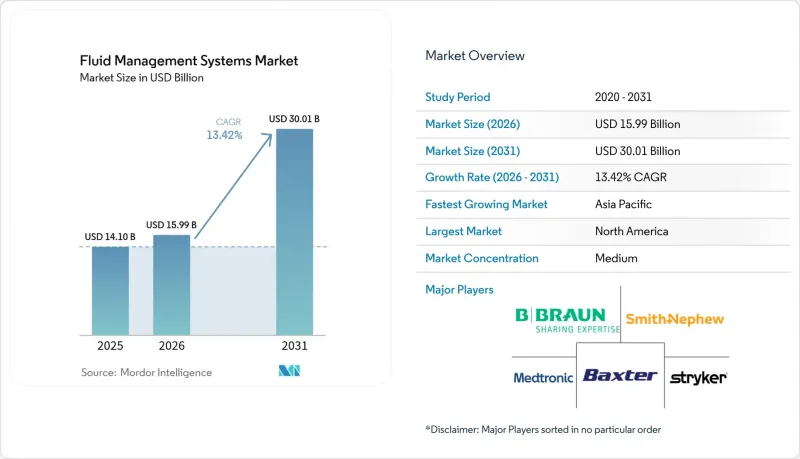
Mordor Intelligence에 의하면, 유체 관리 시스템 시장 규모는 2025년 141억 달러에서 2026년에는 159억 9,000만 달러에 이르고, 2026-2031년 CAGR 13.42%로 성장을 지속하여 2031년에는 300억 1,000만 달러에 달할 것으로 예측됩니다.
본 보고서에서는 산업을 제품별(투석 장치, 인플레이터, 기타), 일회용 제품·부속품별(카테터, 혈액 회로, 기타),용도별(관절경 검사, 복강경 검사, 기타), 최종 사용자별(병원, 기타), 지역별(북미, 유럽, 아시아태평양, 중동 및 아프리카, 남미)로 분류하고 있습니다. 예측치는 금액(달러)으로 표시되어 있습니다.
전 세계 유체 관리 시스템 시장 동향 및 인사이트
최소 침습 수술 건수 증가
현재, 최소 침습 수술은 많은 정형외과 및 일반외과 진료 분야에서 주류를 이루고 있으며, 우수한 시야 확보와 안정적인 관강 내압을 유지할 수 있는 관류, 흡입, 공기 주입 기술에 대한 수요가 증가하고 있습니다. 일일 수술센터에서는 워크플로우와 문서 작성을 효율화하는 통합형 체액 관리 플랫폼을 확보하기 위해 의료 기술 공급업체와의 구매 계약을 표준화하고 있습니다. AI가 통합된 의료기기는 유량 매개변수를 더욱 최적화하여 출혈량의 편차를 줄이고 있습니다. 이러한 변화들이 맞물리면서 병원과 외래 시설 모두에서 고사양 시스템의 도입 대수가 증가하고 있습니다.
만성 신장 질환 및 말기 신부전(ESRD) 유병률 증가
만성 신장 질환은 전 세계적으로 8억 5,000만 명 이상에게 영향을 미치고 있으며, 이로 인해 투석 시술 건수가 증가하는 동시에 바늘을 사용하지 않는 커넥터와 양방향 데이터 통신 기능을 갖춘 새로운 투석 막이 필요해지고 있습니다. 2025년에 도입이 예정된 혈액투석여과(HDF)는 독소 제거 효율이 향상될 것으로 예상되며, 한편 폐쇄 루프 피드백 제어를 통해 28건의 임상시험 중 23건에서 투석 중 저혈압 발생률이 감소했습니다. 이러한 발전으로 인해 클리닉이나 재택 환경을 불문하고 투석 전용 유체 관리 플랫폼에 대한 수요가 지속적으로 뒷받침되고 있습니다.
내시경 수술 훈련을 받은 외과의사 부족
2028년까지 외과 전문의가 18% 감소할 것으로 예측되어, 많은 지역에서 수술 대기 기간이 길어지고 있습니다. 지방 병원에서는 인력 확보가 가장 어려워, 첨단 내시경용 유체 시스템의 도입이 제한되고 이용률이 떨어지고 있습니다. 지방 지역은 외과 의사 부족의 영향을 특히 크게 받고 있어, 첨단 유체 관리 기술에 대한 접근이 제한되고, 의료 제공에 있어 지역 간 격차가 발생하고 있습니다. 현대의 유체 관리 시스템은 복잡하기 때문에 전문적인 훈련이 필요하지만, 모든 의료 현장에서 쉽게 받을 수 있는 것은 아니며, 기술의 발전에도 불구하고 도입률이 제한될 가능성이 있습니다.
부문 분석
투석기는 2025년 매출의 26.31%를 차지하고 있으며, 이는 광범위한 체액 관리 시스템 시장에서 신장 대체 요법이 필수적임을 반영합니다. 프레제니우스 메디컬케어(Fresenius Medical Care)는 2024년에 215억 유로의 매출을 기록하며, 자사의 투석기 제품 라인의 견고함을 입증했습니다. 유체 및 폐기물 관리 시스템은 폐기 관련 규제가 강화되는 가운데 2031년까지 연평균 성장률(CAGR) 14.09%로 확대될 것으로 전망됩니다. 의료 서비스 제공업체들이 최신 안전 기준을 충족하고 온도 제어 기능 및 연기 배출 기능을 갖춘 키트를 최소 침습 수술실에 도입함에 따라, 공기 공급 장치, 흡입 장치, 유체 가열 장치는 꾸준한 성장세를 보이고 있습니다.
AI 센서, 클라우드 대시보드, 모듈형 허브 등으로 구성된 롱테일 ‘기타 제품’ 카테고리는 예측 알고리즘을 통해 측정 가능한 비용 절감이 실현될 경우, 소프트웨어 중심 벤더로 시장 점유율이 이동할 가능성이 있습니다. 부문별 이익률은 크게 다릅니다. 투석기용 소모품은 높은 지속적 수익을 누리고 있는 반면, 자본 집약적인 콘솔은 교체 주기가 길기 때문에 각 하위 시장의 전략적 과제의 차이가 두드러지게 나타나고 있습니다.
카테터는 이 카테고리에서 2025년 매출의 33.02%를 차지하고 있으며, 이는 모든 의료 현장에서 혈관 접근, 관류, 배액에 보편적으로 적용되고 있음을 반영합니다. LSI 소재, 항균 코팅, 비틀림 방지 형태는 프리미엄 SKU를 차별화하고 병원의 감염 관리 목표를 지원하고 있습니다. 밸브는 연평균 성장률(CAGR) 16.55%로 향후 성장을 주도하고 있으며, 스마트팜프와 원활하게 연동되는 자동 차단 기능 및 역류 방지 설계에 대한 수요 증가를 반영하고 있습니다. 튜브 세트와 혈액 회로는 대량으로 소비되는 주력 제품이지만, 압력 센서나 RFID 추적 기능을 통합한 통합 키트로 그 가치가 이동하고 있습니다.
수지 가격 급등으로 인해 이익률 변동이 발생하고 있으며, 각 OEM 업체들은 폴리머 조달처를 2개사로 분산하거나 플라스틱 중량을 줄이기 위해 포장을 재설계하고 있습니다. EU의 법규에 따라 재활용 가능성 기준이 강화되는 가운데, 조기에 배합을 최적화한 공급업체는 다년간공급 계약을 체결하여 유체 관리 시스템 시장에서의 점유율을 공고히 할 수 있을 것으로 보입니다.
지역별 분석
북미는 견실한 상환 제도와 AI 모니터의 조기 도입에 힘입어 2025년 매출의 41.12%를 차지했습니다. 보스턴 사이언티피크(Boston Scientific)의 2025년 1분기 매출액 46억 6,300만 달러는 정밀한 관류 제어에 의존하는 고급 심혈관 솔루션에 대한 이 지역의 높은 수요를 뒷받침합니다. FDA의 규제 조화로 인해 여러 의료기관에서의 도입이 원활해질 전망이지만, 다가오는 외과 의료 인력 부족이 성장을 둔화시킬 가능성이 있습니다.
아시아태평양은 연평균 성장률(CAGR) 14.6%로 성장을 지속하며 시장의 원동력이 되고 있습니다. 중국에서는 3차 의료 기관 확충이 진행되고 있는 반면, 인도에서는 공공 자금이 투석 클리닉에 투입되고 있습니다. 규제의 다양성으로 인해 시장 진입 채널에 대한 개별적인 대응이 필요하지만, 규제 당국이 규제 체계를 현대화함에 따라 의료기기 승인은 전반적으로 가속화되고 있습니다.
유럽에서는 시장의 성숙도와 지속가능성에 대한 요구 간의 균형이 잡혀 있습니다. 시판 후 조사 및 재활용 가능한 포장에 관한 EU 지침에 따라 부품 설계가 재검토되고 있으며, 제조부터 폐기에 이르는 전 과정의 규정 준수를 검증할 수 있는 제조업체가 유리한 입지를 점하고 있습니다. 한편, 독일과 프랑스의 권한 이양 정책으로 인해 휴대용 유체 장치에 의존하는 외래 수술 건수가 증가하고 있습니다.
중동 및 아프리카와 남미는 절대 규모 면에서는 뒤처져 있지만, 인프라 프로젝트와 증가하는 비전염성 질환의 부담이 맞물려 두 자릿수 성장이 예상되는 부문이 존재합니다. 환율 변동과 수입 관세는 여전히 역풍으로 작용하고 있어, 공급업체들은 유체 관리 시스템 시장의 이러한 부문에 진입하기 위해 현지 조립이나 전략적인 유통업체와의 제휴를 모색해야 하는 상황에 처해 있습니다.
기타 혜택
- 엑셀 형식 시장 예측(ME) 시트
- 3개월간의 애널리스트 지원
자주 묻는 질문
목차
제1장 서론
제2장 조사 방법
제3장 주요 요약
제4장 시장 구도
제5장 시장 규모와 성장 예측
제6장 경쟁 구도
제7장 시장 기회와 향후 전망
LSH 26.09.02According to Mordor Intelligence, the fluid management systems market size is expected to grow from USD 14.10 billion in 2025 to USD 15.99 billion in 2026 and is forecast to reach USD 30.01 billion by 2031 at 13.42% CAGR over 2026-2031.
This report Segments the Industry Into by Product (Dialyzers, Insufflators, and More), Disposables and Accessories (Catheters, Bloodlines, and More), Application (Arthroscopy, Laparoscopy, and More), End User (Hospitals, and More), and Geography (North America, Europe, Asia-Pacific, Middle East and Africa, and South America). The Forecasts are Provided in Terms of Value (USD).
Global Fluid Management Systems Market Trends and Insights
Rise in Minimally-Invasive Surgery Volumes
Minimally invasive procedures now dominate many orthopedic and general surgery service lines, increasing demand for irrigation, suction, and insufflation technologies that can maintain clear visibility and stable cavity pressure. Ambulatory surgery centers are standardizing purchasing agreements with med-tech vendors to secure integrated fluid management platforms that streamline workflow and documentation. AI-enhanced devices are further optimizing flow parameters and reducing blood-loss variability. Together, these shifts are enlarging the installed base of high-specification systems in both hospitals and outpatient facilities.
Growing Prevalence of Chronic Kidney Disease & ESRD
Chronic kidney disease affects more than 850 million people worldwide, pushing dialysis procedure volumes higher and requiring new dialyzer membranes with needle-free connectors and bi-directional data feeds. Hemodiafiltration rollouts in the United States during 2025 promise better toxin clearance, while closed-loop feedback controls have lowered intradialytic hypotension events in 23 of 28 clinical trials. These advancements underpin sustained unit demand for dialysis-specific fluid management platforms across clinics and home settings.
Shortage of Endoscopy-Trained Surgeons
An 18% decline in surgical specialists projected by 2028 is delaying procedure backlogs in many regions. Rural hospitals find it hardest to recruit talent, limiting deployment of advanced endoscopic fluid systems and depressing utilization rates. Rural areas are disproportionately affected by surgeon shortages, limiting access to advanced fluid management technologies and creating geographic disparities in care delivery. The complexity of modern fluid management systems requires specialized training that may not be readily available in all healthcare settings, potentially limiting adoption rates despite technological advancement.
Other drivers and restraints analyzed in the detailed report include:
- AI-Enabled Closed-Loop Ultrafiltration Control Adoption
- Integrated Fluid-Waste & Disposable Insufflation Systems
- High Capital Cost of Integrated Platforms
For complete list of drivers and restraints, kindly check the Table Of Contents.
Segment Analysis
Dialyzers generated 26.31% of 2025 revenue, reflecting the indispensable nature of renal replacement therapy within the broader fluid management systems market. Fresenius Medical Care posted EUR 21.5 billion in 2024 revenue, confirming the resilience of its dialyzer line. Fluid-waste management systems are set to rise at a 14.09% CAGR to 2031, propelled by stricter disposal mandates. Insufflators, suction units, and fluid warmers register steady gains as providers equip minimally invasive theaters with temperature-controlled, smoke-evacuation-ready kits that meet modern safety codes.
The long-tail "other products" bucket comprising AI sensors, cloud dashboards, and modular hubs could shift share toward software-centric vendors if predictive algorithms deliver measurable cost savings. Segment margins vary widely: dialyzer consumables enjoy high recurring revenue, whereas capital-intensive consoles face lengthier replacement cycles, underscoring distinct strategic imperatives within each sub-market.
Catheters accounted for 33.02% of 2025 revenues in this category, reflecting universal application in vascular access, irrigation, and drainage across settings. LSI materials, antimicrobial coatings, and kink-resistant geometries differentiate premium SKUs and support hospitals' infection-control targets. Valves headline future growth with a 16.55% CAGR, mirroring rising demand for automated shut-off and anti-reflux designs that pair seamlessly with smart pumps. Tubing sets and bloodlines represent high-volume staples, but value migration is underway toward integrated kits that bundle pressure sensors and RFID tracking.
Resin price spikes create margin volatility, prompting OEMs to dual-source polymers and redesign packaging to cut plastic weight. As EU legislation ratchets up recyclability thresholds, suppliers that calibrate formulations early could lock in multi-year supply contracts and solidify share positions within the fluid management systems market.
Complete Report Scope:
- By Product
- Dialyzers
- Insufflators
- Suction & Irrigation Systems
- Fluid-Warming Devices
- Fluid-Waste Management
- Other Products
- By Disposables & Accessories
- Catheters
- Bloodlines
- Transducers
- Valves
- Tubing Sets
- Other Disposables
- By Application
- Arthroscopy
- Laparoscopy
- Neurology
- Cardiology
- Urology
- Dental
- Gastroenterology
- Other Applications
- By End User
- Hospitals
- Ambulatory Surgical Centers
- Dialysis Centers
- Specialty Clinics
- Home-Care Settings
- By Geography
- North America
- United States
- Canada
- Mexico
- Europe
- Germany
- United Kingdom
- France
- Italy
- Spain
- Rest of Europe
- Asia-Pacific
- China
- Japan
- India
- Australia
- South Korea
- Rest of Asia-Pacific
- Middle East & Africa
- GCC
- South Africa
- Rest of Middle East & Africa
- South America
- Brazil
- Argentina
- Rest of South America
- North America
Geography Analysis
North America produced 41.12% of 2025 revenues, lifted by robust reimbursement and early adoption of AI monitors. Boston Scientific's USD 4.663 billion Q1 2025 sales underline the region's appetite for high-end cardiovascular solutions that rely on precise perfusion control. FDA rule harmonization is expected to streamline multi-site rollouts, though looming surgical workforce shortages could temper growth.
Asia-Pacific is the engine of expansion, advancing at a 14.6% CAGR. China is scaling tertiary hospitals, while India channels public funding into dialysis clinics. Regulatory diversity requires tailored market-access pathways, yet overall device approvals are accelerating as agencies modernize frameworks.
Europe balances maturity with sustainability imperatives. EU directives on post-market surveillance and recyclable packaging are reshaping component design, favoring manufacturers that can verify cradle-to-grave compliance. Meanwhile, decentralization policies in Germany and France bolster outpatient procedure volumes that depend on mobile fluid equipment.
Middle East & Africa and South America trail in absolute size but offer double-digit growth pockets where infrastructure projects align with rising non-communicable disease burdens. Currency fluctuations and import tariffs remain headwinds, pushing suppliers toward local assembly and strategic distributor alliances to penetrate these segments of the fluid management systems market.
- B. Braun
- Baxter
- Beckton Dickinson
- Cardinal Health
- Hologic
- Johnson & Johnson
- Medtronic
- Smiths Group
- Smiths Group
- Stryker
- Fresenius
- Olympus Corp.
- Zimmer Biomet
- Arthrex
- AngioDynamics
- Ecolab (Skytron)
- Teleflex
- Nipro Corp.
- Asahi Kasei Corp.
- ConMed Corp.
- Karl Storz
- Boston Scientific
Additional Benefits:
- The market estimate (ME) sheet in Excel format
- 3 months of analyst support
TABLE OF CONTENTS
1 Introduction
- 1.1 Study Assumptions & Market Definition
- 1.2 Scope of the Study
2 Research Methodology
3 Executive Summary
4 Market Landscape
- 4.1 Market Overview
- 4.2 Market Drivers
- 4.2.1 Rise in Minimally-Invasive Surgery Volumes
- 4.2.2 Growing Prevalence of Chronic Kidney Disease & ESRD
- 4.2.3 AI-Enabled Closed-Loop Ultrafiltration Control Adoption
- 4.2.4 Integrated Fluid-Waste & Disposable Insufflation Systems
- 4.2.5 Shift Toward Portable Home-Dialysis Fluid Platforms
- 4.2.6 Regulatory Push on OR Fluid-Waste Compliance
- 4.3 Market Restraints
- 4.3.1 Shortage of Endoscopy-Trained Surgeons
- 4.3.2 High Capital Cost of Integrated Platforms
- 4.3.3 Single-Use-Plastic Legislation Inflating Consumable Costs
- 4.3.4 Volatile Supply of Medical-Grade Polymers & Resins
- 4.4 Porter's Five Forces Analysis
- 4.4.1 Threat of New Entrants
- 4.4.2 Bargaining Power of Buyers
- 4.4.3 Bargaining Power of Suppliers
- 4.4.4 Threat of Substitutes
- 4.4.5 Intensity of Competitive Rivalry
5 Market Size & Growth Forecasts (Value in USD)
- 5.1 By Product
- 5.1.1 Dialyzers
- 5.1.2 Insufflators
- 5.1.3 Suction & Irrigation Systems
- 5.1.4 Fluid-Warming Devices
- 5.1.5 Fluid-Waste Management
- 5.1.6 Other Products
- 5.2 By Disposables & Accessories
- 5.2.1 Catheters
- 5.2.2 Bloodlines
- 5.2.3 Transducers
- 5.2.4 Valves
- 5.2.5 Tubing Sets
- 5.2.6 Other Disposables
- 5.3 By Application
- 5.3.1 Arthroscopy
- 5.3.2 Laparoscopy
- 5.3.3 Neurology
- 5.3.4 Cardiology
- 5.3.5 Urology
- 5.3.6 Dental
- 5.3.7 Gastroenterology
- 5.3.8 Other Applications
- 5.4 By End User
- 5.4.1 Hospitals
- 5.4.2 Ambulatory Surgical Centers
- 5.4.3 Dialysis Centers
- 5.4.4 Specialty Clinics
- 5.4.5 Home-Care Settings
- 5.5 By Geography
- 5.5.1 North America
- 5.5.1.1 United States
- 5.5.1.2 Canada
- 5.5.1.3 Mexico
- 5.5.2 Europe
- 5.5.2.1 Germany
- 5.5.2.2 United Kingdom
- 5.5.2.3 France
- 5.5.2.4 Italy
- 5.5.2.5 Spain
- 5.5.2.6 Rest of Europe
- 5.5.3 Asia-Pacific
- 5.5.3.1 China
- 5.5.3.2 Japan
- 5.5.3.3 India
- 5.5.3.4 Australia
- 5.5.3.5 South Korea
- 5.5.3.6 Rest of Asia-Pacific
- 5.5.4 Middle East & Africa
- 5.5.4.1 GCC
- 5.5.4.2 South Africa
- 5.5.4.3 Rest of Middle East & Africa
- 5.5.5 South America
- 5.5.5.1 Brazil
- 5.5.5.2 Argentina
- 5.5.5.3 Rest of South America
- 5.5.1 North America
6 Competitive Landscape
- 6.1 Market Concentration
- 6.2 Market Share Analysis
- 6.3 Company Profiles (includes Global level Overview, Market level overview, Core Segments, Financials as available, Strategic Information, Market Rank/Share for key companies, Products & Services, and Recent Developments)
- 6.3.1 B. Braun Melsungen AG
- 6.3.2 Baxter International Inc.
- 6.3.3 Becton, Dickinson & Co.
- 6.3.4 Cardinal Health Inc.
- 6.3.5 Hologic Inc.
- 6.3.6 Johnson & Johnson
- 6.3.7 Medtronic plc
- 6.3.8 Smiths Medical (ICU Medical)
- 6.3.9 Smith & Nephew plc
- 6.3.10 Stryker Corp.
- 6.3.11 Fresenius Medical Care AG & Co. KGaA
- 6.3.12 Olympus Corp.
- 6.3.13 Zimmer Biomet Holdings Inc.
- 6.3.14 Arthrex Inc.
- 6.3.15 AngioDynamics Inc.
- 6.3.16 Ecolab (Skytron)
- 6.3.17 Teleflex Inc.
- 6.3.18 Nipro Corp.
- 6.3.19 Asahi Kasei Corp.
- 6.3.20 ConMed Corp.
- 6.3.21 Karl Storz SE & Co. KG
- 6.3.22 Boston Scientific Corp.
7 Market Opportunities & Future Outlook
- 7.1 White-Space & Unmet-Need Assessment