

|
시장보고서
상품코드
2121730
항콕시듐제 : 시장 점유율 분석, 업계 동향과 통계, 성장 예측(2026-2031년)Anticoccidial Drugs - Market Share Analysis, Industry Trends & Statistics, Growth Forecasts (2026 - 2031) |
||||||
 Mordor Intelligence
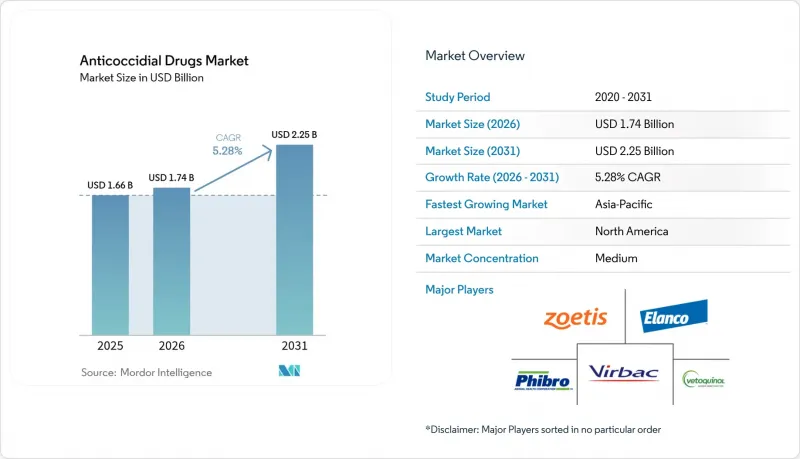
Mordor Intelligence에 따르면 항콕시듐제 시장 규모는 2025년에 16억 6,000만 달러로 평가되며, 2026년 17억 4,000만 달러에서 2031년까지 22억 5,000만 달러에 달할 것으로 예측되며, 예측 기간(2026-2031년) 동안 CAGR은 5.28%가 될 전망입니다.
본 보고서는 제품별(이오노포어계 항콕시듐제, 합성화학계 항콕시듐제, 기타), 동물 유형별(가금류, 소, 돼지, 기타), 약제 작용(콕시디움 증식 억제제, 콕시디움 구제제), 유통 채널(동물병원, 기타), 지역(북미, 유럽, 아시아태평양, 중동 및 아프리카, 남미)별로 분류되어 있습니다. 시장 예측은 금액(달러) 단위로 제시되어 있습니다.
세계 항콕시듐제 시장의 동향 및 인사이트
신흥 경제국에서의 통합형 가금류 생산 급증
중국, 인도, 걸프 국가의 수직 통합형 생산자들은 질병 관리 프로토콜의 통합을 지속하고 있으며, 사망률을 낮추고 사료 효율을 향상시키는 표준화된 항콕시듐제 투여 계획을 의무화하고 있습니다. 확대되는 계약 양계업자 네트워크에서는 공급 계약에 이오노포어 계열 약제의 순환 투여 규정이 포함되어 있어, 이를 통해 구매 주기가 단축되고 주요 제조사와의 대량 구매 할인 협상이 촉진되고 있습니다.
집약적 축산에서 콕시듐증의 유병률 상승 및 경제적 부담
고밀도 사육 시스템에서 체중 증가가 미흡하고 사료 전환율이 상승함에 따라 전 세계적인 경제적 손실은 100억 달러를 초과하고 있습니다. EU와 북미의 케이지 프리 의무화는 의도치 않게 깔짚과의 접촉을 증가시켜 발병률을 15-20% 끌어올리고 있습니다. 육계의 사망률이 2%를 초과하는 경우, 이오노포어 계열 약제를 이용한 예방 조치는 여전히 경제적으로 타당합니다.
기존 약물 군의 항생제 내성 및 로테이션 피로
WHO가 15개국에서 실시한 모니터링에 따르면, 아시아 육계 군의 40% 이상에서 모넨신 내성 아이메리아가 확인되어, 유효한 약물 순환 기간이 12개월에서 6개월로 단축되었습니다. 약제군을 추가하면 닭 한 마리당 사료 비용이 최대 0.02달러 증가하기 때문에 단가가 높음에도 불구하고 통합형 생산자들은 백신으로 전환할 수밖에 없는 실정입니다.
부문 분석
2025년, 이오노포어계 항콕시듐제는 항콕시듐제 시장 점유율의 54.22%를 차지했으며, 모네신스의 광범위한 적용 종과 연간 3억 달러를 넘는 매출이 이를 견인했습니다. 지역별로는 아시아태평양의 구매자들이 펠릿화의 안정성 때문에 살리노마이신과 나라신을 선호하는 반면, 복합 제품은 사육 주기가 긴 종계군을 대상으로 합니다.
식물 유래 대체제는 유기농 인증 수요 확대에 힘입어 연평균 성장률(CAGR) 5.86%로 성장하고 있습니다. Rabar의 ‘Cox-Free’는 브라질과 인도에서 사망률을 63% 감소시켰습니다. 한편, dsm-firmenich의 ‘AccuGut C.1’은 현장 시험에서 사료 전환율 측면에서 모네신과 2% 이내의 차이를 보였습니다. 2026년 말 가동을 시작할 예정인 Ceva의 헝가리 공장은 NAE 티어에 대응하기 위해 연간 80억 회분의 백신을 추가로 공급하게 됩니다.
2025년 항콕시듐제 시장에서 소가 58.07%를 차지했습니다. 이는 비육장에서 모넨신의 채택이 뒷받침한 결과로, 이를 통해 사료 효율이 5-8% 향상되고 메탄 배출량을 최대 15%까지 감축하고 있습니다. 가금류는 매출액 기준으로는 여전히 부차적인 위치를 차지하고 있지만, 수량 기준으로는 주요 위치를 차지하고 있으며, 육계 셔틀 프로그램에서는 이오노포어 계열 약물과 트리아진 계열 약물이 순환적으로 사용되고 있습니다.
반려동물 시장의 매출액은 원격의료 플랫폼의 보급으로 인해 강아지와 새끼 고양이의 콕시듐증 진단이 일반화됨에 따라 연평균 성장률(CAGR) 7.99%로 확대되고 있습니다. 포나즈릴 치료 과정의 소매 가격은 30-50달러이며, 가축용 제품보다 1회 투여당 이익률이 높습니다.
지역별 분석
2025년 매출액 중 북미가 40.91%를 차지했습니다. 이는 사료 프로토콜에 모넨신을 포함하고 있는 95억 마리의 미국산 육계와 9,500만 마리의 소에 의해 뒷받침된 결과입니다. 캐나다의 고급 계란 부문에서는 백신 도입이 가속화된 반면, 멕시코에서는 페소 환율 변동으로 인해 API 수입 비용이 증가했습니다.
아시아태평양은 중국의 2,510만 톤 가금류 생산량과 인도의 계약 사육업자 부상으로 인해 연평균 성장률(CAGR) 9.35%로 확대될 것으로 예측됩니다. 중국 남부의 약물 내성 핫스팟으로 인해 가격이 30-40% 더 비싸음에도 불구하고, 디클라즈릴에 대한 수요가 증가하고 있습니다.
유럽에서는 엄격한 잔류 기준(MRL)과 복지 규제로 인해 백신이 우선시되고 있는 반면, 라틴아메리카에서는 이오노포어 계열 약제의 경제성과 EU 잔류 기준 준수의 균형이 이루어지고 있습니다. 중동 및 아프리카는 수입 API에 의존하고 있으며, 비메다(Bimeda)의 두바이 거점은 아프리벳(Afrivet) 인수를 계기로 현재 남아프리카의 통합 양계 업체에 제품을 공급하고 있습니다.
기타 혜택
- 엑셀 형식의 시장 예측(ME) 시트
- 3개월간 애널리스트 지원
자주 묻는 질문
목차
제1장 소개
제2장 조사 방법
제3장 주요 요약
제4장 시장 구도
제5장 시장 규모와 성장 예측
제6장 경쟁 구도
제7장 시장 기회와 향후 전망
KSM 26.09.07According to Mordor Intelligence, the anticoccidial drugs market size was valued at USD 1.66 billion in 2025 and is estimated to grow from USD 1.74 billion in 2026 to reach USD 2.25 billion by 2031, at a CAGR of 5.28% during the forecast period (2026-2031).
This report is Segmented by Product (Ionophore Anticoccidials, Synthetic Chemical Anticoccidials, and More), Animal Type (Poultry, Cattle, Swine, and More), Drug Action (Coccidiostatic, Coccidiocidal), Distribution Channel (Veterinary Hospitals, and More), and Geography (North America, Europe, Asia-Pacific, Middle East & Africa, South America). Market Forecasts are Provided in Terms of Value (USD).
Global Anticoccidial Drugs Market Trends and Insights
Surge in Integrated Poultry Production in Emerging Economies
Vertically integrated producers in China, India, and the Gulf states continue to consolidate disease-control protocols, mandating standardized anticoccidial regimens that cut mortality and improve feed efficiency. Expanded contract-grower networks embed ionophore rotation rules into supply agreements, compressing purchasing cycles and favoring volume-discount negotiations with top manufacturers.
Rising Prevalence and Economic Burden of Coccidiosis on Intensive Livestock
Global economic losses exceed USD 10 billion, driven by suboptimal weight gain and elevated feed-conversion ratios in high-density systems. Cage-free mandates in the EU and North America inadvertently raise litter contact, lifting incidence by 15-20%. Ionophore-based prevention remains economically justified whenever mortality tops 2% in broilers.
Antimicrobial Resistance & Rotation Fatigue Among Existing Drug Classes
WHO surveillance in 15 countries logged monensin-resistant Eimeria in more than 40% of Asian broiler flocks, shortening effective rotation windows from 12 to 6 months.Adding drug classes increases feed costs by up to USD 0.02 per bird, nudging integrators toward vaccines despite higher unit prices.
Other drivers and restraints analyzed in the detailed report include:
- Regulatory Preference for Non-Medically Important Antimicrobials
- Industry Shift Toward Preventive Feed Additives to Improve Feed Efficiency
- Stringent Residue Limits & Prophylactic Bans in Key Export Markets
For complete list of drivers and restraints, kindly check the Table Of Contents.
Segment Analysis
Ionophore anticoccidials held 54.22% of the anticoccidial market share in 2025, led by monensin's wide species label and USD 300 million-plus annual sales. Regionally, Asia-Pacific buyers favor salinomycin and narasin for pelleting stability, while combination products target breeder flocks with extended cycles.
Botanical alternatives are growing at a 5.86% CAGR, leveraging organic certification pull-through. Rabar's Cox-Free reduced mortality by 63% in Brazil and India, while dsm-firmenich's AccuGut C.1 delivered feed-conversion parity within 2% of monensin in field trials. Ceva's Hungary facility, due to end-2026, will add 8 billion vaccine doses per year to serve the NAE tier.
Cattle accounted for 58.07% of the anticoccidial market in 2025, riding on feedlot adoption of monensin, which lifts feed efficiency by 5-8% and trims methane by up to 15%. Poultry remains secondary in value yet primary in volume, with broiler shuttle programs rotating ionophores and triazines.
Companion-animal revenue is expanding at a 7.99% CAGR as telemedicine platforms normalize coccidiosis diagnosis in puppies and kittens. Ponazuril courses retail at USD 30-50, yielding higher per-dose margins than livestock tonnage.
Complete Report Scope:
- By Product
- Ionophore Anticoccidials
- Synthetic Chemical Anticoccidials
- Botanical & Phytogenic Alternatives
- Combination Products
- Live Attenuated & Recombinant Vaccines
- By Animal Type
- Poultry
- Broilers
- Layers
- Breeders
- Cattle
- Swine
- Sheep & Goats
- Aquaculture
- Companion Animals
- Poultry
- By Drug Action
- Coccidiostatic
- Coccidiocidal
- By Distribution Channel
- Veterinary Hospitals
- Veterinary Clinics
- Online Pharmacies
- By Geography
- North America
- United States
- Canada
- Mexico
- Europe
- Germany
- United Kingdom
- France
- Italy
- Spain
- Rest of Europe
- Asia-Pacific
- China
- Japan
- India
- Australia
- South Korea
- Rest of Asia-Pacific
- Middle East & Africa
- GCC
- South Africa
- Rest of Middle East & Africa
- South America
- Brazil
- Argentina
- Rest of South America
- North America
Geography Analysis
North America accounted for 40.91% of revenue in 2025, underpinned by 9.5 billion U.S. broilers and 95 million cattle that incorporate monensin into feed protocols. Canada's premium egg sector accelerated vaccine uptake, while Mexico's peso volatility widened API import costs.
Asia-Pacific is projected to expand at a 9.35% CAGR, propelled by China's 25.1 million-tonne poultry output and India's contract-grower ascent. Resistance hotspots in southern China are driving up diclazuril demand despite pricing 30-40% higher.
Europe's stringent MRLs and welfare rules prioritize vaccines, whereas Latin America balances ionophore economics with EU residue compliance. Middle East & Africa rely on imported APIs; Bimeda's Dubai hub now supplies South African integrators following its acquisition of Afrivet.
- Abbott Laboratories
- Bayer
- Bimeda Animal Health Ltd.
- BioProperties Pty Ltd.
- Boehringer Ingelheim
- Cargill Incorporated
- Ceva Sante Animale
- Elanco
- Hipra Scientific, S.L.U.
- Huvepharma EOOD
- Impextraco
- Kemin Industries
- Novus International, Inc.
- Phibro Animal Health
- Qilu Animal Health Products Co., Ltd.
- Vetoquinol
- Virbac S.A.
- Zoetis
- Zydus Animal Health
Additional Benefits:
- The market estimate (ME) sheet in Excel format
- 3 months of analyst support
TABLE OF CONTENTS
1 Introduction
- 1.1 Study Assumptions & Market Definition
- 1.2 Scope of the Study
2 Research Methodology
3 Executive Summary
4 Market Landscape
- 4.1 Market Overview
- 4.2 Market Drivers
- 4.2.1 Surge In Integrated Poultry Production In Emerging Economies
- 4.2.2 Rising Prevalence and Economic Burden of Coccidiosis on Intensive Livestock
- 4.2.3 Regulatory Preference for Non-Medically Important Antimicrobials
- 4.2.4 Industry Shift Toward Preventive Feed Additives to Improve Feed Efficiency
- 4.2.5 Adoption of Precision-Dosing Micro-Encapsulated Anticoccidials Via IoT Monitoring
- 4.2.6 Tariff-Driven Localization of Ionophore API Manufacturing
- 4.3 Market Restraints
- 4.3.1 Antimicrobial Resistance & Rotation Fatigue Among Existing Drug Classes
- 4.3.2 Stringent Residue Limits & Prophylactic Bans in Key Export Markets
- 4.3.3 Rapid Uptake of Multi-Valent Eimeria Vaccines in NAE Poultry Segments
- 4.3.4 Volatile Ionophore-Precursor Prices from Supply-Chain Shocks
- 4.4 Regulatory Landscape
- 4.5 Technological Outlook
- 4.6 Porter's Five Forces Analysis
- 4.6.1 Threat of New Entrants
- 4.6.2 Bargaining Power of Buyers
- 4.6.3 Bargaining Power of Suppliers
- 4.6.4 Threat of Substitute Products
- 4.6.5 Intensity of Competitive Rivalry
5 Market Size & Growth Forecasts
- 5.1 By Product
- 5.1.1 Ionophore Anticoccidials
- 5.1.2 Synthetic Chemical Anticoccidials
- 5.1.3 Botanical & Phytogenic Alternatives
- 5.1.4 Combination Products
- 5.1.5 Live Attenuated & Recombinant Vaccines
- 5.2 By Animal Type
- 5.2.1 Poultry
- 5.2.1.1 Broilers
- 5.2.1.2 Layers
- 5.2.1.3 Breeders
- 5.2.2 Cattle
- 5.2.3 Swine
- 5.2.4 Sheep & Goats
- 5.2.5 Aquaculture
- 5.2.6 Companion Animals
- 5.2.1 Poultry
- 5.3 By Drug Action
- 5.3.1 Coccidiostatic
- 5.3.2 Coccidiocidal
- 5.4 By Distribution Channel
- 5.4.1 Veterinary Hospitals
- 5.4.2 Veterinary Clinics
- 5.4.3 Online Pharmacies
- 5.5 By Geography
- 5.5.1 North America
- 5.5.1.1 United States
- 5.5.1.2 Canada
- 5.5.1.3 Mexico
- 5.5.2 Europe
- 5.5.2.1 Germany
- 5.5.2.2 United Kingdom
- 5.5.2.3 France
- 5.5.2.4 Italy
- 5.5.2.5 Spain
- 5.5.2.6 Rest of Europe
- 5.5.3 Asia-Pacific
- 5.5.3.1 China
- 5.5.3.2 Japan
- 5.5.3.3 India
- 5.5.3.4 Australia
- 5.5.3.5 South Korea
- 5.5.3.6 Rest of Asia-Pacific
- 5.5.4 Middle East & Africa
- 5.5.4.1 GCC
- 5.5.4.2 South Africa
- 5.5.4.3 Rest of Middle East & Africa
- 5.5.5 South America
- 5.5.5.1 Brazil
- 5.5.5.2 Argentina
- 5.5.5.3 Rest of South America
- 5.5.1 North America
6 Competitive Landscape
- 6.1 Market Concentration
- 6.2 Market Share Analysis
- 6.3 Company Profiles (includes Global Level Overview, Market Level Overview, Core Segments, Financials as Available, Strategic Information, Market Rank/Share for Key Companies, Products & Services, and Recent Developments)
- 6.3.1 Abbott Laboratories
- 6.3.2 Bayer AG
- 6.3.3 Bimeda Animal Health Ltd.
- 6.3.4 BioProperties Pty Ltd.
- 6.3.5 Boehringer Ingelheim International GmbH
- 6.3.6 Cargill Incorporated
- 6.3.7 Ceva Sante Animale
- 6.3.8 Elanco Animal Health Incorporated
- 6.3.9 Hipra Scientific, S.L.U.
- 6.3.10 Huvepharma EOOD
- 6.3.11 Impextraco NV
- 6.3.12 Kemin Industries, Inc.
- 6.3.13 Novus International, Inc.
- 6.3.14 Phibro Animal Health Corporation
- 6.3.15 Qilu Animal Health Products Co., Ltd.
- 6.3.16 Vetoquinol S.A.
- 6.3.17 Virbac S.A.
- 6.3.18 Zoetis Inc.
- 6.3.19 Zydus Animal Health
7 Market Opportunities & Future Outlook
- 7.1 White-space & Unmet-Need Assessment


