

|
시장보고서
상품코드
2121733
유리 타일 : 시장 점유율 분석, 업계 동향과 통계, 성장 예측(2026-2031년)Glass Tiles - Market Share Analysis, Industry Trends & Statistics, Growth Forecasts (2026 - 2031) |
||||||
 Mordor Intelligence
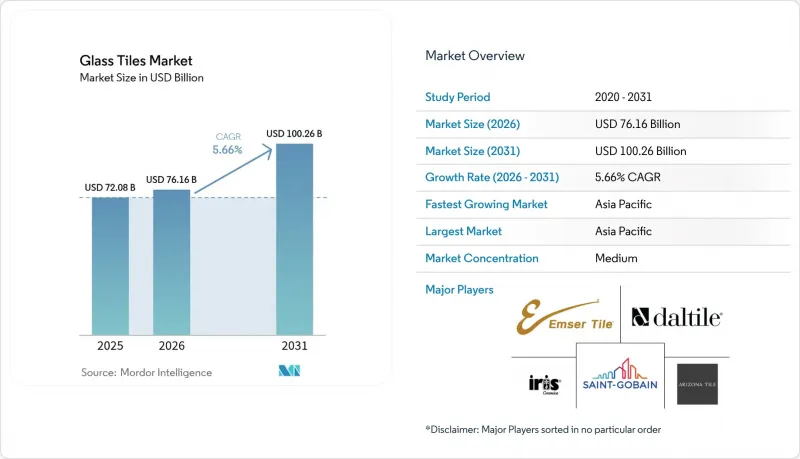
Mordor Intelligence에 의하면, 유리 타일 시장 규모는 2025년에 720억 8,000만 달러로 평가되었고, 2026년 761억 6,000만 달러에서 2031년까지 1,002억 6,000만 달러에 이를 것으로 예측되며, 예측 기간(2026-2031년) CAGR은 5.66%를 기록할 전망입니다.
본 보고서에서는 업계를 제품 유형(무광 마감, 매끄러운 유리 타일), 제조 공정(스마트 타일, 퓨즈드 타일 등), 용도(벽면 마감, 바닥재 등), 최종 사용자 산업(주택, 상업시설 등), 지역(아시아태평양, 북미 등)별로 분류하고 있습니다. 시장 예측은 금액(달러) 기준으로 제시되어 있습니다.
세계 유리 타일 시장 동향 및 인사이트
주택 건설 분야 수요 증가
주택 소유자들이 내구성과 미관 측면에서 예산을 아끼지 않고 주방과 욕실을 리모델링 대상으로 삼고 있는 가운데, 리모델링 수요가 고급 건축자재의 채택을 뒷받침하고 있습니다. 2025년 3월, 캐나다의 건축 투자액은 222억 캐나다 달러에 달했으며, 전년 대비 5.4%의 성장률은 견조한 주택 수요를 뒷받침하고 있습니다. 주택 부문이 51.04%의 점유율을 차지하고 있다는 사실은 범용 세라믹 제품을 대체하는 고부가가치 마감재가 선호되고 있음을 반영합니다. 유리 타일의 오염 저항성과 색상 내구성은 습기가 많은 방에서 장기적인 가치를 제공하며, 라이프사이클 비용이 낮은 제품을 원하는 구매자의 기대에 부응하고 있습니다. 그 결과, 유리 타일 시장은 아시아태평양 및 북미의 성숙한 주택 재고에 대한 꾸준한 리모델링 주기와 고급 아파트 프로젝트 수요의 혜택을 받고 있습니다.
친환경 제조 공정
규제 당국과 건축물 평가 제도는 저탄소 소재를 권장하고 있으며, 이에 따라 제조업체들은 유리 스크랩의 배합 비율을 높이고 재생에너지로의 전환을 추진하고 있습니다. AGC Glass Europe은 2024년에 70만 톤의 유리 파편을 재활용하고, 2030년까지 유리 파편 혼합 비율을 50%로 높여 CO₂ 배출량을 49만 톤 감축하는 것을 목표로 하고 있습니다. NSG 그룹은 영국에 신설된 그린 수소 생산 설비를 기반으로, 2024년까지 재생에너지에 의한 전력 사용 비율을 50%로 높이고, 2050년까지 탄소 중립을 달성할 계획입니다. 이러한 노력은 브랜드 차별화를 도모하는 동시에, 건축가가 LEED나 BREEAM 크레딧 획득에 기여하는 제품을 선정하는 유럽 및 북미의 사양 기준을 충족합니다. 가마 온도를 낮추는 소결 공정은 이러한 환경적 이점을 더욱 확대하며, 검증 가능한 탈탄소화 로드맵을 갖춘 공급업체로부터의 조달을 촉진합니다.
원자재 및 에너지 비용의 변동
유리 제조는 에너지 집약적이기 때문에 제조업체는 연료 가격 급등이나 전력 부족의 영향을 받기 쉽습니다. 『Engineering News-Record』지에 따르면, 2024년 말까지 해당 지의 ‘재료 비용 지수’가 3% 상승할 것이며, 관세 및 에너지 과세의 영향으로 2025년에는 유리 가격이 6-11% 상승할 것으로 예측됩니다. 철강 가격의 11.2% 상승이 용광로 유지 관리 비용을 더욱 끌어올려 이익률을 압박하고 있습니다. 2024년, 유럽의 천연가스 현물 가격이 급등하면서 일시적으로 생산 능력 감축을 피할 수 없게 되었고, 리드타임이 장기화되었습니다. 이러한 가격 변동으로 인해, 특히 친환경 건축에 대한 인센티브가 부족한 신흥 시장에서는 예산이 빠듯해질 경우 개발업자들이 세라믹 타일로 전환할 수밖에 없는 상황에 처하고 있습니다. 유리 타일 제조업체의 경우, 영업 비용을 안정화하기 위해서는 헤지 전략이나 자사 부지 내 재생에너지 활용이 필수적입니다.
부문 분석
2025년에는 매끄럽고 광택이 있는 제품이 55.49%의 점유율을 차지했으나, 무광 마감 제품이 연평균 성장률(CAGR) 6.88%로 가장 빠르게 성장하고 있습니다. 디자이너들은 섬세한 입체감과 현대적인 미관을 선사하는 저반사 표면을 높이 평가했습니다. 지문 방지 가공 덕분에 사람의 왕래가 잦은 호텔 로비에서도 무광 질감을 유지할 수 있게 되었으며, 그 이용 사례는 욕실 이외의 공간으로도 확대되고 있습니다. 나노 에칭 기술의 발전으로 제조업체들은 광택 유리처럼 관리가 쉬운 표면을 유지하면서도 새틴 같은 외관을 구현할 수 있게 되었습니다. 무광 마감 제품은 대개 10-15%의 가격 프리미엄이 붙기 때문에 제조업체들은 이러한 SKU에 추가 생산 능력을 할당하고 있습니다. 하이브리드 디지털 인쇄 시스템은 무광 배경에 메탈릭 액센트를 더해 고급 상업시설의 인테리어 요구를 충족시키고 있습니다. 무광 마감 유리 타일 시장 규모는 아시아태평양의 고급 아파트 수요에 힘입어 2031년까지 446억 2,000만 달러를 넘어설 것으로 예측됩니다.
매끄러운 타일은 불침투성 유약 덕분에 위생 관리가 용이하기 때문에 의료 현장, 외식 산업 분야 및 수영장에서 여전히 필수적입니다. 미국 공중보건 법규에서는 업무용 주방의 조리 라인 뒤쪽 벽면을 비다공성 소재로할 것을 의무화하고 있으며, 이는 광택 유리에 대한 기본적인 수요를 보장하고 있습니다. 각 제조업체는 투명한 유약에 항균 작용이 있는 은 이온을 배합함으로써 세라믹 제품과의 차별화를 꾀하고 있습니다. 무광 마감의 인기가 높아지고 있는 가운데, 균형 잡힌 생산 포트폴리오는 유행의 변동에 따른 영향을 완화하는 데 도움이 됩니다. 통합형 제조 시설에서는 생산 라인을 중단하지 않고 광택 마감과 무광 마감 생산을 번갈아 진행할 수 있도록 연속적인 소성 구역을 마련하여 생산량을 유지하고 있습니다. 전반적으로 제품 유형의 다양화는 유행의 변동으로부터 유리 타일 시장을 보호하는 동시에 판매업체에 폭넓은 선택지를 제공합니다.
2031년까지의 연평균 성장률(CAGR)은 소결 제품이 6.97%로 가장 높은 반면, 용융 타일은 2025년 기준으로 37.58%의 점유율을 유지하고 있습니다. 유리 타일 시장에서는 소결 공정이 주목받고 있습니다. 이는 소성 온도가 낮아 가스 소비량과 CO₂ 배출량을 줄일 수 있기 때문입니다. 제조업체들은 강도를 저하시키지 않으면서 재활용 유리 클레트를 소결 혼합물에 배합하고 있으며, 이는 LEED 평가 기준에도 부합합니다. 퓨즈드 방식은 성숙한 가마 설비 덕분에 대량 생산에서 여전히 주류를 이루고 있지만, 탄소세 인상으로 인해 운영 비용이 증가하고 있습니다. 주조 타일과 스마르티 타일은 수제 특유의 질감이 프리미엄 가격을 정당화해 주는 장인이 제작한 모자이크 작품이나 역사적 건축물 복원에 사용되고 있습니다. 사이타마 공업대학의 조사에 따르면, 유리 타일용 가마에도 적용 가능한 저온 재활용 기법이 제시되어 있으며, 이를 통해 에너지 비용을 더욱 절감할 가능성이 있습니다. 건축가들의 환경 제품 선언(EPD) 요구가 높아지는 가운데, 소결 타일 공급업체들은 공공 자금 지원 프로젝트에서 우선 공급업체로서의 지위를 확보하고 있습니다. 이에 따라 유리 타일 업계는 설비 투자를 폐열 회수 기능을 갖춘 연속 소결 라인으로 전환하고 있으며, 기존의 용융 방식에서 벗어나는 추세가 더욱 가속화되고 있습니다.
열 부하 감소로 인해 가마의 수명이 연장되어, 그만큼 절감된 유지보수 비용을 표면 코팅 연구 개발에 투자할 수 있게 됩니다. 또한, 프레스 및 캘린더 가공의 자동화를 통해 치수 정밀도가 향상되어 현장 설치가 용이해질 뿐만 아니라, 시공업체의 마감 작업에 소요되는 인건비도 절감됩니다. 유리 타일 시장에서는 경량화와 엄격한 공차가 요구되는 통기성 파사드 시스템에 소결 플랭크가 도입되고 있습니다. 제조업체는 무지개색 유약을 단일 공정에서 동시에 소성함으로써, 개별 용융 공정에 비해 사이클 타임을 단축하고 있습니다. 라이프사이클 분석에 따르면, 퓨전 가공품에 비해 내재된 탄소 배출을 최대 25%까지 줄일 수 있는 것으로 나타나, 유럽의 친환경 공공 조달 규정에 따른 조달을 뒷받침하고 있습니다. 그 결과, 소결 기술은 2030년까지 퓨전 가공 제품과의 유리 타일 시장 점유율 격차를 좁힐 것으로 예측됩니다.
지역별 분석
아시아태평양은 2025년에 유리 타일 시장에서 51.84%의 점유율을 차지할 것이며, 2031년까지 연평균 성장률(CAGR) 6.61%로 성장을 이어갈 전망입니다. 중국의 지하철 역 건설 계획, 인도의 ‘스마트 시티 미션’, 그리고 전 세계적인 행사를 앞두고 있는 일본의 호텔 붐이 이 지역의 견조한 구매 수요를 뒷받침하고 있습니다. 광둥성과 산동성의 통합된 공급망을 통해 제조업체는 플로트 유리,착색제, 포장재를 현지에서 조달할 수 있어 물류 비용을 절감하고 경쟁력 있는 수출 가격 책정이 가능해졌습니다. 각국 정부는 재활용 소재 사용 의무화를 추진하고 있으며, 이를 통해 소결 타일 제조업체는 국내 시장에서 우위를 확보하고 지역 내 주도적 지위를 강화하고 있습니다. 또한, 도시 지역의 가구 형성 속도가 급속히 증가함에 따라 주택 리모델링 수요가 꾸준히 확대되고 있어, 아시아태평양은 다국적 타일 브랜드들에게 전략적 우선 지역으로 자리매김하고 있습니다.
북미는 성숙해 가고 있지만 회복력이 있는 시장입니다. 미국에서는 노후화된 주택 재고의 개보수 수요로 인해 리모델링 지출이 견조한 추세를 보이고 있으며, 캐나다에서는 2025년 3월 건설 투자액이 222억 캐나다 달러에 달하며 호황을 누리고 있습니다. 뉴욕, 시카고, 토론토의 고층 빌딩 개보수 공사에서는 구조 보강 비용을 최소화하기 위해 경량 유리 패널이 선호되고 있습니다. 멕시코에서는 상업용 부동산의 성장이 쇼핑센터 내 뒷면 도장 유리 벽화에 대한 수요를 뒷받침하고 있습니다. 엄격한 에너지 규제로 인해 저방사율 코팅이 적용된 유리 외장재의 채택이 촉진되고 있으며, 이는 세라믹 대체재에 비해 기능적 우위를 보이고 있습니다. 그 결과, 경제적 역풍에도 불구하고 유리 타일 시장은 프리미엄 위치를 유지하고 있습니다.
유럽은 칼렛을 풍부하게 함유한 저탄소 유리와 부합하는 엄격한 탈탄소 정책을 기반으로 큰 시장 점유율을 차지하고 있습니다. AGC가 제시한 2030년까지 칼렛 사용률 50%라는 목표와 배출량을 75% 감축하는 하이브리드 용광로 시범 사업은 EU의 택소노미 요건을 충족하고 있습니다. 독일과 프랑스의 공공 기관은 환경 제품 선언(EPD)을 요건으로 하는 교통 허브 개보수 공사를 입찰하고 있으며, 이에 따라 인증 공급업체로부터의 조달이 진행되고 있습니다. 영국과 이탈리아에서는 역사적 건축물의 개보수에 중점을 두고 있으며, 유리 모자이크는 본연의 질감을 해치지 않으면서 복원된 건축물의 미관을 한층 돋보이게 하고 있습니다. 성장률은 아시아태평양에 미치지 못하지만, 안정적인 공공 부문 지출과 규제 확실성이 전 세계 매출에서 유럽이 차지하는 비중을 뒷받침하고 있습니다.
남미, 중동 및 아프리카에서는 초기 단계의 잠재적 성장이 예상됩니다. 브라질에서는 해안 지역의 호텔 및 리조트 건설이 무지개빛으로 빛나는 수영장용 모자이크 타일에 대한 틈새 수요를 불러일으키고 있습니다. 사우디아라비아의 초대형 프로젝트에서는 소매 구역에 대형 백라이트 유리 벽이 사양으로 채택되고 있지만, 공급망 부족과 가격 민감도가 그 광범위한 보급을 저해하고 있습니다. 유통업체들은 리드 타임을 단축하기 위해 지역 창고에 투자하고 있으며, 경제 상황이 안정됨에 따라 유리 타일 시장 수요 증가가 가속화될 준비가 차츰 갖춰지고 있습니다.
기타 혜택:
- 엑셀 형식 시장 예측(ME) 시트
- 3개월간의 애널리스트 지원
자주 묻는 질문
목차
제1장 서론
제2장 조사 방법
제3장 주요 요약
제4장 시장 구도
제5장 시장 규모와 성장 예측
제6장 경쟁 구도
제7장 시장 기회와 향후 전망
LSH 26.09.09According to Mordor Intelligence, the glass tiles market size was valued at USD 72.08 billion in 2025 and estimated to grow from USD 76.16 billion in 2026 to reach USD 100.26 billion by 2031, at a CAGR of 5.66% during the forecast period (2026-2031).
This report Segments the Industry by Product Type (Matte-Finished, and Smooth Glass Tile), Manufacturing Process (Smalti Tiles, Fused Tiles, and More), Application (Wall Cladding, Flooring, and More), End-User Industry (Residential, Commercial, and More), and Geography (Asia-Pacific, North America, and More). The Market Forecasts are Provided in Terms of Value (USD).
Global Glass Tiles Market Trends and Insights
Rising Demand in Residential Construction
Renovation activity fuels premium material uptake as homeowners target kitchens and bathrooms where durability and aesthetics justify higher budgets. Canada's building construction investment reached CAD 22.2 billion in March 2025, and year-over-year growth of 5.4% underscores resilient housing demand . The residential share of 51.04% reflects this preference for higher-value finishes over commodity ceramic alternatives. Glass tiles' stain resistance and color permanence add long-term value in moisture-prone rooms, aligning with buyer expectations for low lifecycle costs. Consequently, the glass tiles market benefits from steady replacement cycles in mature housing stock and upscale condominium projects in Asia-Pacific and North America.
Eco-Friendly Manufacturing Processes
Regulators and building-rating schemes favor low-carbon materials, prompting manufacturers to increase cullet content and switch to renewable power. AGC Glass Europe recycled 700,000 tonnes of cullet in 2024 and targets a 50% cullet ratio by 2030, cutting 490,000 tonnes of CO2 emissions. NSG Group plans to reach 50% renewable electricity in 2024 and achieve carbon neutrality by 2050, supported by new green-hydrogen furnaces in the United Kingdom. These initiatives create brand differentiation and meet specification criteria in Europe and North America, where architects select products that contribute to LEED and BREEAM credits. Sintered processes that lower kiln temperatures amplify these environmental gains, steering procurement toward suppliers with verifiable decarbonization roadmaps.
Raw-Material & Energy Cost Volatility
Glass production is energy-intensive, making manufacturers vulnerable to fuel spikes and electricity shortages. Engineering News-Record reported a 3% increase in its Materials Cost Index by end-2024, with glass prices expected to climb 6-11% in 2025 due to tariffs and energy levies. Steel price inflation of 11.2% compounded furnace maintenance costs, squeezing margins. Spot natural-gas rates in Europe surged during 2024, temporarily forcing capacity curtailments and elongating lead times. Such volatility prompts developers to switch to ceramic tiles when budgets tighten, especially in emerging markets lacking green-building incentives. Hedging strategies and on-site renewable power become critical for glass tile producers to stabilize operating expenses.
Other drivers and restraints analyzed in the detailed report include:
- Growing Usage in Luxury and High-End Architectural Projects
- Increasing Demand for Lightweight Glass Tiles for High-Rise Retrofits
- Cheaper Ceramic & Porcelain Substitutes
For complete list of drivers and restraints, kindly check the Table Of Contents.
Segment Analysis
Smooth/glossy products held 55.49% share in 2025, yet matte finishes expand fastest at 6.88% CAGR. Designers appreciate low-glare surfaces that provide subtle depth and modern aesthetics. Anti-fingerprint treatments now preserve matte purity in high-traffic hotel lobbies, widening use cases beyond bathrooms. Advances in nano-etching allow manufacturers to retain the easy-clean surface of glossy glass while delivering a satin appearance. Matte variants often command price premiums of 10-15%, encouraging producers to allocate incremental capacity to these SKUs. Hybrid digital-print systems apply metallic accents onto matte backgrounds, satisfying luxury commercial interiors. The glass tiles market size for matte finishes is projected to exceed USD 44.62 billion by 2031, underpinned by upscale condominium demand in Asia-Pacific.
Smooth tiles remain essential in clinical settings, foodservice areas, and swimming pools because their impervious glaze simplifies sanitation. Public health codes in the United States mandate non-porous wall surfaces behind commercial kitchen prep lines, securing baseline demand for glossy glass. Producers bundle anti-microbial silver ions into clear glazes, differentiating from ceramic rivals. Although matte popularity rises, balanced production portfolios help mitigate style swings. Integrated facilities dedicate sequential furnace zones to alternate between gloss and matte runs without stopping the line, maintaining throughput. Overall, product-type diversification anchors the glass tiles market against fashion-cycle volatility while giving distributors a broader palette.
Sintered products register the highest 6.97% CAGR through 2031 while fused tiles retain 37.58% share in 2025. The glass tiles market rewards sintering because the process fires at lower temperatures, cutting gas consumption and CO2 emissions. Manufacturers embed recycled cullet into sintered blends without compromising strength, aligning with LEED scoring. Fused formats still dominate large-run production due to mature kiln infrastructure, but rising carbon taxes elevate operating costs. Cast and smalti tiles serve artisanal mosaics and heritage restorations where hand-crafted textures justify premium pricing. Research at the Saitama Institute of Technology shows low-temperature recycling routes that could transfer to glass tile furnaces and further reduce energy bills. As architects demand environmental product declarations, sintered suppliers gain preferred-vendor status in publicly funded projects. The glass tiles industry thus pivots capital expenditure toward continuous sinter lines equipped with waste-heat recovery, reinforcing the shift away from traditional fusion.
Lower thermal budgets extend kiln life, freeing maintenance outlays for surface-coating R&D. Automated pressing and calendaring equipment boosts dimensional accuracy, easing site installation and trimming labor spend for contractors. The glass tiles market sees sintered planks entering ventilated facade systems where lighter weight and tight tolerances are critical. Producers co-fire iridescent glazes in a single pass, reducing cycle time compared with separate fusing stages. Lifecycle analyses demonstrate up to 25% embodied-carbon savings relative to fused equivalents, supporting procurement under green-public-procurement rules in Europe. Consequently, sintered technology is forecast to narrow the glass tiles market share gap with fused formats before 2030.
Complete Report Scope:
- By Product Type
- Matte-finished
- Smooth glass tile
- By Manufacturing Process
- Smalti Tiles
- Fused Tiles
- Sintered Tiles
- Cast Tiles
- Other Manufacturing Processes (Slumped / Etched Tiles)
- By Application
- Wall Cladding
- Flooring
- Backsplashes and Countertops
- Outdoor and Landscape
- By End-User Industry
- Residential
- Commercial
- Infrastructure (Transit, Pools, Facades)
- By Geography
- Asia-Pacific
- China
- India
- Japan
- South Korea
- Rest of Asia-Pacific
- North America
- United States
- Canada
- Mexico
- Europe
- Germany
- United Kingdom
- Italy
- France
- Rest of Europe
- South America
- Brazil
- Argentina
- Rest of South America
- Middle East and Africa
- Saudi Arabia
- South Africa
- Rest of Middle East and Africa
- Asia-Pacific
Geography Analysis
Asia-Pacific held 51.84% share of the glass tiles market in 2025 and continues to grow at a 6.61% CAGR through 2031. China's metro-station construction pipeline, India's Smart Cities Mission, and Japan's hotel boom ahead of global events sustain robust regional purchasing. Integrated supply chains in Guangdong and Shandong provinces let producers source float glass, colorants, and packaging locally, cutting logistics costs and enabling aggressive export pricing. Governments promote recycled-content mandates, giving sintered producers a domestic advantage and bolstering regional leadership. Rapid urban household formation also supports steady residential renovation demand, making Asia-Pacific the strategic priority for multinational tile brands.
North America represents a mature yet resilient market. United States renovation outlays stay strong as aging housing stock needs updates, while Canada's CAD 22.2 billion construction investment in March 2025 signals healthy activity. High rise retrofits in New York, Chicago, and Toronto prefer lightweight glass panels to minimize structural reinforcement costs. Mexico's commercial real-estate growth underpins demand for back-painted glass murals in shopping centers. Stringent energy-codes catalyze adoption of low-emissivity coated glass cladding, offering a functional edge over ceramic alternatives. Consequently, the glass tiles market maintains premium positioning despite economic headwinds.
Europe commands significant share, anchored by strict decarbonization policies that align with cullet-rich, low-carbon glass. AGC's target of 50% cullet usage by 2030, together with hybrid-furnace pilots cutting emissions 75%, meets EU taxonomy requirements. Public authorities in Germany and France tender transit-hub refurbishments demanding environmental product declarations, accelerating procurement from certified suppliers. United Kingdom and Italy focus on heritage building upgrades, where glass mosaics complement restoration aesthetics without compromising authenticity. Although growth lags Asia-Pacific, stable public-sector spending and regulatory certainty underpin Europe's contribution to global revenue.
South America and Middle East and Africa offer early-stage potential. Brazil's hotel and resort construction along coastal corridors spurs niche demand for iridescent pool mosaics. Saudi Arabia's giga-projects specify large-format back-lit glass walls in retail districts, yet supply-chain gaps and price sensitivity limit widespread adoption. Distributors invest in regional warehouses to shorten lead times, positioning the glass tiles market for faster uptake as economic conditions stabilize.
- American Olean
- Arizona Tile
- Artaic, LLC
- Bellavita Tile
- Crossville Inc.
- Daltile
- Emser Tile
- Fireclay Tile
- Hirsch Glass Corp.
- Iris Ceramica Group
- Lunada Bay Tile
- Maniscalco
- Marazzi Group S.r.l.
- Mulia Inc.
- Oceanside Glass & Tile
- Roca Tile USA
- Saint-Gobain
- Sonoma Tilemakers
- Susan Jablon
Additional Benefits:
- The market estimate (ME) sheet in Excel format
- 3 months of analyst support
TABLE OF CONTENTS
1 Introduction
- 1.1 Study Assumptions & Market Definition
- 1.2 Scope of the Study
2 Research Methodology
3 Executive Summary
4 Market Landscape
- 4.1 Market Overview
- 4.2 Market Drivers
- 4.2.1 Rising demand in residential construction
- 4.2.2 Eco-friendly manufacturing processes
- 4.2.3 Growing usage in luxury and high-end architectural projects
- 4.2.4 Increasing demand for lightweight glass tiles for high-rise retrofits
- 4.2.5 Growing popularity in renovation and DIY market
- 4.3 Market Restraints
- 4.3.1 Raw-material & energy cost volatility
- 4.3.2 Cheaper ceramic & porcelain substitutes
- 4.3.3 Micro-cracking risk in seismic zones
- 4.4 Value Chain Analysis
- 4.5 Porter's Five Forces
- 4.5.1 Bargaining Power of Suppliers
- 4.5.2 Bargaining Power of Buyers
- 4.5.3 Threat of New Entrants
- 4.5.4 Threat of Substitutes
- 4.5.5 Degree of Competition
5 Market Size & Growth Forecasts (Value)
- 5.1 By Product Type
- 5.1.1 Matte-finished
- 5.1.2 Smooth glass tile
- 5.2 By Manufacturing Process
- 5.2.1 Smalti Tiles
- 5.2.2 Fused Tiles
- 5.2.3 Sintered Tiles
- 5.2.4 Cast Tiles
- 5.2.5 Other Manufacturing Processes (Slumped / Etched Tiles)
- 5.3 By Application
- 5.3.1 Wall Cladding
- 5.3.2 Flooring
- 5.3.3 Backsplashes and Countertops
- 5.3.4 Outdoor and Landscape
- 5.4 By End-User Industry
- 5.4.1 Residential
- 5.4.2 Commercial
- 5.4.3 Infrastructure (Transit, Pools, Facades)
- 5.5 By Geography
- 5.5.1 Asia-Pacific
- 5.5.1.1 China
- 5.5.1.2 India
- 5.5.1.3 Japan
- 5.5.1.4 South Korea
- 5.5.1.5 Rest of Asia-Pacific
- 5.5.2 North America
- 5.5.2.1 United States
- 5.5.2.2 Canada
- 5.5.2.3 Mexico
- 5.5.3 Europe
- 5.5.3.1 Germany
- 5.5.3.2 United Kingdom
- 5.5.3.3 Italy
- 5.5.3.4 France
- 5.5.3.5 Rest of Europe
- 5.5.4 South America
- 5.5.4.1 Brazil
- 5.5.4.2 Argentina
- 5.5.4.3 Rest of South America
- 5.5.5 Middle East and Africa
- 5.5.5.1 Saudi Arabia
- 5.5.5.2 South Africa
- 5.5.5.3 Rest of Middle East and Africa
- 5.5.1 Asia-Pacific
6 Competitive Landscape
- 6.1 Market Concentration
- 6.2 Strategic Moves
- 6.3 Market Share(%)/Ranking Analysis
- 6.4 Company Profiles (includes Global-level Overview, Market-level Overview, Core Segments, Financials as available, Strategic Information, Market Rank/Share, Products & Services, Recent Developments)
- 6.4.1 American Olean
- 6.4.2 Arizona Tile
- 6.4.3 Artaic, LLC
- 6.4.4 Bellavita Tile
- 6.4.5 Crossville Inc.
- 6.4.6 Daltile
- 6.4.7 Emser Tile
- 6.4.8 Fireclay Tile
- 6.4.9 Hirsch Glass Corp.
- 6.4.10 Iris Ceramica Group
- 6.4.11 Lunada Bay Tile
- 6.4.12 Maniscalco
- 6.4.13 Marazzi Group S.r.l.
- 6.4.14 Mulia Inc.
- 6.4.15 Oceanside Glass & Tile
- 6.4.16 Roca Tile USA
- 6.4.17 Saint-Gobain
- 6.4.18 Sonoma Tilemakers
- 6.4.19 Susan Jablon
7 Market Opportunities & Future Outlook
- 7.1 White-space & Unmet-need Assessment


