

|
시장보고서
상품코드
2121738
항공 관제 장비 : 시장 점유율 분석, 업계 동향과 통계, 성장 예측(2026-2031년)Air Traffic Control Equipment - Market Share Analysis, Industry Trends & Statistics, Growth Forecasts (2026 - 2031) |
||||||
 Mordor Intelligence
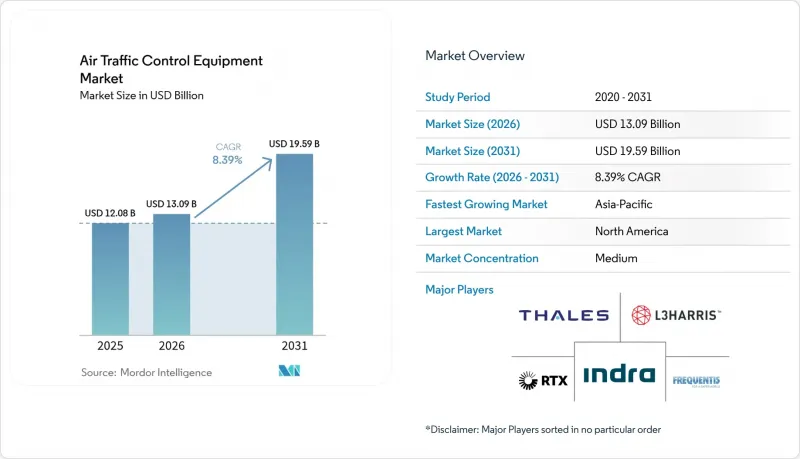
Mordor Intelligence에 따르면 항공 관제 장비 시장 규모는 2025년에 120억 8,000만 달러로 평가되며, 2026년 130억 9,000만 달러에서 2031년까지 195억 9,000만 달러에 달할 것으로 예측되고 있으며, 예측 기간(2026-2031년)에 CAGR은 8.39%에 달할 전망입니다.
이 보고서는 장비 유형(통신 장비, 항법 장비, 기타), 최종사용자(상업용·군사용), 공항 유형(브라운필드 공항·그린필드 공항), 투자 범주(신규 설치, 현대화·업그레이드), 지역(북미, 유럽, 아시아태평양, 남미, 기타)별로 분류되어 있습니다. 시장 예측은 금액(달러) 기준으로 제시되어 있습니다.
글로벌 항공 관제 장비 시장의 동향 및 인사이트
NextGen·SESAR의 자금 지원을 받은 디지털화 물결
유럽의 ATM 마스터 플랜에서는 2050년까지 투자 1단위당 17유로의 수익이 예상되어, 당국이 클라우드 네이티브이며 상호 운용 가능한 아키텍처에 예산을 배정하도록 지원하고 있습니다. 이와 병행하여 진행되고 있는 미국의 NextGen 프로그램에서는 위성 기반 항법, 시간 기반 교통량 관리, 디지털 음성 교환이 우선시되어 플랫폼 공급업체에 대해 수년에 걸친 수주가 확정되었습니다. 최고 수준의 벤더들은 소프트웨어 업데이트를 간소화하고 원격 유지보수를 용이하게 하는 쿠버네티스(Kubernetes) 호환 오픈 시스템으로 이에 대응했습니다.
ADS-B Out 의무화 기한
12개국이 특정 공역에서 ADS-B를 의무화함으로써, 트랜스폰더 및 관련 지상 수신기의 사후 장착 수요를 유지했습니다. FAA는 활주로 침입 사고를 줄이기 위한 ‘Surface Awareness Initiative’에서 ADS-B 데이터를 활용하고, 450개 이상의 공항에서 AeroBOSS를 구축할 수 있는 권한을 Indra에 부여했습니다. 유럽에서는 ‘Digital Sky’ 프레임워크 하에 ADS-C 공통 서비스가 추진되어 모니터링 데이터 생태계가 확대되었습니다.
막대한 설비 투자(CAPEX) 및 장기적인 인증 주기
미국 정부감사원(GAO)은 FAA 시스템의 37%가 지속 불가능하다고 지적했으나, 그럼에도 불구하고 업데이트 프로젝트는 종종 수년에 달하는 인증상의 장벽에 직면하여 지출 집행이 지연되었습니다. 유럽의 EASA 규정 2023/1769는 ATM 장비에 대해 설계 기관의 승인을 의무화하여 중소 공급업체의 개발 기간을 연장시켰습니다.
부문 분석
통신 플랫폼은 2025년 ATC 장비 시장 매출의 42.10%를 차지하며, 내결함성이 높은 음성 채널과 데이터 링크의 중요성을 부각시키고 있습니다. Indra가 FAA로부터 4만 6,000대의 듀얼 모드 디지털 무전기를 공급하는 계약을 2억 4,430만 달러에 수주한 것은 노후화된 아날로그 장비의 교체가 가속화되고 있음을 보여줍니다. Frequentis와 같은 공급업체들은 전 세계 관제사 포스트의 30% 점유율을 차지하고 있으며, 확고한 입지를 구축한 공급업체들이 누리고 있는 규모의 경제가 두드러지게 나타나고 있습니다.
원격 관제 및 디지털 관제탑 모듈은 2025년 매출에서 차지하는 비중이 5.45%에 불과하지만, 공항이 여러 공항을 총괄하는 관제 센터 아래에서 모니터링 기능을 통합함에 따라 연평균 성장률(CAGR) 10.86%로 가장 높은 성장세를 보일 것으로 전망됩니다. 이러한 전환으로 인해 북유럽의 지방 공항에서는 인건비가 최대 30% 절감되고 투자 자본 수익률(ROIC)이 향상되었을 뿐만 아니라, 규제 당국이 4K 센서를 활용한 저시정 조건 하에서의 운항을 승인하는 데에도 기여했습니다.
전 세계 여객 수요의 회복과 ADS-B 탑재 의무화로 인해 2025년 항공 관제 장비 시장 매출의 66.00%는 민간 항공사가 차지했습니다. 보잉(Boeing)사는 2043년까지 아프리카의 항공기 보유 대수가 두 배로 늘어날 것으로 예측하고 있으며, 이는 관제탑, 레이더, 데이터 링크 업그레이드에 대한 하류 수요가 지속되고 있음을 나타냅니다. 동시에 국방 기관들은 조달을 가속화하여 2026-2031년까지 군사 부문 매출을 연평균 성장률(CAGR) 9.70%로 끌어올렸습니다. 미국 공군의 TPY-4 레이더 19기, 4억 7,200만 달러 규모의 주문은 이 부문으로 유입되는 현대화 계약의 규모를 여실히 보여줍니다.
군사 용도는 다층적인 방공 우선순위를 반영하고 있습니다. 사이버 보안, 인공지능, UTM 하드웨어를 둘러싼 민간 및 국방 요구 사항의 융합으로 인해 공급업체 간의 경계가 점점 더 모호해지고 있으며, 통합 플랫폼 공급업체에게는 교차 판매 기회가 계속해서 확대되고 있습니다.
지역별 분석
북미는 2025년 ATC 장비 시장 매출의 40.20%를 차지하며, 그 기반이 되는 것은 FAA(연방항공청)의 디지털 음성 교환, 레이더 업데이트, 관제탑 건설을 위한 150억 달러 규모의 청사진입니다. NAV CANADA는 고립된 비행장을 원격으로 관리하기 위한 ‘디지털 비행장 항공 교통 서비스(Digital Aerodrome Air Traffic Services)’에 투자하여, 운영 측면의 혁신에서 이 지역의 선도적 입지를 강화했습니다.
아시아태평양은 연평균 성장률(CAGR) 10.35%를 기록하며 지역별 가장 높은 성장률을 보였습니다. 인도의 ‘One Airspace’ 구상을 통해 280만 해리²의 공역이 단일 국가 시스템으로 통합된 반면, 중국은 주요 허브 공항의 새로운 활주로 건설과 병행하여 CNS/ATM 도입을 가속화했습니다. 호주의 오프사이트 관제탑 기술의 조기 도입도 이 지역의 성장세를 더욱 지원했습니다.
유럽에서는 SESAR 3 프로그램이 예정대로 진행되어, 2050년까지 4억 톤의 CO₂ 감축이 예상되는 ‘디지털 스카이’ 프로젝트에 300억 유로가 투입되었습니다. 중동 및 아프리카에서는 두바이, 리야드, 도하에서 총 1조 달러 규모의 공항 확장을 필두로, 국지적으로 활발한 투자가 이루어졌습니다. 라틴아메리카에서는 인드라(Indra)사가 해당 지역 관제 센터의 70%를 현대화한 것이 기여했으나, 자금 면의 제약으로 인해 성장세는 둔화되었습니다.
기타 혜택
- 엑셀 형식의 시장 예측(ME) 시트
- 3개월간 애널리스트 지원
자주 묻는 질문
목차
제1장 서론
제2장 조사 방법
제3장 개요
제4장 시장 구도
제5장 시장 규모와 성장 예측
제6장 경쟁 구도
제7장 시장 기회와 향후 전망
KSA 26.09.03According to Mordor Intelligence, the air traffic control equipment market size was valued at USD 12.08 billion in 2025 and estimated to grow from USD 13.09 billion in 2026 to reach USD 19.59 billion by 2031, at a CAGR of 8.39% during the forecast period (2026-2031).
This report is Segmented by Equipment Type (Communication Equipment, Navigation Equipment, and More), End-User (Commercial and Military), Airport Type (Brownfield and Greenfield), Investment (New Installations and Modernization and Upgradation), and Geography (North America, Europe, Asia-Pacific, South America and More). The Market Forecasts are Provided in Terms of Value (USD).
Global Air Traffic Control Equipment Market Trends and Insights
NextGen and SESAR-funded digitalization wave
The European ATM Master Plan estimated a EUR 17 return per unit investment by 2050, encouraging authorities to channel budgets toward cloud-native, interoperable architectures. Parallel US NextGen programs prioritized satellite-based navigation, time-based flow management, and digital voice switching, locking in multiyear orders for platform suppliers. Top-tier vendors responded with Kubernetes-enabled open systems that simplify software updates and facilitate remote maintenance.
Mandated ADS-B Out deadlines
Twelve countries enforced ADS-B for defined airspace bands, sustaining retrofit demand for transponders and associated ground receivers. The FAA leveraged ADS-B data in its Surface Awareness Initiative to cut runway incursions, awarding Indra authority to roll out AeroBOSS at more than 450 airports. Europe advanced ADS-C common services under the Digital Sky framework, widening the surveillance data ecosystem.
High CAPEX and lengthy certification cycles
The US Government Accountability Office found 37% of FAA systems unsustainable, yet replacement projects often faced multi-year certification hurdles that slowed spending draws. European EASA Regulation 2023/1769 imposed design-organization approvals on ATM equipment, extending development timelines for small suppliers.
Other drivers and restraints analyzed in the detailed report include:
- Remote/digital tower adoption at secondary airports
- AI-driven predictive airspace management platforms
- Legacy-system interoperability bottlenecks
For complete list of drivers and restraints, kindly check the Table Of Contents.
Segment Analysis
Communication platforms represented 42.10% of 2025 revenue in the ATC equipment market, underlining the centrality of resilient voice channels and data links. Indra's USD 244.3 million FAA award to supply 46,000 dual-mode digital radios illustrated replacement momentum for aging analog fleets. Vendors such as Frequentis controlled a 30% share of global controller positions, highlighting the scale economies enjoyed by established providers.
Although remote and digital tower modules account for only 5.45% of 2025 revenue, they are forecast to post the fastest 10.86% CAGR as airports consolidate surveillance under multi-airport centers. The transition reduced staffing costs by up to 30% at Nordic regional fields, bolstering return on invested capital and encouraging regulators to certify low-visibility operations using 4K sensors.
Commercial carriers generated 66.00% of 2025 revenue for the ATC equipment market thanks to the rebound in global passenger demand and mandatory ADS-B equipage. Boeing projected Africa's fleet to double by 2043, indicating persistent downstream demand for tower, radar, and data-link upgrades. At the same time, defense agencies accelerated procurements, lifting military revenue at a 9.70% CAGR from 2026 to 2031. A USD 472 million US Air Force order for 19 TPY-4 radars underscored the size of modernization contracts flowing into the segment.
Military applications are mirroring layered air defense priorities. Convergence between civil and defense requirements around cybersecurity, artificial intelligence, and UTM hardware continues to blur supplier boundaries and open cross-selling opportunities for integrated platform vendors.
Complete Report Scope:
- By Equipment Type
- Communication Equipment
- Navigation Equipment
- Surveillance/Automation Systems
- Remote / Digital Tower Modules
- By End User
- Commercial
- Military
- By Airport Type
- Brownfield Airports
- Greenfield Airports
- By Investment Category
- New Installations
- Modernization and Upgradation
- By Region
- North America
- United States
- Canada
- Mexico
- Europe
- Germany
- United Kingdom
- France
- Russia
- Rest of Europe
- Asia-Pacific
- China
- Japan
- India
- South Korea
- Australia
- Rest of Asia-Pacific
- South America
- Brazil
- Rest of South America
- Middle East and Africa
- Middle East
- United Arab Emirates
- Saudi Arabia
- Turkey
- Rest of Middle East
- Africa
- South Africa
- Rest of Africa
- Middle East
- North America
Geography Analysis
North America retained 40.20% of 2025 revenue in the ATC equipment market, anchored by the FAA's USD 15 billion blueprint for digital voice switching, radar replacement, and tower construction. NAV CANADA invested in Digital Aerodrome Air Traffic Services to remotely manage isolated aerodromes, reinforcing the region's leadership in operational innovation.
Asia-Pacific registered the highest regional growth at 10.35% CAGR. India's "One Airspace" initiative unified 2.8 million nmi2 under a single national system, while China accelerated CNS/ATM roll-outs in tandem with new runways at major hubs. Australia's early adoption of off-site tower technology further boosted regional momentum.
Europe progressed on schedule with the SESAR 3 program, channeling EUR 30 billion into Digital Sky projects that promise 400 million tonnes of CO2 savings by 2050. The Middle East and Africa showed pockets of intense spending, led by USD 1 trillion of airport expansions across Dubai, Riyadh, and Doha. Latin America benefited from Indra's modernization of 70% of the region's control centers, though funding constraints moderated its growth trajectory.
- Thales Group
- IndraSistemas S.A.
- RTX Corporation
- L3Harris Technologies, Inc.
- SITA N.V.
- Honeywell International Inc.
- Frequentis AG
- ACAMS AS
- Searidge Technologies
- Saab AB
- Rohde & Schwarz USA, Inc. (Rohde & Schwarz GmbH & Co. KG)
- General Dynamics Mission Systems, Inc. (General Dynamics Corporation)
- Leonardo S.p.A
- NEC Corporation
- Intelcan Technosystems Inc.
- Aquila Air Traffic Management Services Limited
- ARTISYS, s.r.o.
- Leidos Holdings, Inc.
Additional Benefits:
- The market estimate (ME) sheet in Excel format
- 3 months of analyst support
TABLE OF CONTENTS
1 INTRODUCTION
- 1.1 Study Assumptions and Market Definition
- 1.2 Scope of the Study
2 RESEARCH METHODOLOGY
3 EXECUTIVE SUMMARY
4 MARKET LANDSCAPE
- 4.1 Market Overview
- 4.2 Market Drivers
- 4.2.1 NextGen and SESAR-funded digitalization wave
- 4.2.2 Mandated ADS-B Out deadlines
- 4.2.3 Remote/digital tower adoption at secondary airports
- 4.2.4 Integration of UAS-traffic-management (UTM) hardware
- 4.2.5 AI-driven predictive airspace management platforms
- 4.2.6 Green-flight-corridor demand for trajectory-based ops
- 4.3 Market Restraints
- 4.3.1 High CAPEX and lengthy certification cycles
- 4.3.2 Legacy-system interoperability bottlenecks
- 4.3.3 Escalating cyber-security liability on IP-based VCS
- 4.3.4 Urban-corridor RF-spectrum congestion
- 4.4 Value Chain Analysis
- 4.5 Regulatory Landscape
- 4.6 Technological Outlook
- 4.7 Porter's Five Forces Analysis
- 4.7.1 Bargaining Power of Buyers/Consumers
- 4.7.2 Bargaining Power of Suppliers
- 4.7.3 Threat of New Entrants
- 4.7.4 Threat of Substitutes
- 4.7.5 Intensity of Competitive Rivalry
5 MARKET SIZE AND GROWTH FORECASTS (VALUE)
- 5.1 By Equipment Type
- 5.1.1 Communication Equipment
- 5.1.2 Navigation Equipment
- 5.1.3 Surveillance/Automation Systems
- 5.1.4 Remote / Digital Tower Modules
- 5.2 By End User
- 5.2.1 Commercial
- 5.2.2 Military
- 5.3 By Airport Type
- 5.3.1 Brownfield Airports
- 5.3.2 Greenfield Airports
- 5.4 By Investment Category
- 5.4.1 New Installations
- 5.4.2 Modernization and Upgradation
- 5.5 By Region
- 5.5.1 North America
- 5.5.1.1 United States
- 5.5.1.2 Canada
- 5.5.1.3 Mexico
- 5.5.2 Europe
- 5.5.2.1 Germany
- 5.5.2.2 United Kingdom
- 5.5.2.3 France
- 5.5.2.4 Russia
- 5.5.2.5 Rest of Europe
- 5.5.3 Asia-Pacific
- 5.5.3.1 China
- 5.5.3.2 Japan
- 5.5.3.3 India
- 5.5.3.4 South Korea
- 5.5.3.5 Australia
- 5.5.3.6 Rest of Asia-Pacific
- 5.5.4 South America
- 5.5.4.1 Brazil
- 5.5.4.2 Rest of South America
- 5.5.5 Middle East and Africa
- 5.5.5.1 Middle East
- 5.5.5.1.1 United Arab Emirates
- 5.5.5.1.2 Saudi Arabia
- 5.5.5.1.3 Turkey
- 5.5.5.1.4 Rest of Middle East
- 5.5.5.2 Africa
- 5.5.5.2.1 South Africa
- 5.5.5.2.2 Rest of Africa
- 5.5.5.1 Middle East
- 5.5.1 North America
6 COMPETITIVE LANDSCAPE
- 6.1 Market Concentration
- 6.2 Strategic Moves
- 6.3 Market Share Analysis
- 6.4 Company Profiles (includes Global-level Overview, Market-level Overview, Core Segments, Financials as available, Strategic Information, Market Rank/Share, Products and Services, Recent Developments)
- 6.4.1 Thales Group
- 6.4.2 IndraSistemas S.A.
- 6.4.3 RTX Corporation
- 6.4.4 L3Harris Technologies, Inc.
- 6.4.5 SITA N.V.
- 6.4.6 Honeywell International Inc.
- 6.4.7 Frequentis AG
- 6.4.8 ACAMS AS
- 6.4.9 Searidge Technologies
- 6.4.10 Saab AB
- 6.4.11 Rohde & Schwarz USA, Inc. (Rohde & Schwarz GmbH & Co. KG)
- 6.4.12 General Dynamics Mission Systems, Inc. (General Dynamics Corporation)
- 6.4.13 Leonardo S.p.A
- 6.4.14 NEC Corporation
- 6.4.15 Intelcan Technosystems Inc.
- 6.4.16 Aquila Air Traffic Management Services Limited
- 6.4.17 ARTISYS, s.r.o.
- 6.4.18 Leidos Holdings, Inc.
7 MARKET OPPORTUNITIES AND FUTURE OUTLOOK
- 7.1 White-space and Unmet-Need Assessment


