|
시장보고서
상품코드
2121740
연기 감지기 : 시장 점유율 분석, 업계 동향과 통계, 성장 예측(2026-2031년)Smoke Detector - Market Share Analysis, Industry Trends & Statistics, Growth Forecasts (2026 - 2031) |
||||||
 Mordor Intelligence
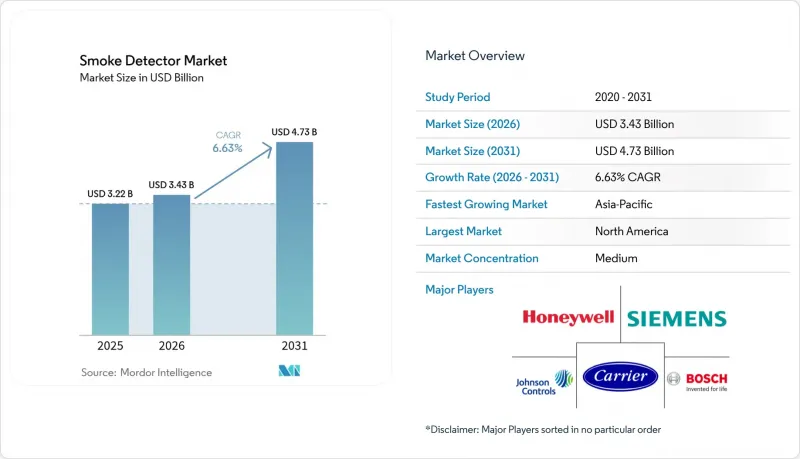
Mordor Intelligence에 따르면 연기 감지기 시장 규모는 2025년 32억 2,000만 달러에서 2026년에는 34억 3,000만 달러로 확대하며, 2026-2031년에 CAGR 6.63%로 추이하며, 2031년에는 47억 3,000만 달러에 달할 것으로 예측됩니다.
이 보고서는 센서 유형(광전식, 이온화식, 듀얼 센서식, 빔식, 기타),전원(배터리 구동식, 유선식, 기타), 연결성(스탠드얼론·기존형, 주소 지정 가능형, 스마트·IoT 지원), 최종사용자(주거용, 상업용, 산업용, 기타), 유통 채널, 지역별로 분류되어 있습니다. 시장 예측은 금액(달러) 기준으로 제시되어 있습니다.
전 세계 연기 감지기 시장의 동향 및 인사이트
미국·캐나다의 주거용 연기 감지기 상호 연결 의무화
24 CFR §3280.209의 개정에 따라 미국의 조립식 주택에 새로 설치되거나 교체되는 모든 경보기는 유선 연결 및 상호 연결이 의무화되어, 한 대가 연기를 감지하면 모든 장치가 작동하도록 되어 있습니다. 국제건축기준협의회(ICC)의 R314 조항도 현장 시공 주택에 대해 유사한 요건을 규정하고 있으며, 소유자가 노후화된 독립형 기기를 교체함에 따라 대규모 개보수 물결이 일어나고 있습니다. 캐나다도 ‘국가 화재 규정(National Fire Code)’에서 유사한 규정을 정하고 있으며, 온타리오주의 ‘화재 규정(Fire Code)’에서는 주거 유닛과 게스트 스위트 모두에서 상호 연결이 의무화되어 있습니다. 건설업자가 이 요건을 준수함에 따라 여러 대를 연결할 수 있는 기기의 출하량이 증가하고, 보험사도 보험료를 인하함으로써 도입이 더욱 촉진되고 있습니다. 각 벤더사는 기존 주택 재고의 업그레이드를 간소화하는 유선 및 무선 메시를 결합한 솔루션을 제공하고 있습니다.
EN 54-29 멀티 센서 요건에 따른 유럽 상업 시설의 개조 가속화
EN 54-29는 연기, 열, 일산화탄소(CO) 감지 기능을 하나의 인증된 멀티 센서 헤드에 통합하여, 유동 인구가 많은 상업 시설에서의 오작동을 줄여줍니다. 독일과 벨기에에서는 현재 EN 54-13에 따른 전체 시스템의 호환성이 의무화되어 있으며, 호텔, 쇼핑몰, 사무실 등은 기존의 단일 기술형 감지기를 형식 인증을 받은 하이브리드형으로 교체해야 합니다. 소방 당국은 검증된 멀티 센서 신호를 확실한 화재로 간주하여 비용이 많이 드는 출동 횟수를 줄이고, 인수 위험을 낮추고 있습니다. 이러한 이점은 일부 보험사가 보험료 할인을 제공함으로써 더욱 증폭되고 있습니다. 시스템 통합사업자는 감지기를 주소 지정 가능한 제어반이나 클라우드 분석 솔루션과 세트로 판매함으로써 프로젝트의 이익률 향상을 도모하고 있습니다. 영국, 프랑스, 북유럽 국가에서는 에너지 절약 개보수 공사가 진행되고 있으며, 개보수 공사가 가속화되고 있습니다.
이온화 챔버용 Am-241 동위원소의 공급 제약
로스앨러모스 국립연구소는 국내에서 Am-241 생산을 재개했으나, 공급량은 여전히 부족하여 생산 확대가 극히 어렵습니다. 지정학적 마찰로 인해 기존 대체 공급원이었던 러시아의 수출이 제한되고 있습니다. 각 제조사는 광전식 또는 듀얼 센서식 헤드를 채택한 제품 라인으로 재설계하여 위험을 회피하고 있지만, 비용을 중시하는 구매자들은 화염의 신속한 감지라는 측면에서 여전히 이온화식을 선호하고 있습니다. 일시적인 공급 부족으로 인해 부품 가격이 상승하여 이익률에 압박을 가하고 있을 뿐만 아니라, 라틴아메리카 및 아프리카 전역에서 광전식 모델과의 가격 차이가 확대되고 있습니다.
부문 분석
2025년, 광전식 모델은 연기 감지기 시장에서 33.58%의 점유율을 차지했으며, 주택내 잔불 화재 위험을 대상으로 한 건축 기준에 힘입어 지지를 받았습니다. 이온화식과 광전식의 원리를 융합한 듀얼 센서 방식 유닛은 상업용 건축 기준이 더 광범위한 감지를 요구함에 따라 8.98%라는 가장 높은 연평균 성장률(CAGR)을 기록하고 있습니다. 이온화식 감지기는 여전히 저소득층 주택에서 판매되고 있지만, Am-241의 공급 제약에 직면해 있습니다. 한편, 빔식 감지기는 장거리 직선 시야가 요구되는 아트리움이나 경기장 등에서 확고한 입지를 다지고 있습니다. 흡입식 시스템은 프리미엄 시장을 점유하고 있으며, Honeywell의 ‘FAAST FLEX’는 오경보가 가동 중단 위험으로 이어지는 먼지가 많은 산업 지역에서 인지도를 높이고 있습니다.
멀티 센서 채택을 지원하는 규제 동향이 연구개발 예산의 방향을 바꾸고 있습니다. '네이처'지의 연구에 따르면 정전용량식 입자 분석을 통해 ppm 수준에서 연기와 증기를 식별할 수 있음이 입증되었으며, 이를 통해 더욱 정교한 알고리즘의 구현이 가능해집니다. EN 54 규격에 따른 표준화 덕분에 서로 다른 공급업체의 센서를 공통 제어반로 연결할 수 있게 되어, 시스템 통합사업자의 위험이 경감됩니다. 석유 및 가스 플랜트에서 이미 시범 도입된 영상식 연기 감지 시스템은 수 초 만에 연기를 식별할 수 있으며, 포인트형 센서 시장에 큰 변화를 가져올 가능성이 있습니다. 다만, 높은 대역폭이 필요하므로 비용이 낮아지기 전까지는 주류로 자리 잡지는 못할 것으로 보입니다.
2025년에도 연기 감지기 시장에서 배터리 구동형 장치의 점유율은 43.21%를 유지했습니다. 이는 기존 설비에 후속 설치시 배선을 추가할 필요가 거의 없기 때문입니다. 그러나 정전 시에도 경보가 계속 작동해야 한다는 규정이 의무화되어 있으며, 배터리 백업 기능을 갖춘 유선식 장치는 8.36%라는 가장 높은 연평균 성장률(CAGR)을 보이고 있습니다. 유럽에서는 연간 유지보수 부담을 줄이고 사용자의 부정 조작을 방지할 수 있는 10년 보증 밀폐형 리튬 배터리 팩이 지지를 얻고 있습니다. 태양광발전식 센서나 에너지 하베스팅형 마이크로 발전기는 여전히 틈새 시장 수준에 머물러 있으며, 외딴 지역의 광산이나 통신 시설 등으로 한정되어 있습니다.
구매자의 선택을 좌우하는 것은 정가보다 총 소유 비용(TCO)입니다. 덴버 소방국은 배터리 잔량 저하를 알리는 ‘삐삐’하는 경고음으로 인한 출동을 줄이기 위해 리튬 배터리식 경보기의 도입을 추진하고 있습니다. OEM 대시보드에서는 현재 배터리 건강 상태가 표시되도록 되어 있으며, 부동산 관리자가 선제적으로 장비를 교체할 수 있게 되었습니다. 조사 결과, 건물의 공조 설비(HVAC) 진동을 통한 에너지 회수가 검토되고 있으나, 상용화까지는 적어도 5년은 걸릴 전망입니다.
지역별 분석
북미는 엄격한 건축 기준과 보험사의 광범위한 인센티브에 힘입어 2025년 연기 감지기 시장 매출의 39.62%를 차지했습니다. 미국의 조립식 주택 관련 규정에서는 유선으로 연결된 상호 연동형 경보기의 설치를 의무화하고 있으며, 캐나다의 소방법도 유사한 조항을 규정하고 있습니다. 스테이트 팜(State Farm)이 200만 개의 Ting 센서를 배포한 것은 보험사 주도의 스마트화 전환을 상징하는 사례이며, 리버티 뮤추얼(Liberty Mutual)은 구글 브랜드의 화재 경보기에 대해 단계적인 보험료 체계를 제공하고 있습니다. 멕시코의 산업 지역에서는 니어쇼어링을 시행하는 브랜드를 위한 수출 창고를 보호하기 위해 흡입식 시스템이 채택되고 있습니다.
아시아태평양은 2026-2031년까지 7.98%라는 가장 높은 연평균 성장률(CAGR)을 기록하고 있습니다. 중국의 GB 55037-2022 규격은 모든 고층 주택에 감지기 네트워크 설치를 의무화하고, 부동산 관리 대시보드와의 IoT 통합을 추진하고 있으며, 이에 따라 2030년까지 해당 지역의 연기 감지기 시장 규모는 극적으로 확대될 전망입니다. 일본에서는 밀집된 도시 지역의 건축물에서 발생하는 과제를 해결하기 위해 멀티센서 제품이 도입되고 있습니다. 한편, 인도의 스마트 시티 프로젝트에서는 예산 사정으로 인해 LoRaWAN 도입이 보류되고 있지만, 지하철 역에서는 주소 지정 가능한 라인이 선호되고 있습니다. 아세안(ASEAN)에서는 설치 업체 부족으로 어려움을 겪고 있으며, 인식이 높아지고 있음에도 불구하고 일부 프로젝트가 지연되고 있습니다.
유럽에서는 EN 54 규격의 조화가 기존 설비의 개조를 촉진하고 있으며, 한 자릿수 중반대의 성장률을 유지하고 있습니다. 독일과 벨기에에서는 EN 54-13 준수 증명이 의무화되어 있으며, 시스템 전체의 업그레이드 수요가 증가하고 있습니다. 영국에서는 오경보에 대한 과금 제도가 새로운 장벽이 되고 있지만, 한편으로는 초기 위험이 해소되면 소유주가 더 우수한 기술에 투자하도록 압박하는 요인이 되기도 합니다. 북유럽 국가에서는 유지보수 비용을 절감하기 위해 밀폐형 리튬 설계가 주류를 이루고 있습니다. 남유럽에서는 관광 산업의 회복에 따라 숙박 시설 건설이 성장의 견인차 역할을 하고 있으며, 소유주들은 새로운 보험 조항을 충족하기 위해 1990년대의 이온화식 감지기를 듀얼 센서식 유닛으로 교체하고 있습니다.
기타 혜택
- 엑셀 형식의 시장 예측(ME) 시트
- 3개월간의 애널리스트 지원
자주 묻는 질문
목차
제1장 서론
제2장 조사 방법
제3장 개요
제4장 시장 구도
제5장 시장 규모와 성장 예측
제6장 경쟁 구도
제7장 시장 기회와 향후 전망
KSA 26.09.03According to Mordor Intelligence, the smoke detector market size is expected to grow from USD 3.22 billion in 2025 to USD 3.43 billion in 2026 and is forecast to reach USD 4.73 billion by 2031 at 6.63% CAGR over 2026-2031.
This report is Segmented by Sensor Type (Photoelectric, Ionization, Dual-Sensor, Beam, and More), Power Source (Battery-Powered, Hard-Wired, and More), Connectivity (Stand-Alone/Conventional, Addressable, Smart/IoT-Enabled), End-User (Residential, Commercial, Industrial, and More), Distribution Channel, and Geography. The Market Forecasts are Provided in Terms of Value (USD).
Global Smoke Detector Market Trends and Insights
Mandatory Interconnection of Residential Smoke Alarms in US & Canada
The 24 CFR § 3280.209 update obliges every new or replacement alarm in US manufactured housing to be hard-wired and interconnected, triggering all units when one senses smoke. The International Code Council's R314 clause mirrors this requirement for site-built dwellings, creating a large retrofit wave as owners replace aging stand-alone devices. Canada follows with similar rules in its National Fire Code, and Ontario's Fire Code enforces interconnection in both dwelling units and guest suites. As builders comply, shipment volumes of multi-linkable devices increase, and insurers lower premiums, further pushing adoption. Vendors respond with combo wired-wireless mesh solutions that simplify upgrades in existing housing stock.
EN 54-29 Multi-Sensor Requirement Accelerating Commercial Retrofits in Europe
EN 54-29 aligns smoke, heat, and CO sensing under one certified multi-sensor head, reducing nuisance triggers in busy commercial spaces. Germany and Belgium now demand EN 54-13 system-wide compatibility, compelling hotels, malls, and offices to swap legacy single-technology detectors for type-approved hybrids. Fire services treat validated multi-sensor signals as confirmed fires, trimming costly call-outs and underwriting risk, a perk amplified by some insurers offering premium credits. Systems integrators see higher project margins as they bundle detectors with addressable panels and cloud analytics. Retrofits gather pace in the UK, France, and Nordics where energy-efficient refurbishments are underway.
Am-241 Isotope Supply Constraints for Ionization Chambers
Los Alamos National Laboratory resumed domestic Am-241 production, yet volumes remain tight and ramp-up is complex. Geopolitical frictions limit Russian exports, the traditional fallback source. Manufacturers hedge by redesigning lines around photoelectric or dual-sensor heads, but cost-sensitive buyers still prefer ionization for fast-flame detection. Spot shortages lift component prices, pressuring margins and widening the price gap to photoelectric models across Latin America and Africa.
Other drivers and restraints analyzed in the detailed report include:
- China's 2024 GB50116 Code Upgrade for High-Rise Buildings
- 10-Year Sealed Lithium-Battery Retrofits Reducing Maintenance Costs in Europe
- Installation Skill Gap in ASEAN Code-Compliant Deployment
For complete list of drivers and restraints, kindly check the Table Of Contents.
Segment Analysis
Photoelectric models held 33.58% share of the smoke detector market in 2025, favored by codes targeting smoldering-fire risk in homes. Dual-sensor units, blending ionization and photoelectric principles, post the fastest 8.98% CAGR as commercial codes demand broader coverage. Ionization heads still sell into low-income housing but face Am-241 constraints, while beam detectors secure spots in atria and stadiums that require long-range line-of-sight. Aspirating systems occupy the premium tier, with Honeywell's FAAST FLEX gaining mindshare in dusty industrial zones where false alarms risk downtime.
The regulatory tilt toward multi-sensor adoption is reshaping R&D budgets. A Nature study proves capacitive particle analysis can recognize smoke versus steam at ppm levels, enabling smarter algorithms. EN 54 uniformity allows mixed-vendor sensors to plug into common panels, cutting integrator risk. Video smoke detection, already piloted in oil-gas plants, may disrupt point sensors by identifying smoke in seconds, though high bandwidth limits mainstream use until costs fall.
Battery-powered devices retained 43.21% share of the smoke detector market in 2025 because retrofits seldom add wiring. Yet hard-wired units with battery backup display the strongest 8.36% CAGR as codes insist alarms keep working during outages. Sealed 10-year lithium packs gain favor in Europe, saving annual maintenance and preventing user tampering. Solar-assisted heads and energy-harvesting micro-generators remain niche, restricted to remote mining or telecom shelters.
Total cost of ownership guides buyer choice more than sticker price. Denver Fire Department promotes lithium-battery alarms to reduce callouts for chirping low-battery alerts. OEM dashboards now flag battery health, letting property managers replace units proactively. Research projects explore energy-scavenging from building HVAC vibration, but commercial readiness is at least five years out.
Complete Report Scope:
- By Sensor Type
- Photoelectric
- Ionization
- Dual-Sensor (Ionization + Photoelectric)
- Beam
- Aspirating / Air-Sampling
- By Power Source
- Battery-Powered
- Hard-Wired
- Hard-Wired with Battery Backup
- Solar and Energy-Harvesting
- By Connectivity
- Stand-Alone / Conventional
- Addressable
- Smart / IoT-Enabled
- By End-User
- Residential
- Commercial
- Corporate Offices
- Hospitality and Leisure
- Education Facilities
- Healthcare Facilities
- Retail and Malls
- Industrial
- Oil and Gas
- Manufacturing Plants
- Data Centers
- Transportation and Logistics
- Aviation
- Marine
- Rail and Metro
- By Distribution Channel
- Direct / System Integrators
- Indirect
- Offline Retail / Wholesale
- Online (E-commerce)
- By Geography
- North America
- United States
- Canada
- Mexico
- Europe
- United Kingdom
- Germany
- France
- Italy
- Rest of Europe
- Asia-Pacific
- China
- Japan
- India
- South Korea
- Rest of Asia-Pacific
- Middle East
- Israel
- Saudi Arabia
- United Arab Emirates
- Turkey
- Rest of Middle East
- Africa
- South Africa
- Egypt
- Rest of Africa
- South America
- Brazil
- Argentina
- Rest of South America
- North America
Geography Analysis
North America contributed 39.62% of 2025 revenue for the smoke detector market, energized by tight building codes and widespread insurer incentives. US manufactured housing rules require hard-wired interconnected alarms, while Canada's Fire Code mirrors those clauses. State Farm's distribution of 2 million Ting sensors exemplifies the insurer-driven smart pivot, and Liberty Mutual offers tiered premiums for Google-branded detectors. Mexico's industrial corridors adopt aspirating systems to safeguard export warehouses serving near-shoring brands.
Asia Pacific records the fastest 7.98% CAGR for 2026-2031. China's GB 55037-2022 dictates detector networks in all high-rise residences and pushes IoT integration with property-management dashboards, lifting the smoke detector market size for the region dramatically through 2030. Japan adopts multi-sensor products to solve dense urban building challenges, while India's smart-city projects politely skip LoRaWAN owing to budget but favor addressable lines in metro stations. ASEAN nations struggle with installer shortages, delaying some projects despite rising awareness.
Europe maintains mid-single-digit growth as EN 54 harmonization underpins retrofits. Germany and Belgium enforce EN 54-13 compatibility proof, boosting demand for full-system upgrades. The UK's false-alarm charging adds an extra hurdle yet simultaneously pressures owners to invest in better technology once bedding-in risks pass. Nordic countries champion sealed lithium designs to cut maintenance. Southern Europe leans on hospitality builds, where tourism rebounds and owners replace 1990s-era ionization heads with dual-sensor units to meet new insurance clauses.
- Honeywell International Inc.
- Siemens AG
- Johnson Controls International plc
- Robert Bosch GmbH
- Hochiki Corporation
- ABB Ltd
- Carrier Global (Kidde)
- Resideo Technologies (First Alert/BRK)
- Google LLC (Nest Labs)
- Schneider Electric SE
- Panasonic Corporation
- Apollo Fire Detectors Ltd (Halma plc)
- X-Sense (Shenzhen Huidu)
- Hekatron Brandschutz
- Fike Corporation
- Nittan Co., Ltd.
- Mircom Group of Companies
- Tyco (Johnson Controls Fire Protection)
- Ei Electronics
- Hochiki America
- Bosch Security Systems
Additional Benefits:
- The market estimate (ME) sheet in Excel format
- 3 months of analyst support
TABLE OF CONTENTS
1 INTRODUCTION
- 1.1 Study Assumptions and Market Definition
- 1.2 Scope of the Study
2 RESEARCH METHODOLOGY
3 EXECUTIVE SUMMARY
4 MARKET LANDSCAPE
- 4.1 Market Overview
- 4.2 Market Drivers
- 4.2.1 Mandatory Interconnection of Residential Smoke Alarms in US and Canada
- 4.2.2 EN 54-29 Multi-Sensor Requirement Accelerating Commercial Retrofits in Europe
- 4.2.3 China's 2024 GB50116 Code Upgrade for High-Rise Buildings
- 4.2.4 10-Year Sealed Lithium-Battery Retrofits Reducing Maintenance Costs in Europe
- 4.2.5 Insurance Premium Discounts for IoT-Connected Detectors
- 4.2.6 E-Commerce Warehousing Boom Driving Aspirating Detectors
- 4.3 Market Restraints
- 4.3.1 Am-241 Isotope Supply Constraints for Ionization Chambers
- 4.3.2 Installation Skill Gap in ASEAN Code-Compliant Deployment
- 4.3.3 False-Alarm Liability Slowing UK Multi-Sensor Adoption
- 4.3.4 High Up-Front Cost of LoRaWAN/BLE Smart Detectors in India and Brazil
- 4.4 Value / Supply-Chain Analysis
- 4.5 Regulatory Outlook
- 4.6 Technological Outlook
- 4.7 Porter's Five Forces Analysis
- 4.7.1 Threat of New Entrants
- 4.7.2 Bargaining Power of Buyers
- 4.7.3 Bargaining Power of Suppliers
- 4.7.4 Threat of Substitutes
- 4.7.5 Intensity of Competitive Rivalry
5 MARKET SIZE AND GROWTH FORECASTS (VALUE)
- 5.1 By Sensor Type
- 5.1.1 Photoelectric
- 5.1.2 Ionization
- 5.1.3 Dual-Sensor (Ionization + Photoelectric)
- 5.1.4 Beam
- 5.1.5 Aspirating / Air-Sampling
- 5.2 By Power Source
- 5.2.1 Battery-Powered
- 5.2.2 Hard-Wired
- 5.2.3 Hard-Wired with Battery Backup
- 5.2.4 Solar and Energy-Harvesting
- 5.3 By Connectivity
- 5.3.1 Stand-Alone / Conventional
- 5.3.2 Addressable
- 5.3.3 Smart / IoT-Enabled
- 5.4 By End-User
- 5.4.1 Residential
- 5.4.2 Commercial
- 5.4.2.1 Corporate Offices
- 5.4.2.2 Hospitality and Leisure
- 5.4.2.3 Education Facilities
- 5.4.2.4 Healthcare Facilities
- 5.4.2.5 Retail and Malls
- 5.4.3 Industrial
- 5.4.3.1 Oil and Gas
- 5.4.3.2 Manufacturing Plants
- 5.4.3.3 Data Centers
- 5.4.4 Transportation and Logistics
- 5.4.4.1 Aviation
- 5.4.4.2 Marine
- 5.4.4.3 Rail and Metro
- 5.5 By Distribution Channel
- 5.5.1 Direct / System Integrators
- 5.5.2 Indirect
- 5.5.2.1 Offline Retail / Wholesale
- 5.5.2.2 Online (E-commerce)
- 5.6 By Geography
- 5.6.1 North America
- 5.6.1.1 United States
- 5.6.1.2 Canada
- 5.6.1.3 Mexico
- 5.6.2 Europe
- 5.6.2.1 United Kingdom
- 5.6.2.2 Germany
- 5.6.2.3 France
- 5.6.2.4 Italy
- 5.6.2.5 Rest of Europe
- 5.6.3 Asia-Pacific
- 5.6.3.1 China
- 5.6.3.2 Japan
- 5.6.3.3 India
- 5.6.3.4 South Korea
- 5.6.3.5 Rest of Asia-Pacific
- 5.6.4 Middle East
- 5.6.4.1 Israel
- 5.6.4.2 Saudi Arabia
- 5.6.4.3 United Arab Emirates
- 5.6.4.4 Turkey
- 5.6.4.5 Rest of Middle East
- 5.6.5 Africa
- 5.6.5.1 South Africa
- 5.6.5.2 Egypt
- 5.6.5.3 Rest of Africa
- 5.6.6 South America
- 5.6.6.1 Brazil
- 5.6.6.2 Argentina
- 5.6.6.3 Rest of South America
- 5.6.1 North America
6 COMPETITIVE LANDSCAPE
- 6.1 Market Concentration
- 6.2 Strategic Moves
- 6.3 Market Share Analysis
- 6.4 Company Profiles (includes Global-level Overview, Market-level Overview, Core Segments, Financials, Strategic Information, Market Rank/Share, Products and Services, Recent Developments)
- 6.4.1 Honeywell International Inc.
- 6.4.2 Siemens AG
- 6.4.3 Johnson Controls International plc
- 6.4.4 Robert Bosch GmbH
- 6.4.5 Hochiki Corporation
- 6.4.6 ABB Ltd
- 6.4.7 Carrier Global (Kidde)
- 6.4.8 Resideo Technologies (First Alert/BRK)
- 6.4.9 Google LLC (Nest Labs)
- 6.4.10 Schneider Electric SE
- 6.4.11 Panasonic Corporation
- 6.4.12 Apollo Fire Detectors Ltd (Halma plc)
- 6.4.13 X-Sense (Shenzhen Huidu)
- 6.4.14 Hekatron Brandschutz
- 6.4.15 Fike Corporation
- 6.4.16 Nittan Co., Ltd.
- 6.4.17 Mircom Group of Companies
- 6.4.18 Tyco (Johnson Controls Fire Protection)
- 6.4.19 Ei Electronics
- 6.4.20 Hochiki America
- 6.4.21 Bosch Security Systems
7 MARKET OPPORTUNITIES AND FUTURE OUTLOOK
- 7.1 White-Space and Unmet-Need Assessment