

|
시장보고서
상품코드
2121741
폴리프로필렌 섬유 : 시장 점유율 분석, 업계 동향과 통계, 성장 예측(2026-2031년)Polypropylene Fibers - Market Share Analysis, Industry Trends & Statistics, Growth Forecasts (2026 - 2031) |
||||||
 Mordor Intelligence
Mordor Intelligence에 따르면 폴리프로필렌 섬유 시장 규모는 2025년에 337만 톤, 2026년에 346만 톤이 되어, 2031년까지 396만 톤에 달할 것으로 예측되고 있으며, 2026-2031년에 CAGR 2.74%로 성장할 것으로 전망되고 있습니다.
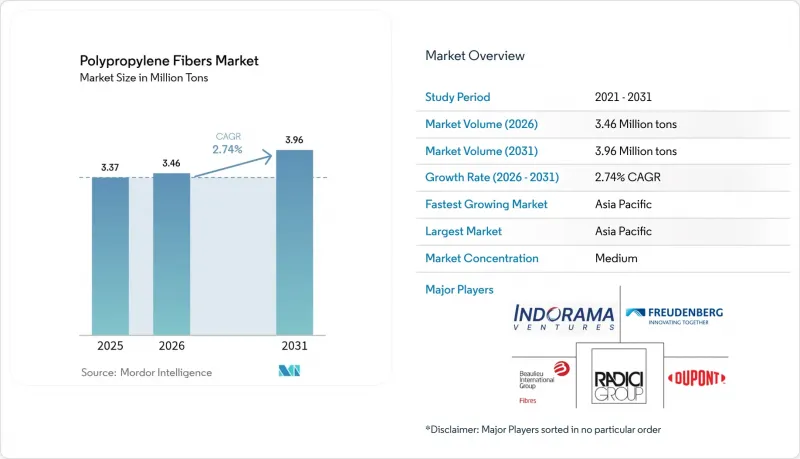
이 보고서는 유형(실·스테이플), 최종사용자 산업(섬유, 건설, 헬스케어·위생, 기타), 지역(아시아태평양, 북미, 유럽, 남미, 중동 및 아프리카)별로 분류되어 있습니다. 시장 예측은 톤 기준으로 제시되어 있습니다.
글로벌 폴리프로필렌 섬유 시장의 동향 및 인사이트
인프라의 매크로 합성 콘크리트 보강재로 전환
인도, 인도네시아, 브라질의 교통부는 현재 용접 철망의 대체재로 3-6kg/m3의 폴리프로필렌 매크로파이버 사용을 허용하고 있으며, 이를 통해 철근 사용량을 20-35% 절감하고 부식과 관련된 보수 공사를 대폭 줄이고 있습니다. 인도의 ‘조항 509’ 사양만으로도 2028년까지 4만 2,000톤의 확정 수요가 창출될 것입니다. 상파울루에서 실시된 현장 시험에서는 90회의 동결·해동 주기 후 균열 폭이 60% 감소한 것으로 나타나, 연방 정부의 노면 재포장 자금 확보로 이어졌습니다. 건설업체들은 혼잡한 도심 도로에서 한 번의 타설로 시공할 수 있다는 점을 높이 평가하고 있으며, 이를 통해 인건비를 4분의 1 가까이 절감할 수 있습니다.
도로 및 연안 공학 분야에서 지오텍스타일의 보급 가속화
동남아시아 전역의 몬순 영향에 취약한 토양은 분리층이 없을 경우 2년 이내에 15-20cm 침하되므로,베트남에서 건설 중인 150억 달러 규모의 남북 고속도로에서는 200g/m² 니들펀치 가공 PP 부직포가 지정되어 있으며, 2027년까지 9,200톤이 소비될 전망입니다. 인도네시아와 필리핀의 지자체에서는 해안선 1킬로미터당 18-22톤이 소요되는 지오텍스타일 튜브 설치가 진행되고 있으며, 그 자금은 아시아개발은행(ADB)의 3억 4,000만 달러 규모 대출 패키지를 통해 조달되고 있습니다. 실험실 시험 결과, 부식성 침출수 속에서 1만 시간이 경과한 후에도 85%의 침투 억제율이 확인되어 EU의 매립지 규정을 충족하고 있습니다. 이에 따라 인프라 수요가 확대되고, 지역 전체의 수요도 증가하고 있습니다. 수명 주기 비용을 평가 기준으로 삼는 정부의 입찰 규정에서는 도로의 수명 기간 중 필요한 유지 관리용 준설 작업을 절반으로 줄일 수 있으므로 지오텍스타일이 유리하게 평가받고 있으며, 그 채택 추세가 더욱 강해지고 있습니다.
고온 용도에서의 낮은 융점 제약
폴리프로필렌의 융점은 160-165℃이므로, 180-220℃에서 재생되는 디젤 미립자 필터나,미국 환경보호청(EPA)의 2025년 기준에 따라 미립자의 99.5%를 포집해야 하는 시멘트 가마의 백하우스 필터에는 사용할 수 없습니다. 따라서 각 OEM 업체들은 1제곱미터당 비용이 40-80% 더 비싸더라도 더 높은 온도를 견딜 수 있는 폴리아미드, 아라미드 또는 PTFE 섬유를 선택하고 있으며, 이로 인해 PP 섬유의 연간 수요 중 약 1만 4,000톤이 다른 용도로 전환되고 있습니다. 무수 말레인의 그래프트화나 HDPE 혼합을 통해 내열 온도 상한을 높이려는 시도에서는 1kg당 0.18-0.25달러의 비용 증가가 발생하지만, 여전히 180°C의 기준치를 충족하지 못합니다. 연구개발을 지속하면 내열성이 향상될 수는 있겠지만, 향후 2년 이내에 상업적인 영향이 나타날 가능성은 낮을 것으로 보입니다.
부문 분석
2025년 폴리프로필렌 섬유 시장 규모의 84.51%를 연속 필라멘트사가 차지하고 있으며,퍼스트 패스 수율 98%를 실현하는 400-600m/min의 직기와 스펀본드 라인에 힘입어, 2031년까지 연평균 성장률(CAGR) 2.78%로 확대될 전망입니다. 스테이플 섬유는 콘크리트 보강재나 니들펀치 가공된 자동차용 카펫에 사용되지만, 절단 및 카딩 공정을 통해 1kg당 0.12-0.18달러의 추가 가공 비용이 발생합니다. 미국과 터키의 카펫 제조업체들은 카딩 공정이 불필요해지고, 인건비를 30-40% 절감하며, 48시간 이내의 적시 납품을 보장할 수 있다는 점 때문에 벌크드 연속 필라멘트로의 전환을 추진하고 있습니다.
스테이플 섬유는 50-75mm 길이의 섬유가 필요한 지오텍스타일 및 스프레이 콘크리트 용도에서 여전히 중요한 역할을 하고 있습니다. 터널 건설 업체들은 일반적으로 분사 콘크리트에 0.9-1.1kg/m3의 섬유를 사용합니다. 또한 특히 위생용 스펀본드 및 직조 지오텍스타일 분야에서 원사 수요가 증가하고 있습니다.
지역별 분석
아시아태평양은 폴리프로필렌 섬유 시장을 주도하고 있으며, 2025년 출하량의 51.12%를 차지하고, 인프라 메가 프로젝트를 배경으로 2031년까지 연평균 성장률(CAGR) 3.37%로 성장할 것으로 전망됩니다. 중국의 생산은 시노펙(Sinopec)과 페트로차이나(PetroChina)가 주도하고 있으며, 수입 가격보다 낮은 가격으로 국내 가공업체에 공급하고 있습니다. 인도에서는 도로교통부가 총연장 10km를 초과하는 모든 국도에 지오텍스타일 층의 설치를 의무화함에 따라 소비량이 증가했습니다. 한편, 일본과 한국은 N95 마스크용 초미세 일렉트릿 멜트블로운 소재 생산에 주력했습니다. 이는 소매 가격이 톤당 3,200-3,800달러 범위에 있는 고수익성 틈새 시장입니다.
북미에서는 미국의 ‘초당적 인프라 법안’에 따라 여러 주에서 폴리프로필렌(PP) 매크로파이버에 대한 추가 수요가 발생할 것으로 전망됩니다. 캐나다에서는 온타리오주의 전기자동차(EV) 조립 라인에서 내장 모듈용 유리섬유 강화 PP 컴파운드의 사용이 증가하고 있습니다. 한편, 멕시코의 마키라도라(수출가공공장)는 USMCA(미국·멕시코·캐나다 협정) 규정에 따라 원사를 수입하고 있으며, 이 규정에 따르면 가치의 상당 부분이 북미 내에서 창출된 경우 관세 없이 재수출이 허용됩니다.
유럽의 수요는 위생용품의 이익률에 영향을 미치는 ‘확대된 생산자 책임(EPR)’ 제도의 요금에 따라 좌우되고 있습니다. 이 지역의 선두 주자인 독일에서는 재사용 기저귀 생산 라인이 소매 시장에서 점유율을 확대하고 있습니다. 프랑스와 이탈리아에서는 주택 건설 회복을 배경으로, 알프스 산맥의 도로 안정화용 지오텍스타일이나 카펫 안감 등의 용도로 PP가 소비되고 있습니다.
남미, 중동 및 아프리카는 각각 세계 시장 규모에서 차지하는 비중이 비교적 작은 지역입니다. 남미에서는 브라질의 고속도로 개보수 공사에서 분리용 패브릭의 수요가 예상됩니다. 중동에서는 사우디아라비아의 NEOM 및 키디야 프로젝트에서 사막 안정화용 PP 직물에 대한 수요가 예상됩니다. 남아프리카에서는 방적업체들이 카펫용 실이나 베일러용 끈을 만들기 위해 PP 수지를 수입하고 있으며, 전년 대비 현저한 증가세를 보였습니다.
기타 혜택
- 엑셀 형식의 시장 예측(ME) 시트
- 3개월간 애널리스트의 지원
자주 묻는 질문
목차
제1장 서론
제2장 조사 방법
제3장 개요
제4장 시장 구도
제5장 시장 규모와 성장 예측
제6장 경쟁 구도
제7장 시장 기회와 향후 전망
KSA 26.09.03According to Mordor Intelligence, the polypropylene fibers market size is projected to be 3.37 Million tons in 2025, 3.46 Million tons in 2026, and reach 3.96 Million tons by 2031, growing at a CAGR of 2.74% from 2026 to 2031.
This report is Segmented by Type (Yarn and Staple), End-User Industry (Textile, Construction, Healthcare and Hygiene, and Other End-User Industries), and Geography (Asia-Pacific, North America, Europe, South America, and Middle-East and Africa). The Market Forecasts are Provided in Terms of Volume (Tons).
Global Polypropylene Fibers Market Trends and Insights
Infrastructure Shift Toward Macro-Synthetic Concrete Reinforcement
Transport ministries in India, Indonesia, and Brazil now allow 3-6 kg/m3 polypropylene macro-fibers to replace welded-wire mesh, cutting rebar by 20-35% and slashing corrosion-related repairs. India's clause 509 specifications alone create 42,000 tons of captive demand by 2028. Sao Paulo field trials show 60% crack-width reduction after 90 freeze-thaw cycles, unlocking federal resurfacing funds. Contractors value single-pour placement that trims labor by almost one-quarter in congested urban corridors.
Accelerating Geotextile Penetration in Road and Coastal Engineering
Monsoon-sensitive soils across Southeast Asia settle 15-20 cm within two years without separation layers, so Vietnam's USD 15 billion North-South Expressway specifies 200 g/m2 needle-punched PP nonwovens, consuming 9,200 tons through 2027. Indonesian and Filipino municipalities install geotextile tubes that require 18-22 tons per shoreline kilometre, financed by an Asian Development Bank USD 340 million loan package. Laboratory tests confirm 85% flow retention after 10,000 hours in aggressive leachate, meeting EU landfill rules. The resulting infrastructure pull lifts regional demand. Government tender rules that score life-cycle cost now favor geotextiles because they halve maintenance dredging over a road's service life, reinforcing adoption momentum.
Low Melting-Point Limits in High-Temperature Uses
Polypropylene melts at 160-165 °C, ruling it out for diesel particulate filters that regenerate at 180-220 °C and for cement-kiln baghouse filters now required to capture 99.5% particulates under the U.S. EPA's 2025 standards. OEMs therefore choose polyamide, aramid, or PTFE fibers that cost 40-80% more per square meter yet survive higher temperatures, diverting an estimated 14,000 tons of annual demand from PP fibers. Attempts to raise the service ceiling by grafting maleic anhydride or blending HDPE add USD 0.18-0.25 per kilogram and still fail to meet 180 °C thresholds. Continued R&D may improve heat resistance, but commercial impact is unlikely within the next two years.
Other drivers and restraints analyzed in the detailed report include:
- Lightweight Automotive Interior Adoption (EV Range Extension)
- Circular-Grade Recycled PP Fibers Enabled by Chemical Recycling
- ESG Scrutiny on Micro-Plastics Leakage from Non-Woven Disposables
For complete list of drivers and restraints, kindly check the Table Of Contents.
Segment Analysis
Continuous-filament yarn controlled 84.51% of the 2025 polypropylene fibers market size and is set to expand at a 2.78% CAGR through 2031, supported by 400-600 m/min weaving and spunbond lines that deliver 98% first-pass yield. Staple fiber is used in concrete reinforcement and needle-punched automotive carpets, but it incurs an additional conversion cost of USD 0.12-0.18/kg due to cutting and carding processes. U.S. and Turkish carpet mills migrated to bulked continuous filament because it eliminates carding, slashing labor 30-40% and ensuring just-in-time deliveries within 48 hours.
Staple fibers remain relevant in geotextile and shotcrete applications requiring 50-75 mm fibers. Tunnel constructors typically use 0.9-1.1 kg/m3 of fibers in shotcrete. Additionally, the demand for yarn is rising, particularly in hygiene spunbond and woven geotextiles.
Complete Report Scope:
- By Type
- Yarn
- Staple
- By End-user Industry
- Textile
- Construction
- Healthcare and Hygiene
- Other End-user Industries
- By Geography
- Asia-Pacific
- China
- India
- Japan
- South Korea
- ASEAN Countries
- Rest of Asia-Pacific
- North America
- United States
- Canada
- Mexico
- Europe
- Germany
- United Kingdom
- France
- Italy
- Spain
- Russia
- Rest of Europe
- South America
- Brazil
- Argentina
- Rest of South America
- Middle-East and Africa
- Saudi Arabia
- South Africa
- Rest of Middle-East and Africa
- Asia-Pacific
Geography Analysis
Asia-Pacific dominates the polypropylene fibers market, holding 51.12% of 2025 volume and growing at a 3.37% CAGR through 2031 on infrastructure megaprojects. China's production was led by Sinopec and PetroChina, supplying domestic converters at prices below import parity. In India, consumption increased following a mandate by the Ministry of Road Transport requiring geotextile layers on all national highways exceeding 10 km. Meanwhile, Japan and South Korea focused on producing ultra-fine electret melt-blown material for N95 respirators, a high-margin niche market with retail prices ranging from USD 3,200 to USD 3,800 per ton.
In North America, the U.S. Bipartisan Infrastructure Law is expected to generate additional demand for polypropylene (PP) macro-fiber across multiple states. In Canada, Ontario's electric vehicle (EV) assembly lines have seen increased utilization of glass-fiber-reinforced PP compounds for interior modules. Meanwhile, Mexico's maquiladoras imported yarn under USMCA regulations, which allow duty-free re-export when a significant portion of the value originates within North America.
Europe's demand is influenced by Extended Producer Responsibility fees that are impacting hygiene product margins. Germany, the regional leader, has seen reusable diaper lines capture a growing share of the retail market. France and Italy collectively consumed PP for applications such as Alpine road-stabilization geotextiles and carpet backing, driven by a rebound in housing construction.
South America and the Middle-East and Africa each account for a smaller portion of global market volume. In South America, Brazil's highway upgrades are expected to require separation fabrics. In the Middle-East, Saudi Arabia's NEOM and Qiddiya projects are projected to demand woven PP for desert stabilization. In South Africa, spinners imported PP resin for carpet yarn and baler twine, marking a notable increase compared to the previous year.
- ABC Polymer Industries LLC
- Beaulieu Fibres International NV
- Belgian Fibers
- Chemosvit Fibrochem SRO
- China National Petroleum Corporation
- DuPont
- Fiberpartner Aps
- Freudenberg Group
- Huimin Taili Chemical Fiber Products Co. Ltd
- Indorama Ventures Public Company Limited
- International Fibres Group
- Kolon Fiber Inc.
- Mitsubishi Chemical Corporation
- Radici Partecipazioni SpA
- Sika AG
- Tri Ocean Textile Co. Ltd
- W. Barnet GmbH & Co. KG
- Zenith Fibres Ltd
Additional Benefits:
- The market estimate (ME) sheet in Excel format
- 3 months of analyst support
TABLE OF CONTENTS
1 Introduction
- 1.1 Study Assumptions and Market Definition
- 1.2 Scope of the Study
2 Research Methodology
3 Executive Summary
4 Market Landscape
- 4.1 Market Overview
- 4.2 Market Drivers
- 4.2.1 Infrastructure shift toward macro-synthetic concrete reinforcement
- 4.2.2 Accelerating geotextile penetration in road and coastal engineering
- 4.2.3 Lightweight automotive interior adoption (EV range extension)
- 4.2.4 3-D printing of PP-fiber reinforced composites (mass-customization)
- 4.2.5 Circular-grade recycled PP fibers enabled by chemical recycling
- 4.3 Market Restraints
- 4.3.1 Low melting-point limits in high-temperature uses
- 4.3.2 ESG scrutiny on micro-plastics leakage from non-woven disposables
- 4.3.3 Ultrafine PP dust flagged in occupational-health regulations
- 4.4 Value Chain Analysis
- 4.5 Porter's Five Forces
- 4.5.1 Bargaining Power of Suppliers
- 4.5.2 Bargaining Power of Buyers
- 4.5.3 Threat of New Entrants
- 4.5.4 Threat of Substitutes
- 4.5.5 Degree of Competition
- 4.6 Raw-Material Analysis
5 Market Size and Growth Forecasts (Volume)
- 5.1 By Type
- 5.1.1 Yarn
- 5.1.2 Staple
- 5.2 By End-user Industry
- 5.2.1 Textile
- 5.2.2 Construction
- 5.2.3 Healthcare and Hygiene
- 5.2.4 Other End-user Industries
- 5.3 By Geography
- 5.3.1 Asia-Pacific
- 5.3.1.1 China
- 5.3.1.2 India
- 5.3.1.3 Japan
- 5.3.1.4 South Korea
- 5.3.1.5 ASEAN Countries
- 5.3.1.6 Rest of Asia-Pacific
- 5.3.2 North America
- 5.3.2.1 United States
- 5.3.2.2 Canada
- 5.3.2.3 Mexico
- 5.3.3 Europe
- 5.3.3.1 Germany
- 5.3.3.2 United Kingdom
- 5.3.3.3 France
- 5.3.3.4 Italy
- 5.3.3.5 Spain
- 5.3.3.6 Russia
- 5.3.3.7 Rest of Europe
- 5.3.4 South America
- 5.3.4.1 Brazil
- 5.3.4.2 Argentina
- 5.3.4.3 Rest of South America
- 5.3.5 Middle-East and Africa
- 5.3.5.1 Saudi Arabia
- 5.3.5.2 South Africa
- 5.3.5.3 Rest of Middle-East and Africa
- 5.3.1 Asia-Pacific
6 Competitive Landscape
- 6.1 Market Concentration
- 6.2 Strategic Moves
- 6.3 Market Share(%)/Ranking Analysis
- 6.4 Company Profiles (includes Global level Overview, Market level overview, Core Segments, Financials as available, Strategic Information, Products and Services, and Recent Developments)
- 6.4.1 ABC Polymer Industries LLC
- 6.4.2 Beaulieu Fibres International NV
- 6.4.3 Belgian Fibers
- 6.4.4 Chemosvit Fibrochem SRO
- 6.4.5 China National Petroleum Corporation
- 6.4.6 DuPont
- 6.4.7 Fiberpartner Aps
- 6.4.8 Freudenberg Group
- 6.4.9 Huimin Taili Chemical Fiber Products Co. Ltd
- 6.4.10 Indorama Ventures Public Company Limited
- 6.4.11 International Fibres Group
- 6.4.12 Kolon Fiber Inc.
- 6.4.13 Mitsubishi Chemical Corporation
- 6.4.14 Radici Partecipazioni SpA
- 6.4.15 Sika AG
- 6.4.16 Tri Ocean Textile Co. Ltd
- 6.4.17 W. Barnet GmbH & Co. KG
- 6.4.18 Zenith Fibres Ltd
7 Market Opportunities and Future Outlook
- 7.1 White-space and Unmet-Need Assessment


