|
시장보고서
상품코드
2121742
신장 바이오마커 : 시장 점유율 분석, 업계 동향과 통계, 성장 예측(2026-2031년)Renal Biomarkers - Market Share Analysis, Industry Trends & Statistics, Growth Forecasts (2026 - 2031) |
||||||
 Mordor Intelligence
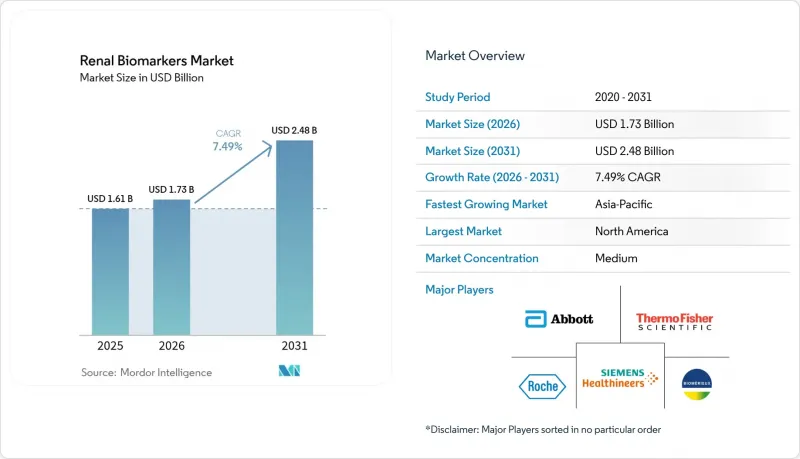
Mordor Intelligence에 따르면 신장 바이오마커 시장 규모는 2025년에 16억 1,000만 달러로 평가되며, 2026년 17억 3,000만 달러에서 2031년까지 24억 8,000만 달러에 달할 것으로 예측되고 있으며, 예측 기간(2026-2031년)에 CAGR은 7.49%에 달할 전망입니다.
이 보고서는 바이오마커 유형(기능성 바이오마커[혈청 크레아티닌 등], 발현 증가 단백질, 기타 바이오마커 유형), 진단 기술(효소면역측정법(ELISA), 기타), 최종사용자(병원, 진단 실험실, 기타),지역(북미, 유럽, 아시아태평양, 기타)별로 분류되어 있습니다. 시장 규모와 전망은 금액(달러) 기준으로 제시되어 있습니다.
전 세계 신장 바이오마커 시장의 동향 및 인사이트
만성 신장 질환(CKD) 및 급성 신장 손상(AKI) 유병률 증가
CKD는 미국 성인 3,700만 명에게 영향을 미치고 있으며, 2030년까지 30세 이상 인구의 유병률은 17%에 달할 것으로 예측됩니다. 이에 따라 의료 시스템이 선별 검사를 신장 내과 클리닉에서 1차 진료 워크플로로 전환함에 따라 검사 건수가 구조적으로 급증할 것으로 예상됩니다. CKD 사례의 최대 90%는 진행 단계에 이르기 전까지 진단되지 않은 채 남아 있으며, 이로 인해 치료비 증가와 투석 의존도가 높아지고 있습니다. 따라서 보험사들은 eGFR이 저하되기 전에 질환을 감지할 수 있는 포괄적인 바이오마커 패널의 도입을 권장하고 있습니다. 현재 임상 경로에서는 크레아티닌 외에도 시스타틴 C, NGAL, 소변 알부민을 조합하여 위험을 계층화하고 치료 강도를 결정하고 있으며, 이는 기능성 단백질 및 발현이 증가한 단백질에 대한 지속적인 수요를 지원하고 있습니다. 미국과 독일의 공중보건 계약에서는 입원 감소에 따른 비용 절감 효과가 입증된 다항목 검사 패널의 비용이 상환되고 있으며, 신장 바이오마커 검사는 확정 진단의 수단이라기보다는 예방적 툴로 변화하고 있습니다. 신흥 시장의 각국 정부도 이러한 성과를 주시하고 있으며, 전 세계적인 보급 추세에는 장기적인 여지가 있음을 시사하고 있습니다.
당뇨병·고혈압 환자층의 증가
전 세계에서 말기 신장 질환 이송 환자의 60% 이상이 당뇨병과 고혈압에 기인하며, KDIGO의 2024년 지침에서는 고위험 당뇨병 환자에 대해 연 1회 검사가 아닌 분기별 신장 바이오마커 검사를 권장하고 있습니다. 이에 대응하여 임상 검사 기관에서는 알부민/크레아티닌 비율, 혈청 크레아티닌, 시스타틴 C, NGAL을 가치 기반 결제 지표에 적합한 단일 주문 코드로 통합하고 있습니다. SGLT2 억제제는 투여량 조정이 eGFR의 조기 변화에 좌우되므로 치료상의 인센티브를 제공하며, 이로 인해 임상의들은 정확하고 빈도가 높은 바이오마커 측정값에 대한 의존도를 높이고 있습니다. 아시아태평양은 제2형 당뇨병 유병률이 가장 급격히 증가하고 있으며, 중국과 인도의 각 정부 부처는 손가락 채혈을 통한 크레아티닌 측정과 현장 진단용 NGAL 카트리지를 병용하는 지역 순회 검진 차량 도입에 자금을 지원하고 있으며,신장 바이오마커 시장이 만성질환 관리 과정에 정착되어 가고 있음을 시사하고 있습니다.
각 검사실 간의 통일된 기준 부재
NGAL, KIM-1, penKid에는 여전히 통일된 교정 표준물질이 부족하여, 검사실 간 변동 계수가 18%를 초과하는 경우가 있으며, 의사의 신뢰를 떨어뜨리고 지침 승인을 지연시키고 있습니다. 국제임상화학연맹(IFCC)은 시스타틴 C에 관한 세계적 기준 시스템을 구축했으나, 세뇨관 장애 관련 단백질에 대한 유사한 노력은 자금 부족에 더해 기술적으로 복잡한 과제에 직면해 있습니다. 신흥 시장이 그 영향을 가장 크게 받고 있습니다. 브라질과 나이지리아의 조달 팀은 플랫폼마다 보고되는 절대값이 달라 분석법 선정이 난항을 겪고 있다는 보고를 보내왔습니다. 일본과 캐나다의 학술 컨소시엄은 인종별 기준 범위를 확립하기 위해 바이오뱅크를 통합하고 있지만, IDMS에서 추적 가능한 크레아티닌과 같은 성공을 거둔 인증 체계가 확립되기 전까지는 새로운 바이오마커의 도입은 단편적인 수준에 그칠 것으로 보입니다.
부문 분석
기능성 바이오마커는 2025년에 8억 3,000만 달러의 매출을 창출하여 신장 바이오마커 시장의 51.78%를 차지했습니다. eGFR 산출에는 여전히 크레아티닌이 널리 사용되고 있지만, 초기 신장 손상을 감지할 수 없다는 한계가 있으며, 임상의들은 종종 혈청 시스타틴 C를 병용하고 있습니다. 시스타틴 C는 동적 범위가 넓기 때문에 소아 및 고령자에서 정확도가 향상됩니다. 기능성 바이오마커 부문 중에서는 알부민뇨 선별 검사 건수가 가장 빠르게 증가하고 있습니다. 이는 당뇨병 치료 프로토콜에서 미량 알부민뇨 결과가 치료 강화와 연계되어 있기 때문입니다. 이 부문은 비색법을 통해 알부민 변화를 측정하고 데이터를 클라우드 대시보드로 전송하는 스마트폰 호환 검사지를 통해 추가적인 성장이 예상되며, 아시아 및 아프리카 농촌 지역의 접근성 확대에 기여하고 있습니다.
발현량이 증가한 단백질은 연평균 성장률(CAGR) 8.12%로 확대될 것으로 예측되며, 이는 다른 모든 카테고리를 능가하는 속도입니다. NGAL은 손상 후 2시간이라는 검출 창을 가지고 있으며, 주목을 받고 있습니다. 독일의 응급의료 부문에서는 현재 크레아티닌보다 더 빨리 신장 손상의 징후를 감지하기 위해 패혈증 검사 패널에 혈장 NGAL을 추가하고 있습니다. 2025년에 암 임상 시험에서 약물 유발성 신독성 모니터링 용도로 승인될 예정인 KIM-1 분석법은 CRO로부터의 신규 수주를 견인할 것으로 예상됩니다. 지침 제정 위원회가 예상대로 적응증을 확대할 경우, 발현 증가 단백질 신장 바이오마커 시장 규모는 2031년까지 5억 2,000만 달러에 달할 가능성이 있으며, 이 부문이 시장 전체의 성장을 가속화하는 역할을 하고 있음이 부각될 것입니다.
지역별 분석
북미는 2025년 신장 바이오마커 시장 규모의 41.80%(6억 7,000만 달러)를 차지했습니다. 이는 견고한 검사실 자동화, 명확한 FDA 승인 절차, 증거 기준을 충족하는 신규 검사에 대한 보험사의 보상 의지에 힘입은 결과입니다. 메디케어의 ‘성과 기반 인센티브 지급 제도(MIPS)’에서는 신장내과 진료 점수가 연간 알부민뇨율과 연동되어 있으며, 이를 통해 검사 프로토콜의 갱신 및 검사 의뢰 빈도의 증가가 촉진되고 있습니다. 미국의 각 벤더 기업은 대학병원과의 근접성을 활용하여 임상시험에 대한 신속한 피험자 등록을 실현함으로써 바이오마커 검증 주기를 단축하고, 해당 지역을 시장 출시의 최전선으로 계속 자리매김하고 있습니다.
아시아태평양은 연평균 성장률(CAGR) 8.45%로 성장의 원동력이 되고 있으며, 중국, 인도, 한국에서는 공중보건상의 의무와 캐시백형 보험 제도를 결합하여 만성 신장 질환(CKD)의 조기 발견을 지원하고 있습니다. 중국 지방 정부는 주요 체외진단(IVD) 기업과 제휴하여 공장내 클리닉에 혈청 크레아티닌 및 NGAL을 검사하는 이동식 검사실을 도입하고 있으며, 이 모델은 2027년까지 100개 규모로 확대될 것으로 전망됩니다. 인도에서는 ‘아유슈만 바라트’ 보험 패키지를 통해 당뇨병 환자를 대상으로 연 2회 알부민/크레아티닌 비율 검사 비용이 보상되게 되면서, 2급 도시에서 검사 건수가 급증하고 있습니다. 이러한 정책에 따른 수요 확대에 더해, 검사 1회당 비용을 절감하는 현지 시약 생산이 맞물리면서, 해당 지역의 신장 바이오마커 시장은 지속적인 성장이 예상됩니다.
유럽에서는 근거 기반 정책 체계를 바탕으로 안정적인 한 자릿수 중반대의 매출 성장이 예상됩니다. 독일의 IQWiG는 크레아티닌 단독 사용에 비해 CKD(만성 신장 질환)의 병기 분류 정확도가 12% 향상된다는 메타분석을 바탕으로, 2025년에 시스타틴 C의 보험 적용을 승인했습니다. 영국의 NICE는 6개 NHS 트러스트에서 NGAL과 KIM-1 병용 패널의 시범 운영을 진행 중이며, 초기 의료 경제 모델에 따르면 투석 개시 지연으로 인한 비용 절감 효과로 24개월 이내에 검사 비용을 회수할 수 있을 것으로 시사되고 있습니다. 스칸디나비아 국가들은 여전히 디지털 헬스 분야의 조기 도입국으로, 스웨덴의 한 스타트업은 현재 스마트 링에서 얻은 eGFR 측정값을 전자 차트에 통합하여, 소비자용 기기와 임상의사결정지원시스템 간에 바이오마커 데이터가 원활하게 오갈 수 있도록 보장하고 있습니다. 전반적으로 비용 대비 효과에 대한 유럽의 신중한 태도는 표면적인 성장률을 억제하는 한편, 검증된 검사법의 장기적인 채택을 공고히 하여 신장 바이오마커 시장에서 26.90%의 점유율을 유지하고 있습니다.
기타 혜택
- 엑셀 형식의 시장 예측(ME) 시트
- 3개월간의 애널리스트 지원
자주 묻는 질문
목차
제1장 서론
제2장 조사 방법
제3장 개요
제4장 시장 구도
제5장 시장 규모와 성장 예측
제6장 경쟁 구도
제7장 시장 기회와 향후 전망
KSA 26.09.03According to Mordor Intelligence, the renal biomarkers market size was valued at USD 1.61 billion in 2025 and estimated to grow from USD 1.73 billion in 2026 to reach USD 2.48 billion by 2031, at a CAGR of 7.49% during the forecast period (2026-2031).
This report is Segmented by Biomarker Type (Functional Biomarker [Serum Creatinine and More], Up-Regulated Protein, Other Biomarker Types), Diagnostic Technique (Enzyme-Linked Immunosorbent Assay (ELISA), and More), End User (Hospitals, Diagnostic Laboratories, and More), and Geography (North America, Europe, Asia-Pacific, and More). The Market and Forecasts are Provided in Terms of Value (USD).
Global Renal Biomarkers Market Trends and Insights
Rising Prevalence of Chronic Kidney Disease (CKD) & Acute Kidney Injury (AKI)
CKD affects 37 million U.S. adults and prevalence is projected to reach 17% among people aged 30 and older by 2030, driving a structural jump in test volumes as health systems move screening from nephrology clinics into primary care workflows . Up to 90% of CKD cases remain undiagnosed until advanced stages, inflating treatment costs and dialysis dependence; payers therefore endorse comprehensive biomarker panels that flag injury before eGFR declines. Clinical pathways now combine creatinine with cystatin C, NGAL and urinary albumin to stratify risk and chart therapy intensity, supporting sustained demand for functional and up-regulated proteins. Population health contracts in the United States and Germany reimburse multi-analyte panels that demonstrate cost offsets from reduced hospitalization, turning renal biomarker testing into a preventive rather than confirmatory tool. Emerging-market governments are watching these outcomes closely, suggesting a long runway for global adoption momentum.
Growing Diabetic & Hypertensive Population Base
Diabetes and hypertension account for more than 60% of end-stage kidney disease referrals worldwide, and KDIGO's 2024 guideline now directs quarterly renal biomarker testing for high-risk diabetics, not yearly reviews. Clinical laboratories are responding by bundling albumin-to-creatinine ratio, serum creatinine, cystatin C and NGAL in one orderable code that suits value-based payment metrics. SGLT2 inhibitors have added a therapeutic incentive because their dose adjustments hinge on early eGFR changes, raising clinician reliance on precise, high-frequency biomarker readings. Asia-Pacific faces the steepest uptick in type 2 diabetes incidence, so ministries in China and India are funding community screening vans that use finger-stick creatinine plus point-of-care NGAL cartridges, signaling the renal biomarkers market will embed itself in chronic-disease management pathways.
Lack of Universal Reference Standards Across Laboratories
NGAL, KIM-1 and penKid still lack harmonized calibrators, so inter-laboratory coefficient of variation can exceed 18%, undermining physician confidence and delaying guideline endorsement. While the International Federation of Clinical Chemistry has convened a global reference system for cystatin C, comparable workstreams for tubular injury proteins remain underfunded and technically complex. Emerging markets feel the impact most: procurement teams in Brazil and Nigeria report assay selection paralysis because platforms report different absolute values. Academic consortia in Japan and Canada are pooling biobanks to establish ethnicity-specific reference intervals, but until a certification scheme mirrors the success of IDMS-traceable creatinine, novel biomarker roll-outs will stay patchy.
Other drivers and restraints analyzed in the detailed report include:
- Rapid Adoption of High-Throughput Multiplex Assays in Nephrology Labs
- Government CKD Screening Mandates
- Stringent Reimbursement Hurdles for Novel Biomarkers
For complete list of drivers and restraints, kindly check the Table Of Contents.
Segment Analysis
Functional biomarkers generated USD 0.83 billion in 2025, equal to 51.78% of the renal biomarkers market. Creatinine remains ubiquitous for eGFR calculation, yet its blind spot in early injury means clinicians frequently pair it with serum cystatin C, whose broader dynamic range improves accuracy in pediatrics and the elderly. Albuminuria screening volumes are rising fastest within the functional block because diabetic care pathways link microalbumin results to therapy intensification. The segment is gaining incremental lift from smartphone-enabled dipsticks that photograph colorimetric albumin changes and relay data to cloud dashboards, widening access in rural Asia and Africa.
Up-regulated proteins are forecasted to climb at an 8.12% CAGR, outpacing all other categories. NGAL grabs the spotlight owing to its 2-hour post-insult detection window; emergency departments in Germany now add plasma NGAL to their sepsis panels to flag impending renal injury earlier than creatinine . KIM-1 assays approved in 2025 for drug-induced nephrotoxicity surveillance in oncology trials are expected to pull incremental orders from CROs. The renal biomarkers market size for up-regulated proteins could hit USD 0.52 billion by 2031 if guideline committees broaden indications as anticipated, underlining the segment's accelerator role in overall market growth.
Complete Report Scope:
- By Biomarker Type
- Functional Biomarkers
- Serum Creatinine
- Serum Cystatin C
- Urine Albumin
- Up-regulated Proteins
- NGAL
- Kidney Injury Molecule-1
- Interleukin-18
- Other Biomarker Types
- Functional Biomarkers
- By Diagnostic Technique
- Enzyme-Linked Immunosorbent Assay (ELISA)
- Particle-Enhanced Turbidimetric Immunoassay (PETIA)
- Colorimetric Assay
- Chemiluminescent Immunoassay (CLIA)
- Liquid Chromatography-Mass Spectrometry (LC-MS)
- Others
- By End User
- Hospitals
- Diagnostic Laboratories
- Academic & Research Institutes
- Other End Users
- By Geography
- North America
- United States
- Canada
- Mexico
- Europe
- Germany
- United Kingdom
- France
- Italy
- Spain
- Rest of Europe
- Asia-Pacific
- China
- Japan
- India
- Australia
- South Korea
- Rest of Asia-Pacific
- Middle East and Africa
- GCC
- South Africa
- Rest of Middle East and Africa
- South America
- Brazil
- Argentina
- Rest of South America
- North America
Geography Analysis
North America held 41.80% revenue in 2025, equal to USD 0.67 billion of the renal biomarkers market size, underpinned by robust laboratory automation, clear FDA pathways and insurer willingness to reimburse novel tests that meet evidentiary thresholds. Medicare's Merit-based Incentive Payment System links nephrology practice scores to annual albuminuria rates, sparking protocol updates and higher test ordering frequency. U.S. vendors leverage proximity to academic medical centers for rapid clinical trial enrollment, shortening biomarker validation cycles and keeping the region at the forefront of first-to-market launches.
Asia-Pacific is the growth engine at 8.45% CAGR, with China, India and South Korea combining public health mandates and cashback insurance schemes to subsidize early CKD detection. Provincial governments in China partnered with leading IVD firms to deploy mobile labs testing serum creatinine and NGAL in factory clinics, a model expected to scale to 100 units by 2027. In India, Ayushman Bharat insurance packages now remunerate albumin-to-creatinine ratio tests twice yearly for diabetic policyholders, driving steep volume increases in tier-2 cities. This policy pull, coupled with local reagent manufacturing that trims cost per test, secures enduring lift for the renal biomarkers market in the region.
Europe contributes stable, mid-single-digit revenue growth anchored in evidence-based policy frameworks. Germany's IQWiG approved cystatin C reimbursement in 2025 following a meta-analysis that demonstrated 12% reclassification improvement in CKD staging over creatinine alone. The United Kingdom's NICE is piloting a combined NGAL and KIM-1 panel in six NHS trusts, with early health-economic modeling suggesting dialysis deferral savings offset assay costs within 24 months. Scandinavian countries remain early adopters of digital health; Swedish startups now integrate eGFR readings from smart rings into electronic medical records, ensuring biomarker data loop seamlessly between consumer devices and clinical decision support. Collectively, European vigilance for cost-effectiveness tempers headline growth but cements long-term adoption of validated assays, maintaining a 26.90% slice of the renal biomarkers market.
- Abbott Laboratories
- F.-Hoffmann-La Roche AG
- Thermo Fisher Scientific
- Siemens Healthineers
- BioPorto Diagnostics A/S
- SEKISUI Medical Co., Ltd.
- bioMerieux
- SphingoTec GmbH
- Randox Laboratories
- Enzo Biochem
- Beckton Dickinson
- QIAGEN
- DiaSorin
- Beckton Dickinson
- Bio-Rad Laboratories
- EKF Diagnostics Holdings plc
- Proteomics International Labs Ltd
- Arkray
- Sysmex
- Danaher Corp. (Cepheid)
Additional Benefits:
- The market estimate (ME) sheet in Excel format
- 3 months of analyst support
TABLE OF CONTENTS
1 Introduction
- 1.1 Study Assumptions & Market Definition
- 1.2 Scope of the Study
2 Research Methodology
3 Executive Summary
4 Market Landscape
- 4.1 Market Overview
- 4.2 Market Drivers
- 4.2.1 Rising Prevalence of Chronic Kidney Disease (CKD) & Acute Kidney Injury (AKI)
- 4.2.2 Growing Diabetic & Hypertensive Population Base
- 4.2.3 Rapid Adoption of High-Throughput Multiplex Assays in Nephrology Labs
- 4.2.4 Government CKD Screening Mandates
- 4.2.5 AI-Enabled Urinary Proteomics for Ultra-Early Detection
- 4.2.6 Integration of Digital Wearables Generating Real-Time eGFR
- 4.3 Market Restraints
- 4.3.1 Lack Of Universal Reference Standards Across Laboratories
- 4.3.2 Stringent Reimbursement Hurdles for Novel Biomarkers
- 4.3.3 Pre-Analytical Sample Variability in Point-Of-Care Settings
- 4.3.4 Limited Validation Data in Minority Ethnic Populations
- 4.4 Regulatory Landscape
- 4.5 Porters Five Forces Analysis
- 4.5.1 Bargaining Power of Suppliers
- 4.5.2 Bargaining Power of Buyers
- 4.5.3 Threat of New Entrants
- 4.5.4 Threat of Substitutes
- 4.5.5 Competitive Rivalry
5 Market Size & Growth Forecasts (Value, USD)
- 5.1 By Biomarker Type
- 5.1.1 Functional Biomarkers
- 5.1.1.1 Serum Creatinine
- 5.1.1.2 Serum Cystatin C
- 5.1.1.3 Urine Albumin
- 5.1.2 Up-regulated Proteins
- 5.1.2.1 NGAL
- 5.1.2.2 Kidney Injury Molecule-1
- 5.1.2.3 Interleukin-18
- 5.1.3 Other Biomarker Types
- 5.1.1 Functional Biomarkers
- 5.2 By Diagnostic Technique
- 5.2.1 Enzyme-Linked Immunosorbent Assay (ELISA)
- 5.2.2 Particle-Enhanced Turbidimetric Immunoassay (PETIA)
- 5.2.3 Colorimetric Assay
- 5.2.4 Chemiluminescent Immunoassay (CLIA)
- 5.2.5 Liquid Chromatography-Mass Spectrometry (LC-MS)
- 5.2.6 Others
- 5.3 By End User
- 5.3.1 Hospitals
- 5.3.2 Diagnostic Laboratories
- 5.3.3 Academic & Research Institutes
- 5.3.4 Other End Users
- 5.4 By Geography
- 5.4.1 North America
- 5.4.1.1 United States
- 5.4.1.2 Canada
- 5.4.1.3 Mexico
- 5.4.2 Europe
- 5.4.2.1 Germany
- 5.4.2.2 United Kingdom
- 5.4.2.3 France
- 5.4.2.4 Italy
- 5.4.2.5 Spain
- 5.4.2.6 Rest of Europe
- 5.4.3 Asia-Pacific
- 5.4.3.1 China
- 5.4.3.2 Japan
- 5.4.3.3 India
- 5.4.3.4 Australia
- 5.4.3.5 South Korea
- 5.4.3.6 Rest of Asia-Pacific
- 5.4.4 Middle East and Africa
- 5.4.4.1 GCC
- 5.4.4.2 South Africa
- 5.4.4.3 Rest of Middle East and Africa
- 5.4.5 South America
- 5.4.5.1 Brazil
- 5.4.5.2 Argentina
- 5.4.5.3 Rest of South America
- 5.4.1 North America
6 Competitive Landscape
- 6.1 Market Concentration
- 6.2 Market Share Analysis
- 6.3 Company Profiles (includes Global level Overview, Market level overview, Core Segments, Financials as available, Strategic Information, Market Rank/Share for key companies, Products & Services, and Recent Developments)\
- 6.3.1 Abbott Laboratories
- 6.3.2 F.-Hoffmann-La Roche AG
- 6.3.3 Thermo Fisher Scientific Inc.
- 6.3.4 Siemens Healthineers AG
- 6.3.5 BioPorto Diagnostics A/S
- 6.3.6 SEKISUI Medical Co., Ltd.
- 6.3.7 BioMerieux SA
- 6.3.8 SphingoTec GmbH
- 6.3.9 Randox Laboratories Ltd
- 6.3.10 Enzo Life Sciences Inc.
- 6.3.11 Beckman Coulter Inc.
- 6.3.12 QIAGEN N.V.
- 6.3.13 DiaSorin S.p.A.
- 6.3.14 Becton, Dickinson & Co.
- 6.3.15 Bio-Rad Laboratories Inc.
- 6.3.16 EKF Diagnostics Holdings plc
- 6.3.17 Proteomics International Labs Ltd
- 6.3.18 Arkray Inc.
- 6.3.19 Sysmex Corporation
- 6.3.20 Danaher Corp. (Cepheid)
7 Market Opportunities & Future Outlook
- 7.1 White-space & Unmet-Need Assessment