
|
시장보고서
상품코드
2121753
뇌종양 치료제 : 시장 점유율 분석, 업계 동향과 통계, 성장 예측(2026-2031년)Brain Tumor Therapeutics - Market Share Analysis, Industry Trends & Statistics, Growth Forecasts (2026 - 2031) |
||||||
 Mordor Intelligence
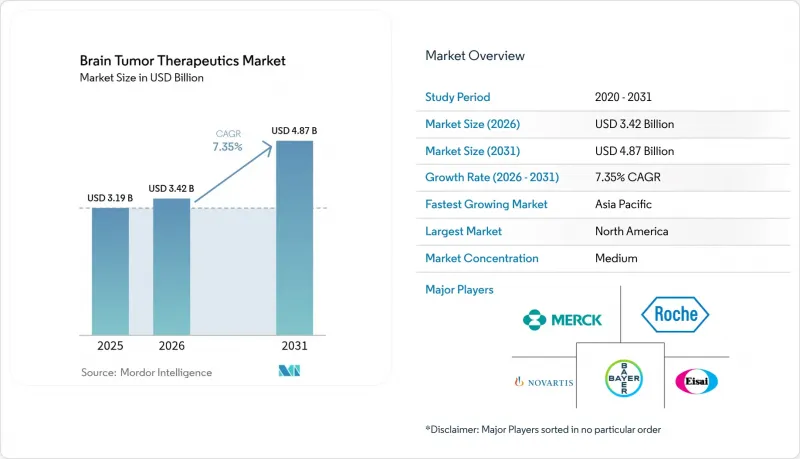
Mordor Intelligence에 의하면, 뇌종양 치료제 시장 규모는 2025년 31억 9,000만 달러에서 2026년에는 34억 2,000만 달러에 이르고, 2026-2031년 CAGR 7.35%로 성장을 지속하여 2031년에는 48억 7,000만 달러에 달할 것으로 예측됩니다.
본 보고서는 뇌종양의 유형(교모세포종, 수막종 등), 치료법(화학요법, 면역요법, 유전자·세포요법 등), 투여 경로(경구, 정맥 내 투여 등), 지역(북미, 유럽, 아시아태평양, 중동 및 아프리카, 남미)별로 분류되어 있습니다. 시장 예측은 금액(달러) 기준으로 제시되어 있습니다.
전 세계 뇌종양 치료제 시장 동향 및 인사이트
후기 임상 개발 파이프라인의 확대와 FDA 승인 가속화
규제 당국의 심사 속도 가속화가 뇌종양 치료제 시장을 지속적으로 재편하고 있습니다. 2024년에 2등급 IDH 돌연변이 글리오마에 대해 승인된 보라시데닙은 위약에 비해 무악화 생존 기간의 중앙값을 2배로 연장하여, 바이오마커 기반 개발 경로의 유효성을 입증했습니다. 획기적 치료법(Breakthrough Therapy) 지정을 통해 개발 기간이 단축되는 한편, 임상시험용 의료기기 면제(IDE) 대상에는 재발성 교모세포종을 위한 Alpha DaRT사의 라듐-224 시드 등 새로운 방사선 치료 플랫폼도 포함되게 되었습니다. 이러한 종합적인 모멘텀에 힘입어 상용화 주기가 단축되고, 분자 하위군과 표적 치료제를 결합한 다군 마스터 임상시험이 촉진되고 있습니다.
바이오마커 기반 치료로의 정밀 의학 전환
현재 주요 의료 기관에서는 IDH 돌연변이, MGMT 프로모터 메틸화 및 1p/19q 공동 결실에 대한 정기 검사가 치료법 선택의 지침이 되고 있습니다. 체액 생검 플랫폼은 실시간 분자 정보를 제공하여, 영상상 진행이 관찰되기 전에 치료법을 전환할 수 있게 해줍니다. 다중 오믹스 프로파일을 통합한 머신러닝 알고리즘은 이미 90% 이상의 정확도로 면역요법 반응을 예측하고 있으며, 이러한 능력 덕분에 체크포인트 억제 요법의 적격 기준이 더욱 정교해지고 있습니다.
신규 치료제 및 병용 요법의 높은 비용
최초의 세포 치료법이나 유전자 치료법은 1코스당 40만 달러를 초과하는 경우가 많으며, 다제 병용 요법의 경우 연간 30만 달러가 추가로 소요되어 지불 주체의 예산에 부담을 주고 있습니다. 현재 의료 제도에서는 보험 급여를 실제 치료 성과와 연계하고 있어, 이로 인해 보험 적용까지 지연이 발생하고, 저소득 지역에서의 조기 도입이 제한되고 있습니다.
부문 분석
2025년 시점에서 교모세포종은 뇌종양 치료제 시장 점유율의 50.78%를 차지하고 있으며, 연평균 성장률(CAGR) 8.02%를 나타낼 것으로 예측되어 2031년까지 뇌종양 치료제 시장 규모에서 가장 큰 점유율을 유지할 것으로 전망됩니다. 높은 사망률, 제한된 표준 치료 옵션, 그리고 종양 치료용 전기장(TTF)의 등장이 투자자들의 관심을 유지하는 요인이 되고 있습니다.
의료기기와 약물의 병용, 펩타이드 백신, IDH 선택적 억제제의 개발이 잇따르고 있어 이 부문에 대한 자본 집중이 두드러집니다. 수막종은 정교해진 방사선 외과 프로토콜 덕분에 시장 규모에서 두 번째로 큰 비중을 차지하고 있습니다. 한편, 뇌하수체 종양은 호르몬 수치를 보다 예측 가능하게 정상화시키는 새로운 내분비 조절제의 혜택을 받고 있습니다. 신경모세포종이나 상피종 등 소아에게서 흔히 나타나는 아형의 경우, 현재 위험도에 따른 방사선 치료와 분자진단이 통합되어 5년 생존율은 향상되고 있으나, 재발 질환에 대한 대책은 여전히 시급한 연구 과제로 남아 있습니다.
지역별 분석
북미는 2025년에도 39.88%의 시장 점유율을 유지하고 있으며, 타의 추종을 불허하는 임상시험 실시 밀도, 유전체 검사 보급률, 그리고 신제품 도입을 가속화하는 지불자 메커니즘을 자랑합니다. 이 지역에 다수 도입된 감마나이프 및 BNCT(양성 핵종 치료) 시스템은 병용 요법을 뒷받침하고 있으며, ‘바이든 암 문샷(Biden Cancer Moonshot)’을 통한 자선 기금이 중개 연구 프로그램을 지원하고 있습니다.
유럽은 EMA(유럽의약품청)의 중앙 승인 제도가 회원국 전체의 접근성을 효율화하고, 민관 파트너십이 희귀암 프로젝트에 공동 자금을 지원하고 있어 꾸준한 기여를 이어가고 있습니다. 독일, 프랑스, 이탈리아에서는 총 120건 이상의 뇌종양 중재 연구가 진행 중이며, 범유럽 등록부가 의료 기술 평가 기관에 실세계 데이터를 제공합니다.
연평균 성장률(CAGR) 8.12%로 가장 빠르게 성장하고 있는 아시아태평양은 중국의 규제 개혁의 혜택을 받고 있으며, 2024년에는 60종 이상의 혁신적인 의약품이 신속 승인 절차를 통해 승인되었습니다. 일본은 BNCT를 조기에 도입함으로써 지역 내 핵심 치료 거점으로 자리매김했으며, 호주의 의료 기관들은 신속한 윤리 심사 절차를 활용하여 해외 환자를 유치하고 있습니다. 한국과 싱가포르의 보험 급여 체계 개선으로 인해 환자들이 최첨단 치료법에 접근할 수 있는 기회가 더욱 확대되고 있습니다.
기타 혜택:
- 엑셀 형식 시장 예측(ME) 시트
- 3개월간의 애널리스트 지원
자주 묻는 질문
목차
제1장 서론
제2장 조사 방법
제3장 주요 요약
제4장 시장 구도
제5장 시장 규모와 성장 예측
제6장 경쟁 구도
제7장 시장 기회와 향후 전망
LSH 26.09.09According to Mordor Intelligence, the brain tumor therapeutics market size is expected to grow from USD 3.19 billion in 2025 to USD 3.42 billion in 2026 and is forecast to reach USD 4.87 billion by 2031 at 7.35% CAGR over 2026-2031.
This report is Segmented by Type of Brain Cancer (Glioblastoma, Meningioma, and More), Therapy (Chemotherapy, Immunotherapy, Gene & Cell Therapy, and More), Route of Administration (Oral, Intravenous, and More), and Geography (North America, Europe, Asia-Pacific, Middle East and Africa, and South America). The Market Forecasts are Provided in Terms of Value (USD).
Global Brain Tumor Therapeutics Market Trends and Insights
Late-stage pipeline expansion & accelerated FDA approvals
Regulatory speed continues to reshape the brain tumor therapeutics market. Vorasidenib's 2024 approval for grade 2 IDH-mutant glioma doubled median progression-free survival versus placebo, validating biomarker-guided development paths. Breakthrough therapy designations are compressing timelines, while investigational device exemptions now cover novel radiotherapy platforms such as Alpha DaRT's radium-224 seeds for recurrent glioblastoma. Collective momentum shortens commercialization cycles and encourages multi-arm master trials that match molecular subsets with targeted agents.
Precision-medicine shift toward biomarker-guided therapies
Routine testing for IDH mutation, MGMT promoter methylation, and 1p/19q codeletion now guides regimen selection in leading centers. Liquid biopsy platforms provide real-time molecular readouts, allowing therapy switches before radiographic progression. Machine-learning algorithms integrating multi-omics profiles already predict immunotherapy responses with 90%+ accuracy, a capability that is refining eligibility criteria for checkpoint blockade.
High cost of novel therapeutics & combination regimens
First-in-class cell and gene therapies often exceed USD 400,000 per course, while multi-agent combinations can add another USD 300,000 annually, straining payer budgets. Health systems now link reimbursement to real-world outcomes, creating coverage delays that limit early adoption in lower-income settings.
Other drivers and restraints analyzed in the detailed report include:
- Commercial roll-out of compact BNCT platforms
- AI-assisted drug repurposing for orphan brain tumors
- Blood-brain barrier limits small-molecule & biologic penetration
For complete list of drivers and restraints, kindly check the Table Of Contents.
Segment Analysis
Glioblastoma held 50.78% of brain tumor therapeutics market share in 2025 and is projected to grow at an 8.02% CAGR, sustaining the largest slice of the brain tumor therapeutics market size through 2031. High mortality, limited standard-of-care options, and the emergence of tumor-treating fields help maintain investor focus.
Continued device-drug pairings, peptide vaccines, and IDH-selective inhibitors illustrate capital concentration in this segment. Meningioma follows in value terms thanks to refined radiosurgery protocols, whereas pituitary tumors benefit from novel endocrine modulators that normalize hormone levels more predictably. Pediatric-leaning subtypes such as medulloblastoma and ependymoma now integrate risk-adapted radiotherapy with molecular diagnostics, improving five-year survival yet leaving relapsed disease an urgent research priority.
Complete Report Scope:
- By Type of Brain Cancer
- Glioblastoma
- Meningioma
- Pituitary Tumors
- Ependymoma
- Medulloblastoma
- Other Rare Tumors
- By Therapy
- Chemotherapy
- Immunotherapy
- Gene & Cell Therapy
- Targeted Small-Molecule Therapy
- Tumor-Treating Fields (TTF) & Electro-therapy
- Radiotherapy Adjuncts
- By Route of Administration
- Oral
- Intravenous
- Intrathecal / Intraventricular
- Convection-Enhanced Delivery
- Geography
- North America
- United States
- Canada
- Mexico
- Europe
- Germany
- United Kingdom
- France
- Italy
- Spain
- Rest of Europe
- Asia-pacific
- China
- Japan
- India
- South Korea
- Australia
- Rest of Asia-pacific
- Middle East and Africa
- GCC
- South Africa
- Rest of Middle East and Africa
- South America
- Brazil
- Argentina
- Rest of South America
- North America
Geography Analysis
North America maintained 39.88% market share in 2025 and enjoys unrivaled clinical-trial density, genomic testing adoption, and payer mechanisms that expedite new product uptake. The region's large installed base of Gamma Knife and BNCT systems supports combination regimens, and philanthropic funding from the Biden Cancer Moonshot sustains translational research programs.
Europe follows with steady contributions as EMA centralized approvals streamline access across member states, and public-private partnerships co-finance orphan-tumor projects. Germany, France, and Italy collectively host more than 120 ongoing brain tumor interventional studies, while pan-European registries supply real-world evidence to health technology assessment agencies.
Asia-Pacific, the fastest-growing region at 8.12% CAGR, benefits from China's regulatory modernization, where 60+ innovative drugs won clearance under accelerated pathways in 2024. Japan's early BNCT adoption makes the country a regional referral hub, and Australian institutions leverage favorable ethics timelines to recruit international patients. Improving reimbursement frameworks in South Korea and Singapore further broaden patient access to leading-edge regimens.
- Amgen
- AstraZeneca
- Bayer
- Bristol-Myers Squibb
- Eisai
- Roche
- GlaxoSmithKline
- Johnson & Johnson
- Merck
- Novartis
- Pfizer
- Novocure Ltd.
- Celldex Therapeutic
- Kintara Therapeutics
- DelMar Pharmaceuticals
- Abbvie
- Daiichi Sankyo Co., Ltd.
- Sumitomo Heavy Industries (BNCT Systems)
- Neutron Therapeutics
- TAE Life Sciences
Additional Benefits:
- The market estimate (ME) sheet in Excel format
- 3 months of analyst support
TABLE OF CONTENTS
1 Introduction
- 1.1 Study Assumptions & Market Definition
- 1.2 Scope of the Study
2 Research Methodology
3 Executive Summary
4 Market Landscape
- 4.1 Market Overview
- 4.2 Market Drivers
- 4.2.1 Rising Incidence of Primary & Metastatic Brain Tumors
- 4.2.2 Continuous Late-stage Pipeline Expansion & Accelerated FDA Approvals
- 4.2.3 Precision-medicine Shift Toward Biomarker-guided Therapies
- 4.2.4 Government-sponsored Brain Cancer Initiatives & Funding Boosts
- 4.2.5 Boron Neutron Capture Therapy (BNCT) Commercial Roll-out Momentum
- 4.2.6 AI-enabled Drug-repurposing Accelerating Orphan-tumor Candidates
- 4.3 Market Restraints
- 4.3.1 High Cost of Novel Therapeutics & Combination Regimens
- 4.3.2 Blood-brain Barrier Limits Small-molecule & Biologic Penetration
- 4.3.3 Tumor Micro-environment-driven Immunotherapy Resistance
- 4.3.4 Radio-isotope Supply Shortages for BNCT Facilities
- 4.4 Supply-Chain Analysis
- 4.5 Regulatory Landscape
- 4.6 Technological Outlook
- 4.7 Porter's Five Forces Analysis
- 4.7.1 Bargaining Power of Buyers/Consumers
- 4.7.2 Bargaining Power of Suppliers
- 4.7.3 Threat of New Entrants
- 4.7.4 Threat of Substitute Products
- 4.7.5 Intensity of Competitive Rivalry
5 Market Size & Growth Forecasts (Value, USD)
- 5.1 By Type of Brain Cancer
- 5.1.1 Glioblastoma
- 5.1.2 Meningioma
- 5.1.3 Pituitary Tumors
- 5.1.4 Ependymoma
- 5.1.5 Medulloblastoma
- 5.1.6 Other Rare Tumors
- 5.2 By Therapy
- 5.2.1 Chemotherapy
- 5.2.2 Immunotherapy
- 5.2.3 Gene & Cell Therapy
- 5.2.4 Targeted Small-Molecule Therapy
- 5.2.5 Tumor-Treating Fields (TTF) & Electro-therapy
- 5.2.6 Radiotherapy Adjuncts
- 5.3 By Route of Administration
- 5.3.1 Oral
- 5.3.2 Intravenous
- 5.3.3 Intrathecal / Intraventricular
- 5.3.4 Convection-Enhanced Delivery
- 5.4 Geography
- 5.4.1 North America
- 5.4.1.1 United States
- 5.4.1.2 Canada
- 5.4.1.3 Mexico
- 5.4.2 Europe
- 5.4.2.1 Germany
- 5.4.2.2 United Kingdom
- 5.4.2.3 France
- 5.4.2.4 Italy
- 5.4.2.5 Spain
- 5.4.2.6 Rest of Europe
- 5.4.3 Asia-pacific
- 5.4.3.1 China
- 5.4.3.2 Japan
- 5.4.3.3 India
- 5.4.3.4 South Korea
- 5.4.3.5 Australia
- 5.4.3.6 Rest of Asia-pacific
- 5.4.4 Middle East and Africa
- 5.4.4.1 GCC
- 5.4.4.2 South Africa
- 5.4.4.3 Rest of Middle East and Africa
- 5.4.5 South America
- 5.4.5.1 Brazil
- 5.4.5.2 Argentina
- 5.4.5.3 Rest of South America
- 5.4.1 North America
6 Competitive Landscape
- 6.1 Market Concentration
- 6.2 Market Share Analysis
- 6.3 Company Profiles (includes Global level Overview, Market level overview, Core Segments, Financials as available, Strategic Information, Market Rank/Share for key companies, Products & Services, and Recent Developments)
- 6.3.1 Amgen Inc.
- 6.3.2 AstraZeneca PLC
- 6.3.3 Bayer AG
- 6.3.4 Bristol-Myers Squibb Company
- 6.3.5 Eisai Co., Ltd.
- 6.3.6 F. Hoffmann-La Roche Ltd
- 6.3.7 GSK plc
- 6.3.8 Johnson & Johnson (Janssen)
- 6.3.9 Merck & Co., Inc.
- 6.3.10 Novartis AG
- 6.3.11 Pfizer Inc.
- 6.3.12 Novocure Ltd.
- 6.3.13 Celldex Therapeutics
- 6.3.14 Kintara Therapeutics
- 6.3.15 DelMar Pharmaceuticals
- 6.3.16 AbbVie Inc.
- 6.3.17 Daiichi Sankyo Co., Ltd.
- 6.3.18 Sumitomo Heavy Industries (BNCT Systems)
- 6.3.19 Neutron Therapeutics
- 6.3.20 TAE Life Sciences
7 Market Opportunities & Future Outlook
- 7.1 White-Space & Unmet-Need Assessment