|
시장보고서
상품코드
2121760
나노 금속 산화물 : 시장 점유율 분석, 업계 동향과 통계, 성장 예측(2026-2031년)Nano-Metal Oxides - Market Share Analysis, Industry Trends & Statistics, Growth Forecasts (2026 - 2031) |
||||||
 Mordor Intelligence
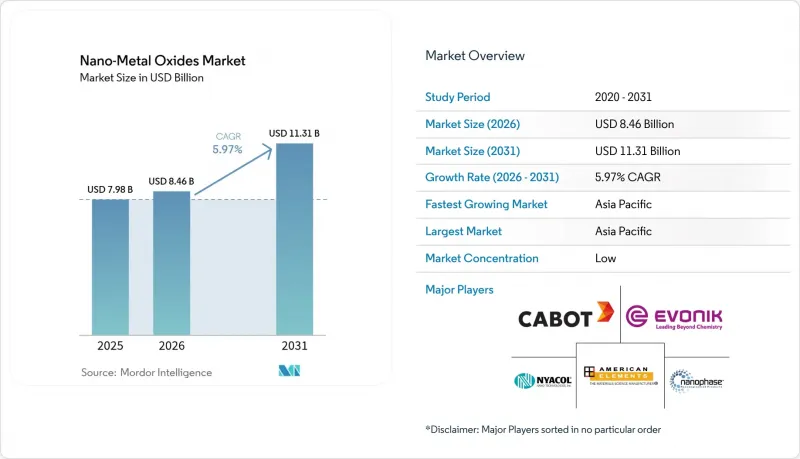
Mordor Intelligence에 의하면, 2026년 나노 금속 산화물 시장 규모는 84억 6,000만 달러로 추정되며, 2025년 79억 8,000만 달러에서 2031년에는 113억 1,000만 달러에 달할 것으로 예측됩니다.
또한 2026-2031년 연평균 성장률(CAGR)은 5.97%를 기록할 전망입니다.
본 보고서는 제품 유형(알루미나, 실리카 등), 입자 크기(20 Nm 미만, 20-80 Nm, 기타), 합성 방법(졸-겔법, 프레임 스프레이 열분해법 등), 최종 사용자 산업(운송, 전자 등), 지역(아시아태평양, 북미, 유럽, 남미, 중동 및 아프리카)별로 분류되어 있습니다. 시장 예측은 금액(달러)으로 제시되어 있습니다.
세계 나노 금속 산화물 시장 동향 및 인사이트
항공우주용 초합금에 나노 소재 적용
항공우주 프로그램에서는 500°C까지 안정적인 기계적 특성을 발휘하는 산화물 분산 강화 합금이 채택되어, 기존의 알루미늄계 소재에 비해 40%의 성능 향상이 이루어졌습니다. 나노 규모의 L12 석출물로 강화된 고엔트로피 니켈 합금은 -196°C에서 600°C까지의 온도 범위에서 인장 강도를 일정하게 유지할 수 있어, 초음속 항공기에서 발생하는 온도 의존성 문제를 해결하고 있습니다. 보잉 787 및 에어버스 A350 플랫폼의 복합재 동체부는 나노 산화물 필러를 통해 구조적 무결성을 유지하면서 이미 20%의 경량화를 실현했습니다. 내하중성 향상은 물론, 내장된 나노 입자는 전자기 차폐 효과를 발휘하여 항공 전자 장비를 외부 간섭으로부터 보호합니다. 이러한 복합적인 이점으로 인해 인증 절차가 가속화되고, Tier 1 공급업체 간의 조달 계약이 활발해지고 있습니다.
퍼스널케어 제품에서의 항균 수요
방부제를 사용하지 않은 화장품에 대한 소비자의 선호도가 높아짐에 따라, 세포 독성을 유발하지 않으면서 세균 증식을 90% 억제하는 산화아연 나노 입자에 대한 관심이 높아지고 있습니다. 다기능 이산화티타늄 입자는 자외선 차단과 광활성화를 통한 병원체 살균을 동시에 실현하여, 하나의 처방당 첨가제 사용량을 줄여줍니다. 산화구리는 뛰어난 항진균 활성을 발휘하여, 내성을 가진 피부사상균을 표적으로 한 고급 스킨케어 제품의 출시를 뒷받침하고 있습니다. 금속계 유효 성분으로의 급속한 전환으로 인해 성분 목록이 간소화되어 ‘클린 라벨’이라는 슬로건을 뒷받침하고 있습니다. 특히 규제 승인이 신속한 아시아태평양에서 이러한 경향이 두드러집니다. 화장품 등급 분산액의 생산 규모를 확대하고 있는 공급업체들은 브랜드 소유주들이 전 세계 SKU 포트폴리오의 재조성을 추진함에 따라 선구자로서의 우위를 확보하고 있습니다.
금속 분말 사용이 환경에 미치는 영향
생명주기 평가에 따르면, 화학적으로 합성되거나 생체 합성된 나노 산화물 모두 수생 생물에게 산화 스트레스나 DNA 손상을 유발할 가능성이 있어 규제 당국의 면밀한 조사가 진행되고 있습니다. 유럽식품안전청(EFSA) 및 미국 식품의약국(FDA)은 현재 소비자 제품에 대해 더 엄격한 노출 기준치를 적용하고 있어, 중소 제조업체의 규정 준수 비용이 증가하고 있습니다. 재활용 절차와 폐쇄형 폐수 처리 시스템은 허가 취득의 필수 조건이 되어가고 있으며, 신규 프로젝트에 대한 설비 투자가 증가하고 있습니다. 따라서 시장 진출기업들은 시장 접근성을 확보하기 위해 혁신과 엄격한 환경 관리 사이의 균형을 맞추어야 합니다.
부문 분석
2025년, 이산화티타늄은 나노 금속 산화물 시장 점유율의 32.75%를 차지했습니다. 이는 광촉매 성능과 유전 안정성 덕분에 자가 세정 외벽에서 고유전율(high-k) 트랜지스터에 이르기까지 폭넓은 용도로 채택되었기 때문입니다. 식물 추출물을 이용한 친환경 제조 공법을 통해, 유사한 밴드갭을 가지면서도 탄소 발자국이 낮은 생체 적합성 입자를 얻을 수 있게 됨에 따라 이 부문의 성장은 계속되고 있습니다. 세륨 산화물은 Ce3+/Ce4+의 이중 상태가 반도체 평탄화에 필수적인 CMP 슬러리를 주도하기 때문에 연평균 성장률(CAGR) 7.86%로 다른 소재를 웃도는 성장이 예상됩니다. 실리카와 산화아연은 배리어 필름 및 피부용 크림 분야에서 여전히 신뢰할 수 있는 소재로 자리 잡고 있지만, 산화철 나노 구조체는 89%에 달하는 염료 분해 효율을 무기로 오염 정화 시스템으로의 진출을 확대되고 있습니다.
시장의 성장세는 입자 공학과 최종 용도 인증을 모두 충족하는 공급업체에 혜택을 가져다주고 있습니다. 이산화티타늄 제조업체는 식품 접촉 용도 및 화장품 분야에서 폭넓은 규제 승인을 활용하는 한편, 세륨 산화물 공급업체는 웨이퍼 수준의 순도에 주력하고 있습니다. 통합형 기업들은 공통된 전구체 네트워크를 활용하여 물류 비용을 절감하고, 나노 금속 산화물 시장의 이 분야에서 경쟁 우위를 강화하고 있습니다.
20-80 nm의 입자 크기 범위는 2025년에 45.90%를 차지하며, 연평균 성장률(CAGR) 7.76%로 시장을 주도할 것으로 예측됩니다. 이 입자 크기 범위는 양자 표면 반응성과 공정 안정성 사이의 균형이 잘 잡혀 있어 잉크나 폴리머에 쉽게 분산되는 한편, 20 nm 미만에서 흔히 발생하는 응집을 피할 수 있습니다. 20 nm 미만의 입자는 뛰어난 촉매 활성을 발휘하지만, 여과 및 분진 안전 문제를 야기하여 취급 비용을 높입니다. 80 nm를 초과하는 입자는 틈새 시장인 광학 용도나 내마모 용도로 사용되지만, 대량 시장에서의 판매량은 중입자 영역에 뒤처집니다. 졸-겔법 및 수열법 반응 장치의 기술 발전으로 현재 ±5 nm의 공차가 확보되어, 배합 설계자는 로트 간의 균일성을 확신할 수 있게 되었습니다.
이 기술을 도입한 기업들은 광촉매에서의 밴드갭 조절 가능성이나 도료에서의 예측 가능한 유변학적 특성과 같은 이 ‘스위트 스팟’을 높이 평가했습니다. 반응 장치의 지속적인 최적화와 인라인 분광 분석의 결합을 통해 처리 능력의 향상이 기대되며, 20-80 nm 범위는 나노 금속 산화물 시장의 주력 부문으로서 입지를 공고히할 것입니다.
지역별 분석
아시아태평양은 2025년에 45.55%의 점유율을 차지하며 연평균 성장률(CAGR) 7.88%를 나타낼 것으로 예측됩니다. 이는 전 세계 실리콘 음극재 시장에서 중국이 67.8%의 점유율을 차지하고, 첨단 소재 특허에서 일본이 21.5%의 점유율을 차지하고 있는 점이 뒷받침되고 있습니다. 수직 통합을 통해 비용이 절감되면서 시범 생산에서 양산으로의 전환이 가속화되고 있습니다. 2001년 이후, 300억 달러가 넘는 정부 자금이 기술 성숙도와 노동력 기술 향상을 도모하는 산학 컨소시엄에 투입되었습니다.
북미는 2위를 차지하고 있으며, 산화물 강화 합금과 첨단 반도체를 필요로 하는 항공우주 산업공급망에 힘입고 있습니다. American Elements 및 Evonik과 같은 제조업체들은 반도체 제조 공장을 위한 초고순도 콜로이드 실리카 생산 공장에 투자했습니다.
유럽에서는 친환경 설계가 중시되고 있습니다. 엄격한 REACH 지침에 따라 친환경 바이오 합성 기술의 조기 도입이 촉진되고 있으며, 에너지 효율 기준을 충족하기 위해 건물 개보수 공사에서는 근적외선(NIR) 반사 코팅이 채택되고 있습니다. 남미 및 중동과 같은 신흥 지역에서는 기후 변화에 강한 인프라 구축을 위해 나노 산화물 파사드가 활용되고 있으며, 현지 규제가 정비됨에 따라 그 소비량은 점차 증가하고 있습니다.
기타 혜택:
- 엑셀 형식 시장 예측(ME) 시트
- 3개월간의 애널리스트 지원
자주 묻는 질문
목차
제1장 서론
제2장 조사 방법
제3장 주요 요약
제4장 시장 구도
제5장 시장 규모와 성장 예측
제6장 경쟁 구도
제7장 시장 기회와 향후 전망
LSH 26.09.09According to Mordor Intelligence, nano-Metal oxides market size in 2026 is estimated at USD 8.46 billion, growing from 2025 value of USD 7.98 billion with 2031 projections showing USD 11.31 billion, growing at 5.97% CAGR over 2026-2031.
This report is Segmented by Product Type (Alumina, Silica, and More), Particle Size (Less Than 20 Nm, 20-80 Nm, and More), Synthesis Method (Sol-Gel, Flame Spray Pyrolysis, and More), End-User Industry (Transportation, Electronics, and More), and Geography (Asia-Pacific, North America, Europe, South America, Middle East and Africa). The Market Forecasts are Provided in Terms of Value (USD).
Global Nano-Metal Oxides Market Trends and Insights
Nanomaterials Adoption in Aerospace Super-Alloys
Aerospace programmes are embedding oxide-dispersion-strengthened alloys that deliver stable mechanical properties up to 500 °C, a 40% improvement on legacy aluminum systems. High-entropy nickel alloys fortified with nanoscale L12 precipitates keep tensile strength constant from -196 °C to 600 °C, removing temperature-sensitivity roadblocks for hypersonic vehicles. Composite fuselage sections on Boeing 787 and Airbus A350 platforms already demonstrate 20% weight savings while preserving structural integrity through nano-oxide fillers. Beyond load-bearing gains, embedded nanoparticles offer electromagnetic shielding that safeguards avionics from external interference. These combined benefits accelerate qualification cycles and ignite procurement contracts across Tier-1 suppliers.
Anti-Microbial Demand in Personal Care Formulations
Consumer preference for preservative-free cosmetics is raising interest in zinc oxide nanoparticles that achieve 90% bacterial growth reduction without cytotoxicity. Multifunctional titanium dioxide particles deliver simultaneous UV protection and photo-activated pathogen kill, reducing additive loading per formulation. Copper oxide offers premium antifungal activity and supports luxury skin-care launches targeting resistant dermatophytes. The swift pivot toward metal-based actives shortens ingredient lists and supports clean-label claims, particularly in Asia-Pacific where regulatory clearance is rapid. Suppliers scaling cosmetic-grade dispersions gain first-mover advantage as brand owners re-formulate global SKU portfolios.
Environmental Implications of Using Metal Powder
Lifecycle assessments reveal that both chemically and bio-synthesised nano-oxides can induce oxidative stress and DNA damage in aquatic species, prompting regulatory scrutiny. The European Food Safety Authority and the FDA now enforce tighter exposure thresholds for consumer products, lifting compliance costs for smaller producers. Recycling protocols and closed-loop wastewater systems are becoming prerequisites for permits, adding capital expenditure to greenfield projects. Market entrants must therefore balance innovation with stringent environmental stewardship to gain market access.
Other drivers and restraints analyzed in the detailed report include:
- Energy Storage Electrode Enhancements
- Growing Demand from Paints and Coatings Industry
- Price Volatility of Precursor Metals
For complete list of drivers and restraints, kindly check the Table Of Contents.
Segment Analysis
Titanium oxide commanded 32.75% of the nano-metal oxides market share in 2025 as its photocatalytic strength and dielectric stability secured usage from self-cleaning facades to high-k transistors. Segment expansion continues as green routes employ plant extracts to yield biocompatible particles with similar band gaps yet lower carbon footprints. Cerium oxide is projected to outpace peers with a 7.86% CAGR as dual Ce3+/Ce4+ states drive CMP slurries vital for semiconductor planarisation. Silica and zinc oxide remain dependable for barrier films and dermatological creams, while iron oxide nanostructures penetrate remediation systems via 89% dye degradation efficiency.
Market momentum benefits suppliers that align particle engineering with end-use certification. Titanium dioxide makers capitalise on broad regulatory acceptance in food contact and cosmetics, whereas ceria suppliers focus on wafer-scale purity. Integrated firms leverage shared precursor networks to cut logistic costs, reinforcing competitive moats in this slice of the nano-metal oxides market.
The 20-80 nm band represented 45.90% in 2025 and is forecast to lead with a 7.76% CAGR. The interval balances quantum surface reactivity and process stability, offering easy dispersion in inks and polymers while avoiding the agglomeration typical below 20 nm. Sub-20 nm particles deliver superior catalytic rates but raise filtration and dust-safety issues that lift handling costs. Sizes above 80 nm serve niche optical or abrasion-resistant roles yet cede mass-market volumes to the mid-range. Advances in sol-gel and hydrothermal reactors now hold +-5 nm tolerances, giving formulators confidence in batch-to-batch consistency.
Adopters value this sweet spot for tunable band gaps in photocatalysts and predictable rheology in paints. Continued reactor optimisation coupled with inline spectroscopy promises to lift throughput, cementing the 20-80 nm window as the workhorse segment of the nano-metal oxides market.
Complete Report Scope:
- By Product Type
- Alumina
- Silica
- Titanium Oxide
- Zinc Oxide
- Iron Oxide
- Other Product Types (Copper Oxide, etc.)
- By Particle Size
- Less than 20 nm
- 20 - 80 nm
- Greater than 80 nm
- By Synthesis Method
- Sol-gel
- Flame Spray Pyrolysis
- Hydrothermal/ Solvothermal
- Chemical Vapor Deposition
- Green/ Bio-synthesis
- By End-user Industry
- Transportation
- Electronics
- Energy
- Construction
- Personal Care
- Healthcare
- Other End-user Industries (Chemicals and Catalysts, etc.)
- By Geography
- Asia-Pacific
- China
- Japan
- India
- South Korea
- ASEAN Countries
- Rest of Asia-Pacific
- North America
- United States
- Canada
- Mexico
- Europe
- Germany
- United Kingdom
- France
- Italy
- Spain
- Russia
- NORDIC Countries
- Rest of Europe
- South America
- Brazil
- Argentina
- Rest of South America
- Middle East and Africa
- Saudi Arabia
- South Africa
- Rest of Middle East and Africa
- Asia-Pacific
Geography Analysis
Asia-Pacific captured 45.55% share in 2025 and is projected to record a 7.88% CAGR, anchored by China's 67.8% share of global silicon-anode materials and Japan's 21.5% cut of advanced material patents. Vertical integration compresses costs and quickens pilot-to-mass-production transitions. Government funding exceeding USD 30 billion since 2001 finances university-industry consortia that raise technology readiness and workforce skills.
North America ranks second, supported by aerospace supply chains that require oxide-strengthened alloys and advanced semiconductors. Producers such as American Elements and Evonik invested in ultra-high-purity colloidal silica plants to serve chip fabs.
Europe emphasises eco-design. Strict REACH directives motivate early adoption of green bio-synthesis, and construction retrofits absorb NIR-reflective coatings to meet energy-efficiency mandates. Emerging regions like South America and the Middle East tap nano-oxide facades for climate-resilient infrastructure, gradually lifting their consumption as local regulations mature.
- Advanced Nano Products Co., Ltd.
- American Elements
- Baikowski SA
- Cabot Corporation
- Cerion Nanomaterials
- Chengyin Technology
- Diamon-Fusion International Inc.
- Evonik Industries AG
- MATEXCEL
- Meliorum Technologies, Inc.
- Merck KGaA
- NaBond Technologies Co., Ltd.
- NanoComposix (Fortis Life Sciences)
- Nano-Oxides Inc.
- Nanophase Technologies Corporation
- Nanoshel LLC
- Nissan Chemical Corporation
- NYACOL Nano Technologies, Inc.
- Reinste Nano Ventures
- SkySpring Nanomaterials Inc.
- US Research Nanomaterials, Inc.
Additional Benefits:
- The market estimate (ME) sheet in Excel format
- 3 months of analyst support
TABLE OF CONTENTS
1 Introduction
- 1.1 Study Assumptions and Market Definition
- 1.2 Scope of the Study
2 Research Methodology
3 Executive Summary
4 Market Landscape
- 4.1 Market Overview
- 4.2 Market Drivers
- 4.2.1 Nanomaterials adoption in aerospace super-alloys
- 4.2.2 Anti-microbial demand in personal care formulations
- 4.2.3 Energy storage electrode enhancements
- 4.2.4 Growing demand for nano metal oxides from paints and coatings industry
- 4.2.5 Increasing technology of 3D-printing Process
- 4.3 Market Restraints
- 4.3.1 Environmental Implications of Using Metal Powder
- 4.3.2 Price volatility of precursor metals
- 4.3.3 High Production Costs
- 4.4 Value Chain Analysis
- 4.5 Porter's Five Forces
- 4.5.1 Bargaining Power of Suppliers
- 4.5.2 Bargaining Power of Buyers
- 4.5.3 Threat of New Entrants
- 4.5.4 Threat of Substitutes
- 4.5.5 Degree of Competition
5 Market Size and Growth Forecasts (Value)
- 5.1 By Product Type
- 5.1.1 Alumina
- 5.1.2 Silica
- 5.1.3 Titanium Oxide
- 5.1.4 Zinc Oxide
- 5.1.5 Iron Oxide
- 5.1.6 Other Product Types (Copper Oxide, etc.)
- 5.2 By Particle Size
- 5.2.1 Less than 20 nm
- 5.2.2 20 - 80 nm
- 5.2.3 Greater than 80 nm
- 5.3 By Synthesis Method
- 5.3.1 Sol-gel
- 5.3.2 Flame Spray Pyrolysis
- 5.3.3 Hydrothermal/ Solvothermal
- 5.3.4 Chemical Vapor Deposition
- 5.3.5 Green/ Bio-synthesis
- 5.4 By End-user Industry
- 5.4.1 Transportation
- 5.4.2 Electronics
- 5.4.3 Energy
- 5.4.4 Construction
- 5.4.5 Personal Care
- 5.4.6 Healthcare
- 5.4.7 Other End-user Industries (Chemicals and Catalysts, etc.)
- 5.5 By Geography
- 5.5.1 Asia-Pacific
- 5.5.1.1 China
- 5.5.1.2 Japan
- 5.5.1.3 India
- 5.5.1.4 South Korea
- 5.5.1.5 ASEAN Countries
- 5.5.1.6 Rest of Asia-Pacific
- 5.5.2 North America
- 5.5.2.1 United States
- 5.5.2.2 Canada
- 5.5.2.3 Mexico
- 5.5.3 Europe
- 5.5.3.1 Germany
- 5.5.3.2 United Kingdom
- 5.5.3.3 France
- 5.5.3.4 Italy
- 5.5.3.5 Spain
- 5.5.3.6 Russia
- 5.5.3.7 NORDIC Countries
- 5.5.3.8 Rest of Europe
- 5.5.4 South America
- 5.5.4.1 Brazil
- 5.5.4.2 Argentina
- 5.5.4.3 Rest of South America
- 5.5.5 Middle East and Africa
- 5.5.5.1 Saudi Arabia
- 5.5.5.2 South Africa
- 5.5.5.3 Rest of Middle East and Africa
- 5.5.1 Asia-Pacific
6 Competitive Landscape
- 6.1 Market Concentration
- 6.2 Strategic Moves
- 6.3 Market Share(%)/Ranking Analysis
- 6.4 Company Profiles {(includes Global level Overview, Market level overview, Core Segments, Financials as available, Strategic Information, Market Rank/Share for key companies, Products and Services, and Recent Developments)}
- 6.4.1 Advanced Nano Products Co., Ltd.
- 6.4.2 American Elements
- 6.4.3 Baikowski SA
- 6.4.4 Cabot Corporation
- 6.4.5 Cerion Nanomaterials
- 6.4.6 Chengyin Technology
- 6.4.7 Diamon-Fusion International Inc.
- 6.4.8 Evonik Industries AG
- 6.4.9 MATEXCEL
- 6.4.10 Meliorum Technologies, Inc.
- 6.4.11 Merck KGaA
- 6.4.12 NaBond Technologies Co., Ltd.
- 6.4.13 NanoComposix (Fortis Life Sciences)
- 6.4.14 Nano-Oxides Inc.
- 6.4.15 Nanophase Technologies Corporation
- 6.4.16 Nanoshel LLC
- 6.4.17 Nissan Chemical Corporation
- 6.4.18 NYACOL Nano Technologies, Inc.
- 6.4.19 Reinste Nano Ventures
- 6.4.20 SkySpring Nanomaterials Inc.
- 6.4.21 US Research Nanomaterials, Inc.
7 Market Opportunities and Future Outlook
- 7.1 White-space and Unmet-Need Assessment