

|
시장보고서
상품코드
2121768
스티렌 : 시장 점유율 분석, 업계 동향과 통계, 성장 예측(2026-2031년)Styrene - Market Share Analysis, Industry Trends & Statistics, Growth Forecasts (2026 - 2031) |
||||||
 Mordor Intelligence
Mordor Intelligence에 의하면, 스티렌 시장 규모는 2025년 2,858만 톤에서 2026년에는 3,012만 톤으로 확대되어 2031년까지 3,918만 톤에 이를 것으로 예상되며, 2026-2031년 CAGR 5.40%를 기록할 전망입니다.
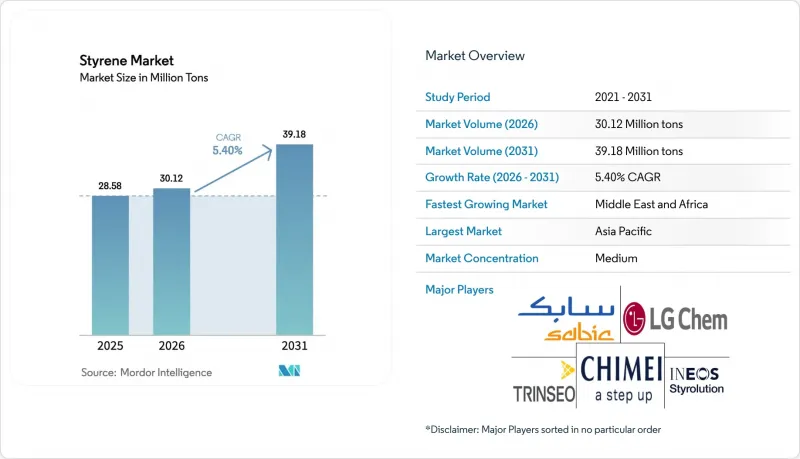
본 보고서는 제품 유형(폴리스티렌, 아크릴로니트릴-부타디엔-스티렌,기타 제품 유형), 최종 사용자 산업(포장, 건설, 소비재, 자동차 및 운송, 전기 및 전자, 기타 최종 사용자 산업), 지역(아시아태평양, 북미, 유럽, 남미, 중동 및 아프리카)별로 분류되어 있습니다. 시장 전망은 수량(톤) 기준으로 제시되어 있습니다.
세계 스티렌 시장 동향 및 인사이트
가볍고 강성이 높은 포장재에 대한 수요 증가
경질 폴리스티렌으로 제작된 클램쉘 용기는 동일한 두께에서 폴리에틸렌이나 폴리프로필렌으로 만든 대체품으로는 구현하기 어려운 투명성과 강성을 갖추고 있습니다. EU의 ‘포장 및 포장 폐기물에 관한 규정(2025/40)’에서는 2030년까지 35%, 2040년까지 65%의 재생재 함유율이 규정되어 있으며, 이에 따라 가공업체는 비식품 용도에는 기계적 재활용 폴리스티렌을,식품 접촉 용도에는 화학적 재활용 모노머를 채택하도록 권장하고 있습니다. INEOS Styrolution사는 열분해 유래 스티렌에 대해 미국 FDA의 식품 접촉 통지 2245를 획득하여, 낙하 충격 저항성을 저해하지 않으면서 요거트 컵이나 베이커리용 트레이가 브랜드의 목표를 달성할 수 있는 길을 열었습니다. Agilyx사의 TruStyrenyx 시설은 하루 100톤 규모의 탈중합 라인 설계를 완료했으나, 최종 투자는 인수 계약 체결 여부에 따라 결정될 예정입니다. 열분해 공정에서는 90% 이상의 단량체 순도를 달성하고 있지만, 원료 수집이 여전히 병목 현상으로 작용하고 있어 대부분의 지역에서 재활용 업체의 가동률이 정격 수준에 미치지 못하고 있습니다.
급증하는 가전제품 케이스 수요
2025년 전 세계 AI 지원 PC 출하량은 1억 1,400만 대로 예측되며, 각 기종의 내부 구조에는 150-200그램의 난연성 ABS가 사용됩니다. 하이퍼스케일 사업자들은 10년간의 실외 노출을 견디고 초킹(백화) 현상이 발생하지 않는 5G 기지국용 케이스에 대해, UV 안정화 아크릴로니트릴·스티렌·아크릴레이트 공중합체의 사용을 지정하고 있습니다. 2024년 1월에 출시된 삼성의 ‘Galaxy S24’ 시리즈에서는 치수 공차가 ±0.05mm 이하이어야 하는 브라켓에 여전히 버진 ABS가 채택되고 있습니다. LG Chem 및 CHIMEI의 내열성 ABS 공급이 부족함에 따라, 전자기기 OEM 각사는 용융 유동 지수(MFI) 사양에 편차가 있음에도 불구하고 중국으로부터의 이중 조달을 선택할 수밖에 없는 상황입니다.
130개국 이상에서 일회용 PS 및 EPS 사용 금지
EU의 ‘포장 및 포장 폐기물에 관한 규정’에 따라, 매장 내 식사용 일회용 EPS 식품 용기는 2029년 1월부터, 테이크아웃용은 2030년 1월부터 금지되어 지역 수요가 18만 톤 감소하게 됩니다. 뉴욕주와 캘리포니아주의 규제로 인해 미국에서는 35,000-4만 톤 수요가 추가로 감소하는 한편, 캐나다에서는 2024년에 전국적인 금지 조치가 발효되었습니다. 패스트푸드점들은 성형 펄프나 폴리프로필렌으로의 전환을 추진하고 있으며, 비용은 10-15% 상승하는 반면 해양 쓰레기 발생량은 감소하고 있습니다. 설비 갱신을 위한 자금이 부족한 중소 압출 성형 업체들은 대형 가공업체에 자산을 매각하고 있어 업계 재편이 가속화되고 있습니다.
부문 분석
폴리스티렌은 2025년 생산량의 46.38%를 차지했으나, 외식 산업에서의 사용 금지 조치로 인해 그 성장률은 스티렌 시장 전체의 연평균 성장률(CAGR)보다 낮을 것으로 예측됩니다. 화학 재활용으로의 전환은 매우 중요합니다. Trinseo사와 Recycling Technologies사는 현재 연간 3만 톤의 사용 후 재료를 EU 규정 10/2011 및 FDA FCN 2245 기준을 충족하는 버진급 단량체로 전환하고 있습니다. 아크릴로니트릴-부타디엔-스티렌(ABS)은 UL 94 V-0 규격 준수가 요구되는 전기차용 배터리 트레이와 5G 기기 케이스에 힘입어 연평균 성장률(CAGR) 6.18%로 시장 확대의 선두를 달리고 있습니다. BASF 및 SABIC의 특수 ABS 등급은 금속 대체재에 비해 부품 중량을 25-30% 줄이고 있습니다. 범용 폴리스티렌의 경우, 2023년부터 2024년에 걸쳐 중국에서 가동을 시작하는 연간 145만 톤 규모의 신규 생산 능력으로 인해 이익률 압박에 직면해 있습니다.
2025년 9월 INEOS Styrolution이 실시한 재생 모노머 검증으로 순환형 경제의 실현 가능성이 입증되었으나, 톤당 150-200달러의 회수 및 선별 비용이 계속해서 영업이익률을 압박하고 있습니다. 스티렌-아크릴로니트릴 공중합체는 투명성이 중시되는 투명 하우징을 중심으로, 전반적인 수요 증가에 발맞추어 시장이 확대되고 있습니다. 미쉐린(Michelin)이 재활용 스티렌을 타이어 트레드에 적용하고, 2030년까지 지속 가능한 소재의 함유율을 40%로 높일 목표를 세운 데 따라, 스티렌-부타디엔 고무(SBR) 수요가 확대되고 있습니다.
지역별 분석
아시아태평양은 2025년 생산량의 49.27%를 차지하며 계속해서 주도적인 위치를 유지할 전망이지만, 생산 능력 확대가 수요 증가를 상회하고 있어 중국은 구조적인 수출국으로 전환되고 있습니다. 인도의 연간 생산량 증가는 소비재 제조에 힘입고 있지만, 여전히 40%를 수입에 의존하고 있어 걸프 국가 수출업체들에게 기회로 작용하고 있습니다. 한국과 대만에서는 내열성 ABS 공급이 부족하여, 이에 따라 각 전자 브랜드 기업들은 중국으로부터의 납기 연장을 받아들일 수밖에 없는 상황입니다. 일본은 Agilyx사의 화학 재활용을 시범 도입하고 있어, 순환형 경제로의 전환을 시사하고 있습니다.
북미의 성장은 아시아태평양에 뒤처지고 있습니다. 이는 해당 지역이 에탄 비용 면에서 우위를 점하고 있음에도 불구하고, INEOS가 사니아 공장을 폐쇄하고 LyondellBasell이 신규 생산 능력 확대보다 순환형 프로젝트를 중시하고 있기 때문입니다. 멕시코는 USMCA(미국·멕시코·캐나다 협정)에 따른 자동차 부품 수출을 통해 성장을 이루고 있습니다.
유럽은 에너지 비용 급등과 엄격한 규제로 인해 성장세가 둔화되고 있습니다. 베르살리스(Versalis)가 프리올로(Priolo)의 크래커를 폐쇄함에 따라, 가공업체들은 재활용 함량 의무를 충족하기 위해 화학적으로 재활용된 원료나 바이오 유래 원료를 확보해야 합니다. EU 지침에 따른 1979년 이전 독일 주택 재고의 개보수는 저탄소 발자국을 조건으로 하고 있지만, EPS 수요를 끌어올리고 있습니다.
중동 및 아프리카은 사우디아라비아가 ‘비전 2030’에 따라 하류 부문으로의 통합을 확대하고, 남아프리카공화국이 수입품을 현지산 EPS 단열재로 대체함에 따라 5.91%라는 지역별 최고 연평균 성장률(CAGR)을 기록하고 있습니다. 탄소 포집 시범 사업은 2030년 이후 EU가 도입할 가능성이 있는 탄소 국경 조정세를 상쇄하는 것을 목표로 하고 있습니다.
기타 혜택:
- 엑셀 형식 시장 예측(ME) 시트
- 3개월간의 애널리스트 지원
자주 묻는 질문
목차
제1장 서론
제2장 조사 방법
제3장 주요 요약
제4장 시장 구도
제5장 시장 규모와 성장 예측
제6장 경쟁 구도
제7장 시장 기회와 향후 전망
LSH 26.09.09According to Mordor Intelligence, the styrene market size is expected to increase from 28.58 million tons in 2025 to 30.12 million tons in 2026 and reach 39.18 million tons by 2031, growing at a CAGR of 5.40% over 2026-2031.
This report is Segmented by Product Type (Polystyrene, Acrylonitrile Butadiene Styrene, and Other Product Types), End-User Industry (Packaging, Construction, Consumer Goods, Automotive and Transportation, Electrical and Electronics, and Other End-User Industries), and Geography (Asia-Pacific, North America, Europe, South America, and Middle East and Africa). The Market Forecasts are Provided in Terms of Volume (Tons).
Global Styrene Market Trends and Insights
Rising Demand for Lightweight, Rigid Packaging
Rigid polystyrene clamshells deliver clarity and stiffness that polyethylene and polypropylene alternatives struggle to match at comparable thickness. The EU Packaging and Packaging Waste Regulation 2025/40 sets 35% recycled content by 2030 and 65% by 2040, pushing converters toward mechanically recycled polystyrene for non-food uses and chemically recycled monomer for food-contact items. INEOS Styrolution obtained U.S. FDA Food Contact Notification 2245 for pyrolysis-derived styrene, clearing the way for yogurt cups and bakery trays to meet brand targets without compromising drop-impact resistance . Agilyx's TruStyrenyx facility completed engineering for a 100 ton-per-day depolymerization line, although final investment hinges on offtake agreements. While pyrolysis achieves more than 90% monomer purity, feedstock collection remains the bottleneck, keeping recyclers' operating rates below nameplate in most regions.
Booming Consumer-Electronics Housing Demand
Global AI-capable PC shipments are projected at 114 million units in 2025, each incorporating 150-200 grams of flame-retardant ABS for internal structures. Hyperscale operators specify UV-stabilized acrylonitrile-styrene-acrylate copolymers for 5G base-station enclosures that must endure 10-year outdoor exposure without chalking. Samsung's Galaxy S24 family, launched January 2024, continues to rely on virgin ABS for brackets where dimensional tolerances below +-0.05 millimeters are mandatory. Supply of high-heat ABS from LG Chem and CHIMEI is tight, compelling electronics OEMs to dual-source from China despite variability in melt-flow index specifications.
Single-Use PS and EPS Bans in More Than 130 Nations
The EU Packaging and Packaging Waste Regulation bans single-use EPS foodware from January 2029 for dine-in and January 2030 for takeaway, eliminating 180,000 tons of regional demand. New York and California restrictions remove another 35,000-40,000 tons in the United States, while Canada's nationwide ban came into force in 2024. Quick-service restaurants migrate to molded-fiber pulp or polypropylene, raising costs 10-15% yet reducing marine-litter exposure. Small extruders lacking capital to retool are selling assets to larger converters, accelerating consolidation.
Other drivers and restraints analyzed in the detailed report include:
- Insulation Push from Net-Zero Construction Codes
- Automotive Lightweighting for EV Range Extension
- Feedstock (Benzene/Ethylene) Price Volatility
For complete list of drivers and restraints, kindly check the Table Of Contents.
Segment Analysis
Polystyrene commanded 46.38% of 2025 volume, though its growth is projected below the overall styrene market CAGR due to food-service bans. The chemical-recycling pivot is critical; Trinseo and Recycling Technologies now convert 30,000 tons per year of post-consumer material into virgin-equivalent monomer that qualifies under EU Regulation 10/2011 and FDA FCN 2245. Acrylonitrile-butadiene-styrene heads the expansion table at a 6.18% CAGR, supported by electric-vehicle battery trays and 5G equipment housings that require UL 94 V-0 compliance. Specialty ABS grades from BASF and SABIC achieve 25-30% part-weight savings versus metal substitutes. Commodity general-purpose polystyrene faces margin compression from 1.45 million tons per year of new Chinese capacity commissioned in 2023-2024.
Recycled monomer validation by INEOS Styrolution in September 2025 demonstrates circular viability, yet collection and sorting costs of USD 150-200 per ton continue to suppress operating margins. Styrene-acrylonitrile copolymers grow in line with overall demand, primarily in transparent housings where clarity is valued. Styrene-butadiene rubber gains traction as Michelin integrates recycled styrene into tire treads, targeting 40% sustainable-material content by 2030.
Complete Report Scope:
- By Product Type
- Polystyrene
- Acrylonitrile Butadiene Styrene
- Styrene Butadiene Rubber
- Other Product Types (Styrene-Acrylonitrile)
- By End-user Industry
- Packaging
- Construction
- Consumer Goods
- Automotive and Transportation
- Electrical and Electronics
- Other End-User Industries (Textile)
- By Geography
- Asia-Pacific
- China
- India
- Japan
- South Korea
- ASEAN Countries
- Rest of Asia-Pacific
- North America
- United States
- Canada
- Mexico
- Europe
- Germany
- United Kingdom
- France
- Italy
- NORDIC Countries
- Rest of Europe
- South America
- Brazil
- Argentina
- Rest of South America
- Middle East and Africa
- Saudi Arabia
- South Africa
- Rest of Middle-East and Africa
- Asia-Pacific
Geography Analysis
Asia-Pacific controlled 49.27% of 2025 volume and will retain leadership, yet capacity expansions outpace demand growth, turning China into a structural exporter. India's annual increase rides consumer-goods manufacturing and remains 40% import-dependent, presenting opportunity for Gulf exporters. South Korea and Taiwan confront tight high-heat ABS supply, prompting electronics brands to accept longer lead times from China. Japan pilots Agilyx chemical recycling, signaling a pivot toward circularity.
North America's growth trails Asia-Pacific as INEOS closed the Sarnia plant and LyondellBasell emphasizes circular projects over new capacity, despite the region's ethane cost advantage. Mexico advances under USMCA-aligned auto-parts exports.
Europe lags due to energy costs and stringent bans. Versalis shuttered its Priolo cracker, and converters must secure chemically recycled or bio-attributed feedstock to meet recycled-content mandates. Renovation of Germany's pre-1979 housing stock under EU directives does lift EPS demand, albeit conditioned on low-carbon footprints.
The Middle East and Africa delivers the highest regional CAGR at 5.91% as Saudi Arabia extends downstream integration under Vision 2030 and South Africa substitutes imports with local EPS insulation. Carbon-capture pilots seek to neutralize potential EU carbon-border levies post-2030.
- Americas Styrenics LLC (AmSty).
- Asahi Kasei Corporation
- BASF
- Chevron Phillips Chemical Company
- CHIMEI
- Covestro AG
- Dow
- Formosa Chemicals & Fibre Corp.
- Hanwha Group
- INEOS Styrolution
- Kumho Petrochemical
- LG Chem
- LyondellBasell Industries Holdings BV
- PetroChina Co. Ltd
- Reliance Industries Ltd
- SABIC
- SIBUR
- Synthos
- TotalEnergies
- Trinseo
- Versalis SpA
- Wanhua Petrochemical (Yantai) Co., Ltd.
- Westlake Corporation
Additional Benefits:
- The market estimate (ME) sheet in Excel format
- 3 months of analyst support
TABLE OF CONTENTS
1 Introduction
- 1.1 Study Assumptions and Market Definition
- 1.2 Scope of the Study
2 Research Methodology
3 Executive Summary
4 Market Landscape
- 4.1 Market Overview
- 4.2 Market Drivers
- 4.2.1 Rising Demand for Lightweight, Rigid Packaging
- 4.2.2 Booming Consumer-Electronics Housing Demand
- 4.2.3 Insulation Push from Net-Zero Construction Codes
- 4.2.4 Automotive Lightweighting for EV Range Extension
- 4.2.5 Breakthrough Chemical-Recycling Capacity Build-Out
- 4.3 Market Restraints
- 4.3.1 Single-Use PS And EPS Bans In more than 130 Nations
- 4.3.2 Feed-Stock (Benzene/Ethylene) Price Volatility
- 4.3.3 EU Carbon-Border Tariffs on High-Energy Polymers
- 4.4 Value Chain Analysis
- 4.5 Porter's Five Forces
- 4.5.1 Bargaining Power of Suppliers
- 4.5.2 Bargaining Power of Buyers
- 4.5.3 Threat of New Entrants
- 4.5.4 Threat of Substitutes
- 4.5.5 Degree of Competition
5 Market Size and Growth Forecasts (Volume)
- 5.1 By Product Type
- 5.1.1 Polystyrene
- 5.1.2 Acrylonitrile Butadiene Styrene
- 5.1.3 Styrene Butadiene Rubber
- 5.1.4 Other Product Types (Styrene-Acrylonitrile)
- 5.2 By End-user Industry
- 5.2.1 Packaging
- 5.2.2 Construction
- 5.2.3 Consumer Goods
- 5.2.4 Automotive and Transportation
- 5.2.5 Electrical and Electronics
- 5.2.6 Other End-User Industries (Textile)
- 5.3 By Geography
- 5.3.1 Asia-Pacific
- 5.3.1.1 China
- 5.3.1.2 India
- 5.3.1.3 Japan
- 5.3.1.4 South Korea
- 5.3.1.5 ASEAN Countries
- 5.3.1.6 Rest of Asia-Pacific
- 5.3.2 North America
- 5.3.2.1 United States
- 5.3.2.2 Canada
- 5.3.2.3 Mexico
- 5.3.3 Europe
- 5.3.3.1 Germany
- 5.3.3.2 United Kingdom
- 5.3.3.3 France
- 5.3.3.4 Italy
- 5.3.3.5 NORDIC Countries
- 5.3.3.6 Rest of Europe
- 5.3.4 South America
- 5.3.4.1 Brazil
- 5.3.4.2 Argentina
- 5.3.4.3 Rest of South America
- 5.3.5 Middle East and Africa
- 5.3.5.1 Saudi Arabia
- 5.3.5.2 South Africa
- 5.3.5.3 Rest of Middle-East and Africa
- 5.3.1 Asia-Pacific
6 Competitive Landscape
- 6.1 Market Concentration
- 6.2 Strategic Moves
- 6.3 Market Share/Ranking Analysis
- 6.4 Company Profiles (includes Global level Overview, Market level overview, Core Segments, Financials as available, Strategic Information, Market Rank/Share for key companies, Products and Services, Recent Developments)
- 6.4.1 Americas Styrenics LLC (AmSty).
- 6.4.2 Asahi Kasei Corporation
- 6.4.3 BASF
- 6.4.4 Chevron Phillips Chemical Company
- 6.4.5 CHIMEI
- 6.4.6 Covestro AG
- 6.4.7 Dow
- 6.4.8 Formosa Chemicals & Fibre Corp.
- 6.4.9 Hanwha Group
- 6.4.10 INEOS Styrolution
- 6.4.11 Kumho Petrochemical
- 6.4.12 LG Chem
- 6.4.13 LyondellBasell Industries Holdings BV
- 6.4.14 PetroChina Co. Ltd
- 6.4.15 Reliance Industries Ltd
- 6.4.16 SABIC
- 6.4.17 SIBUR
- 6.4.18 Synthos
- 6.4.19 TotalEnergies
- 6.4.20 Trinseo
- 6.4.21 Versalis SpA
- 6.4.22 Wanhua Petrochemical (Yantai) Co., Ltd.
- 6.4.23 Westlake Corporation
7 Market Opportunities and Future Outlook
- 7.1 White-space and Unmet-need Assessment


