|
시장보고서
상품코드
2121771
스티렌부타디엔 고무(SBR) : 시장 점유율 분석, 업계 동향과 통계, 성장 예측(2026-2031년)Styrene Butadiene Rubber (SBR) - Market Share Analysis, Industry Trends & Statistics, Growth Forecasts (2026 - 2031) |
||||||
 Mordor Intelligence
Mordor Intelligence에 따르면 스티렌부타디엔 고무(SBR) 시장 규모는 2025년 143억 9,000만 달러에서 2026년에는 149억 4,000만 달러로 확대하며, 2026-2031년에 CAGR 3.80%로 추이하며, 2031년에는 179억 9,000만 달러에 달할 것으로 예측됩니다.
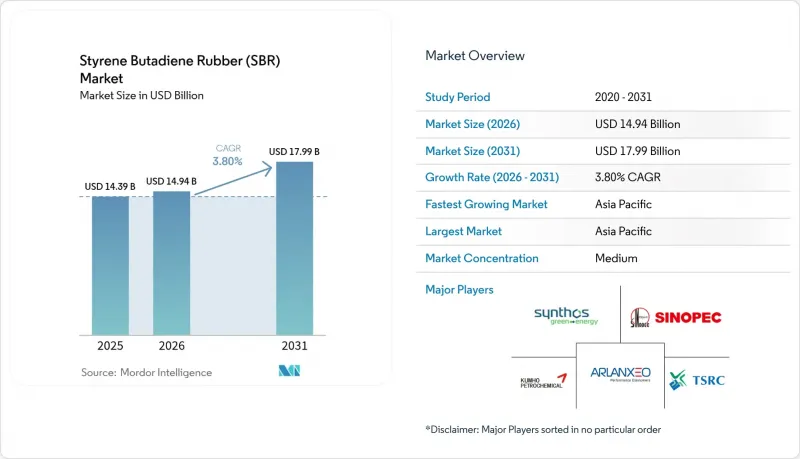
이 보고서는 유형(에멀전 SBR, 솔루션 SBR), 용도(타이어, 접착제, 신발, 기타 용도) 및 지역(아시아태평양, 북미, 유럽, 남미, 중동 및 아프리카)별로 분류되어 있습니다. 시장 예측은 금액(달러) 기준으로 제시되어 있습니다.
글로벌 스티렌-부타디엔 고무(SBR) 시장 동향 및 인사이트
신흥 국가에서의 타이어 교체 수요 급증
차량 대수의 증가와 도로망 확충이 진행됨에 따라 타이어 마모율이 대폭 상승하여, 타이어 컴파운드용 스티렌-부타디엔 고무 시장의 수요를 끌어올리고 있습니다. 인도에서는 교체용 타이어가 이미 전체 타이어 소비량의 60%를 차지하고 있으며, 브리지스톤은 이에 대응하기 위해 현지 생산 능력 확대에 8,500만 달러를 투자하기로 결정했습니다. 레이디얼 타이어의 보급으로 단위당 SBR 사용량이 두 배로 증가하여 수요량은 더욱 확대되고 있습니다. 교체 주기는 OEM 수요에 비해 경기 둔화의 영향을 덜 받기 때문에 업계가 침체기에 있더라도 수요 감소를 막는 역할을 하고 있습니다. 따라서 아시아 신흥 국가 및 라틴아메리카는 세계 판매량에 대해 중기적으로 확실한 상승 효과를 가져오고 있습니다.
EU 및 중국의 저회전저항 타이어로의 전환
플릿의 연비 효율 향상을 목표로 한 규제로 인해 히스테리시스가 낮고 실리카가 배합된 트레드 컴파운드를 가능하게 하는 솔루션 SBR 등급에 대한 수요가 증가하고 있습니다. EU의 소비자 대상 라벨 표시 제도에 따라 구매 동향은 이미 구름 저항 등급 ‘A’ 제품으로 이동하고 있으며, 제조사들은 이러한 프리미엄 카테고리에서 15-20%의 판매량 증가를 기록하고 있습니다. 중국에서도 대형차 부문에서 유사한 동향이 나타나고 있으며, 첨단 기능화를 실현할 수 있는 공급업체에게는 큰 비즈니스 기회가 되고 있습니다. 에멀전 SBR과 솔루션 SBR 간의 성능 격차가 확대됨에 따라 고사양 폴리머의 가격 프리미엄이 강화되는 동시에 연구개발 주도형 생산자들이 보상을 받게 될 것입니다.
원유 가격에 연동되는 부타디엔의 가격 변동
원료 비용은 일반적으로 SBR 총 제조 비용의 최대 70%를 차지하며, 원유 가격이 급등하면 이익률이 압박받습니다. 환율 변동은 수출업체에게 추가적인 불확실성을 야기하고 있습니다. 2024년 천연고무 가격 상승으로 인해 SBR의 상대적 비용 경쟁력은 일시적으로 개선되었으나, 원유 유래 부타디엔 가격의 이중 상승으로 인해 그 우위는 급속히 상실되었습니다. 고정 가격 조항이 포함된 장기 공급 계약으로 인해 업계는 갑작스러운 원자재 가격 급등을 제품 가격에 전가하는 능력이 제한되고 있으며, 많은 기업은 운전자금 수요를 증가시키는 헤지 및 재고 관리 전략을 채택할 수밖에 없는 상황입니다.
부문 분석
2025년 생산량의 70.42%를 차지한 것은 에멀전 SBR이었으나, 2031년까지의 기간 중 솔루션 SBR이 4.27%라는 가장 높은 연평균 성장률(CAGR)을 기록했습니다. 솔루션 등급의 스티렌-부타디엔 고무(SBR) 시장 규모는 고성능 타이어 트레드에 대한 세분화된 수요를 반영하여, 2026년 42억 7,000만 달러에서 2031년에는 52억 6,000만 달러로 확대될 것으로 예측됩니다. 기능화된 용액 중합체는 더 좁은 분자량 분포와 우수한 충전재와의 호환성을 실현하여, 젖은 노면 접지력을 저해하지 않으면서 트레드 무게를 줄일 수 있게 해줍니다. ARLANXEO가 최근 돌마겐에서 실시한 생산 능력 증설은 저회전저항 타이어에 대한 자동차 제조사의 요구 사항에 부합하는 것입니다. 성능 사양이 엄격해짐에 따라 솔루션 SBR의 시장 점유율은 확대되고 있습니다. 특히 소비자 의식이 가장 높은 유럽, 중국 및 프리미엄 교체용 타이어 시장에서 그 추세가 두드러집니다. 에멀전 SBR은 규모의 경제, 광범위한 반응 설비 도입 실적, 그리고 폭넓은 컴파운딩 자유도로 인해 대중 시장 부문에서 여전히 필수적인 존재입니다. 그러나 가격 주도형 포지셔닝으로 인해 원자재 가격 변동에 대한 이익률이 취약합니다. 따라서 저비용 에멀전 플랫폼과 프리미엄 솔루션 제품을 결합한 혼합 판매 전략은 자동차 산업의 경기 사이클 전반에 걸쳐 수입원을 보호해 줄 것입니다.
솔루션 등급이 차지하는 스티렌-부타디엔 고무(SBR)의 시장 점유율은 지속적인 타이어 라벨 규제, 전기자동차의 보급, 그리고 OEM의 지속가능성 목표에 힘입어 2031년까지 2.7포인트 상승할 전망입니다. 비용에 민감한 신흥 국가에서도 젖은 노면 접지력 및 구름 저항 성능에 관한 정책 주도적 요건으로 인해 솔루션 SBR로의 전환이 가속화되고 있습니다. 연속 공정, 첨단 촉매 시스템, 인라인 기능화에 투자하는 제조업체는 에너지 효율 향상 및 플랜트 제어의 디지털화를 통해 변동 비용을 절감하는 동시에 프리미엄 가격을 확보할 수 있습니다.
지역별 분석
아시아태평양은 2025년에 매출 점유율 45.10%를 유지하며, 2031년까지 연평균 성장률(CAGR) 4.17%로 성장할 것으로 예측됩니다. 중국은 광범위한 자체용 타이어 및 합성 고무 생산 능력을 기반으로 지역내 주도적 지위를 확립하고 있으며, 에멀전 등급과 솔루션 등급 모두에서 신속한 생산 확대를 가능하게 하고 있습니다. 국내 수요는 자동차 보유 대수의 증가, 인프라 정비에 대한 부양책, 그리고 수출용 생산 능력을 창출하는 국가 재활용 할당 제도에 힘입어 증가하고 있습니다. 인도 시장의 경우, 2032년까지 타이어 산업 매출이 220억 달러로 두 배 증가할 것으로 예측되며, 이에 따라 생산 능력 확충 및 후방 통합에 대한 투자가 촉진되고 있습니다. 태국과 말레이시아는 천연고무 생산을 통해 상류 공급망을 보완하고 있으며, 이는 컴파운더 기업에게 통합적인 조달상 이점을 제공하고 있습니다. 그러나 탄소 가격 도입, 대기 배출 규제 강화, 수질 오염 대책으로 인해 비용 상승 및 지역내 구형 SBR 자산의 이전이 발생할 가능성이 있습니다.
북미에서는 교체용 타이어, 고속도로 보수용 폴리머 개질 아스팔트, 그리고 E-Commerce용 포장재에 사용되는 접착제 수요에 힘입어 성숙 단계에 접어들었지만 안정적인 소비가 예상됩니다. 미국의 타이어 제조업체들은 기능성 용액 SBR을 많이 사용하는 경트럭용 및 초고성능 타이어와 같은 틈새 시장에 계속해서 주력하고 있습니다. 멕시코가 자동차 조립의 니어쇼어링 거점으로 부상함에 따라 자동차용 고무 부품에 대한 수요가 더욱 증가하고 있습니다. 캐나다의 광업 및 오일샌드 사업은 특히 컨베이어 벨트와 보호 코팅 분야에서 산업용 SBR 수요를 견고하게 유지하고 있습니다. 전반적으로 이 지역의 성장률은 세계 평균에 가까운 수준을 유지하고 있으나, 고부가가치 폴리머로 수요가 편중되는 양상을 보이고 있습니다.
유럽에서는 자동차 생산 증가세가 주춤해 발목을 잡고 있지만, 첨단 저탄소 SBR을 우선시하는 EU의 지속가능성 의제가 호재로 작용하고 있습니다. 독일, 프랑스,이탈리아의 타이어 공장에서는 친환경 성능 등급 제품의 채택이 가속화되고 있으며, 유럽의 생산 능력이 확대될 때까지 한국과 싱가포르로부터의 용액형 SBR 수입이 증가하고 있습니다. 동유럽의 고속도로 및 공항 개보수 공사는 폴리머 개질 아스팔트의 사용을 촉진하고 있으며, 자동차 분야의 부진을 부분적으로 상쇄하고 있습니다. 향후 도입될 CBAM(탄소국경조정조치)에 따라 탄소 배출량이 높은 수입품이 억제되고, 수출국의 현지 조달 및 재생 가능 에너지로의 전환이 촉진될 전망입니다. 스칸디나비아 및 베네룩스 국가 시장에서는 바닥재나 스포츠 시설 표면재에 재생 SBR의 용도가 선도적으로 확대되고 있으며, 순환형 솔루션의 가치를 높이는 틈새 시장이 육성되고 있습니다.
기타 혜택:
- 엑셀 형식의 시장 예측(ME) 시트
- 3개월간의 애널리스트 지원
자주 묻는 질문
목차
제1장 서론
제2장 조사 방법
제3장 개요
제4장 시장 구도
제5장 시장 규모와 성장 예측
제6장 경쟁 구도
제7장 시장 기회와 향후 전망
KSA 26.09.04According to Mordor Intelligence, the styrene butadiene rubber market size is expected to grow from USD 14.39 billion in 2025 to USD 14.94 billion in 2026 and is forecast to reach USD 17.99 billion by 2031 at 3.80% CAGR over 2026-2031.
This report is Segmented by Type (Emulsion SBR, Solution SBR), Application (Tyres, Adhesives, Footwear, Other Applications), and Geography (Asia-Pacific, North America, Europe, South America, Middle East and Africa). The Market Forecasts are Provided in Terms of Value (USD).
Global Styrene Butadiene Rubber (SBR) Market Trends and Insights
Tire Replacement Demand Spike in Emerging Economies
Vehicle fleet expansion combined with improved road networks significantly raises tire wear rates, pushing Styrene Butadiene Rubber market demand for tire compounds. Replacement tires already contribute 60% of total tire consumption in India, and Bridgestone has responded by committing USD 85 million to expand local production capacity. Radial tire adoption multiplies SBR usage per unit, further escalating volumes. Replacement cycles remain less affected by economic slowdowns than OEM demand, providing downside protection during industry troughs. Emerging Asia and Latin America therefore deliver a reliable mid-term uplift to global sales.
Shift Toward Low-Rolling-Resistance Tires in EU & China
Regulations aimed at fleet fuel efficiency elevate demand for solution SBR grades that enable silica-filled tread compounds with lower hysteresis. EU consumer labeling has already shifted purchasing toward A-rated rolling-resistance products, with manufacturers recording 15-20% volume growth in these premium categories. China mirrors the trend in heavy-duty segments, translating to sizeable opportunities for suppliers capable of advanced functionalisation. The widening performance gap between emulsion and solution SBR reinforces price premiums for high-spec polymers while rewarding R&D-driven producers.
Crude-Linked Butadiene Price Volatility
Feedstock costs typically represent up to 70% of total SBR manufacturing expenses, leaving margins exposed when crude prices spike. Currency swings add a further layer of unpredictability for exporters. While natural rubber rallies in 2024 temporarily improved SBR's relative cost position, dual increases in crude derived butadiene quickly eroded that advantage. Long-term supplier contracts with fixed pricing clauses limit the industry's ability to pass on sudden feedstock hikes, forcing many firms to adopt hedging and inventory strategies that raise working capital requirements.
Other drivers and restraints analyzed in the detailed report include:
- Rapid Highway & Airport Construction Boosting Polymer-Modified Asphalt
- OEM Push for 10% Tread Weight Reduction via Functionalised S-SBR
- Growing TPE Substitutes in Footwear
For complete list of drivers and restraints, kindly check the Table Of Contents.
Segment Analysis
Solution SBR recorded the highest 4.27% CAGR through 2031, even though emulsion SBR controlled 70.42% of 2025 volumes. The Styrene Butadiene Rubber market size attributed to solution grades is projected to expand from USD 4.27 billion in 2026 to USD 5.26 billion in 2031, reflecting granular demand for high-performance tire treads. Functionalised solution polymers achieve tighter molecular weight distributions and superior filler compatibility, enabling tread weight reductions without compromising wet grip. ARLANXEO's recent capacity addition in Dormagen aligns with automaker requirements for low-rolling-resistance tires. As performance specifications tighten, solution SBR gains share, particularly in Europe, China, and premium replacement markets where consumer awareness is highest. Emulsion SBR remains indispensable in mass-market segments thanks to scale advantages, extensive installed reactor base, and wide compounding latitude. Yet its price-driven positioning leaves margins vulnerable to feedstock swings. Blended distribution strategies that pair low-cost emulsion platforms with premium solution offerings thus protect revenue streams across automotive cycles.
The Styrene Butadiene Rubber market share commanded by solution grades is likely to rise by 2.7 percentage points by 2031, supported by ongoing tire label regulation, electric vehicle proliferation, and OEM sustainability targets. Even in cost-sensitive emerging economies, policy-driven requirements for wet-grip and rolling-resistance performance accelerate migration to solution SBR. Producers investing in continuous processes, advanced catalyst systems, and in-line functionalisation can capture premium pricing while lowering variable costs via energy efficiency improvements and digitalised plant control.
Complete Report Scope:
- By Type
- Emulsion SBR
- Solution SBR
- By Application
- Tyres
- Adhesives
- Footwear
- Other Applications
- By Geography
- Asia-Pacific
- China
- Japan
- India
- South Korea
- Thailand
- Malaysia
- Vietnam
- Indonesia
- Rest of Asia-Pacific
- North America
- United States
- Canada
- Mexico
- Europe
- Germany
- France
- United Kingdom
- Italy
- Spain
- Nordic
- Turkey
- Russia
- Rest of Europe
- South America
- Brazil
- Argentina
- Colombia
- Rest of South America
- Middle East and Africa
- Saudi Arabia
- United Arab Emirates
- Qatar
- Egypt
- Nigeria
- South Africa
- Rest of Middle East and Africa
- Asia-Pacific
Geography Analysis
Asia-Pacific maintained 45.10% revenue share in 2025 and is projected to grow at 4.17% CAGR through 2031. China anchors regional dominance with extensive captive tire and synthetic rubber capacity, enabling fast scale-up for both emulsion and solution grades. Domestic demand receives a boost from rising car parc, infrastructure stimulus, and national recycling quotas that release capacity for export. India's market is propelled by a forecast doubling of tire industry revenue to USD 22 billion by 2032, spurring incremental capacities and backward integration investments. Thailand and Malaysia complement upstream supply via natural rubber output, affording compounders integrated sourcing advantages. However, carbon pricing, stricter air-emission norms, and water-pollution controls could trigger cost escalations or relocation of older SBR assets within the bloc.
North America delivers mature yet steady consumption underpinned by replacement tires, polymer-modified asphalt for highway rehabilitation, and adhesive uptake in e-commerce packaging. United States tire makers continue to emphasise performance niches such as light-truck and ultra-high-performance variants that lean heavily on functionalised solution SBR. Mexico's emergence as a near-shoring hub for motor vehicle assembly adds incremental demand for automotive rubber parts. Canadian mining and oil sands operations keep industrial SBR uses buoyant, particularly in conveyor belts and protective coatings. Overall, regional growth hovers close to the global average but skews toward higher value polymers.
Europe is constrained by a lower vehicle production trajectory but benefits from the EU's sustainability agenda that favours advanced and lower-carbon SBR. German, French, and Italian tire plants intensify adoption of eco-performance grades, amplifying imports of solution SBR from Korea and Singapore until European capacity expands. Eastern European highway and airport upgrades stimulate polymer-modified asphalt usage, partially offsetting automotive softness. The upcoming CBAM will likely curtail high-carbon imports and encourage local sourcing or renewable-energy upgrades in exporting countries. Scandinavian and Benelux markets lead on recycled SBR applications in flooring and sports surfaces, fostering niches that valorise circular solutions.
- ARLANXEO
- Asahi Kasei Corporation
- China Petrochemical Corporation (Sinopec)
- Dynasol Group
- ENEOS Corporation
- Eni S.p.A
- JSR Corporation
- Kemipex
- Kumho Petrochemical
- LANXESS
- LG Chem
- PETKIM
- SIBUR Holding PJSC
- Sumitomo Chemical Co. Ltd.
- Synthos
- The Goodyear Tire & Rubber Company
- Trinseo
- TSRC
Additional Benefits:
- The market estimate (ME) sheet in Excel format
- 3 months of analyst support
TABLE OF CONTENTS
1 Introduction
- 1.1 Study Assumptions & Market Definition
- 1.2 Scope of the Study
2 Research Methodology
3 Executive Summary
4 Market Landscape
- 4.1 Market Overview
- 4.2 Market Drivers
- 4.2.1 Tire replacement demand spike in emerging economies
- 4.2.2 Shift toward low-rolling-resistance tires in EU & China
- 4.2.3 Rapid highway & airport construction boosting polymer-modified asphalt
- 4.2.4 OEM push for 10% tread weight reduction via functionalised S-SBR
- 4.2.5 Mandatory wet-grip labelling in ASEAN spurring high-vinyl S-SBR uptake
- 4.3 Market Restraints
- 4.3.1 Crude-linked butadiene price volatility
- 4.3.2 Growing TPE substitutes in footwear
- 4.3.3 EU CBAM extending to synthetic rubber imports post-2027
- 4.3.4 Recycling quotas in China cutting virgin SBR demand for conveyor belts
- 4.4 Value Chain Analysis
- 4.5 Porter's Five Forces
- 4.5.1 Bargaining Power of Suppliers
- 4.5.2 Bargaining Power of Buyers
- 4.5.3 Threat of New Entrants
- 4.5.4 Threat of Substitutes
- 4.5.5 Competitive Rivalry
5 Market Size & Growth Forecasts (Value)
- 5.1 By Type
- 5.1.1 Emulsion SBR
- 5.1.2 Solution SBR
- 5.2 By Application
- 5.2.1 Tyres
- 5.2.2 Adhesives
- 5.2.3 Footwear
- 5.2.4 Other Applications
- 5.3 By Geography
- 5.3.1 Asia-Pacific
- 5.3.1.1 China
- 5.3.1.2 Japan
- 5.3.1.3 India
- 5.3.1.4 South Korea
- 5.3.1.5 Thailand
- 5.3.1.6 Malaysia
- 5.3.1.7 Vietnam
- 5.3.1.8 Indonesia
- 5.3.1.9 Rest of Asia-Pacific
- 5.3.2 North America
- 5.3.2.1 United States
- 5.3.2.2 Canada
- 5.3.2.3 Mexico
- 5.3.3 Europe
- 5.3.3.1 Germany
- 5.3.3.2 France
- 5.3.3.3 United Kingdom
- 5.3.3.4 Italy
- 5.3.3.5 Spain
- 5.3.3.6 Nordic
- 5.3.3.7 Turkey
- 5.3.3.8 Russia
- 5.3.3.9 Rest of Europe
- 5.3.4 South America
- 5.3.4.1 Brazil
- 5.3.4.2 Argentina
- 5.3.4.3 Colombia
- 5.3.4.4 Rest of South America
- 5.3.5 Middle East and Africa
- 5.3.5.1 Saudi Arabia
- 5.3.5.2 United Arab Emirates
- 5.3.5.3 Qatar
- 5.3.5.4 Egypt
- 5.3.5.5 Nigeria
- 5.3.5.6 South Africa
- 5.3.5.7 Rest of Middle East and Africa
- 5.3.1 Asia-Pacific
6 Competitive Landscape
- 6.1 Market Concentration
- 6.2 Strategic Moves
- 6.3 Market Share Analysis
- 6.4 Company Profiles {(includes Global level Overview, Market level overview, Core Segments, Financials as available, Strategic Information, Market Rank/Share for key companies, Products & Services, and Recent Developments)}
- 6.4.1 ARLANXEO
- 6.4.2 Asahi Kasei Corporation
- 6.4.3 China Petrochemical Corporation (Sinopec)
- 6.4.4 Dynasol Group
- 6.4.5 ENEOS Corporation
- 6.4.6 Eni S.p.A
- 6.4.7 JSR Corporation
- 6.4.8 Kemipex
- 6.4.9 Kumho Petrochemical
- 6.4.10 LANXESS
- 6.4.11 LG Chem
- 6.4.12 PETKIM
- 6.4.13 SIBUR Holding PJSC
- 6.4.14 Sumitomo Chemical Co. Ltd.
- 6.4.15 Synthos
- 6.4.16 The Goodyear Tire & Rubber Company
- 6.4.17 Trinseo
- 6.4.18 TSRC
7 Market Opportunities & Future Outlook
- 7.1 White-Space & Unmet-Need Assessment