

|
시장보고서
상품코드
2121773
솔라 컨트롤 윈도우 필름 : 시장 점유율 분석, 업계 동향과 통계, 성장 예측(2026-2031년)Solar Control Window Films - Market Share Analysis, Industry Trends & Statistics, Growth Forecasts (2026 - 2031) |
||||||
 Mordor Intelligence
Mordor Intelligence에 따르면 솔라 컨트롤 윈도우 필름 시장 규모는 2025년에 9억 8,000만 달러로 평가되며, 2026년 10억 8,000만 달러에서 2031년까지 17억 4,000만 달러에 달할 것으로 예측되고 있으며, 예측 기간(2026-2031년)에 CAGR은 10.12%에 달할 전망입니다.
국제적인 탈탄소화 규제, 에너지 비용의 급등, 그리고 3년 미만의 검증된 투자 회수 기간 덕분에 수요는 견고한 추세를 보이고 있습니다.
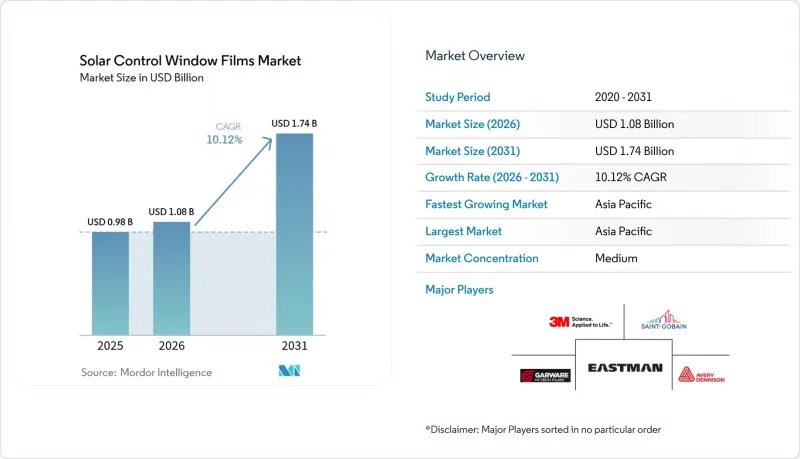
이 보고서에서는 업계를 필름 유형(투명, 착색, 진공 코팅 등), 흡수체 유형(유기, 무기/세라믹, 금속), 설치 형태(신축, 개보수),최종사용자 산업(건설, 자동차 등), 그리고 지역(아시아태평양, 북미, 유럽, 남미, 중동 및 아프리카)별로 분류하고 있습니다. 시장 전망은 금액(달러) 기준으로 제시되어 있습니다.
전 세계 태양열 제어 창문 필름 시장의 동향 및 인사이트
탄소발자국 감축에 대한 관심이 높아지고 있습니다.
기업의 기후 변화 대응 노력이 태양열 제어 창문 필름 시장의 확장을 지원하고 있습니다. 이는 필름이 냉방 부하를 5-15% 줄여, 과학에 기반한 배출 감축 목표 달성의 요건을 충족시키기 때문입니다. 피크 수요 억제는 고온 지역의 전력망 회복력 향상이라는 목표와 완벽하게 부합합니다. 부동산 투자 신탁(REIT)도 창문 유리 개조를 ‘미뤄진 유지보수’가 아닌 자산 가치를 높이는 조치로 인식하고 있습니다. 재생 가능 에너지의 보급이 가속화되는 가운데, 필름과 같은 수요 측 솔루션은 부하 프로파일을 안정화하는 수단으로서 평가가 높아지고 있습니다. 이러한 위상 덕분에 설비 투자가 주춤하는 시기에도 조달 예산을 확보하기가 수월해지고 있습니다.
유럽의 넷제로 건축 기준이 저방사율(Low-E) 필름 채택을 지원
주요 하이라이트
- EU의 ‘건축물 에너지 성능에 관한 지침(개정판)’은 회원국들에게 공공 부문 연면적의 3%를 매년 개보수하여 2050년까지 제로 배출 기준을 달성할 것을 의무화하고 있습니다. 리모델링을 중시하는 이 목표는 고가의 창틀 교체를 수반하지 않고도 단열 성능을 향상시킴으로써 창문 필름의 중요성을 높이고 있습니다. 다국적 기업은 현재 아시아와 북미에서도 유사한 건축 외피 기준을 채택하고 있으며, 유럽의 벤치마크를 전 세계로 확산시키고 있습니다. 수명 주기 탄소 배출량에 관한 조항 또한 탄소 배출량이 많은 유리 교체보다 박막 필름 개조를 장려하고 있습니다. 그 결과, 공급업체들은 공공 입찰에서 보다 장기적인 수주 전망을 확보할 수 있게 되었습니다.
고급 상업용 빌딩에서 다이내믹 스마트 글레이징을 통한 대체 위험
주요 하이라이트
- 일렉트로크로믹 및 서모크로믹 유닛은 유리의 착색을 동적으로 제어하여, 정적 필름으로는 실현할 수 없는 눈부심 감소 효과를 제공합니다. 제조 비용의 하락에 따라 파사드 컨설턴트들은 고급 프로젝트의 더블 스킨이나 유닛형 커튼월을 위해 이러한 시스템을 점점 더 많이 지정하고 있습니다. 가격은 필름 시공 대비 3-5배의 프리미엄이 여전히 존재하지만, 장기적인 에너지 시뮬레이션 결과에서는 동적 제어 방식이 유리한 경우가 많아지고 있습니다. 이에 대응하여 필름 공급업체들은 중저가 시장을 겨냥한 제안을 강화하는 한편, 스마트 유리의 투자 회수 기간이 12년을 초과하는 리모델링 시장으로의 판로 확대를 모색하고 있습니다.
부문 분석
진공 증착 방식의 반사형 제품은 2025년 매출의 42.35%를 차지하고 있으며, 연평균 성장률(CAGR) 10.44%에 힘입어 이 부문의 차열 창문 필름 시장 규모는 염색형이나 투명형 대체 제품을 크게 상회하고 있습니다. 건축가들은 가시광선을 통과시키면서 근적외선을 선택적으로 반사하는 초박형 금속 스택을 높이 평가하고 있습니다.
각 필름 제조사들은 현재 방사율을 0.20 미만으로 억제하는 은, 인듐, 니켈 합금을 이용한 스퍼터링 챔버를 도입하고 있습니다. 대규모 주택 개보수 공사에서는 초기 비용이 저렴하다는 이유로 착색 폴리에스테르 필름이 여전히 선호되고 있지만, 에너지 규제가 엄격해짐에 따라 판매량은 꾸준히 반사형 구조로 전환되고 있습니다.
세라믹 흡수재는 2025년 매출의 45.60%를 차지하고 있으며, 이는 색상 안정성, 높은 융점, 그리고 무시할 수 있을 정도로 적은 무선 주파수 간섭 덕분입니다. 자동차 제조업체들은 텔레매틱스용 안테나의 신호 감쇠를 방지할 수 있으므로 나노세라믹 층을 선호하여 채택하고 있습니다. 그러나 정제된 금속 나노입자 분산액으로 인해 제조 비용이 절감되고, 디포거 그리드의 전도성 이점이 회복됨에 따라 태양열 제어 창문 필름 시장의 점유율 우위는 축소될 가능성이 있습니다.
금속 전용 필름은 무지개 현상을 억제하는 스퍼터 증착 기술의 개선에 힘입어 연평균 성장률(CAGR) 10.42%로 성장을 이어가고 있습니다. 하이브리드 구조의 경우, 현재 은 시드 층 위에 알루미나나 실리카를 증착하여 낮은 반사율과 높은 적외선 차단율을 겸비한 복합 광학 스택을 형성하고 있습니다. 이러한 발전으로 인해 기존의 경계가 모호해지면서, 이 카테고리는 기능 특화형 배합, 눈부심 억제, 낙서 방지 또는 태양광발전용 오버레이와 같은 방향으로 발전하고 있습니다.
지역별 분석
아시아태평양은 2025년 매출의 44.40%를 차지하며 연평균 성장률(CAGR) 10.55%로 확대되고 있으며, 태양열 제어 창문 필름 시장의 중심지로 계속 자리매김할 것으로 확실시됩니다. 중국의 ‘녹색 건축 평가 기준 GB/T 50378’ 및 인도의 ‘에코 니와스(Eco-Nivas)’에서는 일사열 획득 계수가 의무화되어 있으며, 이는 고선택성 필름의 보급을 가속화하고 있습니다.
북미 시장에서는 기존 건물의 개보수에 대한 인센티브가 시장을 지원하고 있습니다. ‘인플레이션 억제법(Inflation Reduction Act)’에 따른 세액 공제 확대로 인해 연방 정부 및 민간 건물에서 건축 외피 개보수가 가속화되고 있으며, 또한 캘리포니아주의 ‘타이틀 24(Title 24)’ 개정에 따라파사드의 외관을 변경하지 않고도 박막 필름이 충족할 수 있는 외부 차광 계수의 기준치가 상향 조정되었습니다.
유럽에서는 시장 침투율이 성숙한 수준을 유지하고 있음에도 불구하고 2030년 ‘Fit-for-55’ 기후 패키지와 연계된 두 번째 수요의 물결이 찾아오고 있습니다.
기타 혜택:
- 엑셀 형식의 시장 예측(ME) 시트
- 3개월간의 애널리스트 지원
자주 묻는 질문
목차
제1장 서론
제2장 조사 방법
제3장 개요
제4장 시장 구도
제5장 시장 규모와 성장 예측
제6장 경쟁 구도
제7장 시장 기회와 향후 전망
KSA 26.09.04According to Mordor Intelligence, the solar control window films market size was valued at USD 0.98 billion in 2025 and estimated to grow from USD 1.08 billion in 2026 to reach USD 1.74 billion by 2031, at a CAGR of 10.12% during the forecast period (2026-2031).International decarbonization rules, rising utility costs, and proven payback periods below three years keep demand resilient.
This report Segments the Industry by Film Type (Clear, Dyed, Vacuum Coated, and More), Absorber Type (Organic, Inorganic/Ceramic, and Metallic), Installation (New-Build and Retrofit), End-User Industry (Construction, Automotive, and More), and Geography (Asia-Pacific, North America, Europe, South America, and Middle East and Africa). The Market Forecasts are Provided in Terms of Value (USD)
Global Solar Control Window Films Market Trends and Insights
Growing Emphasis on Reducing Carbon Footprints
Corporate climate pledges elevate the solar control window films market because films shave 5-15% cooling loads and qualify for science-based emission targets. Peak-demand trimming aligns neatly with grid-resilience objectives in hot regions. Real-estate investment trusts also treat glazing upgrades as accretive to asset value rather than as deferred maintenance. As renewable penetration accelerates, demand-side solutions such as films gain prestige for stabilizing load profiles. This positioning solidifies procurement budgets even during capex slowdowns.
Net-Zero Building Codes in Europe Driving Low-E Film Adoption
Key Highlights
- The EU's recast Energy Performance of Buildings Directive compels member states to renovate 3% of public-sector floor area annually and to meet zero-emission standards by 2050. Retro-orientated targets elevate window films by boosting thermal performance without costly frame replacement. Multinationals now replicate the same envelope standards in Asia and North America, exporting European benchmarks worldwide. Lifecycle-carbon clauses also favor thin-film retrofits over high-embodied-carbon glazing swaps. Consequently, suppliers see longer order visibility in public tenders.
Substitution Risk from Dynamic Smart Glazing in Premium Commercial Towers
Key Highlights
- Electrochromic and thermochromic units dynamically tint glass, providing glare mitigation that static films cannot match. As manufacturing costs fall, facade consultants increasingly specify these systems for double-skin or unitized curtain walls in prestige projects. Although price premiums remain 3-5 times film installations, long-term energy simulations often favor dynamic controls. Film suppliers respond by sharpening mid-market pitches and expanding retrofit channels where smart glass paybacks extend beyond 12 years.
Other drivers and restraints analyzed in the detailed report include:
- Upsurge in the Asia-Pacific Construction Industry
- Awareness of UV Protection and Health Concerns
- Warranty-Linked Liability for Delamination in Hot-Humid Climates
For complete list of drivers and restraints, kindly check the Table Of Contents.
Segment Analysis
Vacuum-coated reflective products captured 42.35% of 2025 revenue, and their 10.44% CAGR keeps the solar control window films market size for this segment well ahead of dyed and clear alternatives. Architects value the micro-thin metallic stack that selectively reflects near-infrared while admitting visible light.
Film manufacturers now deploy sputter chambers using silver, indium, and nickel alloys that achieve emissivity below 0.20. In mass-housing retrofits, dyed polyester films still appeal for initial affordability, yet energy-code tightening steadily redirects volume to reflective constructions.
Ceramic absorbers held 45.60% of 2025 revenue, reflecting their color stability, high melting point, and negligible radio-frequency interference. Automotive OEMs favor nano-ceramic layers because they avoid signal attenuation for telematics antennas. The solar control window films market share advantage may narrow, however, as refined metallic nanoparticle dispersions cut manufacturing costs and restore conductivity benefits for defogger grids.
Metallic-only films are marching at 10.42% CAGR, aided by sputter stack refinements that curb iridescence. Hybrid architectures now deposit alumina or silica atop silver seed layers, creating composite optical stacks that combine low reflectance with steep infrared rejection. Such progress blurs historic boundaries and pushes the category toward function-specific formulations, glare suppression, anti-graffiti, or photovoltaic overlay.
Complete Report Scope:
- By Film Type
- Clear (Non-reflective)
- Dyed (Non-reflective)
- Vacuum-Coated (Reflective)
- High Performance Films
- Other Film Types
- By Absorber Type
- Organic
- Inorganic / Ceramic
- Metallic
- By Installation Stage
- New-Build
- Retrofit
- By End-user Industry
- Construction
- Automotive
- Marine
- Design
- Other End-user Industry
- By Geography
- Asia-Pacific
- China
- India
- Japan
- South Korea
- Rest of Asia-Pacific
- North America
- United States
- Canada
- Mexico
- Europe
- Germany
- United Kingdom
- Italy
- Spain
- France
- Rest of Europe
- South America
- Brazil
- Argentina
- Rest of South America
- Middle East and Africa
- Saudi Arabia
- South Africa
- United Arab Emirates
- Rest of Middle East and Africa
- Asia-Pacific
Geography Analysis
Asia Pacific commanded 44.40% of 2025 revenues and is expanding at a 10.55% CAGR, ensuring it remains the gravitational center of the solar control window films market. China's Green Building Evaluation Standard GB/T 50378 and India's Eco-Niwas mandate solar-heat-gain coefficients that accelerate high-selectivity film uptake.
Retrofit incentives anchor North America. The Inflation Reduction Act's enhanced tax deduction accelerates envelope upgrades across federal and private portfolios, and California's Title 24 revisions elevate exterior-shade coefficient thresholds that thin films meet without altering facade appearance.
Europe maintains mature penetration yet enjoys a second wave of demand tied to the 2030 "Fit-for-55" climate package.
- 3M
- Avery Dennison Corporation
- Decorative Films, LLC
- Eastman Chemical Company
- Garware Hi-Tech Films
- Johnson Window Films, Inc.
- LINTEC Corporation
- Madico
- Polytronix, Inc.
- Purlfrost
- Saint-Gobain
- Sharpline Converting, Inc.
- SOLAR CONTROL FILMS INC
- Thermolite, LLC
- TintFit Window Films Ltd.
- TORAY INDUSTRIES, INC.
- Ziebart International
Additional Benefits:
- The market estimate (ME) sheet in Excel format
- 3 months of analyst support
TABLE OF CONTENTS
1 Introduction
- 1.1 Study Assumptions and Market Definition
- 1.2 Study Deliverables
- 1.3 Scope of the Study
2 Research Methodology
3 Executive Summary
4 Market Landscape
- 4.1 Market Overview
- 4.2 Market Drivers
- 4.2.1 Growing Emphasis on Reducing Carbon Footprints
- 4.2.2 Net-Zero Building Codes in Europe Driving Low-E Film Adoption
- 4.2.3 Upsurge in the Asia-Pacific Construction Industry
- 4.2.4 Awareness of UV Protection and Health Concerns
- 4.2.5 Rapid E-Commerce Warehouse Construction Requiring Day-Lighting Control in APAC
- 4.3 Market Restraints
- 4.3.1 Substitution Risk from Dynamic Smart Glazing in Premium Commercial Towers
- 4.3.2 Warranty-Linked Liability for Delamination in Hot-Humid Climates
- 4.3.3 Volatile Polyester and Nano-Ceramic Raw Material Prices
- 4.4 Value Chain Analysis
- 4.5 Porter's Five Forces
- 4.5.1 Bargaining Power of Suppliers
- 4.5.2 Bargaining Power of Buyers
- 4.5.3 Threat of New Entrants
- 4.5.4 Threat of Substitutes
- 4.5.5 Intensity of Rivalry
- 4.6 Pricing Analysis
5 Market Size and Growth Forecasts (Value)
- 5.1 By Film Type
- 5.1.1 Clear (Non-reflective)
- 5.1.2 Dyed (Non-reflective)
- 5.1.3 Vacuum-Coated (Reflective)
- 5.1.4 High Performance Films
- 5.1.5 Other Film Types
- 5.2 By Absorber Type
- 5.2.1 Organic
- 5.2.2 Inorganic / Ceramic
- 5.2.3 Metallic
- 5.3 By Installation Stage
- 5.3.1 New-Build
- 5.3.2 Retrofit
- 5.4 By End-user Industry
- 5.4.1 Construction
- 5.4.2 Automotive
- 5.4.3 Marine
- 5.4.4 Design
- 5.4.5 Other End-user Industry
- 5.5 By Geography
- 5.5.1 Asia-Pacific
- 5.5.1.1 China
- 5.5.1.2 India
- 5.5.1.3 Japan
- 5.5.1.4 South Korea
- 5.5.1.5 Rest of Asia-Pacific
- 5.5.2 North America
- 5.5.2.1 United States
- 5.5.2.2 Canada
- 5.5.2.3 Mexico
- 5.5.3 Europe
- 5.5.3.1 Germany
- 5.5.3.2 United Kingdom
- 5.5.3.3 Italy
- 5.5.3.4 Spain
- 5.5.3.5 France
- 5.5.3.6 Rest of Europe
- 5.5.4 South America
- 5.5.4.1 Brazil
- 5.5.4.2 Argentina
- 5.5.4.3 Rest of South America
- 5.5.5 Middle East and Africa
- 5.5.5.1 Saudi Arabia
- 5.5.5.2 South Africa
- 5.5.5.3 United Arab Emirates
- 5.5.5.4 Rest of Middle East and Africa
- 5.5.1 Asia-Pacific
6 Competitive Landscape
- 6.1 Market Concentration
- 6.2 Strategic Moves
- 6.3 Market Share Analysis
- 6.4 Company Profiles (includes Global-level Overview, Market-level Overview, Core Segments, Financials, Strategic Information, Market Rank/Share, Products and Services, Recent Developments)
- 6.4.1 3M
- 6.4.2 Avery Dennison Corporation
- 6.4.3 Decorative Films, LLC
- 6.4.4 Eastman Chemical Company
- 6.4.5 Garware Hi-Tech Films
- 6.4.6 Johnson Window Films, Inc.
- 6.4.7 LINTEC Corporation
- 6.4.8 Madico
- 6.4.9 Polytronix, Inc.
- 6.4.10 Purlfrost
- 6.4.11 Saint-Gobain
- 6.4.12 Sharpline Converting, Inc.
- 6.4.13 SOLAR CONTROL FILMS INC
- 6.4.14 Thermolite, LLC
- 6.4.15 TintFit Window Films Ltd.
- 6.4.16 TORAY INDUSTRIES, INC.
- 6.4.17 Ziebart International
7 Market Opportunities and Future Outlook
- 7.1 White-Space and Unmet-Need Assessment
- 7.2 Growing Concerns Regarding UV Protection


