

|
시장보고서
상품코드
2121825
계란 가공 기계 : 시장 점유율 분석, 업계 동향과 통계, 성장 예측(2026-2031년)Egg Processing Machinery - Market Share Analysis, Industry Trends & Statistics, Growth Forecasts (2026 - 2031) |
||||||
 Mordor Intelligence
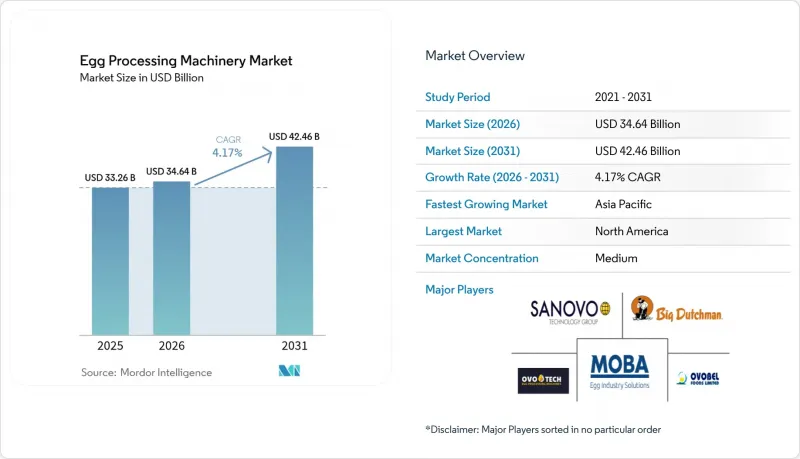
Mordor Intelligence에 따르면 계란 가공 기계 시장 규모는 2025년 332억 6,000만 달러에서 2026년에는 346억 4,000만 달러로 확대하며, 2026-2031년에 CAGR 4.17%로 추이하며, 2031년에는 424억 6,000만 달러에 달할 것으로 예측됩니다.
이 보고서에서는 산업을 기계 유형(달걀 분할기, 달걀 분리기, 기타), 최종 제품(액상 달걀, 기타), 자동화 수준(수동·소규모 시스템, 기타), 최종사용자(달걀 제품 제조업체, 제빵·제과 가공업체, 기타), 지역(북미, 유럽, 아시아태평양, 기타)별로 분류하고 있습니다. 시장 전망은 금액(달러) 기준으로 제시되어 있습니다.
글로벌 계란 가공 기계 시장의 동향 및 인사이트
가공 계란 제품 및 편의형 계란 제품에 대한 수요 증가
소비자의 기호가 레디투잇(ready-to-eat) 제품 및 상온 보관이 가능한 단백질 공급원으로 이동함에 따라 기존 액상란 용도를 뛰어넘는 첨단 가공 기술에 대한 지속적인 수요가 견인되고 있습니다. 2025년 Cal-Maine이 2억 5,800만 달러에 Echo Lake Foods를 인수한 것은 높은 수익률을 가져다주는 한편, 고도화되고 전문적인 가공 기계가 필요한 부가가치가 높은 계란 제품의 전략적 중요성을 부각시키고 있습니다. 이러한 동향으로 인해 가공 기계의 교체 주기가 가속화되고 있습니다. 각 제조사들은 에그바이트, 조리된 오믈렛, 단백질 강화형 편의식품과 같은 혁신적인 제품을 생산할 수 있는 시스템을 원하고 있기 때문입니다. 이러한 제품에는 정밀한 온도 제어와 견고한 오염 방지 대책이 요구되므로, 첨단 기계가 필수적입니다. 특히 호모지나이저와 분무 건조어 부문은 이러한 변화의 수혜를 입고 있는데, 이러한 기술은 편의식품 용도에서 요구되는 식감 조절 및 유통기한 연장을 실현하는 데 필수적이기 때문입니다. 경쟁력을 유지하기 위해 기계 제조업체들은 현재 단일 생산 라인에서 여러 제품 형태를 처리할 수 있는 시스템을 설계해야 합니다. 이러한 요구 사항으로 인해 생산 시스템의 복잡성과 자본 집약도가 높아지고 있으며, 기존의 단일 제품용 기계에 비해 더 높은 기준이 요구되고 있습니다. 시장 역학의 변화는 다양하고 고품질의 편의 식품 제품에 대한 수요 증가에 부응하기 위해 가공 기술의 혁신성과 적응력의 필요성을 부각시키고 있습니다.
식품 안전 및 위생 기준에 대한 관심 증가
규제 집행은 정기적인 검사에서 지속적인 모니터링으로 전환되고 있으며, 이는 기계의 설계 사양과 운영 절차에 막대한 영향을 미치고 있습니다. FDA(미국 식품의약국)가 개정한 ‘계란 규제 프로그램 기준(ERPS)’은 주 정부와 연방 정부의 협력을 위한 견고한 틀을 확립했으며, 이에 따라 검사 빈도가 증가하고 데이터 보고 의무도 더욱 엄격해졌습니다. 이러한 변화에 따라 임베디드 모니터링 시스템, 자동 세척 기술, 실시간 데이터 수집 기능을 갖춘 첨단 장비의 도입이 확대되고 있으며, 이를 통해 수작업 개입을 최소화하면서도 규정 준수를 확보할 수 있게 되었습니다. 또한 미국 농무부(USDA)가 개발한 고주파(RF) 살균 기술은 단 24분 만에 살모넬라균을 99.999% 감소시키는 것을 실현하여, 기존에 57분이 소요되던 공정보다 훨씬 빠릅니다. 이는 규제 요건이 기술 발전을 얼마나 가속화하고 있는지를 보여줍니다. 이러한 혁신적인 안전 기술을 업무 효율을 유지하면서 원활하게 통합할 수 있는 공급업체는 경쟁 우위를 확보할 수 있는 위치에 있습니다. 규제 준수 비용이 수익성에 점점 더 큰 영향을 미치는 시장에서 이러한 기술적 진보는 시장내 리더십을 유지하고 끊임없이 진화하는 안전 기준을 충족하기 위해 필수적인 요소가 되고 있습니다.
가공 기계에 대한 막대한 초기 설비 투자
기계 자금 조달 분야의 기술적 진보는 대규모 가공 업체에 점점 더 많은 혜택을 가져다주는 반면, 소규모 사업자들은 현대화에 따른 과제에 직면해 있습니다. 이러한 과제는 자금 조달에 대한 접근성이 여전히 제한적인 신흥 시장에서 특히 두드러집니다. 포괄적인 도입에 1,000만 달러가 넘는 막대한 설비 투자가 필요한 완전 자동화된 계란 가공 라인은 소규모 사업자가 직면한 자금 면의 장벽을 여실히 드러내고 있습니다. 이러한 제약을 해결하기 위해 인도 정부는 2025년, 식품 가공용 ‘생산 연계형 인센티브 제도(PLIS)’에 따라 1억 4,400만 달러를 배정하며, 정책 주도적 개입의 필요성을 시사하고 있습니다. 자금 조달의 격차는 단계적 도입을 가능하게 하는 EaaS(Equipment-as-a-Service) 모델이나 모듈식 시스템과 같은 대안 솔루션에 대한 기회도 창출하고 있습니다. 그러나 이러한 접근 방식으로는 완전히 통합된 기계와 같은 업무 효율성을 실현하지 못하는 경우가 많습니다. 그 결과, 자본이 제한적인 가공 업체들은 기계 업그레이드를 미루는 경우가 많아, 규제 미준수나 경쟁상 불리함 같은 위험이 높아지는 상황에 직면하고 있습니다. 시간이 지남에 따라 이러한 취약성은 심화되어 시장 점유율 하락이나 시장 세분화로 이어질 가능성이 있습니다.
부문 분석
2025년, 계란 분할기는 시장의 29.45%라는 큰 점유율을 차지하며, 하류 가공 공정의 핵심으로서의 역할을 확고히 했습니다. 이러한 우위는 껍질 달린 계란을 액체 상태로 변환하는 필수적인 기능에서 비롯된 것으로, 이는 부가가치 가공을 수행하기 전의 중요한 공정입니다. 그 결과, 계란 파쇄기는 산업 인프라에 없어서는 안 될 존재가 되었습니다. 이 부문은 기계의 마모와 엄격한 위생 설계 규정 준수로 인한 꾸준한 교체 수요의 혜택을 받고 있습니다. 각 제조사는 이에 대응하여 껍질 자동 분리 기능과 품질 검사 기능을 통합한 첨단 계란 깨기 시스템을 개발하고 있습니다. 이러한 혁신 기술은 오염 위험을 최소화할 뿐만 아니라 수율 효율을 향상시키고 안정적인 성능을 보장합니다. 다른 기계 부문에서도 기술적 진보가 나타나고 있음에도 불구하고 계란 파쇄기가 지속적인 시장 리더십을 유지하고 있다는 사실은 산업계가 기계적 가공 솔루션에 의존하고 있음을 여실히 보여줍니다.
호모자이저는 2031년까지의 예측 연평균 성장률(CAGR)이 6.18%로, 가장 빠르게 성장하는 기계 부문으로 자리매김하고 있습니다. 이러한 성장은 액상 계란 용도에서 균일한 제품 품질과 유통 기한 연장에 대한 수요 증가에 의해 주도되고 있습니다. 이 부문에서 두드러진 혁신 사례로는 보다 온화한 균질화 공정을 가능하게 하는 Moba의 캐비테이션 균질화 기술을 들 수 있습니다. 이 기술은 기존 고압 시스템에 비해 살균기의 가동 시간을 연장하고 운영 비용을 절감함으로써 효율성을 대폭 향상시킵니다. 이 부문의 급속한 성장은 특히 제빵 및 식품 서비스 부문에서 최종 제품의 성능을 결정하는 데 있으며, 균질화 품질이 수행하는 중요한 역할을 업계가 인식하고 있음을 반영합니다. 현대식 균질기는 살균 시스템과 원활하게 통합되어 제품의 품질을 유지하면서 열처리를 최적화합니다. 이러한 기술의 융합으로 전반적인 가공 효율이 향상되었으며, 균질기는 현대적인 계란 가공 라인에서 필수적인 구성 요소로서의 위상을 확고히 하고 있습니다. 이러한 라인에서는 제품 품질과 가동 효율의 유지가 경쟁 우위를 확보하기 위한 핵심 요소입니다.
2025년에는 액상 달걀이 시장 점유율의 45.98%라는 큰 비중을 차지하며, 2031년의 연평균 성장률(CAGR)은 6.92%로 예측됩니다. 이러한 성장은 일관된 품질과 취급의 용이성이 필수적인 식품 서비스 산업, 제빵 산업, 산업용 분야에서 액상 달걀의 다용도성을 부각시키고 있습니다. 이 부문이 시장을 주도하고 있는 배경에는 다양한 최종사용자층의 요구를 충족시키는 능력 외에도, 껍질 달린 달걀에 비해 보관, 운송, 재고 관리가 간소화되는 등 가공업체에 업무 효율성을 가져다준다는 점이 있습니다. 또한 달걀 껍질 살균에서 대장균 불활성화율 97.6%를 달성한 ‘인공 물 나노 구조(EWNS)’ 등의 기술적 진보로 인해 액상 달걀의 안전성과 품질이 더욱 향상되는 동시에, 그 천연 보호 특성도 유지되고 있습니다. 더 나아가 최첨단 가공 시스템에는 실시간 품질 모니터링 및 자동 오염 감지 기능이 통합되어 있으며, 일관된 제품 사양이 보장됩니다. 이 시장에서 차지하고 있는 선도적 위상은 예측 가능하고 효율적인 제조 공정을 가능하게 하는 표준화된 원료에 대한 식품 산업의 수요 증가를 반영하고 있습니다.
또한 액상 달걀은 가공상 이점을 활용하여 편의식품, 단백질 보충제, 기능성 식품 원료 등 새로운 용도로 확대되고 있습니다. 미국 농무부(USDA)가 개발한 고주파 살균 기술은 기존 방식의 57분이 소요되는 공정에 비해 불과 24분 만에 살모넬라균을 99.999% 제거할 수 있으며, 안전성 향상과 가공 시간 단축을 통해 액상 달걀의 용도에 새로운 가능성을 열어주고 있습니다. 이 부문을 지원하는 기계 제조업체들은 수요가 지속적으로 증가하는 한편, 특수한 배합에 대응하고 장기 보존 요건을 충족하는 시스템을 개발해야 한다는 압박이 커지고 있습니다. 강력한 성장 궤도에 오른 액상 달걀은 지속적인 기술 혁신과 새로운 용도로의 다각화에 힘입어 앞으로도 시장 확대를 이어갈 것으로 예상됩니다.
지역별 분석
2025년, 북미는 30.88%의 시장 점유율을 차지하고 있습니다. 이는 첨단 식품 가공 인프라와 기계의 지속적인 현대화를 추진하는 엄격한 규제 체계에 힘입은 결과입니다. 이 지역은 자동화의 광범위한 도입과 편의식품에 대한 강한 선호의 혜택을 받고 있습니다. 그러나 시장이 성숙기에 접어들었기 때문에 신흥 지역과 비교하면 성장 가능성은 제한적입니다. 공급망 혼란이 기회를 창출한 대표적인 사례로, 고병원성 조류 인플루엔자(HPAI) 발생으로 인한 계란 부족에 대처하기 위해 2025년 미국이 터키에서 4억 2,000만 개의 계란을 수입하기로 결정한 것을 들 수 있습니다. 미국 달걀 협회(American Egg Board)에 따르면 미국은 연간 75억 개 이상의 달걀을 생산하고 있음에도 불구하고 터키는 여전히 미국이 달걀을 수입하는 유일한 국가입니다. 이러한 상황은 품질 기준이 서로 다른 다양한 공급처의 원료를 처리할 수 있는 적응성이 높은 가공 시스템에 대한 수요가 증가하고 있음을 여실히 보여줍니다.
아시아태평양은 2031년까지 연평균 성장률(CAGR)이 7.22%에 달할 것으로 예측되며, 가장 빠르게 성장하는 지역으로 자리매김하고 있습니다. 이러한 성장은 급속한 도시화, 단백질 소비량 증가, 식품 가공 산업의 현대화를 목표로 하는 정부 주도의 노력에 의해 주도되고 있습니다. 2000년 4월부터 2024년 3월까지 125억 8,000만 달러의 외국인 직접 투자(FDI)를 유치한 인도의 식품 가공 부문은 이 지역의 투자 매력과 성장 잠재력을 여실히 보여주고 있습니다. 중국에서는 2025년 초 미국산 식품 154건의 수입이 거부된 것과 같은 농업 무역 동향이, 견고한 국내 가공 능력과 엄격한 품질관리 시스템의 필요성을 부각시키고 있습니다. 이 지역의 확장은 현지 기호, 규제 요건, 비용 효율성 요구 사항을 충족하도록 기술을 적용할 수 있는 기계 공급업체에게 큰 기회를 창출하고 있습니다.
유럽에서는 엄격한 규제 준수 및 지속가능성 관련 요건에 힘입어 계속해서 견고한 수요가 나타나고 있습니다. 대조적으로, 남미와 중동 및 아프리카에서는 새로운 기회가 생겨나고 있습니다. 다만, 인프라 부족과 자금 조달 제약으로 인해 성장이 억제되고 있습니다. 이러한 지역 간 격차는 경제 발전 단계와 식품 가공 산업의 성숙도 차이를 반영하고 있습니다. 또한 기계 공급업체에게는 지역 맞춤형 전략을 실행하고 현지 시장의 요구에 부응하는 자금 조달 솔루션을 제공할 기회가 있음을 시사합니다.
기타 혜택
- 엑셀 형식의 시장 예측(ME) 시트
- 3개월간의 애널리스트 지원
자주 묻는 질문
목차
제1장 서론
제2장 조사 방법
제3장 개요
제4장 시장 구도
제5장 시장 규모와 성장 예측
제6장 경쟁 구도
제7장 시장 기회와 향후 전망
KSA 26.09.03According to Mordor Intelligence, the egg processing equipment market size is expected to grow from USD 33.26 billion in 2025 to USD 34.64 billion in 2026 and is forecast to reach USD 42.46 billion by 2031 at 4.17% CAGR over 2026-2031.
This report Segments the Industry by Machine Type (Egg Breakers, Egg Separators, and More); End Product (Liquid Eggs, and More); Automation Level (Manual/Small-Scale Systems, and More); End User (Egg Product Manufacturers, Bakery and Confectionery Processors, and More); and Geography (North America, Europe, Asia-Pacific, and More). The Market Forecasts are Provided in Terms of Value (USD).
Global Egg Processing Machinery Market Trends and Insights
Rising demand for processed and convenience egg products
Shifting consumer preferences toward ready-to-eat and shelf-stable protein sources are driving sustained demand for advanced processing technologies that surpass traditional liquid egg applications. The acquisition of Echo Lake Foods by Cal-Maine for USD 258 million in 2025 highlights the strategic importance of value-added egg products, which offer higher profit margins but require advanced and specialized processing equipment. This trend is accelerating the replacement cycles for processing equipment, as manufacturers seek systems capable of producing innovative products such as egg bites, pre-cooked omelets, and protein-enriched convenience foods. These products demand precise temperature control and robust contamination prevention measures, making advanced equipment essential. The homogenizer and spray dryer segments are particularly benefiting from this shift, as these technologies are critical for achieving the texture modifications and extended shelf life required by convenience food applications. To remain competitive, equipment manufacturers must now design systems that can handle multiple product formats on a single production line. This requirement is increasing both the complexity and capital intensity of production systems, setting a higher standard compared to traditional single-product equipment. The evolving market dynamics underscore the need for innovation and adaptability in processing technologies to meet the growing demand for diverse, high-quality convenience food products.
Increasing focus on food safety and hygiene standards
Regulatory enforcement is evolving from periodic inspections to continuous monitoring, creating a profound impact on equipment design specifications and operational protocols. The FDA's updated Egg Regulatory Program Standards (ERPS) establish robust frameworks for state-federal collaboration, leading to more frequent inspections and stricter data reporting mandates. This shift is driving the adoption of advanced equipment featuring embedded monitoring systems, automated cleaning technologies, and real-time data capture capabilities, which ensure compliance with minimal manual intervention. Additionally, the USDA's development of Radio Frequency (RF) pasteurization technology, which achieves a 99.999% reduction in Salmonella in just 24 minutes-significantly faster than the traditional 57-minute process-demonstrates how regulatory requirements are accelerating technological advancements. Suppliers that can seamlessly integrate these innovative safety technologies while maintaining operational efficiency are positioned to gain a competitive edge. In markets where regulatory compliance costs increasingly influence profitability, such advancements are becoming critical for sustaining market leadership and meeting evolving safety standards.
High initial capital investment in processing equipment
Technological advancements in equipment financing are increasingly benefiting large processors, while smaller operations face growing challenges to modernization. These challenges are particularly pronounced in emerging markets, where access to financing remains constrained. Fully automated egg processing lines, which require significant capital investment exceeding USD 10 million for comprehensive installations, highlight the financial barriers smaller players encounter. To address such constraints, the Indian government has allocated USD 144 million in 2025 under its Production Linked Incentive Scheme for food processing, signaling the need for policy-driven interventions. The financing gap has also opened opportunities for alternative solutions, such as equipment-as-a-service models and modular systems, which enable incremental deployment. However, these approaches often fall short in delivering the operational efficiency of fully integrated installations. Consequently, processors with limited capital frequently delay equipment upgrades, exposing themselves to heightened risks of regulatory non-compliance and competitive disadvantages. Over time, these vulnerabilities can escalate, leading to potential market share erosion and further segmentation within the market.
Other drivers and restraints analyzed in the detailed report include:
- Adoption of automation and smart processing technologies
- Rising popularity of protein-rich diets and functional foods
- Limited adoption in small- and medium-sized enterprises
For complete list of drivers and restraints, kindly check the Table Of Contents.
Segment Analysis
In 2025, egg breakers captured a significant 29.45% share of the market, solidifying their role as the cornerstone of downstream processing operations. This dominance stems from the essential function of converting shell eggs into liquid form, a critical step before any value-added processing can take place. As a result, egg breakers are fundamental to the industry's infrastructure. The segment benefits from steady replacement demand, driven by equipment wear and compliance with stringent sanitary design regulations. Manufacturers have responded by developing advanced breaking systems that incorporate automated shell separation and quality inspection features. These innovations not only minimize contamination risks but also enhance yield efficiency, ensuring consistent performance. The sustained market leadership of egg breakers highlights the industry's reliance on mechanical processing solutions, even as other equipment categories experience technological advancements.
Homogenizers are positioned as the fastest-growing machine category, with a projected CAGR of 6.18% through 2031. This growth is propelled by increasing demand for uniform product consistency and extended shelf life in liquid egg applications. A notable example of innovation in this segment is Moba's cavitation homogenizing technology, which enables gentler homogenization processes. This technology extends pasteurizer run times and reduces operational costs compared to traditional high-pressure systems, offering significant efficiency gains. The rapid growth of this segment reflects the industry's recognition of the critical role homogenization quality plays in determining the performance of final products, particularly in bakery and food service applications. Modern homogenizers now integrate seamlessly with pasteurization systems, optimizing thermal treatments while preserving product integrity. This technological convergence enhances overall processing efficiency and positions homogenizers as indispensable components in contemporary egg processing lines, where maintaining product quality and operational efficiency is key to achieving a competitive advantage.
In 2025, liquid eggs captured a significant 45.98% share of the market, with a projected CAGR of 6.92% through 2031. This growth highlights their versatility across food services, bakeries, and industrial applications, where consistent quality and ease of handling are critical. The segment's dominance is driven by its ability to meet the needs of multiple end-user categories while offering processors operational efficiencies, such as simplified storage, transportation, and inventory management compared to shell eggs. Technological advancements, such as engineered water nanostructures (EWNS) achieving a 97.6% E. coli inactivation rate for eggshell decontamination, have further enhanced the safety and quality of liquid eggs while preserving their natural protective properties. Additionally, advanced processing systems now integrate real-time quality monitoring and automated contamination detection, ensuring consistent product specifications. This market leadership reflects the food industry's growing preference for standardized ingredients that enable predictable and efficient manufacturing processes.
Liquid eggs are also expanding into emerging applications, including convenience foods, protein supplements, and functional food ingredients, leveraging their processing advantages. The USDA's development of Radio Frequency pasteurization technology, which reduces Salmonella by 99.999% in just 24 minutes compared to the traditional 57-minute process, has opened new opportunities for liquid egg applications by improving safety and reducing processing time. Equipment manufacturers supporting this segment are experiencing sustained demand growth but face increasing pressure to develop systems capable of handling specialized formulations and meeting extended shelf-life requirements. With a strong growth trajectory, liquid eggs are expected to continue their market expansion, driven by ongoing technological innovations and diversification into new applications.
Complete Report Scope:
- By Machine Type
- Egg Breakers
- Egg Separators
- Pasteurizers
- Homogenizers
- Spray Dryers
- Centrifuges and Filters
- Other Machine Type (Boiling/Cooling/Peeling Lines)
- By End Product
- Liquid Eggs
- Powdered Eggs
- Frozen Eggs
- By Automation Level
- Manual/Small-Scale Systems
- Semi-Automated
- Fully Automated
- By End User
- Egg Product Manufacturers
- Bakery and Confectionery Processors
- Nutraceutical and Protein Ingredient Firms
- Other End Users
- By Geography
- North America
- United States
- Canada
- Mexico
- Rest of North America
- South America
- Brazil
- Argentina
- Colombia
- Chile
- Peru
- Rest of South America
- Europe
- Germany
- United Kingdom
- Italy
- France
- Netherlands
- Poland
- Belgium
- Sweden
- Rest of Europe
- Asia-Pacific
- China
- India
- Japan
- Australia
- Indonesia
- South Korea
- Thailand
- Singapore
- Rest of Asia-Pacific
- Middle East and Africa
- South Africa
- Saudi Arabia
- United Arab Emirates
- Nigeria
- Egypt
- Morocco
- Turkey
- Rest of Middle East and Africa
- North America
Geography Analysis
In 2025, North America holds a 30.88% market share, supported by its advanced food processing infrastructure and stringent regulatory frameworks that drive continuous equipment modernization. The region benefits from widespread automation adoption and a strong preference for convenience foods. However, market maturity limits its growth potential compared to emerging regions. A notable example of supply chain disruptions creating opportunities is the U.S. decision to import 420 million eggs from Turkey in 2025 to address shortages caused by HPAI outbreaks. Turkey remains the only country from which the U.S. imports eggs, despite the U.S. producing over 7.5 billion eggs annually, as per the American Egg Board. This scenario highlights the increasing demand for adaptable processing systems capable of handling inputs from diverse sources with varying quality standards.
Asia-Pacific is positioned as the fastest-growing region, with a projected CAGR of 7.22% through 2031. This growth is driven by rapid urbanization, increasing protein consumption, and government-led initiatives aimed at modernizing food processing industries. India's food processing sector, which attracted USD 12.58 billion in FDI between April 2000 and March 2024, exemplifies the region's investment appeal and growth potential In China, agricultural trade dynamics, such as the rejection of 154 U.S. food shipments in early 2025, underscore the critical need for robust domestic processing capabilities and stringent quality control systems. The region's expansion creates significant opportunities for equipment suppliers who can adapt technologies to meet local preferences, regulatory requirements, and cost-efficiency demands.
Europe continues to exhibit steady demand, driven by strict regulatory compliance and sustainability mandates. In contrast, South America and the Middle East & Africa present emerging opportunities, albeit with growth constrained by infrastructure deficits and limited capital availability. These geographic disparities reflect varying stages of economic development and food processing industry maturity. They also highlight opportunities for equipment suppliers to implement region-specific strategies and offer financing solutions tailored to local market needs.
- Sanovo Technology Group
- Moba Group
- Ovobel Foods Limited
- OVO-TECH Sp. z o.o.
- Big Dutchman AG
- Dion Ltd
- OVOCONCEPT
- Ecat-iD Technology
- Palamatic Process SAS
- Egg Machines Inc.
- HCS Enterprises
- Paul Mueller Company
- NABEL Co.,Ltd.
- National Poultry Equipment
- Kyowa machinery
- Damtech
- Vencomatic Group
- OVORIDER DWC-LLC-DMCC
- Zhengzhou Wenming Machinery Co,. Ltd
- Hightop
Additional Benefits:
- The market estimate (ME) sheet in Excel format
- 3 months of analyst support
TABLE OF CONTENTS
1 INTRODUCTION
- 1.1 Study Assumptions and Market Definition
- 1.2 Scope of the Study
2 RESEARCH METHODOLOGY
3 EXECUTIVE SUMMARY
4 MARKET LANDSCAPE
- 4.1 Market Overview
- 4.2 Market Drivers
- 4.2.1 Rising demand for processed and convenience egg products
- 4.2.2 Increasing focus on food safety and hygiene standards
- 4.2.3 Adoption of automation and smart processing technologies
- 4.2.4 Rising popularity of protein-rich diets and functional foods
- 4.2.5 Technological advancements in egg processing machinery
- 4.2.6 Emergence of on-farm modular pasteurization systems for cage-free egg production
- 4.3 Market Restraints
- 4.3.1 High initial capital investment in processing equipment
- 4.3.2 Limited adoption in small- and medium-sized enterprises
- 4.3.3 Environmental concerns over egg processing waste
- 4.3.4 Competition from plant-based egg substitutes
- 4.4 Supply Chain Analysis
- 4.5 Regulatory Landscape
- 4.6 Porter's Five Forces Analysis
- 4.6.1 Threat of New Entrants
- 4.6.2 Bargaining Power of Buyers
- 4.6.3 Bargaining Power of Suppliers
- 4.6.4 Threat of Substitute Products
- 4.6.5 Intensity of Competitive Rivalry
5 MARKET SIZE AND GROWTH FORECASTS (VALUE)
- 5.1 By Machine Type
- 5.1.1 Egg Breakers
- 5.1.2 Egg Separators
- 5.1.3 Pasteurizers
- 5.1.4 Homogenizers
- 5.1.5 Spray Dryers
- 5.1.6 Centrifuges and Filters
- 5.1.7 Other Machine Type (Boiling/Cooling/Peeling Lines)
- 5.2 By End Product
- 5.2.1 Liquid Eggs
- 5.2.2 Powdered Eggs
- 5.2.3 Frozen Eggs
- 5.3 By Automation Level
- 5.3.1 Manual/Small-Scale Systems
- 5.3.2 Semi-Automated
- 5.3.3 Fully Automated
- 5.4 By End User
- 5.4.1 Egg Product Manufacturers
- 5.4.2 Bakery and Confectionery Processors
- 5.4.3 Nutraceutical and Protein Ingredient Firms
- 5.4.4 Other End Users
- 5.5 By Geography
- 5.5.1 North America
- 5.5.1.1 United States
- 5.5.1.2 Canada
- 5.5.1.3 Mexico
- 5.5.1.4 Rest of North America
- 5.5.2 South America
- 5.5.2.1 Brazil
- 5.5.2.2 Argentina
- 5.5.2.3 Colombia
- 5.5.2.4 Chile
- 5.5.2.5 Peru
- 5.5.2.6 Rest of South America
- 5.5.3 Europe
- 5.5.3.1 Germany
- 5.5.3.2 United Kingdom
- 5.5.3.3 Italy
- 5.5.3.4 France
- 5.5.3.5 Netherlands
- 5.5.3.6 Poland
- 5.5.3.7 Belgium
- 5.5.3.8 Sweden
- 5.5.3.9 Rest of Europe
- 5.5.4 Asia-Pacific
- 5.5.4.1 China
- 5.5.4.2 India
- 5.5.4.3 Japan
- 5.5.4.4 Australia
- 5.5.4.5 Indonesia
- 5.5.4.6 South Korea
- 5.5.4.7 Thailand
- 5.5.4.8 Singapore
- 5.5.4.9 Rest of Asia-Pacific
- 5.5.5 Middle East and Africa
- 5.5.5.1 South Africa
- 5.5.5.2 Saudi Arabia
- 5.5.5.3 United Arab Emirates
- 5.5.5.4 Nigeria
- 5.5.5.5 Egypt
- 5.5.5.6 Morocco
- 5.5.5.7 Turkey
- 5.5.5.8 Rest of Middle East and Africa
- 5.5.1 North America
6 COMPETITIVE LANDSCAPE
- 6.1 Market Concentration
- 6.2 Strategic Moves
- 6.3 Market Positioning Analysis
- 6.4 Company Profiles (Includes Global-level Overview, Market-level Overview, Core Segments, Financials, Strategic Info, Market Rank/Share, Products and Services, Recent Developments)
- 6.4.1 Sanovo Technology Group
- 6.4.2 Moba Group
- 6.4.3 Ovobel Foods Limited
- 6.4.4 OVO-TECH Sp. z o.o.
- 6.4.5 Big Dutchman AG
- 6.4.6 Dion Ltd
- 6.4.7 OVOCONCEPT
- 6.4.8 Ecat-iD Technology
- 6.4.9 Palamatic Process SAS
- 6.4.10 Egg Machines Inc.
- 6.4.11 HCS Enterprises
- 6.4.12 Paul Mueller Company
- 6.4.13 NABEL Co.,Ltd.
- 6.4.14 National Poultry Equipment
- 6.4.15 Kyowa machinery
- 6.4.16 Damtech
- 6.4.17 Vencomatic Group
- 6.4.18 OVORIDER DWC-LLC-DMCC
- 6.4.19 Zhengzhou Wenming Machinery Co,. Ltd
- 6.4.20 Hightop


