|
시장보고서
상품코드
2121830
이탈리아의 체외진단 시장 : 시장 점유율 분석, 업계 동향과 통계, 성장 예측(2026-2031년)Italy In-Vitro Diagnostics - Market Share Analysis, Industry Trends & Statistics, Growth Forecasts (2026 - 2031) |
||||||
 Mordor Intelligence
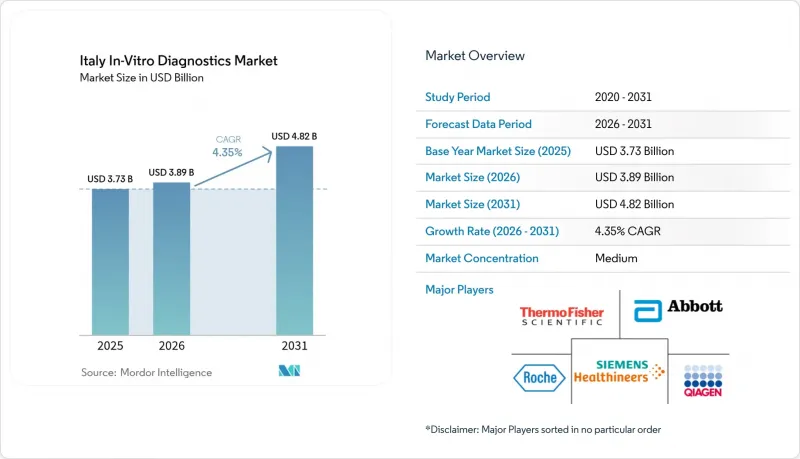
Mordor Intelligence에 따르면 이탈리아의 체외진단 시장 규모는 2025년에 37억 3,000만 달러로 평가되며, 2026년 38억 9,000만 달러에서 2031년까지 48억 2,000만 달러에 달할 것으로 예측되고 있으며, 예측 기간(2026-2031년)에 CAGR은 4.35%에 달할 전망입니다.
이 보고서는 검사 유형(임상화학, 분자진단, 기타), 제품(계측기기·분석장치, 기타), 사용 형태(일회용 체외진단용 의료기기·재사용 체외진단용 의료기기), 용도(감염병, 당뇨병, 기타), 검사 방법(실험실 검사·현장 검사), 최종사용자(병원·클리닉, 진단 실험실, 기타)별로 분류되어 있습니다.
이탈리아 체외진단 시장의 동향 및 인사이트
만성질환 및 생활습관병(당뇨병, 심혈관 질환, 암)의 부담 증가
현재 이탈리아 인구에서 만성질환이 차지하는 비율은 증가 추세에 있으며, 2024년에는 390만 명의 주민이 당뇨병을 앓고 있고, 심혈관 질환은 여전히 사망 원인 1위를 차지하고 있습니다. 증례 수의 증가에 따라 연속 혈당 모니터링, 고감도 심장 마커 검사, 한 번의 측정으로 여러 위험 요인을 평가할 수 있는 다항목 검사 패널에 대한 수요가 높아지고 있습니다. 보험사는 연간 200억 유로를 초과하는 치료비를 억제하는 수단으로 진단 검사를 활용하고 있으며, 조기 발견 툴에 대한 유리한 보상 제도를 추진하고 있습니다. 검사 기관에서는 대사 마커와 염증 마커를 동시에 분석하는 통합 플랫폼 도입이 진행되고 있으며, 시약을 절약하면서 환자 계층화를 개선하고 있습니다. 이러한 장기적인 역학적 변화가 일상적인 검사 건수의 꾸준한 증가를 지원하고 있으며, 그 결과 이탈리아 체외 진단 시장 전체에서 시약 수요가 안정적입니다.
분자 진단 및 면역 진단 분야의 급속한 기술 혁신
차세대 시퀀싱과 멀티플렉스 PCR은 3차 의료기관에서의 일상적인 사용에 적합한 비용 및 처리 능력 수준에 도달하여, 결과 도출 시간을 단축하고 보다 광범위한 유전자 패널 분석을 가능하게 하고 있습니다. 현재 미세유체 카트리지는 더 적은 양의 검체를 처리할 수 있게 되었으며, 이는 소아과 및 종양학 분야의 생검에서 매우 중요한 장점이 되고 있습니다. 이탈리아의 검사실에서는 COVID-19 유행기에 사용되었던 PCR 장비를 종양학,패혈증, 항생제 내성 패널 용도로 개조하고 있으며, 이를 통해 시스템 가동률이 향상되고 검사당 비용이 절감되고 있습니다. 면역진단 부문에서는 시간당 최대 240건의 검사를 자동화하는 화학발광 플랫폼이 활용되고 있으며, 불임, 갑상선, 자가면역 마커 등의 검사 항목이 확대되고 있습니다. 게놈 데이터와 단백질체학 데이터가 융합됨에 따라 임상의는 더욱 풍부한 인사이트를 얻을 수 있게 되었으며, 이는 맞춤형 의료 프로토콜에 활용되어 분자 검사 시장이 시장 평균을 상회하는 성장을 지속하고 있습니다.
엄격하고 끊임없이 변화하는 EU의 IVDR 규제 현황
IVDR에 따라 대다수의 검사가 더 높은 위험 등급으로 재분류되어, 더욱 엄격한 임상 증거 제출 자료와 지속적인 시판 후 모니터링이 요구되고 있습니다. 2024년 현재 IVDR 인증을 승인받은 인증 기관은 불과 12곳에 그치고 있으며, 신청이 지연되면서 제품의 시장 출시가 늦어지고 있습니다. 중소기업의 경우 규정 준수 비용이 연간 매출의 5-15%를 차지할 가능성이 있으며, 새로운 연구에 자금을 투자하기보다는 틈새 시장 검사 사업에서 철수하는 기업도 나타나고 있습니다. 한편, 대형 다국적 기업은 이 기회를 활용하여 문서화 갱신에 어려움을 겪고 있는 국내 동종 경쟁사를 인수함으로써 시장 점유율 확대를 도모하고 있습니다. 저위험 검사 키트의 경우 이동 기한이 2029년까지 연장되었으나, 시장 진입의 불확실성이 단기적인 투자 결정에 큰 부담으로 작용하고 있습니다.
부문별 분석
면역 진단은 2025년 매출의 27.65%를 차지하며, 갑상선 질환, 불임증, 감염증의 혈청학 검사를 위한 루틴 검사 패널을 지원하고 있습니다. 안정적인 보험 급여 환경과 화학 발광 분석기의 광범위한 도입 기반 덕분에 이 부문의 성장률은 한 자릿수 중반대를 유지하고 있습니다. 분자 진단은 기반은 작지만, 차세대 염기서열 분석이 참조 검사실에서 3차 의료 기관으로 전환되고, 종양학 분야의 미세잔류병변(MRD) 모니터링으로의 적용 범위가 확대됨에 따라 연평균 성장률(CAGR) 7.66%를 기록하고 있습니다. 이탈리아 체외진단 시장에서 분자 검사에 기인한 시장 규모는 증후군별 호흡기 패널의 확대와 체액 생검의 보급을 반영하여, 2025-2030년 사이에 2배로 증가할 것으로 예상됩니다. 융합 동향으로는 핵산 검출과 면역 포획 기술을 결합한 다중 검사 플랫폼이 등장하고 있으며, 이를 통해 검사실은 장비 통합을 도모하면서 검사 메뉴를 확충할 수 있게 되었습니다.
COVID-19 대책으로 도입된 인프라(고성능 PCR 사이클러, 자동 추출 장치 등)는 현재 성병 및 항생제 내성 검사에 전용되어 이용률이 향상되고 있습니다. 이탈리아의 스타트업 기업은 시약 사용량을 대폭 줄이는 미세유체 칩 제조 분야에서 혁신을 일으키고 있으며, 예산에 민감한 지역 의료 시스템에 매력적인 선택지가 되고 있습니다. 면역 진단 제조업체들은 신경퇴행성 질환 및 신종 인수공통감염병을 대상으로 한 고감도 검사로 이에 대응하고 있는 반면, 분자 진단 공급업체들은 검사와 생물정보학을 결합한 패키지형 서비스를 통해 종양 센터에 대한 접근을 강화하고 있습니다. 이러한 동향은 기술의 다양성을 강화하고, 이탈리아 체외진단 시장에서 부문 간 협력을 촉진하고 있습니다.
2025년에는 시약과 소모품이 매출의 64.32%를 차지했습니다. 이 점유율은 공급업체의 현금 흐름을 안정시키는 정기적인 수요 패턴에 의해 지원되고 있습니다. 만성질환 모니터링에서 검사량이 증가함에 따라 로트 규모가 확대되어, 검사 기관이 대량 구매를 통한 할인을 협상하기가 더 쉬워졌습니다. 그럼에도 불구하고 많은 분석 기기에서 볼 수 있는 폐쇄형 시스템의 개념은 공급업체의 가격 결정력을 유지하며, 종종 60%를 초과하는 매출 총이익률을 지원하고 있습니다. 장비 및 분석 기기는 시설이 시간당 3,000개의 튜브를 처리할 수 있는 자동 이송 시스템으로 현대화됨에 따라 연평균 성장률(CAGR) 6.37%를 기록하고 있으며, 이를 통해 인력 부족이 완화되고 검체당 비용이 절감되고 있습니다. 미들웨어에서 AI를 활용한 의사결정 지원에 이르기까지 소프트웨어 및 정보학 솔루션은 가장 수익성이 높은 부문으로 부상하고 있으며, 자본 지출을 운영 예산으로 전환하는 시약 임대 계약 하에서 종종 번들로 판매되고 있습니다.
종합 검사 자동화(TLA) 시스템은 수작업으로 인한 처리 오류를 20% 줄일 수 있으며, 대학병원에서 지지를 얻고 있습니다. 클라우드를 통해 제공되는 품질관리 대시보드는 지역 보건 당국이 검사실의 성과를 모니터링하는 데 도움이 되며, 이 기능은 새로운 IVDR(체외진단용 의료기기 규정)의 시판 후 조사 규정과 잘 부합합니다. 오픈 플랫폼 지지자들은 비용 절감을 위해 시약의 상호 운용성을 추진하고 있지만, 공급업체들이 제품 수명 주기 전반에 걸친 수입원을 우선시하고 있으므로 독자적인 규격의 시약 전략이 여전히 주류를 이루고 있습니다.
기타 혜택
- 엑셀 형식의 시장 예측(ME) 시트
- 3개월간의 애널리스트 지원
목차
제1장 서론
제2장 조사 방법
제3장 개요
제4장 시장 구도
제5장 시장 규모와 성장 예측
제6장 경쟁 구도
제7장 시장 기회와 향후 전망
KSAAccording to Mordor Intelligence, the Italy in vitro diagnostics market size was valued at USD 3.73 billion in 2025 and estimated to grow from USD 3.89 billion in 2026 to reach USD 4.82 billion by 2031, at a CAGR of 4.35% during the forecast period (2026-2031).
This report is Segmented by Test Type (Clinical Chemistry, Molecular Diagnostics, and More), Product (Instruments & Analyzers, and More), Usability (Disposable IVD Devices and Reusable IVD Devices), Application (Infectious Disease, Diabetes, and More. ), Mode of Testing (Laboratory-Based Testing and Point-Of-Care Testing), and End-Users (Diagnostic Laboratories, Hospitals and Clinics, and More).
Italy In-Vitro Diagnostics Market Trends and Insights
Rising Burden of Chronic & Lifestyle Diseases (Diabetes, CVD, Cancer)
Chronic conditions now affect a growing share of Italy's population, with 3.9 million residents living with diabetes in 2024 and cardiovascular disease remaining the top cause of mortality. Larger case volumes have spurred demand for continuous glucose-monitoring, high-sensitivity cardiac-marker assays, and multi-parameter panels that profile several risk factors in one run. Payers see diagnostics as a lever to curb treatment costs exceeding EUR 20 billion per year, fostering favorable reimbursement for early-detection tools. Laboratories increasingly deploy integrated platforms that simultaneously analyze metabolic and inflammatory markers, improving patient stratification while conserving reagents. This long-term epidemiological shift underpins steady increases in routine test volumes, thereby stabilizing reagent demand across the Italy in vitro diagnostics market.
Rapid Technological Innovation in Molecular & Immunodiagnostics
Next-generation sequencing and multiplex PCR have reached cost and throughput thresholds suited for routine use in tertiary centers, cutting time-to-result and enabling wider gene panels. Microfluidic cartridges now process smaller sample volumes, a crucial advantage in pediatrics and oncology biopsies. Italian labs are retrofitting COVID-era PCR instruments for oncology, sepsis, and antimicrobial-resistance panels, which lifts system utilization and lowers per-test costs. Immunodiagnostics benefit from chemiluminescent platforms that automate up to 240 tests per hour, expanding menus into fertility, thyroid, and autoimmune markers. As genomic and proteomic data converge, clinicians gain richer insights that feed into personalized-medicine protocols, sustaining above-market growth for molecular assays.
Stringent & Evolving EU IVDR Regulatory Landscape
The IVDR recasts most assays into higher-risk classes that demand stricter clinical-evidence dossiers and ongoing post-market surveillance. Only 12 notified bodies were approved for IVDR certification by 2024, creating application backlogs that slow product launches. Compliance expenses can absorb 5-15% of annual revenue for smaller firms, prompting some to withdraw niche tests rather than fund new studies. Larger multinationals use this window to consolidate share by acquiring domestic peers struggling with documentation upgrades. Although transition deadlines stretch to 2029 for low-risk assays, market-access uncertainty weighs on near-term investment decisions.
Other drivers and restraints analyzed in the detailed report include:
- Expansion of Point-of-Care Testing Across Primary & Home Settings
- Government & EU Investment Programs for Digital Lab Modernization
- Regional Reimbursement Delays & Budget Constraints
For complete list of drivers and restraints, kindly check the Table Of Contents.
Segment Analysis
Immunodiagnostics commanded 27.65% of 2025 revenue, underpinning routine panels for thyroid disorders, fertility, and infectious-disease serology. The stable reimbursement environment and broad installed base of chemiluminescent analyzers anchor segment growth at mid-single-digit rates. Molecular diagnostics, though starting from a smaller base, is charting a 7.66% CAGR as next-generation sequencing migrates from reference labs to tertiary hospitals, extending coverage into oncology minimal-residual-disease monitoring. The Italy in vitro diagnostics market size attributed to molecular assays is expected to double between 2025 and 2030, reflecting expanded syndromic respiratory panels and liquid biopsy uptake. Convergence trends see multiplex platforms combining nucleic-acid detection with immuno-capture technologies, enabling laboratories to consolidate instrument fleets while widening their menus.
COVID-19 infrastructure-high-throughput PCR cyclers and automated extractors-is now repurposed for sexually transmitted infections and antimicrobial-resistance testing, lifting utilization rates. Italian start-ups innovate in microfluidic chip fabrication that slashes reagent volumes, appealing to budget-conscious regional health systems. Immunodiagnostic suppliers respond with high-sensitivity assays targeting neurodegeneration and emerging zoonoses, while molecular vendors court oncology centers with bundled assay-plus-bioinformatics offerings. Such dynamics reinforce technology pluralism and foster cross-segment collaboration within the Italy in vitro diagnostics market.
Reagents and consumables generated 64.32% of turnover in 2025, a share driven by recurring demand patterns that stabilize cash flows for suppliers. Rising test volumes in chronic-disease monitoring lift lot sizes, helping laboratories negotiate bulk-purchase discounts. Still, the closed-system philosophy of many analyzers preserves vendor pricing power and sustains gross margins that often exceed 60%. Instruments and analyzers post a 6.37% CAGR as facilities modernize to automated track systems capable of 3,000 tubes per hour, mitigating staff shortages and lowering per-sample cost. Software and informatics solutions-ranging from middleware to AI-enabled decision support-emerge as the highest-margin category and are frequently bundled under reagent-rental contracts that shift capital expenditure into operating budgets.
Total-laboratory-automation lines gain favor in university hospitals, where they drive 20% reductions in manual handling errors. Cloud-delivered quality-control dashboards help regional health authorities monitor laboratory performance, a feature aligning well with new IVDR post-market surveillance rules. Open-platform advocates push for reagent interoperability to reduce costs, yet proprietary-reagent strategies remain prevalent as suppliers prioritize life-cycle revenue streams.
Complete Report Scope:
- By Test Type
- Clinical Chemistry
- Immunodiagnostics
- Molecular Diagnostics
- Hematology
- Microbiology
- Coagulation
- Point-of-Care (POC) Tests
- By Product
- Instruments & Analyzers
- Reagents & Consumables
- Software & Services
- By Usability
- Disposable IVD Devices
- Reusable IVD Devices
- By Mode of Testing
- Laboratory-Based Testing
- Point-of-Care Testing
- By Application
- Infectious Disease
- Diabetes
- Oncology (Cancer)
- Cardiology
- Autoimmune Disorders
- Other Applications
- By End-User
- Hospitals & Clinics
- Diagnostic Laboratories
- Academic & Research Institutes
- Home-Care / Ambulatory POC Settings
- Other End-Users
List of Companies Covered in this Report:
- Roche
- Abbott Laboratories
- Siemens Healthineers
- Danaher Corp. (Beckman Coulter & Cepheid)
- DiaSorin
- bioMerieux
- Thermo Fisher Scientific
- Sysmex
- QIAGEN
- Beckton Dickinson
- Werfen S.A.
- Menarini Diagnostics S.r.l.
- Sentinel Diagnostics S.p.A.
- Alfa Wassermann Diagnostic Technologies
- Sentinel CH S.p.A.
- Luminex (DiaSorin Group)
- Randox Laboratories
- Bio-Rad Laboratories
- Illumina
- Agilent Technologies
- DIESSE Diagnostica Senese S.p.A.
- Sclavo Diagnostics International
Additional Benefits:
- The market estimate (ME) sheet in Excel format
- 3 months of analyst support
TABLE OF CONTENTS
1 Introduction
- 1.1 Study Assumptions & Market Definition
- 1.2 Scope of the Study
2 Research Methodology
3 Executive Summary
4 Market Landscape
- 4.1 Market Overview
- 4.2 Market Drivers
- 4.2.1 Rising Burden of Chronic & Lifestyle Diseases (Diabetes, CVD, Cancer)
- 4.2.2 Rapid Technological Innovation in Molecular & Immunodiagnostics
- 4.2.3 Expansion of Point-of-Care Testing Across Primary & Home Settings
- 4.2.4 Government & EU Investment Programs for Digital Lab Modernization
- 4.2.5 Growth of Precision Medicine & Companion Diagnostics Adoption
- 4.3 Market Restraints
- 4.3.1 Stringent & Evolving EU IVDR Regulatory Landscape
- 4.3.2 Regional Reimbursement Delays & Budget Constraints
- 4.3.3 Shortage of Skilled Laboratory Personnel & Training Gaps
- 4.4 Regulatory Outlook
- 4.5 Porter's Five Forces Analysis
- 4.5.1 Threat of New Entrants
- 4.5.2 Bargaining Power of Buyers
- 4.5.3 Bargaining Power of Suppliers
- 4.5.4 Threat of Substitutes
- 4.5.5 Competitive Rivalry Intensity
5 Market Size & Growth Forecasts (Value, USD)
- 5.1 By Test Type
- 5.1.1 Clinical Chemistry
- 5.1.2 Immunodiagnostics
- 5.1.3 Molecular Diagnostics
- 5.1.4 Hematology
- 5.1.5 Microbiology
- 5.1.6 Coagulation
- 5.1.7 Point-of-Care (POC) Tests
- 5.2 By Product
- 5.2.1 Instruments & Analyzers
- 5.2.2 Reagents & Consumables
- 5.2.3 Software & Services
- 5.3 By Usability
- 5.3.1 Disposable IVD Devices
- 5.3.2 Reusable IVD Devices
- 5.4 By Mode of Testing
- 5.4.1 Laboratory-Based Testing
- 5.4.2 Point-of-Care Testing
- 5.5 By Application
- 5.5.1 Infectious Disease
- 5.5.2 Diabetes
- 5.5.3 Oncology (Cancer)
- 5.5.4 Cardiology
- 5.5.5 Autoimmune Disorders
- 5.5.6 Other Applications
- 5.6 By End-User
- 5.6.1 Hospitals & Clinics
- 5.6.2 Diagnostic Laboratories
- 5.6.3 Academic & Research Institutes
- 5.6.4 Home-Care / Ambulatory POC Settings
- 5.6.5 Other End-Users
6 Competitive Landscape
- 6.1 Market Concentration
- 6.2 Market Share Analysis
- 6.3 Company Profiles (includes Global-level Overview, Market-level Overview, Core Segments, Financials as available, Strategic Information, Market Rank/Share, Products & Services, Recent Developments)
- 6.3.1 F. Hoffmann-La Roche AG
- 6.3.2 Abbott Laboratories
- 6.3.3 Siemens Healthineers AG
- 6.3.4 Danaher Corp. (Beckman Coulter & Cepheid)
- 6.3.5 DiaSorin S.p.A
- 6.3.6 BioMerieux SA
- 6.3.7 Thermo Fisher Scientific Inc.
- 6.3.8 Sysmex Corporation
- 6.3.9 QIAGEN N.V.
- 6.3.10 Becton, Dickinson and Company
- 6.3.11 Werfen S.A.
- 6.3.12 Menarini Diagnostics S.r.l.
- 6.3.13 Sentinel Diagnostics S.p.A.
- 6.3.14 Alfa Wassermann Diagnostic Technologies
- 6.3.15 Sentinel CH S.p.A.
- 6.3.16 Luminex (DiaSorin Group)
- 6.3.17 Randox Laboratories Ltd
- 6.3.18 Bio-Rad Laboratories Inc.
- 6.3.19 Illumina Inc.
- 6.3.20 Agilent Technologies Inc.
- 6.3.21 DIESSE Diagnostica Senese S.p.A.
- 6.3.22 Sclavo Diagnostics International
7 Market Opportunities & Future Outlook
- 7.1 White-Space & Unmet-Need Assessment