

|
시장보고서
상품코드
2121862
생체 이식재 : 시장 점유율 분석, 업계 동향과 통계, 성장 예측(2026-2031년)Bio-Implants - Market Share Analysis, Industry Trends & Statistics, Growth Forecasts (2026 - 2031) |
||||||
 Mordor Intelligence
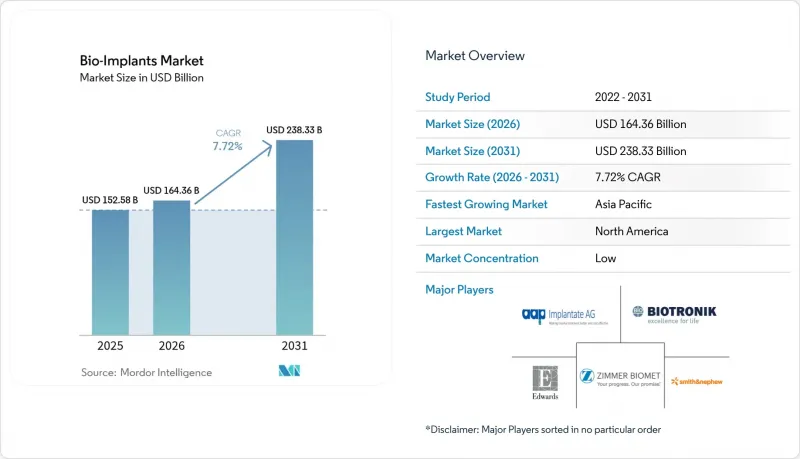
Mordor Intelligence에 의하면, 세계의 생체 이식재 시장 규모는 2025년 1,525억 8,000만 달러에서 2026년에는 1,643억 6,000만 달러에 이르고, 2026-2031년 CAGR 7.72%로 성장을 지속하여 2031년에는 2,383억 3,000만 달러에 달할 것으로 예측됩니다.
본 보고서는 생체 이식재의 유형(심혈관용 임플란트, 정형외과용 임플란트, 척추용 임플란트 등),소재(금속·합금, 폴리머 등), 유래(자가 이식편, 동종 이식편 등), 최종 사용자(병원, 외래수술센터(ASC) 등), 지역(북미, 유럽, 아시아태평양 등)별로 분류되어 있습니다. 시장 예측은 금액(달러) 기준으로 제시되어 있습니다.
세계 생체 이식재 시장 동향 및 인사이트
만성 질환 및 생활습관병의 부담 증가
당뇨병, 심혈관 질환 및 근골격계 질환이 수요 양상을 완전히 바꾸고 있습니다. 제넨텍(Genentech)의 ‘수스비모(Susvimo)’는 1년에 두 번만 보충하면 되는 최초의 지속성 안구 내 약물 전달 임플란트로, 2025년에 미국 식품의약국(FDA)의 승인을 획득했습니다. 이는 다기능 기기가 더 적은 시술로 만성 질환을 관리할 수 있게 되었음을 여실히 보여줍니다. 고소득 국가의 의료 시스템은 예방적 관리로 전환되고 있으며, 재입원을 줄여주는 오래 지속되는 임플란트가 선호되고 있습니다.
저침습 수술에 대한 선호도 증가
2024년, 당일 수술센터에서는 4,400만 건의 수술이 이루어졌으며, 보험사가 외래 인공관절 치환술 비용을 보상함에 따라 그 수는 계속 증가할 전망입니다. 이에 대응하여 임플란트 제조업체들은 수술 시간 단축 및 당일 퇴원 프로토콜에 최적화된 기기를 개발하고 있으며, 관련 생체 임플란트 시장은 기존의 병원 수술실 범위를 훨씬 넘어 확장되고 있습니다.
첨단 임플란트의 높은 초기 비용
센서가 탑재된 고급 기기는 여전히 고가이기 때문에 자본 예산이 제한된 지역에서는 보험사가 도입을 주저하고 있습니다. 각 공급업체는 의료 시스템이 혁신을 저해하지 않으면서도 기능성과 경제적 현실을 양립할 수 있도록 단계적인 제품 라인업을 개발하고 있습니다.
부문 분석
2025년에는 정형외과용 기기가 최대 수익원이 되어 생체 이식재 시장 점유율의 27.58%를 차지했습니다. 한편, 심혈관용 임플란트는 경카테터 판막 및 이식형 혈역학 센서의 주도하에 연평균 성장률(CAGR) 8.23%라는 가장 높은 성장세를 보이고 있습니다. 이 부문은 말기 심부전을 치료 대상으로 하는 BiVACOR사의 전인조 심장 등, FDA의 ‘브레이크스루 디바이스(Breakthrough Device)’ 지정의 혜택을 받고 있습니다. 예측 기간 동안 원격 텔레메트리 기능을 통합한 스마트 페이스메이커 덕분에 생체 이식재 시장 내 심혈관 분야의 점유율은 더욱 확대될 전망입니다.
정형외과 분야의 혁신은 로봇 유도 기술과 베어링 수명을 연장하는 마찰학 분야의 진보에 힘입어 견조한 성장세를 유지하고 있습니다. 신경 자극 장치는 적응형 알고리즘을 활용해 환자의 피드백에 따라 재조정되는 반면, 인공 내이는 완전 이식형으로 점차 전환되고 있습니다. 이 부문은 2031년까지 9억 8,640만 달러에 달할 것으로 예측됩니다. Susvimo와 같은 안과용 플랫폼은 치료 빈도의 기대치를 재정의하며, 모든 임플란트 제품군에 걸쳐 꾸준한 수요를 뒷받침하고 있습니다.
티타늄의 타의 추종을 불허하는 강도 대 중량 비율 덕분에 2025년 매출의 43.72%를 금속 및 합금이 차지했으나, 폴리에테르에테르케톤(PEEK) 및 폴리젖산(PLA)의 변형 소재가 스트레스 실드를 완화하기 때문에복합재료가 8.12%라는 가장 높은 성장률을 보일 전망입니다. 항균성 은 이온이 도핑된 세라믹는 감염 위험을 낮추며, 생체활성 유리 매트릭스는 염증 캐스케이드를 유발하지 않으면서 골 형성을 촉진합니다. 경질 코어에서 유연한 외층으로 변화하는 그라데이션 구조는 자연 조직을 모방하여 연조직 복원의 적용 범위를 확대합니다.
지역별 분석
2025년, 북미는 전 세계 매출의 48.12%를 차지했습니다. 이는 보험 급여의 균일화와 선진적인 연구개발 생태계 덕분에, 2025년 FDA 승인을 받은 메드트로닉(Medtronic)사의 ‘BrainSense’ 플랫폼과 같은 폐쇄 루프형 신경 자극 장치의 보급이 가속화되었기 때문입니다. 캐나다와 멕시코에서 유입되는 국경 간 환자 수가 시술 건수 증가를 더욱 뒷받침하는 한편, 다양한 지불 주체의 구성이 가격 형성을 안정화시키고 있습니다.
아시아태평양은 연평균 성장률(CAGR) 8.11%를 기록하며 가장 빠르게 성장하는 생체 이식물 시장입니다. 중국은 국내 제조를 지원하고, 인도는 규제 기준을 국제 기준에 부합하도록 조정하며, 일본의 초고령 사회에서는 관절 및 심장용 기기가 우선시되고 있습니다. 한국의 디지털 헬스 인프라는 원격 모니터링의 보급을 가속화하고 있으며, 호주의 연구 거점은 지역 내 시장 출시와 관련된 위험을 완화하는 중요한 임상시험을 주관하고 있습니다.
유럽에서는 의료기기 규정(MDR) 인증 과정에서 병목 현상을 겪고 있습니다. 단 43개의 인증 기관이 50만 건의 의료기기를 감독하고 있는 상황으로, 이로 인해 시장 진입이 지연되고 있습니다. 2027년까지의 이행 기간 연장으로 일정한 유예 기간이 주어지기는 했지만, 기업들은 새로운 조달 기준에 포함된 엄격한 환경 요건을 충족해야 합니다. 지속가능성을 중시하는 병원에서는 입찰 조건의 일환으로 수명 주기 분석이나 재활용 가능한 포장을 요구하는 사례가 늘고 있습니다.
기타 혜택:
- 엑셀 형식 시장 예측(ME) 시트
- 3개월간의 애널리스트 지원
자주 묻는 질문
목차
제1장 서론
제2장 조사 방법
제3장 주요 요약
제4장 시장 구도
제5장 시장 규모와 성장 예측
제6장 경쟁 구도
제7장 시장 기회와 향후 전망
LSH 26.09.09According to Mordor Intelligence, the global bio-implants market size is expected to grow from USD 152.58 billion in 2025 to USD 164.36 billion in 2026 and is forecast to reach USD 238.33 billion by 2031 at 7.72% CAGR over 2026-2031.
This report is Segmented by Type of Bio-Implants (Cardiovascular Implants, Orthopedic Implants, Spinal Implants, and More), Material (Metals & Alloys, Polymers, and More), Origin (Autograft, Allograft, and More), End User (Hospitals, Ambulatory Surgical Centers, and More), and Geography (North America, Europe, Asia-Pacific, and More). The Market Forecasts are Provided in Terms of Value (USD).
Global Bio-Implants Market Trends and Insights
Rising Burden of Chronic & Lifestyle Diseases
Diabetes, cardiovascular disease, and musculoskeletal disorders are reshaping demand patterns. Genentech's Susvimo received United States Food and Drug Administration (FDA) approval in 2025 as the first continuous ocular drug-delivery implant needing only twice-yearly refills, underscoring how multifunctional devices now address chronic pathologies with fewer interventions. Healthcare systems in high-income countries are pivoting toward proactive management, favoring long-lasting implants that reduce rehospitalization.
Growing Preference for Minimally-Invasive Surgeries
Ambulatory surgery centers performed 44 million procedures in 2024 and will keep expanding as payers reimburse outpatient joint replacements. Implant manufacturers respond by creating devices optimized for shorter operative windows and same-day discharge protocols, increasing the addressable bio-implants market well beyond traditional hospital theatres.
High Upfront Cost of Advanced Implants
Premium sensor-based devices remain expensive, making payers hesitate in regions where capital budgets are constrained. Suppliers are developing tiered portfolios so health systems can match functionality to economic reality without halting innovation.
Other drivers and restraints analyzed in the detailed report include:
- Aging Population Accelerating Joint-Replacement Volumes
- Surge in 3-D-Printed, Patient-Specific Implants
- Unfavorable / Fragmented Reimbursement Pathways
For complete list of drivers and restraints, kindly check the Table Of Contents.
Segment Analysis
Orthopedic devices represented the single-largest revenue block in 2025, contributing 27.58% of the bio-implants market share. Cardiovascular implants, however, deliver the highest momentum with an 8.23% CAGR, powered by transcatheter valves and implantable hemodynamic sensors. The segment benefits from FDA breakthrough-device designations such as BiVACOR's total artificial heart that target end-stage failure. Over the forecast horizon, smart pacemakers integrated with remote telemetry will further enlarge the cardiovascular footprint within the bio-implants market.
Orthopedic innovation stays robust through robotic guidance and improved tribology that extends bearing life. Neuro-stimulators leverage adaptive algorithms to recalibrate in response to patient feedback, while cochlear implants inch toward fully implantable form factors; the category is projected to reach USD 986.4 million by 2031. Ophthalmic platforms like Susvimo re-shape treatment frequency expectations, reinforcing steady demand across all implant lines.
Metals and alloys accounted for 43.72% of 2025 revenue thanks to titanium's unmatched strength-to-weight ratio, but composites will grow the fastest at 8.12% as polyether-ether-ketone (PEEK) and polylactic acid (PLA) variants mitigate stress shielding. Ceramics doped with antimicrobial silver ions diminish infection risk, and bio-active glass matrices encourage osteogenesis without inflammatory cascade. Gradient builds that shift from rigid cores to compliant outer zones imitate natural tissue and broaden indications for soft-tissue repair.
Complete Report Scope:
- By Type of Bio-Implants
- Cardiovascular Implants
- Orthopedic Implants
- Spinal Implants
- Dental Implants
- Ophthalmic Implants
- Neurological & Cochlear Implants
- Other Implants
- By Material
- Metals & Alloys
- Polymers
- Ceramics & Bio-active Glass
- Composite & Hybrid Biomaterials
- Other Materials
- By Origin
- Autograft
- Allograft
- Xenograft
- Synthetic / Prosthetic
- By End User
- Hospitals
- Ambulatory Surgical Centers
- Specialty Clinics
- Geography
- North America
- United States
- Canada
- Mexico
- Europe
- Germany
- United Kingdom
- France
- Italy
- Spain
- Rest of Europe
- Asia-pacific
- China
- Japan
- India
- Australia
- South Korea
- Rest of Asia-pacific
- Middle East and Africa
- GCC
- South Africa
- Rest of Middle East and Africa
- South America
- Brazil
- Argentina
- Rest of South America
- North America
Geography Analysis
North America held 48.12% of global revenue in 2025 as reimbursement parity and advanced R&D ecosystems speed adoption of closed-loop neuro-stimulators like Medtronic's BrainSense platform, cleared by the FDA in 2025. Cross-border patient flows from Canada and Mexico further support procedure growth while diversified payer mixes stabilize price realization.
Asia-Pacific is the fastest-moving bio-implants market at an 8.11% CAGR. China supports domestic manufacturing, India aligns its regulatory code with international standards, and Japan's super-aged society prioritizes joint and cardiac devices. Digital health infrastructure in South Korea accelerates remote monitoring uptake, and Australian research hubs host pivotal trials that de-risk regional launches.
Europe wrestles with Medical Device Regulation (MDR) certification bottlenecks-only 43 notified bodies oversee half-a-million devices-slowing market entry. Transition extensions to 2027 grant limited reprieve, yet firms must still meet stringent environmental requirements incorporated into new procurement criteria. Sustainability-minded hospitals increasingly request lifecycle analyses and recyclable packaging as part of tender bids.
- Johnson & Johnson
- Medtronic
- Abbott Laboratories
- Zimmer Biomet
- Stryker
- Boston Scientific
- Edward Lifesciences
- BIOTRONIK
- Smiths Group
- Straumann Group
- Dentsply Sirona
- Cochlear
- Bausch Health
- AAP Implantate
- Endo International
- MiMedx Group
- LifeNet Health
- Arthrex
- Globus Medical
- NuVasive
- Exactech
- Conmed
Additional Benefits:
- The market estimate (ME) sheet in Excel format
- 3 months of analyst support
TABLE OF CONTENTS
1 Introduction
- 1.1 Study Assumptions & Market Definition
- 1.2 Scope of the Study
2 Research Methodology
3 Executive Summary
4 Market Landscape
- 4.1 Market Overview
- 4.2 Market Drivers
- 4.2.1 Rising Burden of Chronic & Lifestyle Diseases
- 4.2.2 Growing Preference for Minimally-invasive Surgeries
- 4.2.3 Aging Population Accelerating Joint-replacement Volumes
- 4.2.4 Surge in 3-D-printed, Patient-specific Implants
- 4.2.5 Commercialization of Bioresorbable & Smart Sensor-enabled Implants
- 4.2.6 Value-based-care Bundles Boosting Implant Uptake in EMs
- 4.3 Market Restraints
- 4.3.1 High Upfront Cost of Advanced Implants
- 4.3.2 Unfavorable/Fragmented Reimbursement Pathways
- 4.3.3 Supply-chain Vulnerability for Specialty Biomaterials
- 4.3.4 ESG & Lifecycle-impact Scrutiny Delaying Approvals
- 4.4 Supply-Chain Analysis
- 4.5 Regulatory Landscape
- 4.6 Technological Outlook
- 4.7 Porter's Five Forces Analysis
- 4.7.1 Threat of New Entrants
- 4.7.2 Bargaining Power of Buyers/Consumers
- 4.7.3 Bargaining Power of Suppliers
- 4.7.4 Threat of Substitute Products
- 4.7.5 Intensity of Competitive Rivalry
5 Market Size & Growth Forecasts (Value - USD)
- 5.1 By Type of Bio-Implants
- 5.1.1 Cardiovascular Implants
- 5.1.2 Orthopedic Implants
- 5.1.3 Spinal Implants
- 5.1.4 Dental Implants
- 5.1.5 Ophthalmic Implants
- 5.1.6 Neurological & Cochlear Implants
- 5.1.7 Other Implants
- 5.2 By Material
- 5.2.1 Metals & Alloys
- 5.2.2 Polymers
- 5.2.3 Ceramics & Bio-active Glass
- 5.2.4 Composite & Hybrid Biomaterials
- 5.2.5 Other Materials
- 5.3 By Origin
- 5.3.1 Autograft
- 5.3.2 Allograft
- 5.3.3 Xenograft
- 5.3.4 Synthetic / Prosthetic
- 5.4 By End User
- 5.4.1 Hospitals
- 5.4.2 Ambulatory Surgical Centers
- 5.4.3 Specialty Clinics
- 5.5 Geography
- 5.5.1 North America
- 5.5.1.1 United States
- 5.5.1.2 Canada
- 5.5.1.3 Mexico
- 5.5.2 Europe
- 5.5.2.1 Germany
- 5.5.2.2 United Kingdom
- 5.5.2.3 France
- 5.5.2.4 Italy
- 5.5.2.5 Spain
- 5.5.2.6 Rest of Europe
- 5.5.3 Asia-pacific
- 5.5.3.1 China
- 5.5.3.2 Japan
- 5.5.3.3 India
- 5.5.3.4 Australia
- 5.5.3.5 South Korea
- 5.5.3.6 Rest of Asia-pacific
- 5.5.4 Middle East and Africa
- 5.5.4.1 GCC
- 5.5.4.2 South Africa
- 5.5.4.3 Rest of Middle East and Africa
- 5.5.5 South America
- 5.5.5.1 Brazil
- 5.5.5.2 Argentina
- 5.5.5.3 Rest of South America
- 5.5.1 North America
6 Competitive Landscape
- 6.1 Market Concentration
- 6.2 Strategic Moves
- 6.3 Market Share Analysis
- 6.4 Company Profiles (includes Global level Overview, Market level overview, Core Segments, Financials as available, Strategic Information, Market Rank/Share for key companies, Products & Services, and Recent Developments)
- 6.4.1 Johnson & Johnson (DePuy Synthes)
- 6.4.2 Medtronic PLC
- 6.4.3 Abbott Laboratories
- 6.4.4 Zimmer Biomet
- 6.4.5 Stryker Corporation
- 6.4.6 Boston Scientific Corporation
- 6.4.7 Edwards Lifesciences
- 6.4.8 BIOTRONIK
- 6.4.9 Smith & Nephew
- 6.4.10 Straumann Holding AG
- 6.4.11 Dentsply Sirona
- 6.4.12 Cochlear Limited
- 6.4.13 Bausch & Lomb
- 6.4.14 aap Implantate AG
- 6.4.15 Endo International PLC
- 6.4.16 MiMedx Group
- 6.4.17 LifeNet Health
- 6.4.18 Arthrex Inc.
- 6.4.19 Globus Medical
- 6.4.20 NuVasive
- 6.4.21 Exactech
- 6.4.22 Conmed Corporation
7 Market Opportunities & Future Outlook
- 7.1 White-Space & Unmet-Need Assessment


