

|
시장보고서
상품코드
2121871
에너지 수확 시스템 시장 : 시장 점유율 분석, 업계 동향 및 통계, 성장 예측(2026-2031년)Energy Harvesting Systems - Market Share Analysis, Industry Trends & Statistics, Growth Forecasts (2026 - 2031) |
||||||
 Mordor Intelligence
Mordor Intelligence에 의하면, 2026년 에너지 수확 시스템 시장 규모는 43억 8,000만 달러로 추정되고, 2025년 41억 달러에서 확대해, 2031년에는 60억 6,000만 달러에 이를 것으로 예측됩니다.
2026-2031년 연평균 성장률(CAGR) 6.74%를 기록하며 성장할 것으로 전망됩니다.
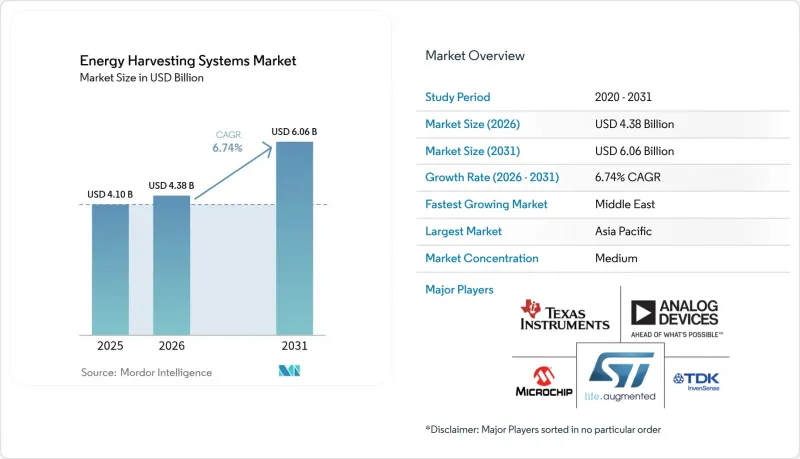
본 보고서는 기술별(광 에너지 수확, 진동 에너지 수확 등), 구성 요소별(에너지 수확용 트랜스듀서, 전원 관리 IC 등), 출력 범위별(10MW 미만, 10-100 MW 등), 용도별(소비자용 전자기기, 빌딩 및 홈 오토메이션, 산업용 IoT 및 오토메이션 등), 지역별로 분류되어 있습니다. 시장 전망은 금액(달러) 기준으로 제시되어 있습니다.
세계의 에너지 수확 시스템 시장 동향 및 인사이트
스마트 빌딩에서의 배터리 없는 IoT 센서 노드 보급
유럽연합(EU)의 에코디자인 규정 2024/1781은 상업시설에 에너지 효율이 높은 제어 시스템의 사용을 의무화하고 있으며, 이에 따라 빌딩 관리자들은 배터리가 필요 없는 무선 센서의 도입을 서두르고 있습니다. 파리와 오비에도에서 실시된 실증 실험에서는 재실 상황 및 환경 데이터를 전송하는 태양광 발전 및 RF 전력 공급식 센서를 도입한 결과, 평균 36.8 kW의 전력 절감 효과가 기록되었습니다. RF 하베스터는 주변 에너지의 10-50%, 조절된 실내 구역에서는 70% 이상을 변환하여 건물의 전체 수명 주기 동안 센서를 지속적으로 작동시킵니다. 시설 소유주들은 총 소유 비용(TCO)을 점점 더 중요하게 여기게 되었으며, 배터리 교체 3회의 비용이 센서의 초기 하드웨어 비용을 초과한다는 사실을 인식함에 따라 에너지 수확 솔루션으로의 전환이 가속화되고 있습니다. 조달 팀이 예산을 유지보수에서 분석 대응형 하드웨어로 전환함에 따라, 에너지 수확 시스템 시장은 상업용 부동산 부문에서 지속적인 수요를 얻고 있습니다.
아시아태평양 공장에서 지속 가능한 저전력 자동화의 의무화
중국, 일본, 한국의 산업 그룹들은 기업의 탄소 감축 목표를 달성하고 배터리 교체로 인한 예상치 못한 가동 중단 시간을 줄이기 위해 에너지 하베스터를 도입하고 있습니다. 텔레포니카 테크(Telefonica Tech)는 배터리 접근이 엄격하게 제한된 석유 및 가스 정제소의 진동 감지 노드에 전력을 공급하는 ATEX 인증 열전 발전기를 출시했습니다. 한국과학기술연구원(KIST) 연구진은 열전 효과와 압전 효과를 결합한 하이브리드형 에너지 하베스터를 개발하여 중장비 모니터링에서의 발전 출력을 50% 이상 향상시켰습니다. 밀접한 제조 생태계 덕분에 시범 도입과 부품 공급업체 간의 신속한 피드백 루프가 가능해져, 부품 원가를 더욱 절감하고 있습니다. 규제 감사에서 생산 공장의 에너지 기준치가 중시되는 가운데, 경영진은 여러 공장 거점에 걸쳐 에너지 수확 플랫폼의 표준화를 추진하고 있으며, 지역적 성장세를 더욱 강화하고 있습니다.
지방 설치 환경에서의 주변 RF 에너지 밀도 저하
현장 시험에 따르면, 노드의 배터리가 예상보다 빨리 소모되기 때문에 농가의 70%가 무선 센서의 시범 도입을 포기하고 있습니다. 이 문제는 RF 밀도가 회수 가능한 수준 이하인 지역에서 더욱 심각해집니다. 현재 각 애그리테크 통합 업체들은 흐린 날씨가 많은 계절이나 RF 신호가 약한 상황에 대비하기 위해 소형 태양광 타일과 관개 펌프에 진동 센서를 결합한 시스템을 채택하고 있습니다. 하지만 하이브리드 설계는 비용을 증가시키고 유지보수 일정을 복잡하게 만들기 때문에 비용에 민감한 농장에서의 광범위한 도입이 지연되고 있습니다. 지방의 통신 인프라가 정비될 때까지는 이러한 제약으로 인해 농업 및 환경 모니터링 분야의 에너지 수확 시스템 시장의 당분간 상승 여력이 제한될 것입니다.
부문 분석
2025년, 빛을 이용한 태양광 발전형 에너지 수확 시스템은 에너지 수확 시스템 시장 점유율의 41.65%를 차지했습니다. 높은 기술 성숙도, 와트당 낮은 비용, 그리고 예측 가능한 일주 에너지 프로파일 덕분에 태양광 발전은 건물 및 실외 설치 분야에서 여전히 선두 자리를 유지하고 있습니다. 한편, RF 에너지 수확은 5G의 집중적인 구축으로 인해 센서의 전원으로 활용 가능한 주변 전자기파 수준이 상승함에 따라, 2031년까지 연평균 성장률(CAGR) 10.62%를 나타낼 것으로 전망됩니다. 진동 및 전자기 에너지 하베스터는 회전 에너지가 풍부한 기계에 활용되는 반면, 열식 제벡 소자는 자동차 배기가스나 산업용 용광로와 같은 틈새 분야에서 활용되고 있습니다. 여러 방식을 결합한 하이브리드 아키텍처는 빛이나 움직임이 끊긴 상황에서도 지속적인 전력 공급을 실현하여 미션 크리티컬한 이용 사례에 적합합니다. 통합기가 지능형 최대 전력점 추적(MPPT)과 적응형 전력 저장을 결합하여 변동하는 전원에서 발전량을 최적화함으로써, 에너지 수확 시스템 시장은 회복탄력성을 높이고 있습니다.
하이브리드 방식의 성공 사례는 다수 존재합니다. Ambient Photonics사는 200럭스 환경에서 기존 셀에 비해 3배의 출력을 기록하여, 실내용 리모컨 및 키보드의 구현을 가능하게 했습니다. 한편, 한국과학기술연구원(KIST)은 캔틸레버형 플랫폼에서 열전 채널과 압전 채널을 통합함으로써 출력을 50% 향상시켰습니다고 보고했습니다. 이러한 진보로 인해 투자 회수 기간이 단축되고 가동 시간 보장이 확대됨에 따라, OEM 제조업체들은 제안 요청서(RFP)에 멀티 소스 설계를 명시하고 있습니다. RF 에너지 수확 효율이 향상되고 부품 가격이 하락함에 따라, 에너지 수확 시스템 시장에서는 부하 수요를 유지하기 위해 몇 밀리초마다 가장 생산성이 높은 전원을 자동으로 선택하는 통합 모듈이 등장할 것입니다.
2025년에는 모든 에너지 수확 토폴로지에서 정확한 전압 조절과 전력 저장 조절이 필요해짐에 따라, 전력 관리 IC가 에너지 수확 시스템 시장 규모(금액 기준)의 37.40%를 차지했습니다. 설계자들이 단일 전원 아키텍처에서 벗어나 특수한 변환 계층이 필요해짐에 따라, 에너지 수확용 변환기는 2031년까지 연평균 성장률(CAGR) 9.05%를 나타낼 것으로 예측됩니다. 박막 전지와 슈퍼커패시터는 간헐적인 에너지 흐름을 완충하고, 초저전력 마이크로컨트롤러는 센서 도입을 정당화하는 분석을 수행합니다. ST마이크로일렉트로닉스의 SPV1050은 태양광 및 열전 입력에 대해 최대 99%의 변환 효율을 달성하고 있으며, 정교한 전압 조절이 노드의 수명을 연장함을 보여줍니다. 아사히카세이의 AP4413 시리즈는 1.43 mm²의 다이에 셀 밸런싱 기능과 트리클 충전 제어를 통합하여, 비용을 중시하는 소비자용 기기에 에너지 수확 솔루션을 제공합니다.
업계 로드맵은 에너지 수확 프런트엔드, 백 부스트 컨버터 및 마이크로컨트롤러를 단일 적층 기판 내에 통합한 시스템 온 칩(SoC) 패키지로 수렴하고 있습니다. 이러한 통합을 통해 기판 수준의 상호 연결로 인한 손실이 해소되고 인증 절차가 간소화되므로, 대상 이용 사례가 산업용 자동화에서 스마트 장난감으로 확대될 것입니다. 예측 기간 동안, 통합형 PMIC의 평균 판매 가격(ASP) 하락이 대량 출하를 촉진하여 에너지 수확 시스템 시장을 더욱 강화할 것입니다.
지역별 분석
아시아는 2025년 전 세계 매출의 34.70%를 차지한 것으로 평가되었으며, 중국의 대규모 IoT 확산과 TDK 주식회사(tdk.com) 등의 기업을 통한 일본의 압전 소재 분야 리더십의 혜택을 받고 있습니다. 서울에서 선전(Shenzhen)에 이르기까지, 정부가 지원하는 스마트 시티 프로그램이 센서 인프라에 대한 보조금을 지급하고 있는 한편, 대만과 말레이시아의 수탁 제조업체들은 제품 주기를 단축하는 비용 효율적인 조립 공정을 제공합니다. 한국의 반도체 생태계는 맞춤형 PMIC 제조를 확대하고 있으며, 싱가포르의 물류 단지에서는 실제 환경에서 하베스터의 견고성을 입증하는 대규모 환경 IoT 어레이 시험이 진행되고 있습니다.
중동은 2031년까지 연평균 성장률(CAGR) 8.78%라는 가장 빠른 성장 궤적을 기록하고 있습니다. 사우디아라비아의 ‘비전 2030’은 재생에너지를 메가시티 계획의 중심에 두고 있으며, 알-하람 모스크에서는 현재 순례자들의 발소리를 전기로 변환하는 압전 타일 바닥재의 시범 운영이 진행되고 있습니다(doi.org). 걸프협력회의(GCC) 회원국의 전력 회사들은 배터리 유지보수를 위한 출장 작업을 피하기 위해 스마트 계량기 케이스에 태양광 발전 하베스터를 통합하고 있습니다. 이스라엘과 아랍에미리트(UAE)는 나노 소재 연구소와 벤처 펀드를 연결하는 지역적 연구개발(R&D) 클러스터의 핵심을 담당하고 있으며, 고효율 하베스터의 상용화 일정을 가속화하고 있습니다.
북미와 유럽에서는 수명 주기의 지속가능성을 중시하는 규제 체계에 힘입어, 성숙 단계에 접어들었음에도 불구하고 견조한 수요가 나타나고 있습니다. 미국 에너지부는 충전기의 대기 전력 제한을 강화하는 방안을 제시하며, 가전 제조업체들에게 친환경 전력 사용으로의 전환을 촉구하고 있습니다. 독일과 영국에서는 3-5년 내 순현재가치 향상을 이유로 공장 내 회전 기계에 진동 발전 장치를 도입하고 있습니다. 이러한 경제권 전반에 걸쳐 엔지니어링 팀은 현재 센서 플랫폼을 선정할 때 탄소 감축 효과를 정량화하고 있으며, 이러한 추세로 인해 초기 투자 비용이 높더라도 에너지 수확 시스템 시장에 안정적인 수주가 이어지고 있습니다.
기타 혜택 :
- 엑셀 형식 시장 예측(ME) 시트
- 3개월간의 애널리스트 지원
자주 묻는 질문
목차
제1장 서론
제2장 조사 방법
제3장 주요 요약
제4장 시장 구도
제5장 시장 규모 및 성장 예측
제6장 경쟁 구도
제7장 시장 기회 및 향후 전망
AJY 26.09.09According to Mordor Intelligence, the energy harvesting systems market size in 2026 is estimated at USD 4.38 billion, growing from 2025 value of USD 4.10 billion with 2031 projections showing USD 6.06 billion, growing at 6.74% CAGR over 2026-2031.
This report is Segmented by Technology (Light Energy Harvesting, Vibration Energy Harvesting, and More), Component (Energy-Harvesting Transducers, Power-Management ICs, and More), Power Range (Less Than 10 MW, 10-100 MW, and More), Application (Consumer Electronics, Building and Home Automation, Industrial IoT and Automation, and More), Geography. The Market Forecasts are Provided in Terms of Value (USD).
Global Energy Harvesting Systems Market Trends and Insights
Proliferation of Battery-less IoT Sensor Nodes in Smart Buildings
The European Union Ecodesign Regulation 2024/1781 obliges commercial properties to use energy-efficient control systems, which pushes building managers toward battery-free wireless sensors Demonstrations in Paris and Oviedo logged 36.8 kW average power savings after integrating solar and RF-powered sensors that communicate occupancy and environmental data. RF harvesters convert 10-50% of ambient energy and more than 70% in tuned indoor zones, keeping sensors operational for the entire building life cycle. Facility owners increasingly weigh total cost of ownership and find that three battery replacement cycles eclipse initial sensor hardware costs, accelerating migration to harvesting solutions. As procurement teams pivot budgets from maintenance to analytics-ready hardware, the energy harvesting systems market gains sustained demand from the commercial real-estate sector.
Mandates for Sustainable Low-Power Automation in APAC Factories
Industrial groups across China, Japan, and South Korea install harvesters to satisfy corporate carbon pledges and cut unscheduled downtime tied to battery swaps. Telefonica Tech rolled out ATEX-certified thermoelectric generators that power vibration nodes in oil and gas refineries where battery access is tightly restricted. Researchers at the Korea Institute of Science and Technology combined thermoelectric and piezoelectric effects in a hybrid harvester that boosts power output by more than 50% for heavy-machinery monitoring. Dense manufacturing ecosystems allow quick feedback loops between pilot deployments and component suppliers, further trimming bill-of-materials cost. As regulatory audits emphasize energy baselines in production plants, executives increasingly standardize harvesting platforms across multiple factory sites, reinforcing regional momentum.
Low Energy Density of Ambient RF in Rural Installations
Field trials show that 70% of growers abandon wireless sensor pilots because nodes exhaust batteries faster than expected, a gap magnified where RF density dips below harvestable levels. Agritech integrators now blend small solar tiles with vibration strips on irrigation pumps to hedge against cloudy seasons and weak RF signals. Even so, hybrid designs raise costs and complicate maintenance schedules, delaying wide deployment in cost-sensitive farms. Until rural connectivity infrastructure expands, this restraint caps immediate upside for the energy harvesting systems market in agriculture and environmental monitoring.
Other drivers and restraints analyzed in the detailed report include:
- Rapid Miniaturization of Ultra-Low-Power MCUs Enabling Sub-µW Thresholds
- Growing Deployment of Wireless Condition-Monitoring in Rail & Aviation OEMs
- Absence of Universal Power-Management Standards
For complete list of drivers and restraints, kindly check the Table Of Contents.
Segment Analysis
Light-based photovoltaic harvesters controlled 41.65% of the energy harvesting systems market share in 2025. Superior maturity, low cost per watt, and predictable diurnal energy profiles keep photovoltaics in pole position for building and outdoor installations. RF harvesting, however, posts an 10.62% CAGR to 2031 as dense 5G deployments raise ambient electromagnetic levels that can be scavenged for sensor power. Vibration and electromagnetic harvesters serve machinery where rotational energy is plentiful, while thermal Seebeck devices find niches in automotive exhaust and industrial furnaces. Hybrid architectures that blend multiple modalities deliver continuity during light or motion lulls, appealing to mission-critical use cases. The energy harvesting systems market gains resilience as integrators pair intelligent maximum-power-point tracking with adaptive storage to optimize yield across variable sources.
Hybrid proof points abound. Ambient Photonics records triple the power output in 200 lux compared with legacy cells, unlocking indoor remote controls and keyboards. Meanwhile, the Korea Institute of Science and Technology reports a 50% power bump by merging thermoelectric and piezoelectric channels in a cantilever platform. These advances compress payback periods and extend uptime guarantees, encouraging original-equipment manufacturers to specify multi-source designs in request-for-proposal documents. As RF harvesting efficiency rises and component prices drop, the energy harvesting systems market will witness converged modules that auto-select the most productive source every few milliseconds to sustain load demands.
Power-management ICs captured 37.40% of the energy harvesting systems market size in 2025 by value because every harvester topology requires accurate voltage regulation and storage orchestration. Energy-harvesting transducers exhibit a 9.05% CAGR to 2031 as designers diversify beyond single-source architectures and need specialized conversion layers. Thin-film batteries and supercapacitors buffer intermittent energy streams, while ultra-low-power microcontrollers perform the analytics that justify sensor deployments. STMicroelectronics' SPV1050 achieves up to 99% conversion efficiency for photovoltaic and thermoelectric inputs, highlighting how sophisticated regulation extends node lifetimes. Asahi Kasei's AP4413 series integrates cell-balancing and trickle-charge control in a 1.43 mm2 die, bringing harvesting solutions to cost-sensitive consumer gadgets.
Industry roadmaps converge on system-on-chip packages that embed harvesting front ends, buck-boost converters, and microcontrollers within a single laminate. This consolidation removes board-level interconnect losses and simplifies certification, expanding addressable use cases from industrial automation to smart toys. Over the forecast window, falling ASPs for integration-ready PMICs will spur volume shipments, further fortifying the energy harvesting systems market.
Complete Report Scope:
- By Technology
- Light (Solar/Photovoltaic) Energy Harvesting
- Vibration (Piezoelectric and Electromagnetic) Energy Harvesting
- Thermal (Seebeck / Thermoelectric) Energy Harvesting
- RF (Radio-Frequency) Energy Harvesting
- Hybrid / Multi-Source Energy Harvesting
- By Component
- Energy-Harvesting Transducers
- Power-Management ICs
- Energy-Storage Units (Thin-Film Batteries, Supercapacitors)
- Ultra-Low-Power Sensors and MCUs
- By Power Range
- Less than 10 micro W
- 10-100 micro W
- 100 micro W-1 mW
- 1-10 mW
- Greater than 10 mW
- By Application
- Consumer Electronics
- Building and Home Automation
- Industrial IoT and Automation
- Transportation
- Automotive
- Rail
- Aviation
- Healthcare and Wearables
- Defense and Security
- Agriculture and Environmental Monitoring
- By Geography
- North America
- United States
- Canada
- Mexico
- Europe
- Germany
- United Kingdom
- France
- Italy
- Spain
- Nordics (Sweden, Norway, Denmark, Finland)
- Benelux (Belgium, Netherlands, Luxembourg)
- Asia-Pacific
- China
- Japan
- India
- South Korea
- ASEAN (Singapore, Malaysia, Thailand, Indonesia, Philippines, Vietnam)
- South America
- Brazil
- Argentina
- Middle East
- Saudi Arabia
- United Arab Emirates
- Israel
- Turkey
- Africa
- South Africa
- Nigeria
- Kenya
- North America
Geography Analysis
Asia held 34.70% of 2025 global revenue, benefiting from China's immense IoT roll-outs and Japan's leadership in piezoelectric materials through firms such as TDK Corporation tdk.com. Government-backed smart-city programs from Seoul to Shenzhen subsidize sensor infrastructure, while contract manufacturers in Taiwan and Malaysia offer cost-efficient assembly paths that shorten product cycles. South Korea's semiconductor ecosystem extends bespoke PMIC fabrication, and Singapore's logistics parks test large-scale ambient IoT arrays that showcase real-world harvester robustness.
The Middle East records the fastest trajectory at a 8.78% CAGR to 2031. Saudi Arabia's Vision 2030 positions renewable energy at the center of megacity planning, and indoor navigation beacons at the Al-Haram mosque now trial piezo tile flooring that converts pilgrim footsteps into grid power doi.org. Gulf Cooperation Council utilities integrate photovoltaic harvesters into smart-meter housings to avoid truck rolls for battery service. Israel and the United Arab Emirates anchor regional R&D clusters that pair nano-material labs with venture funds, accelerating commercialization timelines for high-efficiency harvesters.
North America and Europe show mature yet solid demand tied to regulatory frameworks that emphasize lifecycle sustainability. The United States Department of Energy proposes stricter standby limits for chargers, nudging appliance makers toward ambient power paths. Germany and the United Kingdom equip factories with vibration harvesters for rotating machinery, citing net present value gains over three to five years. Across these economies, engineering teams now quantify carbon abatement when selecting sensor platforms, a trend that channels steady orders into the energy harvesting systems market even where initial capital outlay is higher.
- Microchip Technology Inc.
- STMicroelectronics N.V.
- Texas Instruments Incorporated
- Analog Devices Inc.
- Renesas Electronics Corporation
- NXP Semiconductors N.V.
- onsemi (ON Semiconductor Corp.)
- TDK Corporation (InvenSense)
- Powercast Corporation
- Cymbet Corporation
- EnOcean GmbH
- e-peas S.A.
- ABB Ltd.
- Advanced Linear Devices Inc.
- Cap-XX Limited
- Fujitsu Components America Inc.
- G24 Power Ltd.
- Drayson Technologies Ltd.
- Piezo.com (Mide Technology)
- LORD MicroStrain (Parker Hannifin)
Additional Benefits:
- The market estimate (ME) sheet in Excel format
- 3 months of analyst support
TABLE OF CONTENTS
1 INTRODUCTION
- 1.1 Study Assumptions and Market Definition
- 1.2 Scope of the Study
2 RESEARCH METHODOLOGY
3 EXECUTIVE SUMMARY
4 MARKET LANDSCAPE
- 4.1 Market Overview
- 4.2 Market Drivers
- 4.2.1 Proliferation of Battery-less IoT Sensor Nodes in Smart Buildings (Europe and North America)
- 4.2.2 Mandates for Sustainable Low-Power Automation in APAC Factories
- 4.2.3 Rapid Miniaturization of Ultra-Low-Power MCUs Enabling Sub-W Thresholds
- 4.2.4 Growing Deployment of Wireless Condition-Monitoring in Rail and Aviation OEMs
- 4.2.5 Integration of Photovoltaic Harvesters into Wearables and Medical Patches
- 4.3 Market Restraints
- 4.3.1 Low Energy Density of Ambient RF in Rural Installations
- 4.3.2 Absence of Universal Power-Management Standards
- 4.3.3 Competing LPWAN Batteries Reducing Need for On-Board Harvesters
- 4.3.4 High Up-front Design-Integration Costs for Transportation Retrofits
- 4.4 Value / Supply-Chain Analysis
- 4.5 Regulatory and Technological Outlook
- 4.6 Porter's Five Forces Analysis
- 4.6.1 Bargaining Power of Suppliers
- 4.6.2 Bargaining Power of Buyers
- 4.6.3 Threat of New Entrants
- 4.6.4 Threat of Substitutes
- 4.6.5 Intensity of Competitive Rivalry
- 4.7 Investment Analysis
5 MARKET SIZE AND GROWTH FORECASTS (VALUE)
- 5.1 By Technology
- 5.1.1 Light (Solar/Photovoltaic) Energy Harvesting
- 5.1.2 Vibration (Piezoelectric and Electromagnetic) Energy Harvesting
- 5.1.3 Thermal (Seebeck / Thermoelectric) Energy Harvesting
- 5.1.4 RF (Radio-Frequency) Energy Harvesting
- 5.1.5 Hybrid / Multi-Source Energy Harvesting
- 5.2 By Component
- 5.2.1 Energy-Harvesting Transducers
- 5.2.2 Power-Management ICs
- 5.2.3 Energy-Storage Units (Thin-Film Batteries, Supercapacitors)
- 5.2.4 Ultra-Low-Power Sensors and MCUs
- 5.3 By Power Range
- 5.3.1 Less than 10 micro W
- 5.3.2 10-100 micro W
- 5.3.3 100 micro W-1 mW
- 5.3.4 1-10 mW
- 5.3.5 Greater than 10 mW
- 5.4 By Application
- 5.4.1 Consumer Electronics
- 5.4.2 Building and Home Automation
- 5.4.3 Industrial IoT and Automation
- 5.4.4 Transportation
- 5.4.4.1 Automotive
- 5.4.4.2 Rail
- 5.4.4.3 Aviation
- 5.4.5 Healthcare and Wearables
- 5.4.6 Defense and Security
- 5.4.7 Agriculture and Environmental Monitoring
- 5.5 By Geography
- 5.5.1 North America
- 5.5.1.1 United States
- 5.5.1.2 Canada
- 5.5.1.3 Mexico
- 5.5.2 Europe
- 5.5.2.1 Germany
- 5.5.2.2 United Kingdom
- 5.5.2.3 France
- 5.5.2.4 Italy
- 5.5.2.5 Spain
- 5.5.2.6 Nordics (Sweden, Norway, Denmark, Finland)
- 5.5.2.7 Benelux (Belgium, Netherlands, Luxembourg)
- 5.5.3 Asia-Pacific
- 5.5.3.1 China
- 5.5.3.2 Japan
- 5.5.3.3 India
- 5.5.3.4 South Korea
- 5.5.3.5 ASEAN (Singapore, Malaysia, Thailand, Indonesia, Philippines, Vietnam)
- 5.5.4 South America
- 5.5.4.1 Brazil
- 5.5.4.2 Argentina
- 5.5.5 Middle East
- 5.5.5.1 Saudi Arabia
- 5.5.5.2 United Arab Emirates
- 5.5.5.3 Israel
- 5.5.5.4 Turkey
- 5.5.6 Africa
- 5.5.6.1 South Africa
- 5.5.6.2 Nigeria
- 5.5.6.3 Kenya
- 5.5.1 North America
6 COMPETITIVE LANDSCAPE
- 6.1 Market Concentration
- 6.2 Strategic Moves
- 6.3 Market Share Analysis
- 6.4 Company Profiles {(includes Global level Overview, Market level overview, Core Segments, Financials as available, Strategic Information, Market Rank/Share for key companies, Products and Services, and Recent Developments)}
- 6.4.1 Microchip Technology Inc.
- 6.4.2 STMicroelectronics N.V.
- 6.4.3 Texas Instruments Incorporated
- 6.4.4 Analog Devices Inc.
- 6.4.5 Renesas Electronics Corporation
- 6.4.6 NXP Semiconductors N.V.
- 6.4.7 onsemi (ON Semiconductor Corp.)
- 6.4.8 TDK Corporation (InvenSense)
- 6.4.9 Powercast Corporation
- 6.4.10 Cymbet Corporation
- 6.4.11 EnOcean GmbH
- 6.4.12 e-peas S.A.
- 6.4.13 ABB Ltd.
- 6.4.14 Advanced Linear Devices Inc.
- 6.4.15 Cap-XX Limited
- 6.4.16 Fujitsu Components America Inc.
- 6.4.17 G24 Power Ltd.
- 6.4.18 Drayson Technologies Ltd.
- 6.4.19 Piezo.com (Mide Technology)
- 6.4.20 LORD MicroStrain (Parker Hannifin)
7 MARKET OPPORTUNITIES AND FUTURE OUTLOOK
- 7.1 White-space and Unmet-Need Assessment


