

|
시장보고서
상품코드
2121874
아세트알데히드 시장 : 시장 점유율 분석, 업계 동향 및 통계, 성장 예측(2026-2031년)Acetaldehyde - Market Share Analysis, Industry Trends & Statistics, Growth Forecasts (2026 - 2031) |
||||||
 Mordor Intelligence
Mordor Intelligence에 의하면, 아세트알데히드 시장 규모는 2025년 121만 톤으로 평가되었고, 2026년 125만 톤으로 추정되고, 2031년까지 144만 톤으로 확대될 것으로 예측되며, 2026-2031년 연평균 복합 성장률(CAGR)은 2.91%를 나타낼 전망입니다.
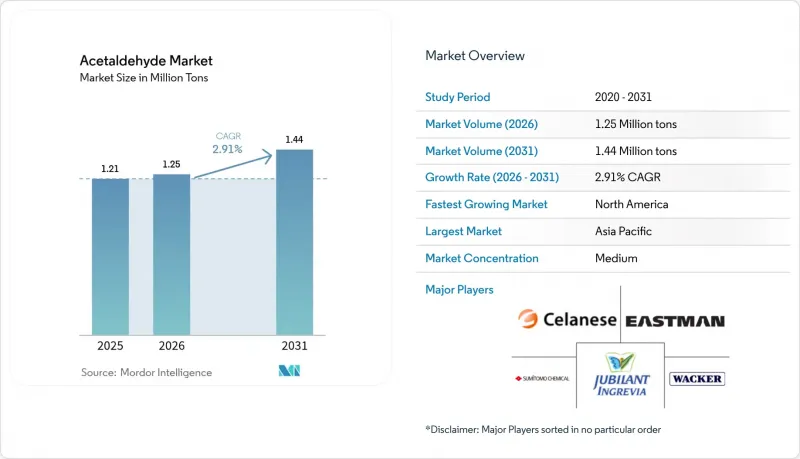
본 보고서는 유도체별(피리딘 및 피리딘 염기, 펜타에리트리톨,아세트산, 아세트산 에스테르 등), 최종 사용자 산업별(접착제, 식품 및 음료, 페인트 및 코팅, 의약품, 기타 최종 사용자 산업), 지역별(아시아태평양, 북미, 유럽, 남미, 중동 및 아프리카)로 분류되어 있습니다. 시장 예측은 수량(톤) 단위로 제시되어 있습니다.
세계의 아세트알데히드 시장 동향 및 인사이트
알키드 수지 및 UV 경화형 수지에서의 펜타에리트리톨 활용 확대
도료 제조업체들은 아세트알데히드에서 제조된 펜타에리트리톨을 원료로 하는 알키드 수지 및 UV 경화형 수지 시스템으로 전환하고 있습니다. 이러한 수지는 유럽연합(EU)이 정한 리터당 50g 미만의 휘발성 유기 화합물(VOC) 제한치를 충족합니다. UV 경화형 도료는 용매 손실 없이 경화되기 때문에 자동차 및 전자 분야에서 수요가 증가하고 있습니다. 바이오 유래 펜타에리트리톨은 수명 주기 동안 배출량을 최대 30%까지 줄일 수 있어, 지속가능성을 중시하는 브랜드에서 가격 프리미엄을 얻을 수 있습니다. 아시아태평양에서는 지속적인 건설 활동으로 소비가 주도되고 있지만, 유럽의 REACH 규제로 인해 저배출 원료의 사용이 촉진되고 있습니다. 그 결과, 펜타에리트리톨의 성장이 아세트알데히드 시장에 대한 추가적인 수요를 보장하고 있습니다.
저VOC 용제 블렌드에서 아세트산 에스테르 수요 증가
에틸 아세테이트, 부틸 아세테이트, 프로파일 아세테이트는 아세트알데히드에서 아세트산을 경유하여 생성되며, 도료, 잉크, 접착제에서 보다 안전한 용매로 기능합니다. EU의 용제 배출 지침 및 캘리포니아주 규정 1113호 등의 규제 체계에 따라, 배합 제조업체들은 방향족 화합물을 아세트산 에스테르로 대체해야 하는 압박을 받고 있습니다. 플렉소 인쇄 업체에서는 에틸 아세테이트가 깨끗하게 휘발되고 독성이 낮다는 점 때문에 그 채택이 진행되고 있습니다. 중국에서는 에스테르화 용도로 할당된 아세트산의 생산 능력을 지속적으로 확대하여 지역 내 공급을 뒷받침하고 있습니다. 북미에서는 에탄올 원료 비용 상승에도 불구하고 2025년에 수요가 회복되며 하류 시장의 회복력을 보여주었습니다. 수직 통합형 생산자는 범용 아세트알데히드만을 판매하는 무역사보다 높은 이익률을 확보하고 있습니다.
발암성 물질의 재분류 및 작업장 노출 한계치 강화
국제암연구소(IARC)는 아세트알데히드를 그룹 2B로 분류하고 있으며, 이에 따라 규제 당국은 노출 한계치를 하향 조정하고 있습니다. ACGIH는 2024년에 상한치를 25 ppm으로 설정했으며, 미국의 일부 주에서는 더욱 엄격한 기준치 도입이 검토되고 있습니다. 향료 및 방부제 배합 제조업체들은 규정 준수 비용을 피하기 위해 제품의 재배합이나 대체 원료로의 전환을 추진하고 있습니다. 산업 사용자들은 폐쇄형 루프 시스템이나 증기 회수 장치에 투자하고 있으며, 이로 인해 고정비가 증가하여 중소기업에 부담이 가중되고 있습니다.
부문 분석
아세트산은 2025년 총량의 28.12%를 차지했으며, 아세트알데히드 시장에서 가장 큰 단일 용도로서의 입지를 공고히 했습니다. 피리딘 및 피리딘 염기와 관련된 아세트알데히드 시장 규모는 농약 및 의약품 제조업체의 아세트알데히드-암모니아 삼량체 중간체에 대한 수요 증가에 힘입어 2031년까지 연평균 성장률(CAGR) 3.78%를 나타낼 것으로 예측됩니다.
펜타에리트리톨은 2위를 차지하고 있으며, 이는 코팅 시장의 성장을 반영합니다. 한편, 아세트산 에스테르는 저VOC 용매에 대한 수요에 힘입어 증가하고 있습니다. 부틸렌글리콜은 틈새 시장에 머물러 있으며, 바이오 발효 경로가 경쟁하는 화장품 분야에서 사용되고 있습니다. 과아세트산은 염소에 비해 규제상 우위를 점하고 있어 식품 위생 분야에서 성장하고 있습니다.
지역별 분석
2025년, 아시아태평양은 전 세계 생산량의 57.25%를 차지한 것으로 평가되었으며, 그 중심에는 중국의 연간 1,081만 톤 규모의 아세트산 생산 능력이 있습니다. 2026년에 가동될 예정인 신규 플랜트는 이익률이 하락하고 있음에도 불구하고 생산 규모 확대가 지속되고 있음을 보여줍니다. 인도에서는 의약품 및 농약 분야에 대한 투자로 아세트알데히드 수요가 증가하고 있으며, 락슈미 오가닉(Lakshmi Organic)과 옐로우스톤 송진화학스(Yellowstone Fine Chemicals)의 합병 등은 원료의 안정적인 확보를 목적으로 한 업계 재편 추세를 여실히 보여주고 있습니다.
북미는 2026-2031년 연평균 성장률(CAGR) 3.13%를 기록할 전망이며, 지역별로는 가장 높은 성장 속도를 보일 것으로 예측됩니다. 에탄이 풍부하게 포함된 원료와 청정 에너지 세액 공제를 포함한 정책 지원이 여러 확장 프로젝트를 뒷받침하고 있습니다. 세레네즈(Selenese)는 2024년 3월 130만 톤 규모의 아세트산 생산 능력 확충을 시작했으며, 해당 지역에 병설된 에틸렌 크래커 덕분에 이를 세계 최저 탄소 배출량을 자랑하는 플랜트로 자리매김하고 있습니다.
유럽에서는 나프타 유래 에틸렌의 높은 원가가 여전히 과제로 남아 있지만, 재생에너지를 활용한 경로를 통해 경쟁력 향상을 도모하고 있습니다. 2024년에 인증을 획득한 세카브(Sekab)사의 목재 셀룰로오스 유래 아세트알데히드 생산 라인은 이러한 전환을 상징하는 사례입니다. 남미에서는 사탕수수 유래 에탄올을 활용하고 있지만, 하류 아세트알데히드 생산 능력에 대한 대규모 투자를 하는 대신 여전히 가공되지 않은 원료를 수출하고 있습니다. 중동의 생산자들은 PdO 촉매 기술에 주목하고 있습니다. 풍부한 에탄을 활용하면, 이 기술이 상용화될 경우 비용 측면에서 우위를 점할 가능성이 있기 때문입니다.
기타 혜택 :
- 엑셀 형식 시장 예측(ME) 시트
- 3개월간의 애널리스트 지원
자주 묻는 질문
목차
제1장 서론
제2장 조사 방법
제3장 주요 요약
제4장 시장 구도
제5장 시장 규모 및 성장 예측
제6장 경쟁 구도
제7장 시장 기회 및 향후 전망
AJY 26.09.09According to Mordor Intelligence, the acetaldehyde market size is projected to expand from 1.21 million tons in 2025 and 1.25 million tons in 2026 to 1.44 million tons by 2031, registering a CAGR of 2.91% between 2026 to 2031.
This report is Segmented by Derivative (Pyridine and Pyridine Bases, Pentaerythritol, Acetic Acid, Acetate Esters, and More), End-User Industry (Adhesives, Food and Beverage, Paints and Coatings, Pharmaceuticals, and Other End-User Industries), and Geography (Asia-Pacific, North America, Europe, South America, and Middle East and Africa). Market Forecasts are Provided in Terms of Volume (Tons).
Global Acetaldehyde Market Trends and Insights
Expanding Pentaerythritol Use in Alkyd and UV-Curable Resins
Coatings makers are shifting toward alkyd and UV-curable systems that rely on pentaerythritol produced from acetaldehyde. These resins meet volatile-organic-compound limits below 50 g per liter in the European Union. UV-curable finishes cure without solvent loss, so demand rises in automotive and electronics. Bio-based pentaerythritol can cut lifecycle emissions by up to 30% and earns pricing premiums in sustainability-focused brands. Asia-Pacific leads consumption because of ongoing construction activity, while Europe's REACH rules encourage lower-emission feedstocks. As a result, pentaerythritol growth secures additional pull for the acetaldehyde market.
Growing Acetate-Ester Demand in Low-VOC Solvent Blends
Ethyl, butyl, and propyl acetates come from acetaldehyde via acetic acid and serve as safer solvents in paints, inks, and adhesives. Regulatory frameworks such as the EU Solvent Emissions Directive and California Rule 1113 push formulators to replace aromatics with acetate esters. Flexographic printers are adopting ethyl acetate because it evaporates cleanly and has low toxicity. China keeps adding acetic-acid capacity earmarked for esterification, supporting intra-regional supply. North American demand rebounded in 2025 despite higher ethanol feed costs, showing the resilience of downstream value. Forward-integrated producers capture higher margins than merchants who only sell commodity acetaldehyde.
Carcinogenic Re-Classification and Tighter Workplace Exposure Limits
The International Agency for Research on Cancer lists acetaldehyde as Group 2B, prompting regulators to lower exposure limits. ACGIH set a ceiling value of 25 ppm in 2024, and several U.S. states consider stricter thresholds. Formulators in flavors and preservatives are reformulating or substituting to avoid compliance costs. Industrial users invest in closed-loop systems and vapor recovery, increasing fixed costs and pressuring smaller firms.
Other drivers and restraints analyzed in the detailed report include:
- Breakthrough Ethane-to-Acetaldehyde PdO Catalysis
- Circular PET De-Aldehyde Upgrades Raising Bottle-Grade Quality Bar
- Ethylene Price Volatility Squeezing Wacker-Process Margins
For complete list of drivers and restraints, kindly check the Table Of Contents.
Segment Analysis
Acetic acid captured 28.12% of the 2025 volume, confirming its position as the largest single outlet within the acetaldehyde market share. The acetaldehyde market size linked to pyridine and pyridine bases is projected to widen at a 3.78% CAGR through 2031 as agrochemical and pharmaceutical producers scale demand for acetaldehyde-ammonia trimer intermediates.
Pentaerythritol ranks second and mirrors coatings growth, while acetate esters rise on the pull from low-VOC solvents. Butylene glycol stays niche, serving cosmetics where bio-based fermentation routes compete. Peracetic acid grows in food sanitation, benefiting from a favorable regulatory status relative to chlorine.
Complete Report Scope:
- By Derivative
- Pyridine and Pyridine Bases
- Pentaerythritol
- Acetic Acid
- Acetate Esters
- Butylene Glycol
- Other Derivatives (Chloral, Peracetic Acid, etc.)
- By End-User Industry
- Adhesives
- Food and Beverage
- Paints and Coatings
- Pharmaceuticals
- Other End-user Industries (Water Treatment, Plastics, Rubber, Fuel Additives, etc.)
- By Geography
- Asia-Pacific
- China
- India
- Japan
- South Korea
- Rest of Asia-Pacific
- North America
- United States
- Canada
- Mexico
- Europe
- Germany
- United Kingdom
- France
- Italy
- Spain
- Russia
- NORDIC
- Turkey
- Rest of Europe
- South America
- Brazil
- Argentina
- Rest of South America
- Middle-East and Africa
- Saudi Arabia
- South Africa
- Rest of Middle-East and Africa
- Asia-Pacific
Geography Analysis
Asia-Pacific accounted for 57.25% of global volume in 2025, anchored by China's 10.81 million-ton annual acetic-acid capacity. New units scheduled for 2026 indicate continuing scale additions despite thinner margins. India's acetaldehyde demand is rising due to pharmaceutical and agrochemical investments, and mergers such as Laxmi Organic with Yellowstone Fine Chemicals highlight consolidation aimed at feedstock security.
North America is forecast to register the fastest regional pace at 3.13% CAGR from 2026-2031. Ethane-rich feedstock and policy support, including clean-energy tax credits, underpin several expansion projects. Celanese started a 1.3 million-ton acetic acid addition in March 2024 and positions it as the lowest-carbon unit globally, courtesy of co-located ethylene crackers.
Europe remains challenged by high naphtha-based ethylene costs but pursues competitiveness through renewable routes. Sekab's wood-cellulose acetaldehyde line, certified in 2024, exemplifies the pivot. South America leverages sugarcane ethanol yet continues to export raw feedstock rather than investing heavily in downstream acetaldehyde capacity. Middle East producers monitor PdO catalysis because abundant ethane could unlock a cost advantage once the technology scales.
- Arkema S.A
- Celanese Corporation
- Daicel Corporation
- Eastman Chemical Company
- INEOS Group Ltd.
- Jubilant Ingrevia Limited
- Laxmi Organic Industries Ltd.
- LCY
- Lonza
- Merck KGaA
- Resonac Corporation
- Sekab
- Sumitomo Chemical Co., Ltd.
- Wacker Chemie AG
Additional Benefits:
- The market estimate (ME) sheet in Excel format
- 3 months of analyst support
TABLE OF CONTENTS
1 Introduction
- 1.1 Study Assumptions and Market Definition
- 1.2 Scope of the Study
2 Research Methodology
3 Executive Summary
4 Market Landscape
- 4.1 Market Overview
- 4.2 Market Drivers
- 4.2.1 Expanding pentaerythritol use in alkyd and UV-curable resins
- 4.2.2 Growing acetate-ester demand in low-VOC solvent blends
- 4.2.3 Breakthrough ethane-to-acetaldehyde PdO catalysis
- 4.2.4 Circular PET de-aldehyde upgrades raising bottle-grade quality bar
- 4.2.5 Bio-ethanol derived acetaldehyde for low-carbon supply chains
- 4.3 Market Restraints
- 4.3.1 Carcinogenic re-classification and tighter workplace exposure limits
- 4.3.2 Ethylene price volatility squeezing Wacker-process margins
- 4.3.3 On-site formaldehyde generation replacing acetaldehyde in disinfectants
- 4.4 Value Chain Analysis
- 4.5 Porter's Five Forces
- 4.5.1 Threat of New Entrants
- 4.5.2 Bargaining Power of Suppliers
- 4.5.3 Bargaining Power of Buyers
- 4.5.4 Threat of Substitutes
- 4.5.5 Degree of Competition
5 Market Size and Growth Forecasts (Volume)
- 5.1 By Derivative
- 5.1.1 Pyridine and Pyridine Bases
- 5.1.2 Pentaerythritol
- 5.1.3 Acetic Acid
- 5.1.4 Acetate Esters
- 5.1.5 Butylene Glycol
- 5.1.6 Other Derivatives (Chloral, Peracetic Acid, etc.)
- 5.2 By End-User Industry
- 5.2.1 Adhesives
- 5.2.2 Food and Beverage
- 5.2.3 Paints and Coatings
- 5.2.4 Pharmaceuticals
- 5.2.5 Other End-user Industries (Water Treatment, Plastics, Rubber, Fuel Additives, etc.)
- 5.3 By Geography
- 5.3.1 Asia-Pacific
- 5.3.1.1 China
- 5.3.1.2 India
- 5.3.1.3 Japan
- 5.3.1.4 South Korea
- 5.3.1.5 Rest of Asia-Pacific
- 5.3.2 North America
- 5.3.2.1 United States
- 5.3.2.2 Canada
- 5.3.2.3 Mexico
- 5.3.3 Europe
- 5.3.3.1 Germany
- 5.3.3.2 United Kingdom
- 5.3.3.3 France
- 5.3.3.4 Italy
- 5.3.3.5 Spain
- 5.3.3.6 Russia
- 5.3.3.7 NORDIC
- 5.3.3.8 Turkey
- 5.3.3.9 Rest of Europe
- 5.3.4 South America
- 5.3.4.1 Brazil
- 5.3.4.2 Argentina
- 5.3.4.3 Rest of South America
- 5.3.5 Middle-East and Africa
- 5.3.5.1 Saudi Arabia
- 5.3.5.2 South Africa
- 5.3.5.3 Rest of Middle-East and Africa
- 5.3.1 Asia-Pacific
6 Competitive Landscape
- 6.1 Market Concentration
- 6.2 Strategic Moves
- 6.3 Market Share(%)/Ranking Analysis
- 6.4 Company Profiles (includes Global Overview, Market Overview, Core Segments, Financials, Strategic Information, Products and Services, Recent Developments)
- 6.4.1 Arkema S.A
- 6.4.2 Celanese Corporation
- 6.4.3 Daicel Corporation
- 6.4.4 Eastman Chemical Company
- 6.4.5 INEOS Group Ltd.
- 6.4.6 Jubilant Ingrevia Limited
- 6.4.7 Laxmi Organic Industries Ltd.
- 6.4.8 LCY
- 6.4.9 Lonza
- 6.4.10 Merck KGaA
- 6.4.11 Resonac Corporation
- 6.4.12 Sekab
- 6.4.13 Sumitomo Chemical Co., Ltd.
- 6.4.14 Wacker Chemie AG
7 Market Opportunities and Future Outlook
- 7.1 White-space and Unmet-Need Assessment


