

|
시장보고서
상품코드
2121876
폴리아크릴아미드 시장 : 시장 점유율 분석, 업계 동향 및 통계, 성장 예측(2026-2031년)Polyacrylamide - Market Share Analysis, Industry Trends & Statistics, Growth Forecasts (2026 - 2031) |
||||||
 Mordor Intelligence
Mordor Intelligence에 의하면, 폴리아크릴아미드 시장 규모는 2025년 232만 톤으로 평가되었고, 2026년에는 245만 톤으로 추정되고, 2031년까지 325만 톤에 이를 것으로 예측되며, 2026-2031년 CAGR 5.81%로 성장할 전망입니다.
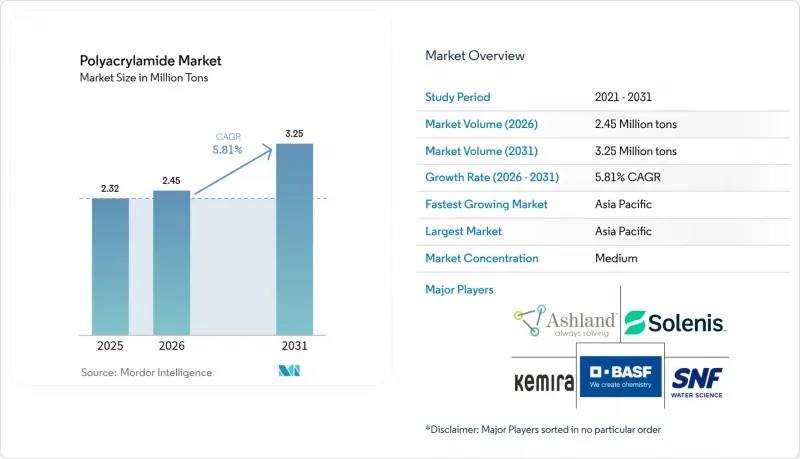
본 보고서는 물리적 형태별(분말, 액체, 에멀젼/분산액), 용도별(석유 증산 회수, 수처리용 응집제, 토양 개량제 등), 최종 사용자 산업별(수처리, 석유 및 가스,펄프·제지 등) 및 지역별(아시아태평양, 북미, 유럽, 남미, 중동 및 아프리카)로 분류되어 있습니다. 시장 예측은 수량(톤) 기준으로 제시되어 있습니다.
세계의 폴리아크릴아미드 시장 동향 및 인사이트
석유 증산 회수(EOR) 분야에서의 활용 확대
현재 폴리머 플러딩은 더 깊고, 고온이며, 염분 농도가 높은 저류층을 대상으로 하고 있으며, 이에 따라 표준 가수분해 폴리아크릴아미드에서 120°C 이상 및 200,000 ppm의 염분 농도에서도 안정적인 ATBS 공중합체 블렌드로의 전환이 진행되고 있습니다. 국영 석유 회사들은 새로운 탐사를 진행하지 않고도 회수율을 5%-15% 향상시킬 수 있기 때문에 EOR을 선호하고 있습니다. 폴리아크릴아미드에 크롬이나 유기 가교제를 조합한 선택적 겔 배치 기술을 통해 수분 비율을 더욱 낮추고, 유정의 수명을 연장하며, 폐정 비용을 미룰 수 있게 됩니다. 이 두 가지 경로를 통해 회수 배럴당 폴리머 수요가 증가하고, 초고분자량 등급의 가치가 높아질 것으로 예측됩니다. 그 결과, 폴리아크릴아미드 시장에서 EOR의 점유율은 다른 어떤 용도보다 빠르게 상승하고 있으며, 공급업체의 제품 포트폴리오는 수익성이 높은 특수 제품으로 재편되고 있습니다.
도시 및 산업 폐수 처리에서의 응집제 수요 증가
EU의 도시 하수 처리 지침에 따라 3차 처리 대상 기준이 인구 환산 1만 명에서 1,000명으로 하향 조정됨에 따라, 침전조 및 원심분리기의 광범위한 교체가 시급해졌습니다. 도시 지역의 바이오솔리드에는 일반적으로 전하 밀도 40%-60%의 양이온성 폴리아크릴아미드가 사용되지만, 아시아의 섬유 공장 폐수에서는 음이온성 염료를 포집하기 위해 80%의 전하 밀도가 필요합니다. 인도의 중앙공해관리위원회는 시멘트 가마에서의 공동 처리에 사용되는 슬러지에 대해 2026년까지 함수율을 20% 미만으로 억제할 것을 의무화하고 있으며, 이에 따라 폴리머 투여량은 건조 톤당 5kg 이상으로 증가하고 있습니다. 또한, 중국에서 도시 슬러지의 소각 또는 열분해를 추진하기 위해서는 고형분 40%를 달성해야 하는데, 이 기준은 고용량의 폴리아크릴아미드 처리를 통해서만 달성할 수 있습니다. 전 세계의 조달 기관들은 실적 기반 계약으로 전환하고 있으며, 과다 투여에 따른 벌금을 피하면서 탈수 목표를 달성할 수 있는 폴리머를 공급하도록 공급업체에 압력을 가하고 있습니다.
잔류 아크릴아미드 단량체에 대한 건강 및 발암성 우려
WHO는 아크릴아마이드를 ‘인체에 발암성이 의심되는 물질’로 지정하고 있는 반면, ATSDR은 일일 0.5 mg/kg을 초과하는 만성 노출 시 신경 독성을 지적하고 있습니다. 미국 환경보호청(EPA)은 식수 처리에 사용되는 폴리머 내 잔류 모노머를 0.05%로 제한하고, 투여량을 1 mg/l로 제한하고 있습니다. 이러한 제한을 충족하려면 진공 증류 또는 반응성 침전 스트립 장비가 필요하며, 이로 인해 생산 비용이 톤당 200-400달러 증가합니다. NSF/ANSI 60에 따라 인증된 프리미엄 등급은 현재 10%-20%의 가격 프리미엄이 붙어 있으며, 폴리아크릴아미드 시장은 인증 제품과 비인증 제품이라는 두 가지 계층으로 나뉘어 있습니다. 규격에 부합하지 않는 출하 제품은 이미 호주 및 뉴질랜드에서 반입이 거부되고 있으며, 이로 인해 수입업체들은 공급업체에 인증서 제시를 요구하고 있습니다.
부문 분석
2025년, 분말 등급은 폴리아크릴아미드 시장 점유율의 43.80%를 차지했으며, 기존 용해 탱크를 보유하고 있는 가격에 민감한 지자체 및 광업 고객에게 공급되고 있습니다. 에멀젼 제제는 일반적으로 30%-40%의 유효 고형분을 함유하고 있으며, 5분 이내에 용해될 뿐만 아니라 분진 노출을 방지합니다. 이는 2024년 OSHA가 아크릴아미드 분진의 허용 한도를 0.03 mg/m3로 낮춘 데 따른 결정적인 이점입니다. 이 부문은 2031년까지 연평균 6.12%의 성장률을 보일 것으로 예상되며, 광업 및 해양 플랫폼에서 자동화 및 실시간 투여가 보편화됨에 따라 폴리아크릴아미드 시장에서 그 점유율을 확대해 나갈 것으로 전망됩니다.
에멀젼 제품은 분말 제품에 비해 10%-20%의 가격 프리미엄이 있지만, 인건비, 용해 에너지 및 과다 투여로 인한 손실을 줄일 수 있으므로 대부분의 경우 총 소유 비용을 절감할 수 있습니다. SNF사가 2024년 호주 라라에서 진행한 확장 공사를 통해 광업 수요에 대응하기 위해 연간 5,000톤의 에멀젼 생산 능력이 추가되었습니다. 이는 공급업체들이 이러한 변화에 주목하고 있음을 반영합니다. 고형분 10%-15%의 액상 등급은 보관의 편의성을 중시하는 화장품 업계나 소규모 폐수 처리 시설용입니다. 아시아태평양 및 라틴아메리카의 기존 분말 사용자들은 여전히 톤당 2,000달러 미만의 가격을 선호하지만, 안전 및 생산성 기준이 엄격해짐에 따라 분말의 우위는 약화되고, 더 안전하고 신속하게 용해되는 형태로 전환될 것입니다.
지역별 분석
아시아태평양은 2025년에 폴리아크릴아미드 시장 점유율의 49.95%를 차지했으며, 반도체 산업의 확대, 1,600만 톤 규모의 신규 컨테이너 보드 생산 능력, 그리고 인도네시아, 말레이시아, 태국 내 배터리 공급망에 대한 투자에 힘입어 2031년까지 연평균 6.25% 성장할 전망입니다. 중국에서는 2025년에 5,500만 톤의 도시 하수 슬러지가 발생하여 탈수용 폴리머 수요를 견인했습니다. 한편, 인도의 ‘스와치 바라트 2.0’ 계획은 2026년까지 슬러지 완전 처리를 목표로 하고 있으며, 5kg/t을 초과하는 양이온성 폴리머의 사용을 장려하고 있습니다. 일본, 한국, 싱가포르에서는 폴리머 입자 배출 기준안이 마련되어 있어, 이것이 지역 전체의 제품 인증 요건을 재구성할 가능성이 있습니다.
북미에서는 다양한 추세가 나타나고 있습니다. 2025년에는 수압 파쇄(하이드로프랙처링) 과정에서 7만 5,000톤의 폴리아크릴아미드가 소비되었으며, SNF 등 공급업체는 셰일 산업 및 지자체 고객에 대한 공급 수요에 대응하기 위해 루이지애나주에서 모노머·폴리머 통합 생산 능력을 확대했습니다. 그래픽 용지 공장 폐쇄 및 포장용지로의 전환에 따라 펄프·용지용 폴리머 판매량은 감소했으나, 캘리포니아주와 캐나다의 산업 폐수 처리 시설 개보수 및 미세 플라스틱 규제가 그 감소분을 일부 상쇄했습니다. 저모노머 함유 인증을 받은 등급에는 프리미엄 가격이 책정되어 있으며, 시장은 NSF 인증 유무에 따라 양극화되고 있습니다.
유럽의 성장은 2029년까지 3차 처리 및 미세 플라스틱 모니터링을 의무화하는 지침 2024/3019와 밀접한 관련이 있습니다. 슬러지 탈수용 양이온성 폴리아크릴아미드 수요는 증가하고 있지만, 동시에 진행되고 있는 생분해성 관련 규제로 인해 조달 동향은 하이브리드형 및 바이오 대체품으로 이동하고 있습니다. 케미라(Kemira)와 솔레니스(Solennis)는 시장 점유율을 유지하기 위해 재생 가능 폴리머 생산 능력에 투자하고 있는 반면, 지역별 인센티브는 수명 주기 전반에 걸쳐 우위를 입증할 수 있는 공급업체를 뒷받침하고 있습니다.
기타 혜택 :
- 엑셀 형식 시장 예측(ME) 시트
- 3개월간의 애널리스트 지원
자주 묻는 질문
목차
제1장 서론
제2장 조사 방법
제3장 주요 요약
제4장 시장 구도
제5장 시장 규모 및 성장 예측
제6장 경쟁 구도
제7장 시장 기회 및 향후 전망
AJY 26.09.09According to Mordor Intelligence, the polyacrylamide market size is expected to increase from 2.32 million tons in 2025 to 2.45 million tons in 2026 and reach 3.25 million tons by 2031, growing at a CAGR of 5.81% over 2026-2031.
This report is Segmented by Physical Form (Powder, Liquid, and Emulsion/Dispersions), Application (Enhanced Oil Recovery, Flocculants for Water Treatment, Soil Conditioner, and More), End-User Industry (Water Treatment, Oil and Gas, Pulp and Paper, and More), and Geography (Asia-Pacific, North America, Europe, South America, and Middle-East and Africa). The Market Forecasts are Provided in Terms of Volume (Tons).
Global Polyacrylamide Market Trends and Insights
Growing Utilization in Enhanced Oil Recovery
Polymer flooding now targets deeper, hotter, and saltier reservoirs, prompting a pivot from standard hydrolyzed polyacrylamide to ATBS-copolymer blends stable above 120°C and at 200,000 ppm salinity. National oil companies favor EOR because it lifts recovery factors by 5%-15% without frontier exploration. Selective gel-placement technologies that pair polyacrylamide with chromium or organic cross-linkers further reduce water cut, extend well life, and defer abandonment costs. These dual pathways are expected to raise polymer demand per barrel recovered and reinforce the value of ultra-high-molecular-weight grades. Consequently, EOR's share of the polyacrylamide market is climbing faster than any other application, reshaping supplier portfolios toward higher-margin specialty products.
Rising Demand for Flocculants in Municipal & Industrial Wastewater Treatment
The EU Urban Wastewater Treatment Directive lowered the tertiary-treatment threshold from 10,000 to 1,000 population equivalents, compelling widespread clarifier and centrifuge upgrades. Municipal biosolids typically rely on cationic polyacrylamide at 40%-60% charge density, while Asian textile effluents need 80% charge to capture anionic dyes. India's Central Pollution Control Board requires sludge for cement-kiln co-processing to reach below 20% moisture by 2026, pushing polymer doses above 5 kg per dry tonne. China's drive to incinerate or pyrolyze municipal sludge also hinges on achieving 40% solids, a benchmark attainable only with high-dose polyacrylamide treatment. Global procurement agencies are shifting to performance-based contracts, pressuring suppliers to deliver polymers that hit dewatering targets without overdosing penalties.
Health & Carcinogenicity Concerns Over Residual Acrylamide Monomer
WHO lists acrylamide as a probable human carcinogen, while ATSDR highlights neurotoxicity at chronic exposures above 0.5 mg/kg day. The US EPA caps residual monomer at 0.05% in polymers used for drinking-water treatment and limits the dose to 1 mg/l. Meeting these limits requires vacuum-distillation or reactive-precipitation stripping units that add USD 200-400/t to production costs. Premium grades certified under NSF/ANSI 60 now command price premiums of 10%-20%, fragmenting the polyacrylamide market between certified and non-certified tiers. Non-compliant shipments have already faced rejections in Australia and New Zealand, prompting importers to demand supplier certification.
Other drivers and restraints analyzed in the detailed report include:
- Expansion of Mining Activities Driving Demand for Sedimentation Aids
- Shift Toward Ultra-High-Molecular-Weight Friction Reducers for Shale Completions
- Rising Preference for Bio-Based Flocculants in Europe
For complete list of drivers and restraints, kindly check the Table Of Contents.
Segment Analysis
Powder grades accounted for 43.80% of the polyacrylamide market share in 2025, serving price-sensitive municipal and mining customers that have existing dissolution tanks. Emulsion formats, typically 30%-40% active solids, dissolve in under five minutes and eliminate dust exposure, a decisive benefit after OSHA cut the permissible acrylamide dust limit to 0.03 mg m-3 in 2024. The segment is forecast to grow at 6.12% annually through 2031, raising its slice of the polyacrylamide market size as automation and real-time dosing spread across mining and offshore platforms.
Emulsions command 10%-20% price premiums over powders but cut labor, dissolution energy, and overdosing losses, often lowering the total cost of ownership. SNF's 2024 expansion in Lara, Australia, added 5,000 t y-1 of emulsion capacity to meet mining demand, reflecting supplier bets on this shift. Liquid grades at 10%-15% solids address cosmetics and small wastewater plants that prioritize storage simplicity. Legacy powder users in Asia-Pacific and Latin America still favor USD <2,000/t pricing, yet as safety and productivity metrics grow stricter, powder's dominance will erode in favor of safer, faster-diluting formats.
Complete Report Scope:
- By Physical Form
- Powder
- Liquid
- Emulsion/Dispersion
- By Application
- Flocculants for Water Treatment
- Enhanced Oil Recovery
- Soil Conditioner
- Binders and Stabilizers in Cosmetics
- Other Applications (Mining & Mineral Processing etc.)
- By End-User Industry
- Water Treatment
- Oil and Gas
- Mining
- Pulp & Paper
- Other End-user Industries (Chemicals & Petrochemicals, etc.)
- By Geography
- Asia-Pacific
- China
- India
- Japan
- South Korea
- Malaysia
- Thailand
- Indonesia
- Vietnam
- Rest of Asia-Pacific
- North America
- United States
- Canada
- Mexico
- Europe
- Germany
- United Kingdom
- France
- Italy
- Spain
- Nordic Countries
- Turkey
- Russia
- Rest of Europe
- South America
- Brazil
- Argentina
- Colombia
- Rest of South America
- Middle East & Africa
- Saudi Arabia
- Qatar
- United Arab Emirates
- Nigeria
- Egypt
- South Africa
- Rest of Middle-East and Africa
- Asia-Pacific
Geography Analysis
Asia-Pacific held 49.95% of the polyacrylamide market share in 2025 and will grow at 6.25% through 2031, buoyed by semiconductor expansion, 16 million t of new containerboard capacity, and battery supply-chain investments in Indonesia, Malaysia, and Thailand. China produced 55 million wet tons of municipal sludge in 2025, driving dewatering polymer demand, while India's Swachh Bharat 2.0 targets full sludge processing by 2026, spurring cationic doses above 5 kg/t. Japan, South Korea, and Singapore are drafting polymer-particle discharge limits that could reshape product certification requirements region-wide.
North America shows divergent patterns: hydraulic fracturing consumed 75,000 t of polyacrylamide in 2025, and suppliers such as SNF ramped up integrated monomer-polymer capacity in Louisiana to serve shale and municipal clients. Pulp-paper polymer volumes slid as graphic mills closed or shifted to packaging, but industrial wastewater upgrades and microplastic regulations in California and Canada partially offset the decline. Certified low-monomer grades command premiums, segmenting the market along NSF accreditation lines.
Europe's growth is tied to Directive 2024/3019, which forces tertiary treatment and microplastic monitoring by 2029. Cationic polyacrylamide demand is climbing for sludge dewatering, yet parallel biodegradability mandates are steering procurement toward hybrid and bio-based alternatives. Kemira and Solenis are investing in renewable-polymer capacity to retain share, while regional incentives favor suppliers with demonstrable life-cycle advantages.
- AnHui JuCheng Fine Chemicals Co. Ltd
- Anhui Tianrun Chemical Industry Co. Ltd
- Ashland
- BASF
- Beijing Hengju Chemical Group Co. Ltd
- Beijing Xitao Technology Development Co. Ltd
- CHINAFLOC
- Envitech Chemical Specialities Pvt. Ltd
- Kemira
- Liaocheng Yongxing Environmental Protection Science & Technology Co. Ltd
- Qingdao Oubo Chemical Co. Ltd
- Shandong Tongli Chemical Co. Ltd
- SNF
- Solenis
- Syensqo
- Universal Fine Chemicals SPC
- Yixing Cleanwater Chemicals Co. Ltd
Additional Benefits:
- The market estimate (ME) sheet in Excel format
- 3 months of analyst support
TABLE OF CONTENTS
1 Introduction
- 1.1 Study Assumptions & Market Definition
- 1.2 Scope of the Study
2 Research Methodology
3 Executive Summary
4 Market Landscape
- 4.1 Market Overview
- 4.2 Market Drivers
- 4.2.1 Growing utilisation in enhanced oil recovery (EOR)
- 4.2.2 Rising demand for flocculants in municipal & industrial wastewater treatment
- 4.2.3 Expansion of mining activities driving demand for sedimentation aids
- 4.2.4 Shift toward ultra-high-molecular-weight friction reducers for shale completions
- 4.2.5 Surge in demand for biodegradable PAM grades in precision agriculture
- 4.3 Market Restraints
- 4.3.1 Health & carcinogenicity concerns over residual acrylamide monomer
- 4.3.2 Rising preference for bio-based flocculants in Europe
- 4.3.3 Growing regulatory pressure on polymer micro-particle discharge into surface waters
- 4.4 Value Chain Analysis
- 4.5 Porter's Five Forces
- 4.5.1 Bargaining Power of Suppliers
- 4.5.2 Bargaining Power of Buyers
- 4.5.3 Threat of New Entrants
- 4.5.4 Threat of Substitutes
- 4.5.5 Competitive Rivalry
5 Market Size & Growth Forecasts (Volume)
- 5.1 By Physical Form
- 5.1.1 Powder
- 5.1.2 Liquid
- 5.1.3 Emulsion/Dispersion
- 5.2 By Application
- 5.2.1 Flocculants for Water Treatment
- 5.2.2 Enhanced Oil Recovery
- 5.2.3 Soil Conditioner
- 5.2.4 Binders and Stabilizers in Cosmetics
- 5.2.5 Other Applications (Mining & Mineral Processing etc.)
- 5.3 By End-User Industry
- 5.3.1 Water Treatment
- 5.3.2 Oil and Gas
- 5.3.3 Mining
- 5.3.4 Pulp & Paper
- 5.3.5 Other End-user Industries (Chemicals & Petrochemicals, etc.)
- 5.4 By Geography
- 5.4.1 Asia-Pacific
- 5.4.1.1 China
- 5.4.1.2 India
- 5.4.1.3 Japan
- 5.4.1.4 South Korea
- 5.4.1.5 Malaysia
- 5.4.1.6 Thailand
- 5.4.1.7 Indonesia
- 5.4.1.8 Vietnam
- 5.4.1.9 Rest of Asia-Pacific
- 5.4.2 North America
- 5.4.2.1 United States
- 5.4.2.2 Canada
- 5.4.2.3 Mexico
- 5.4.3 Europe
- 5.4.3.1 Germany
- 5.4.3.2 United Kingdom
- 5.4.3.3 France
- 5.4.3.4 Italy
- 5.4.3.5 Spain
- 5.4.3.6 Nordic Countries
- 5.4.3.7 Turkey
- 5.4.3.8 Russia
- 5.4.3.9 Rest of Europe
- 5.4.4 South America
- 5.4.4.1 Brazil
- 5.4.4.2 Argentina
- 5.4.4.3 Colombia
- 5.4.4.4 Rest of South America
- 5.4.5 Middle East & Africa
- 5.4.5.1 Saudi Arabia
- 5.4.5.2 Qatar
- 5.4.5.3 United Arab Emirates
- 5.4.5.4 Nigeria
- 5.4.5.5 Egypt
- 5.4.5.6 South Africa
- 5.4.5.7 Rest of Middle-East and Africa
- 5.4.1 Asia-Pacific
6 Competitive Landscape
- 6.1 Market Concentration
- 6.2 Strategic Moves
- 6.3 Market Share(%)/Ranking Analysis
- 6.4 Company Profiles (includes Global level Overview, Market level overview, Core Segments, Financials as available, Strategic Information, Products & Services, Recent Developments)
- 6.4.1 AnHui JuCheng Fine Chemicals Co. Ltd
- 6.4.2 Anhui Tianrun Chemical Industry Co. Ltd
- 6.4.3 Ashland
- 6.4.4 BASF
- 6.4.5 Beijing Hengju Chemical Group Co. Ltd
- 6.4.6 Beijing Xitao Technology Development Co. Ltd
- 6.4.7 CHINAFLOC
- 6.4.8 Envitech Chemical Specialities Pvt. Ltd
- 6.4.9 Kemira
- 6.4.10 Liaocheng Yongxing Environmental Protection Science & Technology Co. Ltd
- 6.4.11 Qingdao Oubo Chemical Co. Ltd
- 6.4.12 Shandong Tongli Chemical Co. Ltd
- 6.4.13 SNF
- 6.4.14 Solenis
- 6.4.15 Syensqo
- 6.4.16 Universal Fine Chemicals SPC
- 6.4.17 Yixing Cleanwater Chemicals Co. Ltd
7 Market Opportunities & Future Outlook
- 7.1 White-Space & Unmet-Need Assessment


