

|
시장보고서
상품코드
2121880
미생물 배양 : 시장 점유율 분석, 업계 동향과 통계, 성장 예측(2026-2031년)Microbial Culture - Market Share Analysis, Industry Trends & Statistics, Growth Forecasts (2026 - 2031) |
||||||
 Mordor Intelligence
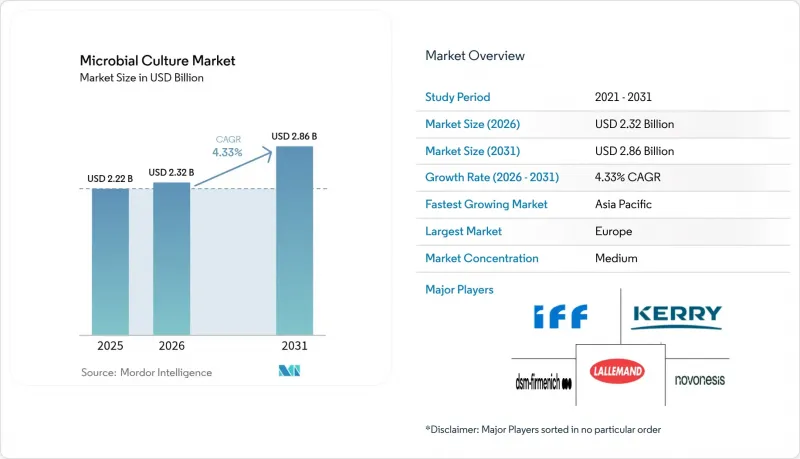
Mordor Intelligence에 의하면, 미생물 배양 시장 규모는 2025년에 22억 2,000만 달러로 평가되었고, 2026년 23억 2,000만 달러에서 2031년까지 28억 6,000만 달러에 이를 것으로 예측되며, 예측 기간(2026-2031년) CAGR은 4.33%를 기록할 전망입니다.
본 보고서는 제품 유형별(세균 배양물, 효모 배양물, 곰팡이/진균 배양물, 혼합/복합 배양물), 용도별(식품 및 음료, 영양보조식품·의약품, 기타), 지역별(북미, 유럽, 아시아태평양, 기타)로 분류되어 있습니다. 시장 전망은 금액(달러) 기준으로 제시되어 있습니다.
세계 미생물 배양 시장 동향 및 인사이트
프로바이오틱스가 풍부하게 함유된 기능성 식품에 대한 수요 증가
장 건강에 초점을 맞춘 제품에 대한 소비자 수요가 유제품 및 음료 제품 구성에 큰 변화를 가져오고 있습니다. 프로바이오틱스가 함유된 요거트와 케피어는 현재 서유럽 소매점의 냉장 유제품 진열대 공간의 40% 이상을 차지하고 있으며, 이는 기능성 식품에 대한 선호도가 높아지고 있음을 반영합니다. 면역 지원에 효과적인 ‘락토바실러스 람노서스 GG’나 소화기 건강에 도움이 되는 ‘비피도박테리움 락티스 HN019’ 등 특정 균주에서 유래한 효능 표시는 보충제에서 일반 식품으로 점차 확대되고 있습니다. 이러한 변화에 따라, 효능을 유지하면서도 저온 살균이나 낮은 pH 환경, 장기 보관을 견딜 수 있는 배양균의 개발이 요구되고 있습니다. 또한, 유산균 공급업체들은 식물 유래 브랜드와 공동 개발 계약을 적극적으로 체결하고 있으며, 귀리,대두, 완두콩 등의 기질을 발효시키면서도 이취가 발생하지 않고, 안정성이 높으며 비용 대비 효과가 뛰어난 균주 개발에 주력하고 있습니다. 건강 지향적인 소비자들 사이에서 식물 유래 제품의 인기가 계속 높아지고 있는 가운데, 이러한 제휴는 매우 중요합니다. EFSA(유럽식품안전청)의 2024년 QPS 목록 업데이트(3종의 새로운 Lactiplantibacillus 속이 추가됨) 등 규제 측면의 진전에 따라, 승인 절차가 효율화되고 유럽 내 신제품 시장 출시 기간이 단축될 것으로 기대되며, 이는 해당 분야의 혁신을 더욱 촉진할 것입니다.
산업용 바이오의약품 발효 능력 확대
세계 바이오의약품 발효 능력은 급속히 확대되고 있으며, 미생물 배양 시장에 현저한 성장을 가져오고 있습니다. 바이오의약품, 백신, 항체 치료제, 재조합 단백질이 제약 파이프라인의 주류를 이루는 가운데, 대규모 미생물 및 포유류 발효는 산업용 바이오프로세스의 핵심 요소로 자리 잡고 있습니다. 2024년, 수탁 개발·제조 기관(CDMO)은 전례 없는 속도로 일회용 바이오리액터의 생산 능력을 확대하여 전 세계적으로 50만 리터 이상의 새로운 교반식 바이오리액터 용량을 추가했습니다. 이 생산 능력의 대부분은 업스트림 공정 생산 워크플로우에 할당되었습니다. 이러한 확장으로 인해 세포 배양 배지에서 필수적인 질소원인 세균 가수분해물, 효모 추출물, 펩톤 등 미생물 유래 원료에 대한 수요가 직접적으로 증가했습니다. 바이오의약품 제조업체들이 생산을 파일럿 규모에서 상업적 규모로 확대함에 따라, 일관되고 고순도의 미생물 배양 원료에 대한 수요가 높아지고 있으며, 이는 배지 성분 및 특수 발효 기질 시장의 성장을 주도하고 있습니다.
엄격한 규제 승인
식품 안전과 의약품 등급 승인 절차의 차이는 특히 소규모 배양 원료 공급업체에게 이중의 규정 준수 과제를 야기하고 있습니다. EFSA의 QPS 프레임워크는 확립된 속의 경우 절차를 간소화하고 있지만, 신규 균주의 경우 여전히 전체 유전체 시퀀싱과 항생제 내성 프로파일링이 요구됩니다. 최근 이 절차는 레코노스톡(Leuconostoc) 속 및 바이셀라(Wisela) 속의 신청 사례에서 18-24개월이 소요되었으며, 30만-50만 유로의 비용이 발생했습니다. 그 결과, 공급업체들은 완전히 새로운 종을 개발하기보다는 승인된 균주의 적용 범위를 넓히는 데 전략적으로 집중하고 있으며, 이로 인해 발효 식물 유래 해산물이나 프로바이오틱스가 함유된 반려동물사료와 같은 새로운 용도에 대응하는 업계의 역량이 제한되고 있습니다. 또한, 일본 후생노동성은 2024년에 수입 배양균에 대한 새로운 추적성 요건을 도입했습니다. 이 규정에 따라 배지에 포함된 모든 원재료에 대해 원산지 증명서 제출이 의무화되었으며, 이로 인해 일본 외 지역 공급업체의 리드타임이 8-12주 연장되고 있습니다.
부문 분석
2025년, 미생물 배양 시장 중 세균 배양이 62.35%를 차지하며, 전통적인 유제품, 채소, 육류 발효에 중요한 역할을 하고 있습니다. 락토바실러스속, 락토코커스속, 연쇄상구균속의 유산균은 치즈와 요거트 제조에 필수적이며, 노보자임(Novozymes)사의 FreshQ 균주는 유럽 유제품 제조업체에서 상당한 시장 침투율을 달성하고 있습니다. 연평균 성장률(CAGR) 6.74%를 나타낼 것으로 예측되며, 베이커리 제품의 클린 라벨 트렌드, 수제 맥주의 풍미 혁신, 그리고 2세대 바이오에탄올의 제품별 역할로 인해 주목을 받고 있습니다.
세균 배양물 시장 규모는 꾸준히 확대될 것으로 예상되지만, 비유제품 및 바이오에탄올로의 응용이 확대됨에 따라 효모 배양물이 시장 점유율의 일부를 차지할 것으로 전망됩니다. 세균, 효모, 곰팡이를 단일 접종으로 통합한 복합 배양물은 식물 유래 유제품 대체품 분야에서 주목받고 있습니다. 이러한 다균주 블렌드는 해당 제품에서 전통적인 식감을 구현하는 데 중요한 역할을 하고 있습니다. 이러한 추세에 따라, 풍미의 일관성을 유지하면서 유제품 및 콩류 유래 기질 모두에 대응할 수 있는 적응성이 높은 파이프라인을 위한 균주 라이브러리에 대한 투자가 촉진되고 있습니다.
지역별 분석
2025년, 유럽은 전체 미생물 배양 시장의 31.65%를 차지했습니다. 이는 파르미지아노 레지아노나 록포르와 같은 전통 치즈에 대해 전통적인 배양균의 사용을 의무화하는 엄격한 원산지 명칭 보호(PDO) 규정에 힘입은 결과입니다. 독일, 프랑스, 이탈리아 3개국이 유럽 수요의 60% 이상을 차지하고 있으며, 이는 치즈 소비량이 많고 가공육 제품에 대한 클린 라벨 요구 사항에 대한 수요가 증가함에 따라 주도되고 있습니다. 또한, 2030년까지 항균제 사용량을 50% 감축하겠다는 EU 그린딜 목표에 따라, 프로바이오틱스 사료 첨가제에 대한 투자도 주목받고 있습니다. 유럽은 성숙한 시장이기 때문에 판매량 증가에는 한계가 있지만, 육류용 생물학적 보호 배양균, 식물 유래 유제품 대체품, 그리고 정밀 발효용 원료 분야에서는 꾸준한 진전이 나타나고 있습니다.
아시아태평양은 중국의 발효 음료 시장 확대, 인도의 요거트 품질 향상을 위한 협동조합 업그레이드 프로그램, 그리고 일본의 발효 식품 전국적 보급 촉진과 같은 요인에 힘입어 2031년까지 연평균 성장률(CAGR) 5.74%를 나타낼 것으로 예측됩니다. 2024년, 중국은 12종의 새로운 국산 균주를 승인하여, 이를 통해 서유럽 국가로부터의 수입 의존도를 낮추고 공급망의 현지화를 도모했습니다. 한편, 인도는 5,000만 달러 규모의 이니셔티브를 시작하여 낙농 협동조합에 배양균 첨가 설비를 도입함으로써, 현재 생산량의 15%를 초과하는 부패로 인한 손실을 해소하기 위해 노력하고 있습니다.
북미는 처방전이 필요한 프로바이오틱스의 길을 열어준 FDA의 ‘생물학적 제제에 관한 지침’에 힘입어, 혁신에 중점을 둔 고부가가치 시장으로 자리매김하고 있습니다. 브라질에서는 가금류 업계가 항생제 미사용 수출을 지원하기 위해 효모 유래 프로바이오틱스의 사용을 확대되고 있습니다. 중동에서는 사우디아라비아의 ‘비전 2030’에 기반한 유제품 산업에 대한 투자가 미생물 배양물 수요를 견인하고 있습니다. 이 지역에서의 성장은 콜드체인의 제약을 해결하기 위해 GMP 기준을 충족하는 배양물과 상온 보관이 가능한 형태를 제공할 수 있는 공급업체에 달려 있습니다.
기타 혜택:
- 엑셀 형식 시장 전망(ME) 시트
- 3개월간의 애널리스트 지원
자주 묻는 질문
목차
제1장 서론
제2장 조사 방법
제3장 주요 요약
제4장 시장 구도
제5장 시장 규모와 성장 예측
제6장 경쟁 구도
제7장 시장 기회와 향후 전망
LSH 26.09.09According to Mordor Intelligence, the microbial culture market size was valued at USD 2.22 billion in 2025 and estimated to grow from USD 2.32 billion in 2026 to reach USD 2.86 billion by 2031, at a CAGR of 4.33% during the forecast period (2026-2031).
This report is Segmented by Product Type (Bacterial Cultures, Yeast Cultures, Mold/Fungal Cultures, and Mixed/Composite Cultures), by Application (Food and Beverages, Dietary Supplements and Pharmaceuticals, and Others), and by Geography (North America, Europe, Asia-Pacific, and More). The Market Forecasts are Provided in Terms of Value (USD).
Global Microbial Culture Market Trends and Insights
Rising demand for probiotic-rich functional foods
Consumer demand for gut-health-focused products is driving significant changes in dairy and beverage portfolios. Probiotic yogurt and kefir now represent over 40% of chilled-dairy shelf space in Western European retailers, reflecting a growing preference for functional foods. Strain-specific claims, such as Lactobacillus rhamnosus GG for immune support and Bifidobacterium lactis HN019 for digestive health, are increasingly transitioning from dietary supplements to mainstream food products. This shift necessitates the development of cultures that can withstand pasteurization, low pH levels, and extended shelf life while maintaining their efficacy. Furthermore, culture suppliers are actively entering co-development agreements with plant-based brands, focusing on creating stable and cost-effective strains capable of fermenting substrates such as oats, soy, or peas without producing off-flavors. These collaborations are critical as plant-based products continue to gain traction among health-conscious consumers. Regulatory developments, such as EFSA's 2024 update to its QPS list, which added three new Lactiplantibacillus species, are expected to streamline the approval process and reduce time-to-market for new product launches in Europe, further supporting innovation in this space .
Expansion of industrial biopharmaceutical fermentation capacity
The global biopharmaceutical fermentation capacity is expanding rapidly, driving significant growth in the microbial cultures market. With biologics, vaccines, antibody therapies, and recombinant proteins dominating pharmaceutical pipelines, large-scale microbial and mammalian fermentation has become a critical component of industrial bioprocessing. In 2024, contract development and manufacturing organizations (CDMOs) increased single-use bioreactor capacity at an unprecedented rate, adding over 500,000 liters of new stirred-tank bioreactor volume globally. A significant portion of this capacity is allocated to upstream production workflows. This expansion has directly increased the demand for microbial-derived inputs, including bacterial hydrolysates, yeast extracts, and peptones, which are essential nitrogen sources in cell-culture media. As biopharmaceutical manufacturers scale production from pilot to commercial levels, their need for consistent, high-purity microbial culture ingredients grows, driving market growth for culture media components and specialized fermentation-grade substrates.
Stringent regulatory approvals
The divergence between food-safety and pharmaceutical-grade approval pathways creates a dual compliance challenge, particularly for smaller culture suppliers. While EFSA's QPS framework simplifies the process for established genera, it still requires whole-genome sequencing and antimicrobial-resistance profiling for novel strains. This process has recently taken 18 to 24 months and incurred costs ranging from EUR 300,000 to EUR 500,000 for submissions of Leuconostoc and Weissella. As a result, suppliers are strategically focusing on extending approved strains rather than developing entirely new species, which restricts the industry's capacity to address emerging applications such as fermented plant-based seafood or probiotic pet foods. Additionally, Japan's Ministry of Health, Labour and Welfare introduced new traceability requirements in 2024 for imported cultures. These regulations require country-of-origin documentation for every raw material in the growth medium, which extends lead times for non-Japanese suppliers by 8 to 12 weeks.
Other drivers and restraints analyzed in the detailed report include:
- Shift toward clean-label natural preservatives in food and beverage industry
- Rapid adoption of precision fermentation for alternative proteins
- High cold-chain dependence drives up logistics complexity and costs
For complete list of drivers and restraints, kindly check the Table Of Contents.
Segment Analysis
Bacterial cultures accounted for 62.35% of the microbial culture market in 2025, playing a key role in traditional dairy, vegetable, and meat fermentations. Lactic acid bacteria from the Lactobacillus, Lactococcus, and Streptococcus genera remain essential for cheese and yogurt production, with Novozymes' FreshQ strains achieving significant market penetration in European dairies. Propionibacterium freudenreichii contributes to extended shelf life and vitamin B12 enrichment, while Leuconostoc and Pediococcus are utilized in localized applications such as sauerkraut and salami production. Yeast cultures, projected to grow at a 6.74% CAGR, are gaining traction due to clean-label trends in bakery products, flavor innovation in craft brewing, and their role in second-generation bioethanol co-products.
The market size for bacterial cultures is expected to grow steadily, however, yeast cultures are anticipated to capture a portion of the market share as non-dairy and bioethanol applications expand. Composite cultures, which integrate bacteria, yeast, and mold in a single inoculation, are gaining prominence in plant-based dairy alternatives. These multi-strain blends are instrumental in achieving traditional mouthfeel in such products. This trend is driving investments in strain libraries toward adaptable pipelines capable of serving both dairy and legume-based substrates while maintaining flavor consistency.
Complete Report Scope:
- By Product Type
- Bacterial Cultures
- Lactic Acid Bacteria
- Propionic Bacteria
- Other Bacteria
- Yeast Cultures
- Mold/Fungal Cultures
- Mixed/Composite Cultures
- Bacterial Cultures
- By Application
- Food and Beverages
- Dairy and Dairy Products
- Meat, Poultry, and Seafood
- Beverages
- Others
- Dietary Supplements and Pharmaceuticals
- Others (Animal Feed and Pet Nutrition, Agriculture)
- Food and Beverages
- By Geography
- North America
- United States
- Canada
- Mexico
- Rest of North America
- Europe
- Germany
- United Kingdom
- France
- Italy
- Spain
- Rest of Europe
- Asia-Pacific
- China
- Japan
- India
- South Korea
- Australia
- Rest of Asia-Pacific
- South America
- Brazil
- Argentina
- Rest of South America
- Middle East and Africa
- Saudi Arabia
- United Arab Emirates
- South Africa
- Rest of Middle East and Africa
- North America
Geography Analysis
Europe accounted for 31.65% of the microbial culture market in 2025, supported by stringent Protected Designation of Origin (PDO) rules that mandate the use of traditional cultures for heritage cheeses such as Parmigiano-Reggiano and Roquefort. Germany, France, and Italy collectively account for over 60% of European demand, driven by high cheese consumption and the increasing demand for clean-label requirements in processed meat products. Investments are also focused on probiotic feed additives, aligning with the EU Green Deal's goal of reducing antimicrobial use by 50% by 2030. Although Europe's mature market limits volume growth, incremental advancements are being observed in bioprotective meat cultures, plant-based dairy alternatives, and precision fermentation inputs.
The Asia-Pacific region is projected to grow at a compound annual growth rate (CAGR) of 5.74% through 2031, driven by factors such as China's expanding fermented-beverage market, India's cooperative upgrade program for yogurt quality, and Japan's nationwide promotion of fermented foods. In 2024, China approved 12 new domestic strains, thereby reducing its reliance on Western imports and localizing its supply chains. Meanwhile, India has launched a USD 50 million initiative to equip dairy cooperatives with culture-dosing equipment, addressing spoilage losses that currently exceed 15% of production.
North America remains a high-value market with a focus on innovation, supported by the FDA's live-biotherapeutic guidance, which paves the way for prescription probiotics. In Brazil, the poultry sector is scaling up the use of yeast-based probiotics to support antibiotic-free exports. In the Middle East, Saudi Arabia's Vision 2030 dairy investments are driving demand for microbial culture. Growth in these regions depends on suppliers capable of providing GMP-grade cultures and ambient-stable formats to address cold-chain limitations.
- Novonesis A/S
- dsm-firmenich
- International Flavors & Fragrances Inc.
- Lallemand Inc.
- Kerry Group plc
- Bioprox
- HiMedia Laboratories
- Biena BioTech GmbH
- CSK Food Enrichment BV
- Mediterranea Biotechnologie s.r.l.
- Angel Yeast Co., Ltd.
- AB Mauri
- Lesaffre
- Sacco System
- Novozymes A/S
- Tate & Lyle PLC
- BioGaia AB
- Probi AB
- Ganeden
- JiangSu Wecare BioTech
Additional Benefits:
- The market estimate (ME) sheet in Excel format
- 3 months of analyst support
TABLE OF CONTENTS
1 INTRODUCTION
- 1.1 Study Assumptions and Market Definition
- 1.2 Scope of the Study
2 RESEARCH METHODOLOGY
3 EXECUTIVE SUMMARY
4 MARKET LANDSCAPE
- 4.1 Market Overview
- 4.2 Market Drivers
- 4.2.1 Rising demand for probiotic-rich functional foods
- 4.2.2 Expansion of industrial biopharmaceutical fermentation capacity
- 4.2.3 Shift toward clean-label natural preservatives in food and beverage industry
- 4.2.4 Rapid adoption of precision fermentation for alternative proteins
- 4.2.5 Carbon-negative bioprocessing incentives in climate policies
- 4.2.6 Rising adoption in agriculture and animal feed
- 4.3 Market Restraints
- 4.3.1 Stringent regulatory approvals
- 4.3.2 Volatility in raw material supply for culture media
- 4.3.3 High risk of batch contamination and product recalls
- 4.3.4 High cold-chain dependence drives up logistics complexity and costs
- 4.4 Supply Chain Analysis
- 4.5 Regulatory and Technological Outlook
- 4.6 Porter's Five Forces Analysis
- 4.6.1 Threat of New Entrants
- 4.6.2 Bargaining Power of Buyers
- 4.6.3 Bargaining Power of Suppliers
- 4.6.4 Threat of Substitutes
- 4.6.5 Intensity of Competitive Rivalry
5 MARKET SIZE AND GROWTH FORECATS (VALUE)
- 5.1 By Product Type
- 5.1.1 Bacterial Cultures
- 5.1.1.1 Lactic Acid Bacteria
- 5.1.1.2 Propionic Bacteria
- 5.1.1.3 Other Bacteria
- 5.1.2 Yeast Cultures
- 5.1.3 Mold/Fungal Cultures
- 5.1.4 Mixed/Composite Cultures
- 5.1.1 Bacterial Cultures
- 5.2 By Application
- 5.2.1 Food and Beverages
- 5.2.1.1 Dairy and Dairy Products
- 5.2.1.2 Meat, Poultry, and Seafood
- 5.2.1.3 Beverages
- 5.2.1.4 Others
- 5.2.2 Dietary Supplements and Pharmaceuticals
- 5.2.3 Others (Animal Feed and Pet Nutrition, Agriculture)
- 5.2.1 Food and Beverages
- 5.3 By Geography
- 5.3.1 North America
- 5.3.1.1 United States
- 5.3.1.2 Canada
- 5.3.1.3 Mexico
- 5.3.1.4 Rest of North America
- 5.3.2 Europe
- 5.3.2.1 Germany
- 5.3.2.2 United Kingdom
- 5.3.2.3 France
- 5.3.2.4 Italy
- 5.3.2.5 Spain
- 5.3.2.6 Rest of Europe
- 5.3.3 Asia-Pacific
- 5.3.3.1 China
- 5.3.3.2 Japan
- 5.3.3.3 India
- 5.3.3.4 South Korea
- 5.3.3.5 Australia
- 5.3.3.6 Rest of Asia-Pacific
- 5.3.4 South America
- 5.3.4.1 Brazil
- 5.3.4.2 Argentina
- 5.3.4.3 Rest of South America
- 5.3.5 Middle East and Africa
- 5.3.5.1 Saudi Arabia
- 5.3.5.2 United Arab Emirates
- 5.3.5.3 South Africa
- 5.3.5.4 Rest of Middle East and Africa
- 5.3.1 North America
6 COMPETITIVE LANDSCAPE
- 6.1 Most Active Companies
- 6.2 Market Positioning Analysis
- 6.3 Company Profiles {(includes Global level Overview, Market level overview, Core Segments, Financials as available, Strategic Information, Market Rank/Share for key companies, Products and Services, and Recent Developments)}
- 6.3.1 Novonesis A/S
- 6.3.2 dsm-firmenich
- 6.3.3 International Flavors & Fragrances Inc.
- 6.3.4 Lallemand Inc.
- 6.3.5 Kerry Group plc
- 6.3.6 Bioprox
- 6.3.7 HiMedia Laboratories
- 6.3.8 Biena BioTech GmbH
- 6.3.9 CSK Food Enrichment BV
- 6.3.10 Mediterranea Biotechnologie s.r.l.
- 6.3.11 Angel Yeast Co., Ltd.
- 6.3.12 AB Mauri
- 6.3.13 Lesaffre
- 6.3.14 Sacco System
- 6.3.15 Novozymes A/S
- 6.3.16 Tate & Lyle PLC
- 6.3.17 BioGaia AB
- 6.3.18 Probi AB
- 6.3.19 Ganeden
- 6.3.20 JiangSu Wecare BioTech


