

|
시장보고서
상품코드
2121884
비스코스 단섬유 : 시장 점유율 분석, 업계 동향과 통계, 성장 예측(2026-2031년)Viscose Staple Fiber - Market Share Analysis, Industry Trends & Statistics, Growth Forecasts (2026 - 2031) |
||||||
 Mordor Intelligence
Mordor Intelligence에 의하면, 2026년 비스코스 단섬유 시장 규모는 651만 톤으로 추정되며, 2025년 619만 톤에서 2031년에는 835만 톤에 이를 것으로 예측됩니다.
또한 2026-2031년 연평균 성장률(CAGR)은 5.11%를 기록할 전망입니다.
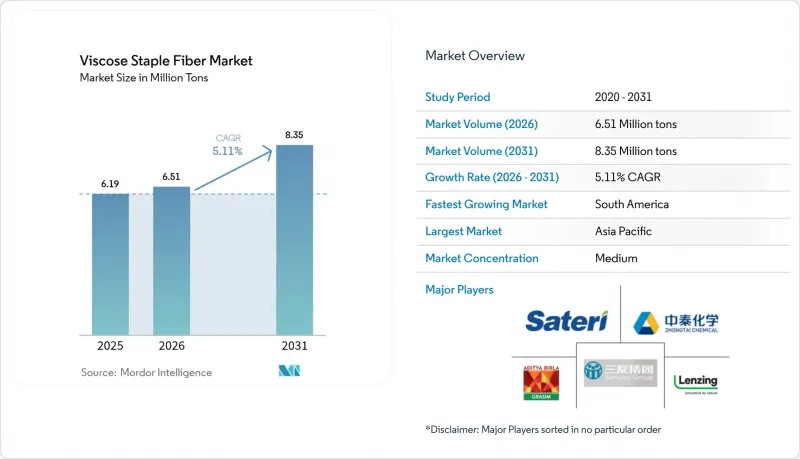
본 보고서는 용도별(직물, 부직포, 특수 용도), 최종 사용자 산업별(섬유 및 의류 제품, 의료 및 헬스케어, 자동차, 산업용 및 기타), 지역별(아시아태평양, 북미, 유럽, 남미, 중동 및 아프리카)로 분류되어 있습니다. 시장 전망은 수량(톤) 기준으로 제시되어 있습니다.
세계 비스코스 단섬유 시장 동향 및 인사이트
의류 및 의류 제품에 대한 수요 증가
세계 의류 소비량은 여전히 증가 추세를 보이고 있으며, 비스코스는 면과 합성섬유 모두로부터 시장 점유율을 계속 빼앗고 있습니다. 소매업체들은 중저가대이면서도 고급스러운 외관을 구현하는 데 도움이 되는 이 섬유의 흡습성, 드레이프성 및 염색성을 높이 평가했습니다. 패스트 패션 체인들은 디자인에서 매장 진열까지의 주기가 단축되는 가운데, 천연섬유와 같은 질감을 재현하기 위해 비스코스를 활용하고 있습니다. 미국의 방적 능력이 제한적이어서 증가한 생산량은 아시아의 방적 공장으로 전환되고 있으며, 이로 인해 지역 간 공급 불균형이 두드러지고 있습니다. 편안함과 합리적인 가격을 새롭게 중시하는 소비자들은 비스코스를 많이 함유한 혼방 소재를 점점 더 많이 선택하고 있으며, 재량 지출이 감소하는 상황에서도 기초적인 수요는 유지되고 있습니다.
면 가격 변동이 비스코스에 호재
2024년, 면화 가격은 급격한 변동을 보였습니다. 이러한 가격 변동은 계절별 원가 계획을 복잡하게 만들었고, 방적 제조업체들이 목재 유래 비스코스 단섬유 시장의 계약이 지닌 상대적인 안정성으로 눈을 돌리게 하고 있습니다. 이와 동시에 용해 펄프 가격의 안정화로 인해 비스코스의 비용 우위가 더욱 확대되면서, 방적 제조업체들은 장기적인 공급 확보를 서두르고 있습니다. 기상 리스크, 토지 이용을 둘러싼 경쟁, 정책 전환 등이 면화 공급에 지속적인 불확실성을 초래하고 있으며, 이는 섬유 포트폴리오 내에서 비스코스가 헤지 수단으로서의 역할을 강화하고 있습니다.
합성섬유와의 경쟁 심화
폴리에스터 및 스판덱스 생산자들은 대중 시장에서의 점유율을 지키기 위해 적극적인 가격 인하를 단행하고 있으며, 재활용 PET 원사에는 현재 비스코스의 ‘천연’ 이미지에 도전하는 듯한 지속가능성 라벨이 부착되어 있습니다. 스판덱스 분야는 성장을 이어가고 있으며, 이는 합성섬유가 틈새 고성능 분야를 개척할 수 있는 능력을 반영합니다. 확립된 탄화수소 원료 공급망은 가격 안정성을 제공하여 가치 지향적인 소매업체들의 지지를 받고 있지만, 미세 플라스틱에 대한 환경적 감시가 그 우위를 다소 약화시키고 있습니다.
부문 분석
2025년, 직물 부문은 비스코스 단섬유 시장의 출하량의 71.62%를 차지할 것으로 예상되며, 이는 아시아태평양 전체에 뿌리내린 의류 및 홈 텍스타일 가공 능력을 반영합니다. 뛰어난 드레이프성, 통기성, 그리고 선명한 발색성 덕분에 비스코스 직물은 셔츠, 드레스, 침구류의 핵심 소재로 자리 잡고 있습니다. 의류 수요 전반은 정상화되고 있지만, 비용에 민감한 브랜드들은 판매 가격을 관리하면서도 고급스러운 미관을 유지하기 위해 여전히 비스코스 혼방을 지정하고 있습니다.
현재 규모는 작지만, 위생용품 및 의료용 등급에 대한 수요가 확대됨에 따라 특수 부직포 용도는 연평균 성장률(CAGR) 6.26%로 성장을 지속하고, 있습니다. 발수성 비스코스의 기술 혁신으로 인해, 과거 폴리프로필렌이 주류를 이루었던 기저귀의 흡수층이나 여성 위생용품의 톱시트에 비스코스가 채택되는 추세가 확대되고 있습니다. 의료기기 제조업체들은 생분해성 및 피부 친화성이 소폭 높은 비용이 상쇄될 만한 이점이 있다는 점을 고려하여, 흡수성 상처 패드나 일회용 수술용 커버에 비스코스를 채택하고 있습니다. 예측 기간 동안 부직포의 급속한 성장으로 인해 직물 시장 점유율은 점차 줄어들겠지만, 생산량 면에서의 주도적 지위를 위협하지는 않을 것입니다.
지역별 분석
2025년, 아시아태평양은 세계 총 생산량의 52.10%를 차지했습니다. 이는 중국의 펄프에서 섬유에 이르는 통합형 복합 시설과 하류 직물·의류 산업의 고도화된 발전에 힘입은 결과입니다. 중국은 세계 최대의 비스코스 생산 능력을 자랑하며, 현지 가공업체에 안정적인 섬유 공급을 보장하는 동시에 적극적인 수출 가격 책정을 가능하게 하고 있습니다. 인도네시아와 베트남 등 동남아시아 국가들은 규모를 확대하고 있으며, 베트남에 계획된 재활용 시설은 해당 지역 내 순환형 공급 체계로의 전환을 시사하고 있습니다. 견고한 물류 회랑과 섬유 허브에 대한 정부의 지원으로 인해, 2031년까지 아시아태평양의 우위성이 유지될 전망입니다.
남미는 생산 규모는 작지만, 2031년까지의 지역별 연평균 성장률(CAGR)은 6.12%로 가장 높은 성장세를 보이고 있습니다. 브라질의 니트웨어 공장 확대와 역내 무역 협정 개선이 생산 능력 증대를 뒷받침하고 있습니다. 가처분 소득 증가로 인해 고부가가치 의류 분야에서 국내 시장에서는 면에서 비스코스로의 대체가 진행되고 있습니다. 여전히 수입 펄프와 섬유에 의존하고 있지만, 현지 이해관계자들은 운송 비용 절감과 환율 변동 위험을 헤지하기 위해 합작 사업 검토를 추진하고 있습니다.
북미와 유럽은 성숙하고 안정적인 수요 패턴을 보이고 있지만, 그 규제 환경은 세계 생산 기준에 지대한 영향을 미치고 있습니다. EU의 탄소 배출 규제로 인해 전 세계 공장은 스크러버, 용제 회수, 그리고 인증받은 지속 가능한 산림 관리에 대한 투자를 강요받고 있습니다. 북미 브랜드의 지속가능성 평가 기준에서는 펄프의 원산지 추적 가능성 및 폐쇄형 루프 가공이 점점 더 필수 조건이 되고 있습니다. 이러한 기대에 따라, 절대적인 소비량 증가세가 완만하더라도 기술적으로 선진적인 공장의 경쟁력은 높아지고 있습니다.
기타 혜택:
- 엑셀 형식 시장 예측(ME) 시트
- 3개월간 애널리스트 지원
자주 묻는 질문
목차
제1장 서론
제2장 조사 방법
제3장 주요 요약
제4장 시장 구도
제5장 시장 규모와 성장 예측
제6장 경쟁 구도
제7장 시장 기회와 향후 전망
LSH 26.09.09According to Mordor Intelligence, the viscose staple fiber market size in 2026 is estimated at 6.51 million tons, growing from 2025 value of 6.19 million tons with 2031 projections showing 8.35 million tons, growing at 5.11% CAGR over 2026-2031.
This report is Segmented by Application (Woven Textiles and Non-Woven and Specialty), End-User Industry (Textile and Apparel Products, Medical and Healthcare, Automotive, and Industrial and Others), and Geography (Asia-Pacific, North America, Europe, South America, Middle-East and Africa). The Market Forecasts are Provided in Terms of Volume (Tons).
Global Viscose Staple Fiber Market Trends and Insights
Growing Demand for Apparel and Clothing
Global apparel consumption is still climbing, and viscose continues to win share from both cotton and synthetics. Retailers favor the fiber's moisture management, drape, and dye uptake that help deliver premium aesthetics at mid-tier price points. Fast-fashion chains leverage viscose to replicate natural-fiber looks inside compressed design-to-shelf cycles. Limited U.S. spinning capacity redirected incremental volumes toward Asian mills, underscoring regional supply imbalances. Consumers newly focused on comfort and affordability increasingly choose viscose-rich blends, sustaining baseline demand even as discretionary spending ebbs.
Cotton-Price Volatility Favouring Viscose
Cotton prices swung sharply during 2024. Such volatility complicates seasonal cost planning and pushes mills toward the relative stability of wood-based viscose staple fibre market contracts. Concurrent dissolving-pulp price relief has widened viscose's cost advantage, encouraging mills to lock in longer-term supply. Weather risks, land-use competition, and policy shifts continue to inject uncertainty into cotton supply, strengthening viscose's hedge role in fiber portfolios.
Intensifying Competition from Synthetics
Polyester and spandex producers discount aggressively to defend mass-market shares, and recycled PET yarns now carry sustainability labels that challenge viscose's natural image. The spandex segment is growing, reflecting synthetics' ability to tap niche performance niches. Established hydrocarbon feedstock chains lend price stability that resonates with value retailers, although environmental scrutiny of microplastics tempers the advantage.
Other drivers and restraints analyzed in the detailed report include:
- Expansion of Fast-Fashion Manufacturing in the Asia-Pacific
- Surge in Hygiene and Wipes Non-Wovens Blending
- Stricter CS2 Emission Regulations
For complete list of drivers and restraints, kindly check the Table Of Contents.
Segment Analysis
The woven textiles segment accounted for 71.62% of the viscose staple fiber market volume in 2025, reflecting entrenched apparel and home-textile processing capacity across the Asia-Pacific. Strong drape, breathability, and vibrant dye profiles keep viscose woven fabrics central to shirts, dresses, and bed linens. Although overall apparel demand normalizes, cost-conscious brands still specify viscose blends to manage ticket prices and maintain premium aesthetics.
Although smaller today, specialty non-woven uses post a 6.26% CAGR as hygiene and medical grades gain traction. Hydrophobic viscose innovations allow diaper acquisition layers and fem-care topsheets once dominated by polypropylene. Medical device firms adopt viscose for absorbent wound pads and single-use surgical covers where biodegradability and skin compatibility outweigh slightly higher costs. Over the forecast horizon, non-wovens' faster growth gradually chips away at woven's share but does not displace its volumetric leadership.
Complete Report Scope:
- By Application
- Woven Textiles
- Non-woven and Specialty
- By End-user Industry
- Textile and Apparel Products
- Medical and Healthcare
- Automotive
- Industrial and Others
- By Geography
- Asia-Pacific
- China
- India
- Japan
- South Korea
- Rest of Asia-Pacific
- North America
- United States
- Canada
- Mexico
- Europe
- Germany
- United Kingdom
- France
- Italy
- Russia
- Rest of Europe
- South America
- Brazil
- Argentina
- Rest of South America
- Middle-East and Africa
- Saudi Arabia
- South Africa
- Rest of Middle-East and Africa
- Asia-Pacific
Geography Analysis
Asia-Pacific commanded 52.10% of global volume in 2025, anchored by China's integrated pulp-to-fiber complexes and deep downstream weaving and garment industries. Domestic viscose output tops the global capacity, providing local converters with predictable access to fiber and enabling aggressive export pricing. Southeast Asian nations such as Indonesia and Vietnam add incremental scale, with Vietnam's planned recycling facilities signaling a shift toward circular supply within the bloc. Robust logistics corridors and government support for textile hubs sustain APAC's primacy through 2031.
While representing a smaller base, South America delivers the fastest regional CAGR at 6.12% through 2031. Brazil's expanding knitwear mills and improved intra-regional trade pacts underpin capacity additions. Rising disposable income prompts domestic substitution of cotton with viscose in value apparel segments. Although still dependent on imported pulp and fiber, local stakeholders explore joint ventures to reduce freight costs and hedge currency volatility.
North America and Europe display mature, steady demand profiles, yet their regulatory environment wields outsized influence on global production standards. EU carbon and emission rules compel mills worldwide to invest in scrubbers, solvent recovery, and certified sustainable forestry. North American brand sustainability scorecards increasingly mandate traceability for pulp origin and closed-loop processing. These expectations elevate the competitive standing of technologically advanced mills even if absolute consumption grows modestly.
- Acelon Chemicals & Fiber Corporation
- Asia Pacific Rayon Limited
- Century Rayon
- Fulida Group Holding Co., Ltd
- Grasim Industries Limited (Aditya Birla Group)
- Jilin Chemical Fibre Group
- Kelheim Fibres GmbH
- Lenzing AG
- Nanjing Chemical Fibre
- Sateri
- Shandong Helon Textile Sci. & Tech. Co., Ltd.
- Tangshan Sanyou Xingda Chemical Fiber CO.,Ltd
- Xinjiang Zhongtai Group
- Yibin Hiest Fibre Limited Corporation
Additional Benefits:
- The market estimate (ME) sheet in Excel format
- 3 months of analyst support
TABLE OF CONTENTS
1 Introduction
- 1.1 Study Assumptions and Market Definition
- 1.2 Scope of the Study
2 Research Methodology
3 Executive Summary
4 Market Landscape
- 4.1 Market Overview
- 4.2 Market Drivers
- 4.2.1 Growing demand for apparels and clothing
- 4.2.2 Cotton-price volatility favouring viscose
- 4.2.3 Expansion of fast-fashion manufacturing in the Asia-Pacific
- 4.2.4 Surge in hygiene and wipes non-wovens blending
- 4.2.5 Textile-to-pulp recycling enabling circular feedstock
- 4.3 Market Restraints
- 4.3.1 Intensifying competition from synthetics
- 4.3.2 Stricter CS2 emission regulations
- 4.3.3 Dissolving-pulp supply bottlenecks
- 4.4 Value Chain Analysis
- 4.5 Regulatory Landscape
- 4.6 Technological Outlook
- 4.7 Porter's Five Forces Analysis
- 4.7.1 Bargaining Power of Suppliers
- 4.7.2 Bargaining Power of Buyers
- 4.7.3 Threat of New Entrants
- 4.7.4 Threat of Substitutes
- 4.7.5 Degree of Competition
- 4.8 Production Process Analysis
5 Market Size and Growth Forecasts (Volume)
- 5.1 By Application
- 5.1.1 Woven Textiles
- 5.1.2 Non-woven and Specialty
- 5.2 By End-user Industry
- 5.2.1 Textile and Apparel Products
- 5.2.2 Medical and Healthcare
- 5.2.3 Automotive
- 5.2.4 Industrial and Others
- 5.3 By Geography
- 5.3.1 Asia-Pacific
- 5.3.1.1 China
- 5.3.1.2 India
- 5.3.1.3 Japan
- 5.3.1.4 South Korea
- 5.3.1.5 Rest of Asia-Pacific
- 5.3.2 North America
- 5.3.2.1 United States
- 5.3.2.2 Canada
- 5.3.2.3 Mexico
- 5.3.3 Europe
- 5.3.3.1 Germany
- 5.3.3.2 United Kingdom
- 5.3.3.3 France
- 5.3.3.4 Italy
- 5.3.3.5 Russia
- 5.3.3.6 Rest of Europe
- 5.3.4 South America
- 5.3.4.1 Brazil
- 5.3.4.2 Argentina
- 5.3.4.3 Rest of South America
- 5.3.5 Middle-East and Africa
- 5.3.5.1 Saudi Arabia
- 5.3.5.2 South Africa
- 5.3.5.3 Rest of Middle-East and Africa
- 5.3.1 Asia-Pacific
6 Competitive Landscape
- 6.1 Market Concentration
- 6.2 Strategic Moves
- 6.3 Market Share (%)/ Ranking Analysis
- 6.4 Company Profiles (includes Global level Overview, Market level overview, Core Segments, Financials as available, Strategic Information, Market Rank/Share for key companies, Products and Services, and Recent Developments)
- 6.4.1 Acelon Chemicals & Fiber Corporation
- 6.4.2 Asia Pacific Rayon Limited
- 6.4.3 Century Rayon
- 6.4.4 Fulida Group Holding Co., Ltd
- 6.4.5 Grasim Industries Limited (Aditya Birla Group)
- 6.4.6 Jilin Chemical Fibre Group
- 6.4.7 Kelheim Fibres GmbH
- 6.4.8 Lenzing AG
- 6.4.9 Nanjing Chemical Fibre
- 6.4.10 Sateri
- 6.4.11 Shandong Helon Textile Sci. & Tech. Co., Ltd.
- 6.4.12 Tangshan Sanyou Xingda Chemical Fiber CO.,Ltd
- 6.4.13 Xinjiang Zhongtai Group
- 6.4.14 Yibin Hiest Fibre Limited Corporation
7 Market Opportunities and Future Outlook
- 7.1 White-space and Unmet-need Assessment


